

Paper Menu >>
Journal Menu >>
 Materials Sciences and Applicatio ns, 2010, 1, 66-71 doi:10.4236/msa.2010.12012 Published Online June 2010 (http://www.SciRP.org/journal/msa) Copyright © 2010 SciRes. MSA Structure and Electrical Properties of Oxide Doped Rhombohedral Pb(Ni1/3Nb2/3)O3-PbTiO3 Ferroelectric Ceramics Bijun Fang, Dun Wu, Qingbo Du, Limin Zhou, Yongyong Yan School of Materials Science and Engineering, Changzhou University, Changzhou, China. Email: [email protected] Received February 28th, 2010; revised May 3rd, 2010; accepted May 5th, 2010. ABSTRACT 0.7Pb(Ni1/3Nb2/3)O3-0.3PbTiO3 (0.7PNN-0.3PT) and 1 mol% La2O3-, Y2O3-, ZnO-, MnO2- and Nb2O5-doped 0.7PNN- 0.3PT ferroelectric ceramics were prepared by the conventional solid-state reaction method via the columbite precursor route. The ceramics sintered at 1180 ℃ exhibit pure rhombohedral perovskite structure except the Y2O3-doped 0.7PNN-0.3PT ceramics. The oxide-doped 0.7PNN-0.3PT ceramics exhibit rather homogeneous microstructure and improved densification, especially for the MnO 2-and La2O3-doped 0.7PNN-0.3PT (defect) ceramics whose relative density is larger than 96%. All the above dopants decrease the dielectric loss of the 0.7PNN-0.3PT ceramics, whereas the values of the dielectric maximum ( m) and the temperature of m (Tm), and the character of dielectric response vary differently. ZnO and Nb2O5 doping increase remanent polarization Pr, and La2O3, ZnO, MnO2 and Nb2O5 doping decrease coercive field Ec of the 0.7PNN-0.3PT ceramics. Piezoelectric property is greatly improved by Y2O3, MnO2, Nb2O5 and ZnO doping, where the MnO2-doped 0.7PNN-0.3PT ceramics exhibit the largest value of piezoelectric constant d33, which reaches 191 pC/N. Keywords: Lead Nickel Niobate-Lead Titanate, Perovskite, Dielectric Property, Ferroelectric Property, Piezoelectricity Property 1. Introduction Relaxor-based ferroelectric ceramics have arisen exten- sive research due to their high and nearly temperature insensitive dielectric constant, electromechanical constant and electro-optical performance, which make them po- tential revolution in electromechanical transducer and actuator applications and promising candidates for optical devices [1,2]. To meet the requirements of these applica- tions, ideal materials should possess high relative dielec- tric constant and low dielectric loss. Recently, a novel me- thodology is devised to stabilize perovskite phase and develop piezoelectric materials by adding stable perovs- kite normal ferroelectrics to relaxor ferroelectrics. The formation of solid solutions increases the tolerance factor and electronegativity difference, leading to the stabiliza- tion of the perovskite structure [3,4]. Among relaxor ferroelectrics, Pb(Ni1/3Nb2/3)O3 (PNN) is a typical relaxor ferroelectric with perovskite structure, which exhibits broad and diffused dielectric response peaks accompanied by apparent dielectric frequency dis- persion. PbTiO3 (PT) is a typical normal ferroelectric sharing perovskite structure, which exhibits sharp and frequency independent dielectric response peaks at Curie temperature (TC) 490℃. Since the arrangement of het- erovalent cations in the perovskite structure, their elec- trostatic interactions and the morphotropic phase bound- ary (MPB) effects affect electrical properties of ferro- electrics greatly, the development of perovskite structure and the MPB composition of the solid solution (1-x)- Pb(Ni1/3Nb2/3)O3-xPbTiO3 (PNN-PT) have arisen great research attention [5,6]. In this paper 0.7Pb(Ni1/3Nb2/3)O3-0.3PbTiO3 (0.7PNN- 0.3PT) ferroelectric ceramics were prepared by the co- lumbite precursor method. This composition was chosen since 0.7PNN-0.3PT locates around the MPB composition and exhibits typical rhombohedral structure, which re- veals enhanced microstructure and electrical properties, and was easy to research the effects of che- mical doping on structure and performance of the ferroelectric solid solution. La2O3, Y2O3, ZnO, MnO2 and Nb2 O5 were used as dopants to investigate the influence on stabilization of 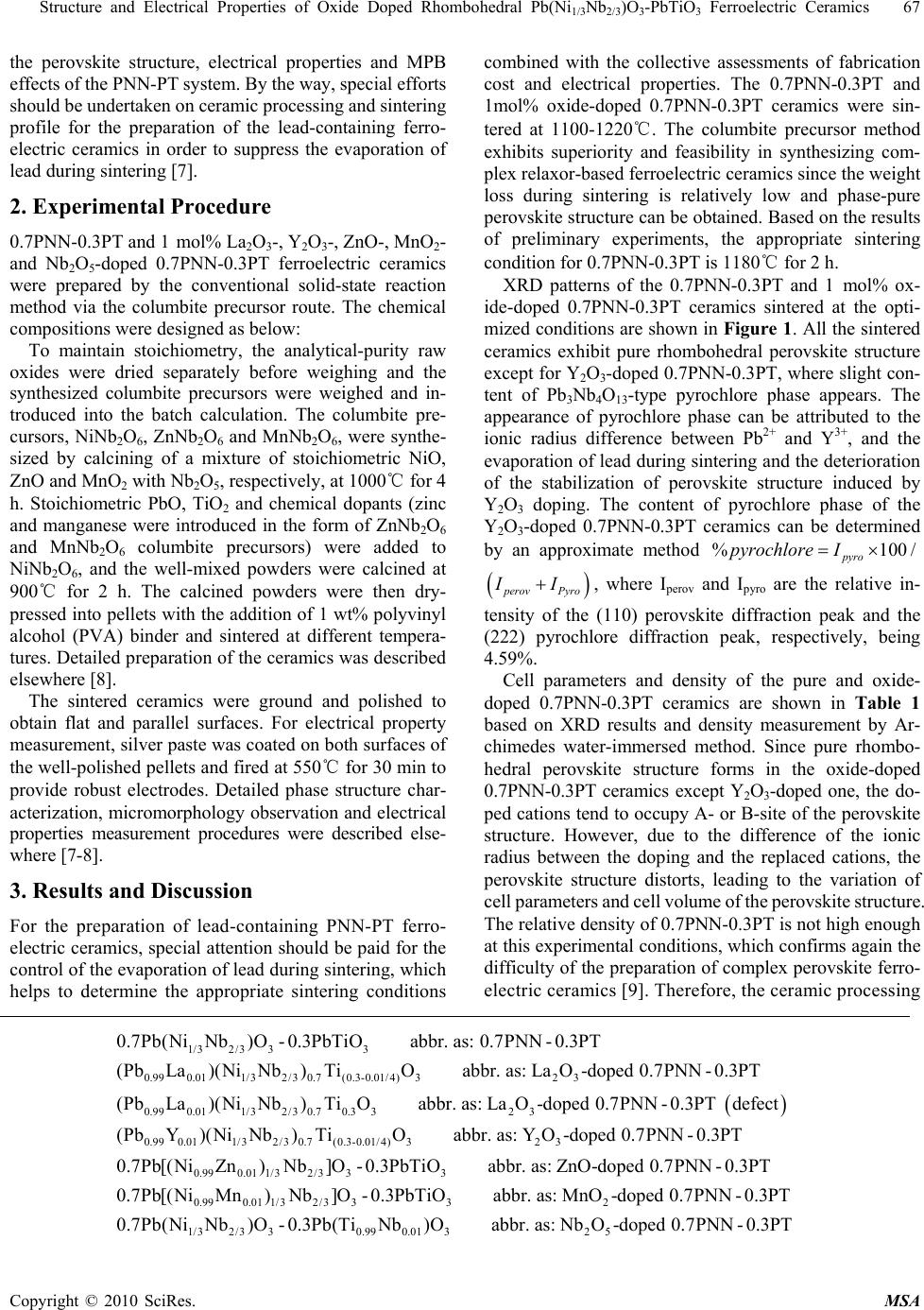 Structure and Electrical Properties of Oxide Doped Rhombohedral Pb(NiNb )O -PbTiO Ferroelectric Ceramics 67 1/32/3 3 3 00/ the perovskite structure, electrical properties and MPB effects of the PNN-PT system. By the way, special efforts should be undertaken on ceramic processing and sintering profile for the preparation of the lead-containing ferro- electric ceramics in order to suppress the evaporation of lead during sintering [7]. 2. Experimental Procedure 0.7PNN-0.3PT and 1 mol% La2O3-, Y2O3-, ZnO-, MnO2- and Nb2O5-doped 0.7PNN-0.3PT ferroelectric ceramics were prepared by the conventional solid-state reaction method via the columbite precursor route. The chemical compositions were designed as below: To maintain stoichiometry, the analytical-purity raw oxides were dried separately before weighing and the synthesized columbite precursors were weighed and in- troduced into the batch calculation. The columbite pre- cursors, NiNb2O6, ZnNb2O6 and MnNb2O6, were synthe- sized by calcining of a mixture of stoichiometric NiO, ZnO and MnO2 with Nb2O5, respectively, at 1000℃ for 4 h. Stoichiometric PbO, TiO2 and chemical dopants (zinc and manganese were introduced in the form of ZnNb2O6 and MnNb2O6 columbite precursors) were added to NiNb2O6, and the well-mixed powders were calcined at 900℃ for 2 h. The calcined powders were then dry- pressed into pellets with the addition of 1 wt% polyvinyl alcohol (PVA) binder and sintered at different tempera- tures. Detailed preparation of the ceramics was described elsewhere [8]. The sintered ceramics were ground and polished to obtain flat and parallel surfaces. For electrical property measurement, silver paste was coated on both surfaces of the well-polished pellets and fired at 550℃ for 30 min to provide robust electrodes. Detailed phase structure char- acterization, micromorphology observation and electrical properties measurement procedures were described else- where [7-8]. 3. Results and Discussion For the preparation of lead-containing PNN-PT ferro- electric ceramics, special attention should be paid for the control of the evaporation of lead during sintering, which helps to determine the appropriate sintering conditions combined with the collective assessments of fabrication cost and electrical properties. The 0.7PNN-0.3PT and 1mol% oxide-doped 0.7PNN-0.3PT ceramics were sin- tered at 1100-1220℃. The columbite precursor method exhibits superiority and feasibility in synthesizing com- plex relaxor-based ferroelectric ceramics since the weight loss during sintering is relatively low and phase-pure perovskite structure can be obtained. Based on the results of preliminary experiments, the appropriate sintering condition for 0.7PNN-0.3PT is 1180℃ for 2 h. XRD patterns of the 0.7PNN-0.3PT and 1 mol% ox- ide-doped 0.7PNN-0.3PT ceramics sintered at the opti- mized conditions are shown in Figure 1. All the sintered ceramics exhibit pure rhombohedral perovskite structure except for Y2O3-doped 0.7PNN-0.3PT, where slight con- tent of Pb3Nb4O13-type pyrochlore phase appears. The appearance of pyrochlore phase can be attributed to the ionic radius difference between Pb2+ and Y3+, and the evaporation of lead during sintering and the deterioration of the stabilization of perovskite structure induced by Y2O3 doping. The content of pyrochlore phase of the Y2O3-doped 0.7PNN-0.3PT ceramics can be determined by an approximate method %1 pyro pyrochlore I p erov Pyro II, where Iperov and Ipyro are the relative in- tensity of the (110) perovskite diffraction peak and the (222) pyrochlore diffraction peak, respectively, being 4.59%. Cell parameters and density of the pure and oxide- doped 0.7PNN-0.3PT ceramics are shown in Table 1 based on XRD results and density measurement by Ar- chimedes water-immersed method. Since pure rhombo- hedral perovskite structure forms in the oxide-doped 0.7PNN-0.3PT ceramics except Y2O3-doped one, the do- ped cations tend to occupy A- or B-site of the perovskite structure. However, due to the difference of the ionic radius between the doping and the replaced cations, the perovskite structure distorts, leading to the variation of cell parameters and cell volume of the perovskite structure. The relative density of 0.7PNN-0.3PT is not high enough at this experimental conditions, which confirms again the difficulty of the preparation of complex perovskite ferro- electric ceramics [9]. Therefore, the ceramic processing 1/32/3 33 0.990.011/32/3 0.7(0.3-0.01/4)323 0.990.011/32/3 0.70.3323 0.7Pb(NiNb)O-0.3PbTiOabbr. as: 0.7PNN-0.3PT (PbLa)(NiNb)TiOabbr. as: LaO-doped 0.7PNN-0.3PT (PbLa)(NiNb)TiOabbr. as: LaO-doped 0.7PNN-0.3PT 0.990.011/32/3 0.7(0.3-0.01/4)323 0.990.01 1/32/333 0.990.011/32/333 defect (PbY)(NiNb)TiOabbr. as: Y O-doped 0.7PNN-0.3PT 0.7Pb[(NiZn)Nb]O-0.3PbTiOabbr. as: ZnO-doped 0.7PNN-0.3PT 0.7Pb[(NiMn)Nb]O-0.3PbTiOab2 1/32/330.990.0132 5 b r. as: MnO-doped 0.7PNN-0.3PT 0.7Pb(NiNb)O-0.3Pb(TiNb)Oabbr. as: NbO-doped 0.7PNN-0.3PT Copyright © 2010 SciRes. MSA 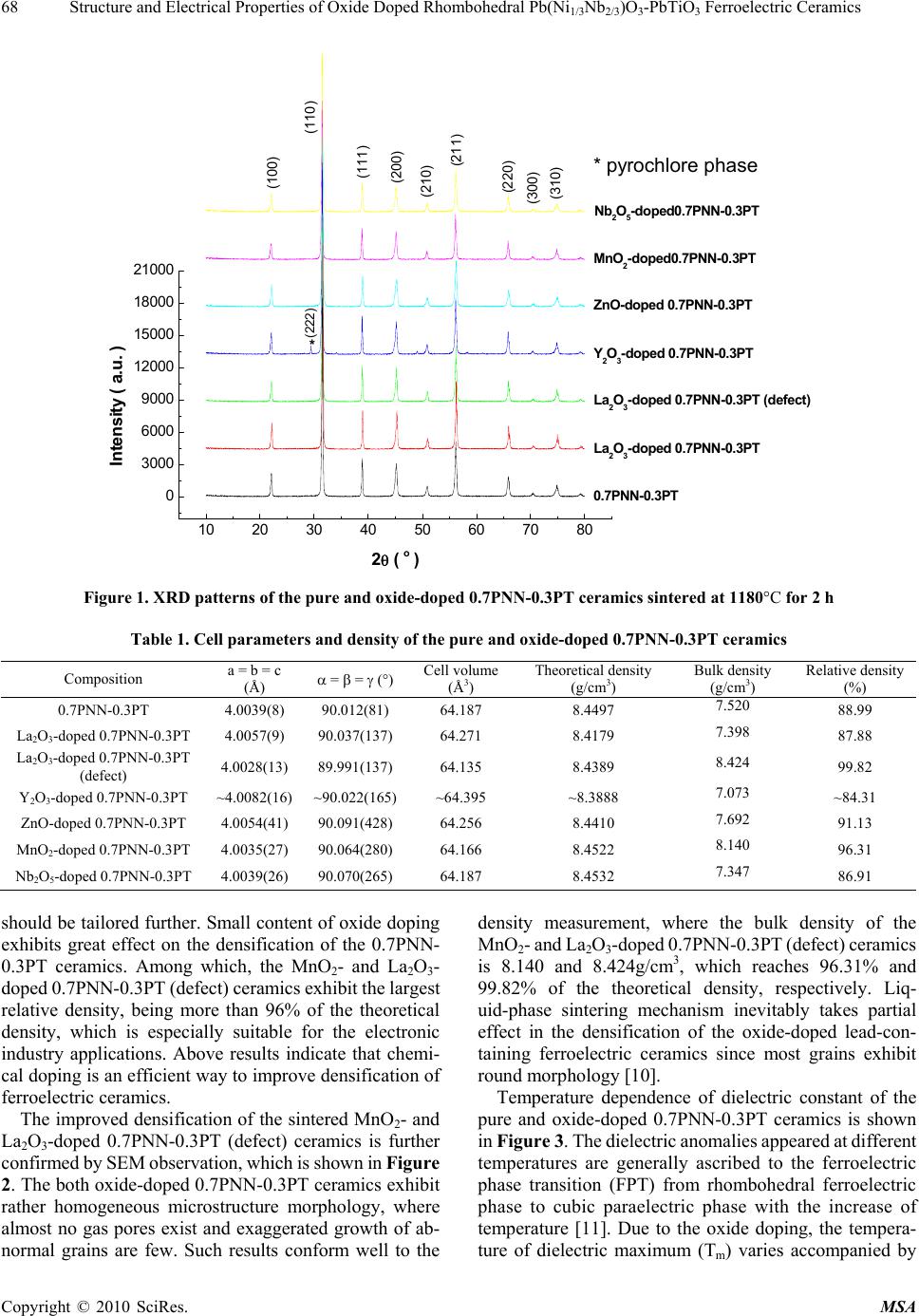 68 Structure and Electrical Properties of Oxide Doped Rhombohedral Pb(NiNb )O -PbTiO Ferroelectric Ceramics 1/32/3 3 3 10 20 30 40 50 60 70 80 0 3000 6000 9000 12000 15000 18000 21000 Nb2O5-doped0.7PNN-0.3PT MnO2-doped0.7PNN-0.3PT ZnO-doped 0.7P N N-0.3PT Y2O3-doped 0.7PNN-0.3PT La2O3-doped 0 .7P NN -0.3PT (defect) La2O3-doped 0 .7P NN -0.3PT 0.7PNN- 0. 3PT (222) (310) (300) (22 0 ) (211) (21 0 ) (200) (11 1 ) (110) (100) * * py r ochl ore phase Intensity ( a.u. ) 2 ( o ) Figure 1. XRD patterns of the pure and oxide-doped 0.7PNN-0.3PT ceramics sintered at 1180 C for 2 h Table 1. Cell parameters and density of the pure and oxide-doped 0.7PNN-0.3PT ceramics Composition a = b = c (Å) = = ()Cell volume (Å3) Theoretical density (g/cm3) Bulk density (g/cm3) Relative density (%) 0.7PNN-0.3PT 4.0039(8) 90.012(81) 64.187 8.4497 7.520 88.99 La2O3-doped 0.7PNN-0.3PT 4.0057(9) 90.037(137)64.271 8.4179 7.398 87.88 La2O3-doped 0.7PNN-0.3PT (defect) 4.0028(13) 89.991(137)64.135 8.4389 8.424 99.82 Y2O3-doped 0.7PNN-0.3PT ~4.0082(16) ~90.022(165)~64.395 ~8.3888 7.073 ~84.31 ZnO-doped 0.7PNN-0.3PT 4.0054(41) 90.091(428)64.256 8.4410 7.692 91.13 MnO2-doped 0.7PNN-0.3PT 4.0035(27) 90.064(280)64.166 8.4522 8.140 96.31 Nb2O5-doped 0.7PNN-0.3PT 4.0039(26) 90.070(265)64.187 8.4532 7.347 86.91 should be tailored further. Small content of oxide doping exhibits great effect on the densification of the 0.7PNN- 0.3PT ceramics. Among which, the MnO2- and La2O3- doped 0.7PNN-0.3PT (defect) ceramics exhibit the largest relative density, being more than 96% of the theoretical density, which is especially suitable for the electronic industry applications. Above results indicate that chemi- cal doping is an efficient way to improve densification of ferroelectric ceramics. The improved densification of the sintered MnO2- and La2O3-doped 0.7PNN-0.3PT (defect) ceramics is further confirmed by SEM observation, which is shown in Figure 2. The both oxide-doped 0.7PNN-0.3PT ceramics exhibit rather homogeneous microstructure morphology, where almost no gas pores exist and exaggerated growth of ab- normal grains are few. Such results conform well to the density measurement, where the bulk density of the MnO2- and La2O3-doped 0.7PNN-0.3PT (defect) ceramics is 8.140 and 8.424g/cm3, which reaches 96.31% and 99.82% of the theoretical density, respectively. Liq- uid-phase sintering mechanism inevitably takes partial effect in the densification of the oxide-doped lead-con- taining ferroelectric ceramics since most grains exhibit round morphology [10]. Temperature dependence of dielectric constant of the pure and oxide-doped 0.7PNN-0.3PT ceramics is shown in Figure 3. The dielectric anomalies appeared at different temperatures are generally ascribed to the ferroelectric phase transition (FPT) from rhombohedral ferroelectric phase to cubic paraelectric phase with the increase of temperature [11]. Due to the oxide doping, the tempera- ture of dielectric maximum (Tm) varies accompanied by Copyright © 2010 SciRes. MSA 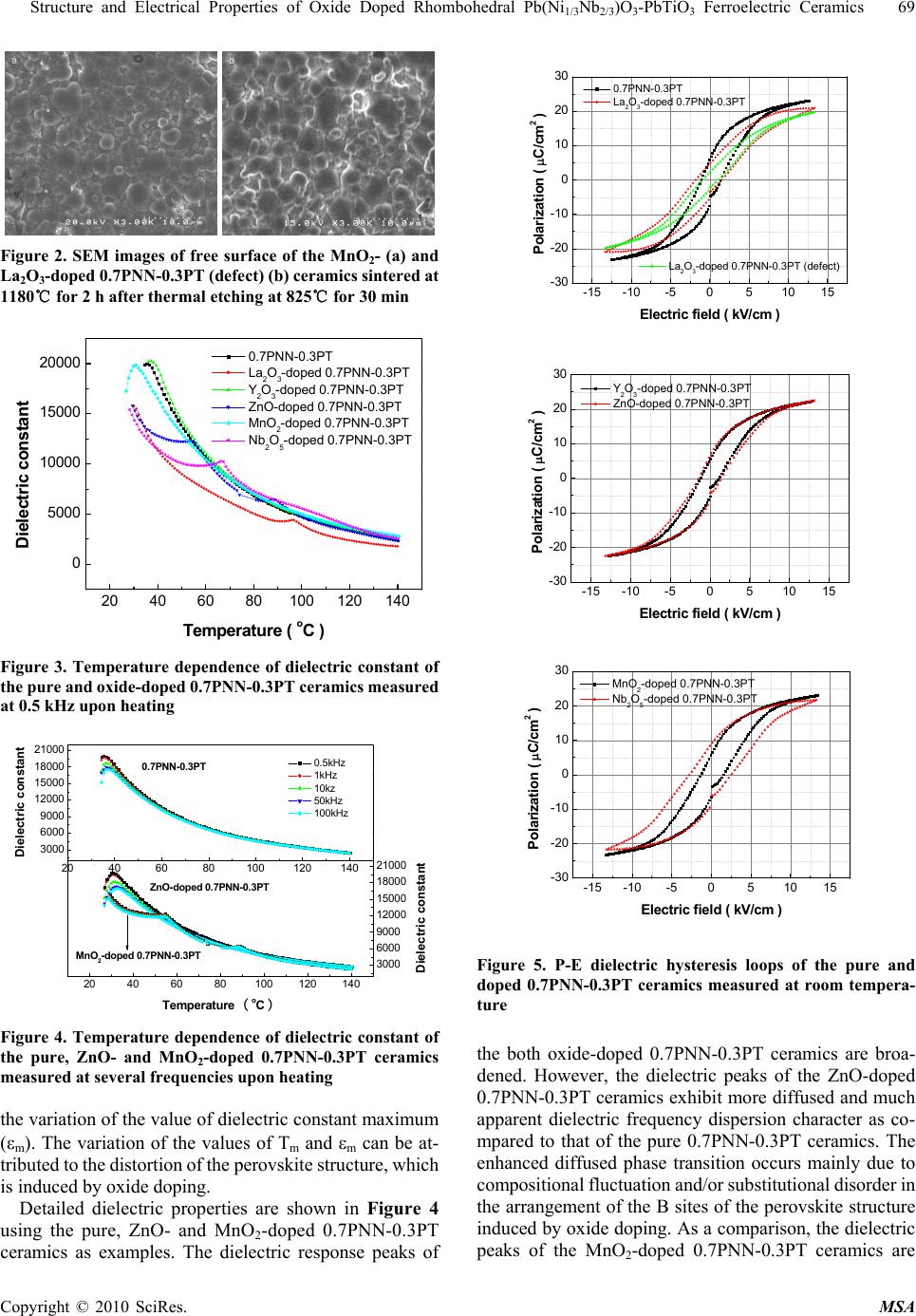 Structure and Electrical Properties of Oxide Doped Rhombohedral Pb(NiNb )O -PbTiO Ferroelectric Ceramics 69 1/32/3 3 3 Figure 2. SEM images of free surface of the MnO2- (a) and La2O3-doped 0.7PNN-0.3PT (defect) (b) ceram ics sintered at 1180℃ for 2 h after thermal etching at 825℃ for 30 min 20 40 60 80100120140 0 5000 10000 15000 20000 0.7PNN-0.3PT La2O3-doped 0.7PNN-0.3PT Y2O3-doped 0.7PNN-0.3PT ZnO-doped 0.7PNN-0.3PT MnO2-doped 0.7PNN-0.3PT Nb2O5-doped 0.7PNN-0.3PT Dielectric constant Tem perature ( oC ) Figure 3. Temperature dependence of dielectric constant of the pure and oxide-doped 0.7PNN-0.3PT ceramics meas ured at 0.5 kHz upon heating 20 40 60 80100120140 3000 6000 9000 12000 15000 18000 21000 0.7PNN-0.3PT Dielectric constant 0.5kHz 1kHz 10kz 50kHz 100kHz 20 40 60 80100120140 3000 6000 9000 12000 15000 18000 21000 MnO2-doped 0.7PNN-0.3PT ZnO-doped 0.7PNN-0.3PT Dielectric constant Temperature ( oC ) Figure 4. Temperature dependence of dielectric constant of the pure, ZnO- and MnO2-doped 0.7PNN-0.3PT ceramics measured at several fre quencies upon heating the variation of the value of dielectric constant maximum (m). The variation of the values of Tm and m can be at- tributed to the distortion of the perovskite structure, which is induced by oxide doping. Detailed dielectric properties are shown in Figure 4 using the pure, ZnO- and MnO2-doped 0.7PNN-0.3PT ceramics as examples. The dielectric response peaks of -15 -10-5051015 -30 -20 -10 0 10 20 30 La2O3-doped 0.7PNN-0.3PT (defect) 0.7PNN-0.3PT La2O3-doped 0.7PNN-0.3PT Polariza tion ( C/cm2 ) Electric field ( kV/cm ) -15 -10-5051015 -30 -20 -10 0 10 20 30 Y2O3-doped 0.7PNN-0.3PT ZnO-doped 0.7P NN-0.3PT Polarization ( C/cm2 ) Electric field ( kV/cm ) -15 -10-5051015 -30 -20 -10 0 10 20 30 MnO2-doped 0.7PNN-0.3PT Nb2O5-doped 0.7PNN-0.3PT Pola r iza tion ( C/cm2 ) Electric field ( k V/cm ) Figure 5. P-E dielectric hysteresis loops of the pure and doped 0.7PNN-0.3PT ceramics measured at room tempera- ture the both oxide-doped 0.7PNN-0.3PT ceramics are broa- dened. However, the dielectric peaks of the ZnO-doped 0.7PNN-0.3PT ceramics exhibit more diffused and much apparent dielectric frequency dispersion character as co- mpared to that of the pure 0.7PNN-0.3PT ceramics. The enhanced diffused phase transition occurs mainly due to compositional fluctuation and/or substitutional disorder in the arrangement of the B sites of the perovskite structure induced by oxide doping. As a comparison, the dielectric peaks of the MnO2-doped 0.7PNN-0.3PT ceramics are Copyright © 2010 SciRes. MSA 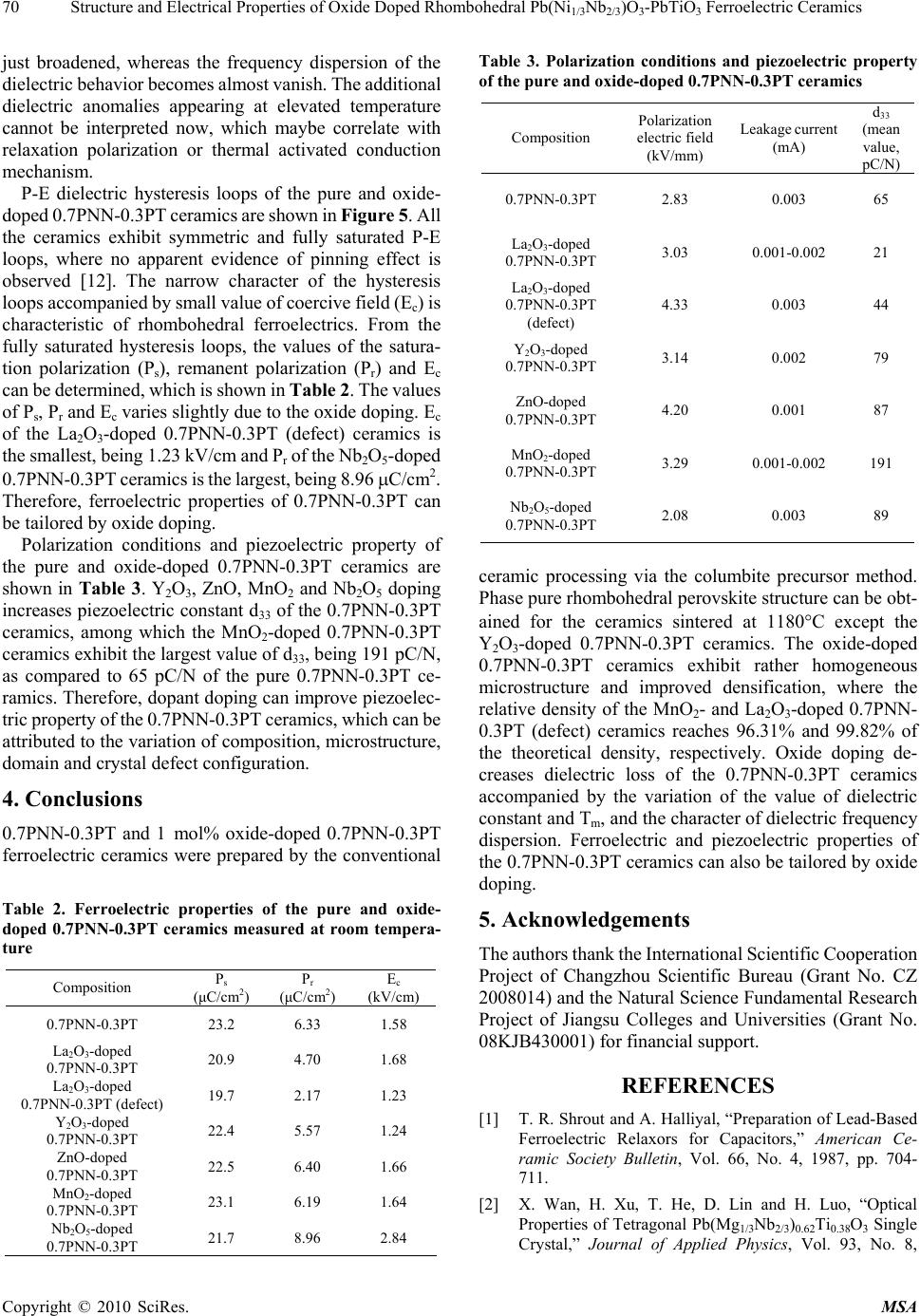 70 Structure and Electrical Properties of Oxide Doped Rhombohedral Pb(NiNb )O -PbTiO Ferroelectric Ceramics 1/32/3 3 3 just broadened, whereas the frequency dispersion of the dielectric behavior becomes almost vanish. The additional dielectric anomalies appearing at elevated temperature cannot be interpreted now, which maybe correlate with relaxation polarization or thermal activated conduction mechanism. P-E dielectric hysteresis loops of the pure and oxide- doped 0.7PNN-0.3PT ceramics are shown in Figure 5. All the ceramics exhibit symmetric and fully saturated P-E loops, where no apparent evidence of pinning effect is observed [12]. The narrow character of the hysteresis loops accompanied by small value of coercive field (Ec) is characteristic of rhombohedral ferroelectrics. From the fully saturated hysteresis loops, the values of the satura- tion polarization (Ps), remanent polarization (Pr) and Ec can be determined, which is shown in Table 2. The values of Ps, Pr and Ec varies slightly due to the oxide doping. Ec of the La2O3-doped 0.7PNN-0.3PT (defect) ceramics is the smallest, being 1.23 kV/cm and Pr of the Nb2O5-doped 0.7PNN-0.3PT ceramics is the largest, being 8.96 C/cm2. Therefore, ferroelectric properties of 0.7PNN-0.3PT can be tailored by oxide doping. Polarization conditions and piezoelectric property of the pure and oxide-doped 0.7PNN-0.3PT ceramics are shown in Table 3. Y2O3, ZnO, MnO2 and Nb2O5 doping increases piezoelectric constant d33 of the 0.7PNN-0.3PT ceramics, among which the MnO2-doped 0.7PNN-0.3PT ceramics exhibit the largest value of d33, being 191 pC/N, as compared to 65 pC/N of the pure 0.7PNN-0.3PT ce- ramics. Therefore, dopant doping can improve piezoelec- tric property of the 0.7PNN-0.3PT ceramics, which can be attributed to the variation of composition, microstructure, domain and crystal defect configuration. 4. Conclusions 0.7PNN-0.3PT and 1 mol% oxide-doped 0.7PNN-0.3PT ferroelectric ceramics were prepared by the conventional Table 2. Ferroelectric properties of the pure and oxide- doped 0.7PNN-0.3PT ceramics measured at room tempera- ture Composition Ps (μC/cm2) Pr (μC/cm2) Ec (kV/cm) 0.7PNN-0.3PT 23.2 6.33 1.58 La2O3-doped 0.7PNN-0.3PT 20.9 4.70 1.68 La2O3-doped 0.7PNN-0.3PT (defect) 19.7 2.17 1.23 Y2O3-doped 0.7PNN-0.3PT 22.4 5.57 1.24 ZnO-doped 0.7PNN-0.3PT 22.5 6.40 1.66 MnO2-doped 0.7PNN-0.3PT 23.1 6.19 1.64 Nb2O5-doped 0.7PNN-0.3PT 21.7 8.96 2.84 Table 3. Polarization conditions and piezoelectric property of the pure and oxide-doped 0.7PNN-0.3PT ceramics Composition Polarization electric field (kV/mm) Leakage current (mA) d33 (mean value, pC/N) 0.7PNN-0.3PT 2.83 0.003 65 La2O3-doped 0.7PNN-0.3PT 3.03 0.001-0.002 21 La2O3-doped 0.7PNN-0.3PT (defect) 4.33 0.003 44 Y2O3-doped 0.7PNN-0.3PT 3.14 0.002 79 ZnO-doped 0.7PNN-0.3PT 4.20 0.001 87 MnO2-doped 0.7PNN-0.3PT 3.29 0.001-0.002 191 Nb2O5-doped 0.7PNN-0.3PT 2.08 0.003 89 ceramic processing via the columbite precursor method. Phase pure rhombohedral perovskite structure can be obt- ained for the ceramics sintered at 1180C except the Y2O3-doped 0.7PNN-0.3PT ceramics. The oxide-doped 0.7PNN-0.3PT ceramics exhibit rather homogeneous microstructure and improved densification, where the relative density of the MnO2- and La2O3-doped 0.7PNN- 0.3PT (defect) ceramics reaches 96.31% and 99.82% of the theoretical density, respectively. Oxide doping de- creases dielectric loss of the 0.7PNN-0.3PT ceramics accompanied by the variation of the value of dielectric constant and Tm, and the character of dielectric frequency dispersion. Ferroelectric and piezoelectric properties of the 0.7PNN-0.3PT ceramics can also be tailored by oxide doping. 5. Acknowledgements The authors thank the International Scientific Cooperation Project of Changzhou Scientific Bureau (Grant No. CZ 2008014) and the Natural Science Fundamental Research Project of Jiangsu Colleges and Universities (Grant No. 08KJB430001) for financial support. REFERENCES [1] T. R. Shrout and A. Halliyal, “Preparation of Lead-Based Ferroelectric Relaxors for Capacitors,” American Ce- ramic Society Bulletin, Vol. 66, No. 4, 1987, pp. 704- 711. [2] X. Wan, H. Xu, T. He, D. Lin and H. Luo, “Optical Properties of Tetragonal Pb(Mg1/3Nb2/3)0.62Ti0.38O3 Single Crystal,” Journal of Applied Physics, Vol. 93, No. 8, Copyright © 2010 SciRes. MSA  Structure and Electrical Properties of Oxide Doped Rhombohedral Pb(Ni1/3Nb2/3)O3-PbTiO3 Ferroelectric Ceramics 71 Copyright © 2010 SciRes. MSA 4766-4768. [3] Z.-G. Ye, “Crystal Chemistry and Domain Structure of Relaxor Piezocrystals,” Current Opinion in Solid State and Materials Science, Vol. 6, No. 1, February 2002, pp. 35-44. [4] T. R. Shrout, S. L. Swartz and M. J. Haun, “Dielectric Properties in the Pb(Fe1/2Nb1/2)O3-Pb(Ni1/3Nb2/3)O3 Solid- Solution System,” American Ceramic Society Bulletin, Vol. 63, No. 6, 1984, pp. 808-810, 820. [5] P. Xiang, N. Zhong and X. Dong, “Single-Calcination Synthesis of Pyrochlore-Free Pb(Ni1/3Nb2/3)O3-PbTiO3 Using a Coating Method,” Solid State Communications, Vol. 127, No. 11, September 2003, pp. 699-701. [6] C. Lei, K. Chen and X. Zhang, “Dielectric and Ferroelec- tric Properties of Pb(Ni1/3Nb 2/3)O3-PbTiO3 Ferroelectric Ceramic near the Morphotropic Phase Boundary,” Mate- rials Letters, Vol. 54, No. 1, May 2002, pp. 8-12. [7] B. Fang, R. Sun, Y. Shan, K. Tezuka and H. Imoto, “On the Feasibility of Synthesizing Complex Perovskite Ferro- electric Ceramics via a B-Site Oxide Mixing Route,” Journal of Materials Science, Vol. 42, No. 22, November 2007, pp. 9227-9233. [8] B. Fang, C. Ding, Q. Du and L. Zhou, “Effect of Oxide Doping on Electrical Properties of Tetragonal Perovskite Pb(Ni1/3Nb2/3)O3-PbTiO3 Ferroelectric Ceramics,” Ferro- electrics, Vol. 393, No. 1, 2009, pp. 94-105. [9] B. Fang, Y. Shan, K. Tezuka and H. Imoto, “High Curie temperature Pb(Fe1/2Nb1/2)O3-based ferroelectrics: 0.40Pb (Fe1/2Nb1/2)O3-0.34PbZrO3-0.26PbTiO3,” Physica Status Solidi A, Vol. 202, No. 3, 2005, pp. 481-489. [10] S.-J. Park, H.-Y. Park, K.-H. Cho, S. Nahm, H.-G. Lee, D.-H. Kim and B.-H. Choi, “Effect of CuO on the Sintering Temperature and Piezoelectric Properties of Lead-Free 0.95(Na0.5K0.5)NbO3-0.05CaTiO3 Ceramics,” Materials Research Bulletin, Vol. 43, 2008, pp. 3580-3586. [11] B.-G. Kim, S.-M. Cho, T.-Y. Kim and H.-M. Jang, “Giant Dielectric Permittivity Observed in Pb-Based Perovskite Ferroelectrics,” Physical Review Letters, Vol. 86, No. 15, April 2001, pp. 3404-3406. [12] X. Wen, C. Feng, L. Chen and S. Huang, “Dielectric Tunability and Imprint Effect in Pb(Mg1/3Nb2/3)O3-PbTiO3 Ceramics,” Ceramics International, Vol. 33, No. 5, July 2007, pp. 815-819. |