

Paper Menu >>
Journal Menu >>
 Journal of Minerals & Materials Characterization & Engineering, Vol. 8, No.2, pp 107-114, 2009 jmmce.org Printed in the USA. All rights reserved ENGINEERING RESEARCH FOR SELF-RELIANCE- Modeling and Simulation Perspective O. Oluwole Mechanical Engineering Department, University of Ibadan, Ibadan. E-mail:[email protected] Tel: +234(0)8033899701 ABSTRACT Engineering research is a sine-qua-non for development of new products, new production processes, hence production lines in the quest for self reliance in any economy. Modeling and simulation is a veritable tool for such research and development. This paper presents the multifaceted use of modeling and simulation as decision tools for engineering facet of an economy drawing examples from two different engineering disciplines- Metallurgic al and Civil. Key words: Modeling; Simulation; R&D; Self-reliance. 1. INTRODUCTION Modeling and simulation in the foundry industry is now an integral part in economical production of new designs (Chen et al, 1994; Chen and Hwang, 1996). The casting engineer is assisted through modeling and simulation in trans l a t ing paper designs into manufacturing designs. The engineer is able to determine among other things th e co rr ec t p la ce ment of risers, gatings, chills and paddings. He is able to simulate the solidification process, locating the solidus and liquidus, the temperature at different points in the casting as the solidification progresses and thus be able to make intelligent decisions as to possible defect formation in the casting (Cheng et al, 1992; Fackeldy et al, 1996; Ehlen et al, 2000). Resulting microstructures can be s i mulated (Fackeldy et al, 1996; Ludwig, 2001). Heat-treatment microstructures and grain growth can be simulated as well. 107  108 O. Oluwole Vol.8, No.2 The use of computers in civil and structural engine ering is well established. Behaviour of novel designs cannot be ascertained without subjection of designs to simulations of behaviour in true- life situations using mathematical models. Stress-strain behaviour and hence mode of possible shear could be simulated in concrete stru ctur es-b uild ing s, brid ges, houses, dams etc. 2. MODELS AND DEVELOPMENT OF THE SIMULATION SOFTWARE 2.1 Simulation Software Development The mathematical representation of many physical processes like the solidification process and elasticity problems in building structures have been understood for long. The development of digital computers has stimulated research in the areas of modeling and simulation of these processes. Early work (Marron et al, 1970 and Pelke and Kirt, 1973) had utilized the finite difference method. The implicit method with Gauss –Seidel iteration permitted the use of the finite difference method for irregular shapes. However, the finite element method with its flexibility of meshing with irregular or complex shapes has found wide usage in process and engineering simulati ons . R esul tin g fr om the multifaceted research into this area, different software have been produced both private and commercial for prediction of many engineering processes ( Oluwole et al, 2007b). Some multipurpose software for engineering modeling and simulation are: (i) Ansys by Swanson Analysis Systems of Philadelphia (ii) Nastran by McNeal Schwender Corporation of Los Angeles (iii) Matlab by the Math Works Inc, USA. Specialised commercial s o f t w a r e f or s olidification are also available, e.g., (i) Magmasoft by Magma of Alsdorf, Germany (ii) Solstar by Foseco Inc. (iii) Procast by Universal Energy Systems, USA (iv) Swift by JML research, USA (v) Phoenics by CHAM of North America (vi) Simulor by Aluminium Pechiney of France What makes the above software stand out is the graphics user interface (GUI) making results translated into visual display in seconds (Figs 1-4). Simplicity of use, accuracy of results and justifiable cost of software acquisition are other attractive points. 2.2 Geometric Representation In both the finite difference and finite element methods, geometry of interest is divided into elements which are simple geometric shapes. These are usually triangles and /or quadrilaterals for two-dimensional ob jects and tetrahedrons for 3-dimensional objects.  Vol.8, No.2 Engineering Research 109 Mesh generation could be by automatic generation or by manual generation. Generating meshes involve understanding of the casting requirement and the numerical method being used. Experience is needed to h ave an accurate representation of the geometry of interest. Automated meshing needs a graphic int e grated user interphase for geometric modeling. 2.3 Flexibility of Program General purpose programs prove to be very unwieldy and lack d epth and it is better when programs are focused on specific problem areas such as solidification (Fig. 5), elasticity, structures, etc., rather than lumping all together in one software package. 2.4 Graphics Interphase Interactive graphic user interphase (GUI) using programs like the C++ builder, Visual Basic and MatlabR make programs user friendly. However, many real life programs in 3-dimensions still have to be connected to plotters for graphic displays. 2.5 Accuracy of Results Accuracy of results is affected by the accuracy of the numerical method and the fineness of the meshing. The best way in evaluating the degree of error is by comparison with experimental results (validation). 2.6 Stability of Numerical Method The explicit finite diffe rence and the finite element methods are known to introduce oscillations in the results when the time step is too large. For solidification proble ms using the explic i t finite difference method, the time step α 2 )( 2 1x tΔ ≤Δ for 1-D problems α 2 )( 4 1x tΔ ≤Δ for 2-D problems and α 2 )( 6 1x tΔ ≤Δ for 3-D problems. For the finite element method, α 2 )( 4 1x tΔ ≥Δ . steptimet − = Δ spacinggridx −=Δ ydiffusivitthermal −= α 2.7 Complexity Systems Complexity problems are dynamical systems at the edge of chaos. Modeling using finite elements is not feasib le f or t h es e sy stems. Dynamical systems model time –dependent phenomena in which the next state is computable from the current state (Kroc, 1999). Many  110 O. Oluwole Vol.8, No.2 physical systems are modeled as dynamical systems. However, cellular automaton (CA) becomes very useful in modeling dynamical systems that are spatially and locally dynamic as it is itself a temporarily and spatially discrete dynamical system. The updating of the system is spatially localized making it very useful tool in modeling and simulation of chaos, fractals, randomness, complexity and particles which numerical approximation methods cannot handle. Thus it finds usefulness in modeling and simulation of recrystallization and phase transformations in materials. In CA, all cells behave identically and have some connectivity. Thus, there is parallelism (individual cells a r e u p dated independently of each other); ther e i s localization (a cells update is based on its old state and that of its neighbours) and there is homogeneity (same rules apply to all cell updates). These rules make it easy in simulating phase transformation as cells modeled using voronoi tessellation can be updated with transformed phases in each cell. Same rule applies to recrystallization since it’s a dynamical system itself. . Fig.1: Grain size modeling with voronoi tessellation using Matlab C (author’s unpublished work)  Vol.8, No.2 Engineering Research 111 Fig.2: Modeling strains in reinforced concrete structures using Matlab Pdetool (author’s unpublished work) Fig.3: Modeling displacement in ductile iron using MatlabR Pdetool (Oluwole and Olorunniwo, 2007) 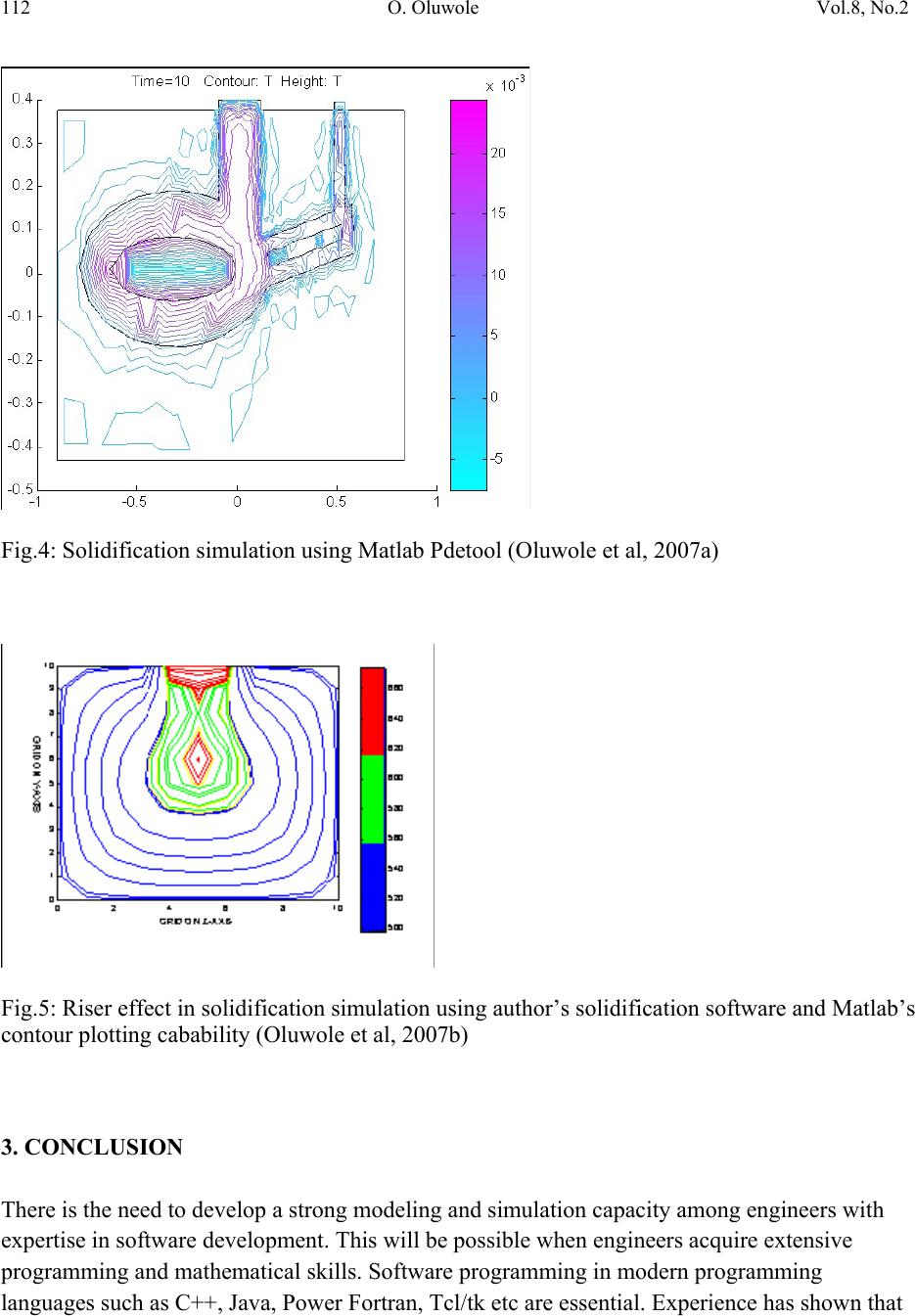 112 O. Oluwole Vol.8, No.2 Fig.4: Solidification simulation using Matlab Pdetool (Oluwole et al, 2007a) Fig.5: Riser effect in solidification simulation using author’s solidification software and Matlab’s contour plotting cabability (Oluwole et al, 2007b) 3. CONCLUSION There is the need to deve l op a strong modeling and simulation capacity among engineers with expertise in software de ve lop ment. This will be p ossible when engineers acquire extensive programming and mathematical skills. Software programming in modern programming languages such as C+ +, Java, Power Fortran, Tcl/tk etc are essential. Experience has shown that 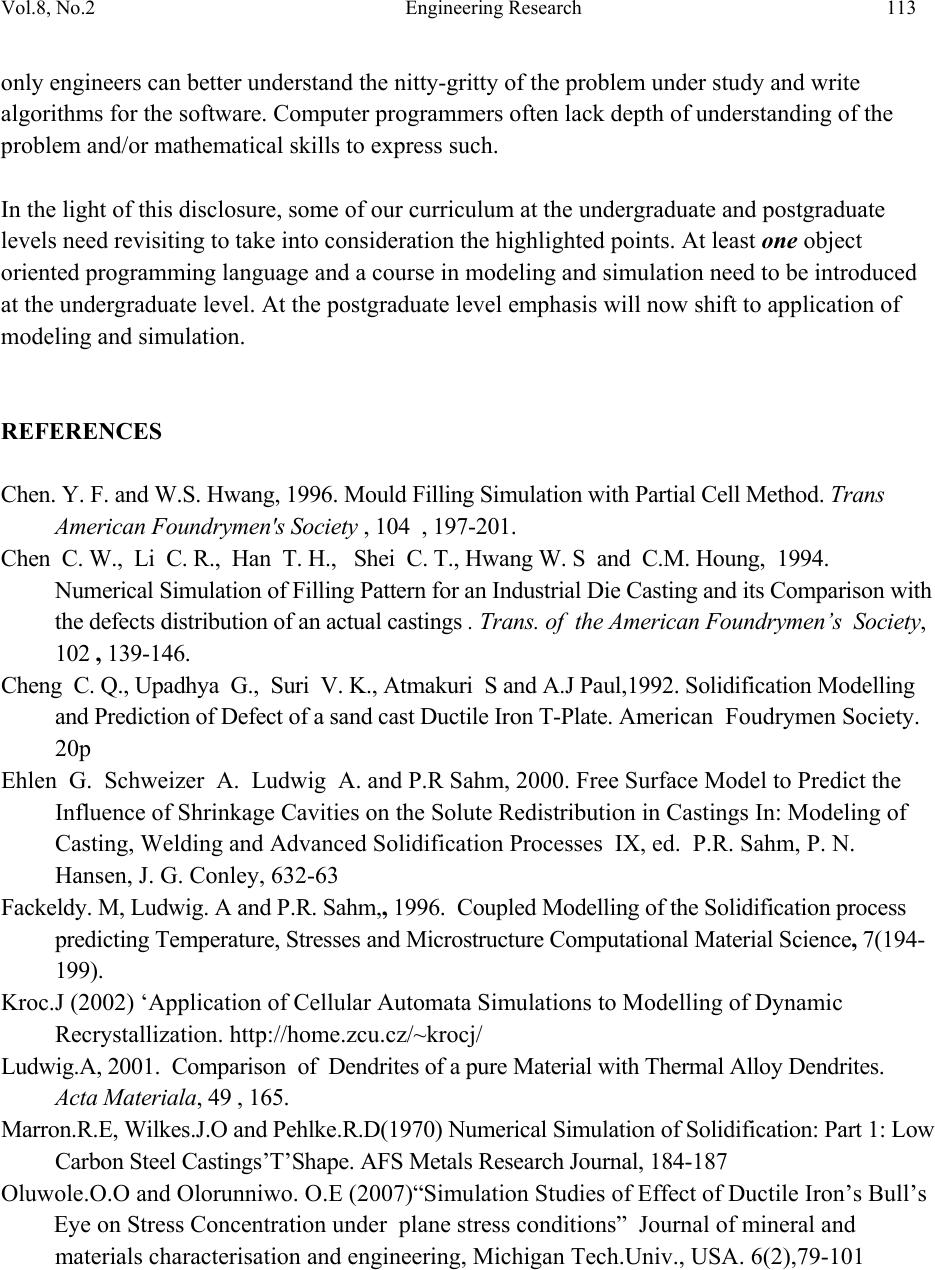 Vol.8, No.2 Engineering Research 113 only engineers can better understand the nitty-gritty of the problem under study and write algorithms for the software. Computer programmers often lack depth of understanding of the problem and/or mathematical skills to express such. In the light of this d i sclosure, some of our curriculum at the undergraduate and postgraduate levels need revisiting to take into consideration the highlighted points. At least one object oriented programming language and a c o u r s e i n m o de l i n g an d s i mulation need to be introduced at the undergraduate level. At the postgraduate level emphasis will now shift to application of modeling and simulation. REFERENCES Chen. Y. F. and W.S. Hwang, 1996. Mould Filling Simulation with Partial Cell Method. Trans American Foundrymen's Society , 104 , 197-201. Chen C. W., Li C. R ., Han T. H., S hei C. T., Hw ang W. S and C.M. Houng, 1994. Numerical Simulation of Filling Pattern for an Industrial Die Casting and its Comparison with the defects distribution of an actual castings . Trans. of the American Foundrymen’s Society, 102 , 139-146. Cheng C. Q., Upadhya G., Suri V. K., Atmakuri S and A.J Paul,1992. Solidification Modelling an d P r e d i c t io n of De f e c t o f a s and c as t D u c t i l e Iron T-Plate. American Foudrymen Society. 20p Ehlen G. Schweizer A. Ludwig A. and P.R Sahm, 2000. Free S u r f a c e M o d e l t o P r e d i c t t h e Influence of Shrinkage Cavities on the Solute Redistribution in Castings In: Modeling of Casting, Welding and Advanced Solidification Processes IX, ed. P.R. Sahm, P. N. Hansen, J. G. Conley, 632-63 Fackeldy. M, Ludwig. A and P.R. S ahm, , 1996. Coupled Modelling of the Solidification process predicting Temperature, Stresses and Microstructure Computational Material Science, 7(194- 199). Kroc.J (2002) ‘Application of Cellular Automata Simulations to Modelling of Dynamic Recrystallization. http://home.zcu.cz/~krocj/ Ludwig.A, 2001. Com parison of Dendrites of a pure Material with Th ermal Alloy Dendrites. Acta Materiala, 49 , 165. Marron.R.E, Wilkes.J.O and Pehlke.R.D (1970) Num erical Simulation of Solidification: Part 1: Low Carbon Steel Castings’T’Shape. AFS Metals Research Journal, 184-187 Oluwole.O.O and Olorunniwo. O.E (2007)“Simulation Studies of Effect of Ductile Iron’s Bull’s Eye on Stress Concentration under plane stress conditions” Journal of mineral and materials characterisation and engineering, Michigan Tech.Univ., USA. 6(2),79-101  114 O. Oluwole Vol.8, No.2 Oluwole.O.O, Olorunniwo.O.E and Atanda.P.O (2007a)” Simulation of Riser Size from Mushy Zone of Unrisered AlSi7Mg Alloy” Journal of Applied Sciences Research ,Pakistan 3(10):908-912 O.O. Oluwole, G.O. Oluwadare and A.A. Afonja, (2007b), “Development of Mathematical Equation for Fraction of Solid in AlSi7Mg Alloy Solidification Simulation”. Journal of Minerals and Materials Characterization and Engineering, Michigan Technological University, USA.7(1),71-82 Pehlke.R.D and Kirt.M.J (1973) Numerical Simulation of Casting Solidification. AFS Cast Metals Research Journal, 49-55. |