

Paper Menu >>
Journal Menu >>
 Journal of Analytical Sciences, Methods and Instrumentation, 2012, 2, 92-97 http://dx.doi.org/10.4236/jasmi.2012.22017 Published Online June 2012 (http://www.SciRP.org/journal/jasmi) Textile Environmental Conditioning: Effect of Relative Humidity Variation on the Tensile Properties of Different Fabrics Mansoor Iqbal, Munazza Sohail, Aleem Ahmed, Kamran Ahmed, Arsheen Moiz, Khalil Ahmed* Applied Chemistry Research Centre, PCSIR Laboratories Complex, Karachi, Pakistan. Email: *[email protected] Received December 25th, 2011; revised January 7th, 2012; accepted January 31st, 2012 ABSTRACT With the aim that to confirm the n eed for humidity control in the environment in wh ich textile sample are visually and instrumentally analyzed, three different pre-conditioned fabrics sample of cotton, p ol yester and silk were treated at a fix temperature of 21˚C. The relative humidity adjusted to four levels: 55%, 65%, 75% and 85% RH for a conditioning time of 24 hour s as specified in ASTM D-1776-98. It h a s been observed that as the r e lative humidity increase from 55% to 85% cotton increase its tensile strength, silk losses its strength and there was no significant change observed in the tensile strength of polyester fabric. Keywords: Tensile Properties; Relative Humidity; Temperature; Fiber; Silk; Polyester; Cotton 1. Introduction The properties of textile fibers are in many cases strongly affected by the atmospheric moisture content. Many fi- bers, particularly the natural ones are hygroscopic in the sense that they are able to absorb water vapour from a moist atmosphere and to give up water to a dry atmos- phere. If sufficient time is allowed, equilibrium will be reached. The amount of moisture that such fiber contains strongly affects many of their most important physical properties [1]. Many physical properties of a fiber are affected by the amount of water absorbed such as dimen- sions, tensile strength, elastic recovery, electrical resis- tance, rigidity and so on. When in fabric from the mois- ture relationships of a fiber play a major part in deciding whether the fabric is unsuitable for a particular purpose. The importance of this point is appreciated when fabrics for clothing, both outerwear and underwear, are consid- ered additional factors arise in these cases since the structural details of the can modify the apparent behavior of the fiber [2]. In an orderly array of molecules the side chain will be linked, but in a random arrangement a number of free links or hooks will be available, and if they are of a polar character i.e. possess an attraction of polar chemical groups such as hydroxyl OH, carboxyl COOH, carbonyl CO etc, th en water molecule can attach themselves. Orderly arrays of molecules occur in the crystalline region of the fiber structure and random ar- rays in the amorphous region. For a first approximation we could conclude that the absorption of water takes place in the amorphous region [3]. An alternative defini- tion for Relative Humidity (RH) is the ab solute humidity of the air to that of air saturated with water vapour at the same temperature and pressure. This ratio may then be expressed as a percentage. At ordinary temperatures such as those at which processing and testing are carried out the two ratios are almost identical. It is convenient to describe a given atmosphere in term of relative humidity rather than absolute humidity because the region of tex- tile materials appears depends upon the relative hu midity rather than the actual amount of water vapour present. Since the relative humidity affect the region of textile materials and since the properties of textile materials influenced by the region. It is necessary to specify the atmospheric condition in which testing should be carried out [4]. Because of the important changes that occur in textile properties as the moisture content changes, it is necessary to specify atmospheric condition in which any testing carried out. Therefore a standard atmosphere has been agreed for testing purposes and is defined as a rela- tive humidity of 65% and a temperature of 20˚C. For practical purposes certain tolerances in these values are allowed so that for testing atmosphere the RH is 65% ± 2%, 20˚C ± 2˚C. In tropical region a temperature of 27˚C ± 2C may be used [5]. Even though a testing laboratory may have a controlled atmosphere, it is not good practice *Corresponding author. Copyright © 2012 SciRes. JASMI 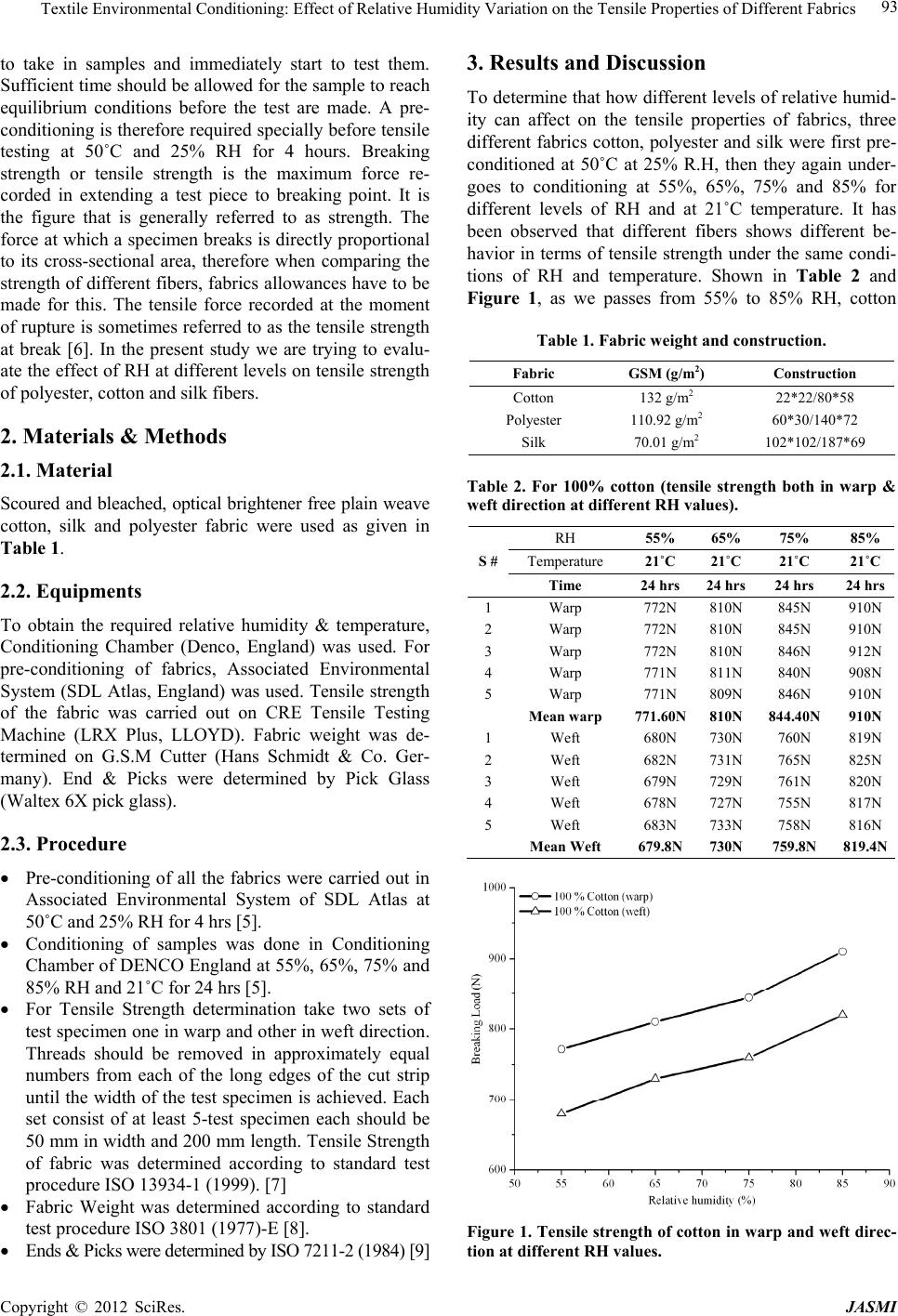 Textile Environmental Conditioning: Effect of Relative Humidity Variation on the Tensile Properties of Different Fabrics 93 to take in samples and immediately start to test them. Sufficient time should be allowed for the sample to reach equilibrium conditions before the test are made. A pre- conditioning is therefore required specially before tensile testing at 50˚C and 25% RH for 4 hours. Breaking strength or tensile strength is the maximum force re- corded in extending a test piece to breaking point. It is the figure that is generally referred to as strength. The force at which a specimen breaks is directly proportional to its cross-sectional area, therefore when comparing the strength of different fibers, fabrics allowances have to be made for this. The tensile force recorded at the moment of rupture is sometimes referred to as the tensile strength at break [6]. In the present study we are trying to evalu- ate the effect of RH at different levels on tensile strength of polyester, cotton and silk fibers. 2. Materials & Methods 2.1. Material Scoured and bleached, optical brightener free plain weave cotton, silk and polyester fabric were used as given in Table 1. 2.2. Equipments To obtain the required relative humidity & temperature, Conditioning Chamber (Denco, England) was used. For pre-conditioning of fabrics, Associated Environmental System (SDL Atlas, England) was used. Tensile strength of the fabric was carried out on CRE Tensile Testing Machine (LRX Plus, LLOYD). Fabric weight was de- termined on G.S.M Cutter (Hans Schmidt & Co. Ger- many). End & Picks were determined by Pick Glass (Waltex 6X pick glass). 2.3. Procedure Pre-conditioning of all the fabrics were carried out in Associated Environmental System of SDL Atlas at 50˚C and 25% RH for 4 hrs [5]. Conditioning of samples was done in Conditioning Chamber of DENCO England at 55%, 65%, 75% and 85% RH and 21˚C for 24 h rs [5]. For Tensile Strength determination take two sets of test specimen one in warp and other in weft direction. Threads should be removed in approximately equal numbers from each of the long edges of the cut strip until the width of the test specimen is achieved. Each set consist of at least 5-test specimen each should be 50 mm in width and 200 mm length. Tensile Strength of fabric was determined according to standard test procedure ISO 13934-1 (1999). [7] Fabric Weight was determined according to standard test procedure ISO 3801 (1977)-E [8]. Ends & Picks were determined by ISO 7211-2 (1984) [9] 3. Results and Discussion To determine that how different levels of relative humid- ity can affect on the tensile properties of fabrics, three different fabrics cotton, polyester and silk were first pre- conditioned at 50˚C at 25% R.H, then they again under- goes to conditioning at 55%, 65%, 75% and 85% for different levels of RH and at 21˚C temperature. It has been observed that different fibers shows different be- havior in terms of tensile strength under the same condi- tions of RH and temperature. Shown in Table 2 and Figure 1, as we passes from 55% to 85% RH, cotton Table 1. Fabric weight and construc tion. Fabric GSM (g/m2) Construction Cotton 132 g/m2 22*22/80*58 Polyester 110.92 g/m2 60*30/140*72 Silk 70.01 g/m2 102*102/187*69 Table 2. For 100% cotton (tensile strength both in warp & weft direction at different RH value s). RH 55% 65% 75% 85% Temperature 21˚C 21˚C 21˚C 21˚C S # Time 24 hrs 24 hrs 24 hrs 24 hrs 1 Warp 772N 810N 845N 910N 2 Warp 772N 810N 845N 910N 3 Warp 772N 810N 846N 912N 4 Warp 771N 811N 840N 908N 5 Warp 771N 809N 846N 910N Mean warp 771.60N 810N 844.40N 910N 1 Weft 680N 730N 760N 819N 2 Weft 682N 731N 765N 825N 3 Weft 679N 729N 761N 820N 4 Weft 678N 727N 755N 817N 5 Weft 683N 733N 758N 816N Mean Weft 679.8N 730N 759.8N 819.4N Figure 1. Tensile strength of cotton in warp and weft direc- tion at different RH values. Copyright © 2012 SciRes. JASMI  Textile Environmental Conditioning: Effect of Relative Humidity Variation on the Tensile Properties of Different Fabrics 94 increases its strength. Fundamentally, it is due to the de- crease in cohesive force between the chain molecules due to swelling and the release of internal strain by swelling. Thus in the native cellulosic fiber, such as cotton, the release of internal strain between the long chain mole- cules predominant and this increase the fiber strength because of a more uniform internal distribution of stress. Also the av er age cha in leng th (DP) in co tton is fiv e ti mes greater than regenerated cellulose, so that the individual molecules in cotton may be expected to have more point of adhesion and so to process greater internal strain [10]. In its mature dried form, nearly 90 per cent by weight of the cotton fibre is cellulose. In fact the cellulose found in cotton fibres is the purest form of cellulose found in all plants. The cellulose in cotton fibres is mostly (88 - 96.5 per cent). The non-cellulose components (4 - 12 per cent) are located either on the outer layers of the cotton fibre in the cuticle and primary cell wall or inside the residual protoplasm called the lumen. The secondary wall of ma- ture fibres is primarily cellulose in its most highly crys- talline and oriented form Figure 2 show s the structure of the cellulose molecules in cotton. From a physical view- point the molecule is a ribbon-like structure of linked six-member rings each with three hydroxyl groups (OH) on the C2, C3 and C6 atoms projecting out of the plane of the ribbon. As well as providing structural stability the hydroxyl groups allow extensive intermolecular hydro- gen bonding with many molecules, including water. The accessibility of water to these hydroxyl groups depends on the spacing between crystal lattice planes. From a completely dry state, water molecules will form hydro- gen bonds with hydroxyl groups that are not already linked within crystalline regions [11]. Figure 2. Assembly of cellulose molecules in a sheet. Hy- drogen bonds are shown by dotted lines. Circled carbon atoms; C2, C3 and C6, show location of hydroxyl (-OH) groups. As indicated from Table 3 and Figure 3, the silk fab- ric shows a reverse result as compared to cotton, as we move from 55% towards 85% R.H, the tensile strength determined were gradually decreased. The silk fiber are linear, fibroin polymer that forms a chemical point of view, differ from wool fiber due to their different amino acid composition. More precisely, silk fiber does not contain disulphide bonds. This Chemical difference may affect the morphology of the crystal, producing only the β-configuration, which together with the high degree of crystallinity is responsible for high tens ile strength of silk fiber. In wet conditions the tensile strength of silk fiber decreases because water molecules hydrolyze a signifi- cant number of hydrogen bond [12]. Silk is a natural fi- ber secreted as a continuous filament by the silk worm, Table 3. For silk (tensile strength both in warp & weft direc- tion at different RH values). RH 55% 65% 75% 85% Temperature 21˚C 21˚C 21˚C 21˚C S # Time 24 hrs 24 hrs 24 hrs 24 hrs 1Warp 512N 480N 452N 407N 2Warp 510N 480N 450N 410N 3Warp 508N 478N 449N 409N 4Warp 514N 483N 453N 405N 5Warp 512N 480N 452N 403N Mean Warp511.20N480.20N 451.20N406.8N 1Weft 463N 441N 414N 368N 2Weft 465N 444N 416N 370N 3Weft 462N 445N 418N 371N 4Weft 466N 438N 412N 365N 5Weft 460N 440N 413N 367N Mean Weft 463.20N441.6N 414.6N368.2N Figure 3. Tensile strength of silk in warp and weft direction at different RH values. Copyright © 2012 SciRes. JASMI  Textile Environmental Conditioning: Effect of Relative Humidity Variation on the Tensile Properties of Different Fabrics 95 Bombyx mori. Silk consists essentially fibroin polymer and in the raw state coated with a gum Sericin that is usually removed before spinning. The silk polymer is composed of 16 different amino acids linked with pep- tide bonds. The important chemical groups of the silk polymer are the peptide groups which gives rise to hy- drogen bonds, and the carboxyl and amine groups which gives rise to the salt linkag es. The silk filament is strong. This strength is due to its linear, β-configuration polymer and very crystalline polymer system. These two factors permit more hydrogen bonds to be formed in a much regular manner. When wet silk losses its strength. This is due to water molecules hydrolyzing a significant number of hydrogen bonds and in the pro cess weakening the silk polymer. The greater crystalline of silk polymer system allows fewer molecules enter into the polymer system of silk [13]. -NH-CH-CO-NH-CH-CO-NH-CH-CO- H- n - OH RR1R2 The general formula for the polypeptide polymer. De- pending upon the type of radical R, R1, R2, the polypep- tide polymer would be identical either as being a silk fibroin polymer or a wool keratin polymer. The results obtained from Table 4 and Figure 4, poly- ester fabric shows that it is strong to very strong fabric because of their extremely crystalline polymer system. This allows the formation of very effective Van der Waals forces as well as the very weak hydrogen bond, resulting in very good tensile properties one associated with polyester polymer. The tensile strength of polyester fiber remains unaltered when we passes from 55% to 85% RH. This occurs because of the completely hydro- phobic and extremely crystalline polyester polymer sys- tem, which resists the entry of water molecules to any significant extant [14]. Polyester fiber is the condensation polymerization product of ethylene glycol and terepthalic acid. The word ester is the name given to salt formed from the reaction between an alcohol and an acid. Ester is organic salt and polyester means many organic salts. Chemically it is a polymer of polyethylene glycol terphlate. The important chemical groups in the polyester polymer are the ethyl- ene group, - CH2-, the sligh tly polar carb onyl group, -CO-, and the ester group, -O CO- group. The one of the distin- guishing characteristics of polyester is attributed to the benzene rings in the polymer chain. The aromatic char- acter leads to chain stiffness, preventing the deformation of disordered regions, which results in weak Van der Waals interaction forces between chains. The aromatic, carboxyl and aliphatic molecular groups are nearly planar in configuration and exist in a side-by-side arrangement. The cohesion of polyester chains is a result of hydrogen bonds and van der Waals interactions, caused by dipole interaction, induction and dispersion forces among the chains. The insignificant amount of moisture, which may be present in polyester textile materials, exists as a mo- lecular film of water on the surface of filaments of staple fiber [15]. OOCCOO CH22n Polyet hylene Terpthlate Table 4. For polyester (Tensile Strength both in warp & weft direction at different RH value s). RH 55% 65% 75%85% Temperature 21˚C 21˚C 21˚C21˚C S # Time 24 hrs 24 hrs 24 hrs24 hrs 1 Warp 935N 942N 937N939N 2 Warp 936N 945N 939N937N 3 Warp 938N 944N 940N936N 4 Warp 933N 939N 934N940N 5 Warp 934N 941N 935N942N Mean warp 935.2N 942.2N 937N938.8N 1 Weft 860N 864N 862N863N 2 Weft 861N 866N 866N864N 3 Weft 857N 864N 868N867N 4 Weft 859N 867N 857N859N 5 Weft 863N 858N 858N861N Mean Weft 860N 863.8N 862.2N862.8N Figure 4. Tensile strength of polyester in warp and weft direction at different RH values. Copyright © 2012 SciRes. JASMI 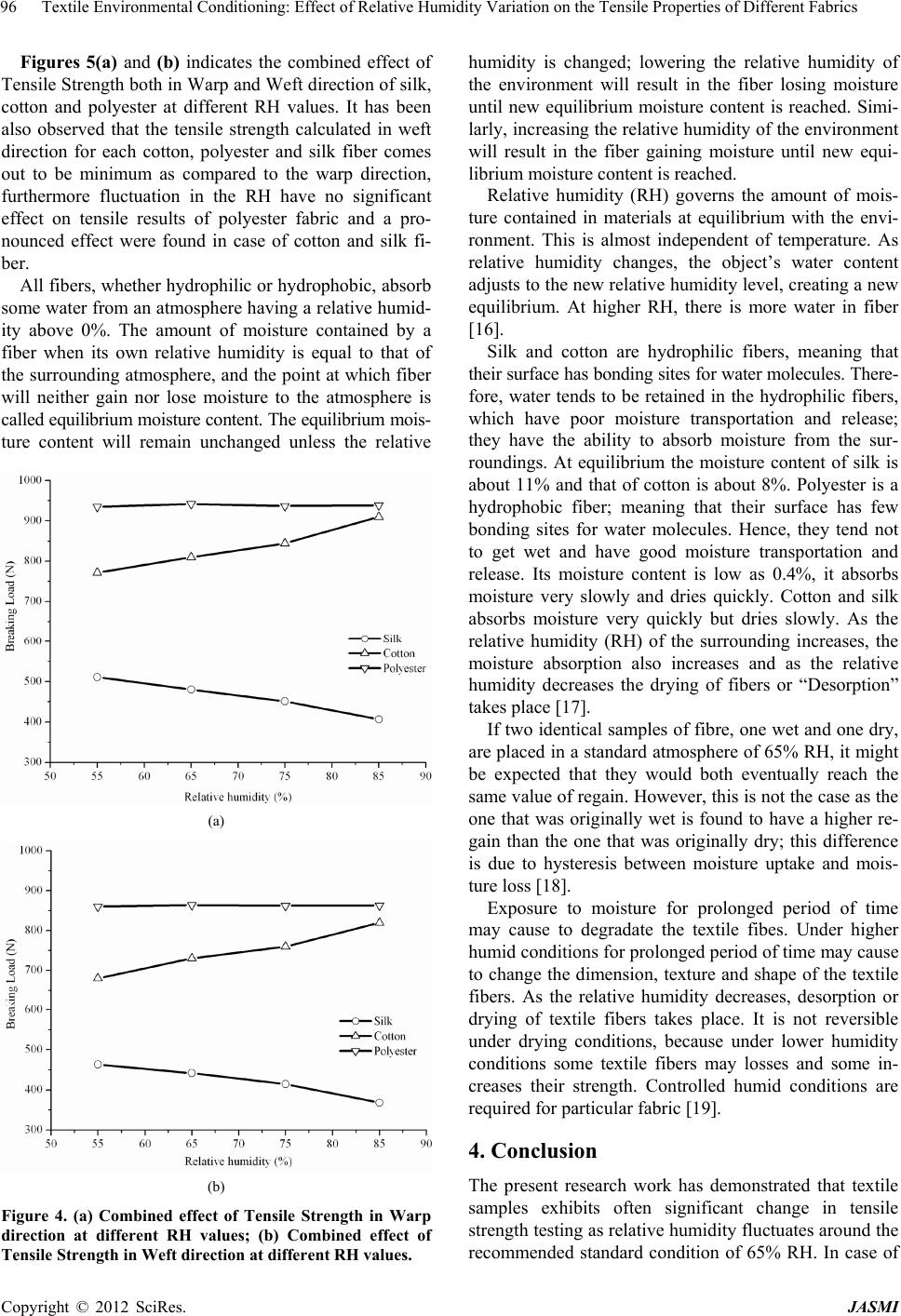 Textile Environmental Conditioning: Effect of Relative Humidity Variation on the Tensile Properties of Different Fabrics 96 Figures 5(a) and (b) indicates the combined effect of Tensile Strength both in Warp and Weft direction of silk, cotton and polyester at different RH values. It has been also observed that the tensile strength calculated in weft direction for each cotton, polyester and silk fiber comes out to be minimum as compared to the warp direction, furthermore fluctuation in the RH have no significant effect on tensile results of polyester fabric and a pro- nounced effect were found in case of cotton and silk fi- ber. All fibers, whether hydrophilic or hydrophobic, absorb some water from an atmosphere having a relative humid- ity above 0%. The amount of moisture contained by a fiber when its own relative humidity is equal to that of the surrounding atmosphere, and the point at which fiber will neither gain nor lose moisture to the atmosphere is called equilibrium moisture co ntent. The equilibrium mois- ture content will remain unchanged unless the relative (a) (b) Figure 4. (a) Combined effect of Tensile Strength in Warp direction at different RH values; (b) Combined effect of Tensile Strength in Weft direction at different RH values. humidity is changed; lowering the relative humidity of the environment will result in the fiber losing moisture until new equilibrium moisture content is reached. Simi- larly, increasing the relative humidity of the environment will result in the fiber gaining moisture until new equi- librium moisture content is reached. Relative humidity (RH) governs the amount of mois- ture contained in materials at equilibrium with the envi- ronment. This is almost independent of temperature. As relative humidity changes, the object’s water content adjusts to the new relative humidity level, creating a new equilibrium. At higher RH, there is more water in fiber [16]. Silk and cotton are hydrophilic fibers, meaning that their surface has bonding sites for water molecules. There- fore, water tends to be retained in the hydrophilic fibers, which have poor moisture transportation and release; they have the ability to absorb moisture from the sur- roundings. At equilibrium the moisture content of silk is about 11% and that of cotton is about 8%. Polyester is a hydrophobic fiber; meaning that their surface has few bonding sites for water molecules. Hence, they tend not to get wet and have good moisture transportation and release. Its moisture content is low as 0.4%, it absorbs moisture very slowly and dries quickly. Cotton and silk absorbs moisture very quickly but dries slowly. As the relative humidity (RH) of the surrounding increases, the moisture absorption also increases and as the relative humidity decreases the drying of fibers or “Desorption” takes place [17]. If two identical samples of fibre, one wet and one dry, are placed in a standard atmosphere of 65% RH, it might be expected that they would both eventually reach the same value of regain. However, this is not the case as the one that was originally wet is found to have a higher re- gain than the one that was originally dry; this difference is due to hysteresis between moisture uptake and mois- ture loss [18]. Exposure to moisture for prolonged period of time may cause to degradate the textile fibes. Under higher humid conditions for prolonged period of time may cause to change the dimension, texture and shape of the textile fibers. As the relative humidity decreases, desorption or drying of textile fibers takes place. It is not reversible under drying conditions, because under lower humidity conditions some textile fibers may losses and some in- creases their strength. Controlled humid conditions are required for partic u la r f abric [19]. 4. Conclusion The present research work has demonstrated that textile samples exhibits often significant change in tensile strength testing as relative humidity fluctu ates around the recommended standard condition of 65% RH. In case of Copyright © 2012 SciRes. JASMI 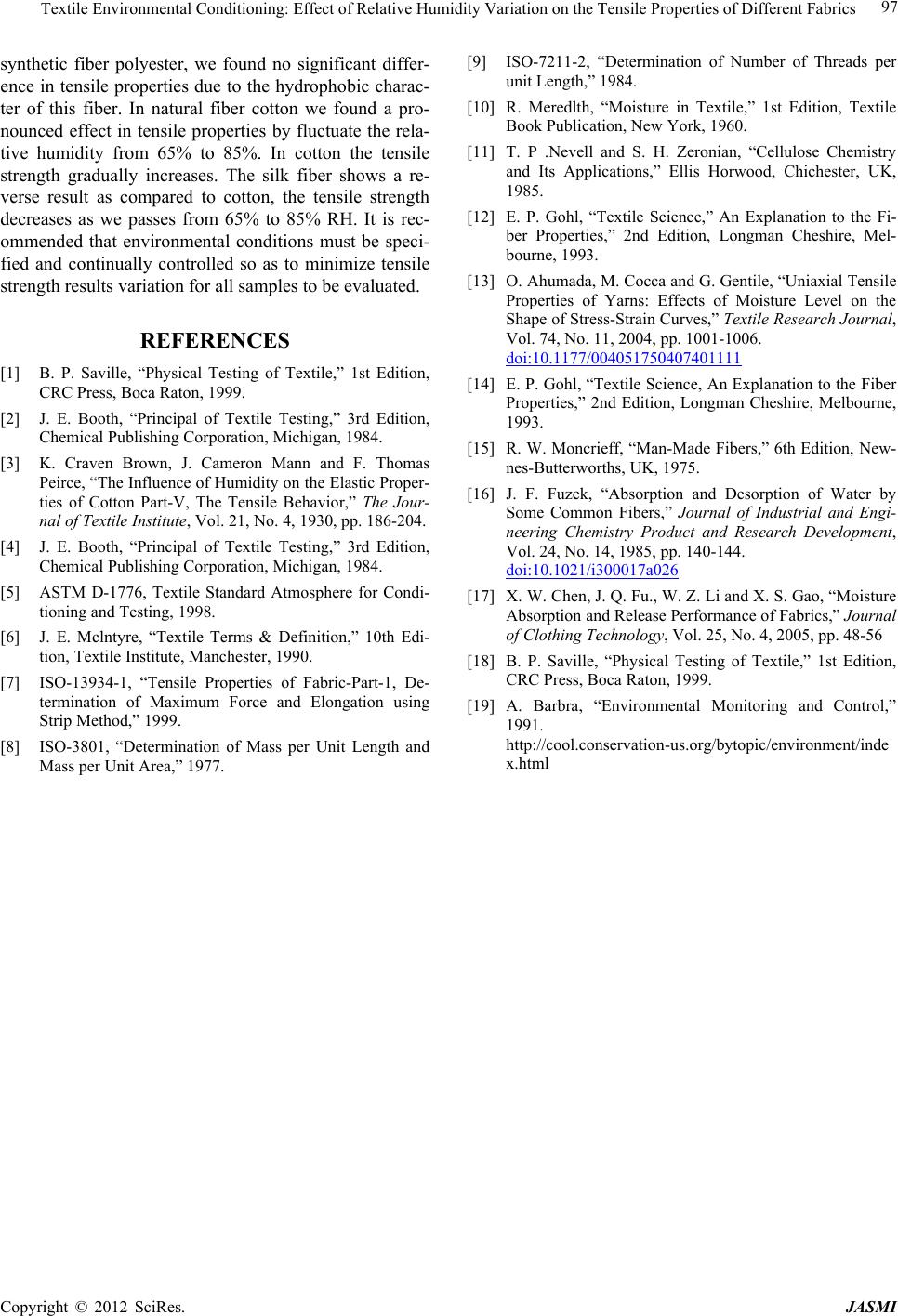 Textile Environmental Conditioning: Effect of Relative Humidity Variation on the Tensile Properties of Different Fabrics Copyright © 2012 SciRes. JASMI 97 synthetic fiber polyester, we found no significant differ- ence in tensile properties due to the hydrophobic charac- ter of this fiber. In natural fiber cotton we found a pro- nounced effect in tensile properties by fluctuate the rela- tive humidity from 65% to 85%. In cotton the tensile strength gradually increases. The silk fiber shows a re- verse result as compared to cotton, the tensile strength decreases as we passes from 65% to 85% RH. It is rec- ommended that environmental conditions must be speci- fied and continually controlled so as to minimize tensile strength results variation for all samples to be evaluated. REFERENCES [1] B. P. Saville, “Physical Testing of Textile,” 1st Edition, CRC Press, Boca Raton, 1999. [2] J. E. Booth, “Principal of Textile Testing,” 3rd Edition, Chemical Publishing Corporation, Michigan, 1984. [3] K. Craven Brown, J. Cameron Mann and F. Thomas Peirce, “The Influence of Humidity on the Elastic Proper- ties of Cotton Part-V, The Tensile Behavior,” The Jour- nal of Textile Institute, Vol. 21, No. 4, 1930, pp. 186-204. [4] J. E. Booth, “Principal of Textile Testing,” 3rd Edition, Chemical Publishing Corporation, Michigan, 1984. [5] ASTM D-1776, Textile Standard Atmosphere for Condi- tioning and Testing, 1998. [6] J. E. Mclntyre, “Textile Terms & Definition,” 10th Edi- tion, Textile Institute, Manchester, 1990. [7] ISO-13934-1, “Tensile Properties of Fabric-Part-1, De- termination of Maximum Force and Elongation using Strip Method,” 1999. [8] ISO-3801, “Determination of Mass per Unit Length and Mass per Unit Area,” 1977. [9] ISO-7211-2, “Determination of Number of Threads per unit Length,” 1984. [10] R. Meredlth, “Moisture in Textile,” 1st Edition, Textile Book Publication, New York, 1960. [11] T. P .Nevell and S. H. Zeronian, “Cellulose Chemistry and Its Applications,” Ellis Horwood, Chichester, UK, 1985. [12] E. P. Gohl, “Textile Science,” An Explanation to the Fi- ber Properties,” 2nd Edition, Longman Cheshire, Mel- bourne, 1993. [13] O. Ahumada, M. Cocca and G. Gentile, “Uniaxial Tensile Properties of Yarns: Effects of Moisture Level on the Shape of Stress-Strain Curves,” Textile Research Journal, Vol. 74, No. 11, 2004, pp. 1001-1006. doi:10.1177/004051750407401111 [14] E. P. Gohl, “Textile Science, An Explanation to the Fiber Properties,” 2nd Edition, Longman Cheshire, Melbourne, 1993. [15] R. W. Moncrieff, “Man-Made Fibers,” 6th Edition, New- nes-Butterworths, UK, 1975. [16] J. F. Fuzek, “Absorption and Desorption of Water by Some Common Fibers,” Journal of Industrial and Engi- neering Chemistry Product and Research Development, Vol. 24, No. 14, 1985, pp. 140-144. doi:10.1021/i300017a026 [17] X. W. Chen, J. Q. Fu., W. Z. Li and X. S. Gao, “Moisture Absorption and Release Performance of Fabrics,” Journal of Clothing Technology, Vol. 25, No. 4, 2005, pp. 48-56 [18] B. P. Saville, “Physical Testing of Textile,” 1st Edition, CRC Press, Boca Raton, 1999. [19] A. Barbra, “Environmental Monitoring and Control,” 1991. http://cool.conservation-us.org/bytopic/environment/inde x.html |