

Paper Menu >>
Journal Menu >>
 Journal of Analytical Sciences, Methods and Instrumentation, 2012, 2, 74-80 http://dx.doi.org/10.4236/jasmi.2012.22014 Published Online June 2012 (http://www.SciRP.org/journal/jasmi) Optimal Sample Preservation and Analysis of Cr(VI) in Drinking Water Samples by High Resolution Ion Chromatography Followed by Post Column Reaction and UV/Vis Detection* Prince Ezebuiro1, Jay Gandhi2, Chunlong Zhang1, Johnson Mathew3, Melvin Ritter3, Marvelyn Humphrey3 1University of Houston-Clear Lake, Houston, USA; 2Metrohm USA Inc., Riverview, Florida, USA; 3US EPA Region 6 Laboratory, Houston, USA. Email: [email protected] Received November 29th, 2011; revised January 16th, 2012; accepted January 31st, 2012 ABSTRACT A recent study by the Environmental Working Group reported the detection of hexavalent chromium (Cr(VI)) in tap water at 31 out of 35 states investigated in the United States. Even though Cr(III) is an essential element for human diet, Cr(VI) is a potential carcinogen. Previous work has clearly identified a linear trend of increasing risk of lung cancer mortality with increasing cumulative exposure to water soluble Cr(VI). Regardless, Cr(VI) is still not regulated or monitored in drinking water in the US. There is an existing method (EPA 218.6) for the analysis of Cr(VI), however, this analytical method does not addresses detailed sample preservation techniques and optimization process to achieve lowest detection limit possible. In this study, five buffer solutions with pH of 9 and above were compared to determine the most suitable buffer to preserve Cr(VI) in drinking water samples for an extended period of time. Results showed that the five buffers responded very differently to Cr(VI)-fortified drinking water. The best preserving reagent was found to be Ammonium Hydroxide + Ammonium Sulfate (pH 9.2) and Sodium Carbonate + Sodium Bicarbonate+ Ammonium Sulfate (pH 9.7), whereas a buffer solution with Sodium Hydroxide + Sodium Carbonate (pH 11.5+) re- sulted in a poor chromatographic resolution. A controlled study with a fortified Cr(III) at 1 ppb was also conducted to ensure no false positive detection of Cr(VI) due to the potential oxidation of Cr(III) during sample storage. The optimal preserving reagent identified from this study was compatible with the existing EPA method 218.6 using ion chroma- tography followed by post column reaction, with a method quantitation limit of 0.020 ppb and matrix spike recovery of ± 10%. Keywords: Hexavalent Chromium; Ion Chromatography; USEPA Method; Sample Preservation 1. Introduction Chromium (Cr) exists in oxidation states varying from –2 to +6 [1], but exists predominantly in the environment in two stable forms, i.e., trivalent {Cr(III)} and hexavalent {Cr(VI)} chromium. Cr(III) is a known essential element for both animals and humans, whereas Cr(VI) in either oxyanionic forms as chromate () or dichromate () and bichromate (), is a known toxin and carcinogen. It has been reported that the yellowish coloration of water is due mainly to the presence of monomeric specie of Cr(VI) at concentrations greater than 1.0 mg/L while the orange coloration is due to the presence of high levels of the dichromate, 2 4 CrO 4 rO 2 27 Cr OHC 2 27 Cr O . Chromium contamination in the environment can occur through leakages, improper waste disposal or poor stor- age [2,3]. Conversion between these two major forms of chro- mium can occur at their respective environmental condi- tions either in the ambient water or during sample storage period. Cr(VI) is a strong oxidant, which can be easily reduced to Cr(III) The equations below show the reduc- tion of different species of Cr(VI) in the presence of a reducing agent (an electron donor): *Disclaimer: Reference herein to any specific commercial products or nonprofit organization, process, or service by trade name, trademark, manufacturer, or other-wise, does not necessarily constitute or imply its endorsement, recommendation, or favoring by the United States Gov- ernment. The views and opinions of authors expressed herein do not necessarily state or reflect those of the United States Government and shall not be used for advertising or product endorsement purposes. Copyright © 2012 SciRes. JASMI 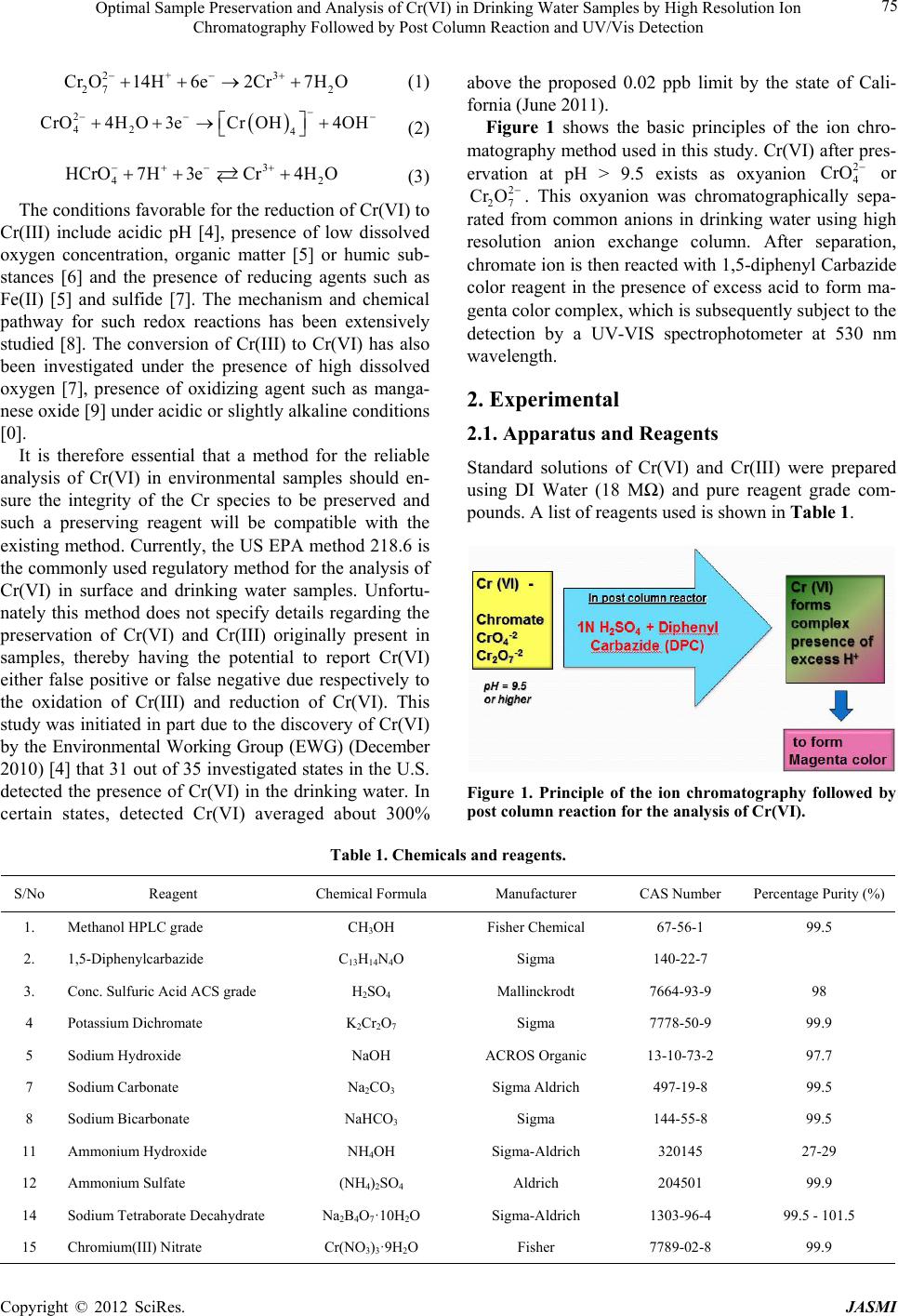 Optimal Sample Preservation and Analysis of Cr(VI) in Drinking Water Samples by High Resolution Ion Chromatography Followed by Post Column Reaction and UV/Vis Detection 75 2+ 3 27 2 Cr O14H6e2Cr7HO (1) 2 42 4 CrO4H O3eCrOH4OH 2 (2) 3 4 HCrO7H3eCr4H O (3) The conditions favorable for the reduction of Cr(VI) to Cr(III) include acidic pH [4], presence of low dissolved oxygen concentration, organic matter [5] or humic sub- stances [6] and the presence of reducing agents such as Fe(II) [5] and sulfide [7]. The mechanism and chemical pathway for such redox reactions has been extensively studied [8]. The conversion of Cr(III) to Cr(VI) has also been investigated under the presence of high dissolved oxygen [7], presence of oxidizing agent such as manga- nese oxide [9] under acidic or slightly alkaline conditions [0]. It is therefore essential that a method for the reliable analysis of Cr(VI) in environmental samples should en- sure the integrity of the Cr species to be preserved and such a preserving reagent will be compatible with the existing method. Currently, the US EPA method 218.6 is the commonly used regulatory method for the analysis of Cr(VI) in surface and drinking water samples. Unfortu- nately this method does not specify details regarding the preservation of Cr(VI) and Cr(III) originally present in samples, thereby having the potential to report Cr(VI) either false positive or false negative due respectively to the oxidation of Cr(III) and reduction of Cr(VI). This study was initiated in part due to the discovery of Cr(VI) by the Environmental Working Group (EWG) (December 2010) [4] that 31 out of 35 investigated states in the U.S. detected the presence of Cr(VI) in the drinking water. In certain states, detected Cr(VI) averaged about 300% above the proposed 0.02 ppb limit by the state of Cali- fornia (June 2011). Figure 1 shows the basic principles of the ion chro- matography method used in this study. Cr(VI) after pres- ervation at pH > 9.5 exists as oxyanion 2 4 CrO or 2 27 Cr O . This oxyanion was chromatographically sepa- rated from common anions in drinking water using high resolution anion exchange column. After separation, chromate ion is then reacted with 1,5-diphenyl Carbazide color reagent in the presence of excess acid to form ma- genta color complex, which is subsequently subject to the detection by a UV-VIS spectrophotometer at 530 nm wavelength. 2. Experimental 2.1. Apparatus and Reagents Standard solutions of Cr(VI) and Cr(III) were prepared using DI Water (18 MΩ) and pure reagent grade com- pounds. A list of reagents used is shown in Table 1. Figure 1. Principle of the ion chromatography followed by post column reaction for the analysis of Cr(VI). Table 1. Chemicals and reagents. S/No Reagent Chemical Formula Manufacturer CAS Number Percentage Purity (%) 1. Methanol HPLC grade CH3OH Fisher Chemical 67-56-1 99.5 2. 1,5-Diphenylcarbazide C13H14N4O Sigma 140-22-7 3. Conc. Sulfuric Acid ACS grade H2SO4 Mallinckrodt 7664-93-9 98 4 Potassium Dichromate K2Cr2O7 Sigma 7778-50-9 99.9 5 Sodium Hydroxide NaOH ACROS Organic 13-10-73-2 97.7 7 Sodium Carbonate Na2CO3 Sigma Aldrich 497-19-8 99.5 8 Sodium Bicarbonate NaHCO3 Sigma 144-55-8 99.5 11 Ammonium Hydroxide NH4OH Sigma-Aldrich 320145 27-29 12 Ammonium Sulfate (NH4)2SO4 Aldrich 204501 99.9 14 Sodium Tetraborate Decahydrate Na2B4O7·10H2O Sigma-Aldrich 1303-96-4 99.5 - 101.5 15 Chromium(III) Nitrate Cr(NO3)3·9H2O Fisher 7789-02-8 99.9 Copyright © 2012 SciRes. JASMI  Optimal Sample Preservation and Analysis of Cr(VI) in Drinking Water Samples by High Resolution Ion Chromatography Followed by Post Column Reaction and UV/Vis Detection 76 2.2. Instrumentation The ion chromatography system employed in this study was Metrohm IC system (model # 850 Professional IC AnCat version) consisting of an auto-sampler (model # 858 Professional AS), with 6 port injection valve (2000 µL injection loop), dual metal-free pumps, a column oven, post column reactor (PCR Box) and a Metrohm UV detector (model # 887). Major instrumental condi- tions are given in Table 2. A strict QA/QC protocol was maintained for the entire experiment as per USEPA method guidelines [10]. Each sequence run contained DI water blank to demonstrate lack of carryover due to the instrument or any of its components. A 0.1ppb standard containing the analyte of interest was measured to show the accuracy of the cur- rent calibration. The percent recovery was within 10% (Figure 2). 2.3. Experimental Setup a) Preparation of Mobile Phase: The IC mobile phase was prepared by adding 1.3568 g sodium carbonate, 0.336 g sodium bicarbonate, and 0.25 g ammonium sul- fate in 1 L volumetric flask. Dilution was made by using 18 mega-ohm DI water produced by a series of activated carbon, cationic/anionic exchange column, and finally 0.22 µm filter. Alternatively, pre-made concentrated carbonate/bicarbonate can be used. b) Preparation of Post Column Reagent: The color reagent was prepared by first dissolving 0.5 g 1,5-diphenyl Carbazide (DPC) into 50 mL HPLC grade methanol, then adding this dissolved DPC into approximately 450 mL of 18-mega-ohm DI water in a 1 L volumetric flask. This was followed by gently adding 28 mL concentrated H2SO4 and finally diluted with DI water to 1 L. This light sensitive solution was kept in dark prior to use. Table 2. Method parameters for the analysis of Cr(VI) using IC with post column reaction. Method Parameters Analytical Conditions IC Column Metrosep ASUPP5-150 Oven Temperature (˚C) 45 Mobile Phase 12.8 mmol/L Sodium Carbonate + 4.0 mmol/L Sodium Bicarbonate + 2.5 mM Ammonium Sulfate Column Flow Rate 0.7 mL/min Post Column Reagent (PCR) 2 mmol/L 1,5-Diphenyl Carbazide + 1 N H2SO4 PCR Flow rate 0.25 mL/min UV Wavelength 530 nm Injection Volume 2000 µL Figure 2. CCV statistics for 200+ injections. Copyright © 2012 SciRes. JASMI  Optimal Sample Preservation and Analysis of Cr(VI) in Drinking Water Samples by High Resolution Ion Chromatography Followed by Post Column Reaction and UV/Vis Detection 77 c) Preparation of sample preservation buffer: Five buffer solutions were tested for their potential as the pre- serving reagent for Cr(VI). Buffer A was selected be- cause it is suggested by USEPA method 3060A and 1636, whereas buffer C was used in USEPA method 218.6 [11, 12]. As noted in Table 3, all buffers have pH of higher than 9.0. 3. Results and Discussion 3.1. Initial Calibration and Quality Control for Entire Experiment Multi-point calibration was established for analytical range as per Table 4. 3.2. Sample Chromatography and Calibration Curve (Figures 3 and 4) Table 3. Preparation of buffer solutions for the preservation of Cr(VI). Buffer Chemical Composition Initial measured pH A 2 mM Na2CO3 + 10 mM NaOH in 1000 mL 12.0 B 1.25 mM Na2CO3 + 1.25 mM NaHCO3 in 1000 mL 10.2 C 0.4 g (NH4)2SO4 + 0.65 mL NH4OH in 1000 mL 10.0 D 1.25 mM Na2CO3 + 1.25 mM NaHCO3 + 0.15 g/L (NH4)2SO4 in 1000 mL 9.25 E 5 mM NaHCO3 + 10 mM Na Tetra Borate in 1000 mL 9.10 Table 4. Calibration standards. Calibration Level Chromium(VI), parts per billion (ppb) Level 1 0.025 Level 2 0.050 Level 3 0.100 Level 4 0.250 Level 5 0.500 Level 6 1.000 Level 7 2.000 Level 8 5.000 0.0 2.0 4.0 6.0 mAU 0.01.02.0 3.0 4.0 5.0 6.0min Chrom-6 Figure 3. Cr(VI) at 0.025 ppb. 0.0 1.0 2.0 3.0 4.0 5.0 6.0 (mAU) x min 0.01.02.0 3.0 4.0 5.0 pp b Figure 4. Calibration curve. 3.3. Method Detection Limit (MDL) Study [10] A method detection limit (MDL) is the minimum con- centration of a specified analyte that can be detected and quantified with a 99% confidence level. The MDL was determined by injecting 7 replicates of known concentra- tion near the expected limit of detection. The standard deviation is determined from the results and multiplied by the t value. The t value for 7 replicates is 3.14 at a 99% confidence level. An MDL study was performed for Chromium(VI) over three days. Table 5 demonstrates the data for the study. a) Minimum Reporting Limit (MRL) study (new QC parameter for USEPA Chromium (VI) method Analyze seven replicate at or below the proposed MRL concentra- tion. Calculate the mean (Mean) and standard deviation for these replicates. Determine the Half Range for the Prediction Interval of Results (HRPIR) using the equation HRPIR = 3.963S Copyright © 2012 SciRes. JASMI 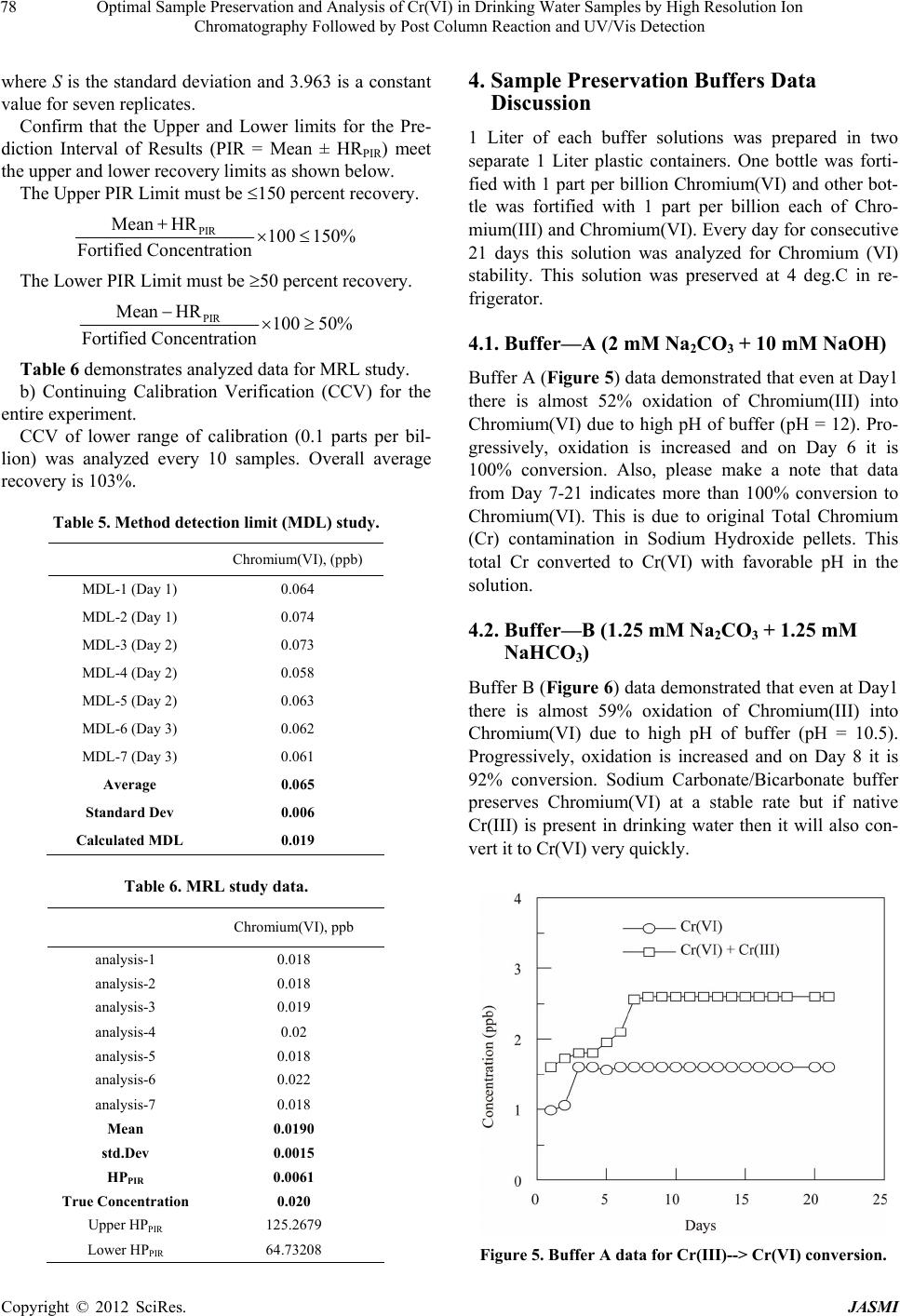 Optimal Sample Preservation and Analysis of Cr(VI) in Drinking Water Samples by High Resolution Ion Chromatography Followed by Post Column Reaction and UV/Vis Detection 78 where S is the standard deviation and 3.963 is a constant value for seven replicates. Confirm that the Upper and Lower limits for the Pre- diction Interval of Results (PIR = Mean ± HRPIR) meet the upper and lower recovery limits as shown below. The Upper PIR Limit must be 150 percent recovery. PIR Mean HR100 150% Fortified Concentration The Lower PIR Limit must be 50 percent recovery. PIR Mean HR100 50% Fortified Concentration Table 6 demonstrates analyzed data for MRL study. b) Continuing Calibration Verification (CCV) for the entire experiment. CCV of lower range of calibration (0.1 parts per bil- lion) was analyzed every 10 samples. Overall average recovery is 103%. Table 5. Method detection limit (MDL) study. Chromium(VI), (ppb) MDL-1 (Day 1) 0.064 MDL-2 (Day 1) 0.074 MDL-3 (Day 2) 0.073 MDL-4 (Day 2) 0.058 MDL-5 (Day 2) 0.063 MDL-6 (Day 3) 0.062 MDL-7 (Day 3) 0.061 Average 0.065 Standard Dev 0.006 Calculated MDL 0.019 Table 6. MRL study data. Chromium(VI), ppb analysis-1 0.018 analysis-2 0.018 analysis-3 0.019 analysis-4 0.02 analysis-5 0.018 analysis-6 0.022 analysis-7 0.018 Mean 0.0190 std.Dev 0.0015 HPPIR 0.0061 True Concentration 0.020 Upper HPPIR 125.2679 Lower HPPIR 64.73208 4. Sample Preservation Buffers Data Discussion 1 Liter of each buffer solutions was prepared in two separate 1 Liter plastic containers. One bottle was forti- fied with 1 part per billion Chromium(VI) and other bot- tle was fortified with 1 part per billion each of Chro- mium(III) and Chromium(VI). Every day for consecutive 21 days this solution was analyzed for Chromium (VI) stability. This solution was preserved at 4 deg.C in re- frigerator. 4.1. Buffer—A (2 mM Na2CO3 + 10 mM NaOH) Buffer A (Figure 5) data demonstrated that even at Day1 there is almost 52% oxidation of Chromium(III) into Chromium(VI) due to high pH of buffer (pH = 12). Pro- gressively, oxidation is increased and on Day 6 it is 100% conversion. Also, please make a note that data from Day 7-21 indicates more than 100% conversion to Chromium(VI). This is due to original Total Chromium (Cr) contamination in Sodium Hydroxide pellets. This total Cr converted to Cr(VI) with favorable pH in the solution. 4.2. Buffer—B (1.25 mM Na2CO3 + 1.25 mM NaHCO3) Buffer B (Figure 6) data demonstrated that even at Day1 there is almost 59% oxidation of Chromium(III) into Chromium(VI) due to high pH of buffer (pH = 10.5). Progressively, oxidation is increased and on Day 8 it is 92% conversion. Sodium Carbonate/Bicarbonate buffer preserves Chromium(VI) at a stable rate but if native Cr(III) is present in drinking water then it will also con- vert it to Cr(VI) very quickly. Figure 5. Buffer A data for Cr(III)--> Cr(VI) conversion. Copyright © 2012 SciRes. JASMI 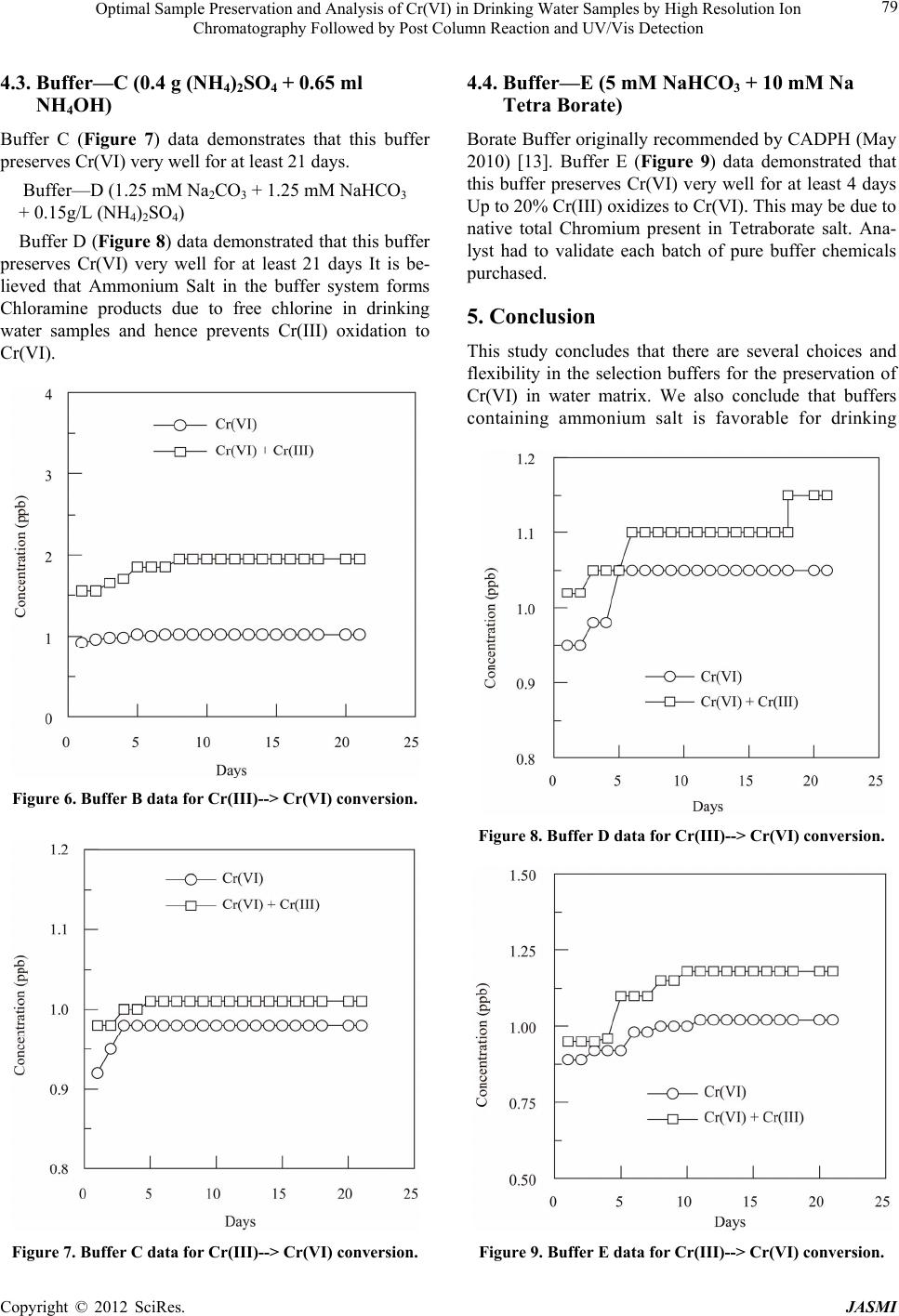 Optimal Sample Preservation and Analysis of Cr(VI) in Drinking Water Samples by High Resolution Ion Chromatography Followed by Post Column Reaction and UV/Vis Detection 79 4.3. Buffer—C (0.4 g (NH4)2SO4 + 0.65 ml NH4OH) Buffer C (Figure 7) data demonstrates that this buffer preserves Cr(VI) very well for at least 21 days. Buffer—D (1.25 mM Na2CO3 + 1.25 mM NaHCO3 + 0.15g/L (NH4)2SO4) Buffer D (Figure 8) data demonstrated that this buffer preserves Cr(VI) very well for at least 21 days It is be- lieved that Ammonium Salt in the buffer system forms Chloramine products due to free chlorine in drinking water samples and hence prevents Cr(III) oxidation to Cr(VI). Figure 6. Buffer B data for Cr(III)--> Cr(VI) conversion. Figure 7. Buffer C data for Cr(III)--> Cr(VI) conversion. 4.4. Buffer—E (5 mM NaHCO3 + 10 mM Na Tetra Borate) Borate Buffer originally recommended by CADPH (May 2010) [13]. Buffer E (Figure 9) data demonstrated that this buffer preserves Cr(VI) very well for at least 4 days Up to 20% Cr(III) oxidizes to Cr(VI). This may be due to native total Chromium present in Tetraborate salt. Ana- lyst had to validate each batch of pure buffer chemicals purchased. 5. Conclusion This study concludes that there are several choices and flexibility in the selection buffers for the preservation of Cr(VI) in water matrix. We also conclude that buffers containing ammonium salt is favorable for drinking Figure 8. Buffer D data for Cr(III)--> Cr(VI) conversion. Figure 9. Buffer E data for Cr(III)--> Cr(VI) conversion. Copyright © 2012 SciRes. JASMI 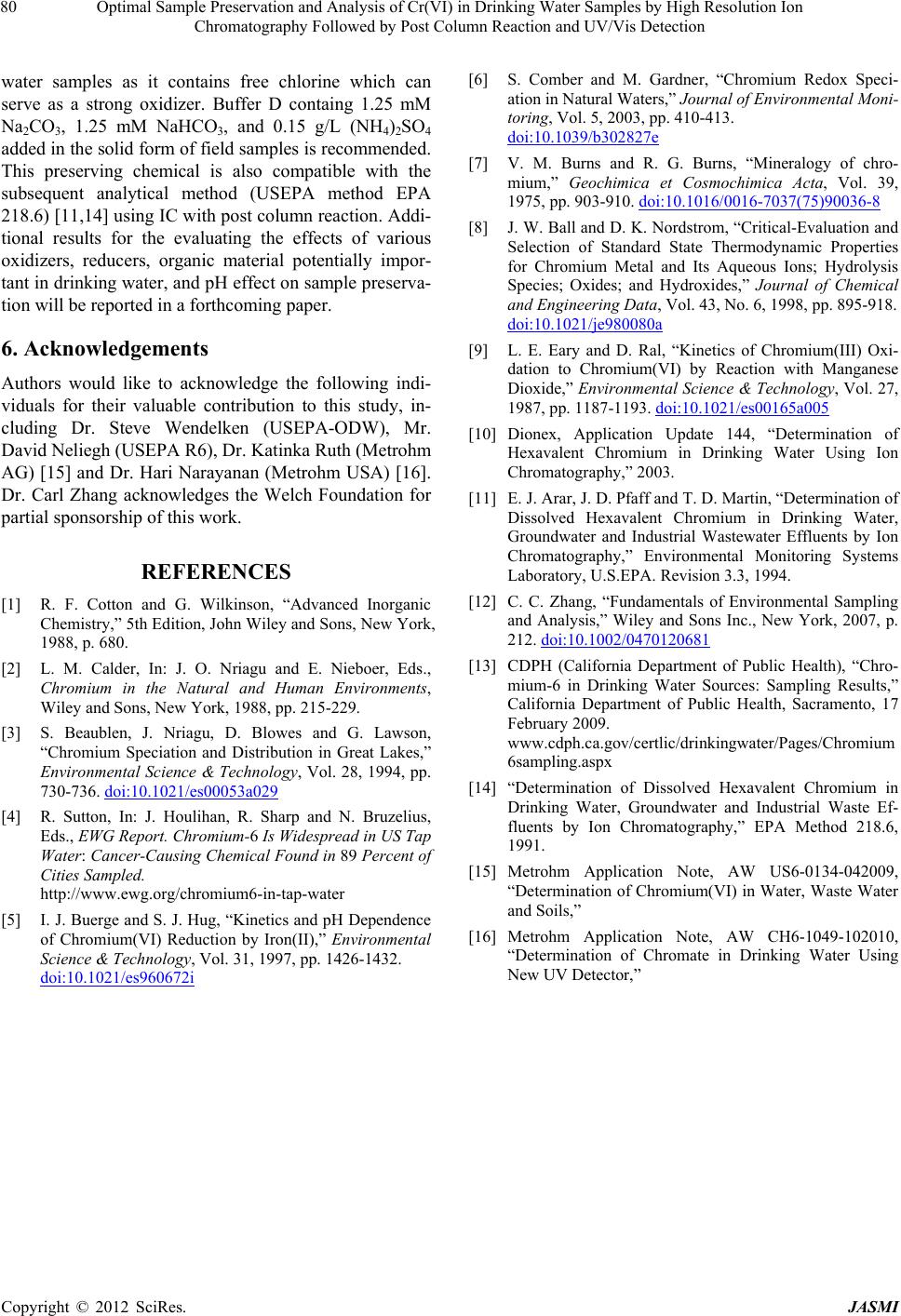 Optimal Sample Preservation and Analysis of Cr(VI) in Drinking Water Samples by High Resolution Ion Chromatography Followed by Post Column Reaction and UV/Vis Detection Copyright © 2012 SciRes. JASMI 80 water samples as it contains free chlorine which can serve as a strong oxidizer. Buffer D containg 1.25 mM Na2CO3, 1.25 mM NaHCO3, and 0.15 g/L (NH4)2SO4 added in the solid form of field samples is recommended. This preserving chemical is also compatible with the subsequent analytical method (USEPA method EPA 218.6) [11,14] using IC with post column reaction. Addi- tional results for the evaluating the effects of various oxidizers, reducers, organic material potentially impor- tant in drinking water, and pH effect on sample preserva- tion will be reported in a forthcoming paper. 6. Acknowledgements Authors would like to acknowledge the following indi- viduals for their valuable contribution to this study, in- cluding Dr. Steve Wendelken (USEPA-ODW), Mr. David Neliegh (USEPA R6), Dr. Katinka Ruth (Metrohm AG) [15] and Dr. Hari Narayanan (Metrohm USA) [16]. Dr. Carl Zhang acknowledges the Welch Foundation for partial sponsorship of this work. REFERENCES [1] R. F. Cotton and G. Wilkinson, “Advanced Inorganic Chemistry,” 5th Edition, John Wiley and Sons, New York, 1988, p. 680. [2] L. M. Calder, In: J. O. Nriagu and E. Nieboer, Eds., Chromium in the Natural and Human Environments, Wiley and Sons, New York, 1988, pp. 215-229. [3] S. Beaublen, J. Nriagu, D. Blowes and G. Lawson, “Chromium Speciation and Distribution in Great Lakes,” Environmental Science & Technology, Vol. 28, 1994, pp. 730-736. doi:10.1021/es00053a029 [4] R. Sutton, In: J. Houlihan, R. Sharp and N. Bruzelius, Eds., EWG Report. Chromium-6 Is Widespread in US Tap Water: Cancer-Causing Chemical Found in 89 Percent of Cities Sampled. http://www.ewg.org/chromium6-in-tap-water [5] I. J. Buerge and S. J. Hug, “Kinetics and pH Dependence of Chromium(VI) Reduction by Iron(II),” Environmental Science & Technology, Vol. 31, 1997, pp. 1426-1432. doi:10.1021/es960672i [6] S. Comber and M. Gardner, “Chromium Redox Speci- ation in Natural Waters,” Journal of Environmental Moni- toring, Vol. 5, 2003, pp. 410-413. doi:10.1039/b302827e [7] V. M. Burns and R. G. Burns, “Mineralogy of chro- mium,” Geochimica et Cosmochimica Acta, Vol. 39, 1975, pp. 903-910. doi:10.1016/0016-7037(75)90036-8 [8] J. W. Ball and D. K. Nordstrom, “Critical-Evaluation and Selection of Standard State Thermodynamic Properties for Chromium Metal and Its Aqueous Ions; Hydrolysis Species; Oxides; and Hydroxides,” Journal of Chemical and Engineering Data, Vol. 43, No. 6, 1998, pp. 895-918. doi:10.1021/je980080a [9] L. E. Eary and D. Ral, “Kinetics of Chromium(III) Oxi- dation to Chromium(VI) by Reaction with Manganese Dioxide,” Environmental Science & Technology, Vol. 27, 1987, pp. 1187-1193. doi:10.1021/es00165a005 [10] Dionex, Application Update 144, “Determination of Hexavalent Chromium in Drinking Water Using Ion Chromatography,” 2003. [11] E. J. Arar, J. D. Pfaff and T. D. Martin, “Determination of Dissolved Hexavalent Chromium in Drinking Water, Groundwater and Industrial Wastewater Effluents by Ion Chromatography,” Environmental Monitoring Systems Laboratory, U.S.EPA. Revision 3.3, 1994. [12] C. C. Zhang, “Fundamentals of Environmental Sampling and Analysis,” Wiley and Sons Inc., New York, 2007, p. 212. doi:10.1002/0470120681 [13] CDPH (California Department of Public Health), “Chro- mium-6 in Drinking Water Sources: Sampling Results,” California Department of Public Health, Sacramento, 17 February 2009. www.cdph.ca.gov/certlic/drinkingwater/Pages/Chromium 6sampling.aspx [14] “Determination of Dissolved Hexavalent Chromium in Drinking Water, Groundwater and Industrial Waste Ef- fluents by Ion Chromatography,” EPA Method 218.6, 1991. [15] Metrohm Application Note, AW US6-0134-042009, “Determination of Chromium(VI) in Water, Waste Water and Soils,” [16] Metrohm Application Note, AW CH6-1049-102010, “Determination of Chromate in Drinking Water Using New UV Detector,” |