

Paper Menu >>
Journal Menu >>
 Journal of Analytical Sciences, Methods and Instrumentation, 2012, 2, 49-53 http://dx.doi.org/10.4236/jasmi.2012.22010 Published Online June 2012 (http://www.SciRP.org/journal/jasmi) 49 Microfluidic Behavior of Ternary Mixed Carrier Solvents Based on the Tube Radial Distribution in Triple-Branched Microchannels in a Microchip Naoya Jinno, Masahiko Hashimoto, Kazuhiko Tsukagoshi* Department of Chemical Engineering and Materials Science, Faculty of Science and Engineering, Doshisha University, Kyotanabe, Japan. Email: *[email protected] Received March 1st, 2012; revised March 21st, 2012; accepted April 8th, 2012 ABSTRACT Microfluidic behavior of ternary mixed carrier solvents of water-acetonitrile-ethyl acetate (2:3:1 volume ratio) was ex- amined by use of a microchip incorporating microchannels in which one wide channel was separated into three narrow channels, i.e., triple-branched microchannels. When the ternary carrier solution containing the fluorescent dyes, hydro- phobic perylene (blue) and relatively hydrophilic Eosin Y (green), was fed into the wide channel under laminar flow conditions, the carrier solvent molecules or fluorescence dyes were radially distributed in the channel, forming inner (organic solvent-rich major; blue) and outer (water-rich minor; green) phases in the wide channel. And then, in the nar- row channels, perylene molecules mostly appeared to flow through the center narrow channel and Eosin Y, which is distributed in the outer phases in the wide channel, flowed through the both side narrow channels. A metal ion, Cu(II) as a model, dissolved in the ternary mixed carrier solution was also examined. The Cu(II) showed fluidic behavior, trans- ferring from the homogeneous carrier solution to the water-rich solution in the side narrow channels through the tri- ple-branched microchannels. Keywords: Triple-Branched Microchannels; Ternary Mixed Solvents; Fluorescence Dyes; Metal Ion; Tube Radial Distribution Phenomenon (TRDP) 1. Introduction The development of micro total analysis systems that include a microchip or microfluidic device technology is an interesting aspect of analytical chemistry [1,2]. Mi- crofluidics exhibit various types of fluidic behavior of solvents in a microchannel. The microfluidic behavior has been examined by varying the channel configuration and flow rate of the solvents, by using aqueous-organic solvent mixtures, and by introducing specific obstacles into the microchannel [3-5]. The fluidic behavior of the solvents in the microchannel is related to the mixing, separation, diffusion, and reaction of the solutes. Infor- mation regarding the flow pattern of the solvents is im- portant and useful to design microreactors or micro total analysis systems [6,7]. Recently, we reported that when ternary mixed solvents of water-hydrophilic/hydrophobic organic solvents are fed into a microspace, such as microchannels in a micro- chip or capillary tubes, the solvent molecules are radially distributed under laminar flow conditions. This is called the “tube radial distribution phenomenon” (TRDP) [8- 11]. In TRDP, in an organic solvent-rich carrier solution, the organic solvent-rich major phase is formed around the center of the microspace as an inner phase, while the water-rich minor phase is formed near the inner wall as an outer phase. On the other hand, in the water-rich car- rier solution, the water-rich major phase is formed as an inner phase and the organic solvent-rich minor phase as an outer phase. TRDP forms a specific liquid-liquid interface, which is not static but kinetic, in a micro- space. Until now, TRDP has been investigated by use of mainly capillary tubes and straight single line microchannels [8-11]. The triple-branched microchannels in which one wide channel was separated into three narrow channels in a microchip was designed and manufactured in our pre- vious study to conform TRDP, where the ternary mixed carrier solution was fed from the three narrow channels to the one wide channels [8]. In this study microfluidic behavior of the ternary mixed carrier solution in the tri- ple-branched microchannels was examined with the re- verse flow direction against the previous paper [8], i.e., *Corresponding author. Copyright © 2012 SciRes. JASMI 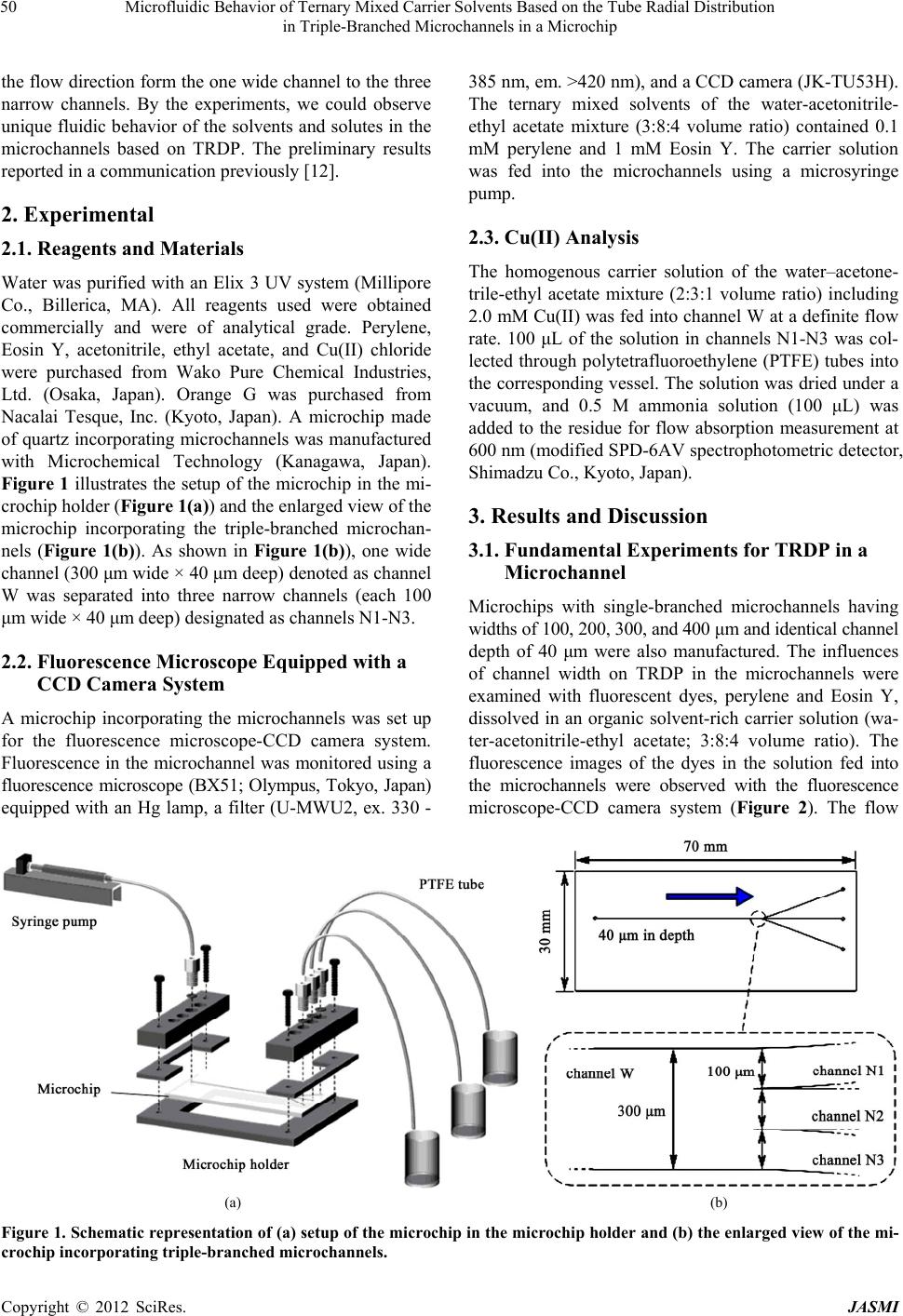 Microfluidic Behavior of Ternary Mixed Carrier Solvents Based on the Tube Radial Distribution in Triple-Branched Microchannels in a Microchip 50 the flow direction form the one wide channel to the three narrow channels. By the experiments, we could observe unique fluidic behavior of the solvents and solutes in the microchannels based on TRDP. The preliminary results reported in a communication previously [12]. 2. Experimental 2.1. Reagents and Materials Water was purified with an Elix 3 UV system (Millipore Co., Billerica, MA). All reagents used were obtained commercially and were of analytical grade. Perylene, Eosin Y, acetonitrile, ethyl acetate, and Cu(II) chloride were purchased from Wako Pure Chemical Industries, Ltd. (Osaka, Japan). Orange G was purchased from Nacalai Tesque, Inc. (Kyoto, Japan). A microchip made of quartz incorporating microchannels was manufactured with Microchemical Technology (Kanagawa, Japan). Figure 1 illustrates the setup of the microchip in the mi- crochip holder (Figure 1(a)) and the enlarged view of the microchip incorporating the triple-branched microchan- nels (Figure 1(b)). As shown in Figure 1(b)), one wide channel (300 μm wide × 40 μm deep) denoted as channel W was separated into three narrow channels (each 100 μm wide × 40 μm deep) designated as channels N1-N3. 2.2. Fluorescence Microscope Equipped with a CCD Camera System A microchip incorporating the microchannels was set up for the fluorescence microscope-CCD camera system. Fluorescence in the microchannel was monitored using a fluorescence microscope (BX51; Olympus, Tokyo, Japan) equipped with an Hg lamp, a filter (U-MWU2, ex. 330 - 385 nm, em. >420 nm), and a CCD camera (JK-TU53H). The ternary mixed solvents of the water-acetonitrile- ethyl acetate mixture (3:8:4 volume ratio) contained 0.1 mM perylene and 1 mM Eosin Y. The carrier solution was fed into the microchannels using a microsyringe pump. 2.3. Cu(II) Analysis The homogenous carrier solution of the water–acetone- trile-ethyl acetate mixture (2:3:1 volume ratio) including 2.0 mM Cu(II) was fed into channel W at a definite flow rate. 100 μL of the solution in channels N1-N3 was col- lected through polytetrafluoroethylene (PTFE) tubes into the corresponding vessel. The solution was dried under a vacuum, and 0.5 M ammonia solution (100 μL) was added to the residue for flow absorption measurement at 600 nm (modified SPD-6AV spectrophotometric detector, Shimadzu Co., Kyoto, Japan). 3. Results and Discussion 3.1. Fundamental Experiments for TRDP in a Microchannel Microchips with single-branched microchannels having widths of 100, 200, 300, and 400 μm and identical channel depth of 40 μm were also manufactured. The influences of channel width on TRDP in the microchannels were examined with fluorescent dyes, perylene and Eosin Y, dissolved in an organic solvent-rich carrier solution (wa- ter-acetonitrile-ethyl acetate; 3:8:4 volume ratio). The fluorescence images of the dyes in the solution fed into the microchannels were observed with the fluorescence microscope-CCD camera system (Figure 2). The flow (a) (b) Figure 1. Schematic representation of (a) setup of the microchip in the microchip holder and (b) the enlarged view of the mi- crochip incorporating triple-branched microchannels. Copyright © 2012 SciRes. JASMI 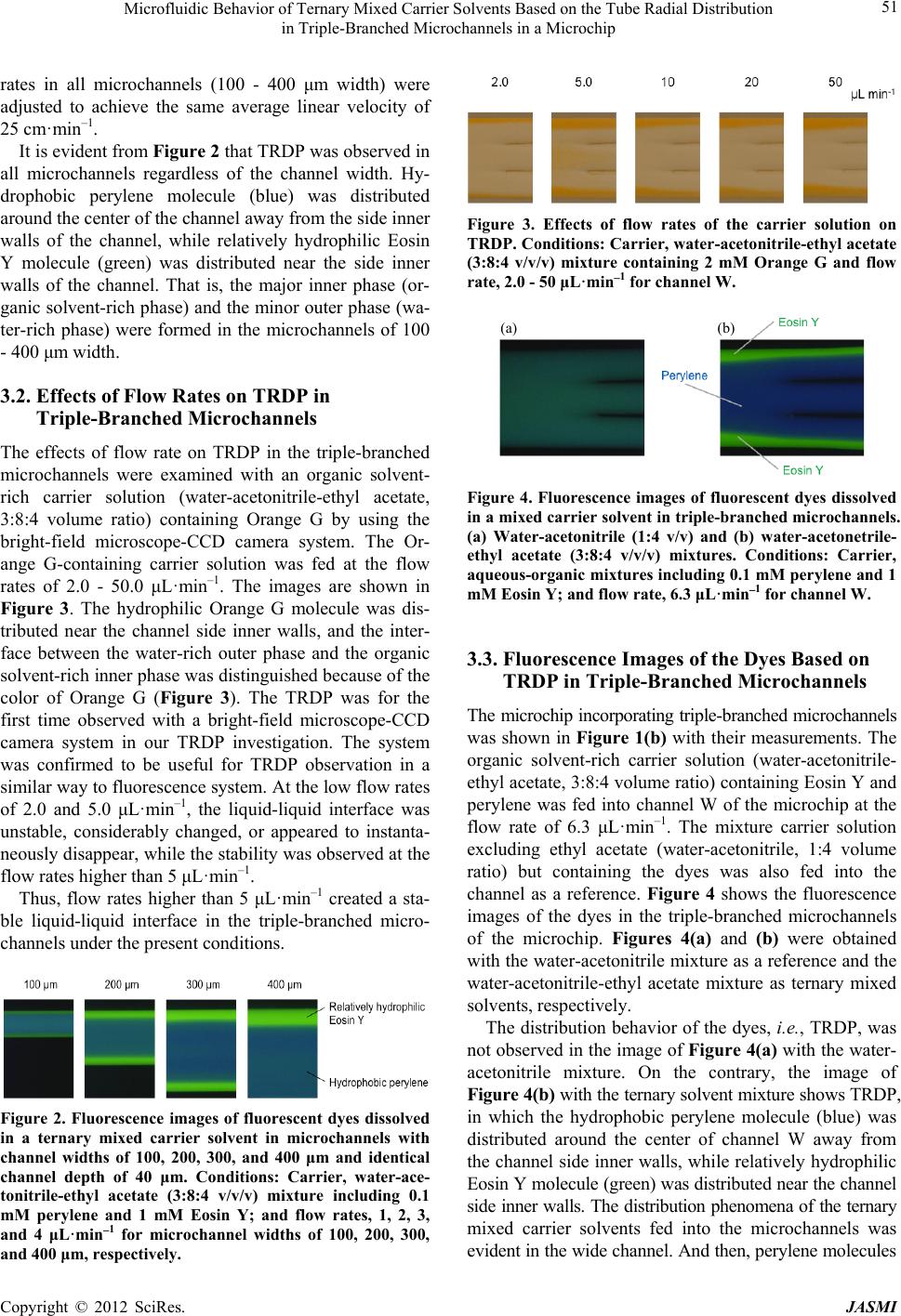 Microfluidic Behavior of Ternary Mixed Carrier Solvents Based on the Tube Radial Distribution in Triple-Branched Microchannels in a Microchip 51 rates in all microchannels (100 - 400 μm width) were adjusted to achieve the same average linear velocity of 25 cm·min–1. It is evident from Figure 2 that TRDP was observed in all microchannels regardless of the channel width. Hy- drophobic perylene molecule (blue) was distributed around the center of the channel away from the side inner walls of the channel, while relatively hydrophilic Eosin Y molecule (green) was distributed near the side inner walls of the channel. That is, the major inner phase (or- ganic solvent-rich phase) and the minor outer phase (wa- ter-rich phase) were formed in the microchannels of 100 - 400 μm width. 3.2. Effects of Flow Rates on TRDP in Triple-Branched Microchannels The effects of flow rate on TRDP in the triple-branched microchannels were examined with an organic solvent- rich carrier solution (water-acetonitrile-ethyl acetate, 3:8:4 volume ratio) containing Orange G by using the bright-field microscope-CCD camera system. The Or- ange G-containing carrier solution was fed at the flow rates of 2.0 - 50.0 μL·min–1. The images are shown in Figure 3. The hydrophilic Orange G molecule was dis- tributed near the channel side inner walls, and the inter- face between the water-rich outer phase and the organic solvent-rich inner phase was distinguished because of the color of Orange G (Figure 3). The TRDP was for the first time observed with a bright-field microscope-CCD camera system in our TRDP investigation. The system was confirmed to be useful for TRDP observation in a similar way to fluorescence system. At the low flow rates of 2.0 and 5.0 μL·min–1, the liquid-liquid interface was unstable, considerably changed, or appeared to instanta- neously disappear, while the stability was observed at the flow rates higher than 5 μL·min–1. Thus, flow rates higher than 5 μL·min–1 created a sta- ble liquid-liquid interface in the triple-branched micro- channels under the present conditions. Figure 2. Fluorescence images of fluorescent dyes dissolved in a ternary mixed carrier solvent in microchannels with channel widths of 100, 200, 300, and 400 μm and identical channel depth of 40 μm. Conditions: Carrier, water-ace- tonitrile-ethyl acetate (3:8:4 v/v/v) mixture including 0.1 mM perylene and 1 mM Eosin Y; and flow rates, 1, 2, 3, and 4 μL·min–1 for microchannel widths of 100, 200, 300, and 400 μm, respectively. Figure 3. Effects of flow rates of the carrier solution on TRDP. Conditions: Carrier, water-acetonitrile-ethyl acetate (3:8:4 v/v/v) mixture containing 2 mM Orange G and flow rate, 2.0 - 50 μL·min–1 for channel W. (a) (b) Figure 4. Fluorescence images of fluorescent dyes dissolved in a mixed carrier solvent in triple-branched microchannels. (a) Water-acetonitrile (1:4 v/v) and (b) water-acetonetrile- ethyl acetate (3:8:4 v/v/v) mixtures. Conditions: Carrier, aqueous-organic mixtures including 0.1 mM perylene and 1 mM Eosin Y; and flow rate, 6.3 μL·min–1 for channel W. 3.3. Fluorescence Images of the Dyes Based on TRDP in Triple-Branched Microchannels The microchip incorporating triple-branched microchannels was shown in Figure 1(b) with their measurements. The organic solvent-rich carrier solution (water-acetonitrile- ethyl acetate, 3:8:4 volume ratio) containing Eosin Y and perylene was fed into channel W of the microchip at the flow rate of 6.3 μL·min–1. The mixture carrier solution excluding ethyl acetate (water-acetonitrile, 1:4 volume ratio) but containing the dyes was also fed into the channel as a reference. Figure 4 shows the fluorescence images of the dyes in the triple-branched microchannels of the microchip. Figures 4(a) and (b) were obtained with the water-acetonitrile mixture as a reference and the water-acetonitrile-ethyl acetate mixture as ternary mixed solvents, respectively. The distribution behavior of the dyes, i.e., TRDP, was not observed in the image of Figure 4(a) with the water- acetonitrile mixture. On the contrary, the image of Figure 4(b) with the ternary solvent mixture shows TRDP, in which the hydrophobic perylene molecule (blue) was distributed around the center of channel W away from the channel side inner walls, while relatively hydrophilic Eosin Y molecule (green) was distributed near the channel side inner walls. The distribution phenomena of the ternary mixed carrier solvents fed into the microchannels was evident in the wide channel. And then, perylene molecules Copyright © 2012 SciRes. JASMI 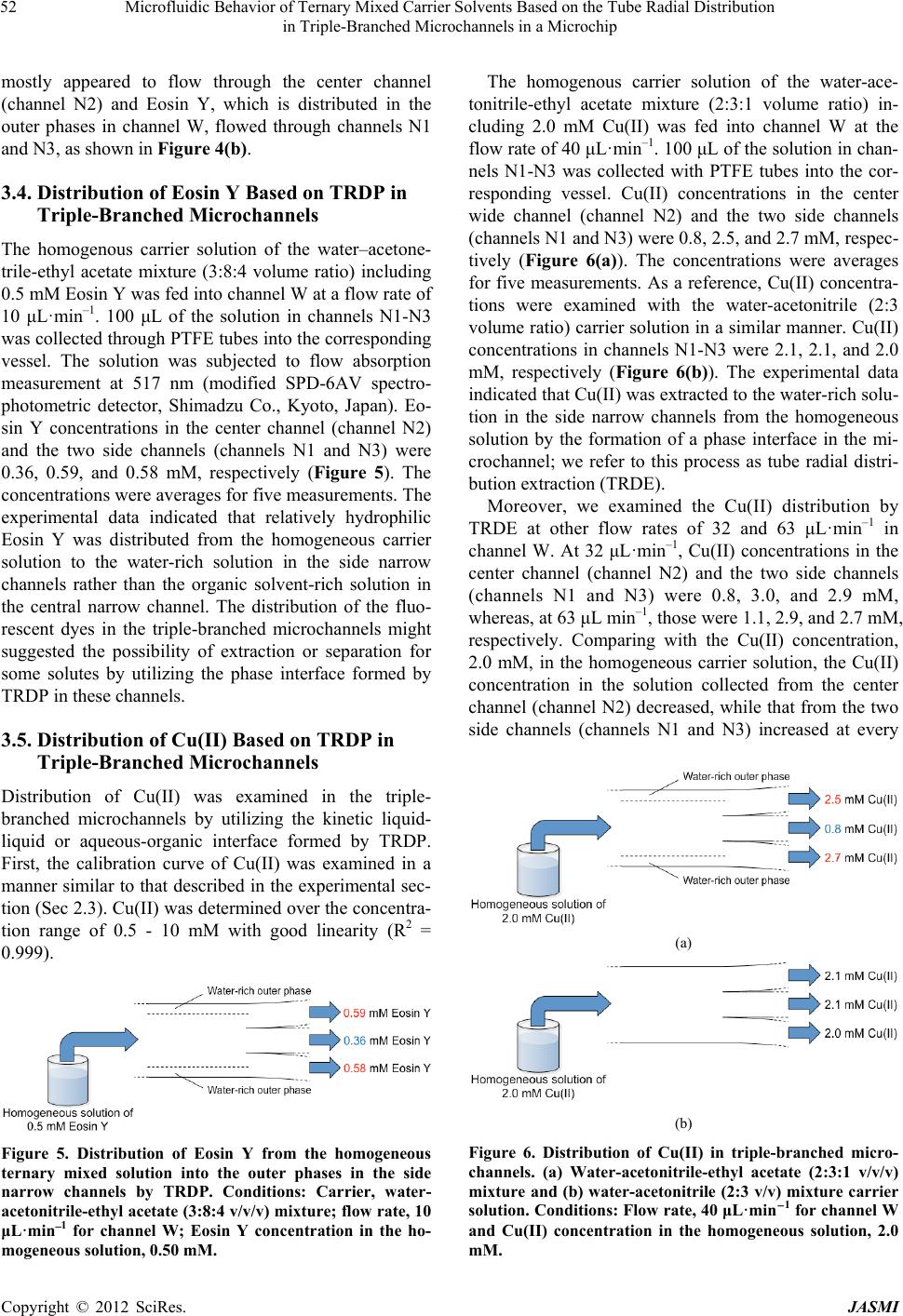 Microfluidic Behavior of Ternary Mixed Carrier Solvents Based on the Tube Radial Distribution in Triple-Branched Microchannels in a Microchip 52 mostly appeared to flow through the center channel (channel N2) and Eosin Y, which is distributed in the outer phases in channel W, flowed through channels N1 and N3, as shown in Figure 4(b). 3.4. Distribution of Eosin Y Based on TRDP in Triple-Branched Microchannels The homogenous carrier solution of the water–acetone- trile-ethyl acetate mixture (3:8:4 volume ratio) including 0.5 mM Eosin Y was fed into channel W at a flow rate of 10 μL·min –1. 100 μL of the solution in channels N1-N3 was collected through PTFE tubes into the corresponding vessel. The solution was subjected to flow absorption measurement at 517 nm (modified SPD-6AV spectro- photometric detector, Shimadzu Co., Kyoto, Japan). Eo- sin Y concentrations in the center channel (channel N2) and the two side channels (channels N1 and N3) were 0.36, 0.59, and 0.58 mM, respectively (Figure 5). The concentrations were averages for five measurements. The experimental data indicated that relatively hydrophilic Eosin Y was distributed from the homogeneous carrier solution to the water-rich solution in the side narrow channels rather than the organic solvent-rich solution in the central narrow channel. The distribution of the fluo- rescent dyes in the triple-branched microchannels might suggested the possibility of extraction or separation for some solutes by utilizing the phase interface formed by TRDP in these channels. 3.5. Distribution of Cu(II) Based on TRDP in Triple-Branched Microchannels Distribution of Cu(II) was examined in the triple- branched microchannels by utilizing the kinetic liquid- liquid or aqueous-organic interface formed by TRDP. First, the calibration curve of Cu(II) was examined in a manner similar to that described in the experimental sec- tion (Sec 2.3). Cu(II) was determined over the concentra- tion range of 0.5 - 10 mM with good linearity (R2 = 0.999). Figure 5. Distribution of Eosin Y from the homogeneous ternary mixed solution into the outer phases in the side narrow channels by TRDP. Conditions: Carrier, water- acetonitrile-ethyl acetate (3:8:4 v/v/v) mixture; flow rate, 10 μL·min–1 for channel W; Eosin Y concentration in the ho- mogeneous solution, 0.50 mM. The homogenous carrier solution of the water-ace- tonitrile-ethyl acetate mixture (2:3:1 volume ratio) in- cluding 2.0 mM Cu(II) was fed into channel W at the flow rate of 40 μL·min–1. 100 μL of the solution in chan- nels N1-N3 was collected with PTFE tubes into the cor- responding vessel. Cu(II) concentrations in the center wide channel (channel N2) and the two side channels (channels N1 and N3) were 0.8, 2.5, and 2.7 mM, respec- tively (Figure 6(a)). The concentrations were averages for five measurements. As a reference, Cu(II) concentra- tions were examined with the water-acetonitrile (2:3 volume ratio) carrier solution in a similar manner. Cu(II) concentrations in channels N1-N3 were 2.1, 2.1, and 2.0 mM, respectively (Figure 6(b)). The experimental data indicated that Cu(II) was extracted to the water-rich solu- tion in the side narrow channels from the homogeneous solution by the formation of a phase interface in the mi- crochannel; we refer to this process as tube radial distri- bution extraction (TRDE). Moreover, we examined the Cu(II) distribution by TRDE at other flow rates of 32 and 63 μL·min–1 in channel W. At 32 μL·min–1, Cu(II) concentrations in the center channel (channel N2) and the two side channels (channels N1 and N3) were 0.8, 3.0, and 2.9 mM, whereas, at 63 μL min–1, those were 1.1, 2.9, and 2.7 mM, respectively. Comparing with the Cu(II) concentration, 2.0 mM, in the homogeneous carrier solution, the Cu(II) concentration in the solution collected from the center channel (channel N2) decreased, while that from the two side channels (channels N1 and N3) increased at every (a) (b) Figure 6. Distribution of Cu(II) in triple-branched micro- channels. (a) Water-acetonitrile-ethyl acetate (2:3:1 v/v/v) mixture and (b) water-acetonitrile (2:3 v/v) mixture carrier solution. Conditions: Flow rate, 40 μL·min−1 for channel W and Cu(II) concentration in the homogeneous solution, 2.0 mM. Copyright © 2012 SciRes. JASMI  Microfluidic Behavior of Ternary Mixed Carrier Solvents Based on the Tube Radial Distribution in Triple-Branched Microchannels in a Microchip Copyright © 2012 SciRes. JASMI 53 flow rates. The obtained data showed that TRDE oc- curred in the triple-branched microchannels of the mi- crochip. 4. Conclusion TRDP has been investigated by use of mainly capillary tubes and straight single line microchannels. The TRDP of the ternary mixed carrier solution in the triple- branched microchannels was observed with fluorescence microscope-CCD camera system. Consequently, pery- lene molecules mostly appeared to flow through the cen- ter narrow channel and Eosin Y flowed through channels in the side narrow channels. The TRDP was also ob- served through bright-light microscope-CCD camera system. We tried to apply the phase interface formed by TRDP, i.e., inner and outer phases, to the distribution or extraction procedure of Cu(II) in the triple-branched mi- crochannels. This process will be helpful for investigat- ing separation and extraction in a microfluidic device. 5. Acknowledgements This work was supported by a Grant-in-Aid for Scientific Research (C) from the Ministry of Education, Culture, Sports, Science, and Technology, Japan. This work was also supported by “Advanced Study for Integrated Parti- cle Science, and Technology,” Strategic Development of Research Infrastructure for Private Universities, the Mini- stry of Education, Culture, Sports, Science, and Techno- logy, Japan. REFERENCES [1] K. Ueno, F. Kitagawa and N. Kitamura, “One-Step Elec- trochemical Cyanation Reaction of Pyrene in Polymer Microchannel-Electrode Chips,” Bulletin of the Chemical Society of Japan, Vol. 77, No. 7, 2011, pp. 1331-1338. doi:10.1246/bcsj.77.1331 [2] D. R. Reyes, D. Iossifidis, P. A. Auroux and A. Manz, “Micro Total Analysis Systems. 1. Introduction, Theory, and Technology,” Analytical Chemistry, Vol. 74, No. 12, 2002, pp. 2623-2636. doi:10.1021/ac0202435 [3] Y. Kikutani, H. Hisamoto, M. Tokeshi and T. Kitamori, “Micro Wet Analysis System Using Multi-Phase Laminar Flows in Three-Dimensional Microchannel Network,” Lab on a Chip, Vol. 4, No. 4, 2004, pp. 328-332. doi:10.1039/b400233d [4] A. Hibara, M. Tokeshi, K. Uchiyama, H. Hisamoto and T. Kitamori, “Integrated Multilayer Flow System on a Mi- crochip,” Analytical Sciences, Vol. 17, No. 1, 2001, pp. 89-93. doi:10.2116/analsci.17.89 [5] N. Kaji, Y. Okamoto, M. Tokeshi and Y. Baba, “Nano- pillar, Nanoball, and Nanofibers for Highly Efficient Analysis of Biomolecules,” Chemical Society Reviews, Vol. 39, No. 3, 2010, pp. 948-956. doi:10.1039/b900410f [6] H. Nakamura, Y. Yamaguchi, M. Miyazaki, H. Maeda and M. Uehara, “Preparation of CdSe Nanocrystals in a Micro-Flow-Reactor,” Chemical Communications, No. 23, 2002, pp. 2844-2845. doi:10.1039/b208992k [7] H. Kawazumi, A. Tashiro, K. Ogino and H. Maeda, “Ob- servation of Fluidic Behavior in a Polymethylmethacry- late-Fabricated Microchannel by a Simple Spectroscopic Analysis,” Lab on a C h ip, Vol. 2, No. 1, 2002, pp. 8-10. doi:10.1039/b109058e [8] N. Jinno, M. Murakami, K. Mizohata, M. Hashimoto and K. Tsukagoshi, “Fluorescence Observation Supporting Capillary Chromatography Based on Tube Radial Distri- bution of Carrier Solvents under Laminar Flow Condi- tions,” Analyst, Vol. 136, No. 5, 2011, pp. 927-932. doi:10.1039/c0an00820f [9] N. Jinno, M. Hashimoto and K. Tsukagoshi, “Experi- mental Consideration of Capillary Chromatography Based on Tube Radial Distribution of Ternary Mixture Carrier Solvents under Laminar Flow Conditions,” Ana- lytical Sciences, Vol. 27, No. 3, 2011, pp. 259-264. doi:10.2116/analsci.27.259 [10] M. Murakami, N. Jinno, M. Hashimoto and K. Tsukago- shi, “Tube Radial Distribution Phenomenon of Ternary Mixed Solvents in a Microspace under Laminar Flow Conditions,” Analytical Sciences, Vol. 27, No. 8, 2011, pp. 793-798. doi:10.2116/analsci.27.793 [11] S. Fujinaga, N. Jinno, M. Hashimoto and K. Tsukagoshi, “Use of Tube Radial Distribution of Ternary Mixed Car- rier Solvents for Introduction of Absorption Reagent for Metal Ion Separation and Online Detection into Capil- lary,” Journal of Separation Science, Vol. 34, No. 20, 2011, pp. 2833-2839. doi:10.1002/jssc.201100404 [12] N. Jinno, M. Hashimoto and K. Tsukagoshi, “Extraction of Cu(II) Based on Tube Radial Distribution of Ternary Mixed Carrier Solvent in Microchannels,” Chemistry Letters, Vol. 40, No. 6, 2011, pp. 654-655. doi:10.1246/cl.2011.654 |