

Paper Menu >>
Journal Menu >>
 Crystal Structure Theory and Applications, 2012, 1, 1-8 http://dx.doi.org/10.4236/csta.2012.11001 Published Online June 2012 (http://www.SciRP.org/journal/csta) Crystal and Molecular Structure of 4-Benzoyl-1,5-diphenyl-1H-pyrazole-3-carbonitrile E. Korkusuz1, E. Şahin2, İ. Yildirim3* 1Kayseri Vocational Colage, Erciyes University, Kayseri, Turkey 2Department of Chemistry, Faculty of Sciences, Atatürk University, Erzurum, Turkey 3Department of Chemistry, Faculty of Sciences, Erciyes University, Kayseri, Turkey Email: *[email protected] Received April 5, 2012; revised May 22, 2012; accepted June 11, 2012 ABSTRACT The crystal structure of potential active 4-benzoyl-1,5-diphenyl-1H-pyrazole-3-carbonitrile (C23H15N3O) (I) has been determined from single crystal X-ray diffraction data. Also IR, Uv-vis and NMR spectral data were determined. The title compound crystallizes in the monoclinic space group P 21/c, with a = 9.3167(2), b = 20.6677(3), c = 10.6143(3) Å, β = 112.665(3)˚, V = 1886.00(8) Å3, Dcalc = 1.23g cm–3, Z = 4. In the structure, intermolecular H-bonds lead to the for- mation of a centrosymmetric dimmer of the molecule. Furthermore, the compound has a wide transmission window (300 to 1100 nm) with a transparency of nearly 100% and the UV cut-off wavelength occurs at 242 nm. Keywords: Pyrazole-3-Carbonitrile; 2,3-Furandione; Single Crystal Structure; X-Ray Diffraction; IR; NMR Spectra 1. Introduction Pyrazole nucleus and its derivatives such as nitriles, am- ides or esters possess numerous chemical, biological, medicinal, and agricultural applications due to their ver- satile biological activities appearing as antimicrobial [1,2], antiviral [3,4], antibacterial [5], antitumor [6-8], anti-inflammatory [9,10], antihistaminic [11], pesticidal [12,13], antifungal [14], against rheumatoid arthritis [15], anticonvulsant [16], antidepressant [17], antipyretic [18], and commercially important dyestuffs [19] agents. Their excellent control activities on various plant diseases are studied, too [20,21]. Recently, reactions of cyclic oxalyl compounds have been reported to give substituted het- erocyclic compounds [22-26]. The reaction of 4-benzoyl- 5-phenylfuran-2,3-dione, obtained easily from dibenzoyl- methane and oxalyl dichloride [22], with various phenyl hydrazones and phenylhydrazine leads to pyrazole car- boxylic acids and pyridazinones [27-29]. Nitriles are widely used for transformation into amides, amines, es- ters, carboxylic acids etc. [30]. Hence they have been used as intermediates for the synthesis of fine chemicals such as agricultural chemicals, dyes and medicines [31]. Title compound was mainly synthesized from 4-benzoyl- 1,5-diphenyl-1H-pyrazole-3-carboxylic acid together with- acid chloride and its amide derivatives (Scheme 1). Fur- thermore, a cold solution of the acid amide in a mixture of Dimethyl formamide (DMF) and Thionylchloride (SOCl2) was stirred at 0˚C - 5˚C for 2 hours to give the nitrile product. In view of these wide ranges of biological and pharmaceutical importance [32], in the present study, we report the synthesis, spectroscopic and structural characterization and the X-ray diffraction (XRD) study of the title compound, too, as well as for the comparisons of the geometrical features with related compounds in the literature. The structure of the title compound confirms the molecular formula based on microanalysis, IR, Uv-vis and NMR spectra beside X-ray diffraction data. 2. Experimental 2.1. Synthesis of the Title Compound The title compound was prepared by the reaction of 4- benzoyl-1,5-diphenyl-1H-pyrazole-3-carboxylic acid am- ide with DMF and SOCl2 (Figure 1). A cold solution of the acid amide (0.37 g, 1.0 mmol) in a mixture of DMF (0.7 mL) and SOCl2 (0.15 mL) was stirred at 0˚C - 5˚C for 2 h similarly given in [5], and the solution was left stirring overnight. Then the mixture was poured over crushed ice and the precipitate formed was filtered off, washed with water and recrystallized from methanol and dried on P2O5 M.p. 167˚C, yield 70% (0.245 g). The au- thenticity of the compound has been established by mi- croanalyses, UV, IR, 1H and 13C NMR spectra. 2.2. Materials and Physical Measurements The melting point was determined on an Electrother- malModel 9200 apparatus and is uncorrected. The IR ab *Corresponding author. C opyright © 2012 SciRes. CSTA 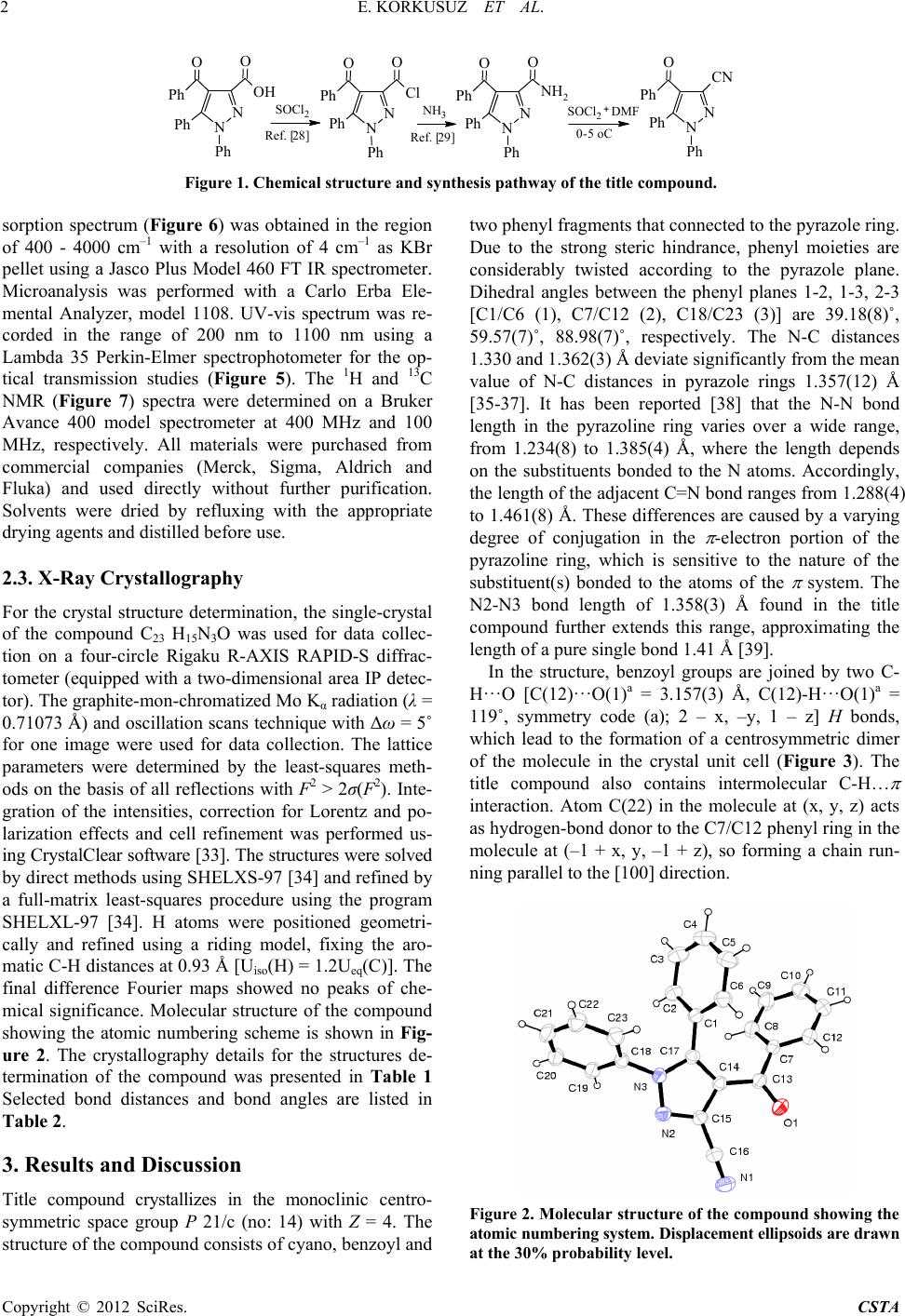 E. KORKUSUZ ET AL. 2 OO Ph Ph NN OH Ph SOCl2 Ph Ph NN Cl Ph OO NH3 Ph Ph NN NH2 Ph OO SOCl2+DMF 0-5 oC Ph Ph NN CN Ph O Ref. [Ref. [ 28] 29] Figure 1. Chemical structure and synthesis pathway of the title compound. sorption spectrum (Figure 6) was obtained in the region of 400 - 4000 cm–1 with a resolution of 4 cm–1 as KBr pellet using a Jasco Plus Model 460 FT IR spectrometer. Microanalysis was performed with a Carlo Erba Ele- mental Analyzer, model 1108. UV-vis spectrum was re- corded in the range of 200 nm to 1100 nm using a Lambda 35 Perkin-Elmer spectrophotometer for the op- tical transmission studies (Figure 5). The 1H and 13C NMR (Figure 7) spectra were determined on a Bruker Avance 400 model spectrometer at 400 MHz and 100 MHz, respectively. All materials were purchased from commercial companies (Merck, Sigma, Aldrich and Fluka) and used directly without further purification. Solvents were dried by refluxing with the appropriate drying agents and distilled before use. 2.3. X-Ray Crystallography For the crystal structure determination, the single-crystal of the compound C23 H15N3O was used for data collec- tion on a four-circle Rigaku R-AXIS RAPID-S diffrac- tometer (equipped with a two-dimensional area IP detec- tor). The graphite-mon-chromatized Mo Kα radiation (λ = 0.71073 Å) and oscillation scans technique with Δω = 5˚ for one image were used for data collection. The lattice parameters were determined by the least-squares meth- ods on the basis of all reflections with F2 > 2σ(F2). Inte- gration of the intensities, correction for Lorentz and po- larization effects and cell refinement was performed us- ing CrystalClear software [33]. The structures were solved by direct methods using SHELXS-97 [34] and refined by a full-matrix least-squares procedure using the program SHELXL-97 [34]. H atoms were positioned geometri- cally and refined using a riding model, fixing the aro- matic C-H distances at 0.93 Å [Uiso(H) = 1.2Ueq(C)]. The final difference Fourier maps showed no peaks of che- mical significance. Molecular structure of the compound showing the atomic numbering scheme is shown in Fig- ure 2. The crystallography details for the structures de- termination of the compound was presented in Table 1 Selected bond distances and bond angles are listed in Table 2. 3. Results and Discussion Title compound crystallizes in the monoclinic centro- symmetric space group P 21/c (no: 14) with Z = 4. The structure of the compound consists of cyano, benzoyl and two phenyl fragments that connected to the pyrazole ring. Due to the strong steric hindrance, phenyl moieties are considerably twisted according to the pyrazole plane. Dihedral angles between the phenyl planes 1-2, 1-3, 2-3 [C1/C6 (1), C7/C12 (2), C18/C23 (3)] are 39.18(8)˚, 59.57(7)˚, 88.98(7)˚, respectively. The N-C distances 1.330 and 1.362(3) Å deviate significantly from the mean value of N-C distances in pyrazole rings 1.357(12) Å [35-37]. It has been reported [38] that the N-N bond length in the pyrazoline ring varies over a wide range, from 1.234(8) to 1.385(4) Å, where the length depends on the substituents bonded to the N atoms. Accordingly, the length of the adjacent C=N bond ranges from 1.288(4) to 1.461(8) Å. These differences are caused by a varying degree of conjugation in the -electron portion of the pyrazoline ring, which is sensitive to the nature of the substituent(s) bonded to the atoms of the system. The N2-N3 bond length of 1.358(3) Å found in the title compound further extends this range, approximating the length of a pure single bond 1.41 Å [39]. In the structure, benzoyl groups are joined by two C- H···O [C(12)···O(1)a = 3.157(3) Å, C(12)-H···O(1)a = 119˚, symmetry code (a); 2 – x, –y, 1 – z] H bonds, which lead to the formation of a centrosymmetric dimer of the molecule in the crystal unit cell (Figure 3). The title compound also contains intermolecular C-H… interaction. Atom C(22) in the molecule at (x, y, z) acts as hydrogen-bond donor to the C7/C12 phenyl ring in the molecule at (–1 + x, y, –1 + z), so forming a chain run- ning parallel to the [100] direction. Figure 2. Molecular structure of the compound showing the atomic numbering system. Displacement ellipsoids are drawn at the 30% probability level. Copyright © 2012 SciRes. CSTA 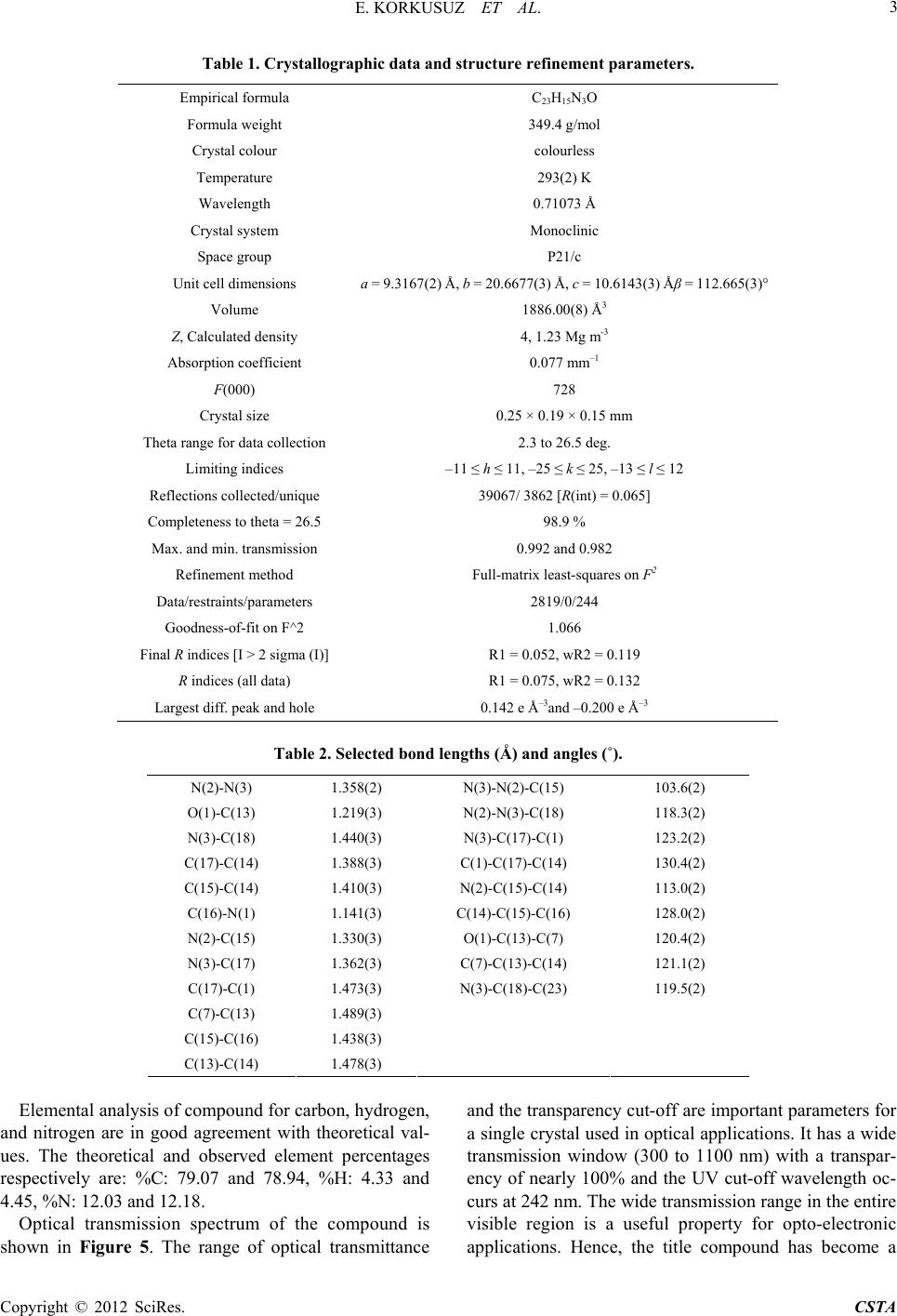 E. KORKUSUZ ET AL. 3 Table 1. Crystallographic data and structure refinement parameters. Empirical formula C23H15N3O Formula weight 349.4 g/mol Crystal colour colourless Temperature 293(2) K Wavelength 0.71073 Å Crystal system Monoclinic Space group P21/c Unit cell dimensions a = 9.3167(2) Å, b = 20.6677(3) Å, c = 10.6143(3) Åβ = 112.665(3)° Volume 1886.00(8) Å3 Z, Calculated density 4, 1.23 Mg m-3 Absorption coefficient 0.077 mm–1 F(000) 728 Crystal size 0.25 × 0.19 × 0.15 mm Theta range for data collection 2.3 to 26.5 deg. Limiting indices –11 ≤ h ≤ 11, –25 ≤ k ≤ 25, –13 ≤ l ≤ 12 Reflections collected/unique 39067/ 3862 [R(int) = 0.065] Completeness to theta = 26.5 98.9 % Max. and min. transmission 0.992 and 0.982 Refinement method Full-matrix least-squares on F2 Data/restraints/parameters 2819/0/244 Goodness-of-fit on F^2 1.066 Final R indices [I > 2 sigma (I)] R1 = 0.052, wR2 = 0.119 R indices (all data) R1 = 0.075, wR2 = 0.132 Largest diff. peak and hole 0.142 e Å–3and –0.200 e Å–3 Table 2. Selected bond lengths (Å) and angles (˚). N(2)-N(3) 1.358(2) N(3)-N(2)-C(15) 103.6(2) O(1)-C(13) 1.219(3) N(2)-N(3)-C(18) 118.3(2) N(3)-C(18) 1.440(3) N(3)-C(17)-C(1) 123.2(2) C(17)-C(14) 1.388(3) C(1)-C(17)-C(14) 130.4(2) C(15)-C(14) 1.410(3) N(2)-C(15)-C(14) 113.0(2) C(16)-N(1) 1.141(3) C(14)-C(15)-C(16) 128.0(2) N(2)-C(15) 1.330(3) O(1)-C(13)-C(7) 120.4(2) N(3)-C(17) 1.362(3) C(7)-C(13)-C(14) 121.1(2) C(17)-C(1) 1.473(3) N(3)-C(18)-C(23) 119.5(2) C(7)-C(13) 1.489(3) C(15)-C(16) 1.438(3) C(13)-C(14) 1.478(3) Elemental analysis of compound for carbon, hydrogen, and nitrogen are in good agreement with theoretical val- ues. The theoretical and observed element percentages respectively are: %C: 79.07 and 78.94, %H: 4.33 and 4.45, %N: 12.03 and 12.18. Optical transmission spectrum of the compound is shown in Figure 5. The range of optical transmittance and the transparency cut-off are important parameters for a single crystal used in optical applications. It has a wide transmission window (300 to 1100 nm) with a transpar- ency of nearly 100% and the UV cut-off wavelength oc- curs at 242 nm. The wide transmission range in the entire visible region is a useful property for opto-electronic applications. Hence, the title compound has become a Copyright © 2012 SciRes. CSTA 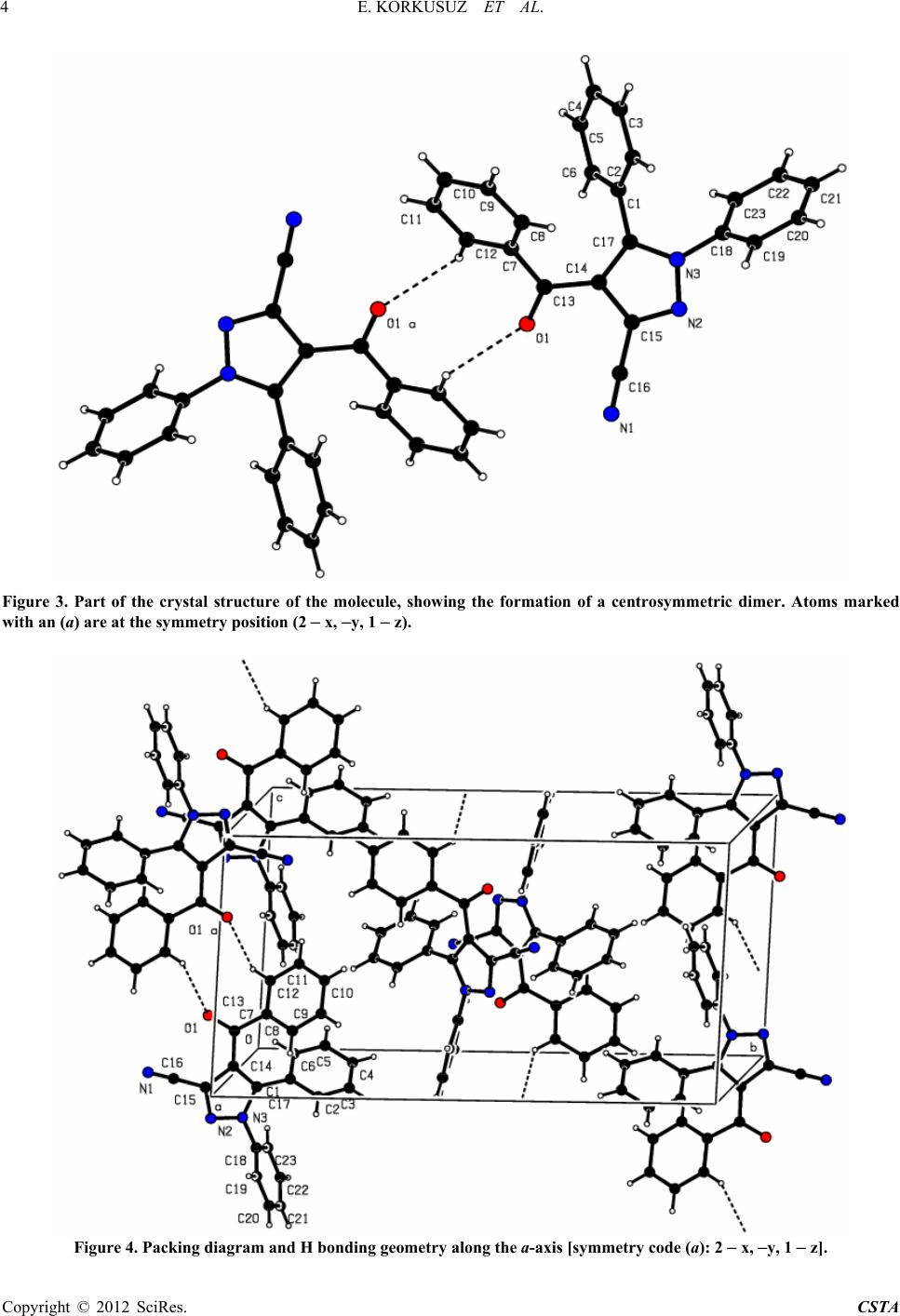 E. KORKUSUZ ET AL. 4 Figure 3. Part of the crystal structure of the molecule, showing the formation of a centrosymmetric dimer. Atoms marked with an (a) are at the symmetry position (2 – x, –y, 1 – z). Figure 4. Packing diagram and H bonding geometry along the a-axis [symmetry code (a): 2 – x, –y, 1 – z]. Copyright © 2012 SciRes. CSTA 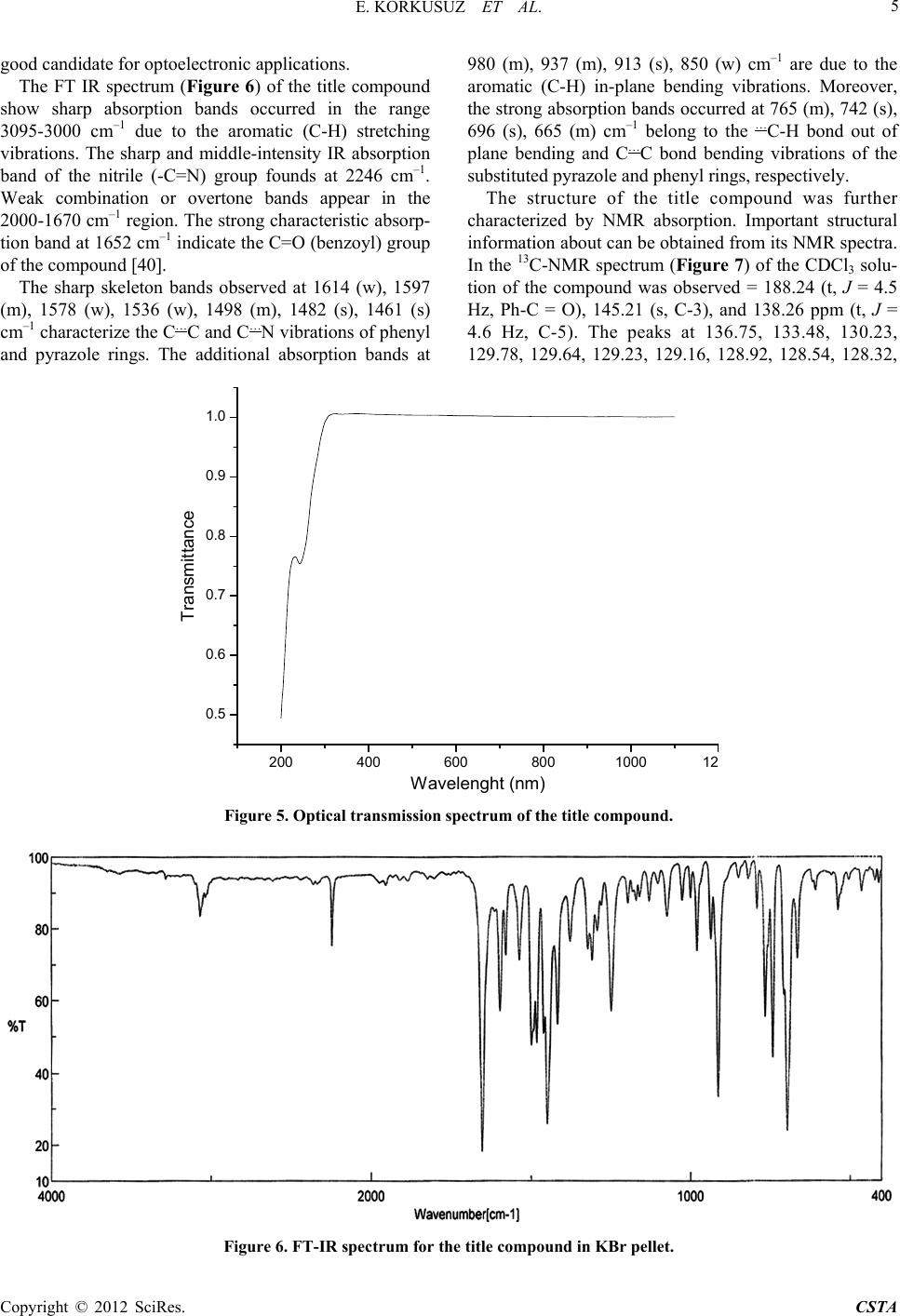 E. KORKUSUZ ET AL. 5 good candidate for optoelectronic applications. ompound The FT IR spectrum (Figure 6) of the title c show sharp absorption bands occurred in the range 3095-3000 cm–1 due to the aromatic (C-H) stretching vibrations. The sharp and middle-intensity IR absorption band of the nitrile (-C=N) group founds at 2246 cm–1. Weak combination or overtone bands appear in the 2000-1670 cm–1 region. The strong characteristic absorp- tion band at 1652 cm–1 indicate the C=O (benzoyl) group of the compound [40]. The sharp skeleton bands observed at 1614 (w), 1597 (m), 1578 (w), 1536 (w), 1498 (m), 1482 (s), 1461 (s) cm–1 characterize the C…C and C…N vibrations of phenyl and pyrazole rings. The additional absorption bands at aromatic (C-H) in-plane bending vibrations. Moreover, the strong absorption bands occurred at 765 (m), 742 (s), 696 (s), 665 (m) cm–1 belong to the … 980 (m), 937 (m), 913 (s), 850 (w) cm–1 are due to the C-H bond out of plane bending and C…C bond bending vibrations of the substituted pyrazole and phenyl rings, respectively. The structure of the title compound was further characterized by NMR absorption. Important structural information about can be obtained from its NMR spectra. In the 13C-NMR spectrum (Figure 7) of the CDCl3 solu- tion of the compound was observed = 188.24 (t, J = 4.5 Hz, Ph-C = O), 145.21 (s, C-3), and 138.26 ppm (t, J = 4.6 Hz, C-5). The peaks at 136.75, 133.48, 130.23, 129.78, 129.64, 129.23, 129.16, 128.92, 128.54, 128.32, 0.9 1.0 2004006008001000 12 0.5 0.6 0.7 0.8 Transmittance Wavelenght ( nm) Figure 5. Optical transmission spectrum of the title compound. Figure 6. FT-IR spectrum for the title compound in KBr pellet. Copyright © 2012 SciRes. CSTA 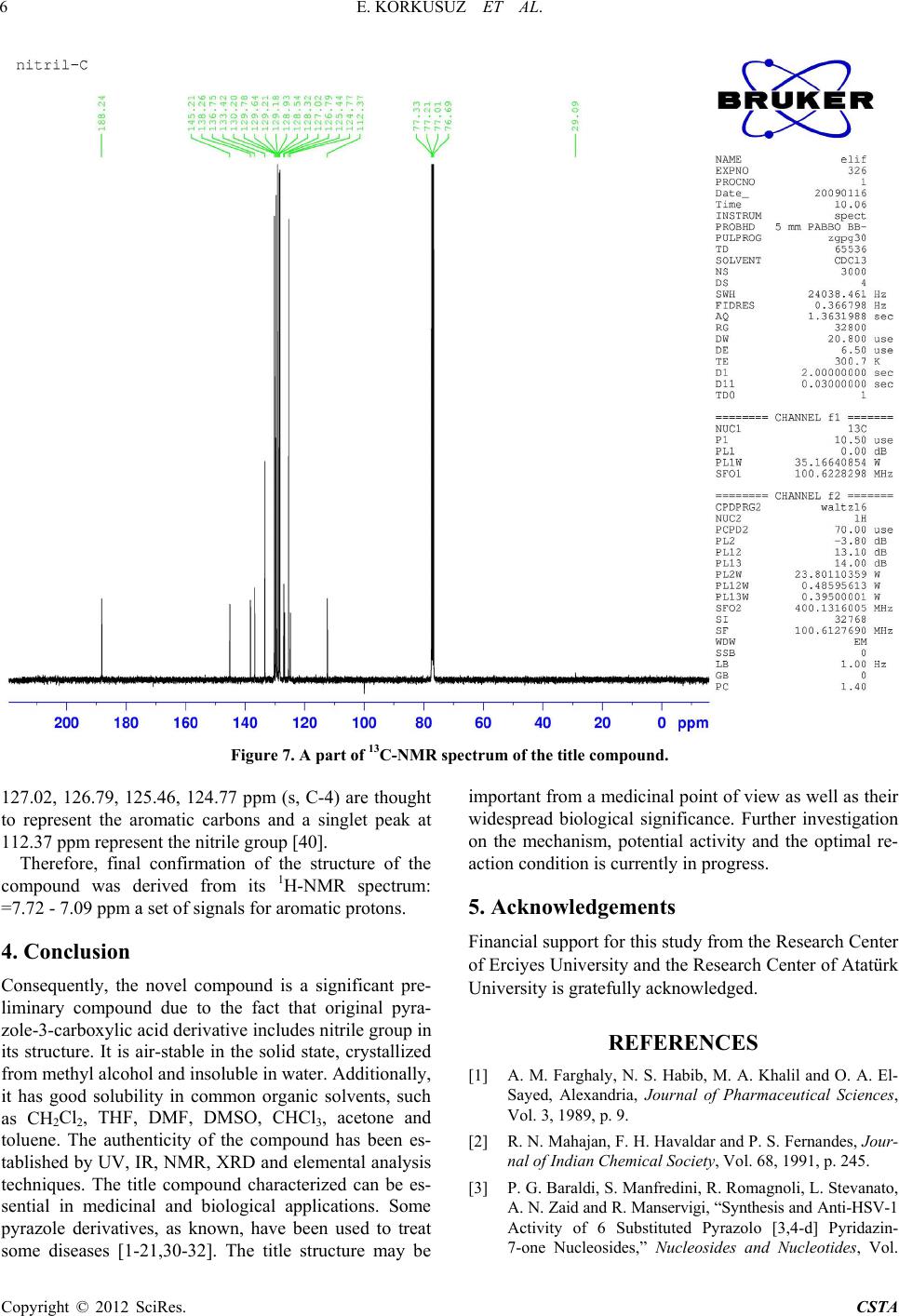 E. KORKUSUZ ET AL. 6 Figure 7. A part of 13C-NMR spectrum of the title compound. 127.02, 126.79, 125.46, 124.77 ppm (s, C-4) are thought cture of the co 4. Conclusion novel compound is a significant pre- important from a medicinal point of view as well as their y from the Research Center Research Center of Atatürk [1] A. M. Farghalhalil and O. A. El- Sayed, Alexanaceutical Sciences, ical Society, Vol. 68, 1991, p. 245. -1 to represent the aromatic carbons and a singlet peak at 112.37 ppm represent the nitrile group [40]. Therefore, final confirmation of the stru mpound was derived from its 1H-NMR spectrum: =7.72 - 7.09 ppm a set of signals for aromatic protons. Consequently, the liminary compound due to the fact that original pyra- zole-3-carboxylic acid derivative includes nitrile group in its structure. It is air-stable in the solid state, crystallized from methyl alcohol and insoluble in water. Additionally, it has good solubility in common organic solvents, such as CH2Cl2, THF, DMF, DMSO, CHCl3, acetone and toluene. The authenticity of the compound has been es- tablished by UV, IR, NMR, XRD and elemental analysis techniques. The title compound characterized can be es- sential in medicinal and biological applications. Some pyrazole derivatives, as known, have been used to treat some diseases [1-21,30-32]. The title structure may be widespread biological significance. Further investigation on the mechanism, potential activity and the optimal re- action condition is currently in progress. 5. Acknowledgements Financial support for this stud of Erciyes University and the University is gratefully acknowledged. REFERENCES y, N. S. Habib, M. A. K dria, Journal of Pharm Vol. 3, 1989, p. 9. [2] R. N. Mahajan, F. H. Havaldar and P. S. Fernandes, Jour- nal of Indian Chem [3] P. G. Baraldi, S. Manfredini, R. Romagnoli, L. Stevanato, A. N. Zaid and R. Manservigi, “Synthesis and Anti-HSV Activity of 6 Substituted Pyrazolo [3,4-d] Pyridazin- 7-one Nucleosides,” Nucleosides and Nucleotides, Vol. Copyright © 2012 SciRes. CSTA 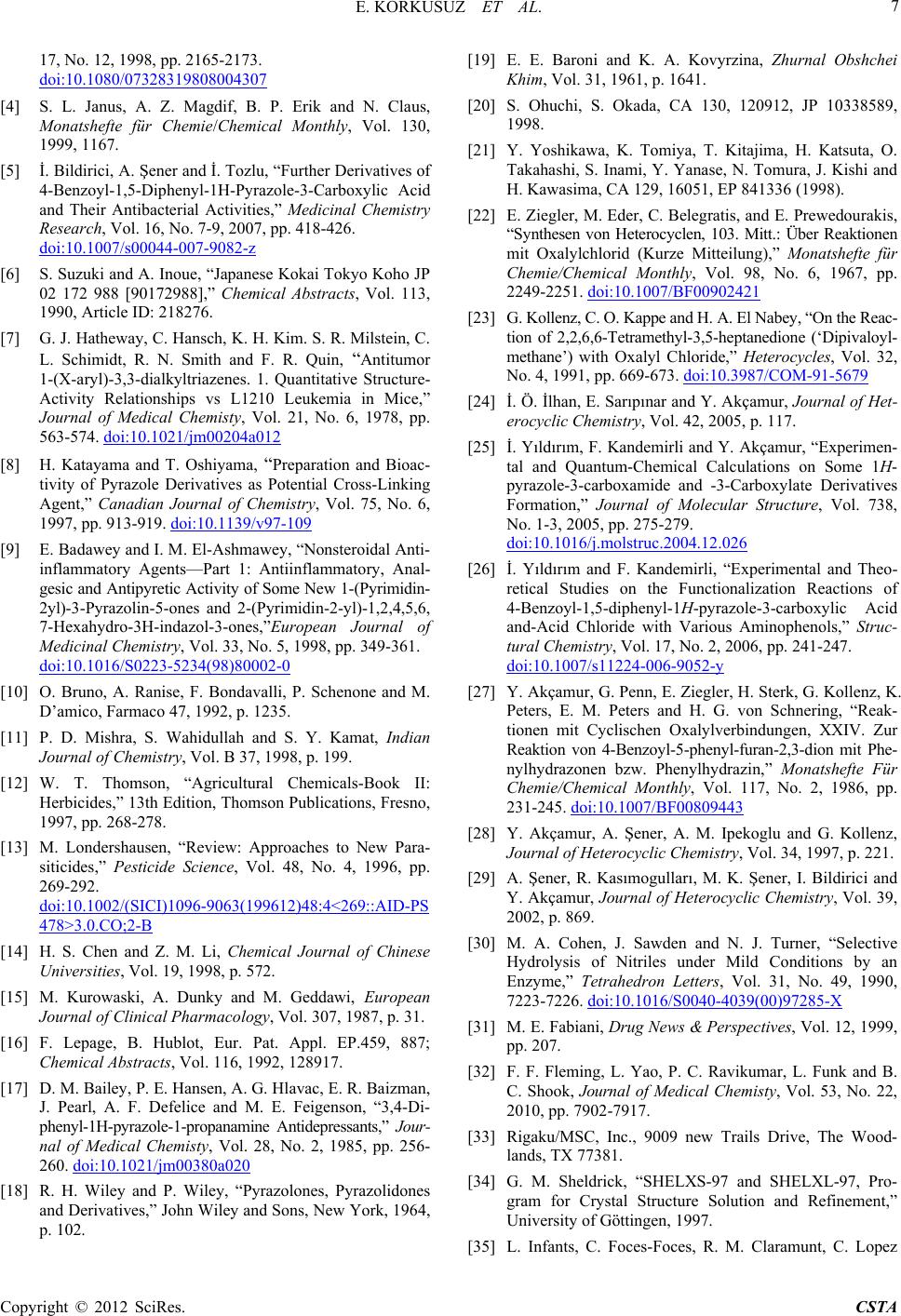 E. KORKUSUZ ET AL. 7 17, No. 12, 1998, pp. 2165-2173. doi:10.1080/07328319808004307 [4] S. L. Janus, A. Z. Magdif, B. P. Erik and N. Claus, Monatshefte für Chemie/Chemica 1999, 1167. l Monthly, Vol. 130, tibacterial Activities,” Medicinal Chemistry [5] İ. Bildirici, A. Şener and İ. Tozlu, “Further Derivatives of 4-Benzoyl-1,5-Diphenyl-1H-Pyrazole-3-Carboxylic Acid and Their An Research, Vol. 16, No. 7-9, 2007, pp. 418-426. doi:10.1007/s00044-007-9082-z [6] S. Suzuki and A. Inoue, “Japanese Kokai Tokyo Koho JP 02 172 988 [90172988],” Chemical Abstracts, V 1990, Article ID: 218276. ol. 113, nes. 1. Quantitative Structure- [7] G. J. Hatheway, C. Hansch, K. H. Kim. S. R. Milstein, C. L. Schimidt, R. N. Smith and F. R. Quin, “Antitumor 1-(X-aryl)-3,3-dialkyltriaze Activity Relationships vs L1210 Leukemia in Mice,” Journal of Medical Chemisty, Vol. 21, No. 6, 1978, pp. 563-574. doi:10.1021/jm00204a012 [8] H. Katayama and T. Oshiyama, “Preparation and Bioac- tivity of Pyrazole Derivatives as Potential Cross-Linking Agent,” Canadian Journal of Chemistry, Vol. 75, No. 6, 1997, pp. 913-919. doi:10.1139/v97-109 [9] E. Badawey and I. M. El-Ashmawey, “Nonsteroidal Anti- inflammatory Agents—Part 1: Antiinflammatory, Anal- gesic and Antipyretic Activity of Some New 1-(Pyrimidin- 2yl)-3-Pyrazolin-5-ones and 2-(Pyrimidin-2-yl)-1,2,4,5,6, 7-Hexahydro-3H-indazol-3-ones,”European Journal of Medicinal Chemistry, Vol. 33, No. 5, 1998, pp. 349-361. doi:10.1016/S0223-5234(98)80002-0 [10] O. Bruno, A. Ranise, F. Bondavalli, P. Schenone and M. D’amico, Farmaco 47, 1992, p. 1235. [11] P. D. Mishra, S. Wahidullah and S. Y. Kamat, Indian Journal of Chemistry, Vol. B 37, 1998, p. 199. W. T. Thomson, “Agricultural C[12] hemicals-Book II: Herbicides,” 13th Edition, Thomson Publications, Fresno, 1997, pp. 268-278. [13] M. Londershausen, “Review: Approaches to New Para- siticides,” Pesticide Science, Vol. 48, No. 4, 1996, pp. 269-292. doi:10.1002/(SICI)1096-9063(199612)48:4<269::AID-PS 478>3.0.CO;2-B [14] H. S. Chen and Z. M. Li, Chemical Journal of Chinese Universities, Vol. 19, 1998, p. 572. [15] M. Kurowaski, A. Dunky and M. Geddawi, European Journal of Clinical Pharmacology, Vol. 307, 1987, p. 31. [16] F. Lepage, B. Hublot, Eur. Pat. Appl. EP.459, 887; Chemical Abstracts, Vol. 116, 1992, 128917. [17] D. M. Bailey, P. E. Hansen, A. G. Hlavac, E. R. Baizman, J. Pearl, A. F. Defelice and M. E. Feigenson, “3,4-Di- phenyl-1H-pyrazole-1-propanamine Antidepressants,” Jour- nal of Medical Chemisty, Vol. 28, No. 2, 1985, pp. 256- 260. doi:10.1021/jm00380a020 [18] R. H. Wiley and P. Wiley, “Pyrazolones, Pyrazolidones and Derivatives,” John Wiley and Sons, New York, 1964, p. 102. [19] E. E. Baroni and K. A. Kovyrzina, Zhurnal Obshchei Khim, Vol. 31, 1961, p. 1641. shi, S. Inami, Y. Yanase, N. Tomura, J. Kishi and tionen [20] S. Ohuchi, S. Okada, CA 130, 120912, JP 10338589, 1998. [21] Y. Yoshikawa, K. Tomiya, T. Kitajima, H. Katsuta, O. Takaha H. Kawasima, CA 129, 16051, EP 841336 (1998). [22] E. Ziegler, M. Eder, C. Belegratis, and E. Prewedourakis, “Synthesen von Heterocyclen, 103. Mitt.: Über Reak mit Oxalylchlorid (Kurze Mitteilung),” Monatshefte für Chemie/Chemical Monthly, Vol. 98, No. 6, 1967, pp. 2249-2251. doi:10.1007/BF00902421 [23] G. Kollenz, C. O. Kappe and H. A. El Nabey, “On the Reac- tion of 2,2,6,6-Tetramethyl-3,5-heptanedione (‘Dipivaloyl- methane’) with Oxalyl Chloride,” Heterocycles, Vol. 32, No. 4, 1991, pp. 669-673. doi:10.3987/COM-91-5679 [24] İ. Ö. İlhan, E. Sarıpınar and Y. Akçamur, Journal of Het- erocyclic Chemistry, Vol. 42, 2005, p. 117. [25] İ. Yıldırım, F. Kandemirli and Y. Akçamur, “Experimen- tal and Quantum-Chemical Calculations on Some 1H- pyrazole-3-carboxamide and -3-Carboxylate Derivatives Formation,” Journal of Molecular Structure, Vol. 738, No. 1-3, 2005, pp. 275-279. doi:10.1016/j.molstruc.2004.12.026 [26] İ. Yıldırım and F. Kandemir retical Studies on the Functionaliz li, “Experimental and Theo- ation Reactions of 4-Benzoyl-1,5-diphenyl-1H-pyrazole-3-carboxylic Acid and-Acid Chloride with Various Aminophenols,” Struc- tural Chemistry, Vol. 17, No. 2, 2006, pp. 241-247. doi:10.1007/s11224-006-9052-y [27] Y. Akçamur, G. Penn, E. Ziegler, H. Sterk, G. Kolle Peters, E. M. Peters and H. G. nz, K. von Schnering, “Reak- tionen mit Cyclischen Oxalylverbindungen, XXIV. Zur Reaktion von 4-Benzoyl-5-phenyl-furan-2,3-dion mit Phe- nylhydrazonen bzw. Phenylhydrazin,” Monatshefte Für Chemie/Chemical Monthly, Vol. 117, No. 2, 1986, pp. 231-245. doi:10.1007/BF00809443 [28] Y. Akçamur, A. Şener, A. M. Ipekoglu and G. Kollenz, Journal of Heterocyclic Chemistry, Vol. 34, 1997, p. 221. Nitriles under Mild Conditions by an [29] A. Şener, R. Kasımogulları, M. K. Şener, I. Bildirici and Y. Akçamur, Journal of Heterocyclic Chemistry, Vol. 39, 2002, p. 869. [30] M. A. Cohen, J. Sawden and N. J. Turner, “Selective Hydrolysis of Enzyme,” Tetrahedron Letters, Vol. 31, No. 49, 1990, 7223-7226. doi:10.1016/S0040-4039(00)97285-X [31] M. E. Fabiani, Drug News & Perspectives, Vol. 12, 1999, pp. 207. [32] F. F. Fleming, L. Yao, P. C. Ravikumar, L. Funk and B. C. Shook, Journal of Medical Chemisty, Vol. 53, No. 22, Structure Solution and Refinement,” 2010, pp. 7902-7917. [33] Rigaku/MSC, Inc., 9009 new Trails Drive, The Wood- lands, TX 77381. [34] G. M. Sheldrick, “SHELXS-97 and SHELXL-97, Pro- gram for Crystal University of Göttingen, 1997. [35] L. Infants, C. Foces-Foces, R. M. Claramunt, C. Lopez Copyright © 2012 SciRes. CSTA 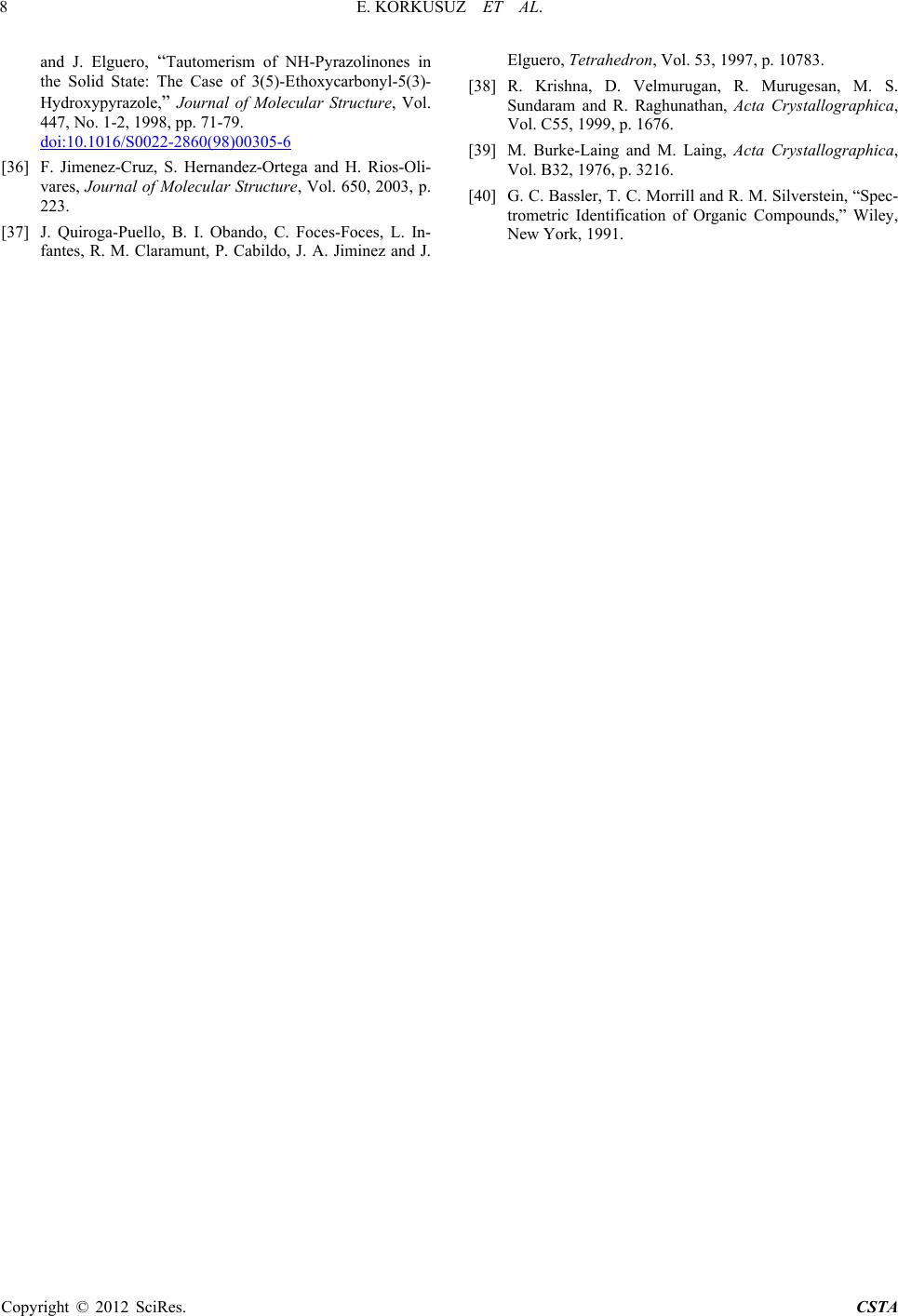 E. KORKUSUZ ET AL. Copyright © 2012 SciRes. CSTA 8 of NH-Pyrazolinones in and J. Elguero, “Tautomerism the Solid State: The Case of 3(5)-Ethoxycarbonyl-5(3)- Hydroxypyrazole,” Journal of Molecular Structure, Vol. 447, No. 1-2, 1998, pp. 71-79. doi:10.1016/S0022-2860(98)00305-6 [36] F. Jimenez-Cruz, S. Hernandez vares, Journal of Molecular Structure, Vol. 650 -Ortega and H. Rios-Oli- , 2003, p. , R. M. Claramunt, P. Cabildo, J. A. Jiminez and J. [39] 223. [37] J. Quiroga-Puello, B. I. Obando, C. Foces-Foces, L. In- fantes Elguero, Tetrahedron, Vol. 53, 1997, p. 10783. [38] R. Krishna, D. Velmurugan, R. Murugesan, M. S. Sundaram and R. Raghunathan, Acta Crystallographica, Vol. C55, 1999, p. 1676. M. Burke-Laing and M. Laing, Acta Crystallographica, Vol. B32, 1976, p. 3216. [40] G. C. Bassler, T. C. Morrill and R. M. Silverstein, “Spec- trometric Identification of Organic Compounds,” Wiley, New York, 1991. |