

Paper Menu >>
Journal Menu >>
 J. Service Science & Management, 2010, 3, 235-240 doi:10.4236/jssm.2010.32028 Published Online June 2010 (http://www.SciRP.org/journal/jssm) Copyright © 2010 SciRes. JSSM The Method of Real Options to Encourage the R & D Team Junfeng Gao1, Lan Jiang2 1School of Management and Economics, University of Electronics Science and Technology of China, Chengdu, China; 2Tian Fu College, Southwestern University of Finance and Economics, Chengdu, China. Email: [email protected] Received February 21st, 2010; revised March 27th, 2010; accepted May 1st, 2010. ABSTRACT In some projects, the R & D appears to be a failure, and according to traditional methods of encouragement motivation, it is hard to get any awards for the R & D team. But there is a valuable option implied in it. This article discusses the method of real options to encourage R & D team when the enterprises can not achieve the desired economic benefit in the case of high-risk project or the immature market. The process of method includes: Identify the real option type of high-risk projects, Design the incentive mechanism and Design specific exercise ways. Keywords: The High-Risk R & D Project, Real Option Incentive, R & D Team 1. Introduction The emphasis of the researchers in the enterprise is to explore or update new products or services, which req- uires high technology and strong innovation and needs inter-disciplinary team work and multi-professionals’ participation. The collaboration of R & D project team requires companies to adopt collective rather than indi- vidual compensation system [1]. But team incentive is more complicated in actual work, especially in high risk R & D project. When enterprises fail to achieve the desired economic benefit in the imm- ature market, it is a big problem to motivate team effec- tively. It is unfair for the R & D team if we deny its con- tribution, because the lessons at least can help us avoid similar risk, and the technology experience accumulated can establish good foundation for the latter project. If there is no reward, no one would do these high-risk pro- jects or they maybe change job with these expensive ex- perience. However, if the reward is paid, what is the cri- terion of incentive and how to evaluate contribution of the project should be considered. And this paper will intro- duce a new incentive method-real option incentive plan. 2. A Brief Overview of Literature A team incentive system sends a message to employees that their team’s output and performance is valued by the organization [2]. If team performance is not rewarded, such performance is not likely to be optimal [3,4]. Ex- isted literatures discuss many incentive ways to R & D from a management perspective, which are: 1) team gains sharing or profit-sharing, 2) team goal-based incen- tive systems. 3) team discretionary bonus systems, 4) team skill incentive systems, 5) team member skill in- centive systems, 6) team member goal incentive systems, and 7) team member merit incentive systems [5]. The typical methods include spiritual incentives such as rec- ognition, confer honor, promotion [6], and material in- centives such as compensation incentive [7], stock incen- tive [8], stock option [9] and so on. However, because these incentives are based on different performance indi- cators, such as financial indicator, internal operating tar- get and customer indicator [10], so can not solve the in- centive problem of high-risk R & D project. As an expansion of financial option theory in real (non-financial) assets option, real option change inves- tors’ view to risk and make them pay more attention to the value of opportunities [11]. In recent years, scholars have put forth real option incentive approaches for the executives [12] and R & D personnel [13]. The former is to balance business investment and strategic investment, focus on guiding operators to develop the future strategic growth opportunities; the latter is based on the com- pounded options and relatively effective for the multi- stage technology projects or successful projects. But both do not come down to the incentive problems of high-risk R & D projects. There is little literature to discuss real The paper is supported by National Natural Science Foundation o f China ( P r o j ect No. 70772069 ) . 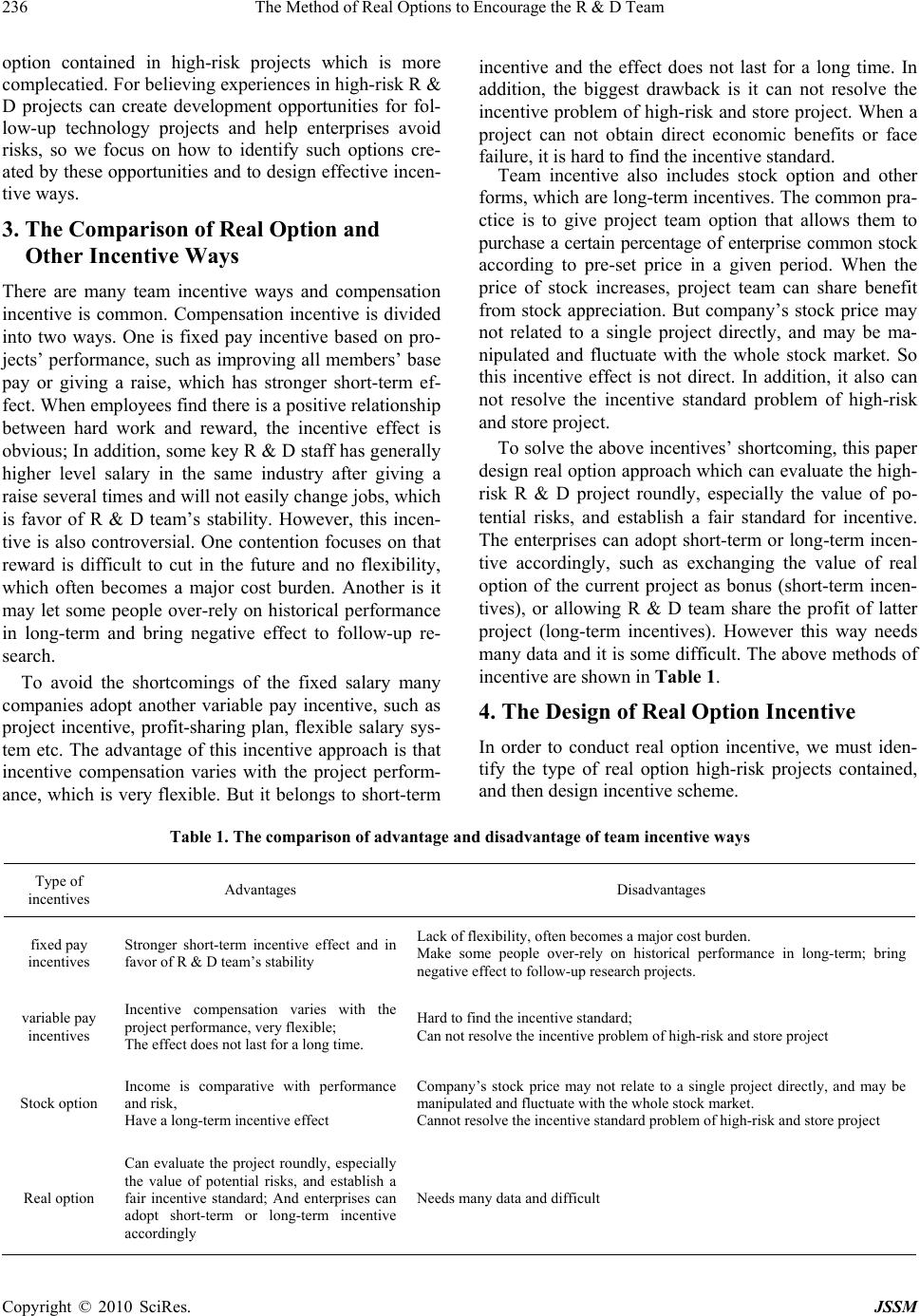 The Method of Real Options to Encourage the R & D Team 236 option contained in high-risk projects which is more complecatied. For believing experiences in high-risk R & D projects can create development opportunities for fol- low-up technology projects and help enterprises avoid risks, so we focus on how to identify such options cre- ated by these opportunities and to design effective incen- tive ways. 3. The Comparison of Real Option and Other Incentive Ways There are many team incentive ways and compensation incentive is common. Compensation incentive is divided into two ways. One is fixed pay incentive based on pro- jects’ performance, such as improving all members’ base pay or giving a raise, which has stronger short-term ef- fect. When employees find there is a positive relationship between hard work and reward, the incentive effect is obvious; In addition, some key R & D staff has generally higher level salary in the same industry after giving a raise several times and will not easily change jobs, which is favor of R & D team’s stability. However, this incen- tive is also controversial. One contention focuses on that reward is difficult to cut in the future and no flexibility, which often becomes a major cost burden. Another is it may let some people over-rely on historical performance in long-term and bring negative effect to follow-up re- search. To avoid the shortcomings of the fixed salary many companies adopt another variable pay incentive, such as project incentive, profit-sharing plan, flexible salary sys- tem etc. The advantage of this incentive approach is that incentive compensation varies with the project perform- ance, which is very flexible. But it belongs to short-term incentive and the effect does not last for a long time. In addition, the biggest drawback is it can not resolve the incentive problem of high-risk and store project. When a project can not obtain direct economic benefits or face failure, it is hard to find the incentive standard. Team incentive also includes stock option and other forms, which are long-term incentives. The common pra- ctice is to give project team option that allows them to purchase a certain percentage of enterprise common stock according to pre-set price in a given period. When the price of stock increases, project team can share benefit from stock appreciation. But company’s stock price may not related to a single project directly, and may be ma- nipulated and fluctuate with the whole stock market. So this incentive effect is not direct. In addition, it also can not resolve the incentive standard problem of high-risk and store project. To solve the above incentives’ shortcoming, this paper design real option approach which can evaluate the high- risk R & D project roundly, especially the value of po- tential risks, and establish a fair standard for incentive. The enterprises can adopt short-term or long-term incen- tive accordingly, such as exchanging the value of real option of the current project as bonus (short-term incen- tives), or allowing R & D team share the profit of latter project (long-term incentives). However this way needs many data and it is some difficult. The above methods of incentive are shown in Table 1. 4. The Design of Real Option Incentive In order to conduct real option incentive, we must iden- tify the type of real option high-risk projects contained, and then design incentive scheme. Table 1. The comparison of advantage and disadvantage of team incentive ways Type of incentives Advantages Disadvantages fixed pay incentives Stronger short-term incentive effect and in favor of R & D team’s stability Lack of flexibility, often becomes a major cost burden. Make some people over-rely on historical performance in long-term; bring negative effect to follow-up research projects. variable pay incentives Incentive compensation varies with the project performance, very flexible; The effect does not last for a long time. Hard to find the incentive standard; Can not resolve the incentive problem of high-risk and store project Stock option Income is comparative with performance and risk, Have a long-term incentive effect Company’s stock price may not relate to a single project directly, and may be manipulated and fluctuate with the whole stock market. Cannot resolve the incentive standard problem of high-risk and store project Real option Can evaluate the project roundly, especially the value of potential risks, and establish a fair incentive standard; And enterprises can adopt short-term or long-term incentive accordingly Needs many data and difficult Copyright © 2010 SciRes. JSSM 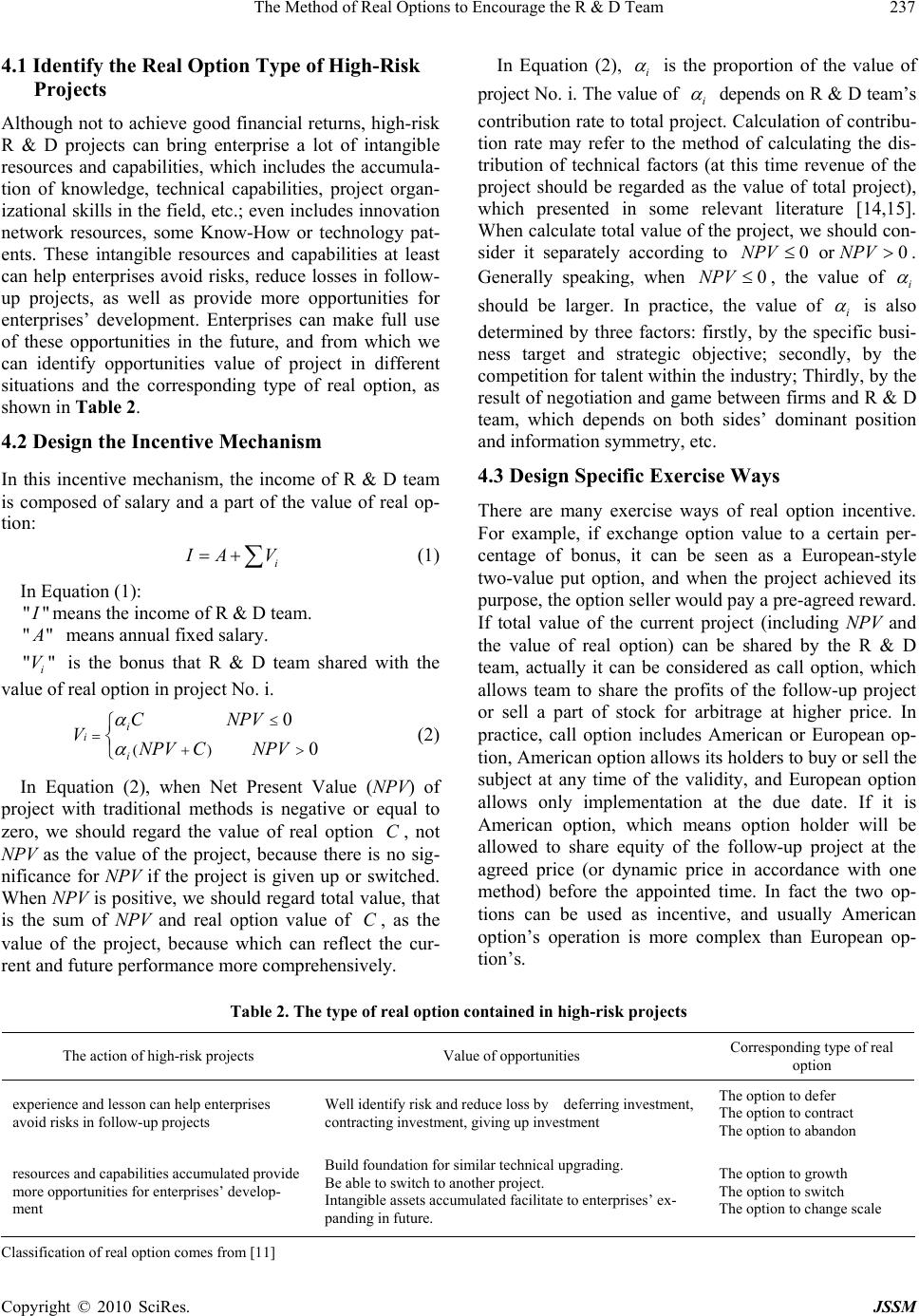 The Method of Real Options to Encourage the R & D Team237 4.1 Identify the Real Option Type of High-Risk Projects Although not to achieve good financial returns, high-risk R & D projects can bring enterprise a lot of intangible resources and capabilities, which includes the accumula- tion of knowledge, technical capabilities, project organ- izational skills in the field, etc.; even includes innovation network resources, some Know-How or technology pat- ents. These intangible resources and capabilities at least can help enterprises avoid risks, reduce losses in follow- up projects, as well as provide more opportunities for enterprises’ development. Enterprises can make full use of these opportunities in the future, and from which we can identify opportunities value of project in different situations and the corresponding type of real option, as shown in Table 2. 4.2 Design the Incentive Mechanism In this incentive mechanism, the income of R & D team is composed of salary and a part of the value of real op- tion: i I AV (1) In Equation (1): "" I means the income of R & D team. "" A means annual fixed salary. "" i V is the bonus that R & D team shared with the value of real option in project No. i. () 0 0 i i i CNPV VNPV CNPV (2) In Equation (2), when Net Present Value (NPV) of project with traditional methods is negative or equal to zero, we should regard the value of real option , not NPV as the value of the project, because there is no sig- nificance for NPV if the project is given up or switched. When NPV is positive, we should regard total value, that is the sum of NPV and real option value of , as the value of the project, because which can reflect the cur- rent and future performance more comprehensively. C C In Equation (2), i is the proportion of the value of project No. i. The value of i depends on R & D team’s contribution rate to total project. Calculation of contribu- tion rate may refer to the method of calculating the dis- tribution of technical factors (at this time revenue of the project should be regarded as the value of total project), which presented in some relevant literature [14,15]. When calculate total value of the project, we should con- sider it separately according to . Generally speaking, when , the value of 0or 0NPV NPV 0i NPV should be larger. In practice, the value of i is also determined by three factors: firstly, by the specific busi- ness target and strategic objective; secondly, by the competition for talent within the industry; Thirdly, by the result of negotiation and game between firms and R & D team, which depends on both sides’ dominant position and information symmetry, etc. 4.3 Design Specific Exercise Ways There are many exercise ways of real option incentive. For example, if exchange option value to a certain per- centage of bonus, it can be seen as a European-style two-value put option, and when the project achieved its purpose, the option seller would pay a pre-agreed reward. If total value of the current project (including NPV and the value of real option) can be shared by the R & D team, actually it can be considered as call option, which allows team to share the profits of the follow-up project or sell a part of stock for arbitrage at higher price. In practice, call option includes American or European op- tion, American option allows its holders to buy or sell the subject at any time of the validity, and European option allows only implementation at the due date. If it is American option, which means option holder will be allowed to share equity of the follow-up project at the agreed price (or dynamic price in accordance with one method) before the appointed time. In fact the two op- tions can be used as incentive, and usually American option’s operation is more complex than European op- tion’s. Table 2. The type of real option contained in high-risk projects The action of high-risk projects Value of opportunities Corresponding type of real option experience and lesson can help enterprises avoid risks in follow-up projects Well identify risk and reduce loss by deferring investment, contracting investment, giving up investment The option to defer The option to contract The option to abandon resources and capabilities accumulated provide more opportunities for enterprises’ develop- ment Build foundation for similar technical upgrading. Be able to switch to another project. Intangible assets accumulated facilitate to enterprises’ ex- panding in future. The option to growth The option to switch The option to change scale Classification of real option comes from [11] Copyright © 2010 SciRes. JSSM 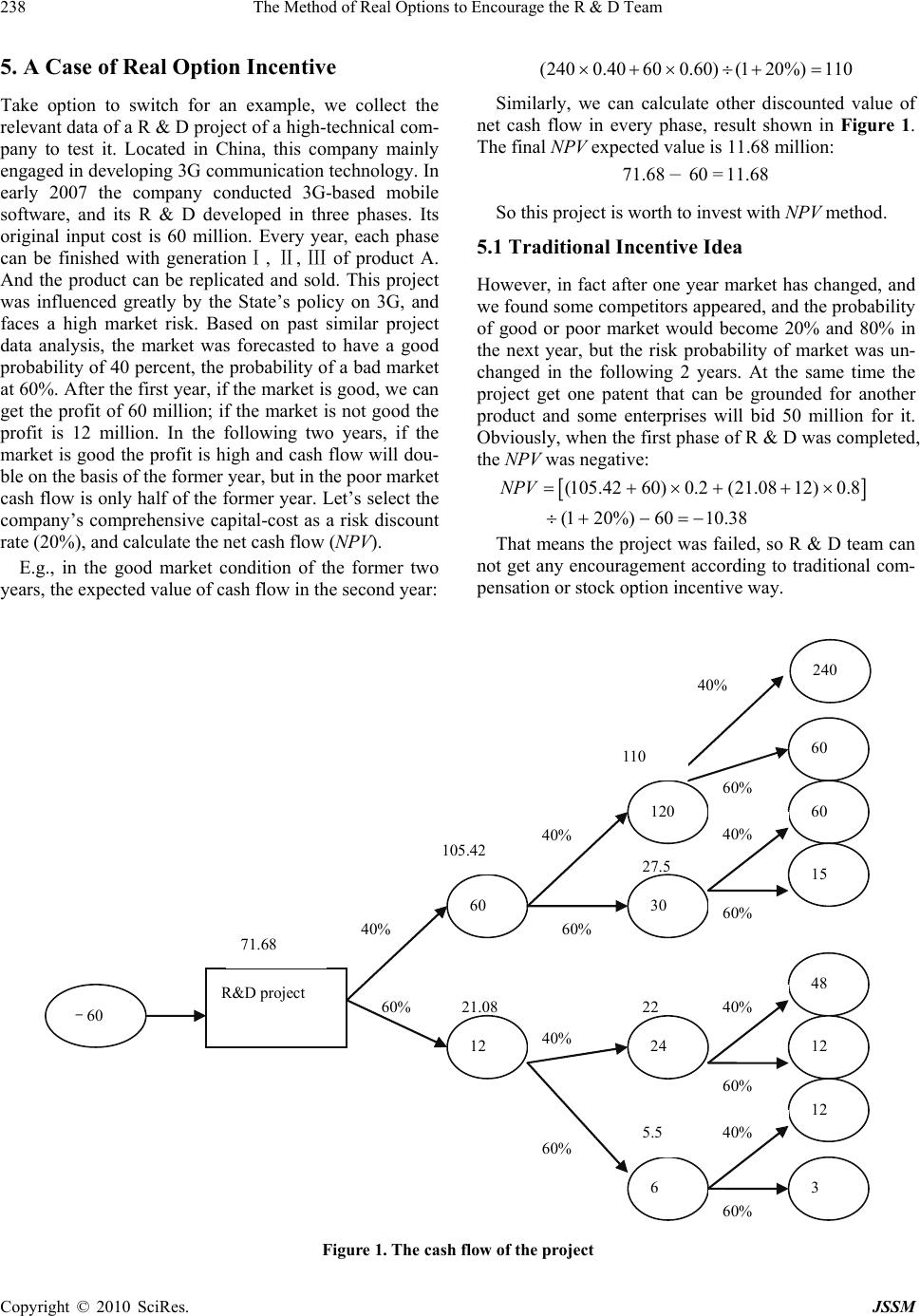 The Method of Real Options to Encourage the R & D Team 238 5. A Case of Real Option Incentive Take option to switch for an example, we collect the relevant data of a R & D project of a high-technical com- pany to test it. Located in China, this company mainly engaged in developing 3G communication technology. In early 2007 the company conducted 3G-based mobile software, and its R & D developed in three phases. Its original input cost is 60 million. Every year, each phase can be finished with generation, , of product A.ⅠⅡⅢ And the product can be replicated and sold. This project was influenced greatly by the State’s policy on 3G, and faces a high market risk. Based on past similar project data analysis, the market was forecasted to have a good probability of 40 percent, the probability of a bad market at 60%. After the first year, if the market is good, we can get the profit of 60 million; if the market is not good the profit is 12 million. In the following two years, if the market is good the profit is high and cash flow will dou- ble on the basis of the former year, but in the poor market cash flow is only half of the former year. Let’s select the company’s comprehensive capital-cost as a risk discount rate (20%), and calculate the net cash flow (NPV). E.g., in the good market condition of the former two years, the expected value of cash flow in the second year: (240 0.4060 0.60)(120%) 110 Similarly, we can calculate other discounted value of net cash flow in every phase, result shown in Figure 1. The final NPV expected value is 11.68 million: 71.6860= 11.68- So this project is worth to invest with NPV method. 5.1 Traditional Incentive Idea However, in fact after one year market has changed, and we found some competitors appeared, and the probability of good or poor market would become 20% and 80% in the next year, but the risk probability of market was un- changed in the following 2 years. At the same time the project get one patent that can be grounded for another product and some enterprises will bid 50 million for it. Obviously, when the first phase of R & D was completed, the NPV was negative: (105.4260) 0.2(21.0812)0.8 (120%)6010.38 NPV That means the project was failed, so R & D team can not get any encouragement according to traditional com- pensation or stock option incentive way. 21.08 22 27.5 60% R&D project -60 60 12 40% 60% 120 30 40% 60% 24 6 40% 60% 240 60 40% 60% 60 15 40% 60% 48 12 40% 60% 12 3 40% 110 105.42 5.5 71.68 Figure 1. The cash flow of the project Copyright © 2010 SciRes. JSSM  The Method of Real Options to Encourage the R & D Team239 5.2 Real Option Incentive Program Now if we consider real option, the evaluation to the project is entirely different. When R & D in the first phase was completed, cash flow was only 33.08 million in the poor market (that is, cash flow expected value after one year in poor market: ), if we switched to another product at this time, the value of the previous R & D was 50 million. Obviously, such a con- version opportunity is valuable. Actually it is option to switch: the agreed price is 50 million, maturity period is 1 year, the current price of the subject is 49.62 million (hat is, expected value of current cash flow, [( 21.08+12=33.08 105.42 60) ), maybe rise to 165.42 million (that is, expected value of cash flow after one year in good market: 105 ) or drop to 33.08 million due to date (that is, expected value of cash flow after one year in poor market: ). We can use 0.221.08 120.8] () 21.08+12=33.08 (1 20%)49.62 .42 + 60 =165.42 binomial tree model [16] and set up the probability of price raise is “P”. With the hypothesis of symmetric information and risk-neutral, we can get the value of this real option at risk-free inter- est rate of 3.87%, which is bank interest rate for one-year. 0.0387 165.4233.08(1) 49.62PPe 0.1398P That is to say, the probability of the call option is 13.98% of which value is 55.8 million (165.42 50 ). And the probability equals 1 - P when the value of the call option is zero, that is 86.02%. 115.42 Expected cash flow of the option to switch is: 115.42 13.98%086.02%16.13 Discount at the risk rate of 20%, get current value of option to switch: 16.13 / (120%)13.44 Therefore, project team will be able to share a part of this value as an incentive with real option incentive ap- proach when finished the first phase. The firm can de- termine the proportion αi as 10% based on strategic ob- jective and current industry competition. So, R & D team may get 1.344 million as a reward. It is reasonable for the both because this project can build foundation for an- other product’s R & D and contribute to the company’s development. Considering that being start-up period and need more liquidity for more follow-up R & D projects, the company decided not to use bonus but share the value of latter project in the future. 5.3 Comparative Analysis about Advantage of Real Option The high-risk project is common for any firm. Real op- tion incentive put forwarded in this paper is one of ways to solve how to encourage R & D team in such project, which advantages include: 1) to avoid short-term goal- oriented, companies can determine benchmarks of team incentive based on the follow-up value of high-risk pro- ject; 2) To design more flexible incentive methods, companies can use different types of real option or de- sign different exercise methods; 3) If we combine real option incentive with other motivation methods, the ef- fect will be more targeted-oriented and more comprehen- sive. 6. Conclusions This article discusses the method of real options to en- courage R & D team when the enterprises can not achieve the desired economic benefit in the case of high-risk project or the immature market. The steps of method include: identify the real option type of high-risk projects, design the incentive mechanism and design specific exercise ways. In fact, real option presented in this paper can be applied not only to high-risk project, but also to other technical project. In addition, some non-material incentives, such as honor or job promotion, will bring more opportunities for R & D team, which itself can be regarded as one of real options. How to quantify the value of these non-material incentives ap- proach and combine with other materials will be our next research direction and focus. REFERENCES [1] F. Hu, “Incentive Compensation Study on R & D Team,” South China Normal University, Guangzhou, 2004. [2] T. J. Englander, “Casey at the Bank,” Incentive, Vol. 167, No. 2, 1993, p. 20. [3] R. J. Doyle, “Caution: Self-Directed Work Teams,” Hu- man Resource Magazine, Vol. 37, No. 6, 1992, pp. 153-155. [4] B. Geber, “The Bugaboo of Team Pay,” Training, Vol. 32, No. 8, 1995, pp. 25-34. [5] J. R. Hoffman and S. G. Rogelberg, “A Guide to Team Incentive Systems,” Team Performance Management, Vol. 4, No. 1, 1998, pp. 23-32. [6] S. Y. Chen, X. W. Tang, D. B. Ni et al., “Value Analysis on Non Material Incentive in Combination Incentive to Managers,” Chinese Journal of Management Science, Vol. 13, No. 1, 2005, pp.122-126. [7] W. J. Zhang and J. F. Li, “Motivation System in Chinese Knowledge-Enterprises,” Science Research Management, V ol. 22, No. 6, 2001, pp. 90-96. [8] X. Li and G. S. Zhang, “The Effect of Stock Option In- centive for Manager from the Team Theory,” Business Ti m e s , Beijing, 2007. [9] L. Yin, Z. Y. Zhao et al., “The Theory and Practice of Stock and Option Incentive for High-tech Enterprise,” Copyright © 2010 SciRes. JSSM  The Method of Real Options to Encourage the R & D Team 240 Science Press, Beijing, 2004. [10] X. W. Yuna, Z. Qin and J. B. Yi, “Interplay Mechanism of Learning and Performance in Organizations,” Science Research Management, Vol. 27, No. 6, 2006, pp. 80-85. [11] S. F. Bi, D. S. Li and X. Ma, “The Application of Com- pound Option Method to the Project Evaluation,” Science Research Management, Vol. 29, No. 3, 2008, pp. 109-113. [12] C. Wu and H. H. Hu, “Research on the Long Term Incen- tive Mechanism under Executive’s Management of Com- bined Investment,” Chinese Journal of Management Sci- ence, Vol. 15, No. 6, 2007, pp. 125-131. [13] Z. G. Zhang, “Study on R & D Staff Incentive Payment Based on Compound option Model,” Science of Science and Management of S. & T., Vol. 28, No. 8, 2007, pp. 179-183. [14] H. L. Ding, “The Path Research of Benefit Apportion- ment for Technology Elements,” Journal of Nanjing Party Institute of CPC and Nanjing Administration Institute, V ol. 5, 2004, pp. 26-29. [15] F. L. Chen and Z. G. Hu, “Research on Quantitative Ap- portionment Involving Technological Factors for Tech- nology-oriented Enterprises,” Science Research Man- agement, Vol. 29, No. 2, 2008, pp. 89-96. [16] C. P. Yang, “Real Option and its Application,” Fudan University Press, Shanghai, 2003. Copyright © 2010 SciRes. JSSM |