

Paper Menu >>
Journal Menu >>
 International Journal of Modern Nonlinear Theory and Application, 2012, 1, 40-46 doi:10.4236/ijmnta.2012.12005 Published Online June 2012 (http://www.SciRP.org/journal/ijmnta) Effect of Geometry of Filler Particles on the Effective Thermal Conductivity of Two-Phase Systems Deepti Chauhan*, Nilima Singhvi, Ramvir Singh Department of Physics, Heat Transfer Laboratory, University of Rajasthan, Jaipur, India Email: *[email protected] Received March 24, 2012; revised April 22, 2012; accepted April 30, 2012 ABSTRACT The present paper deals with the effect of geometry of filler particles on the effective thermal conductivity for polymer composites. In the earlier models, less emphasis has been given on the shape of filler particles. In this paper, expres- sions for effective thermal conductivity has been derived using the law of minimal thermal resistance and equal law of the specific equivalent thermal conductivity for three different shapes i.e. spherical, elliptical and hexagonal of filler particles respectively. Calculated values of effective thermal conductivity for various samples using the derived expres- sions then compared with experimental data available and other models developed in the literature. The results calcu- lated are in good agreement with the earlier experimental data and the deviation, is least in our expressions showing the success of the model. Keywords: Effective Thermal Conductivity; Polymer Composites; Minimal Thermal Resistance; Shape of Filler 1. Introduction Particle filled polymer composites have become impor- tant because of their wide applications in science and engineering for technological developments. Incorporat- ing inorganic fillers into a matrix enhances various physi- cal properties of the materials such as mechanical strength, elastic modulus and heat transfer coefficient [1,2]. In gen- eral, the mechanical properties of particulate filled poly- mer composites depend strongly on size, shape and dis- tribution of filler particles in the polymer matrix [3]. Composite materials have primarily been used for stru- ctural applications. Polymer composite materials have been found extremely useful for heat dissipation applica- tions like in electronic packaging, in computer chips [1, 2]. Polymer composites filled with metal particles are of interest for many fields of engineering. The interest in these composite materials arises from the fact that the thermal characterization of such composites are close to the properties of metals, whereas the mechanical proper- ties and the processing methods are typical for plastics [3, 4]. Adding fillers to plastics, changes the behaviour of polymers and a significant increase in the effective ther- mal conductivity of the system has been observed [5,6]. Therefore, it is very important to understand the heat transfer mechanism in polymer composites. Maxwell [7] calculated the effective thermal conductivity of a random distribution of spheres in a continuous medium, which worked well for low filler concentrations. Bruggeman [8] derived another model for the effective thermal conduc- tivity, under different assumptions for permeability and field strength. Hamilton and Crosser [9] extended Max- well’s model to include the empirical factor n to account for the shape of the particles (n = 3 for spheres and n = 6 for the cylinders). Liang and Liu [10] gave a theoretical model for evaluating the effective thermal conductivity of inorganic particulate polymer composites. Liang and Lia [11] measured the effective thermal conductivity (eff K ) of hollow glass-bead (HGB) filled polypropylene composites by means of a thermal conductivity instru- ment to identify the effect of the content and size of the HGBs on the effective thermal conductivity (eff K ). Tekce et al. [12] studied the thermal conductivity of copper filled polyamide composites using the Hot-Disk method in the range of filler content 0% - 30% by volume for short fibers and 50% - 60% by volume for particle shape of plates and spheres. Nielson [13], Cheng and Vachon [14] and Agari et al. [15] proposed various theoretical models for describing the heat transfer mechanism in polymer composites. Liang and Lia [16] studied the heat transfer mechanism in inorganic hollow micro-spheres filled polymer composites and proposed a heat transfer model. In the present paper, expressions for effective thermal conductivity (eff K ) of various inorganic particles filled polymer composites has been developed for different shapes of filler particles as spherical, elliptical and hex- *Corresponding author. Copyright © 2012 SciRes. IJMNTA  D. CHAUHAN ET AL. 41 agonal using the law of minimal thermal resistance and equal law of the specific equivalent thermal conductivity. The calculations were done for samples and compared with the experimental results available in the literature. 2. Theory There are several mathematical models for predicting the effective thermal conductivity of particle filled polymer composites like Maxwell model, Russell model, Hamil- ton and Crosser model and others [7-17]. Some of them are as under: Maxwell model 22 2 fm fm eff m fm fm K KKK KK KK KK (1) Russell model 22 33 22 33 1 1 m ff f eff m m ff f f K K KK K K (2) Hamilton and Crosser model 11 1 fm fm eff m fmfm KnKn KK K K KnKKK (3) Here m K and f K are the conductivity coefficients of the polymer matrix and the filler particles, and n is an empirical factor to account for the shape of the filler par- ticles, (n = 3) for spheres and (n = 6) for cylinders. These models are basically developed for dilute dispersion. Liang and Liu [10] established a theoretical model of inorganic particulate-filled polymer composites. This mo- del is based on the specific equivalent thermal resistance of the element of composites, when only heat conduction is considered. Therefore, the calculation of the equivalent thermal conductivity for composites can be attributed to the determination of the equivalent thermal conductivity of the unit cell with the same specific equivalent thermal resistance. In this paper, we start with the assumption that an over- all composite consists of a number of small squared unit cells having sides H and each cell contains only one filler particle which can be of different shapes as spherical, elliptical and hexagonal, kept at the center of the unit cell. We also assumed that the heat flow into the element is from the top of the square. A series model of heat con- duction through the unit cell in an inorganic particulate filled polymer composite is shown in Figure 1. To study the effect of various shapes of filler particles on the effective thermal conductivity (eff K ) of the sys- (a) (b) (c) Figure 1. Heat transfer series model for different shapes of filler particles. tem, we assumed that the filler particle is located at the center of the unit cell. The cell is then divided into three parts as shown in Figure 1. The mean thermal conduc- tivity of the matrix and the filler are p K and f K re- spectively. The quantity of heat flowing through a body depends upon the heat transfer route in the materials. The equivalent thermal resistance of these three parts for dif- ferent shapes is given as: For spherical shape 13 p h RR K A (4) and 2 2 4 p pff r R K VKV (5) Here 2 21.33π p VHr r3 r (6) and (7) 3 1.33π f V For elliptical shape Copyright © 2012 SciRes. IJMNTA  D. CHAUHAN ET AL. Copyright © 2012 SciRes. IJMNTA 42 Here 1 13 p h RR K A (8) 2 22.433 p VHr r 3 (14) a nd 2 2 p pff r R K VKV (9) a nd 3 2.43 3 f Vr (15) Here A is the total cross-sectional area of the unit cell, p V and f V are the volume of polymer matrix and filler particles, and r is a variable parameter defined in Figures 1(a)-(c) respectively. Here 2 2.828 0.166π p VHr 3 r r (10) The total equivalent thermal resistance is then given by a nd (11) 3 0.166π f V For hexagonal shape 12 RRR R 3 (16) 2 13 p h RR K A (12) Solving Equations (4)-(15) and keeping the volume of the unit cell for different shapes same as that of the spherical shape, the expressions for effective thermal con- ductivity are obtained for spherical, elliptical and hex- agonal shapes as under: a nd 2 2 4 p pff r R K VKV (13) For spherical shape of filler particles, the equation is 1 3 11 33 1 6 11 2 π2 4ππ 39π eff f pp f p fp f K KK K KK (17) For elliptical shape of filler particles, the equation is 1 3 11 33 1 6 11 2 π2 ππ 69π 2 eff f pp pf f p f K KK K K K (18) and for hexagonal shape of filler particles, the equation is 1 3 1 3 1 3 1 11.23 2 1.62 1.29 eff fp pp f fp f K K KK K K (19) Here f is the volume fraction of filler in the resin matrix. 3. Results and Discussion In this paper, we have obtained semi empirical relations for effective thermal conductivities given by Equations (17)-(19). These equations have been derived taking into account the different shapes of filler particles as spherical, elliptical and hexagonal. And then the calculations were done considering these shapes. The calculated values are then compared with the experimental data available in the literature for phenol-aldehyde/graphite, phenol-alde- hyde/aluminum oxide, polypropylene/aluminum and poly- propylene/copper composites with volume fraction rang- ing from 0 - 0.5. Figures 2-5 show the comparison be- tween the predictions by Equations (1)-(3) and the ex- perimental data of the effective thermal conductivity of the phenol-aldehyde/graphite, phenol-aldehyde/aluminum oxide, polypropylene/aluminum and polypropylene/cop- per composites. The values of the thermal conductivities of the samples used are given in Table 1. The graphs represented in Figures 2-5 show that value of eff K calculated by the Equations (17)-(19) were closer to the experimental data then calculated with other models given by Equations (1)-(3). Most of the models fail to predict the effective thermal conductivity over the ntire range of filler concentration. It is seen that Maxwell e  D. CHAUHAN ET AL. 43 Figure 2. Variation of effective thermal conductivity and filler volume fraction of phenol-aldehyde/graphite composites for different shapes. Figure 3. Variation of effective thermal conductivity and filler volume fraction of phenolaldehyde/aluminum oxide compos- ites for different shapes. Copyright © 2012 SciRes. IJMNTA 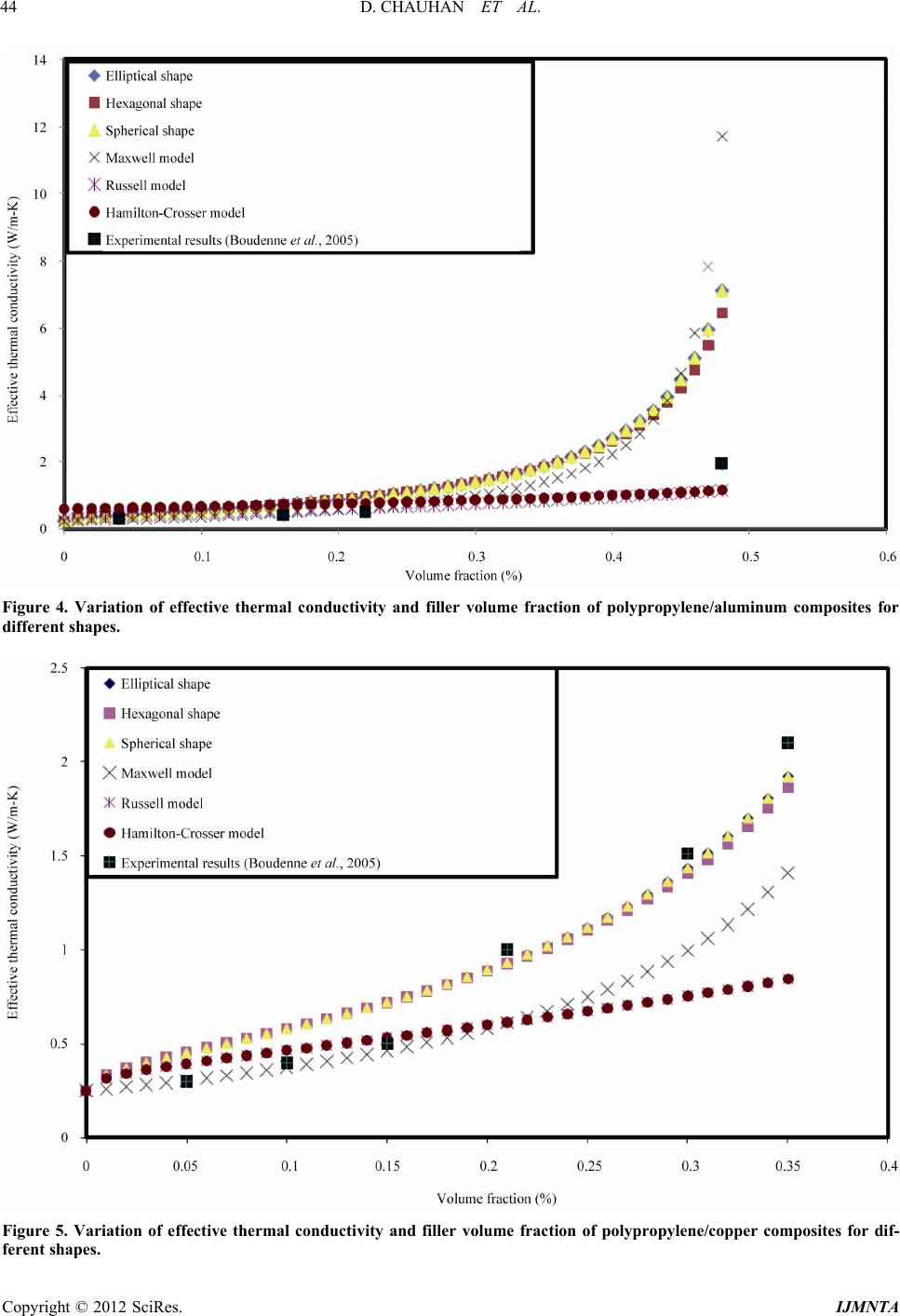 D. CHAUHAN ET AL. 44 Figure 4. Variation of effective thermal conductivity and filler volume fraction of polypropylene/aluminum composites for different shapes. Figure 5. Variation of effective thermal conductivity and filler volume fraction of polypropylene/copper composites for dif- ferent shapes. Copyright © 2012 SciRes. IJMNTA 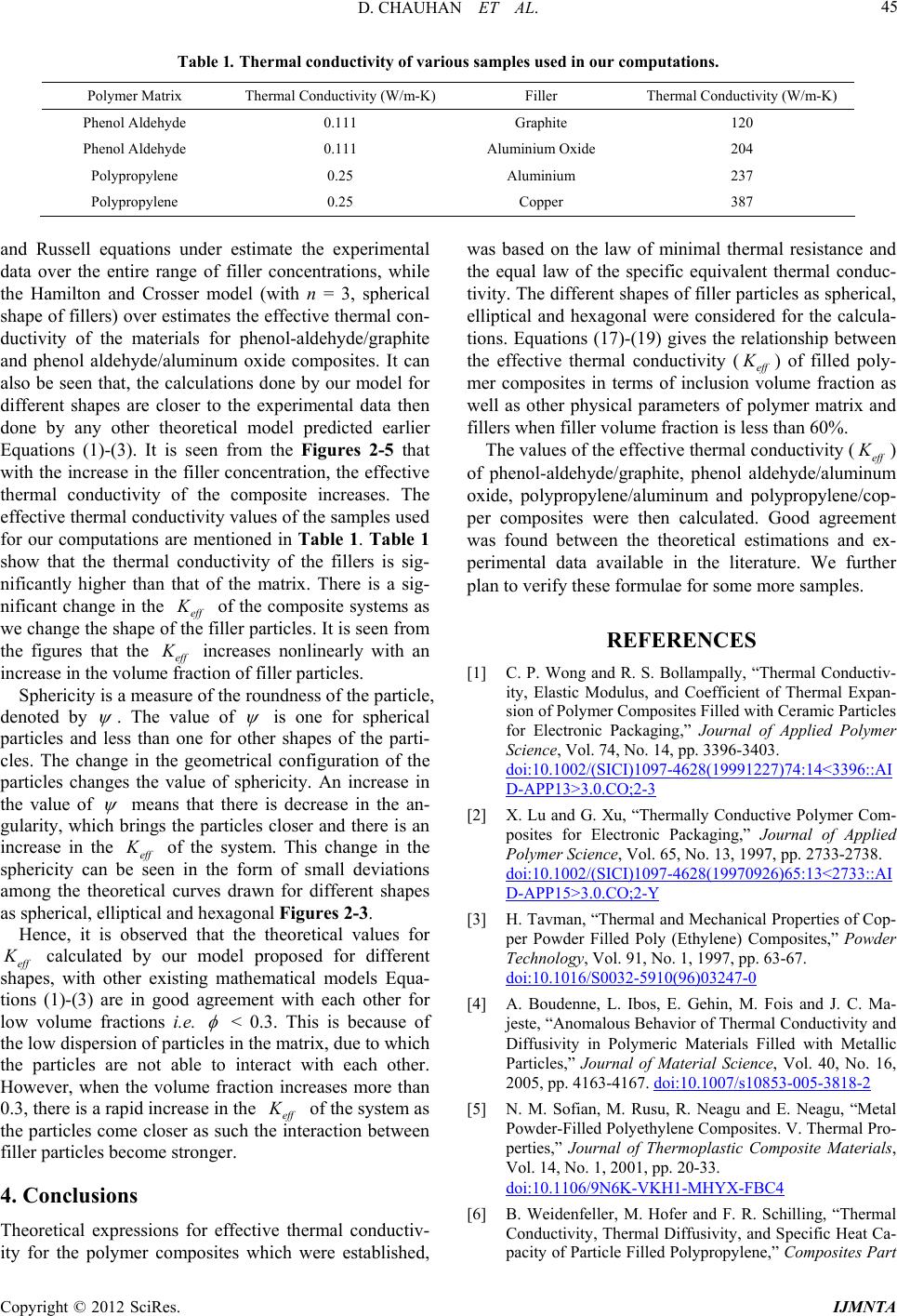 D. CHAUHAN ET AL. Copyright © 2012 SciRes. IJMNTA 45 Table 1. Thermal conductivity of various samples used in our computations. Polymer Matrix Thermal Conductivity (W/m-K) Filler Thermal Conductivity (W/m-K) Phenol Aldehyde 0.111 Graphite 120 Phenol Aldehyde 0.111 Aluminium Oxide 204 Polypropylene 0.25 Aluminium 237 Polypropylene 0.25 Copper 387 and Russell equations under estimate the experimental data over the entire range of filler concentrations, while the Hamilton and Crosser model (with n = 3, spherical shape of fillers) over estimates the effective thermal con- ductivity of the materials for phenol-aldehyde/graphite and phenol aldehyde/aluminum oxide composites. It can also be seen that, the calculations done by our model for different shapes are closer to the experimental data then done by any other theoretical model predicted earlier Equations (1)-(3). It is seen from the Figures 2-5 that with the increase in the filler concentration, the effective thermal conductivity of the composite increases. The effective thermal conductivity values of the samples used for our computations are mentioned in Table 1. Table 1 show that the thermal conductivity of the fillers is sig- nificantly higher than that of the matrix. There is a sig- nificant change in the eff K of the composite systems as we change the shape of the filler particles. It is seen from the figures that the eff K increases nonlinearly with an increase in the volume fraction of filler particles. Sphericity is a measure of the roundness of the particle, denoted by . The value of is one for spherical particles and less than one for other shapes of the parti- cles. The change in the geometrical configuration of the particles changes the value of sphericity. An increase in the value of means that there is decrease in the an- gularity, which brings the particles closer and there is an increase in the eff K of the system. This change in the sphericity can be seen in the form of small deviations among the theoretical curves drawn for different shapes as spherical, elliptical and hexagonal Figures 2-3. Hence, it is observed that the theoretical values for eff K calculated by our model proposed for different shapes, with other existing mathematical models Equa- tions (1)-(3) are in good agreement with each other for low volume fractions i.e. < 0.3. This is because of the low dispersion of particles in the matrix, due to which the particles are not able to interact with each other. However, when the volume fraction increases more than 0.3, there is a rapid increase in the eff K of the system as the particles come closer as such the interaction between filler particles become stronger. 4. Conclusions Theoretical expressions for effective thermal conductiv- ity for the polymer composites which were established, was based on the law of minimal thermal resistance and the equal law of the specific equivalent thermal conduc- tivity. The different shapes of filler particles as spherical, elliptical and hexagonal were considered for the calcula- tions. Equations (17)-(19) gives the relationship between the effective thermal conductivity (eff K ) of filled poly- mer composites in terms of inclusion volume fraction as well as other physical parameters of polymer matrix and fillers when filler volume fraction is less than 60%. The values of the effective thermal conductivity (eff K ) of phenol-aldehyde/graphite, phenol aldehyde/aluminum oxide, polypropylene/aluminum and polypropylene/cop- per composites were then calculated. Good agreement was found between the theoretical estimations and ex- perimental data available in the literature. We further plan to verify these formulae for some more samples. REFERENCES [1] C. P. Wong and R. S. Bollampally, “Thermal Conductiv- ity, Elastic Modulus, and Coefficient of Thermal Expan- sion of Polymer Composites Filled with Ceramic Particles for Electronic Packaging,” Journal of Applied Polymer Science, Vol. 74, No. 14, pp. 3396-3403. doi:10.1002/(SICI)1097-4628(19991227)74:14<3396::AI D-APP13>3.0.CO;2-3 [2] X. Lu and G. Xu, “Thermally Conductive Polymer Com- posites for Electronic Packaging,” Journal of Applied Polymer Science, Vol. 65, No. 13, 1997, pp. 2733-2738. doi:10.1002/(SICI)1097-4628(19970926)65:13<2733::AI D-APP15>3.0.CO;2-Y [3] H. Tavman, “Thermal and Mechanical Properties of Cop- per Powder Filled Poly (Ethylene) Composites,” Powder Technology, Vol. 91, No. 1, 1997, pp. 63-67. doi:10.1016/S0032-5910(96)03247-0 [4] A. Boudenne, L. Ibos, E. Gehin, M. Fois and J. C. Ma- jeste, “Anomalous Behavior of Thermal Conductivity and Diffusivity in Polymeric Materials Filled with Metallic Particles,” Journal of Material Science, Vol. 40, No. 16, 2005, pp. 4163-4167. doi:10.1007/s10853-005-3818-2 [5] N. M. Sofian, M. Rusu, R. Neagu and E. Neagu, “Metal Powder-Filled Polyethylene Composites. V. Thermal Pro- perties,” Journal of Thermoplastic Composite Materials, Vol. 14, No. 1, 2001, pp. 20-33. doi:10.1106/9N6K-VKH1-MHYX-FBC4 [6] B. Weidenfeller, M. Hofer and F. R. Schilling, “Thermal Conductivity, Thermal Diffusivity, and Specific Heat Ca- pacity of Particle Filled Polypropylene,” Composites Part 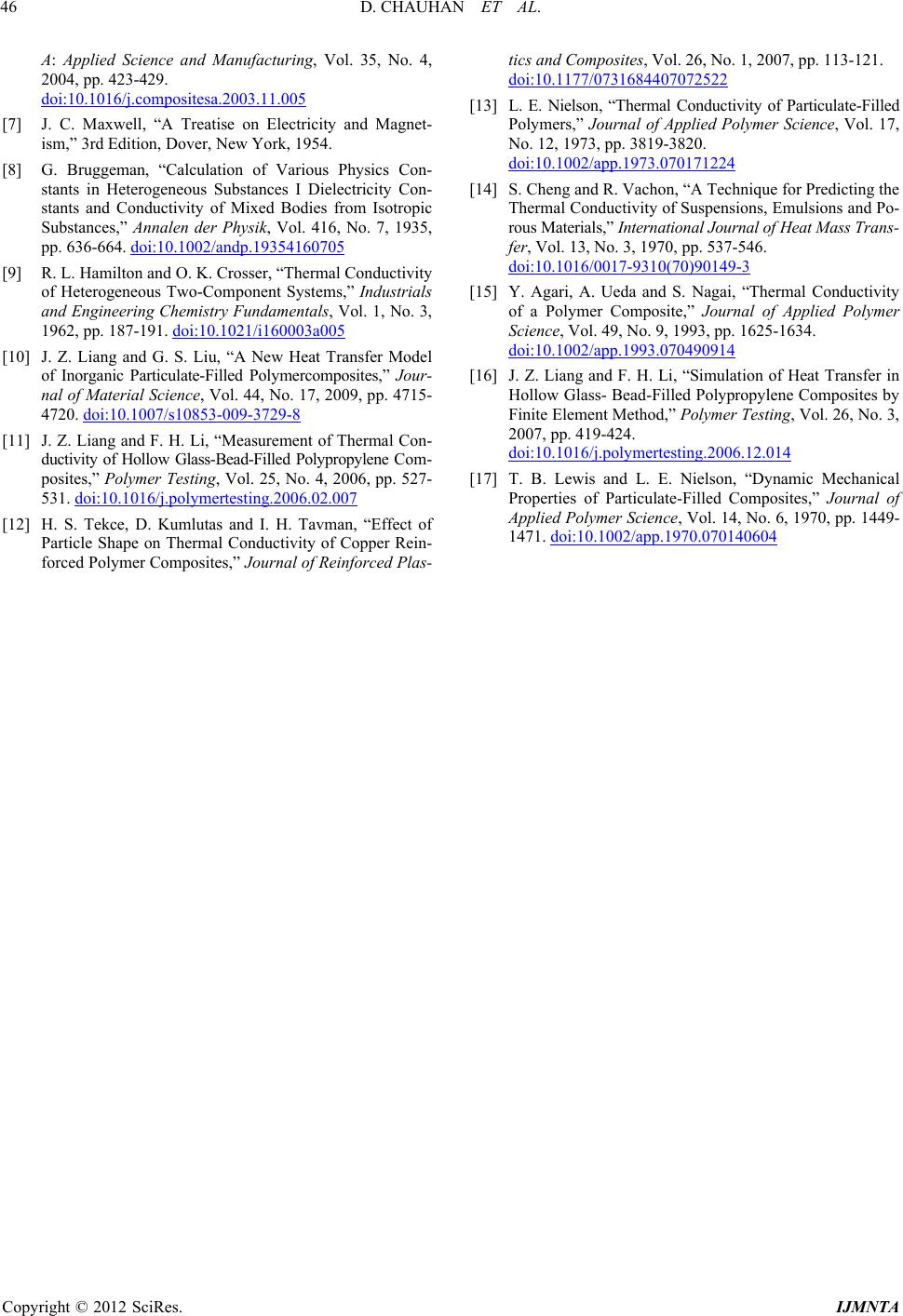 D. CHAUHAN ET AL. 46 A: Applied Science and Manufacturing, Vol. 35, No. 4, 2004, pp. 423-429. doi:10.1016/j.compositesa.2003.11.005 [7] J. C. Maxwell, “A Treatise on Electricity and Magnet- ism,” 3rd Edition, Dover, New York, 1954. [8] G. Bruggeman, “Calculation of Various Physics Con- stants in Heterogeneous Substances I Dielectricity Con- stants and Conductivity of Mixed Bodies from Isotropic Substances,” Annalen der Physik, Vol. 416, No. 7, 1935, pp. 636-664. doi:10.1002/andp.19354160705 [9] R. L. Hamilton and O. K. Crosser, “Thermal Conductivity of Heterogeneous Two-Component Systems,” Industrials and Engineering Chemistry Fundamentals, Vol. 1, No. 3, 1962, pp. 187-191. doi:10.1021/i160003a005 [10] J. Z. Liang and G. S. Liu, “A New Heat Transfer Model of Inorganic Particulate-Filled Polymercomposites,” Jour- nal of Material Science, Vol. 44, No. 17, 2009, pp. 4715- 4720. doi:10.1007/s10853-009-3729-8 [11] J. Z. Liang and F. H. Li, “Measurement of Thermal Con- ductivity of Hollow Glass-Bead-Filled Polypropylene Com- posites,” Polymer Testing, Vol. 25, No. 4, 2006, pp. 527- 531. doi:10.1016/j.polymertesting.2006.02.007 [12] H. S. Tekce, D. Kumlutas and I. H. Tavman, “Effect of Particle Shape on Thermal Conductivity of Copper Rein- forced Polymer Composites,” Journal of Reinforced Plas- tics and Composites, Vol. 26, No. 1, 2007, pp. 113-121. doi:10.1177/0731684407072522 [13] L. E. Nielson, “Thermal Conductivity of Particulate-Filled Polymers,” Journal of Applied Polymer Science, Vol. 17, No. 12, 1973, pp. 3819-3820. doi:10.1002/app.1973.070171224 [14] S. Cheng and R. Vachon, “A Technique for Predicting the Thermal Conductivity of Suspensions, Emulsions and Po- rous Materials,” International Journal of Heat Mass T rans- fer, Vol. 13, No. 3, 1970, pp. 537-546. doi:10.1016/0017-9310(70)90149-3 [15] Y. Agari, A. Ueda and S. Nagai, “Thermal Conductivity of a Polymer Composite,” Journal of Applied Polymer Science, Vol. 49, No. 9, 1993, pp. 1625-1634. doi:10.1002/app.1993.070490914 [16] J. Z. Liang and F. H. Li, “Simulation of Heat Transfer in Hollow Glass- Bead-Filled Polypropylene Composites by Finite Element Method,” Polymer Testing, Vol. 26, No. 3, 2007, pp. 419-424. doi:10.1016/j.polymertesting.2006.12.014 [17] T. B. Lewis and L. E. Nielson, “Dynamic Mechanical Properties of Particulate-Filled Composites,” Journal of Applied Polymer Science, Vol. 14, No. 6, 1970, pp. 1449- 1471. doi:10.1002/app.1970.070140604 Copyright © 2012 SciRes. IJMNTA |