

Paper Menu >>
Journal Menu >>
 Open Journal of Modern Linguistics 2012. Vol.2, No.2, 43-50 Published Online June 2012 in SciRes (http://www.SciRP.org/journal/ojml) http://dx.doi.org/10.4236/ojml.2012.22006 Copyright © 2012 SciRes. 43 Globalization and EFL Learning Motivation: A New Perspective on Integrative vs. Instrumental Motivation among Iranian Learners of English Saeed Mehrpour1, Mehdi Vojdani2 1Department of Foreign Languages and Linguistics, Shi raz University, Shiraz, Ir a n 2Fakher Higher Education Collage, Shiraz, Iran Email: [email protected] azu.ac.ir, mehdivojdani09@gmail. com Received January 9th, 2012; re vised Ma rch 1st, 2012; accept e d March 8th, 2012 The present study had a globalization perspective on Iranian EFL learners’ motivation to learn the global language, English. It investigated the effects of technological variables such as the Internet and satellite television programs, and social issues like migration and willingness for education at universities abroad on motivation for learning English as a foreign language among Iranian learners. In order to conduct the study, 238 learners of English (107 females and 131 males) were randomly selected from four language teaching institutes in Shiraz, Iran. A questionnaire was first developed based on the operationalization of some aspects of globalization which were either related to instrumental motivation or integrative motiva- tion. The data obtained from the administration of the questionnaire to the participants were later on ana- lyzed and the results revealed that technological, sociological and scientific aspects created or intensified through the process of globalization influenced Iranian EFL learners’ motivation to learn English and that the participants were mainly instrumentally motivated. Keywords: Globalization; Motivation; Instrumental; Integrative; Technological Introduction Nearly all human behaviors originate from certain kind of “motivation”. Motivation is commonly considered to be an inner drive, impulse, emotion or desire that moves one to a particular action. It is a highly complex term, widely used not only in everyday life but also in many areas of social sciences, for example in various branches of psychology, educational studies and in applied linguistics. Gardener (1972) defines mo- tivation in his social-psychological model as a combination of efforts plus desire to achieve the goal of learning the language plus favorable attitudes towards learning the language. Arnold and Brown (1999) define it as the learners’ reasons for at- tempting to acquire the foreign language. Almost all applied linguists are unanimous about the pivotal role of motivation in L2 learning. That is why many different kinds of motivation have been proposed so far. But the most widely known con- cepts associated with Gardeners’ work in the field of second language are two orientations labeled as “integrative” and “in- strumental” motivations. Gardener and Lambert (1972) differ- entiate between the two kinds of motivations. Integrative moti- vation occurs when the learner wishes to learn more about the cultural community because he or she is interested in it in an open-mind way. In contrast, if the purpose of the language learning reflects more utilitarian values of linguistic achieve- ment such as getting ahead in one’s occupation, the motivation is said to be instrumental. Gardener’s Socio-psychological Model maintained that successful language learners must be integratively motivated but the subsequent studies showed something else. Lukmani (1972), Niitsuma (1991) and Agni- hotri and Khanna’s (1998) findings showed that there is hardly any integrativeness in Bambay, Japan and South Asia, respec- tively. It probably shows that EFL learners seem to have been more instrumenta lly motivated than their E SL peers. This utili- tarian orientation to foreign language learning in EFL context seems to have been accelerated by “globalization process” and the development of global communication. Globalization as Giddens (1990) refers to is “the phenome- non of acceleration and intensification of world wide social relation which links distant localities” (p. 64). It focuses on a “borderless single society and culture” where all nationalities with different languages coexist. This amount of interconnect- edness and interdependencies requires a shared linguistic code, or an international language such as English for modern social life. Therefore, in our global era knowing English, as Kachru (1986a) holds it, is “like possessing the fabled Aladdin’s lamp, which permits one to open the linguistic gates to international business, technology, science and travel” (p. 1). That is why De Swaan (2001) argues that English is a ‘hypercollective good’: The more speakers it has, the more people want to learn the language and the higher the language’s communication value for them. De Swaan looks at the concepts of economic theory which offer the study of language in the age of globalization. Like Bourdieu (1991), he finds that linguistic behaviour is profit-driven and thus concludes that, concerning English, peo- ple seek to learn the language because it is perceived to be so- cially and economically useful to them. Acquiring English is a skill that is seen to lead to an increase of both “symbol capi- tal”-prestige and honour—as well as “economic capital”— material wealth (Bourdieu, 1991). Indeed, the more global the use of English becomes, the greater the motivation becomes to learn it. This ultrafunction of English as the language of the  S. MEHRPOUR, M. VOJDANI world at large has had major consequences on L2 motivation especially in EFL contexts. Block and Cameron (2002) have noted that globalization changes the condition under which language learning takes place. Some of the most significant changes are economic. They believe that globalization has made a condition under which people are learning languages for more economic reasons. Some commentators like Heller (1999a) have suggested that languages (and mainly English) are treated more and more as economic commodities. This com- modification of language affects both people’s motivations for language learning and their choices about which language to learn. Wee (2003) uses the term “linguistic instrumentalism” to refer to this recent ideological change due to globalization and capitalism. By the same token, Graddol (1997) predicts a fore- casting model towards EFL demand around the world which suggests that patterns of English language usage will be deter- mined by economic and technological development rather than cultural or political factors. By and large, the world has greatly changed since Gardener and Lambert first introduced the notion of integrative and in- strumental motivation in the late 1950s. The last decade has seen what Gardener himself has called a “motivational renais- sance” (Gardener & Tremblay, 1994) with new concepts, new needs and, consequently, new motivational attitudes toward language learning. It is increasingly recognized that learner attributes and activities are profoundly influenced by economic environment emerging through globalization and technology forces. In this situation, there seems to be some aspects of the processes of globalization and modernism which have been motivating language learners instrumentally in EFL contexts such as Iran to learn the global language English at any cost. Status of English in Asia and Iran: A Brief Overview Kim (2002) describes the status of English in Asia as fol- lows: English as a world/global language has successfully made its way to a central position in non-English speaking countries such as Korea, Japan, and China as well as Southeast Asian nations and countries in the Middle East where people believe the economic power and prestige are connected to the language, English. (p. 29) With regard to the status of English in Iran, it can be stated that the role of English in Iran is almost purely functional as English is used as a language of international link. Unlike some EFL contexts such as Singapore and Malaysia, English is not used as an interpersonal and inter-institutional means of com- munication and there is seemingly no possibility of English becoming the lingua franca in Iran. But English has been used for years and for different purposes in Iran and gradually it is becoming part of the socio-cultural system. As the use of Eng- lish is increasing day by day in different forms, there is signifi- cant evidence of use of English along with Persian in the form of code-mixing and code-switching (Monajemi, 2001; Vojdani, 2008). English is taught in Iran from Junior high school, but recently, it has been tentatively included in course programs not only in some elementary schools but also in some kindergartens or pre-school centers under the supervision of the Ministry of Education. But the language teaching institutes play the main role in developing English language learning in Iran. In recent years, the number of language institutes has considerably in- creased. In a sample survey, Vojdani (2008) compared the number of language institutes and EFL learners in Shiraz City. He showed that in 1375 (1996) there existed around 207 Eng- lish language institutes for about 36432 language learners whereas in 1386 (2007) there were about 356 institutes for ap- proximately 60797 learners in Shiraz. This clearly shows that today more and more knowledge of English is needed in Iran due to some globalization requirements and consequently new forms of motivations might be identified. Literature Review A significant amount of research has been conducted in the study of motivation in foreign language learning ever since. But, to the best of the researchers’ knowledge, very few studies have ever dealt with the effects of globalization or technological aspects on EFL learner’s motivation. As the initial pieces of research on the relation between mo- tivation and language learning, Gardener (1960) and Gardener and Lambert (1959) investigated the relation between learners’ motivation and their linguistic performance. They identified two kinds of motivation, namely instrumental and integrative. Gardener and Lambert (1972) carried out an extensive study in Quebec, Ontario, Hartford, Connecticut, Louisiana and Maine. Their study showed that in all cases motivation is a leading factor in students’ success and students with integrative orien- tation are more successful as compared with those with instru- mental motivation. Another study was conducted by Gardener and his coworkers in the Philippines. The result of the research showed that for an EFL context such as the Philippines, learners seemed to be more instrumentally motivated and they tried to learn English for their better job positions. Since then, further researches (such as Lukmani, 1972; Dornyei, 1990; Shaaban & Ghaith, 2000; Warden & Lin, 2000) have highlighted the significance of instrumental or utilitarian dimension of L2 motivation which belonged mostly to EFL contexts. Raham (2005) analyzes the various socio-psychological ori- entations of the undergraduate students of private universities of Bangladesh towards learning English. His study focuses on what are considered as the two most important social psycho- logical variables: attitude and motivation. Domain use is also investigated to determine the present linguistic reality of Bang- ladesh and features important in describing the motivational orientations of students. To achieve the goal, 94 students (56 male and 38 female) of 19 - 23 age group were randomly se- lected from the American International University, Bangladesh (AIUB) to give their ideas about their motivation for English learning. The findings of the research finally shows that stu- dents focus on English for its “functional role” (i.e. its utilitar- ian value) in limited and discrete domain areas where knowl- edge of English is required. Raham believes that the study does not reject or undermine Gardner’s theory, rather it tries to find out the reliability and applicably of such theory in a strong EFL country like Bangladesh as it was investigated before in other EFL contexts. This study also demonstrates that the learners learn English for “instrumental” reasons as opposed to previous research conducted in Bangladesh, which concluded that “inte- grative motivation” functioned as the dominant motivational orientation for the students to learn English. It seems that, as it was previously mentioned, the more Bangladesh is globalised, the more language learning is considered as a utilitarian value than a cultural identity. Copyright © 2012 SciRes. 44  S. MEHRPOUR, M. VOJDANI The volume, Motivation, Language Attitudes and Globali- zation: A Hungarian Perspective, written by Dörnyei, Csizér, and Németh (2006) contains the results of the largest ever-con- ducted L2 motivation survey, involving over 13,000 language learners on three successive occasions: in 1993, 1999 and 2004. The survey took place in one particular country, Hungary, and the sample represents young teenagers from the whole cross- section of the nation. The examined period covers a particularly prominent time in the country’s history, the transition from a closed, Communist society to a Western-style democracy dur- ing which the country finally became a member of the Euro- pean Union in 2004. The book presents a good example of an overall change in language learning motivation due to global- ization process in an EFL context. It describes how sociopoliti- cal changes and globalization process introducing English as the global language has affected the various language attitudes prevailing amongst Hungarians and their motivation to learn five different target languages: English, German, French, Italian and Russian. Their study, with respect to the third phase of the data (gained in 2004), showed that Hungarians tend to take up the study of English increasingly as a self-evident part of edu- cation. Therefore, the global English is becoming increasingly associated with a cosmopolitan and technologically advanced “imagined community” and thus with the pathway to career success among Hungarians. In another study, Lamb (2004) investigates the effects of globalization and global forces on integrative motivation of Indonesian children aged 11 - 12 years old, as they begin for- mal English in an urban junior high school. His main idea re- volves the notion of “integrativeness” which he believes to have greatly changed since the emergence of globalization process. He argues that as English loses its association with particular Anglophone cultures and is instead identified with the powerful forces of globalization, the desire to integrate loses its explanatory power in many EFL contexts and therefore, the individuals learn English to develop a bicultural identity of their local culture and at the same time as a member of the “global culture”. Knowing English gives Indonesian young generation a sense of belonging to a worldwide culture and awareness of information, style and events of that. It is specu- lated that changes in individuals’ motivation to learn the lan- guage may therefore be partly explained by reference to ongo- ing processes of identification which, in turn, may change through some social processes like globalization. Al-Atemi & Shuib (2009) undertook a study on learners’ motivation and attitudes towards learning English in Yemen. The study focused on three motivational constructs, i.e., in- strumental motivation, integrative motivation, and personal motivation. The results of the study revealed that both instru- mental and personal reasons were important motives for learn- ing English. However, integrative motivation had the least im- pact on learners’ language learning. Abdol Latif, et al. (2011) using a questionnaire conducted a project to determine the link between attitude, motivation, anxiety and instrumental orientation on performance of a group of 757 learners of English in Open University Malaysia (OUM). The regression analysis of the data revealed that all the vari- ables except for personal motivation had a significant effect on performance with anxiety having a negative impact while atti- tude and instrume n t a l orien tation having positive impacts. Alqahtani (2011) explored 35 Kuwaiti learners’ perceptions of the relationship between English and globalization through interviewing them. The findings indicated that despite recog- nizing and appreciating the establishment and identity of Eng- lish as a global language, learners did not seem to have a clear and complete understanding of the “essence” of this global era. As far as the situation of learning English in Iran is con- cerned, some studies have been conducted on motivational variables among Iranian language learners during the last dec- ade. Roohani (2001) studied the motivational variables (integra- tive and instrumental) towards learning English as a foreign language among senior students at two state-run and private universities. The results indicated that the students at the state-run university were more integratively motivated as com- pared with their peers at the private university. Vaezi (2008) conducted a study to describe and examine a group of Iranian’s undergraduate students’ integrative and in- strumental motivation toward learning English as a foreign language. The results of the study revealed that the participants had very high motivation and positive attitudes towards learn- ing English and were more inst rumentally motivated. As the literature review shows, most of the previous studies conducted in Iran have dealt with the classic concepts of inte- grative and instrumental motivation and no study has ever been focused on the effects of globalization and 21st century issues on EFL learners’ motivation in the country. Objectives of the Study For many EFL learners in our globalizing world, knowledge of English seems to be utilized more as a tool to address their needs, in terms of dealing with modern technology or some social issues like migration to Europe or North America to have better job positions and life style. The current study had a glob- alization perspective on Iranian EFL learners’ motivation to learn the global language, English and it was meant to investi- gate the effects of technological variables such as the Internet and satellite television programs; social issues like migration and high tendencies to education at overseas’ universities on motivation for learning English among Iranian learners. Con- sidering the purpose of the study and the studies reviewed, the researchers addressed the following research questions: 1) Has globalization and its technological and social aspects affected Iranian EFL learners’ type of motivation toward learn- ing English? 2) If so, how has it been effective? In other words, has it made learners more instrumentally or integratively motivated? Method Participants To conduct the study, 238 English language learners (107 female and 131 male) from four language teaching institutes were randomly selected. The participants were of different socio-economic backgrounds and different levels of proficiency, that is, beginner, intermediate and advance levels. To minimize the effects of age on the study, the range of 17 to 27 was chosen which also accounts for the largest number of learners of Eng- lish in Iran. Instrument In order to examine and investigate the possible effects of Copyright © 2012 SciRes. 45 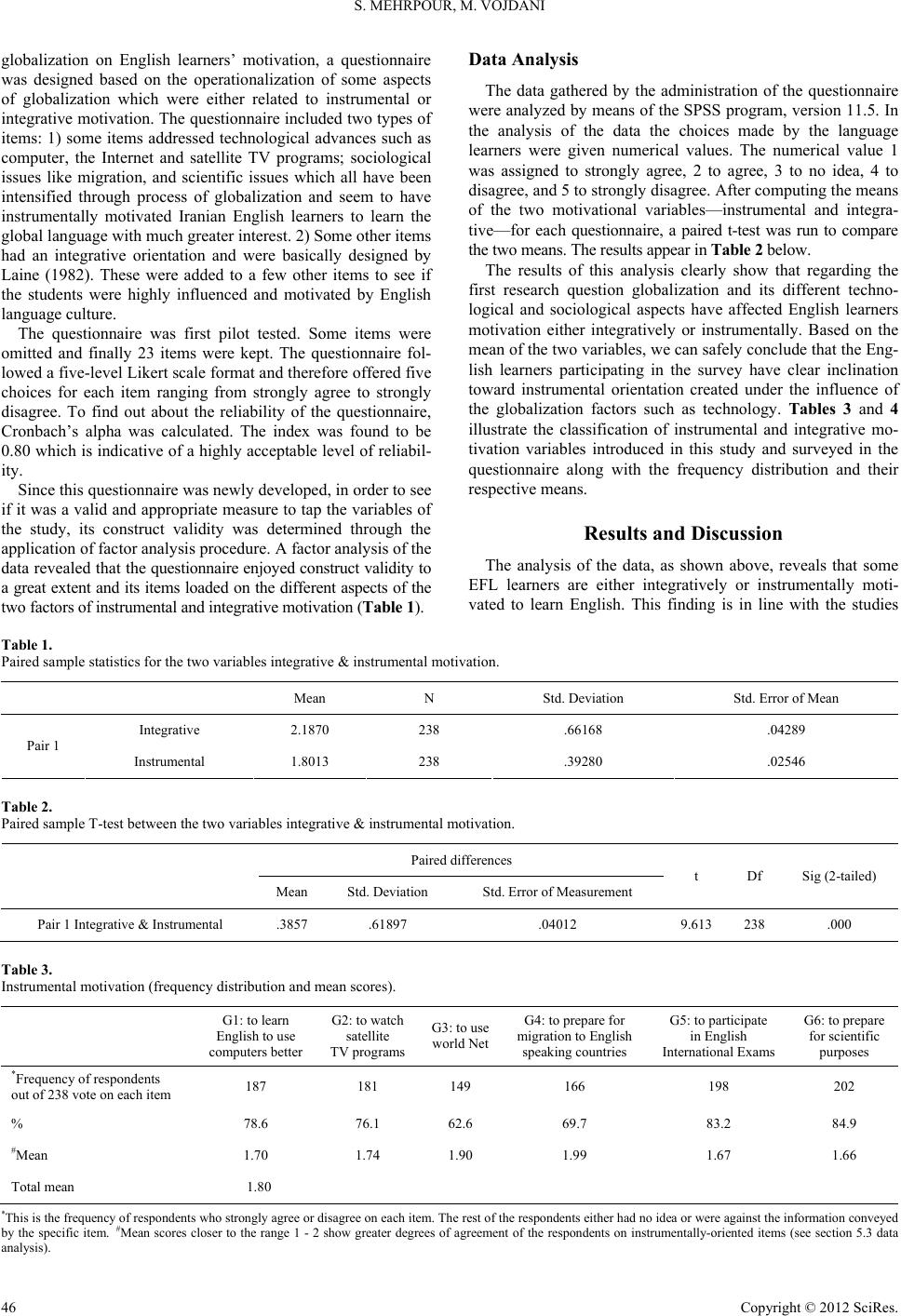 S. MEHRPOUR, M. VOJDANI Copyright © 2012 SciRes. 46 globalization on English learners’ motivation, a questionnaire was designed based on the operationalization of some aspects of globalization which were either related to instrumental or integrative motivation. The questionnaire included two types of items: 1) some items addressed technological advances such as computer, the Internet and satellite TV programs; sociological issues like migration, and scientific issues which all have been intensified through process of globalization and seem to have instrumentally motivated Iranian English learners to learn the global language with much greater interest. 2) Some other items had an integrative orientation and were basically designed by Laine (1982). These were added to a few other items to see if the students were highly influenced and motivated by English language culture . The questionnaire was first pilot tested. Some items were omitted and finally 23 items were kept. The questionnaire fol- lowed a five-level Likert scale format and therefore offered five choices for each item ranging from strongly agree to strongly disagree. To find out about the reliability of the questionnaire, Cronbach’s alpha was calculated. The index was found to be 0.80 which is indicative of a highly acceptable level of reliabil- ity. Since this questionnaire was newly developed, in order to see if it was a valid and appropriate measure to tap the variables of the study, its construct validity was determined through the application of factor analysis procedure. A factor analysis of the dat a re vea led t hat t he questionna ire enjoyed construct validity to a great extent and its items loaded on the different aspects of the two factors of instrumental and integrative motivation (Table 1). Data Analysis The data gathered by the administration of the questionnaire were analyzed by means of the SPSS program, version 11.5. In the analysis of the data the choices made by the language learners were given numerical values. The numerical value 1 was assigned to strongly agree, 2 to agree, 3 to no idea, 4 to disagree, and 5 to strongly disagree. After computing the means of the two motivational variables—instrumental and integra- tive—for each questionnaire, a paired t-test was run to compare the two means. The results appear in Table 2 below. The results of this analysis clearly show that regarding the first research question globalization and its different techno- logical and sociological aspects have affected English learners motivation either integratively or instrumentally. Based on the mean of the two variables, we can safely conclude that the Eng- lish learners participating in the survey have clear inclination toward instrumental orientation created under the influence of the globalization factors such as technology. Tables 3 and 4 illustrate the classification of instrumental and integrative mo- tivation variables introduced in this study and surveyed in the questionnaire along with the frequency distribution and their respective means. Results and Discussion The analysis of the data, as shown above, reveals that some EFL learners are either integratively or instrumentally moti- vated to learn English. This finding is in line with the studies Table 1. Paired sample statistics for th e two variables integrative & instrumental motivation. Mean N Std. Deviati on Std. Error of Mean Integrative 2.1870 238 .66168 .04289 Pair 1 Instrumental 1.8013 238 .39280 .02546 Table 2. Paired sample T-test between the two variables integrative & i nstrumental motivation. Paired differences Mean Std. Deviation Std. Error of Measurement t Df Sig (2-tailed) Pair 1 Integrative & Ins trumental .3857 .61897 .04012 9.613 238 .000 Table 3. Instrumental motivation (frequency distri but ion and mean scores) . G1: to learn English to use computers better G2: to watch satellite TV programs G3: to use world Net G4: to prepare for migration to English speaking coun t ries G5: to participate in English International Exams G6: to prepare for scientific purposes *Frequency of responde n ts out of 238 vote on each item 187 181 149 166 198 202 % 78.6 76.1 62.6 69.7 83.2 84.9 #Mean 1.70 1.74 1.90 1.99 1.67 1.66 Total mean 1.80 *This is the frequency of respondents who strongly agree or disagree on each item. The rest of the respondents either had no idea or were against the information conveyed by the specific item. #Mean scores closer to the range 1 - 2 show greater degrees of agreement of the respondents on instrumentally-oriented items (see section 5.3 data analysis). 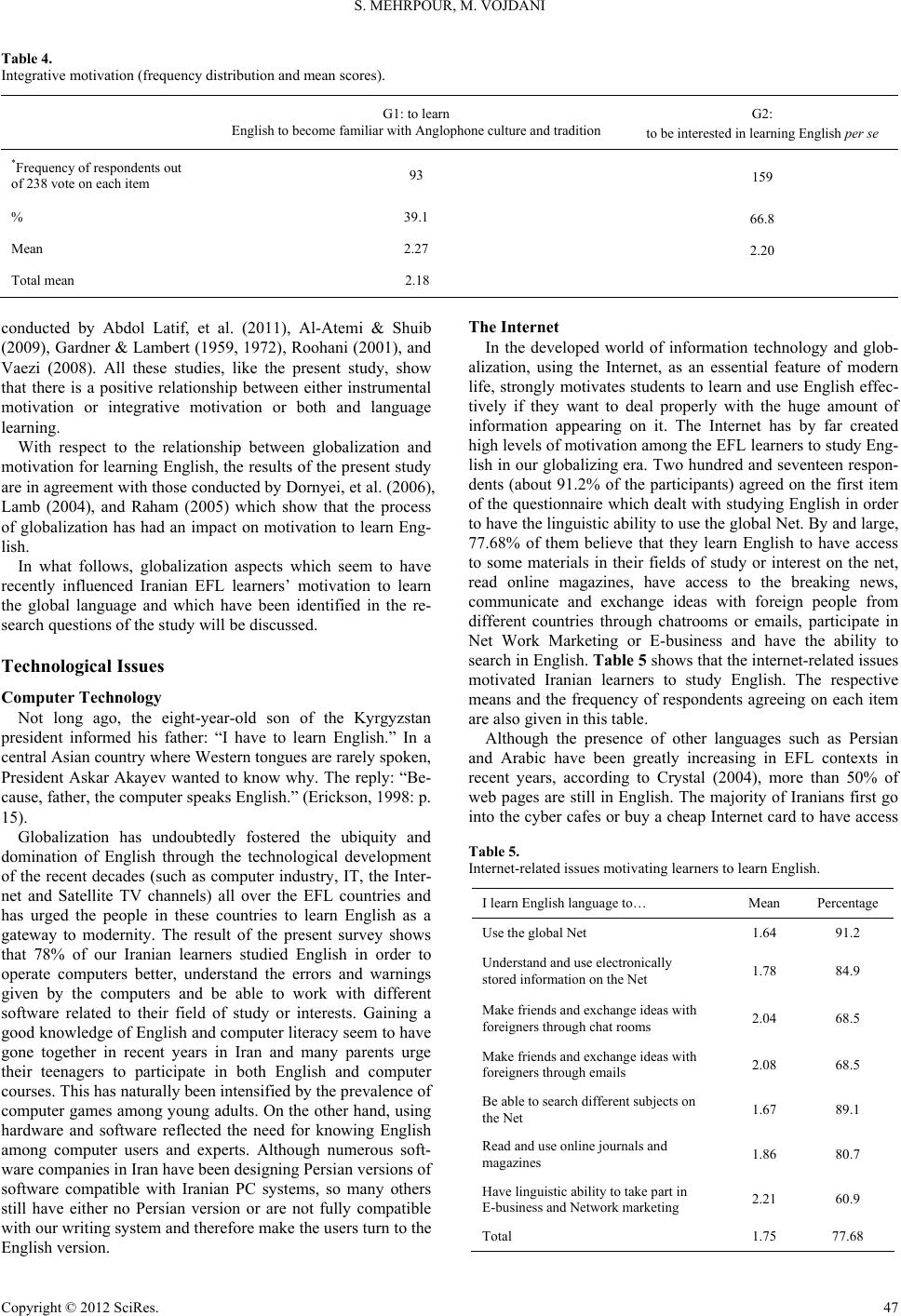 S. MEHRPOUR, M. VOJDANI Table 4. Integrative motivation (frequency distribution and mean scores). G1: to learn English to become familiar with Anglophone culture a n d t r adition G2: to be interested in learning English per se *Frequenc y of respondents out of 238 vote on each item 93 159 % 39.1 66.8 Mean 2.27 2.20 Total mean 2.18 conducted by Abdol Latif, et al. (2011), Al-Atemi & Shuib (2009), Gardner & Lambert (1959, 1972), Roohani (2001), and Vaezi (2008). All these studies, like the present study, show that there is a positive relationship between either instrumental motivation or integrative motivation or both and language learning. With respect to the relationship between globalization and motivation for learning English, the results of the present study are in agreement with those conducted by Dornyei, et al. (2006), Lamb (2004), and Raham (2005) which show that the process of globalization has had an impact on motivation to learn Eng- lish. In what follows, globalization aspects which seem to have recently influenced Iranian EFL learners’ motivation to learn the global language and which have been identified in the re- search questions of the study will be discussed. Technological Issues Computer Technology Not long ago, the eight-year-old son of the Kyrgyzstan president informed his father: “I have to learn English.” In a central Asian country where Western tongues are rarely spoken, President Askar Akayev wanted to know why. The reply: “Be- cause, father, the computer speaks English.” (Erickson, 1998: p. 15). Globalization has undoubtedly fostered the ubiquity and domination of English through the technological development of the recent decades (such as computer industry, IT, the Inter- net and Satellite TV channels) all over the EFL countries and has urged the people in these countries to learn English as a gateway to modernity. The result of the present survey shows that 78% of our Iranian learners studied English in order to operate computers better, understand the errors and warnings given by the computers and be able to work with different software related to their field of study or interests. Gaining a good knowledge of English and computer literacy seem to have gone together in recent years in Iran and many parents urge their teenagers to participate in both English and computer courses. This has naturally been intensified by the prevalence of computer games among young adults. On the other hand, using hardware and software reflected the need for knowing English among computer users and experts. Although numerous soft- ware companies in Iran have been designing Persian versions of software compatible with Iranian PC systems, so many others still have either no Persian version or are not fully compatible with our writing system and therefore make the users turn to the English version. The Internet In the developed world of information technology and glob- alization, using the Internet, as an essential feature of modern life, strongly motivates students to learn and use English effec- tively if they want to deal properly with the huge amount of information appearing on it. The Internet has by far created high levels of motivation among the EFL learners to study Eng- lish in our globalizing era. Two hundred and seventeen respon- dents (about 91.2% of the participants) agreed on the first item of the questionnaire which dealt with studying English in order to have the linguistic ability to use the global Net. By and large, 77.68% of them believe that they learn English to have access to some materials in their fields of study or interest on the net, read online magazines, have access to the breaking news, communicate and exchange ideas with foreign people from different countries through chatrooms or emails, participate in Net Work Marketing or E-business and have the ability to search in English. Table 5 shows that the internet-related issues motivated Iranian learners to study English. The respective means and the frequency of respondents agreeing on each item are also given in this table. Although the presence of other languages such as Persian and Arabic have been greatly increasing in EFL contexts in recent years, according to Crystal (2004), more than 50% of web pages are still in English. The majority of Iranians first go into the cyber cafe s or buy a cheap Internet card to ha ve access Table 5. Internet-related issues motivating learners to learn English. I learn English language to… Mean Percentage Use the global Net 1.64 91.2 Understand and use electronically stored information on the Net 1.78 84.9 Make friends and exchange ideas with foreigners through ch at rooms 2.04 68.5 Make friends and exchange ideas with foreigners t hrough emails 2.08 68.5 Be able to search different subjects on the Net 1.67 89.1 Read and use online journals and magazines 1.86 80.7 Have linguistic ability to take part in E-business and Netw or k marketing 2.21 60.9 Total 1.75 77.68 Copyright © 2012 SciRes. 47 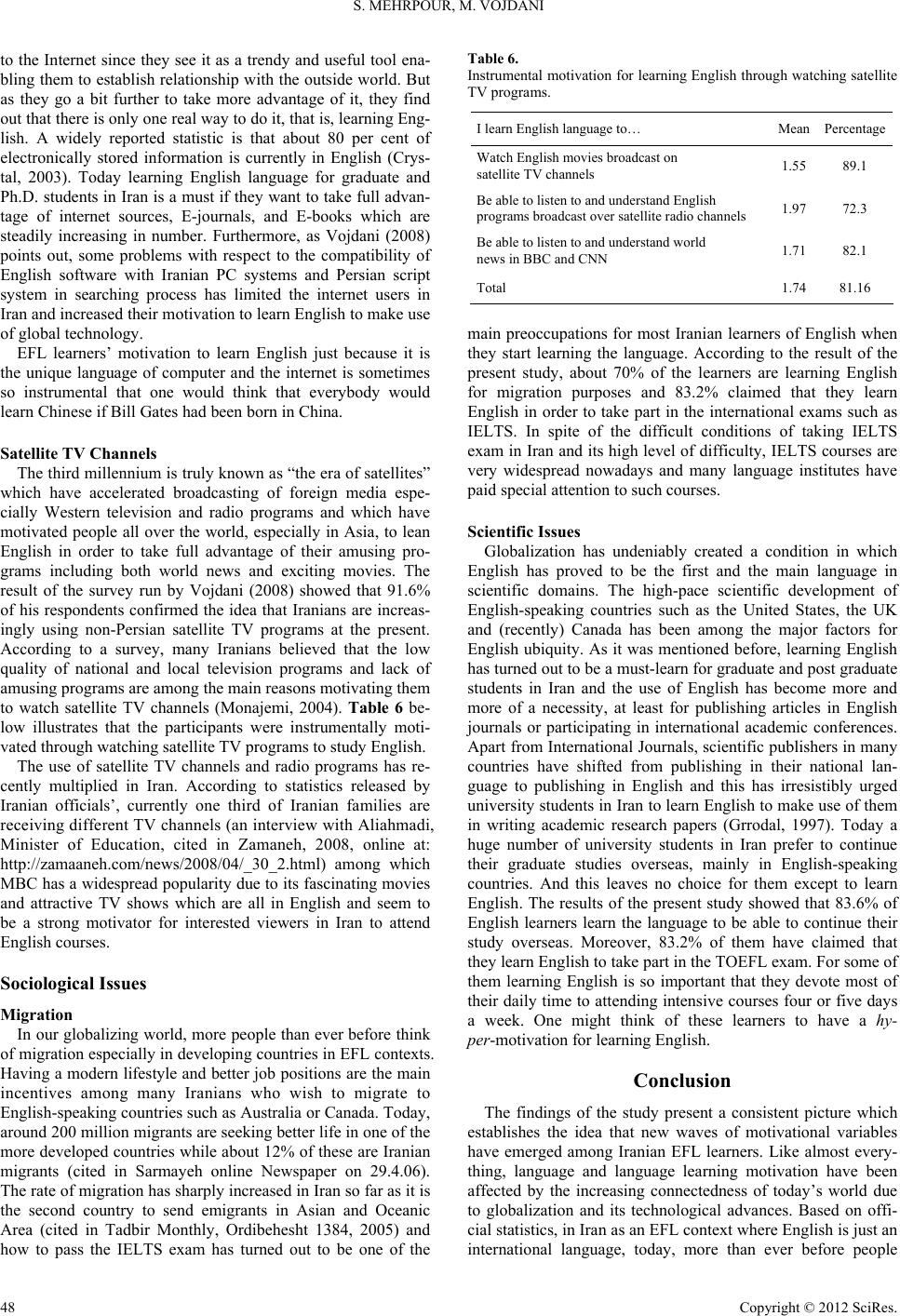 S. MEHRPOUR, M. VOJDANI to the Internet since they see it as a trendy and useful tool ena- bling them to establish relationship with the outside world. But as they go a bit further to take more advantage of it, they find out that there is only one real way to do it, that is, learning Eng- lish. A widely reported statistic is that about 80 per cent of electronically stored information is currently in English (Crys- tal, 2003). Today learning English language for graduate and Ph.D. students in Iran is a must if they want to take full advan- tage of internet sources, E-journals, and E-books which are steadily increasing in number. Furthermore, as Vojdani (2008) points out, some problems with respect to the compatibility of English software with Iranian PC systems and Persian script system in searching process has limited the internet users in Iran and increased their motivation to learn English to make use of global technology. EFL learners’ motivation to learn English just because it is the unique language of computer and the internet is sometimes so instrumental that one would think that everybody would learn Chinese if Bill Gates had been born in China. Satellite TV Channels The third millennium is truly known as “the era of satellites” which have accelerated broadcasting of foreign media espe- cially Western television and radio programs and which have motivated people all over the world, especially in Asia, to lean English in order to take full advantage of their amusing pro- grams including both world news and exciting movies. The result of the survey run by Vojdani (2008) showed that 91.6% of his respondents confirmed the idea that Iranians are increas- ingly using non-Persian satellite TV programs at the present. According to a survey, many Iranians believed that the low quality of national and local television programs and lack of amusing programs are among the main reasons moti v a ti n g them to watch satellite TV channels (Monajemi, 2004). Table 6 be- low illustrates that the participants were instrumentally moti- vated through watching satellite TV programs to study English. The use of satellite TV channels and radio programs has re- cently multiplied in Iran. According to statistics released by Iranian officials’, currently one third of Iranian families are receiving different TV channels (an interview with Aliahmadi, Minister of Education, cited in Zamaneh, 2008, online at: http://zamaaneh.com/news/2008/04/_30_2.html) among which MBC has a widespread popularity due to its fascinating movies and attractive TV shows which are all in English and seem to be a strong motivator for interested viewers in Iran to attend English courses. Sociological Issues Migration In our globalizing world, more people than ever before think of migration especially in developing countries in EFL contexts. Having a modern lifestyle and better job positions are the main incentives among many Iranians who wish to migrate to English-speaking countries such as Australia or Canada. Today, around 200 million migrants are seeking better life in one of the more developed countries while about 12% of these are Iranian migrants (cited in Sarmayeh online Newspaper on 29.4.06). The rate of migration has sharply increased in Iran so far as it is the second country to send emigrants in Asian and Oceanic Area (cited in Tadbir Monthly, Ordibehesht 1384, 2005) and how to pass the IELTS exam has turned out to be one of the Table 6. Instrumental motivation for learning English through watching satellite TV programs. I learn English language t o… MeanPercentage Watch English movies broadc ast on satellite TV channels 1.55 89.1 Be able to listen to and unders t and English programs broadcast over sa t ellite radio channels 1.97 72.3 Be able to listen to and unders tand world news in BBC and CNN 1.71 82.1 Total 1.74 81.16 main preoccupations for most Iranian learners of English when they start learning the language. According to the result of the present study, about 70% of the learners are learning English for migration purposes and 83.2% claimed that they learn English in order to take part in the international exams such as IELTS. In spite of the difficult conditions of taking IELTS exam in Iran and its high level of difficulty, IELTS courses are very widespread nowadays and many language institutes have paid special attention to such courses. Scientific Issues Globalization has undeniably created a condition in which English has proved to be the first and the main language in scientific domains. The high-pace scientific development of English-speaking countries such as the United States, the UK and (recently) Canada has been among the major factors for English ubiquity. As it was mentioned before, learning English has turned out to be a must-learn for graduate and post graduate students in Iran and the use of English has become more and more of a necessity, at least for publishing articles in English journals or participating in international academic conferences. Apart from International Journals, scientific publishers in many countries have shifted from publishing in their national lan- guage to publishing in English and this has irresistibly urged university students in Iran to learn English to make use of them in writing academic research papers (Grrodal, 1997). Today a huge number of university students in Iran prefer to continue their graduate studies overseas, mainly in English-speaking countries. And this leaves no choice for them except to learn English. The results of the present study showed that 83.6% of English learners learn the language to be able to continue their study overseas. Moreover, 83.2% of them have claimed that they learn English to take part in the TOEFL exam. For some of them learning English is so important that they devote most of their daily time to attending intensive courses four or five days a week. One might think of these learners to have a hy- per-motivation for learning English. Conclusion The findings of the study present a consistent picture which establishes the idea that new waves of motivational variables have emerged among Iranian EFL learners. Like almost every- thing, language and language learning motivation have been affected by the increasing connectedness of today’s world due to globalization and its technological advances. Based on offi- cial statistics, in Iran as an EFL context where English is just an international language, today, more than ever before people Copyright © 2012 SciRes. 48 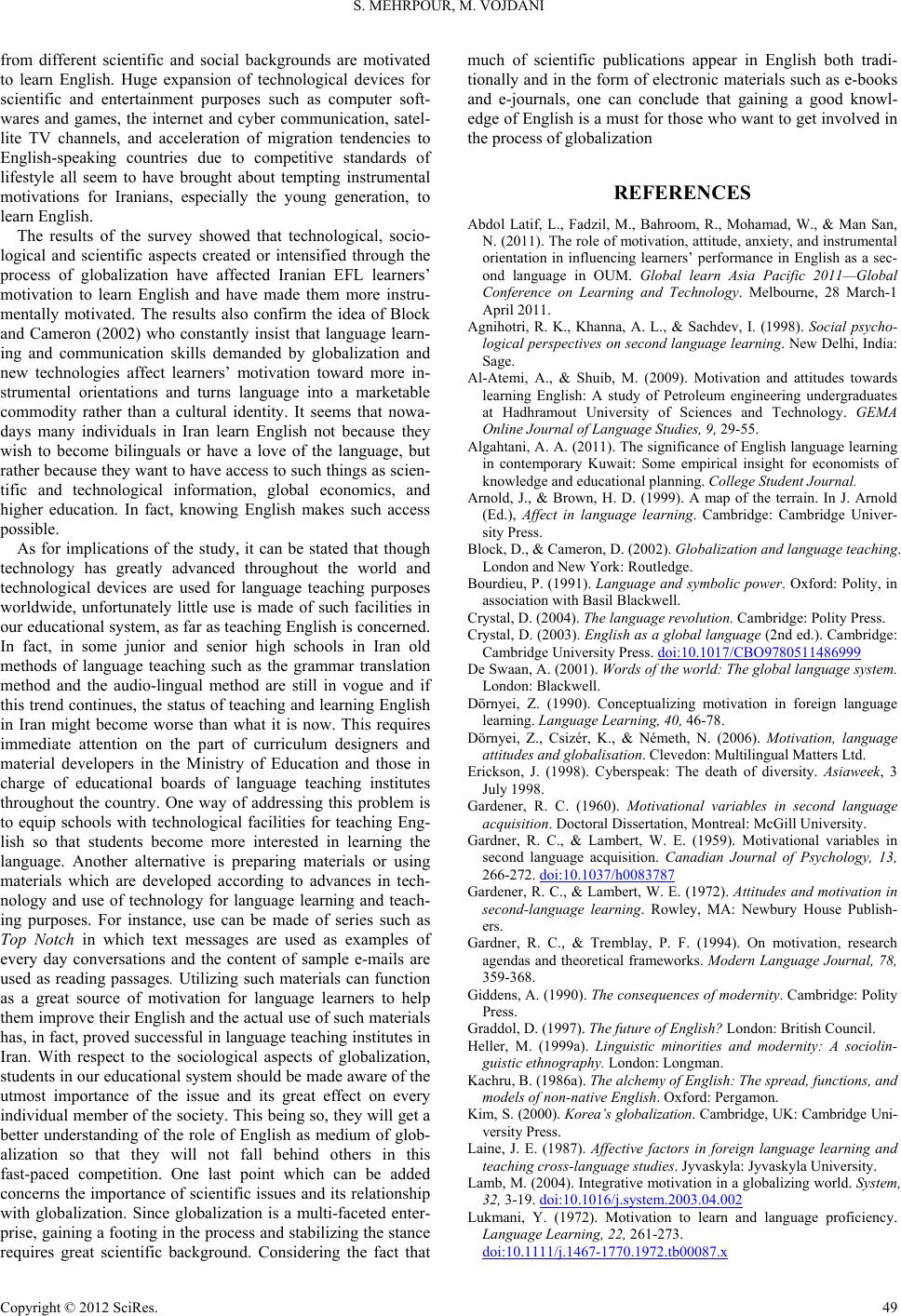 S. MEHRPOUR, M. VOJDANI from different scientific and social backgrounds are motivated to learn English. Huge expansion of technological devices for scientific and entertainment purposes such as computer soft- wares and games, the internet and cyber communication, satel- lite TV channels, and acceleration of migration tendencies to English-speaking countries due to competitive standards of lifestyle all seem to have brought about tempting instrumental motivations for Iranians, especially the young generation, to learn English. The results of the survey showed that technological, socio- logical and scientific aspects created or intensified through the process of globalization have affected Iranian EFL learners’ motivation to learn English and have made them more instru- mentally motivated. The results also confirm the idea of Block and Cameron (2002) who constantly insist that language learn- ing and communication skills demanded by globalization and new technologies affect learners’ motivation toward more in- strumental orientations and turns language into a marketable commodity rather than a cultural identity. It seems that nowa- days many individuals in Iran learn English not because they wish to become bilinguals or have a love of the language, but rather because they want to have access to such things as scien- tific and technological information, global economics, and higher education. In fact, knowing English makes such access possible. As for implications of the study, it can be stated that though technology has greatly advanced throughout the world and technological devices are used for language teaching purposes worldwide, unfortunately little use is made of such facilities in our educational system, as far as teaching English is concerned. In fact, in some junior and senior high schools in Iran old methods of language teaching such as the grammar translation method and the audio-lingual method are still in vogue and if this trend continues, the status of teaching and learning English in Iran might become worse than what it is now. This requires immediate attention on the part of curriculum designers and material developers in the Ministry of Education and those in charge of educational boards of language teaching institutes throughout the country. One way of addressing this problem is to equip schools with technological facilities for teaching Eng- lish so that students become more interested in learning the language. Another alternative is preparing materials or using materials which are developed according to advances in tech- nology and use of technology for language learning and teach- ing purposes. For instance, use can be made of series such as Top Notch in which text messages are used as examples of every day conversations and the content of sample e-mails are used as reading passages. Utilizing such materials can function as a great source of motivation for language learners to help them improve their English and the actual use of such materials has, in fact, proved successful in language teaching institutes in Iran. With respect to the sociological aspects of globalization, students in our educational system should be made aware of the utmost importance of the issue and its great effect on every individual member of the society. This being so, they will get a better understanding of the role of English as medium of glob- alization so that they will not fall behind others in this fast-paced competition. One last point which can be added concerns the importance of scientific issues and its relationship with globalization. Since globalization is a multi-faceted enter- prise, gaining a footing in the process and stabilizing the stance requires great scientific background. Considering the fact that much of scientific publications appear in English both tradi- tionally and in the form of electronic materials such as e-books and e-journals, one can conclude that gaining a good knowl- edge of English is a must for those who want to get involved in the process of globalization REFERENCES Abdol Latif, L., Fadzil, M., Bahroom, R., Mohamad, W., & Man San, N. (2011). The role of motivation, attitude, anxiety, and instrumental orientation in influencing learners’ performance in English as a sec- ond language in OUM. Global learn Asia Pacific 2011—Global Conference on Learning and Technology. Melbourne, 28 March-1 April 2011. Agnihotri, R. K., Khanna, A. L., & Sachdev, I. (1998). Social psycho- logical perspectives on second language learning. New Delhi, India: Sage. Al-Atemi, A., & Shuib, M. (2009). Motivation and attitudes towards learning English: A study of Petroleum engineering undergraduates at Hadhramout University of Sciences and Technology. GEMA Online Journal of Language Studies, 9, 29-55. Algahtani, A. A. (2011). The significance of English language learning in contemporary Kuwait: Some empirical insight for economists of knowledge and educational planning. College Studen t Journal. Arnold, J., & Brown, H. D. (1999). A map of the terrain. In J. Arnold (Ed.), Affect in language learning. Cambridge: Cambridge Univer- sity Press. Block, D., & Cameron, D. (2002). Globalization and language teaching. London and New York: Routledge. Bourdieu, P. (1991). Language and symbolic power. Oxford: Polity, in association with Basil Blackwell. Crystal, D. (2004). The language revolution. Cambridge: Polity Press. Crystal, D. (2003). English as a global language (2nd ed.). Cambridge: Cambridge University Press. doi:10.1017/CBO9780511486999 De Swaan, A. (2001). Words of the world: The global language system. London: Blackwell. Dörnyei, Z. (1990). Conceptualizing motivation in foreign language learning. Language Learn ing , 40, 46-78. Dörnyei, Z., Csizér, K., & Németh, N. (2006). Motivation, language attitudes and globalisatio n. Clevedon: Multilingual Matters Ltd. Erickson, J. (1998). Cyberspeak: The death of diversity. Asiaweek, 3 July 1998. Gardener, R. C. (1960). Motivational variables in second language acquisition. Doctoral Dissertation, Montreal: McGill University. Gardner, R. C., & Lambert, W. E. (1959). Motivational variables in second language acquisition. Canadian Journal of Psychology, 13, 266-272. doi:10.1037/h0083787 Gardener, R. C., & Lambert, W. E. (1972). Attitudes and motivation in second-language learning. Rowley, MA: Newbury House Publish- ers. Gardner, R. C., & Tremblay, P. F. (1994). On motivation, research agendas and theoretical frameworks. Modern Language Journal, 78, 359-368. Giddens, A. (1990). The consequences of modernity. Cambridge: Polity Press. Graddol, D. (1997). The fu t u re of E nglish? London : B ri ti sh C ou nci l. Heller, M. (1999a). Linguistic minorities and modernity: A sociolin- guistic ethnography. London: Longman. Kachru, B. (1986a). The alchemy of English: The spread, functi ons , and models of non-native English. Oxford: Pergamon. Kim, S. (2000). Korea’s globalization. C ambridge, UK: Cambridge Uni- versity Press. Laine, J. E. (1987). Affective factors in foreign language learning and teaching cross-language studies. Jyvaskyla: Jyvaskyla University. Lamb, M. (2004). Integrative motivation in a globalizing world. System, 32, 3-19. doi:10.1016/j.system.2003.04.002 Lukmani, Y. (1972). Motivation to learn and language proficiency. Language Learning, 22, 261-273. doi:10.1111/j.1467-1770.1972.tb00087.x Copyright © 2012 SciRes. 49  S. MEHRPOUR, M. VOJDANI Copyright © 2012 SciRes. 50 Monajemi, E. (2004). Can ethnic and minority languages survive in the context of global development? The First National Congress on Ira- nian Studies, Tehran, 17-20 June 2002. Niitsuma, H. (1992). A study of the motivation of Japanese junior high school students towards learning English as a foreign language. Unpublished Dissertation, University of Exeter. Rahman, S. (2005). Orientations and motivation in English language learning: A study of Bangladeshi students at undergraduate level. Asian EFL Journal, 7. Roohani, A. (2001). An investigation into EFL students’ motivation in Shiraz stated and Islamic Azad University. Unpublished M.A. Thesis, Shiraz: Shiraz University. Shaaban, K. A., & Ghaith, G. M. (2000). Student motivation to learn English as a foreign language. Foreign Language Annals, 33, 632- 644. doi:10.1111/j.1944-9720.2000.tb00932.x Vaezi, Z. (2008). Language learning motivation among Iranian under- graduate students. World A ppl ie d Sc ie nc es Jo ur na l, 5, 54-61. Vojdani, M. (2008). Effects of globalization on Persian language: A sociolinguistic approach. Unpublished M.A. Thesis, Shiraz: Shiraz University. Warden, C., & Lin, H. J. (2000). Existence of integrative motivation in Asian EFL setting. Foreign Language Annals, 33, 535-547. doi:10.1111/j.1944-9720.2000.tb01997.x Wee, L. (2003). Linguistic instrumentalism in Singapore. Journal of Multilingual and Multicultural De ve lop me nt , 24 , 211-224. doi:10.1080/01434630308666499 |