

Paper Menu >>
Journal Menu >>
 Open Journal of Applied Sciences, 2012, 2, 93-97 doi:10.4236/ojapps.2012.22012 Published Online June 2012 (http://www.SciRP.org/journal/ojapps) Synthesis and Surface Activity of Cashew-Based Anion-Nonionic Surfactants Haiyan Li1, Jun Wang1*, Cha ng h ua n Li u1, Jun Han2, Cuiqin Li1, Mengmeng Ning1 1College of Chemistry and Chemical Engineering, Northeast Petroleum University, Daqing, China 2Jinzhou Engineering Technology Department of Liaohe Oilfield Company, Jinzhou, China Email: *[email protected] Received April 13, 2012; revised May 14, 2012; accepted May 23, 2012 ABSTRACT Four novel anion-nonionic surfactants were synthesized using cashew phenol as raw material. The four structures were characterized by IR and elemental analysis. Their surface activities were investigated. Their critical micelle concentra- tions (CMC) are 9.30 × 10⁻³ mol/L, 8.50 × 10⁻³ mol/L, 8.10 × 10⁻³ mol/L and 7.71 × 10⁻³ mol/L respectively, and the corresponding surface tensions at CMC are 28.38 mN/m, 28.60 mN/m, 30.40 mN/m and 30.00 mN/m respectively. The contact angles of the solutions on sheet galsses were measured to observe their surface wettabilities. The effects of their concentrations, the concentrations of NaCl and temperature on their foaming capacity and foam stability were studied. Keywords: Cashew Phenol; Anion-Nonionic Surfactant; Surface Activity; CMC 1. Introduction Anionic surfactants are easy to generate precipitation so as to lose surface activity in high salinity formation water, and nonionic surfactants are difficult to dissolve when temperature exceeds the cloud point. But anion-nonionic surfactants can overcome the weaknesses of the single anionic or nonionic surfactants and apply to the reservoir conditions of high salinity and high temperature [1,2]. Cashew phenol is cheap, green and easy to get in na- ture, so the surfactants synthesized by cashew phenol have better ecological performance and accord with the demand of “green raw materials” of green surfactants. There are no reports on anion-nonionic surfactants with cashew phenol as starting material till now. In the present study, we prepared a series of novel surfactants-cashew phenol polyoxyethylene-carboxylates modified anion-nonionic surfactants containing nonionic and anionic hydrophilic moieties and investigated their properties. In this paper, we report the surface activities of theses surfactants, including their surface tension, wetting and foaming properties, and they exhibit surface activities similar to those of traditional surfactants [3]. 2. Materials and Methods 2.1. Materials Cashew phenol was supplied by Shanghai Meidong Bio- logical Material Co., Ltd. in commercial grade. Ethylene oxide was supplied Liaoyang Petrochemical Company in commercial grade. Chloroacetic acid, sodium hydroxide, potassium hydroxide and acetone, purchased from Tian- jin Damao chemical reagent factory, were of analysis grade. 2.2. Preparation of Cashew Phenol Polyoxyethylene-Carboxylates Modified Anion-Nonionic Surfactants We obtained novel surfactants possessing anion-nonionic structures through a three-step process (shown in Scheme 1) [4]. In the first step, a series of polyoxyethylene ethers presenting hydrophilic ethylene oxide chain segments at phenolic hydroxyl were obtained through ring-opening polymerizations of cashew phenol with ethylene oxide in the presence of potassium hydroxide as a catalyst. In the second step, these polyoxyethylene ethers and chloroace- tic acid were reacted with sodium hydroxide. The third step was nucleophilic substitution reaction. The following description is typical of the procedures used to prepare the anion-nonionic surfactants: cashew phenol (0.5 mol), ethylene oxide (4 mol, 5 mol, 6 mol, 7 mol respectively), and potassium hydroxide (catalyst, 1g) was stirred me- chanically and heated to 120˚C - 140˚C under the pressure of 0.25 ± 0.05 MPa. Polyoxyethylene ether (0.02 mol, 13.04 g, 14.8 g, 16.56 g, 18.32 g), chloroacetic acid (3.78 g), and sodium hydroxide (6.4 g) was stirred magnetically and heated 30˚C for 1h, and then heated 60˚C for 4.5 h under the pressure of 5.32 ± 0.05 KPa. The sodium salts of the products were washed with acetone. Compounds A, *Corresponding author. Copyright © 2012 SciRes. OJAppS 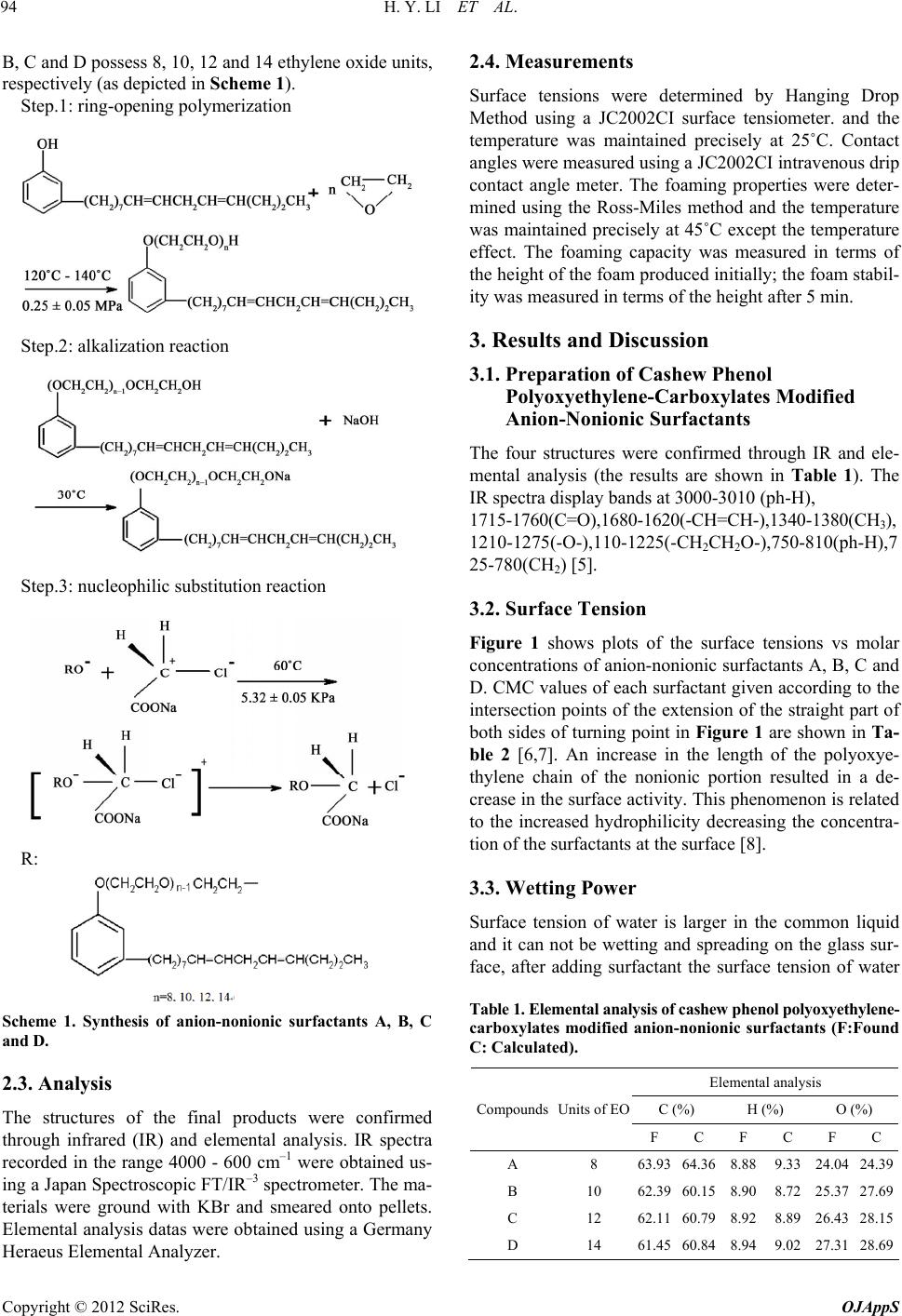 H. Y. LI ET AL. 94 B, C and D possess 8, 10, 12 and 14 ethylene oxide units, respectively (as depicted in Scheme 1). Step.1: ring-opening polymerization Step.2: alkalization reaction Step.3: nucleophilic substitution reaction R: Scheme 1. Synthesis of anion-nonionic surfactants A, B, C and D. 2.3. Analysis The structures of the final products were confirmed through infrared (IR) and elemental analysis. IR spectra recorded in the range 4000 - 600 cm–1 were obtained us- ing a Japan Spectroscopic FT/IR–3 spectrometer. The ma- terials were ground with KBr and smeared onto pellets. Elemental analysis datas were obtained using a Germany Heraeus Elemental Analyzer. 2.4. Measurements Surface tensions were determined by Hanging Drop Method using a JC2002CI surface tensiometer. and the temperature was maintained precisely at 25˚C. Contact angles were measured using a JC2002CI intravenous drip contact angle meter. The foaming properties were deter- mined using the Ross-Miles method and the temperature was maintained precisely at 45˚C except the temperature effect. The foaming capacity was measured in terms of the height of the foam produced initially; the foam stabil- ity was measured in terms of the height after 5 min. 3. Results and Discussion 3.1. Preparation of Cashew Phenol Polyoxyethylene-Carboxylates Modified Anion-Nonionic Surfactants The four structures were confirmed through IR and ele- mental analysis (the results are shown in Table 1). The IR spectra display bands at 3000-3010 (ph-H), 1715-1760(C=O),1680-1620(-CH=CH-),1340-1380(CH3), 1210-1275(-O -),110 -1225(-CH 2CH2O-),750-810(p h-H),7 25-780(CH2) [5]. 3.2. Surface Tension Figure 1 shows plots of the surface tensions vs molar concentrations of anion-nonionic surfactants A, B, C and D. CMC values of each surfactant given according to the intersection points of the extension of the straight part of both sides of turning point in Figure 1 are shown in Ta- ble 2 [6,7]. An increase in the length of the polyoxye- thylene chain of the nonionic portion resulted in a de- crease in the surface activity. This phenomenon is related to the increased hydrophilicity decreasing the concentra- tion of the surfactants at the surface [8]. 3.3. Wetting Power Surface tension of water is larger in the common liquid and it can not be wetting and spreading on the glass sur- face, after adding surfactant the surface tension of water Table 1. Elemental analysis of cashew phenol polyoxyethylene- carboxylates modified anion-nonionic surfactants (F:Found C: Calculated). Elemental analysis C (%) H (%) O (%) CompoundsUnits of EO F C F C F C A 8 63.9364.36 8.88 9.33 24.0424.39 B 10 62.3960.15 8.90 8.72 25.3727.69 C 12 62.1160.79 8.92 8.89 26.4328.15 D 14 61.4560.84 8.94 9.02 27.3128.69 Copyright © 2012 SciRes. OJAppS 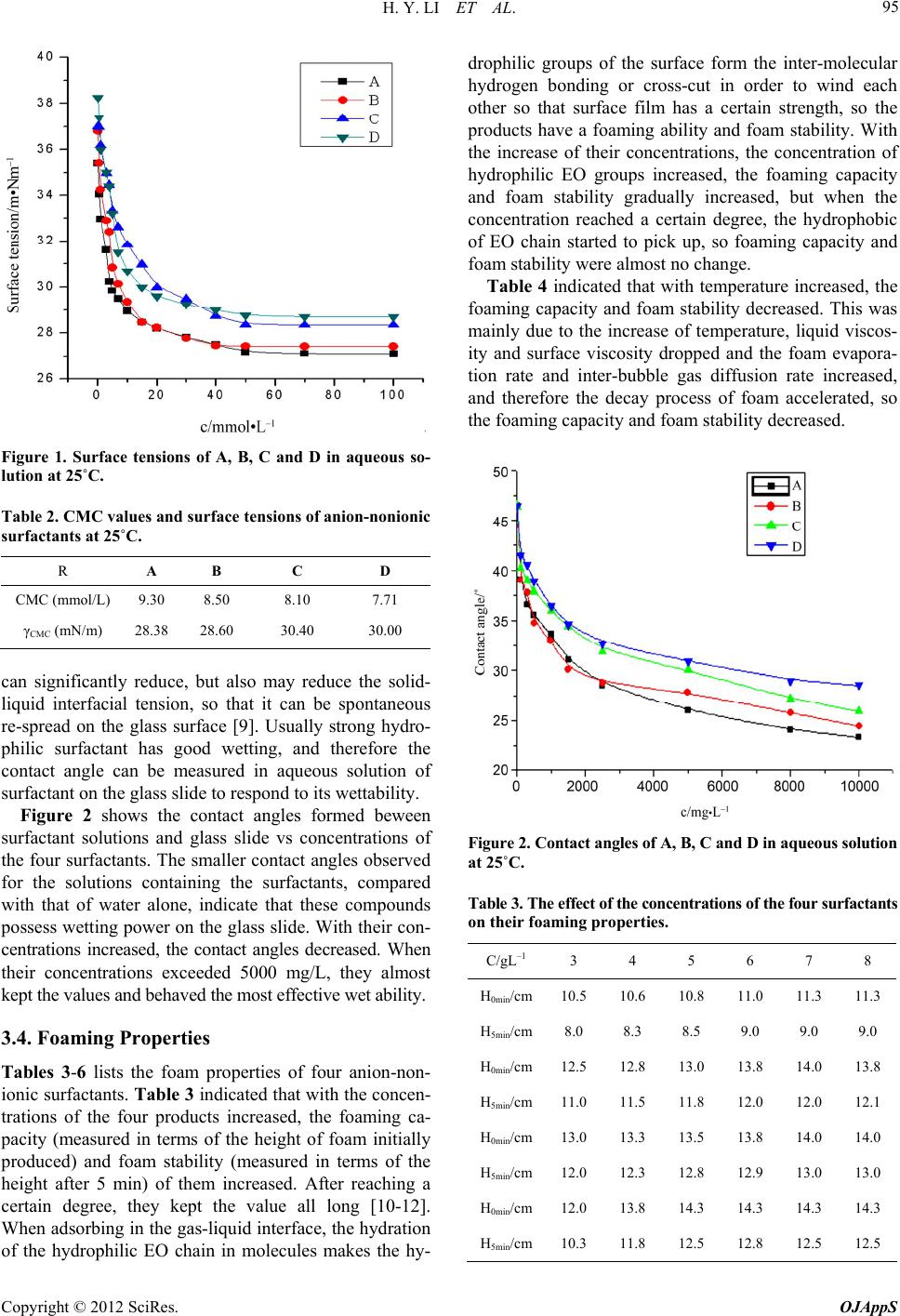 H. Y. LI ET AL. 95 Figure 1. Surface tensions of A, B, C and D in aqueous so- lution at 25˚C. Table 2. CMC values and surface te nsions of anion-nonionic surfactants at 25˚C. R A B C D CMC (mmol/L) 9.30 8.50 8.10 7.71 γCMC (mN/m) 28.38 28.60 30.40 30.00 can significantly reduce, but also may reduce the solid- liquid interfacial tension, so that it can be spontaneous re-spread on the glass surface [9]. Usually strong hydro- philic surfactant has good wetting, and therefore the contact angle can be measured in aqueous solution of surfactant on the glass slide to respond to its wettability. Figure 2 shows the contact angles formed beween surfactant solutions and glass slide vs concentrations of the four surfactants. The smaller contact angles observed for the solutions containing the surfactants, compared with that of water alone, indicate that these compounds possess wetting power on the glass slide. With their con- centrations increased, the contact angles decreased. When their concentrations exceeded 5000 mg/L, they almost kept the values and behaved the most effective wet ability. 3.4. Foaming Properties Tables 3-6 lists the foam properties of four anion-non- ionic surfactants. Table 3 indicated that with the concen- trations of the four products increased, the foaming ca- pacity (measured in terms of the height of foam initially produced) and foam stability (measured in terms of the height after 5 min) of them increased. After reaching a certain degree, they kept the value all long [10-12]. When adsorbing in the gas-liquid interface, the hydration of the hydrophilic EO chain in molecules makes the hy- drophilic groups of the surface form the inter-molecular hydrogen bonding or cross-cut in order to wind each other so that surface film has a certain strength, so the products have a foaming ability and foam stability. With the increase of their concentrations, the concentration of hydrophilic EO groups increased, the foaming capacity and foam stability gradually increased, but when the concentration reached a certain degree, the hydrophobic of EO chain started to pick up, so foaming capacity and foam stability were almost no change. Table 4 indicated that with temperature increased, the foaming capacity and foam stability decreased. This was mainly due to the increase of temperature, liquid viscos- ity and surface viscosity dropped and the foam evapora- tion rate and inter-bubble gas diffusion rate increased, and therefore the decay process of foam accelerated, so the foaming capacity and foam stability decreased. Figure 2. Contact angles of A, B, C and D in aqueous solution at 25˚C. Table 3. The effect of the concentrations of the four surfactants on their foaming properties. C/gL–1 3 4 5 6 7 8 H0min/cm10.5 10.6 10.8 11.0 11.3 11.3 H5min/cm8.0 8.3 8.5 9.0 9.0 9.0 H0min/cm12.5 12.8 13.0 13.8 14.0 13.8 H5min/cm11.0 11.5 11.8 12.0 12.0 12.1 H0min/cm13.0 13.3 13.5 13.8 14.0 14.0 H5min/cm12.0 12.3 12.8 12.9 13.0 13.0 H0min/cm12.0 13.8 14.3 14.3 14.3 14.3 H5min/cm10.3 11.8 12.5 12.8 12.5 12.5 Copyright © 2012 SciRes. OJAppS 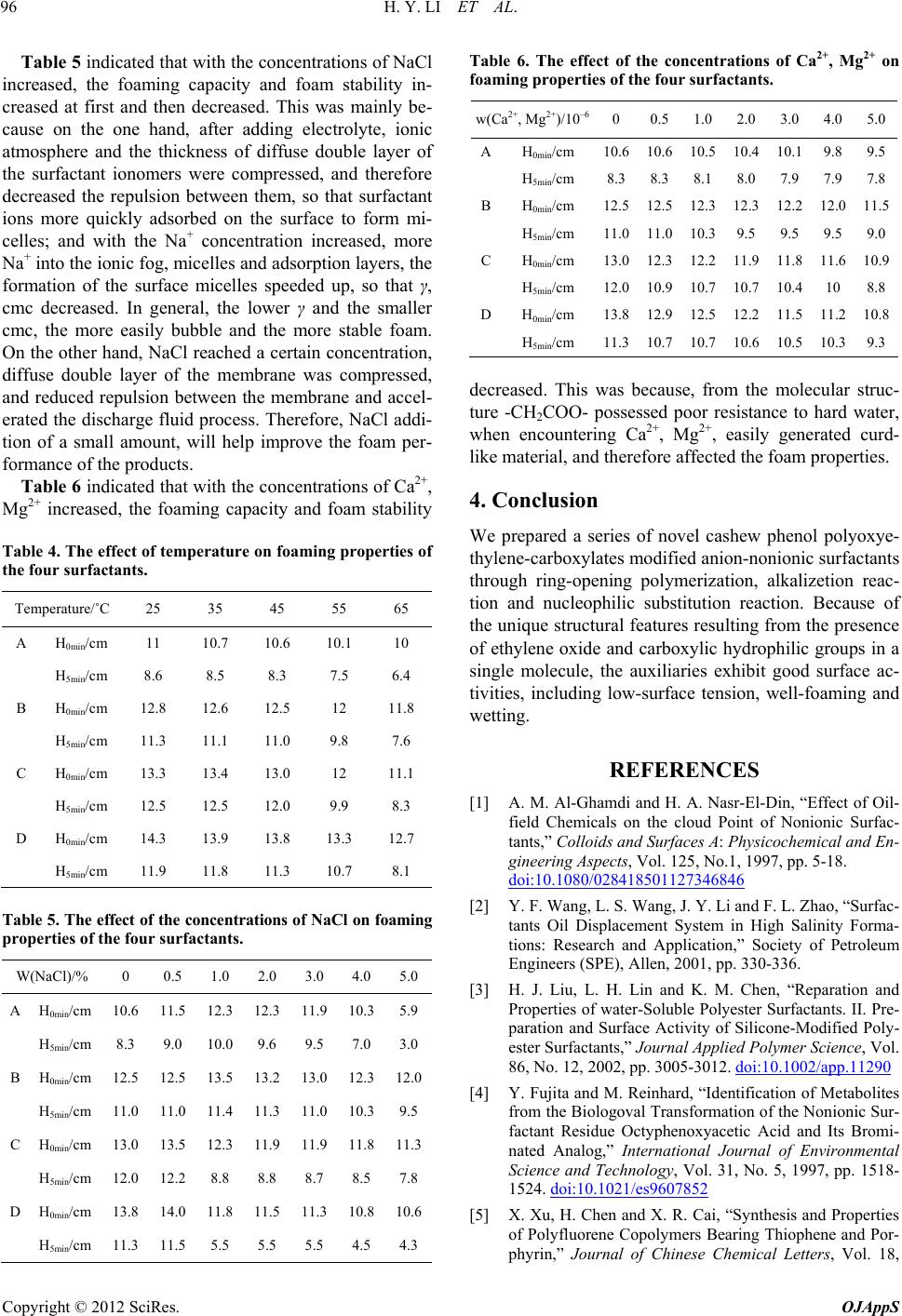 H. Y. LI ET AL. 96 Table 5 indicated that with the concentrations of NaCl increased, the foaming capacity and foam stability in- creased at first and then decreased. This was mainly be- cause on the one hand, after adding electrolyte, ionic atmosphere and the thickness of diffuse double layer of the surfactant ionomers were compressed, and therefore decreased the repulsion between them, so that surfactant ions more quickly adsorbed on the surface to form mi- celles; and with the Na+ concentration increased, more Na+ into the ionic fog, micelles and adsorption layers, the formation of the surface micelles speeded up, so that γ, cmc decreased. In general, the lower γ and the smaller cmc, the more easily bubble and the more stable foam. On the other hand, NaCl reached a certain concentration, diffuse double layer of the membrane was compressed, and reduced repulsion between the membrane and accel- erated the discharge fluid process. Therefore, NaCl addi- tion of a small amount, will help improve the foam per- formance of the products. Table 6 indicated that with the concentrations of Ca2+, Mg2+ increased, the foaming capacity and foam stability Table 4. The effect of temperature on foaming properties of the four surfactants. Temperature/˚C 25 35 45 55 65 A H0min/cm 11 10.7 10.6 10.1 10 H 5min/cm 8.6 8.5 8.3 7.5 6.4 B H0min/cm 12.8 12.6 12.5 12 11.8 H 5min/cm 11.3 11.1 11.0 9.8 7.6 C H0min/cm 13.3 13.4 13.0 12 11.1 H 5min/cm 12.5 12.5 12.0 9.9 8.3 D H0min/cm 14.3 13.9 13.8 13.3 12.7 H 5min/cm 11.9 11.8 11.3 10.7 8.1 Table 5. The effect of the concentrations of NaCl on foaming properties of the four surfactants. W(NaCl)/% 0 0.5 1.0 2.0 3.0 4.0 5.0 A H0min/cm 10.6 11.5 12.312.3 11.9 10.35.9 H 5min/cm 8.3 9.0 10.09.6 9.5 7.0 3.0 B H0min/cm 12.5 12.5 13.5 13.2 13.0 12.3 12.0 H 5min/cm 11.0 11.0 11.411.3 11.0 10.39.5 C H0min/cm 13.0 13.5 12.3 11.9 11.9 11.8 11.3 H 5min/cm 12.0 12.2 8.88.8 8.7 8.57.8 D H0min/cm 13.8 14.0 11.811.5 11.3 10.8 10.6 H 5min/cm 11.3 11.5 5.55.5 5.5 4.54.3 Table 6. The effect of the concentrations of Ca2+, Mg2+ on foaming properties of the four surfactants. w(Ca2+, Mg2+)/10–6 0 0.51.0 2.0 3.0 4.05.0 AH 0min/cm 10.610.610.5 10.4 10.1 9.89.5 H 5min/cm 8.38.38.1 8.0 7.9 7.97.8 BH 0min/cm 12.5 12.5 12.3 12.3 12.2 12.0 11.5 H 5min/cm 11.011.010.3 9.5 9.5 9.59.0 CH 0min/cm 13.0 12.3 12.2 11.9 11.8 11.6 10.9 H 5min/cm 12.010.910.7 10.7 10.4 108.8 DH 0min/cm 13.8 12.9 12.5 12.2 11.5 11.2 10.8 H 5min/cm 11.3 10.7 10.7 10.6 10.5 10.39.3 decreased. This was because, from the molecular struc- ture -CH2COO- possessed poor resistance to hard water, when encountering Ca2+, Mg2+, easily generated curd- like material, and therefore affected the foam properties. 4. Conclusion We prepared a series of novel cashew phenol polyoxye- thylene-carboxylates modified anion-nonionic surfactants through ring-opening polymerization, alkalizetion reac- tion and nucleophilic substitution reaction. Because of the unique structural features resulting from the presence of ethylene oxide and carboxylic hydrophilic groups in a single molecule, the auxiliaries exhibit good surface ac- tivities, including low-surface tension, well-foaming and wetting. REFERENCES [1] A. M. Al-Ghamdi and H. A. Nasr-El-Din, “Effect of Oil- field Chemicals on the cloud Point of Nonionic Surfac- tants,” Colloids and Surfaces A: Physicochemical and En- gineering Aspects, Vol. 125, No.1, 1997, pp. 5-18. doi:10.1080/028418501127346846 [2] Y. F. Wang, L. S. Wang, J. Y. Li and F. L. Zhao, “Surfac- tants Oil Displacement System in High Salinity Forma- tions: Research and Application,” Society of Petroleum Engineers (SPE), Allen, 2001, pp. 330-336. [3] H. J. Liu, L. H. Lin and K. M. Chen, “Reparation and Properties of water-Soluble Polyester Surfactants. II. Pre- paration and Surface Activity of Silicone-Modified Poly- ester Surfactants,” Journal Applied Polymer Science, Vol. 86, No. 12, 2002, pp. 3005-3012. doi:10.1002/app.11290 [4] Y. Fujita and M. Reinhard, “Identification of Metabolites from the Biologoval Transformation of the Nonionic Sur- factant Residue Octyphenoxyacetic Acid and Its Bromi- nated Analog,” International Journal of Environmental Science and Technology, Vol. 31, No. 5, 1997, pp. 1518- 1524. doi:10.1021/es9607852 [5] X. Xu, H. Chen and X. R. Cai, “Synthesis and Properties of Polyfluorene Copolymers Bearing Thiophene and Por- phyrin,” Journal of Chinese Chemical Letters, Vol. 18, Copyright © 2012 SciRes. OJAppS  H. Y. LI ET AL. Copyright © 2012 SciRes. OJAppS 97 No. 7, 2007, pp. 879-882. doi:10.1016/j.cclet.2007.05.040 [6] C. C. Lai and K. M. Chen, “Preparation and surface Ac- tivity of Polyoxyethylene-Carboxylated Modified Gemini Surfactants,” Journal of Colloids and Surfaces A: Phys- icochemical and Engineering Aspects, Vol. 320, No.1-3, 2008, pp. 6-10. doi:10.1016/j.colsurfa.2007.12.056 [7] L. G. Qiu, A. J. Xie and Y. H. Shen, “Synthesis and Sur- face Activity of Novel Triazole-Based Cationic Gemini Surfactants,” Journal of Chinese Chemical Letters, Vol. 14, No. 6, 2003, pp. 653-656. [8] M. J. Rosen, “Wetting and Its Modification by Surfactants,” Surfactants and Interfacial Phenomena, 3rd Edition, Wiley- Interscience, New York, 1978, p. 174. [9] S. Paria and K. C. Khilar, “A Review on Experimental Stu- dies of Surfactant Adsorption at the Hydrophilic Solid- Water Interface,” Advances in Colloid and Interface Sci- ence, Vol. 110, No. 3, 2004, pp. 75-95. doi:10.1016/j.cis.2004.03.001 [10] K. M. Chen and H. J. Liu, “Preparation and Surface Ac- tivity of Water-Soluble Polyesters,” Journal Applied Po- lymer Science, Vol. 34, No. 5, 1987, pp. 1879-1888. doi:10.1002/app.1987.070340507 [11] Y. Li, P. Zhang, G. Q. Zhao, X. L. Cao, Q. W. Wang and H. Y. Wang. “Effect of Equilibrium and Dynamic Surface Activity of Surfactant on Foam Transport in Porous Me- dium,” Journal of Colloids and Surfaces A: Physico- chemical and Engineering Aspects, Vol. 272, No. 1-2, 2006, pp.124-129. doi:10.1016/j.colsurfa.2005.07.037 [12] D. Beneventi, B. Carre and A. Gandini, “Role of Surfac- tant Structure on Surface and foaming Properties,” Jour- nal of Colloids and Surfaces A: Physicochemical and En- gineering Aspects, Vol. 189, No. 1-3, 2001, pp. 65-73. doi:10.1016/S0927-7757(01)00602-1 |