

Paper Menu >>
Journal Menu >>
 Natural Resources, 2012, 3, 71-74 http://dx.doi.org/10.4236/nr.2012.32011 Published Online June 2012 (http://www.SciRP.org/journal/nr) 71 Preparation of Calcium Phosphate with Oyster Shells Hiroaki Onoda, Hironari Nakanishi Department of Informatics and Environmental Sciences, Kyoto Prefectural University, Kyoto, Japan. Email: [email protected] Received April 16th, 2012; revised May 10th, 2012; accepted May 18th, 2012 ABSTRACT Oyster shells have received attention for use as a calcium resource. For this study, calcium phosphate was prepared from phosphoric acid and oyster shells. The influences of the concentration of phosphoric acid and pH in the prepara- tion conditions were studied from the yields of calcium phosphate and unreacted carbonate, and the Ca/P ratios in pre- cipitates. The yield of calcium phosphate and carbonate was low in the preparation condition with 0.1 mol/l of phos- phoric acid. The obtained precipitates were the mixture of calcium hydrogen phosphate dihydrate and the unreacted calcium carbonate. The reactivity of the oyster shells with phosphoric acid was discussed from the yields and Ca/P ra- tios in precipitates. Keywords: Calcium Phosphate; Oyster Shells; Calcium Carbonate; Yield; Powder Properties 1. Introduction Recently, interest in the recycling of waste materials is increasing. From this viewpoint, seashells have been used as a raw material for various applications [1,2]. Generally, edible parts of shellfish are few. Therefore, large amounts of waste material are produced from shellfish processing. Because seashells are easy to gather, they are suitable for use as a raw material. To date, seashells that are light with little pigment, for ex ample scallops, hav e been used as a calcium resource [3,4]. Nevertheless, it is difficult to use seashells that are dark and which have much pig- ment. Calcium phosphates are important materials for many applications, such as ion exchangers, adsorbents, and so on [5,6]. Calcium phosphates were prepared from sea urchin shells and artificial phosphorus waste fluid in earlier studies [7,8]. The obtained precipitates’ main component was CaHPO4·2H2O. The precipitates con- taining organic coloring materials were obtained in the process with the sea-urchin shell heated at lower tem- peratures as a pretreatment. Sea urchin shells have overly strong coloring materials. In contrast, corbicula and oyster shells were expected to produce calcium phos- phate with fewer coloring materials [9]. In previous work, corbicula shells were used to prepare calcium phosphate [10]. The corbicula shells with and without heating reacted with phosphoric acid to calcium hydrogen phosphate dihydrate. Oyster is one of the popular seafoods in all o ver the world. Therefore, the oyster shells are easy to gather, these oyster shells have a possibility to use as one of cal- cium resource. In this work, we tried to use this oyster shell as a cal- cium resource to prepare calcium phosphate. The concen- tration of phosphoric acid and pH value were varied to clarify the formation mechanism of calcium phosphate. The chemical composition and powder properties of pre- cipitates were investigated. The obtained phosphate ma- terials were also assessed for the comparison with cal- cium phosphate prepared from phosphoric acid and commercial calcium carbonate. 2. Experimental Oyster shells were washed and milled to a powder condi- tion. Half were heated at 400˚C for 1 hour. The shell powders without heating and heated at 400℃ were mixed with 0.1, 0.05, and 0.01 mol/l of phosphoric acid in the ratio of Ca/P = 1, 2, and 10, respectively. At this time, the weight of oyster shells was calculated as that of cal- cium carbonate. These solutions were adjusted with am- monia water to pH 5, 7, and 9. The precipitates in these solutions were filtered off and dried. For comparison, commercial calcium carbonate was reacted with phos- phoric acid in the same conditions as those used for oys- ter shells. A part of the precipitates was dissolved in hydrochloric acid solution. The ratios of phosphorus and calcium in the precipitates were also calculated from ICP results of these solutions, using SPS1500VR, Seiko Instruments Inc. XRD patterns of materials were recorded on a Rigaku Denki RINT 2000 X-Ray diffractometer using monochromated CuKα radiation. Copyright © 2012 SciRes. NR 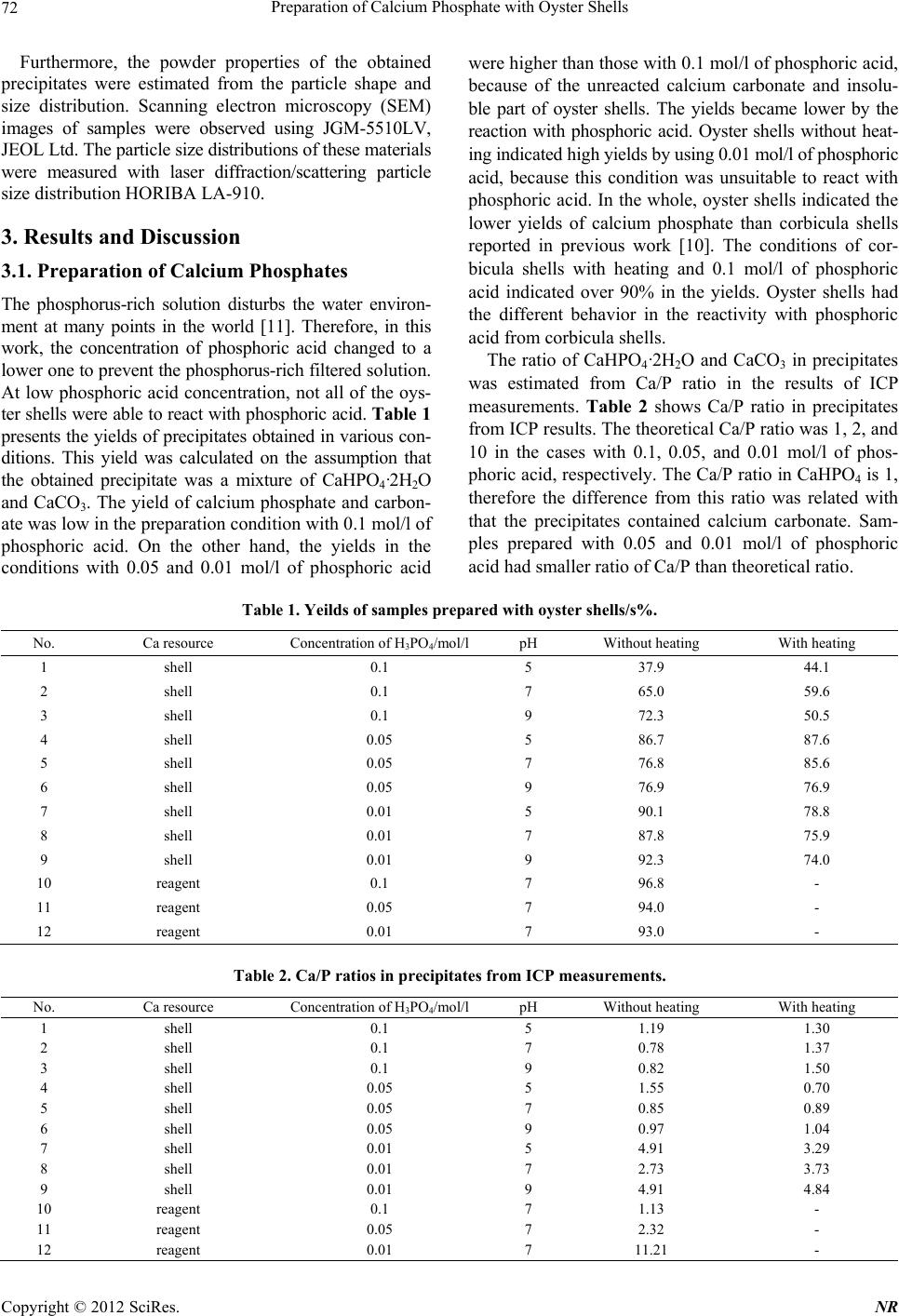 Preparation of Calcium Phosphate with Oyster Shells 72 Furthermore, the powder properties of the obtained precipitates were estimated from the particle shape and size distribution. Scanning electron microscopy (SEM) images of samples were observed using JGM-5510LV, JEOL Ltd. The particle size distributions of these m ate rials were measured with laser diffraction/scattering particle size distribution HORIBA L A- 910. 3. Results and Discussion 3.1. Preparation of Calcium Phosphates The phosphorus-rich solution disturbs the water environ- ment at many points in the world [11]. Therefore, in this work, the concentration of phosphoric acid changed to a lower one to prevent the phosphorus-rich filtered solu tio n. At low phosphoric acid concentration, not all of the oys- ter shells were able to react with phosphoric acid. Table 1 presents the yields of precipitates obtained in various con- ditions. This yield was calculated on the assumption that the obtained precipitate was a mixture of CaHPO4·2H2O and CaCO3. The yield of calcium phosphate and carbon- ate was low in the preparation condition with 0.1 mol/l of phosphoric acid. On the other hand, the yields in the conditions with 0.05 and 0.01 mol/l of phosphoric acid were higher than those with 0.1 mol/l of phosphoric acid, because of the unreacted calcium carbonate and insolu- ble part of oyster shells. The yields became lower by the reaction with phosphoric acid. Oyster shells without heat- ing indicated high yi elds by usi ng 0.01 m ol/l of phosphori c acid, because this condition was unsuitable to react with phosphoric acid. In the whole, oyster shells indicated the lower yields of calcium phosphate than corbicula shells reported in previous work [10]. The conditions of cor- bicula shells with heating and 0.1 mol/l of phosphoric acid indicated over 90% in the yields. Oyster shells had the different behavior in the reactivity with phosphoric acid from corbicula shells. The ratio of CaHPO4·2H2O and CaCO3 in precipitates was estimated from Ca/P ratio in the results of ICP measurements. Table 2 shows Ca/P ratio in precipitates from ICP results. The theoretical Ca/P ratio was 1, 2, and 10 in the cases with 0.1, 0.05, and 0.01 mol/l of phos- phoric acid, respectively. The Ca/P ratio in CaHPO4 is 1, therefore the difference from this ratio was related with that the precipitates contained calcium carbonate. Sam- ples prepared with 0.05 and 0.01 mol/l of phosphoric acid had smaller ratio of Ca/P than theoretical ratio. Table 1. Yeilds of samples prepared with oyster shells/s%. No. Ca resource Concentration of H3PO4/mol/l pH Without heating With heating 1 shell 0.1 5 37.9 44.1 2 shell 0.1 7 65.0 59.6 3 shell 0.1 9 72.3 50.5 4 shell 0.05 5 86.7 87.6 5 shell 0.05 7 76.8 85.6 6 shell 0.05 9 76.9 76.9 7 shell 0.01 5 90.1 78.8 8 shell 0.01 7 87.8 75.9 9 shell 0.01 9 92.3 74.0 10 reagent 0.1 7 96.8 - 11 reagent 0.05 7 94.0 - 12 reagent 0.01 7 93.0 - Table 2. Ca/P ratios in precipitates from ICP measurements. No. Ca resource Concentration of H3PO4/mol/l pH Without heating With heating 1 shell 0.1 5 1.19 1.30 2 shell 0.1 7 0.78 1.37 3 shell 0.1 9 0.82 1.50 4 shell 0.05 5 1.55 0.70 5 shell 0.05 7 0.85 0.89 6 shell 0.05 9 0.97 1.04 7 shell 0.01 5 4.91 3.29 8 shell 0.01 7 2.73 3.73 9 shell 0.01 9 4.91 4.84 10 reagent 0.1 7 1.13 - 11 reagent 0.05 7 2.32 - 12 reagent 0.01 7 11.21 - Copyright © 2012 SciRes. NR 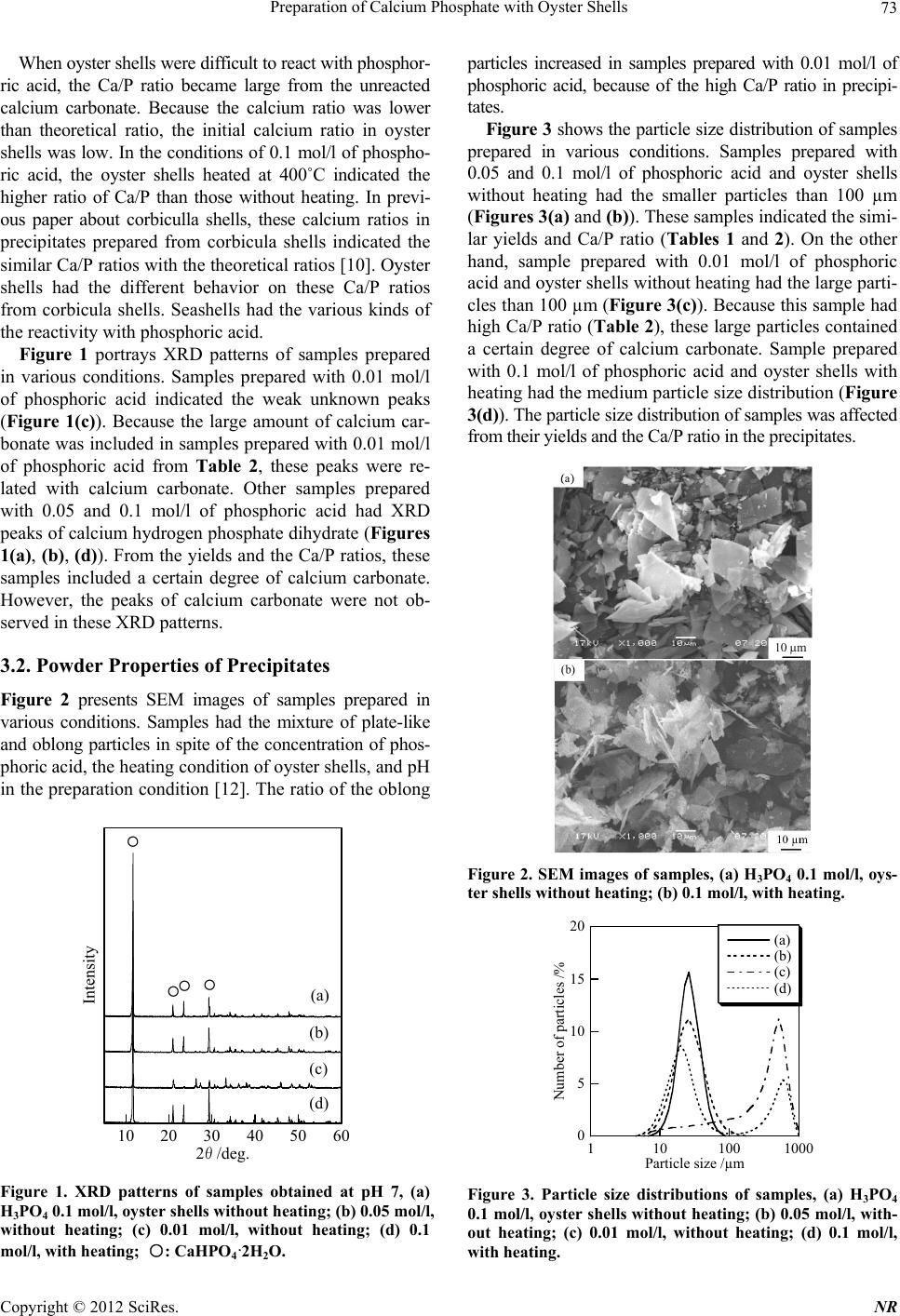 Preparation of Calcium Phosphate with Oyster Shells 73 When oyster shells were difficult to react with phosphor- ric acid, the Ca/P ratio became large from the unreacted calcium carbonate. Because the calcium ratio was lower than theoretical ratio, the initial calcium ratio in oyster shells was low. In the conditions of 0.1 mol/l of phospho- ric acid, the oyster shells heated at 400˚C indicated the higher ratio of Ca/P than those without heating. In previ- ous paper about corbiculla shells, these calcium ratios in precipitates prepared from corbicula shells indicated the similar Ca/P ratios with the theoretical ratios [10]. Oyster shells had the different behavior on these Ca/P ratios from corbicula shells. Seashells had the various kinds of the reactivity with phosphoric acid. Figure 1 portrays XRD patterns of samples prepared in various conditions. Samples prepared with 0.01 mol/l of phosphoric acid indicated the weak unknown peaks (Figure 1(c)). Because the large amount of calcium car- bonate was included in samples prepared with 0.01 mol/l of phosphoric acid from Table 2, these peaks were re- lated with calcium carbonate. Other samples prepared with 0.05 and 0.1 mol/l of phosphoric acid had XRD peaks of calcium hydrogen phosphate dihydrate (Figures 1(a), (b), (d)). From the yields and the Ca/P ratios, these samples included a certain degree of calcium carbonate. However, the peaks of calcium carbonate were not ob- served in these XRD patterns. 3.2. Powder Properties of Precipitates Figure 2 presents SEM images of samples prepared in various conditions. Samples had the mixture of plate-like and oblong particles in spite of the concentration of phos- phoric acid, the heatin g co nd itio n of o yst er shells , and pH in the preparatio n condition [12]. The ratio of the oblong 10 20 30 40 5060 Intensity 2 /deg. ○ ○○ ○ θ (a) (b) (c) (d) Figure 1. XRD patterns of samples obtained at pH 7, (a) H3PO4 0.1 mol/l, oyster she lls with out heating; (b) 0.05 mol/l, without heating; (c) 0.01 mol/l, without heating; (d) 0.1 mol/l, with heating; ○: CaHPO4·2H2O. particles increased in samples prepared with 0.01 mol/l of phosphoric acid, because of the high Ca/P ratio in precipi- tates. Figure 3 shows the particle size distribution of samples prepared in various conditions. Samples prepared with 0.05 and 0.1 mol/l of phosphoric acid and oyster shells without heating had the smaller particles than 100 µm (Figures 3(a) and (b)). These samples indicated the simi- lar yields and Ca/P ratio (Tables 1 and 2). On the other hand, sample prepared with 0.01 mol/l of phosphoric acid and oyster shells without heating had the large parti- cles than 100 µm (Figure 3(c)). Because this sample had high Ca/P ratio (Tab le 2), these large particles contained a certain degree of calcium carbonate. Sample prepared with 0.1 mol/l of phosphoric acid and oyster shells with heating had the medium particle size distribution (Figure 3(d)). The particle size distribution of samples was affected from their yields and the Ca/P ratio in the precipitates. Figure 2. SEM images of samples, (a) H3PO4 0.1 mol/l, oys- ter shells without heating; (b) 0.1 mol/l, with heating. 0 5 10 15 20 110100 1000 (a) (b) (c) (d) Number of particles /% Particle size /µm Figure 3. Particle size distributions of samples, (a) H3PO4 0.1 mol/l, oyster shells without heating; (b) 0.05 mol/l, with- out heating; (c) 0.01 mol/l, without heating; (d) 0.1 mol/l, with heating. Copyright © 2012 SciRes. NR  Preparation of Calcium Phosphate with Oyster Shells 74 4. Conclusion Calcium phosphates were prepared using oyster shells and phosphoric acid. The reactivity between oyster shells and phosphoric acid was estimated from the yield of cal- cium phosphate and carbonate and the Ca/P ratio in pre- cipitates. The yields in the co nditions with 0.05 and 0.01 mol/l of phosphoric acid were higher than those with 0.1 mol/l of phosphoric acid, because of the unreacted calcium carbonate and insoluble part of oyster shells. The obta in ed samples prepared with 0.1 and 0.05 mol/l of phosphoric acid indicated XRD peak pattern of calcium hydrogen phosphate dihydrate. Samples prepared with 0.01 mol/l of phosphoric acid included a large amount of calcium carbonate. REFERENCES [1] J.-H. Jung, K.-S. Yoo, H.-G. Kim, H.-K. Lee and B.-H. Shon, “Reuse of Waste Oyster Shells as a SO2/NOx Re- moval Absorbent,” Journal of Industrial and Engineering Chemistry, Vol. 13, No. 4, 2007, pp. 512-517. [2] D. S. Jeon and S. H. Ye om, “Recycling Wast ed Biomate- rial, Crab Shells, as an Adsorbent for the Removal of High Concentration of Phosphate,” Bioresource Tech- nology, Vol. 100, No. 9, 2009, pp. 2646-2649. doi:10.1016/j.biortech.2008.11.035 [3] J. Sawai, M. Satoh, M. Horikawa, H. Shiga and H. Ko- jima, “Heated Scallop-Shell Powder Slurry Treatment of Shredded Cabbage,” Journal of Food Protection, Vol. 64, No. 10, 2001, pp. 1579-1583. [4] J. Sawai, H. Shiga and H. Kojima, “Kinetic Analysis of the Bactericidal Action of Heated Scallop-Shell Powder,” International Journal of Food Microbiology, Vol. 71, No. 2-3, 2001, pp. 211-218. doi:10.1016/S0168-1605(01)00619-5 [5] M. P. Ginebra, T. Traykova and J. A. Planell, “Calcium Phosphate Cements as Bone Drug Delivery System: A Review,” Journal of Controlled Release, Vol. 113, No. 2, 2006, pp. 102-110. doi:10.1016/j.jconrel.2006.04.007 [6] J. Ryu, K.-Y. Kim, B.-D. Hahn, J.-J. Choi, W.-H. Yoon, B.-K. Lee, D.-S. Park and C. Park, “Photocatalytic Nano- composite Thin Films of TiO2-Beta-Calcium Phosphate by Aerosol-Deposition,” Catalysis Communications, Vol. 10, No. 5, 2009, pp. 596-599. doi:10.1016/j.catcom.2008.10.045 [7] H. Onoda, H. Kawade and A. Takenaka, “Preparation of Calcium Phosphates from Resemble Phosphorus Waste Water and Sea Urchin Shells,” Journal of Ecotechnology Research, Vol. 15, No. 3-4, 2010, pp. 107-111. [8] H. Onoda, M. Ichimura and A. Takenaka, “Preparation and Lead Removal Effects of Calcium Phosphates from Sea Urchin Shell,” Phosphorus Research Bulletin, Vol. 24, 2010, pp. 49-53. doi:10.3363/prb.24.49 [9] Y. Yu, R. Wu and M. Clark, “Phosphate Removal by Hydrothermally Modified Fumed Silica and Pulverized Oyster Shells,” Journal of Colloid and Interface Science, Vol. 350, No. 2, 2010, pp. 538-543. doi:10.1016/j.jcis.2010.06.033 [10] H. Onoda, H. Nakanishi and A. Takenaka, “Preparation of Calcium Phosphates with Corbicula Shells,” Journal of Ecotechnology Research, Vol. 16, No. 3-4, 2012, pp. 85-89. [11] A. P. Davis, M. Shokouhian, H. Sharma and C. Minami, “Water Quality Improvement through Bloretention Media: Nitrogen and Phosphorus Removal,” Water Environment Research, Vol. 78, No. 3, 2006, pp. 284-293. doi:10.2175/106143005X94376 [12] G. Madhurambai, R. Subha and S. C. Mojumdar, “Crys- tallization and Thermal Characterization of Calcium Hy- drogen Phosphate Dihydrate Crystals,” Journal of Ther- mal Analysis Calorimetry, Vol. 96, No. 1, 2009, pp. 73- 76. doi:10.1007/s10973-008-9841-1 Copyright © 2012 SciRes. NR |