

Paper Menu >>
Journal Menu >>
 Natural Resources, 2012, 3, 29-34 http://dx.doi.org/10.4236/nr.2012.32005 Published Online June 2012 (http://www.SciRP.org/journal/nr) 29 Effect of the Pre-Treatment Severity on the Antioxidant Properties of Ethanol Organosolv Miscanthus x giganteus Lignin Roland El Hage1,2, Dominique Perrin3, Nicolas Brosse3* 1Centre des Matériaux de Grande Diffusion (CMGD), Ecole des Mines d’Alès, France; 2INNOBAT, Cap Alpha, Clapiers, France; 3Laboratoire d’Etude et de Recherche sur le MAteriau Bois, Faculté des Sciences et Techniques, Nancy-Université, Vandœuvre- lès-Nancy, France. Email: *[email protected] Received November 7th, 2011; revised December 29th, 2011; accepted January 8th, 2012 ABSTRACT The effect of the severity of an organosolv treatment of Miscanthus x giganteus on antioxidant capacity of the obtained lignin was studied. Four organosolv lignins extracted with different severity conditions were chosen and tested. Results obtained using the methyl linoleate method have shown a correlation between oxygen uptake index and the combined severity. It was found that lignin extracted at higher severity pre-treatment and with a higher phenolic hydroxyl content, lower aliphatic hydroxyl content, molecular weight and polydispersity has the highest antioxidant capacity. Keywords: Miscanthus x giganteus; Organosolv Lignin; Antioxidant; Combined Severity; Molecular Weight; Phenolic and Aliphatic Hydroxyl 1. Introduction The organosolv pulping has been the subject of con- siderable research activity and has generated increasing interest as the pulp and paper industry is moving toward minimization of environmental impact [1]. In the 1990’s, this technology was developed at the industrial scale in Canada (Alcell® Process). One of the advantages of the organosolv process is the fractionation of the lignocel- lulosic materials into three major components: cellulosic fibers, hemicelluloses and lignin. As a result, with the increasing attention devoted to the biorefinery concept, a renewed interest in the organosolv treatment is currently observed and this technology seems to be promising for the production of ethanol and high value chemicals and materials from lignin, hemicelluloses and extractives [2]. Indeed, production of high-quality lignin is one of the unique advantages of the organosolv treatment over alter- native processes which generally produce a degraded lignin employed in low added value applications and energy production. Oganosolv lignins are high-purity, low molecular weight and sulfur-free products. Moreover, they are soluble in many organic solvents, possess low glass transition temperatures, and are easier to thermally process than kraft lignins. Thus, availability of such high- quality lignin in large quantities should stimulate deve- lopment in new lignin applications in the fields of fibers, biodegradable polymers, adhesives... Lignins as well as other polyphenols are potent free radical scavengers [3] and organosolv lignins are considered to be a valuable source of antioxidant phenolic compounds, which could be recovered as functional food or feed ingredients. A large number of biochemical or chemical methods are used to measure antioxidant capacity. One class of those methods is based upon inhibition of oxidation of organic substrates: styrene [4], linoleic acid, methyl or ethyl linoleate [5], canola oil [6]. The oxygen uptake measure- ment is the most direct method used to measure the reaction extent. Moreover, the induced oxidation of methyl linoleate and its radical long chain reaction is well documented and well known to be inhibited by various antioxidants [7,8]. Pan et al. [9] have examined the radical scavenging effect of organosolv lignins from hybrid poplar and the relationship between the antioxidant capacity, lignin struc- ture and extraction conditions. The applicability of lignins from different sources as antioxidants has been also suc- cessfully tested [10]. Recently Garcia et al. [11] have studied the effect of pre-treatment processes on the antio- xidant capacity of miscanthus sinensis lignins. Miscanthus x giganteus (MxG) is one of the biomass resources which has attracted considerable attention as a possible dedicated energy crop [12,13]. Indeed, MxG *Corresponding author. Copyright © 2012 SciRes. NR 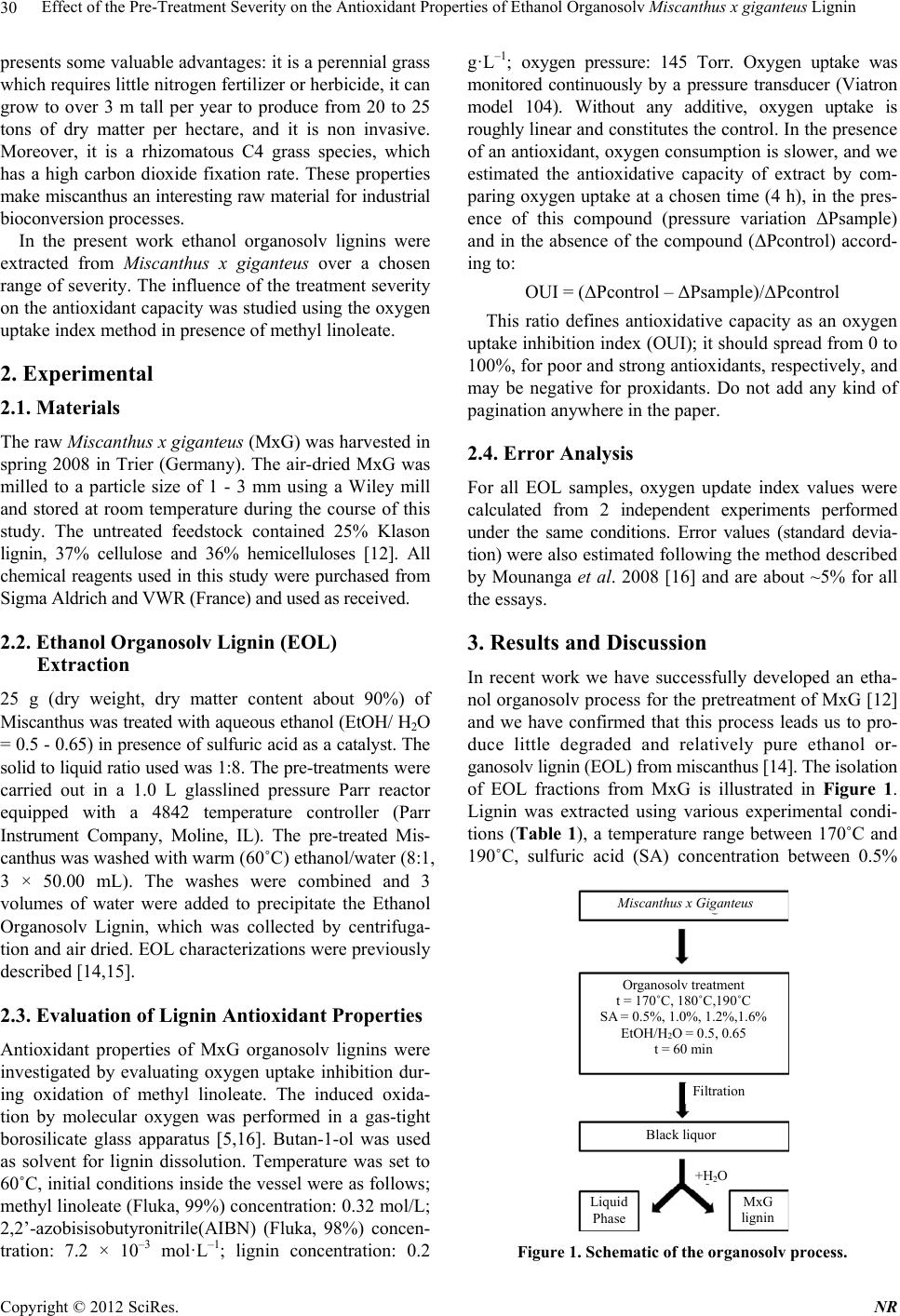 Effect of the Pre-Treatment Severity on the Antioxidant Properties of Ethanol Organosolv Miscanthus x giganteus Lignin 30 presents some valuable advantages: it is a perennial grass which requires little nitrogen fertilizer or herbicide, it can grow to over 3 m tall per year to produce from 20 to 25 tons of dry matter per hectare, and it is non invasive. Moreover, it is a rhizomatous C4 grass species, which has a high carbon dioxide fixation rate. These properties make miscanthus an interesting raw material for industrial bioconversion processes. In the present work ethanol organosolv lignins were extracted from Miscanthus x giganteus over a chosen range of severity. The influence of the treatment severity on the antioxidant capacity was studied using the oxygen uptake index method in presence of methyl linoleate. 2. Experimental 2.1. Materials The raw Miscanthus x giganteus (MxG) was harvested in spring 2008 in Trier (Germany). The air-dried MxG was milled to a particle size of 1 - 3 mm using a Wiley mill and stored at room temperature during the course of this study. The untreated feedstock contained 25% Klason lignin, 37% cellulose and 36% hemicelluloses [12]. All chemical reagents used in this study were purchased from Sigma Aldrich and VWR (France) and used as received. 2.2. Ethanol Organosolv Lignin (EOL) Extraction 25 g (dry weight, dry matter content about 90%) of Miscanthus was treated with aqueous ethanol (EtOH/ H2O = 0.5 - 0.65) in presence of sulfuric acid as a catalyst. The solid to liquid ratio used was 1:8. The pre-treatments were carried out in a 1.0 L glasslined pressure Parr reactor equipped with a 4842 temperature controller (Parr Instrument Company, Moline, IL). The pre-treated Mis- canthus was washed with warm (60˚C) ethanol/water (8:1, 3 × 50.00 mL). The washes were combined and 3 volumes of water were added to precipitate the Ethanol Organosolv Lignin, which was collected by centrifuga- tion and air dried. EOL characterizations were previously described [14,15]. 2.3. Evaluation of Lignin Antioxidant Properties Antioxidant properties of MxG organosolv lignins were investigated by evaluating oxygen uptake inhibition dur- ing oxidation of methyl linoleate. The induced oxida- tion by molecular oxygen was performed in a gas-tight borosilicate glass apparatus [5,16]. Butan-1-ol was used as solvent for lignin dissolution. Temperature was set to 60˚C, initial conditions inside the vessel were as follows; methyl linoleate (Fluka, 99%) concentration: 0.32 mol/L; 2,2’-azobisisobutyronitrile(AIBN) (Fluka, 98%) concen- tration: 7.2 × 10⁻³ mol·L–1; lignin concentration: 0.2 g·L–1; oxygen pressure: 145 Torr. Oxygen uptake was monitored continuously by a pressure transducer (Viatron model 104). Without any additive, oxygen uptake is roughly linear and constitutes the control. In the presence of an antioxidant, oxygen consumption is slower, and we estimated the antioxidative capacity of extract by com- paring oxygen uptake at a chosen time (4 h), in the pres- ence of this compound (pressure variation ΔPsample) and in the absence of the compound (ΔPcontrol) accord- ing to: OUI = (ΔPcontrol – ΔPsample)/ΔPcontrol This ratio defines antioxidative capacity as an oxygen uptake inhibition index (OUI); it should spread from 0 to 100%, for poor and strong antioxidants, respectively, and may be negative for proxidants. Do not add any kind of pagination anywhere in the paper. 2.4. Error Analysis For all EOL samples, oxygen update index values were calculated from 2 independent experiments performed under the same conditions. Error values (standard devia- tion) were also estimated following the method described by Mounanga et al. 2008 [16] and are about ~5% for all the essays. 3. Results and Discussion In recent work we have successfully developed an etha- nol organosolv process for the pretreatment of MxG [12] and we have confirmed that this process leads us to pro- duce little degraded and relatively pure ethanol or- ganosolv lignin (EOL) from miscanthus [14]. The isolation of EOL fractions from MxG is illustrated in Figure 1. Lignin was extracted using various experimental condi- tions (Table 1), a temperature range between 170˚C and 190˚C, sulfuric acid (SA) concentration between 0.5% Miscanthus x Giganteus Organosolv treatment t = 170˚C, 180˚C,190˚C SA = 0.5%, 1.0%, 1.2%,1.6% EtOH/H 2 O = 0.5, 0.65 t = 60 min Black liquor Filtration Liquid Phase MxG lignin +H 2 O Figure 1. Schematic of the or ganosolv process. Copyright © 2012 SciRes. NR 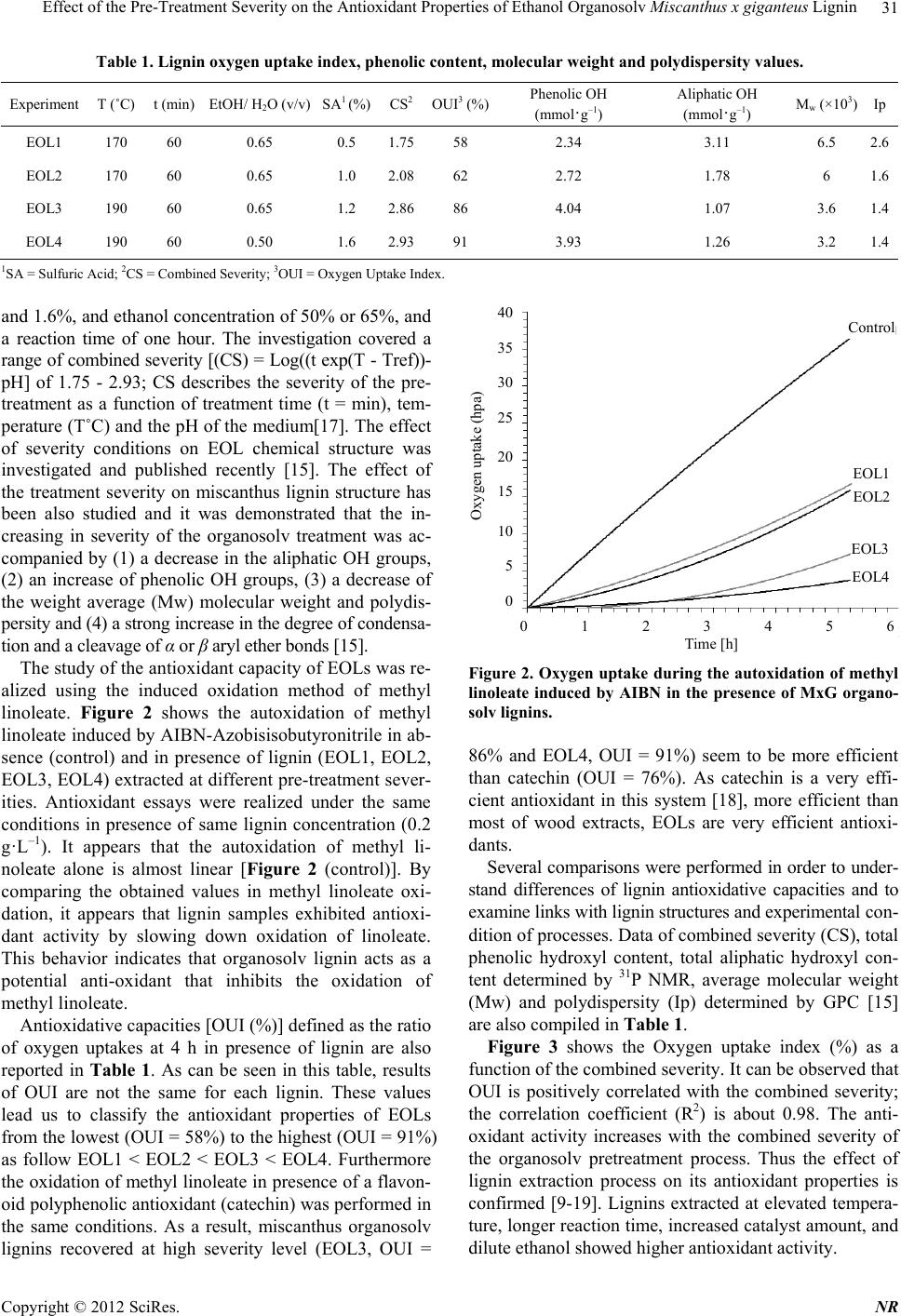 Effect of the Pre-Treatment Severity on the Antioxidant Properties of Ethanol Organosolv Miscanthus x giganteus Lignin Copyright © 2012 SciRes. NR 31 Table 1. Lignin oxygen uptake index, phenolic content, molecular weight and polydispersity values. Experiment T (˚C) t (min) EtOH/ H2O (v/v) SA1 (%) CS2OUI3 (%)Phenolic OH (mmol·g–1) Aliphatic OH (mmol·g–1) Mw (×103)Ip EOL1 170 60 0.65 0.5 1.7558 2.34 3.11 6.5 2.6 EOL2 170 60 0.65 1.0 2.0862 2.72 1.78 6 1.6 EOL3 190 60 0.65 1.2 2.8686 4.04 1.07 3.6 1.4 EOL4 190 60 0.50 1.6 2.9391 3.93 1.26 3.2 1.4 1SA = Sulfuric Acid; 2CS = Combined Severity; 3OUI = Oxygen Uptake Index. 0 1 2 3 4 5 6 Time [ h ] 40 35 30 25 20 15 10 5 0 Control Oxygen uptake (hpa) EOL1 EOL2 EOL3 EOL4 and 1.6%, and ethanol concentration of 50% or 65%, and a reaction time of one hour. The investigation covered a range of combined severity [(CS) = Log((t exp(T - Tref))- pH] of 1.75 - 2.93; CS describes the severity of the pre- treatment as a function of treatment time (t = min), tem- perature (T˚C) and the pH of the medium[17]. The effect of severity conditions on EOL chemical structure was investigated and published recently [15]. The effect of the treatment severity on miscanthus lignin structure has been also studied and it was demonstrated that the in- creasing in severity of the organosolv treatment was ac- companied by (1) a decrease in the aliphatic OH groups, (2) an increase of phenolic OH groups, (3) a decrease of the weight average (Mw) molecular weight and polydis- persity and (4) a strong increase in the degree of condensa- tion and a cleavage of α or β aryl ether bonds [15]. The study of the antioxidant capacity of EOLs was re- alized using the induced oxidation method of methyl linoleate. Figure 2 shows the autoxidation of methyl linoleate induced by AIBN-Azobisisobutyronitrile in ab- sence (control) and in presence of lignin (EOL1, EOL2, EOL3, EOL4) extracted at different pre-treatment sever- ities. Antioxidant essays were realized under the same conditions in presence of same lignin concentration (0.2 g·L–1). It appears that the autoxidation of methyl li- noleate alone is almost linear [Figure 2 (control)]. By comparing the obtained values in methyl linoleate oxi- dation, it appears that lignin samples exhibited antioxi- dant activity by slowing down oxidation of linoleate. This behavior indicates that organosolv lignin acts as a potential anti-oxidant that inhibits the oxidation of methyl linoleate. Figure 2. Oxygen uptake during the autoxidation of methyl linoleate induced by AIBN in the presence of MxG organo- solv lignins. 86% and EOL4, OUI = 91%) seem to be more efficient than catechin (OUI = 76%). As catechin is a very effi- cient antioxidant in this system [18], more efficient than most of wood extracts, EOLs are very efficient antioxi- dants. Several comparisons were performed in order to under- stand differences of lignin antioxidative capacities and to examine links with lignin structures and experimental con- dition of processes. Data of combined severity (CS), total phenolic hydroxyl content, total aliphatic hydroxyl con- tent determined by 31P NMR, average molecular weight (Mw) and polydispersity (Ip) determined by GPC [15] are also compiled in Table 1. Antioxidative capacities [OUI (%)] defined as the ratio of oxygen uptakes at 4 h in presence of lignin are also reported in Table 1. As can be seen in this table, results of OUI are not the same for each lignin. These values lead us to classify the antioxidant properties of EOLs from the lowest (OUI = 58%) to the highest (OUI = 91%) as follow EOL1 < EOL2 < EOL3 < EOL4. Furthermore the oxidation of methyl linoleate in presence of a flavon- oid polyphenolic antioxidant (catechin) was performed in the same conditions. As a result, miscanthus organosolv lignins recovered at high severity level (EOL3, OUI = Figure 3 shows the Oxygen uptake index (%) as a function of the combined severity. It can be observed that OUI is positively correlated with the combined severity; the correlation coefficient (R2) is about 0.98. The anti- oxidant activity increases with the combined severity of the organosolv pretreatment process. Thus the effect of lignin extraction process on its antioxidant properties is confirmed [9-19]. Lignins extracted at elevated tempera- ture, longer reaction time, increased catalyst amount, and dilute ethanol showed higher antioxidant activity.  Effect of the Pre-Treatment Severity on the Antioxidant Properties of Ethanol Organosolv Miscanthus x giganteus Lignin 32 1.5 2 2.5 3 Combined severity 100 90 80 70 60 50 y = 31x R 2 = 0.9759 Oxygen uptake index (%) Figure 3. Oxygen uptake index as a function of organosolv pre-treatment combined severity. The antioxidant efficiency of isolated lignin fractions is described to be related to their structure, purity and polydispersity [3,9,20]. Figures 4(a) and (b) show the oxygen uptake index as a function of phenolic hydroxyl and aliphatic hydroxyl content respectively. As we pre- viously demonstrated, aliphatic hydroxyl moieties in MxG organosolv lignin decreased with the severity of the treatment while phenolic hydroxyl moieties increased [15]. In our case it can be observed in Figures 4(a) and (b) that OUI is correlated to phenolic hydroxyl group (ArOH) and to aliphatic hydroxyl group (AlkOH) re- spectively. OUI increases with the lignin phenolic OH content and with the reduction of aliphatic OH. It is clear from Figures 4(c) and (d) that lignin with high molecu- lar weight and polydispersity had low antioxidant prop- erties. Low molecular weights result from cleavage of some inter-unit bonds in lignin and this degradation is accompanied by an increasing of OH aliphatic content and decreasing in OH phenolic group. The radical scavenging activity of lignin phenolic com- pounds depends not only on the hydrogen atom withdraw- ing but also on stability of the radical formed [9]. Figure 5 shows the mechanism generally invoked for induced oxidation of polyunsaturated acids [7-21]. It was also reported that methoxyl groups ameliorate the antioxidant activity [3-9]. In our recent published work results [15], we have shown using 13C NMR that EOLs contain methoxyl group (about 1.4 MeO per aromatic unit) and that no demethoxylation was observed during the or- ganosolv treatment, even at high severity. So the in- creasing in the antioxidant activity observed in this study could be rationalized by a simultaneous effect: 1) in- creasing donating hydrogen atom and phenoxyl radical formation due to higher phenolic group contents and 2) stability of the radicals formed in presence of methoxy group in ortho positions (Figure 5). 1.5 2 2.5 3 3.5 4 4.5 Phenolic OH (mmol·g –1 ) 100 90 80 70 60 50 y = 1.9741x2 + 6.3787x+31.44 R2 = 0.9635 OUI (%) (a) 0.5 1 1.5 2 2.5 3 3.5 Aliphatic OH (mmol·g –1 ) 100 90 80 70 60 50 y = 15.096x2 – 76.826x+150.92 R 2 = 0.97 OUI (%) (b) 3 3.5 4 4.5 5 5.5 6 6.5 7 Average molecular weight (Mw × 103) 100 90 80 70 60 50 y = –9.994x + 122.47 R 2 = 0.9988 OUI (%) (c) 1 1.5 2 2.5 3 Polydispersity (Ip) 100 90 80 70 60 50 OUI (%) (d) Figure 4. Oxygen uptake index as a function of EOL pheno- lic OH and aliphatic OH content, average molecular we ight and polydispersity. Copyright © 2012 SciRes. NR 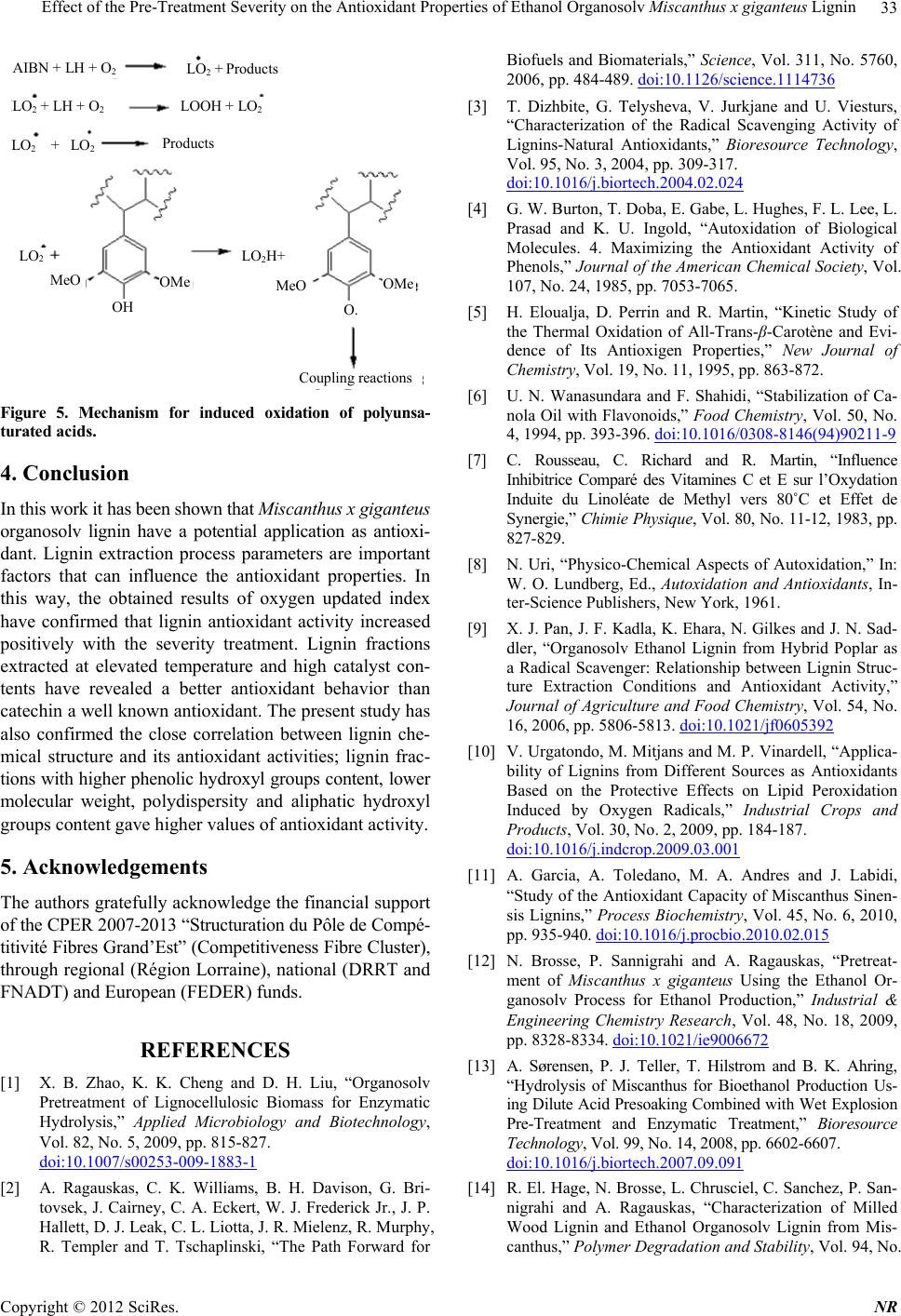 Effect of the Pre-Treatment Severity on the Antioxidant Properties of Ethanol Organosolv Miscanthus x giganteus Lignin 33 Products Coupling reactions MeO LO 2 H+ LO 2 OH OMe MeO OMe O. LO 2 + LO 2 LO 2 + Products LOOH + LO 2 AIBN + LH + O 2 LO 2 + LH + O 2 Figure 5. Mechanism for induced oxidation of polyunsa- turated aci ds. 4. Conclusion In this work it has been shown that Miscanthus x giganteus organosolv lignin have a potential application as antioxi- dant. Lignin extraction process parameters are important factors that can influence the antioxidant properties. In this way, the obtained results of oxygen updated index have confirmed that lignin antioxidant activity increased positively with the severity treatment. Lignin fractions extracted at elevated temperature and high catalyst con- tents have revealed a better antioxidant behavior than catechin a well known antioxidant. The present study has also confirmed the close correlation between lignin che- mical structure and its antioxidant activities; lignin frac- tions with higher phenolic hydroxyl groups content, lower molecular weight, polydispersity and aliphatic hydroxyl groups content gave higher values of antioxidant activity. 5. Acknowledgements The authors gratefully acknowledge the financial support of the CPER 2007-2013 “Structuration du Pôle de Compé- titivité Fibres Grand’Est” (Competitiveness Fibre Cluster), through regional (Région Lorraine), national (DRRT and FNADT) and European (FEDER) funds. REFERENCES [1] X. B. Zhao, K. K. Cheng and D. H. Liu, “Organosolv Pretreatment of Lignocellulosic Biomass for Enzymatic Hydrolysis,” Applied Microbiology and Biotechnology, Vol. 82, No. 5, 2009, pp. 815-827. doi:10.1007/s00253-009-1883-1 [2] A. Ragauskas, C. K. Williams, B. H. Davison, G. Bri- tovsek, J. Cairney, C. A. Eckert, W. J. Frederick Jr., J. P. Hallett, D. J. Leak, C. L. Liotta, J. R. Mielenz, R. Murphy, R. Templer and T. Tschaplinski, “The Path Forward for Biofuels and Biomaterials,” Science, Vol. 311, No. 5760, 2006, pp. 484-489. doi:10.1126/science.1114736 [3] T. Dizhbite, G. Telysheva, V. Jurkjane and U. Viesturs, “Characterization of the Radical Scavenging Activity of Lignins-Natural Antioxidants,” Bioresource Technology, Vol. 95, No. 3, 2004, pp. 309-317. doi:10.1016/j.biortech.2004.02.024 [4] G. W. Burton, T. Doba, E. Gabe, L. Hughes, F. L. Lee, L. Prasad and K. U. Ingold, “Autoxidation of Biological Molecules. 4. Maximizing the Antioxidant Activity of Phenols,” Journal of the American Chemical Society, Vol. 107, No. 24, 1985, pp. 7053-7065. [5] H. Eloualja, D. Perrin and R. Martin, “Kinetic Study of the Thermal Oxidation of All-Trans-β-Carotène and Evi- dence of Its Antioxigen Properties,” New Journal of Chemistry, Vol. 19, No. 11, 1995, pp. 863-872. [6] U. N. Wanasundara and F. Shahidi, “Stabilization of Ca- nola Oil with Flavonoids,” Food Chemistry, Vol. 50, No. 4, 1994, pp. 393-396. doi:10.1016/0308-8146(94)90211-9 [7] C. Rousseau, C. Richard and R. Martin, “Influence Inhibitrice Comparé des Vitamines C et E sur l’Oxydation Induite du Linoléate de Methyl vers 80˚C et Effet de Synergie,” Chimie Physique, Vol. 80, No. 11-12, 1983, pp. 827-829. [8] N. Uri, “Physico-Chemical Aspects of Autoxidation,” In: W. O. Lundberg, Ed., Autoxidation and Antioxidants, In- ter-Science Publishers, New York, 1961. [9] X. J. Pan, J. F. Kadla, K. Ehara, N. Gilkes and J. N. Sad- dler, “Organosolv Ethanol Lignin from Hybrid Poplar as a Radical Scavenger: Relationship between Lignin Struc- ture Extraction Conditions and Antioxidant Activity,” Journal of Agriculture and Food Chemistry, Vol. 54, No. 16, 2006, pp. 5806-5813. doi:10.1021/jf0605392 [10] V. Urgatondo, M. Mitjans and M. P. Vinardell, “Applica- bility of Lignins from Different Sources as Antioxidants Based on the Protective Effects on Lipid Peroxidation Induced by Oxygen Radicals,” Industrial Crops and Products, Vol. 30, No. 2, 2009, pp. 184-187. doi:10.1016/j.indcrop.2009.03.001 [11] A. Garcia, A. Toledano, M. A. Andres and J. Labidi, “Study of the Antioxidant Capacity of Miscanthus Sinen- sis Lignins,” Process Biochemistry, Vol. 45, No. 6, 2010, pp. 935-940. doi:10.1016/j.procbio.2010.02.015 [12] N. Brosse, P. Sannigrahi and A. Ragauskas, “Pretreat- ment of Miscanthus x giganteus Using the Ethanol Or- ganosolv Process for Ethanol Production,” Industrial & Engineering Chemistry Research, Vol. 48, No. 18, 2009, pp. 8328-8334. doi:10.1021/ie9006672 [13] A. Sørensen, P. J. Teller, T. Hilstrom and B. K. Ahring, “Hydrolysis of Miscanthus for Bioethanol Production Us- ing Dilute Acid Presoaking Combined with Wet Explosion Pre-Treatment and Enzymatic Treatment,” Bioresource Technology, Vol. 99, No. 14, 2008, pp. 6602-6607. doi:10.1016/j.biortech.2007.09.091 [14] R. El. Hage, N. Brosse, L. Chrusciel, C. Sanchez, P. San- nigrahi and A. Ragauskas, “Characterization of Milled Wood Lignin and Ethanol Organosolv Lignin from Mis- canthus,” Polymer Degradation and Stability, Vol. 94, No. Copyright © 2012 SciRes. NR  Effect of the Pre-Treatment Severity on the Antioxidant Properties of Ethanol Organosolv Miscanthus x giganteus Lignin 34 10, 2009, pp. 1632-1638. doi:10.1016/j.polymdegradstab.2009.07.007 [15] R. El Hage, N. Brosse, P. Sannigrahi and A. Ragauskas, “Effect of Process on the Chemical Structure of Miscan- thus Ethanol Organosolv Lignin,” Polymer Degradation and Stability, Vol. 95, No. 6, 2010, pp. 997-1003. doi:10.1016/j.polymdegradstab.2010.03.012 [16] T. K. Mounanga, P. Gérardin, B. Poaty, D. Perrin and C. Gérardin, “Synthesis and Properties of Antioxidant Am- phiphilic Ascorbate Salts,” Colloids and Surfaces A: Physicochemical Engineering Aspects, Vol. 318, No. 1-3, 2008, pp. 134-140. doi:10.1016/j.colsurfa.2007.12.048 [17] D. Montane, X. Farriol, J. Salvado, P. Jollez and E. Chor- net, “Fractionation of Wheat Straw by Steam-Explosion Pre-Treatment and Alkali Delignification. Cellulose Pulp and Byproducts from Hemicelluloses and Lignin,” Jour- nal of Wood Chemistry and Technology, Vol. 18, No. 2, 1998, pp. 171-191. doi:10.1080/02773819809349575 [18] P.-N. Diouf, A. Merlin and D. Perrin, “Antioxidant Prop- erties of Wood Extracts and Colour Stability of Woods,” Annals of Forest Science, Vol. 63, No. 5, 2006, pp. 525-534. doi:10.1051/forest:2006035 [19] H. Nadji, P.-N. Diouf, A. Benaboura, Y. Bedard, B. Riedl and T. Stevanovic, “Comparative Study of Lignins Iso- lated from Alfa Grass (Stipa tenacissima L.),” Biorsource Technology, Vol. 100, No. 14, 2009, pp. 3585-3592. doi:10.1016/j.biortech.2009.01.074 [20] C. Pouteau, P. Dole, B. Cathala, L. Averous and N. Bo- quillon, “Antioxidant Properties of Lignin in Polypropyl- ene,” Polymer Degradation and Stability, Vol. 81, No. 1, 2003, pp. 9-18. doi:10.1016/S0141-3910(03)00057-0 [21] E. Niki, T. Saito, A. Kawakami and Y. Kamiya, “Inhibi- tion of Oxidation of Methyl Linoleate in Solution by Vi- tamin E and Vitamin C,” The Journal of Biological Chemistry, Vol. 259, No. 7, 1984, pp. 4177-4182. Copyright © 2012 SciRes. NR |