

Paper Menu >>
Journal Menu >>
 World Journal of Nano Science and Engineering, 2012, 2, 41-46 http://dx.doi.org/10.4236/wjnse.2012.22007 Published Online June 2012 (http://www.SciRP.org/journal/wjnse) A Method to Improve the Up-Conversion Fluorescence of Polymer Modified NaYF4:Yb,Er(Tm) Nanocomposites Weina Cui1, Siyu Ni1, Shunan Shan2, Xingping Zhou1* 1College of Chemistry, Chemical Engineering and Biotechnology, Donghua University, Shanghai, China 2College of Life and Environment, Shanghai Normal University, Shanghai, China Email: *[email protected] Received October 3, 2011; revised November 11, 2011; accepted December 15, 2011 ABSTRACT The modification of NaYF4:Yb,Er(Tm) nanoparticles synthesized in the presence of an ionic surfactant is critical to their application in biological fields for better solubility and biocompatibility. In this work, NaYF4:Yb,Er(Tm) was transformed from insoluble, inactive to hydrophilic, biocompatible via ligand exchange modification with polyacrylic acid (PAA). Ligand exchange was carried out at room temperature when a colloidal solution of NaYF4:Yb,Er(Tm) in tetrahydrofuran (THF) was treated with excess PAA. The PAA modified NaYF4:Yb,Er(Tm) nanoparticles got better surface properties but with declined inner up-conversion fluorescence. Generally, coating an analogous layer of material outside the core nanoparticles can improve the optical properties of the core. Accordingly, NaYF4:Yb,Er(Tm)/NaYF4 nanoparticles were synthesized before PAA modification to avoid the optical intensity decaying. The result of fluores- cence test proved that the water soluble NaYF4:Yb,Er(Tm)/NaYF4/PAA nanocomposites had a sound up-conversion property compared with that of NaYF4:Yb,Er(Tm)/PAA. Furthermore, the up-conversion fluorescence property of the nanocomposite varied with the doping ratio of Er(Tm) to Yb and the possible mechanism for this change was also dis- cussed. Keywords: Doping Ratio; Fluorescence; Ligand Exchange; Polyacrylic Acid; Sodium Yttrium Fluoride; Surface Modification 1. Introduction Up-conversion fluorescence materials are attracting much attention, owing to their unique optical properties and potential applications. Among all the up-conversion fluo- rescence materials, hexagonal-phase NaYF4:Yb,Er(Tm) is one of the most efficient 980 nm near-infrared (NIR) to visible (green and blue) up-conversion phosphors [1,2]. In bulk, the low phonon energy of the host strongly sup- presses multiphonon relaxation process in the emission centers, leading to up-conversion emission. Yb3+ work- ing as a activator with Y3+ sensitizes Er3+(Tm3+) to emit green (blue) and red lights. In the recent decade, the re- search of up-conversion materials was mainly focused on the biological and medical fields such as low-intensity IR imaging and sensitive bioprobes [3,4]. Biological application of the up-conversion fluores- cence materials presents new challenges of the develop- ment of nano-sciecnce and nano-technology, especially the surface modification study of nanoparticles. As well known, ligand exchange is a versatile way to modify the surfaces of nanoparticles for better solubility and bio- compatibility. Dykstra et al. [5] prepared the CdSe/ZnS nanoparticles by an organometallic route in the presence of trioctylphosphine oxide (TOPO) and then used (PEG)- phosphine oxide copolymer to remove the TOPO for obtaining hydrophilic nanoparticles. Zhang et al. [6] chose polyacrylic acid and poly-allylamine to replace the ori- ginnal hydrophobic ligand on magnetic nanoparticles at an elevated temperature in a glycol solvent and rendered it high water solubility. Lin et al. [7] successfully synthe- sized at 150˚C the OA-capped PbS QDs with emission in the NIR and modified the PbS by ligand exhange with polyelectrolytes for the application of deep-tissue in vivo imaging. Ligand exchange is also suitable for the modification of NaYF4. In our work, PAA was chosen as the ligand polymer because of its excellent properties including hydrophilicity, abundant reactant groups (carboxyl) and non-toxicity. In order to eliminate the quenching effect from polymer, the nanoparticles of NaYF4:Yb,Er(Tm)/NaYF4 core-shell were firstly synthesized before PAA modification [8]. The middle NaYF4 layer protected the inner core and its crystal structure, thus enhancing the fluorescence property. The final resultant of NaYF4:Yb,Er(Tm)/NaYF4/PAA nanocomposites prom- *Corresponding author. C opyright © 2012 SciRes. WJNSE  W. N. CUI ET AL. 42 ised to have better comprehensive properties, which made it possible to be applied in biological fields. To the best of our knowledge, fluorescence properties of the NaYF4 with a size of several nanometers after modification are barely discussed, although the research about the up-converting fluorescence of NaYF4 core ma- terial has been widely carried out. However, in our work, fluorescence properties of the NaYF4:Yb,Er(Tm)/PAA core-shell nanoparticles and the NaYF4:Yb,Er(Tm)/ NaYF4/ PAA core-shell-shell nanocomposites were mainly ex- plored. It is more significant to study the fluorescence of polymer modified NaYF4, as the existence of polymer often causes the quenching effect which is one of the most important influence factors for a bio-labeling mate- rial. Besides that, the color changing rules of NaYF4:Yb, Er(Tm)/NaYF4/PAA nanocomposites were also revealed in this article. It is the first time to explore the relation- ship in details between lanthanide doping ratio and fluo- rescence property of the nanoparticles after modificatioin with PAA. 2. Experimental 2.1. Synthesis of the Host Material: Hexagonal NaYF4 Nanoparticles The synthesis basically followed the routes below. Briefly, the yttrium perchlorate (Y(ClO4)3) was prepared at the beginning by dissolving the rare earth oxide in perchlo- rate acid. Ten mL of 0.4 M Y(ClO4)3 was dispersed in 60 mL cyclohexane. Under vigorous stirring in a three-neck flask, the mixture was heated to 40˚C and maintained for 20 min after the addition of some amount of the surface- tant sodium oleate of 0.4 M. Then, 20 mL of 0.8 M sodium fluoride was added into this reaction system and main- tained at the same temperature for 60 min. The final mix- ture was standing for 15 min to gain an obvious interface between oil and water phases. The product was dispersed homogeneously in 60 mL of cyclohexane (oil layer). NaYF4 nanoparticles were precipitated by centrifugation and ultrasonication treatments for the cyclohexane solu- tion and washed by ethanol and hydroxide sodium for at least 3 times. 2.2. Synthesis of NaYF4:Yb,Er(Tm) Nanoparticles and NaYF4:Yb,Er(Tm)/ NaYF4 Core/Shell Nanoparticles The synthesis of NaYF4:Yb,Er(Tm) is similar to that of NaYF4 nanoparticles. The lanthanides were put into the reaction system in the form of rare earth perchlorate in- cluding Y(ClO4)3, Yb(ClO4)3, Er(ClO4)3 and Tm(ClO4)3. Ten mL mixture of a designated molar ratio of Y to Ln (0.4M Y(ClO4)3 and Ln(ClO4)3 (Ln = Yb, Er(Tm)) was dispersed in 60 mL cyclohexane. The reaction condition and other procedures are the same as those of NaYF4 mentioned above. NaYF4:Yb,Er(Tm) nanoparticles were precipitated by centrifugating half of the cyclohexane (oil layer) suspension. Recently, several similar methods have been reported in the literature for synthesizing NaYF4:Yb,Er(Tm)/ NaYF4 core/shell nanoparticles [9-11]. In this paper, we also take this way to produce NaYF4:Yb,Er(Tm)/NaYF4 core/shell nanoparticles. In a typical process, five mL 0.4 M Y(ClO4)3 and 5 mL of sodium oleate solution (0.4 M) were then put into another half of the cyclohexane sus- pension and stirred for 20 min. Ten mL of 0.8 M sodium fluoride was added and vigorously stirred for 60 min. All the reactions were carried out at 40˚C. After centrifuga- tion, the resulting nanoparticles of NaYF4:Yb,Er(Tm) and NaYF4:Yb,Er(Tm)/NaYF4 core/shell composites were dried in vacuum at 60˚C for at least 12 h. 2.3. PAA Surface Modification of NaYF4:Yb,Er (Tm) and NaYF4:Yb,Er(Tm)/NaYF4 Core/Shell Nanoparticles via Ligand Exchange The NaYF4:Yb,Er(Tm)/PAA and NaYF4:Yb,Er(Tm)/ NaYF4/PAA were prepared by mixing a solution of ex- cess PAA with that of NaYF4 nanoparticles in tetrahy- drofuran (THF) and then stirred overnight. Herein, THF is good solvent for hydrophilic PAA and hydrophobic NaYF4 nanoparticles, and the other organic solvents don’t reach the same effects as THF does. Taking the synthesis of NaYF4:Yb,Er/PAA as an example, PAA (84.7 mg) was mixed with NaYF4:Yb,Er(20.8 mg) in THF(15.0 mL) in a 50 mL conical flask and this mixture was stirred at 30˚C overnight. The resultant was homogeneous and ivory white in color. This conical flask was then placed into a boiling water bath to evaporate the THF. After the solvent evaporation, a white solid was obtained. This white solid was then washed by sodium hydroxide and alcohol for 3 times. NaYF4:Yb,Er/PAA was not soluble in cyclohexane but can readily be transferred to methanol or water to form robust colloidal solutions. 2.4. Characterization TEM images of the NaYF4:Yb,Er(Tm) nanoparticles and NaYF4:Yb,Er(Tm)/NaYF4 core/shell nanocom-posites were collected on a JEOL JEM 3010 transmission elec- tron microscope. Powder X-ray diffraction spectra were acquired with a D8 advance X-ray diffractometer, with Cu Kα radiation at 1.5406 Ǻ. Fourier transform infrared spectroscopy (FTIR) was performed to further charac- terize the composition and structure of the nanocom- posites. Samples of the modified nanoparticles were ground with KBr and then compressed into slices. The spectrum was taken from 500 to 3500 cm–1. Copyright © 2012 SciRes. WJNSE  W. N. CUI ET AL. 43 2.5. Fluorescence Property Up-conversion fluorescence spectra were obtained on a LS-55 luminescence spectrometer (Perkin-Elmer) with an external 980 nm laser diode (1 W, continuous wave with 1 m fiber, Beijing Viasho Technology Co.) as the excitation source in place of the Xe-lamp in the spectro- meter. For comparison, all the nanoparticles were milled to powder and compressed into the groove. 3. Results and Discussion 3.1. Size Analysis of the Core Nanoparticles by XRD and TEM Figure 1 shows the X-ray diffraction (XRD) result of the host material NaYF4. The well-defined peaks indicated the high crystallinity of the nanoparticles. The peak posi- tions and intensities of XRD patterns matched closely with those of hexagonal β-NaYF4 in JCPDF (28 - 1192) [9]. From the line breadth of the diffraction peaks, the crystallite size of the samples was estimated to be appro- ximately 6.9 nm for NaYF4 nanoparticles based on the Debye-Scherrer formula. Figures 2(a) and (b) show the transmission electron microscopy (TEM) images of NaYF4:Yb,Er(Tm) core and NaYF4:Yb,Er(Tm)/NaYF4 core/shell nanoparticles, respectively. It was calculated that the average sizes of them were 8.2 nm and 12.0 nm, respectively. The doping ratio of Lanthanide Yb,Er (Tm) is so tiny compared with yttrium that Figure 2(a) also can represent the TEM image of NaYF4 host materials. So the size of NaYF4 (8.2 nm) from TEM is basically consistent with the result (6.9 nm) from Debye-Scherrer formula. 3.2. FTIR Spectra of NaYF4:Yb,Er(Tm) Nanoparticles before and after PAA Modification To demonstrate the capping of PAA on the nanoparticles, FTIR spectra of the NaYF4:Yb,Er(Tm)/PAA (Figure 3(c)) were compared with those of NaYF4:Yb,Er(Tm) without surface modification (Figure 3(a)) and pure PAA (Figure 3(b)). In Figure 3(a), the intense bands in the vicinity of 2920 cm–1 and 2850 cm–1 are due to the antisymmetric and symmetric vibration of the -CH2, and the bands in 1545 cm–1 and 1457 cm–1 are contributed to C = O antisymmetric and symmetric stretching vibrations of carboxylate groups. The band position and shape are the same as the FTIR spectra of sodium oleate [12], so it is concluded that the nanoparticles are capped with sodium oleate before modification. It is obvious that the nano- particles after ligand exchange (Figure 3(c)) have no absorption band of -CH2 and two new bands appear near 1600 cm–1 and 1400 cm–1 corresponding to the R-COO– antisymmetric and symmetric stretching vibrations. The Figure 1. XRD pattern of NaYF4 nanocrystals synthesized with sodium oleate. (a) (b) Figure 2. TEM images of (a) NaYF4:Yb,Er(Tm) and (b) NaYF4: Yb,Er(Tm)/NaYF4. Transmittance Figure 3. FTIR spectra of (a) NaYF4:Yb,Er(Tm); (b) Pure PAA; and (c) NaYF4:Yb,Er(Tm)/PAA. appearance of R-COO– stretching vibration can also be found in the other nanocomposites, such as polyacrylic acid modified aluminum oxide and ferroferric oxide [13,14]. This observation clearly indicates that the sodium oleate on the surface of nanoparticles has been successfully replaced by PAA. Copyright © 2012 SciRes. WJNSE  W. N. CUI ET AL. 44 3.3. Fluorescence Properties of NaYF4:Yb,Er (Tm), NaYF4:Yb,Er(Tm)/PAA, and NaYF4: Yb,Er(Tm)/NaYF4/PAA Figure 4 shows the up-conversion luminescence mecha- nism of NaYF4:Yb,Er(Tm). Up-conversion is an effec- tive avenue for the generation of visible emission with near-infrared (NIR) excitation, which is based on sequen- tial photon absorption and energy transfer steps [15]. In the case of NaYF4:Yb,Er, under the excitation of 980 nm light, which can be absorbed by Yb3+, the elec- trons of Er3+ are first excited from the 4I15/2 to higher level via excitation energy transfer from Yb3+ to Er3+ and then to the 4F7/2 level by absorbing the energy of another electron from Yb3+ ( 2F5/2). The excited electrons of the 4F7/2 (Er3+) level then decay to the emitting 2H11/2 (the line at 540 nm), and 4F9/2 levels (the line at 650 nm), mainly through nonradioactive process. Meanwhile, as for NaYF4: Yb,Tm, the emission process is a little different. An Yb3+ ion in the 2F7/2 ground state absorbs a 980 nm photon and transits to excited state 2F5/2. When it drops back to the ground state (2F5/2-2F7/2), energy is transferred to an adja- cent ground state (3H6) Tm3+ ion. After the multistep ex- citation energy transfer, the Tm3+ is promoted to the 1D2 and 1G4 emission levels. These excited electrons on the emitting levels (1D2 and 1G4) then drop back to the low-energy levels (3F4 and 3H6) via fluorescence emis- sion [16,17]. But the 1D2 level of Tm3+ commonly cannot be populated by the photon from Yb3+ via energy transfer to the 1G4 due to the large energy mismatch between them [18]. Figures 5 and 6 show the up-conversion fluorescence spectra of NaYF4:Yb 10%, Er (Tm) 3% before and after surface modification with a 0 - 1500 mw adjustable 980 nm laser. In Figure 5, the straight line represents the NaYF4:Yb,Er core material, where the green emission around 540 nm and the red emission around 650 nm are attributed to the transitions of 2H11/2-4I15/2 and 4F9/2-4I15/2 for the Er3+ ions. It is obvious that the emission band of dash line representing NaYF4:Yb,Er/PAA is very weak due to the quenching effect from organic PAA. Neverthe- less, the emission intensity of NaYF4:Yb,Er/NaYF4/PAA showed as the dot dash line is dramatically increased by the protection of middle NaYF4 layer. Especially the red emission band at 650 nm is almost as high as that of the NaYF4:Yb,Er nanoparticles before modification. In the case of NaYF4:Yb,Tm (shown in Figure 6), the red emission appears at the same position and the blue emission is shifted to 470 nm arising from the 1G4 to 3H6 energy transition. Likewise, the emission intensity of NaYF4:Yb,Tm/NaYF4/PAA is higher than that of NaYF4: Yb,Tm/PAA. So it is concluded that the middle NaYF4 layer works as a protecting layer which can reduce the influence on fluorescent intensity probably caused from the organic modification. Figure 4. Schematic energy level diagrams: upconversion excitation and visible emission schemes for the Er3+,Tm3+ and Yb3+ ions. 4 4 4 4 Figure 5. Fluorescent spectra of nanoparticles doped with Yb3+,Er3+ before and after PAA modification. 4 4 4 4 Figure 6. Fluorescent spectra of nanoparticles doped with Yb3+,Tm3+ before and after PAA modification. Copyright © 2012 SciRes. WJNSE 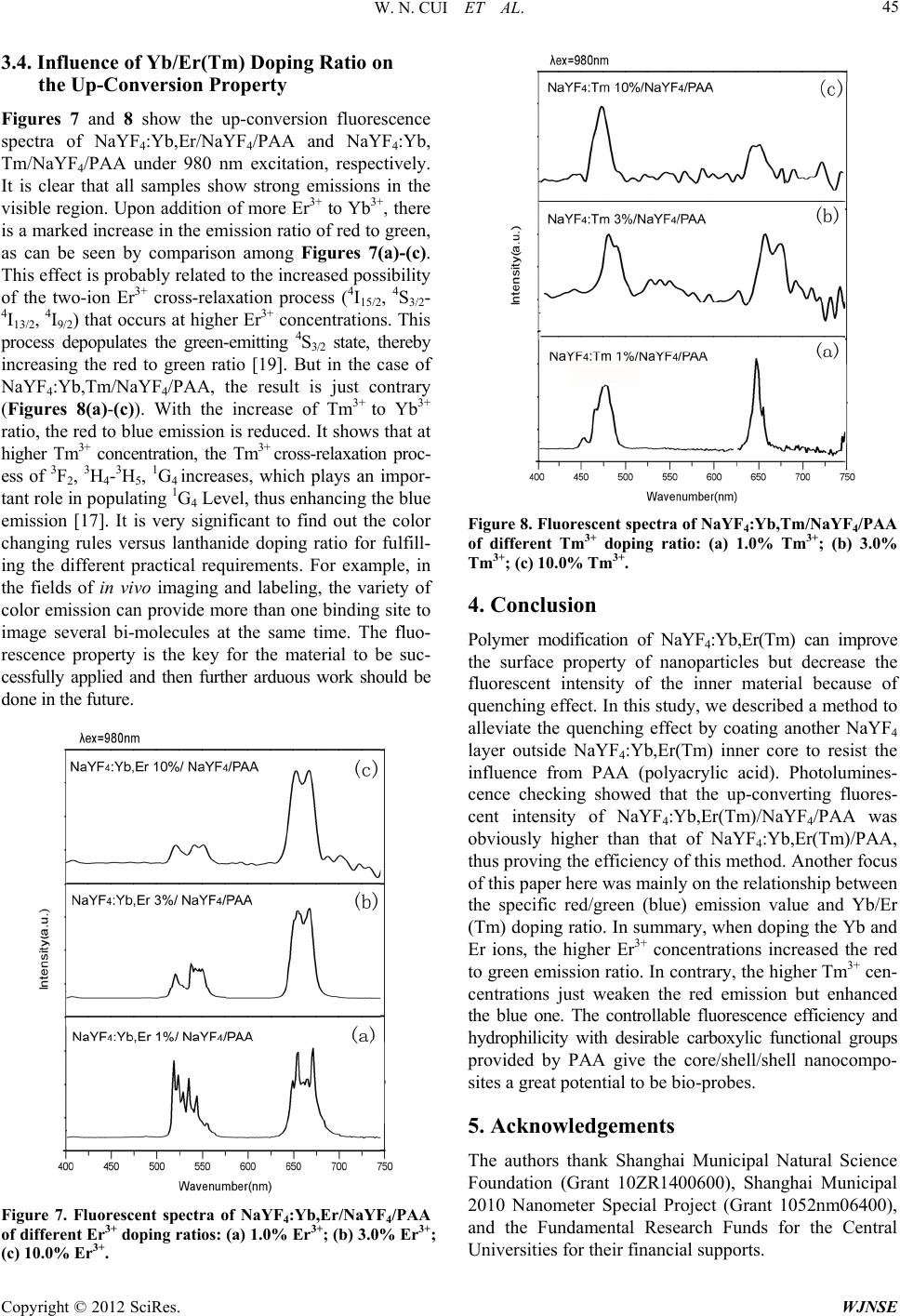 W. N. CUI ET AL. 45 3.4. Influence of Yb/Er(Tm) Doping Ratio on the Up-Conversion Property Figures 7 and 8 show the up-conversion fluorescence spectra of NaYF4:Yb,Er/NaYF4/PAA and NaYF4:Yb, Tm/NaYF4/PAA under 980 nm excitation, respectively. It is clear that all samples show strong emissions in the visible region. Upon addition of more Er3+ to Yb3+, there is a marked increase in the emission ratio of red to green, as can be seen by comparison among Figures 7(a)-(c). This effect is probably related to the increased possibility of the two-ion Er3+ cross-relaxation process (4I15/2, 4S3/2- 4I13/2, 4I9/2) that occurs at higher Er3+ concentrations. This process depopulates the green-emitting 4S3/2 state, thereby increasing the red to green ratio [19]. But in the case of NaYF4:Yb,Tm/NaYF4/PAA, the result is just contrary (Figures 8(a)-(c)). With the increase of Tm3+ to Yb3+ ratio, the red to blue emission is reduced. It shows that at higher Tm3+ concentration, the Tm3+ cross-relaxation proc- ess of 3F2, 3H4-3H5, 1G4 increases, which plays an impor- tant role in populating 1G4 Level, thus enhancing the blue emission [17]. It is very significant to find out the color changing rules versus lanthanide doping ratio for fulfill- ing the different practical requirements. For example, in the fields of in vivo imaging and labeling, the variety of color emission can provide more than one binding site to image several bi-molecules at the same time. The fluo- rescence property is the key for the material to be suc- cessfully applied and then further arduous work should be done in the future. Figure 7. Fluorescent spectra of NaYF4:Yb,Er/NaYF4/PAA of different Er3+ doping ratios: (a) 1.0% Er3+; (b) 3.0% Er3+; (c) 10.0% Er3+. Figure 8. Fluorescent spectra of NaYF4:Yb,Tm/NaYF4/PAA of different Tm3+ doping ratio: (a) 1.0% Tm3+; (b) 3.0% Tm3+; (c) 10.0% Tm3+. 4. Conclusion Polymer modification of NaYF4:Yb,Er(Tm) can improve the surface property of nanoparticles but decrease the fluorescent intensity of the inner material because of quenching effect. In this study, we described a method to alleviate the quenching effect by coating another NaYF4 layer outside NaYF4:Yb,Er(Tm) inner core to resist the influence from PAA (polyacrylic acid). Photolumines- cence checking showed that the up-converting fluores- cent intensity of NaYF4:Yb,Er(Tm)/NaYF4/PAA was obviously higher than that of NaYF4:Yb,Er(Tm)/PAA, thus proving the efficiency of this method. Another focus of this paper here was mainly on the relationship between the specific red/green (blue) emission value and Yb/Er (Tm) doping ratio. In summary, when doping the Yb and Er ions, the higher Er3+ concentrations increased the red to green emission ratio. In contrary, the higher Tm3+ cen- centrations just weaken the red emission but enhanced the blue one. The controllable fluorescence efficiency and hydrophilicity with desirable carboxylic functional groups provided by PAA give the core/shell/shell nanocompo- sites a great potential to be bio-probes. 5. Acknowledgements The authors thank Shanghai Municipal Natural Science Foundation (Grant 10ZR1400600), Shanghai Municipal 2010 Nanometer Special Project (Grant 1052nm06400), and the Fundamental Research Funds for the Central Universities for their financial supports. Copyright © 2012 SciRes. WJNSE 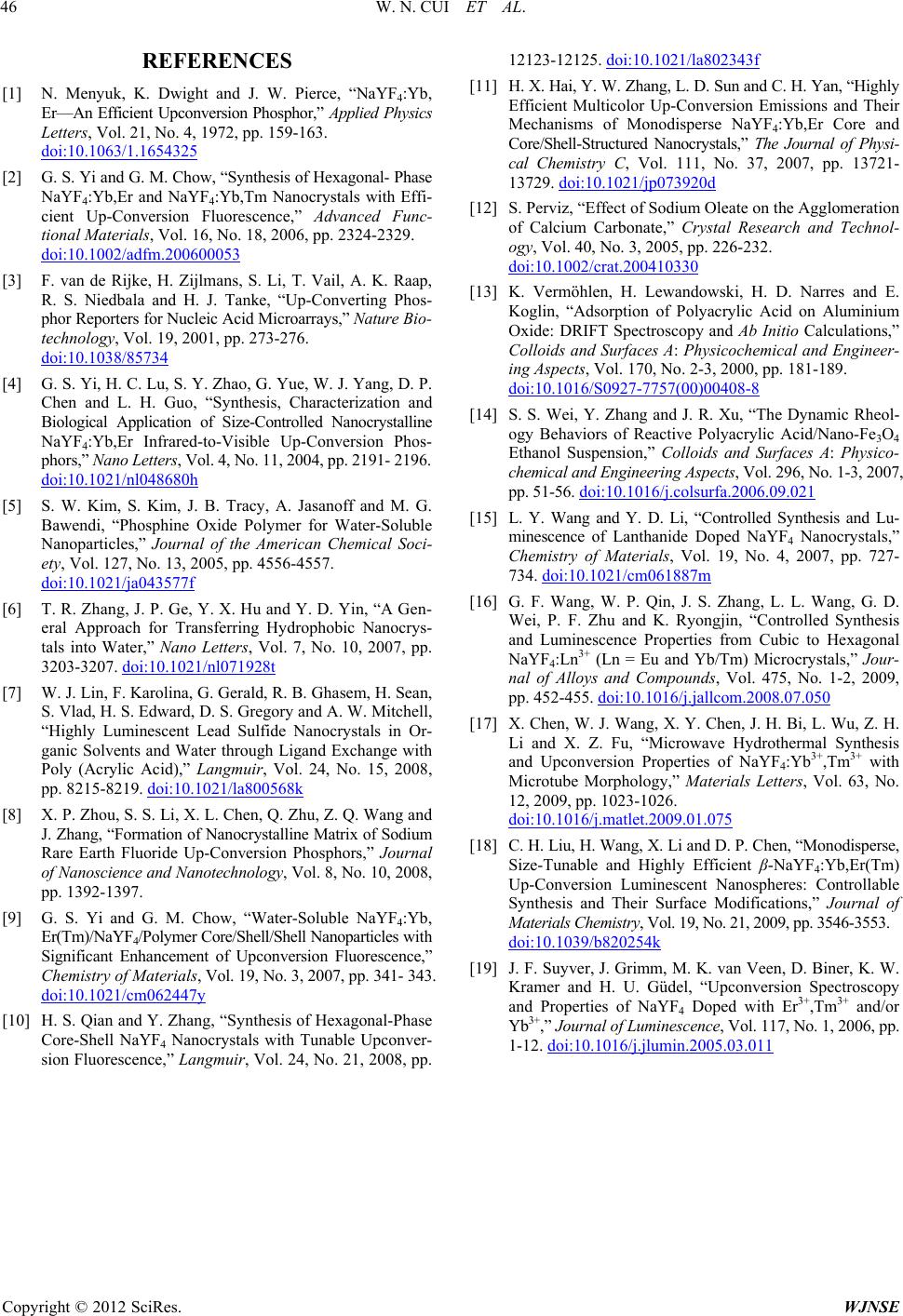 W. N. CUI ET AL. Copyright © 2012 SciRes. WJNSE 46 REFERENCES [1] N. Menyuk, K. Dwight and J. W. Pierce, “NaYF4:Yb, Er—An Efficient Upconversion Phosphor,” Applied Physics Letters, Vol. 21, No. 4, 1972, pp. 159-163. doi:10.1063/1.1654325 [2] G. S. Yi and G. M. Chow, “Synthesis of Hexagonal- Phase NaYF4:Yb,Er and NaYF4:Yb,Tm Nanocrystals with Effi- cient Up-Conversion Fluorescence,” Advanced Func- tional Materials, Vol. 16, No. 18, 2006, pp. 2324-2329. doi:10.1002/adfm.200600053 [3] F. van de Rijke, H. Zijlmans, S. Li, T. Vail, A. K. Raap, R. S. Niedbala and H. J. Tanke, “Up-Converting Phos- phor Reporters for Nucleic Acid Microarrays,” Nature Bio- technology, Vol. 19, 2001, pp. 273-276. doi:10.1038/85734 [4] G. S. Yi, H. C. Lu, S. Y. Zhao, G. Yue, W. J. Yang, D. P. Chen and L. H. Guo, “Synthesis, Characterization and Biological Application of Size-Controlled Nanocrystalline NaYF4:Yb,Er Infrared-to-Visible Up-Conversion Phos- phors,” Nano Letters, Vol. 4, No. 11, 2004, pp. 2191- 2196. doi:10.1021/nl048680h [5] S. W. Kim, S. Kim, J. B. Tracy, A. Jasanoff and M. G. Bawendi, “Phosphine Oxide Polymer for Water-Soluble Nanoparticles,” Journal of the American Chemical Soci- ety, Vol. 127, No. 13, 2005, pp. 4556-4557. doi:10.1021/ja043577f [6] T. R. Zhang, J. P. Ge, Y. X. Hu and Y. D. Yin, “A Gen- eral Approach for Transferring Hydrophobic Nanocrys- tals into Water,” Nano Letters, Vol. 7, No. 10, 2007, pp. 3203-3207. doi:10.1021/nl071928t [7] W. J. Lin, F. Karolina, G. Gerald, R. B. Ghasem, H. Sean, S. Vlad, H. S. Edward, D. S. Gregory and A. W. Mitchell, “Highly Luminescent Lead Sulfide Nanocrystals in Or- ganic Solvents and Water through Ligand Exchange with Poly (Acrylic Acid),” Langmuir, Vol. 24, No. 15, 2008, pp. 8215-8219. doi:10.1021/la800568k [8] X. P. Zhou, S. S. Li, X. L. Chen, Q. Zhu, Z. Q. Wang and J. Zhang, “Formation of Nanocrystalline Matrix of Sodium Rare Earth Fluoride Up-Conversion Phosphors,” Journal of Nanoscience and Nanotechnology, Vol. 8, No. 10, 2008, pp. 1392-1397. [9] G. S. Yi and G. M. Chow, “Water-Soluble NaYF4:Yb, Er(Tm)/NaYF4/Polymer Core/Shell/Shell Nanoparticles with Significant Enhancement of Upconversion Fluorescence,” Chemistry of Materials, Vol. 19, No. 3, 2007, pp. 341- 343. doi:10.1021/cm062447y [10] H. S. Qian and Y. Zhang, “Synthesis of Hexagonal-Phase Core-Shell NaYF4 Nanocrystals with Tunable Upconver- sion Fluorescence,” Langmuir, Vol. 24, No. 21, 2008, pp. 12123-12125. doi:10.1021/la802343f [11] H. X. Hai, Y. W. Zhang, L. D. Sun and C. H. Yan, “Highly Efficient Multicolor Up-Conversion Emissions and Their Mechanisms of Monodisperse NaYF4:Yb,Er Core and Core/Shell-Structured Nanocrystals,” The Journal of Physi- cal Chemistry C, Vol. 111, No. 37, 2007, pp. 13721- 13729. doi:10.1021/jp073920d [12] S. Perviz, “Effect of Sodium Oleate on the Agglomeration of Calcium Carbonate,” Crystal Research and Technol- ogy, Vol. 40, No. 3, 2005, pp. 226-232. doi:10.1002/crat.200410330 [13] K. Vermöhlen, H. Lewandowski, H. D. Narres and E. Koglin, “Adsorption of Polyacrylic Acid on Aluminium Oxide: DRIFT Spectroscopy and Ab Initio Calculations,” Colloids and Surfaces A: Physicochemical and Engineer- ing Aspects, Vol. 170, No. 2-3, 2000, pp. 181-189. doi:10.1016/S0927-7757(00)00408-8 [14] S. S. Wei, Y. Zhang and J. R. Xu, “The Dynamic Rheol- ogy Behaviors of Reactive Polyacrylic Acid/Nano-Fe3O4 Ethanol Suspension,” Colloids and Surfaces A: Physico- chemical and Engineering Aspects, Vol. 296, No. 1-3, 2007, pp. 51-56. doi:10.1016/j.colsurfa.2006.09.021 [15] L. Y. Wang and Y. D. Li, “Controlled Synthesis and Lu- minescence of Lanthanide Doped NaYF4 Nanocrystals,” Chemistry of Materials, Vol. 19, No. 4, 2007, pp. 727- 734. doi:10.1021/cm061887m [16] G. F. Wang, W. P. Qin, J. S. Zhang, L. L. Wang, G. D. Wei, P. F. Zhu and K. Ryongjin, “Controlled Synthesis and Luminescence Properties from Cubic to Hexagonal NaYF4:Ln3+ (Ln = Eu and Yb/Tm) Microcrystals,” Jour- nal of Alloys and Compounds, Vol. 475, No. 1-2, 2009, pp. 452-455. doi:10.1016/j.jallcom.2008.07.050 [17] X. Chen, W. J. Wang, X. Y. Chen, J. H. Bi, L. Wu, Z. H. Li and X. Z. Fu, “Microwave Hydrothermal Synthesis and Upconversion Properties of NaYF4:Yb3+,Tm3+ with Microtube Morphology,” Materials Letters, Vol. 63, No. 12, 2009, pp. 1023-1026. doi:10.1016/j.matlet.2009.01.075 [18] C. H. Liu, H. Wang, X. Li and D. P. Chen, “Monodisperse, Size-Tunable and Highly Efficient β-NaYF4:Yb,Er(Tm) Up-Conversion Luminescent Nanospheres: Controllable Synthesis and Their Surface Modifications,” Journal of Materials Chemistry, Vol. 19, No. 21, 2009, pp. 3546-3553. doi:10.1039/b820254k [19] J. F. Suyver, J. Grimm, M. K. van Veen, D. Biner, K. W. Kramer and H. U. Güdel, “Upconversion Spectroscopy and Properties of NaYF4 Doped with Er3+,Tm3+ and/or Yb3+,” Journal of Luminescence, Vol. 117, No. 1, 2006, pp. 1-12. doi:10.1016/j.jlumin.2005.03.011 |