

Paper Menu >>
Journal Menu >>
 Open Journal of Soil Science, 2012, 2, 116-122 http://dx.doi.org/10.4236/ojss.2012.22017 Published Online June 2012 (http://www.SciRP.org/journal/ojss) Acacia trotilis and Calotropis procera: Do They Substantially Promote Soil Carbon Sequestration? Taoufik Saleh Ksiksi Department of Biology, Faculty of Science, UAE University, Al-Ain, UAE. Email: [email protected] Received October 23rd, 2011; revised November 30th, 2011; accepted December 18, 2011 ABSTRACT Very little is known about the type and mix of desert plant species and their management to optimize carbon sequestra- tion in desert ecosystems. Overgrazing is one important practice that affects soil carbon cycling and therefore sequestra- tion. Improving soil carbon in desert ecosystems may be best through the use of native trees and shrubs. Acacia tortilis and calotropis procera are two important species in the United Arab Emirates (UAE). The former is a native species that improves biodiversity and the latter is not native and has been reported to be an indicator of overgrazing. The average soil organic matter (SOM) content was higher in soils dominated by A. tortilis when compared to those dominated by C. procera; 2.98 and 1.34; respectively (P < 0.05). Moreover, A. tortilis leaves had a higher OM content than C. procera leaves (94.1% and 90.6%; respectively). The higher OM content of A. tortilis leaves explains the higher contribution of this species to the overall soil organic matter inputs. There was also a significant effect of shrub species on total SOC (P < 0.05). A total of about 14.7 tons of SOC were added per hectare in the areas dominated by A. tortilis. While only about 6.6 tons of SOC were added to the areas dominated by C. procera. In short, it is believed that both species sub- stantially promote soil carbon sequestration. Some significant superiority of the native A. tortilis has been shown. But much has to be done to investigate the mix of plant species that promote the best soil carbon sequestration in the desert areas. Further studies are required in order to assess temporal as well as spatial variations in soil carbon sequestration in the UAE deserts. This will certainly help, in addition to other practices, in mitigating CO2 emission. Keywords: Desert Soils; Nutrient Cycling; Soil Carbon 1. Introduction Soil restoration and woodland regeneration are sound strategies to increase soil carbon pool [1]. Increasing soil carbon improves soil quality, productivity and long-term sustainability. Equally important are the growing con- cerns about global greenhouse gas emission issues, which call for proper management of the terrestrial carbon pool. Specifically, this calls for a better understanding of car- bon sequestration and ways to optimize it. Especially that desert lands are believed to contain small amounts of soil carbon. In general terms, carbon sequestration in terres- trial ecosystems can be defined as the net removal of car- bon dioxide from the atmosphere into long-lived pools of carbon. These pools can be living above-ground biomass, wood products, living biomass in soils such as roots and micro-organisms or recalcitrant organic and inorganic carbon in soils [2]. In the UAE, for example, soil carbon pools become more important and relevant if we consider the vast areas covered by desert ecosystems, which oc- cupy at least two-third of the country’s land area. Fortunately, terrestrial carbon pools could be signifi- cantly enhanced by adopting sound management prac- tices in desert ecosystems. As in other agricultural sys- tems, the potential of desert ecosystems to store carbon is dependent on how adequately the soil-plant resources are managed. For instance, promoting healthy perennial plant species is a management option that could improve the terrestrial carbon pool, through increased rooting depth. This will be even more pertinent if native shrub and tree species were used. Unfortunately, very little is known about the type and mix of desert plant species that optimize carbon stocks in desert ecosystems. Additionally management principles and practices which can maintain carbon stocks through time are not well defined and adopted. Panicum, for in- stance, offers an excellent carbon sequestration option because of its deep rooting system and perenniality [3]. Understandably, plant species differ markedly in their impact on soil carbon concentration and distribution, mainly because of differences in their root systems. For example, the mean carbon concentration in the top 10 cm of soil in areas dominated by Panicum maximum was 3.31% compared to 1.89% and 0.74% in areas dominated Copyright © 2012 SciRes. OJSS 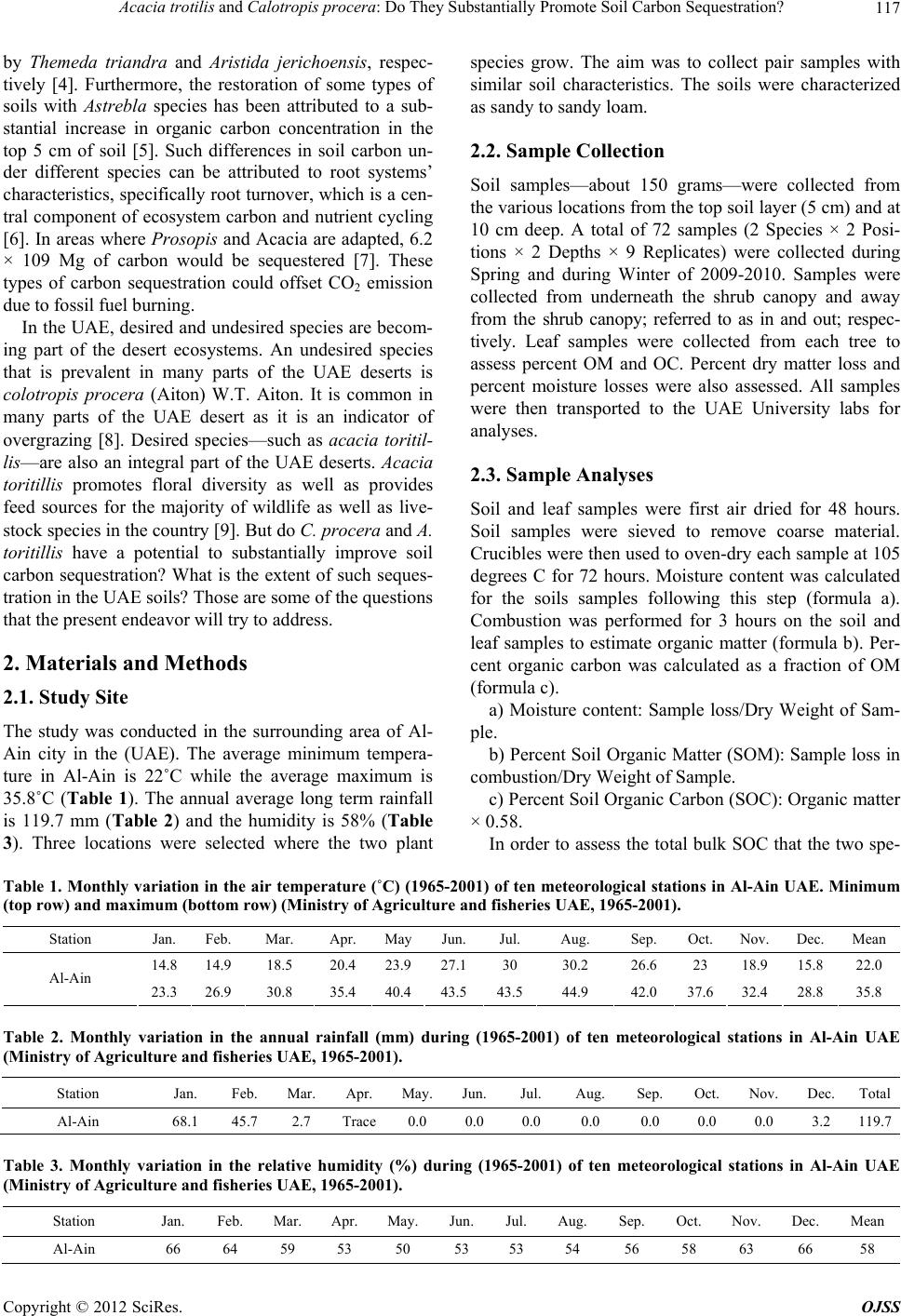 Acacia trotilis and Calotropis procera: Do They Substantially Promote Soil Carbon Sequestration? 117 by Themeda triandra and Aristida jerichoensis, respec- tively [4]. Furthermore, the restoration of some types of soils with Astrebla species has been attributed to a sub- stantial increase in organic carbon concentration in the top 5 cm of soil [5]. Such differences in soil carbon un- der different species can be attributed to root systems’ characteristics, specifically root turnover, which is a cen- tral component of ecosystem carbon and nutrient cycling [6]. In areas where Prosopis and Acacia are adapted, 6.2 × 10⁹ Mg of carbon would be sequestered [7]. These types of carbon sequestration could offset CO2 emission due to fossil fuel burning. In the UAE, desired and undesired species are becom- ing part of the desert ecosystems. An undesired species that is prevalent in many parts of the UAE deserts is colotropis procera (Aiton) W.T. Aiton. It is common in many parts of the UAE desert as it is an indicator of overgrazing [8]. Desired species—such as acacia toritil- lis—are also an integral part of the UAE deserts. Ac acia toritillis promotes floral diversity as well as provides feed sources for the majority of wildlife as well as live- stock species in the country [9]. But do C. procera and A. toritillis have a potential to substantially improve soil carbon sequestration? What is the extent of such seques- tration in the UAE soils? Those are some of the questions that the present endeavor will try to address. 2. Materials and Methods 2.1. Study Site The study was conducted in the surrounding area of Al- Ain city in the (UAE). The average minimum tempera- ture in Al-Ain is 22˚C while the average maximum is 35.8˚C (Table 1). The annual average long term rainfall is 119.7 mm (Table 2) and the humidity is 58% (Table 3). Three locations were selected where the two plant species grow. The aim was to collect pair samples with similar soil characteristics. The soils were characterized as sandy to sandy loam. 2.2. Sample Collection Soil samples—about 150 grams—were collected from the various locations from the top soil layer (5 cm) and at 10 cm deep. A total of 72 samples (2 Species × 2 Posi- tions × 2 Depths × 9 Replicates) were collected during Spring and during Winter of 2009-2010. Samples were collected from underneath the shrub canopy and away from the shrub canopy; referred to as in and out; respec- tively. Leaf samples were collected from each tree to assess percent OM and OC. Percent dry matter loss and percent moisture losses were also assessed. All samples were then transported to the UAE University labs for analyses. 2.3. Sample Analyses Soil and leaf samples were first air dried for 48 hours. Soil samples were sieved to remove coarse material. Crucibles were then used to oven-dry each sample at 105 degrees C for 72 hours. Moisture content was calculated for the soils samples following this step (formula a). Combustion was performed for 3 hours on the soil and leaf samples to estimate organic matter (formula b). Per- cent organic carbon was calculated as a fraction of OM (formula c). a) Moisture content: Sample loss/Dry Weight of Sam- ple. b) Percent Soil Organic Matter (SOM): Sample loss in combustion/Dry Weight of Sample. c) Percent Soil Organic Carbon (SOC): Organic matter × 0.58. In order to assess the total bulk SOC that the two spe- Table 1. Monthly variation in the air temperature (˚C) (1965-2001) of ten meteorological stations in Al-Ain UAE. Minimum (top row) and maximum (bottom row) (Ministry of Agriculture and fisheries UAE, 1965-2001). Station Jan. Feb.Mar. Apr. MayJun. Jul. Aug. Sep. Oct. Nov. Dec.Mean 14.8 14.918.5 20.4 23.927.1 30 30.2 26.6 23 18.9 15.822.0 Al-Ain 23.3 26.930.8 35.4 40.443.5 43.544.9 42.0 37.6 32.4 28.835.8 Table 2. Monthly variation in the annual rainfall (mm) during (1965-2001) of ten meteorological stations in Al-Ain UAE (Ministry of Agriculture and fisheries UAE, 1965-2001). Station Jan. Feb. Mar. Apr. May.Jun. Jul. Aug. Sep. Oct. Nov. Dec.Total Al-Ain 68.1 45.7 2.7 Trace0.0 0.0 0.0 0.0 0.0 0.0 0.0 3.2 119.7 Table 3. Monthly variation in the relative humidity (%) during (1965-2001) of ten meteorological stations in Al-Ain UAE (Ministry of Agriculture and fisheries UAE, 1965-2001). Station Jan. Feb. Mar. Apr. May.Jun. Jul. Aug. Sep. Oct. Nov. Dec. Mean Al-Ain 66 64 59 53 50 53 53 54 56 58 63 66 58 Copyright © 2012 SciRes. OJSS 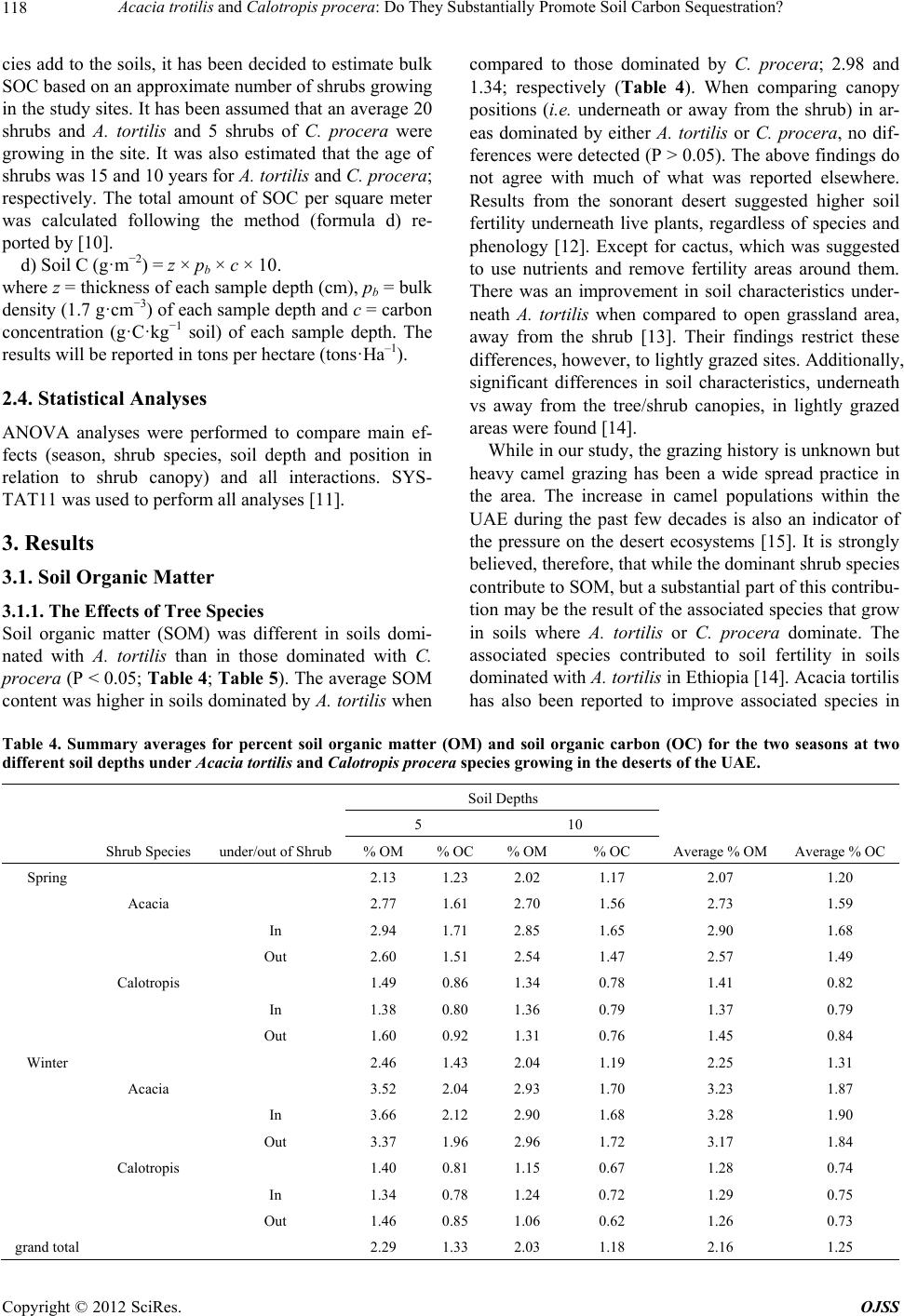 Acacia trotilis and Calotropis procera: Do They Substantially Promote Soil Carbon Sequestration? 118 cies add to the soils, it has been decided to estimate bulk SOC based on an approximate number of shrubs growing in the study sites. It has been assumed that an average 20 shrubs and A. tortilis and 5 shrubs of C. procera were growing in the site. It was also estimated that the age of shrubs was 15 and 10 years for A. to rtilis and C. procera; respectively. The total amount of SOC per square meter was calculated following the method (formula d) re- ported by [10]. d) Soil C (g·m−2) = z × pb × c × 10. where z = thickness of each sample depth (cm), pb = bulk density (1.7 g·cm−3) of each sample depth and c = carbon concentration (g·C·kg−1 soil) of each sample depth. The results will be reported in tons per hectare (tons·Ha–1). 2.4. Statistical Analyses ANOVA analyses were performed to compare main ef- fects (season, shrub species, soil depth and position in relation to shrub canopy) and all interactions. SYS- TAT11 was used to perform all analyses [11]. 3. Results 3.1. Soil Organic Matter 3.1.1. The Effects of Tree Species Soil organic matter (SOM) was different in soils domi- nated with A. tortilis than in those dominated with C. procera (P < 0.05; Table 4; Table 5). The average SOM content was higher in soils dominated by A. tortilis when compared to those dominated by C. procera; 2.98 and 1.34; respectively (Table 4). When comparing canopy positions (i.e. underneath or away from the shrub) in ar- eas dominated by either A. tortilis or C. procera, no dif- ferences were detected (P > 0.05). The above findings do not agree with much of what was reported elsewhere. Results from the sonorant desert suggested higher soil fertility underneath live plants, regardless of species and phenology [12]. Except for cactus, which was suggested to use nutrients and remove fertility areas around them. There was an improvement in soil characteristics under- neath A. tortilis when compared to open grassland area, away from the shrub [13]. Their findings restrict these differences, however, to lightly grazed sites. Additionally, significant differences in soil characteristics, underneath vs away from the tree/shrub canopies, in lightly grazed areas were found [14]. While in our study, the grazing history is unknown but heavy camel grazing has been a wide spread practice in the area. The increase in camel populations within the UAE during the past few decades is also an indicator of the pressure on the desert ecosystems [15]. It is strongly believed, therefore, that while the dominant shrub species contribute to SOM, but a substantial part of this contribu- tion may be the result of the associated species that grow in soils where A. tortilis or C. procera dominate. The associated species contributed to soil fertility in soils dominated with A. tortilis in Ethiopia [14]. Acacia tortilis has also been reported to improve associated species in Table 4. Summary averages for percent soil organic matter (OM) and soil organic carbon (OC) for the two seasons at two different soil depths under Acacia tortilis and Calotropis procera species growing in the deserts of the UAE. Soil Depths 5 10 Shrub Species under/out of Shrub % OM % OC % OM % OC Average % OM Average % OC Spring 2.13 1.23 2.02 1.17 2.07 1.20 Acacia 2.77 1.61 2.70 1.56 2.73 1.59 In 2.94 1.71 2.85 1.65 2.90 1.68 Out 2.60 1.51 2.54 1.47 2.57 1.49 Calotropis 1.49 0.86 1.34 0.78 1.41 0.82 In 1.38 0.80 1.36 0.79 1.37 0.79 Out 1.60 0.92 1.31 0.76 1.45 0.84 Winter 2.46 1.43 2.04 1.19 2.25 1.31 Acacia 3.52 2.04 2.93 1.70 3.23 1.87 In 3.66 2.12 2.90 1.68 3.28 1.90 Out 3.37 1.96 2.96 1.72 3.17 1.84 Calotropis 1.40 0.81 1.15 0.67 1.28 0.74 In 1.34 0.78 1.24 0.72 1.29 0.75 Out 1.46 0.85 1.06 0.62 1.26 0.73 grand total 2.29 1.33 2.03 1.18 2.16 1.25 Copyright © 2012 SciRes. OJSS 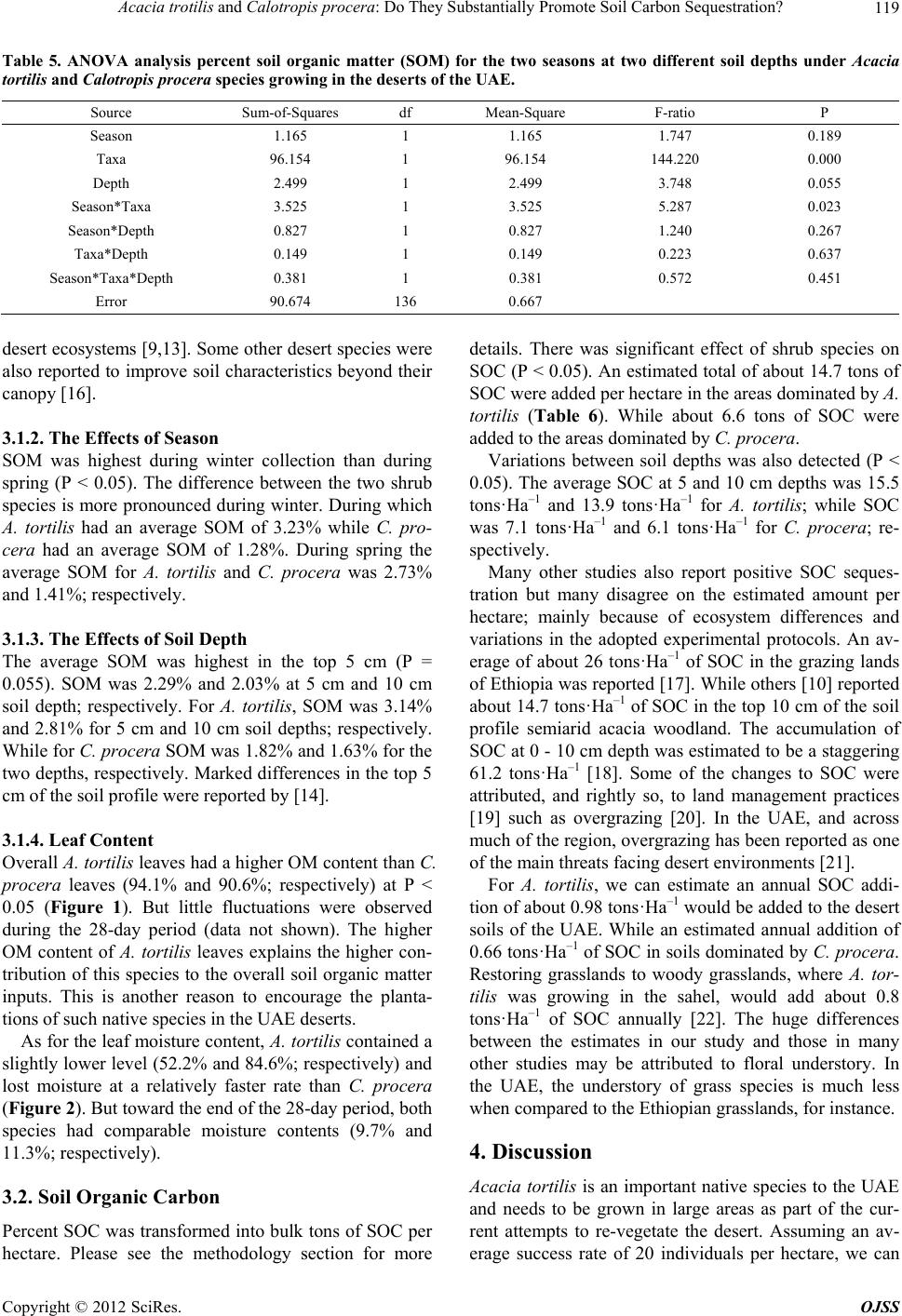 Acacia trotilis and Calotropis procera: Do They Substantially Promote Soil Carbon Sequestration? 119 Table 5. ANOVA analysis percent soil organic matter (SOM) for the two seasons at two different soil depths under Acacia tortilis and Calotropis procera species growing in the deserts of the UAE. Source Sum-of-Squares df Mean-Square F-ratio P Season 1.165 1 1.165 1.747 0.189 Taxa 96.154 1 96.154 144.220 0.000 Depth 2.499 1 2.499 3.748 0.055 Season*Taxa 3.525 1 3.525 5.287 0.023 Season*Depth 0.827 1 0.827 1.240 0.267 Taxa*Depth 0.149 1 0.149 0.223 0.637 Season*Taxa*Depth 0.381 1 0.381 0.572 0.451 Error 90.674 136 0.667 desert ecosystems [9,13]. Some other desert species were also reported to improve soil characteristics beyond their canopy [16]. 3.1.2. The Effects of Season SOM was highest during winter collection than during spring (P < 0.05). The difference between the two shrub species is more pronounced during winter. During which A. tortilis had an average SOM of 3.23% while C. pro- cera had an average SOM of 1.28%. During spring the average SOM for A. tortilis and C. procera was 2.73% and 1.41%; respectively. 3.1.3. The Effects of Soil Depth The average SOM was highest in the top 5 cm (P = 0.055). SOM was 2.29% and 2.03% at 5 cm and 10 cm soil depth; respectively. For A. tortilis, SOM was 3.14% and 2.81% for 5 cm and 10 cm soil depths; respectively. While for C. procera SOM was 1.82% and 1.63% for the two depths, respectively. Marked differences in the top 5 cm of the soil profile were reported by [14]. 3.1.4. Leaf Content Overall A. tortilis leaves had a higher OM content than C. procera leaves (94.1% and 90.6%; respectively) at P < 0.05 (Figure 1). But little fluctuations were observed during the 28-day period (data not shown). The higher OM content of A. tortilis leaves explains the higher con- tribution of this species to the overall soil organic matter inputs. This is another reason to encourage the planta- tions of such native species in the UAE deserts. As for the leaf moisture content, A. tortilis contained a slightly lower level (52.2% and 84.6%; respectively) and lost moisture at a relatively faster rate than C. procera (Figure 2). But toward the end of the 28-day period, both species had comparable moisture contents (9.7% and 11.3%; respectively). 3.2. Soil Organic Carbon Percent SOC was transformed into bulk tons of SOC per hectare. Please see the methodology section for more details. There was significant effect of shrub species on SOC (P < 0.05). An estimated total of about 14.7 tons of SOC were added per hectare in the areas dominated by A. tortilis (Table 6). While about 6.6 tons of SOC were added to the areas dominated by C. pr ocer a. Variations between soil depths was also detected (P < 0.05). The average SOC at 5 and 10 cm depths was 15.5 tons·Ha–1 and 13.9 tons·Ha–1 for A. tortilis; while SOC was 7.1 tons·Ha–1 and 6.1 tons·Ha–1 for C. procera; re- spectively. Many other studies also report positive SOC seques- tration but many disagree on the estimated amount per hectare; mainly because of ecosystem differences and variations in the adopted experimental protocols. An av- erage of about 26 tons·Ha–1 of SOC in the grazing lands of Ethiopia was reported [17]. While others [10] reported about 14.7 tons·Ha–1 of SOC in the top 10 cm of the soil profile semiarid acacia woodland. The accumulation of SOC at 0 - 10 cm depth was estimated to be a staggering 61.2 tons·Ha–1 [18]. Some of the changes to SOC were attributed, and rightly so, to land management practices [19] such as overgrazing [20]. In the UAE, and across much of the region, overgrazing has been reported as one of the main threats facing desert environments [21]. For A. tortilis, we can estimate an annual SOC addi- tion of about 0.98 tons·Ha–1 would be added to the desert soils of the UAE. While an estimated annual addition of 0.66 tons·Ha–1 of SOC in soils dominated by C. procera. Restoring grasslands to woody grasslands, where A. tor- tilis was growing in the sahel, would add about 0.8 tons·Ha–1 of SOC annually [22]. The huge differences between the estimates in our study and those in many other studies may be attributed to floral understory. In the UAE, the understory of grass species is much less when compared to the Ethiopian grasslands, for instance. 4. Discussion Acacia tortilis is an important native species to the UAE and needs to be grown in large areas as part of the cur- rent attempts to re-vegetate the desert. Assuming an av- erage success rate of 20 individuals per hectare, we can Copyright © 2012 SciRes. OJSS 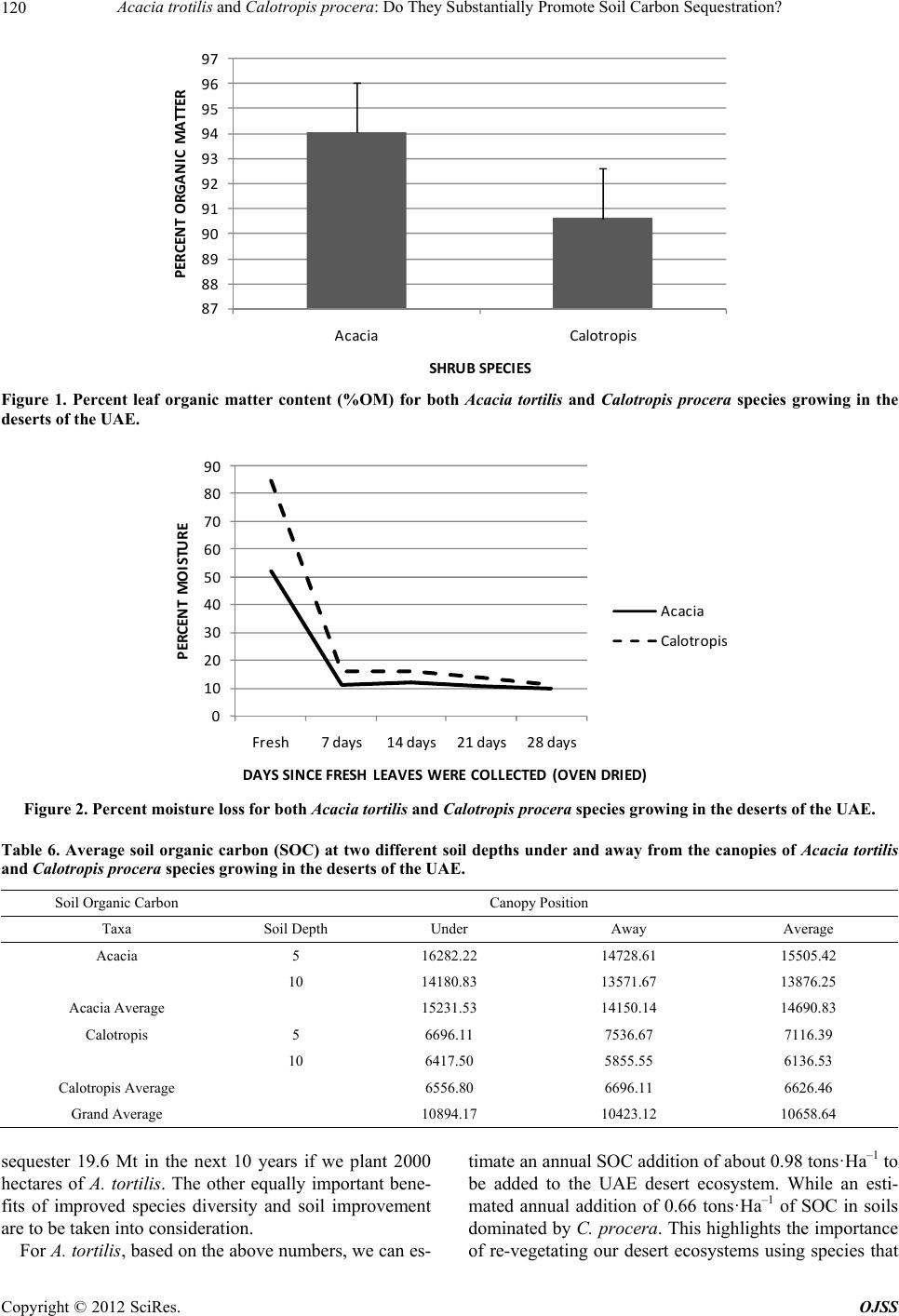 Acacia trotilis and Calotropis procera: Do They Substantially Promote Soil Carbon Sequestration? 120 87 88 89 90 91 92 93 94 95 96 97 Acacia Calotropis PERCEN TORGANI CMATTER SHRUBSPECIES Figure 1. Percent leaf organic matter content (%OM) for both Acacia tortilis and Calotropis procera species growing in the deserts of the UAE. 0 10 20 30 40 50 60 70 80 90 Fresh 7days14days 21days 28days PERCENTMO ISTURE DAY S SINCEFRESHLEAVESWERECOLL ECTED(OVENDRIED) Acacia Calotr o pis Figure 2. Percent moisture loss for both Acacia tortilis and Calotropis procera species growing in the deserts of the UAE. Table 6. Average soil organic carbon (SOC) at two different soil depths under and aw ay from the canopies of Acacia tortilis and Calotropis procera species growing in the deserts of the UAE. Soil Organic Carbon Canopy Position Taxa Soil Depth Under Away Average Acacia 5 16282.22 14728.61 15505.42 10 14180.83 13571.67 13876.25 Acacia Average 15231.53 14150.14 14690.83 Calotropis 5 6696.11 7536.67 7116.39 10 6417.50 5855.55 6136.53 Calotropis Average 6556.80 6696.11 6626.46 Grand Average 10894.17 10423.12 10658.64 sequester 19.6 Mt in the next 10 years if we plant 2000 hectares of A. tortilis. The other equally important bene- fits of improved species diversity and soil improvement are to be taken into consideration. For A. tortilis, based on the above numbers, we can es- timate an annual SOC addition of about 0.98 tons·Ha–1 to be added to the UAE desert ecosystem. While an esti- mated annual addition of 0.66 tons·Ha–1 of SOC in soils dominated by C. procera. This highlights the importance of re-vegetating our desert ecosystems using species that Copyright © 2012 SciRes. OJSS  Acacia trotilis and Calotropis procera: Do They Substantially Promote Soil Carbon Sequestration? 121 promote carbon sequestration. The direct benefits are the greening of these ecosystems, while indirect benefits may include the creation of islands of fertility underneath these shrubs and the improvement of the vegetative cover in the floral understory. Islands of fertility in the Sonoran Desert underneath mesquite canopies played important ecosystem functions [22]. Furthermore, SOC inputs enrich soil characteristics. An increase of 1 ton of soil carbon of degraded cropland soils may increase crop yield by 20 to 40 kg·Ha–1 for wheat, 10 to 20 kg·Ha–1 for maize, and 0.5 to 1 kg·Ha–1 for cowpeas. In addition to enhancing food security, car- bon sequestration has may possibly offset fossil fuel emissions by 0.4 to 1.2 gigatons of carbon per year, or 5 to 15% of the global fossil-fuel emissions [1]. Finally and to address the question stated in the project title, it is believed that both species substantially promote soil carbon sequestration. It is important to note that one species is a native wanted species (A. tortilis) and the other is an introduced unwanted plant species (C. pro- cera). Some significant superiority of the native A. tor- tilis has been shown. As for the extent of soil carbon se- questration, some evidence of vertical as well as horizon- tal variability was shown. Much has to be done, however, to investigate the mix of plant species that promote the best soil carbon sequestration in desert areas. Besides enhancing food security, soil carbon sequestration offsets global fossil fuel emission by up to 15% [1]. The extent of such quantitative estimates within the region and more specifically within the UAE is unknown. More detailed studies are to be initiated in order to assess temporal as well as spatial variations in soil carbon sequestration in the UAE deserts. 5. Acknowledgements The investigator would like to express his sincere appre- ciation to the Research Affairs at the United Arab Emir- ates University for the financial support of this project under fund Grant # 01-04-2-11/09. The support from the Biology Department and the Faculty of Science is also much appreciated. The investigator would also like to express his gratitude to Drs Mohamed T. Moussa and Nael Fawzi for their assistance in data collection. REFERENCES [1] R. Lal, “Soil Carbon Sequestration Impacts on Global Climate Change and Food Security,” Science, Vol. 304, No. 5677, 2004, pp. 1623-1627. doi:10.1126/science.1097396 [2] R. C. Dahlman and G. K. Jacobs, “Research Challenges for Carbon Sequestration in Terrestrial Ecosystems,” Anl. Gov., USA, 2001, pp. 718-720. [3] Z. Ma, C. Wood and D. Bransby, “Soil Management Im- pacts on Soil Carbon Sequestration by Switchgrass,” Bio- mass and Bioenergy, Vol. 18, No. 6, 2000, pp. 469-477. doi:10.1016/S0961-9534(00)00013-1 [4] J. O. Carter, K. A. Day, W. B. Hall and S. M. Howden, “Evaluation of the Impact of Climate Change on Northern Australian Grazing Industries,” A Final Report for the Rural Industries Research and Development Corporation (RIRDC), 1998, p. 291. [5] T. H. Chen, A. Henderson-Sellers, P. C. D. Milly, A. J. Pitman, A. C. M. Beljaars, J. Polcher, F. Abramopoulos, A. Boone, S. Chang, F. Chen, Y. Dai, C. E. Desborough, R. E. Dickinson, L. Dümenil, M. Ek, J. R. Garratt, N. Gedney, Y. M. Gusev, J. Kim, R. Koster, E. A. Kowalczyk, K. Laval, J. Lean, D. Lettenmaier, X. Liang, J.-F. Mahfouf, H.-T. Mengelkamp, K. Mitchell, O. N. Nasonova, J. Noilhan, A. Robock, C. Rosenzweig, J. Schaake, C. A. Schlosser, J.-P. Schulz, Y. Shao, A. B. Shmakin, D. L. Verseghy, P. Wetzel, E. F. Wood, Y. Xue, Z.-L. Yang and Q. Zeng, “Cabauw Experimental Results from the Project for Intercomparison of Land-Surface Parameterization Schemes,” Journal of Climate, Vol. 10, No. 6, 1997, pp. 1194-1215. doi:10.1175/1520-0442(1997)010<1194:CERFTP>2.0.C O;2 [6] R. A. Gill and R. B. Jackson, “Global Patterns of Root Turnover for Terrestrial Ecosystems,” New Phytologist, Vol. 147, No. 1, 2000, pp. 13-31. doi:10.1046/j.1469-8137.2000.00681.x [7] D. Geesing, P. Felker and R. L. Bingham, “Influence of Mesquite (Prosopis glandulosa) on Soil Nitrogen and Car- bon Development: Implications for Global Carbon Se- questration,” Journal of Arid Environments, Vol. 46, No. 2, 2000, pp. 157-180. doi:10.1006/jare.2000.0661 [8] A. Wezel and S. Bender, “Degradation of Agro-Pastoral Village Land in Semi-Arid Southeastern Cuba,” Journal of Arid Environments, Vol. 59, No. 2, 2004, pp. 299-311. doi:10.1016/j.jaridenv.2003.12.010 [9] A. El-Keblawy and T. Ksiksi, “Artificial Forests as Con- servation Sites for the Native Flora of the UAE,” Forest ecology and management, Vol. 213, No. 1-3, 2005, pp. 288-296. doi:10.1016/j.foreco.2005.03.058 [10] M. Lemenih and F. Itanna, “Soil Carbon Stocks and Turnovers in Various Vegetation Types and Arable Lands along an Elevation Gradient in Southern Ethiopia,” Ge- oderma, Vol. 123, No. 1-2, 2004, pp. 177-188. doi:10.1016/j.geoderma.2004.02.004 [11] K. Kroeger, “SYSTAT 11. Getting Started,” Manual. Richmond, CA, SYSTAT Software Inc., USA, 2004. [12] B. J. Butterfield and J. M. Briggs, “Patch Dynamics of Soil Biotic Feedbacks in the Sonoran Desert,” Journal of Arid Environments, Vol. 73, No. 1, 2009, pp. 96-102. doi:10.1016/j.jaridenv.2008.09.012 [13] F. Abdallah, Z. Noumi, B. Touzard, A. O. Belgacem, M. Neffati and M. Chaieb, “The Influence of Acacia Tortilis (Forssk.) Subsp. Raddiana (Savi) and Livestock Grazing on Grass Species Composition, Yield and Soil Nutrients in arid Environments of South Tunisia,” Flora-Mor- phology, Distribution, Functional Ecology of Plants, Vol. 203, No. 2, 2008, pp. 116-125. Copyright © 2012 SciRes. OJSS  Acacia trotilis and Calotropis procera: Do They Substantially Promote Soil Carbon Sequestration? Copyright © 2012 SciRes. OJSS 122 doi:10.1016/j.flora.2007.02.002 [14] E. Abule, G. N. Smit and H. A. Snyman, “The Influence of Woody Plants and Livestock Grazing on Grass Species Composition, Yield and Soil Nutrients in the Middle Awash Valley of Ethiopia,” Journal of Arid Environ- ments, Vol. 60, No. 2, 2005, pp. 343-358. doi:10.1016/j.jaridenv.2004.04.006 [15] D. J. Gallacher and J. P. Hill, “Effects of Camel Grazing on the Ecology of Small Perennial Plants in the Dubai (UAE) Inland Desert,” Journal of Arid Environments, Vol. 66, No. 4, 2006, pp. 738-750. doi:10.1016/j.jaridenv.2005.12.007 [16] J. Li, C. Zhao, H. Zhu, Y. Li and F. Wang, “Effect of Plant Species on Shrub Fertile Island at an Oasis-Desert Ecotone in the South Junggar Basin,” China Journal of Arid Environments, Vol. 71, No. 4, 2007, pp. 350-361. doi:10.1016/j.jaridenv.2007.03.015 [17] J. Nyssen, H. Temesgen, M. Lemenih, A. Zenebe, N. Haregeweyn and M. Haile, “Spatial and Temporal Varia- tion of Soil Organic Carbon Stocks in a Lake Retreat Area of the Ethiopian Rift Valley,” Geoderma, Vol. 146, No. 1-2, 2008, pp. 261-268. doi:10.1016/j.geoderma.2008.06.007 [18] M. P. McClaran, J. Moore-Kucera, D. A. Martens, J. Van Haren and S. E. Marsh, “Soil Carbon and Nitrogen in Relation to Shrub Size and Death in a Semi-Arid Grass- land,” Geoderma, Vol. 145, No. 1-2, 2008, pp. 60-68. doi:10.1016/j.geoderma.2008.02.006 [19] B. A. El Tahir, D. M. Ahmed, J. Ardö, A. M. Gaafar and A. A. Salih, “Changes in Soil Properties Following Con- version of Acacia Senegal Plantation to Other Land Man- agement Systems in North Kordofan State, Sudan,” Jour- nal of Arid Environments, Vol. 73, No. 4-5, 2009, pp. 499-505. doi:10.1016/j.jaridenv.2008.11.007 [20] A. El-Keblawy, T. Ksiksi and H. El Alqamy, “Camel Grazing Affects Species Diversity and Community Struc- ture in the Deserts of the UAE,” Journal of Arid Envi- ronments, Vol. 73, No. 3, 2009, pp. 347-354. doi:10.1016/j.jaridenv.2008.10.004 [21] P. L. Woomer, A. Toure and M. Sall, “Carbon Stocks in Senegal’s Sahel Transition Zone,” Journal of arid envi- ronments, Vol. 59, No. 3, 2004, pp. 499-510. doi:10.1016/j.jaridenv.2004.03.027 [22] J. D. Schade and S. E. Hobbie, “Spatial and Temporal Variation in Islands of Fertility in the Sonoran Desert,” Biogeochemistry, Vol. 73, No. 3, 2005, pp. 541-553. doi:10.1007/s10533-004-1718-1 |