

Paper Menu >>
Journal Menu >>
 Journal of Water Resource and Protection, 2012, 4, 464-473 http://dx.doi.org/10.4236/jwarp.2012.47054 Published Online July 2012 (http://www.SciRP.org/journal/jwarp) Improvement of Fe(II)-Adsorption Capacity of FeOOH-Coated Brick in Solutions, and Kinetics Aspects Saint Charles Dehou1, Joseph Mabingui1, Ludovic Lesven2, Michel Wartel2, Abdel Boughriet2,3* 1Chaire Unesco sur la Gestion de l’Eau, Laboratoire Hydrosciences Lavoisier, Faculté des Sciences, Université de Bangui, Bangui City, République Centrafricaine 2Université de Lille1 Laboratoire Géosystèmes Equipe Chimie Analytique et Marine, CNRS UMR 8217, Villeneuve d’Ascq, France 3Département de Chimie, Université Lille Nord de France, I.U.T de Béthune, Rue de l’Université, Béthune, France Email: *[email protected] Received April 12, 2012, revised May 11, 2012; accepted May 30, 2012 ABSTRACT The adsorbent, iron oxy-hydroxide coated brick, was used in the present work for removal of iron(II) from aqueous so- lutions. The adsorption performances of this composite were significantly improved when brick pellets (as a support material) were pre-treated in a 6 M HCl solution at 90˚C for 6 hours, when compared to untreated ones and those pre-washed in a 1 M HCl solution at RT for 1 day. This phenomenon was attributed to larger surface areas measured for modified brick by BET, thus enabling a better FeOOH deposition. The ability of this new composite to better adsorb Fe2+ ions from synthetic solutions was evidenced from fixed-bed column experiments: data were compared to those obtained from raw brick and iron oxides-coated sand columns. The adsorption mechanism followed better pseudo-sec- ond-order reaction kinetics, suggesting a chemisorption process, and the rate constant increased with a temperature in- crease, revealing the endothermic nature of Fe(II) adsorption. Furthermore, the equilibrium data fitted the Langmuir isotherm model with a maximum monolayer sorption capacity Qmax = 0.669 mg/g and a Langmuir constant KL = 0.659 L/mg at room temperature. The activation energy (Ea) of Fe(II) adsorption and the changes in entropy (ΔS), enthalpy (ΔH) and free energy (ΔG) of activation were determined, with values suggesting the involvement of an activated chemical adsorption and an associative mechanism. Keywords: Brick; Ferrous Ion; Iron Oxyhydroxide; Acid Activation; Adsorption; Kinetics; Activation Energy; Water Treatment 1. Introduction To remove soluble iron efficiently from ground waters, various modern processes could be implemented for their treatments. For instance, an important water-treatment technology that is often used by drinking water supply companies in developed countries to remove soluble iron from ground waters consists to inject O2-rich water into an aquifer [1]. However, industrial methods are ex- tremely expensive for poor people in developing coun- tries. This has led many researchers to develop low-cost effective and economic techniques that can be easily used in rural and remote regions. On this view, many works demonstrated the beneficiary effects of surface coatings of iron oxide(s)/hydroxide(s) on the sorption behavior towards metal ions onto, for instance: 1) silica and Al(OH)3/SiO 2 [2-8]; 2) aluminosilicate minerals such as zeolite [9,10]; and 3) hydrated magnesium silicate mineral, sepiolite [11]. One possible solution to this problem is to use the brick material which is composed predominantly of sand and clays. Recently published works had allowed us to show that brick pellets reco- vered with FeOOH represented an appropriate material for removing soluble iron from ground waters [12]. The first objective of the present work had been to im- prove the Fe(II)-adsorption capacity performances of the brick made by craftsmen in Central African Republic. The adsorption capacity of a new absorbent (FeOOH deposited onto 6 M HCl-treated brick pellets) was inves- tigated by carrying out column experiments, and data were compared to those obtained with untreated brick grains and ones that were previously gently treated in a 1 M HCl solution at RT before their FeOOH coating. The second objective of this work had been to investi- gate the adsorption kinetics and isotherm models of iron(II) removal from aqueous solutions by this new composite, and to elucidate the resulting Fe(II)—adsorp- *Corresponding author. C opyright © 2012 SciRes. JWARP  S. C. DEHOU ET AL. 465 tion mechanism . 2. Materials and Experiments 2.1. Materials Bricks were made by craftsmen and used for construction activity by local people in Bangui region (Central Afri- can Republic). Bricks makers extracted starting material directly near their homes at ≥0.2 m below ground. Briefly, extracted soils were mixed with water and the obtained mud was shaped manually; Resulting air-dried (48 h) bricks were placed in efficient stackings in order to ensure a continuous air flow through a setting up as- similated to a basic oven (that was built simply on ground), heat treated with dry wood for a period of about three days at temperatures ranging from 500˚C to 800˚C and finally cooled progressively up to ambient tempera- ture during two/three days. In order to increase the sur- face area of the brick material, this latter was broken in grains manually by using a hammer. The brick particles were afterwards sieved with a mechanical sieves and the fraction containing particles sizes which varied from 0.7 to 1.0 mm, was kept for our experiments. This fraction was washed with Milli-Q water and then decanted; After settling, the water was eliminated and brick grains were dried at 105˚C. The dried solid particles thus obtained were ready for two leaching procedures: the first one consisted of washing brick pellets with a 1 M HCl solu- tion for one day and with Milli-Q water several times, and finally dried them at 105˚C; the second one consisted of leaching the material in a 6 M HCl solution at a con- stant temperature of 90˚C for six hours. Afterwards, a deposition of FeOOH onto modified brick grains was performed by the precipitation of a 0.25 M ferric nitrate solution in the presence of a 6 NaOH solution followed by a 1 M NaOH solution in order to adjust pH at 6 - 7; and finally, the resulting pellets were washed several times with Milli-Q water in order to eliminate the excess of FeOOH not attached to grains. Specific surface areas pore volumes of brick pellets before and after chemical treatments were determined by nitrogen adsorption isotherm analyses (BET) using Sor- ptomatic 1990 Carlo Erba at –196˚C. 2.2. Column Experiments All the experiments were conducted in a glass column with an inner diameter of 1.4 cm, a height of 25 cm, and a medium—porosity sintered—pyrex disc at its bottom in order to prevent any loss of material. This column was packed with an absorbent composite (14.1 g) which con- tained either sand or brick as the support material. The adsorption capacity of these different absorbents was in- vestigated for a bed height of about 10 cm. The iron(II)- containing influent ([Fe2+] = 9.6 mg/L) passed at room temperature through the column downward using a peri- staltic pump at a flow rate of 10 mL per minute. Before being used in every experiment, about 5 bed volumes of Milli-Q water were passed through the column: 1) first in order to remove any unbound and thin particles/iron ox- ide(s)/hydroxide(s); 2) second to check the absence of soluble iron in the effluent by ICP-AES (Inductively Coupled Plasma Atomic Emission Spectroscopy); and 3) third to confirm the stability of the FeOOH coating on brick grains. Effluent samples were collected at various time intervals, and the concentration of soluble iron in the effluent was analyzed with time using an ICP-AES spectrometer model: Varian Pro axial view. 2.3. Adsorption Experiments Kinetics studies on Fe(II) adsorption onto Bangui brick were carried out with brick grains with 0.7 - 1.0 mm sizes that were first pre-treated with a 6 M HCl solution at 90˚C for six hours, and second coated with FeOOH. Experimental data were afterwards compared to those found for FeOOH-brick composites that were prepared directly from raw brick grains and from ones pre-washed in a 1 M HCl solution for 24 hours. 50 mL of a Fe2+ ions solution [prepared from the salt: Fe(NH4)2(SO4)2, 6H2O] at a concentration of 30 mg of iron per liter were trans- ferred into a cell containing 4 g of brick pellets (with average diameters varying from 0.7 to 1.0 mm). The mixture thus prepared was shaken gently at a constant speed of 120 rpm using a mechanical shaker (Model: IKA Labortechnik KS 250 basic). 1 mL of the super- natant (which was filtered through a 0.45 µm pore di- ameter cellulose nitrate filter) was collected at various time intervals from 0 to 30 minutes and analyzed for the determination of iron level by using an ICP-AES spec- trometer (Inductively Coupled Plasma Atomic Emission Spectroscopy; Model: Varian Pro axial view). The re- producibility of concentration measurements was ensured by repeating three times the same experiments under identical experiment conditions. This procedure permit- ted us to determine average values of iron content in the reaction solution, and standard deviations of these analy- ses were evaluated to be within ±3%. The Fe(II) adsorp- tion capacity of brick was calculated by using the fol- lowing equation: Qe = (Co – Ce)V/m, where Qe repre- sented the adsorption capacity of iron(II) on FeOOH- coated brick (in mg/g); Co was the initial content of iron(II) in the cell (in mg/L); Ce represented the equilib- rium solute concentration (in mg/L); and m and V corre- sponded to the mass of brick used (g) and the volume of Fe(II) solution used (L), respectively. Adsorption-isotherms studies were performed in ten 100 mL-flasks each one containing 2 g of brick pellets in which were added 50 mL of an iron(II) solution having a concentration ranging from 2 to 20 mg/L. These flasks Copyright © 2012 SciRes. JWARP 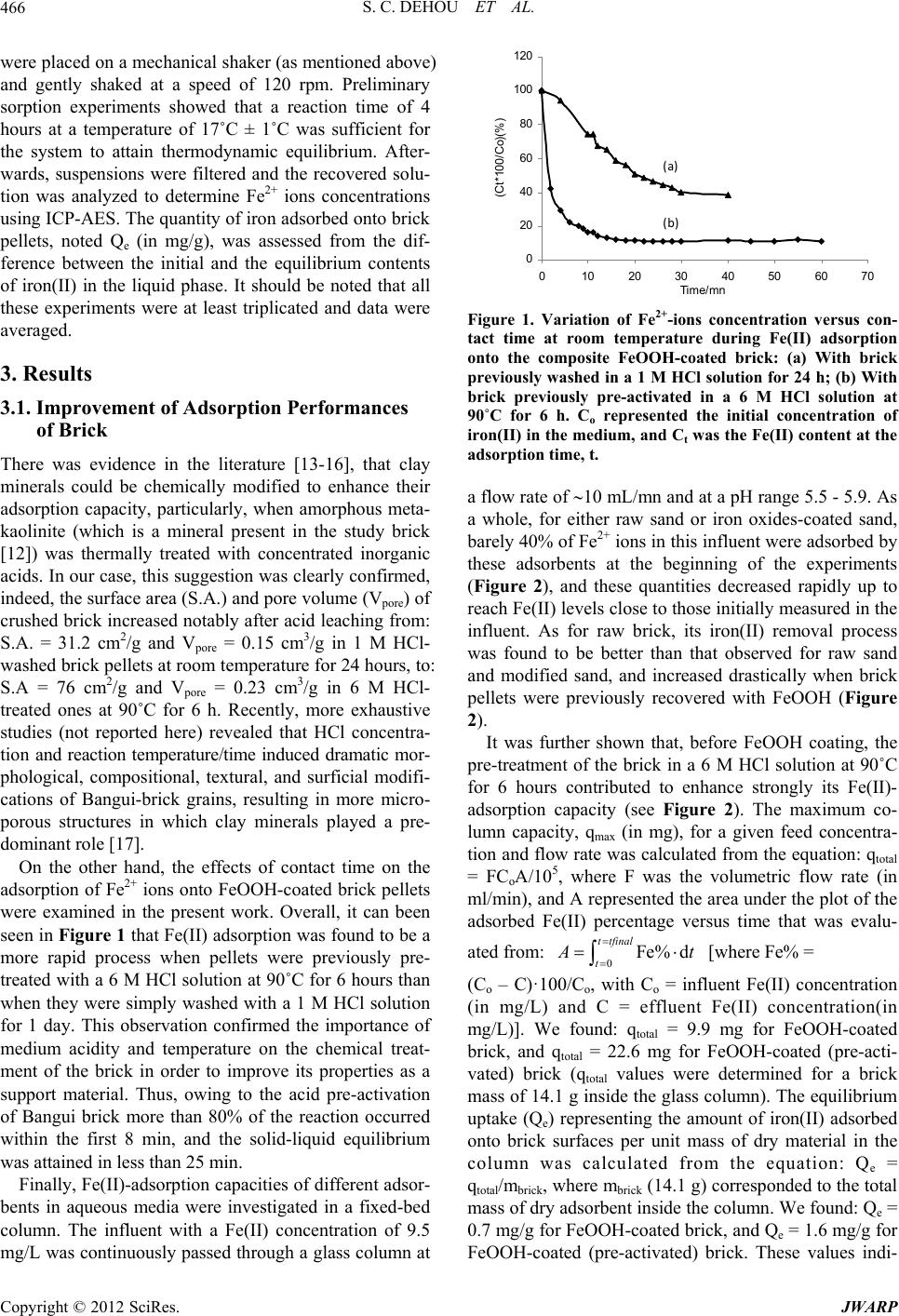 S. C. DEHOU ET AL. 466 0 20 40 60 80 100 120 010203040506070 Time/mn (Ct* 100/ Co)(% ) were placed on a mechanical shaker (as mentioned above) and gently shaked at a speed of 120 rpm. Preliminary sorption experiments showed that a reaction time of 4 hours at a temperature of 17˚C ± 1˚C was sufficient for the system to attain thermodynamic equilibrium. After- wards, suspensions were filtered and the recovered solu- tion was analyzed to determine Fe2+ ions concentrations using ICP-AES. The quantity of iron adsorbed onto brick pellets, noted Qe (in mg/g), was assessed from the dif- ference between the initial and the equilibrium contents of iron(II) in the liquid phase. It should be noted that all these experiments were at least triplicated and data were averaged. (a) (b) 0Fe% d t tfinal t 3. Results 3.1. Improvement of Adsorption Performances of Brick There was evidence in the literature [13-16], that clay minerals could be chemically modified to enhance their adsorption capacity, particularly, when amorphous meta- kaolinite (which is a mineral present in the study brick [12]) was thermally treated with concentrated inorganic acids. In our case, this suggestion was clearly confirmed, indeed, the surface area (S.A.) and pore volume (Vpore) of crushed brick increased notably after acid leaching from: S.A. = 31.2 cm2/g and Vpore = 0.15 cm3/g in 1 M HCl- washed brick pellets at room temperature for 24 hours, to: S.A = 76 cm2/g and Vpore = 0.23 cm3/g in 6 M HCl- treated ones at 90˚C for 6 h. Recently, more exhaustive studies (not reported here) revealed that HCl concentra- tion and reaction temperature/time induced dramatic mor- phological, compositional, textural, and surficial modifi- cations of Bangui-brick grains, resulting in more micro- porous structures in which clay minerals played a pre- dominant role [17]. On the other hand, the effects of contact time on the adsorption of Fe2+ ions onto FeOOH-coated brick pellets were examined in the present work. Overall, it can been seen in Figure 1 that Fe(II) adsorption was found to be a more rapid process when pellets were previously pre- treated with a 6 M HCl solution at 90˚C for 6 hours than when they were simply washed with a 1 M HCl solution for 1 day. This observation confirmed the importance of medium acidity and temperature on the chemical treat- ment of the brick in order to improve its properties as a support material. Thus, owing to the acid pre-activation of Bangui brick more than 80% of the reaction occurred within the first 8 min, and the solid-liquid equilibrium was attained in less than 25 min. Finally, Fe(II)-adsorption capacities of different adsor- bents in aqueous media were investigated in a fixed-bed column. The influent with a Fe(II) concentration of 9.5 mg/L was continuously passed through a glass column at Figure 1. Variation of Fe2+-ions concentration versus con- tact time at room temperature during Fe(II) adsorption onto the composite FeOOH-coated brick: (a) With brick previously washed in a 1 M HCl solution for 24 h; (b) With brick previously pre-activated in a 6 M HCl solution at 90˚C for 6 h. Co represented the initial concentration of iron(II) in the medium, and Ct was the Fe(II) content at the adsorption time, t. a flow rate of 10 mL/mn and at a pH range 5.5 - 5.9. As a whole, for either raw sand or iron oxides-coated sand, barely 40% of Fe2+ ions in this influent were adsorbed by these adsorbents at the beginning of the experiments (Figure 2), and these quantities decreased rapidly up to reach Fe(II) levels close to those initially measured in the influent. As for raw brick, its iron(II) removal process was found to be better than that observed for raw sand and modified sand, and increased drastically when brick pellets were previously recovered with FeOOH (Figure 2). It was further shown that, before FeOOH coating, the pre-treatment of the brick in a 6 M HCl solution at 90˚C for 6 hours contributed to enhance strongly its Fe(II)- adsorption capacity (see Figure 2). The maximum co- lumn capacity, qmax (in mg), for a given feed concentra- tion and flow rate was calculated from the equation: qtotal = FCoA/105, where F was the volumetric flow rate (in ml/min), and A represented the area under the plot of the adsorbed Fe(II) percentage versus time that was evalu- t [where Fe% = A ated from: (Co – C)·100/Co, with Co = influent Fe(II) concentration (in mg/L) and C = effluent Fe(II) concentration(in mg/L)]. We found: qtotal = 9.9 mg for FeOOH-coated brick, and qtotal = 22.6 mg for FeOOH-coated (pre-acti- vated) brick (qtotal values were determined for a brick mass of 14.1 g inside the glass column). The equilibrium uptake (Qe) representing the amount of iron(II) adsorbed onto brick surfaces per unit mass of dry material in the column was calculated from the equation: Qe = qtotal/mbrick, where mbrick (14.1 g) corresponded to the total mass of dry adsorbent inside the column. We found: Qe = 0.7 mg/g for FeOOH-coated brick, and Qe = 1.6 mg/g for FeOOH-coated (pre-activated) brick. These values indi- Copyright © 2012 SciRes. JWARP 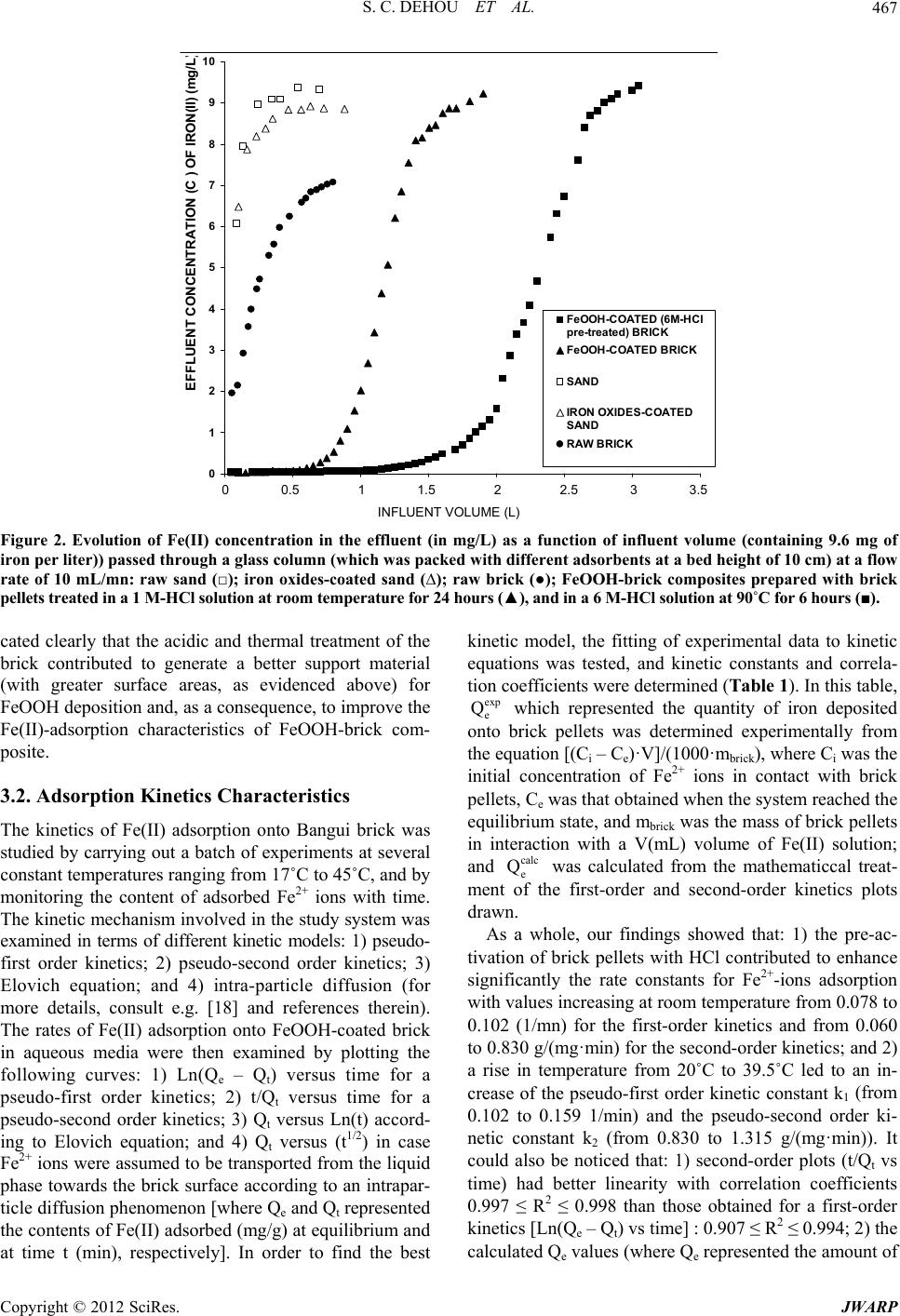 S. C. DEHOU ET AL. Copyright © 2012 SciRes. JWARP 467 0 1 2 3 4 5 6 7 8 9 10 EFFLUENT CONC ENTRA TI ON (C ) OF I R ON(I I ) ( m g/ L ) FeOOH-C pre -tre a teO A TED (6M - HCl d) BRICK FeOO H-CO A TED BRICK SAND I RON OXI SAND DES-COATED RA W BRI CK 0 0.5 1 1.5 2 2.5 3 3.5 INFLUENT VOLUME (L) Figure 2. Evolution of Fe(II) concentration in the effluent (in mg/L) as a function of influent volume (containing 9.6 mg of iron per liter)) passed through a glass column (which was packed with different adsorbents at a bed height of 10 cm) at a flow rate of 10 mL/mn: raw sand (□); iron oxides-coated sand (∆); raw brick (●); FeOOH-brick composites prepared with brick pellets treated in a 1 M-HCl solution at room temperature for 24 hours (▲), and in a 6 M-HCl solution at 90˚C for 6 hours (■). cated clearly that the acidic and thermal treatment of the brick contributed to generate a better support material (with greater surface areas, as evidenced above) for FeOOH deposition and, as a consequence, to improve the Fe(II)-adsorption characteristics of FeOOH-brick com- posite. 3.2. Adsorption Kinetics Characteristics The kinetics of Fe(II) adsorption onto Bangui brick was studied by carrying out a batch of experiments at several constant temperatures ranging from 17˚C to 45˚C, and by monitoring the content of adsorbed Fe2+ ions with time. The kinetic mechanism involved in the study system was examined in terms of different kinetic models: 1) pseudo- first order kinetics; 2) pseudo-second order kinetics; 3) Elovich equation; and 4) intra-particle diffusion (for more details, consult e.g. [18] and references therein). The rates of Fe(II) adsorption onto FeOOH-coated brick in aqueous media were then examined by plotting the following curves: 1) Ln(Qe – Qt) versus time for a pseudo-first order kinetics; 2) t/Qt versus time for a pseudo-second order kinetics; 3) Qt versus Ln(t) accord- ing to Elovich equation; and 4) Qt versus (t1/2) in case Fe2+ ions were assumed to be transported from the liquid phase towards the brick surface according to an intrapar- ticle diffusion phenomenon [where Qe and Qt represented the contents of Fe(II) adsorbed (mg/g) at equilibrium and at time t (min), respectively]. In order to find the best kinetic model, the fitting of experimental data to kinetic equations was tested, and kinetic constants and correla- tion coefficients were determined (Table 1). In this table, e which represented the quantity of iron deposited onto brick pellets was determined experimentally from the equation [(Ci – Ce)·V]/(1000·mbrick), where Ci was the initial concentration of Fe2+ ions in contact with brick pellets, Ce was that obtained when the system reached the equilibrium state, and mbrick was the mass of brick pellets in interaction with a V(mL) volume of Fe(II) solution; and e was calculated from the mathematiccal treat- ment of the first-order and second-order kinetics plots drawn. exp Q calc Q As a whole, our findings showed that: 1) the pre-ac- tivation of brick pellets with HCl contributed to enhance significantly the rate constants for Fe2+-ions adsorption with values increasing at room temperature from 0.078 to 0.102 (1/mn) for the first-order kinetics and from 0.060 to 0.830 g/(mg·min) for the second-order kinetics; and 2) a rise in temperature from 20˚C to 39.5˚C led to an in- crease of the pseudo-first order kinetic constant k1 (from 0.102 to 0.159 1/min) and the pseudo-second order ki- netic constant k2 (from 0.830 to 1.315 g/(mg·min)). It could also be noticed that: 1) second-order plots (t/Qt vs time) had better linearity with correlation coefficients 0.997 ≤ R2 ≤ 0.998 than those obtained for a first-order kinetics [Ln(Qe – Qt) vs time] : 0.907 ≤ R2 ≤ 0.994; 2) the calculated Qe values (where Qe represented the amount of 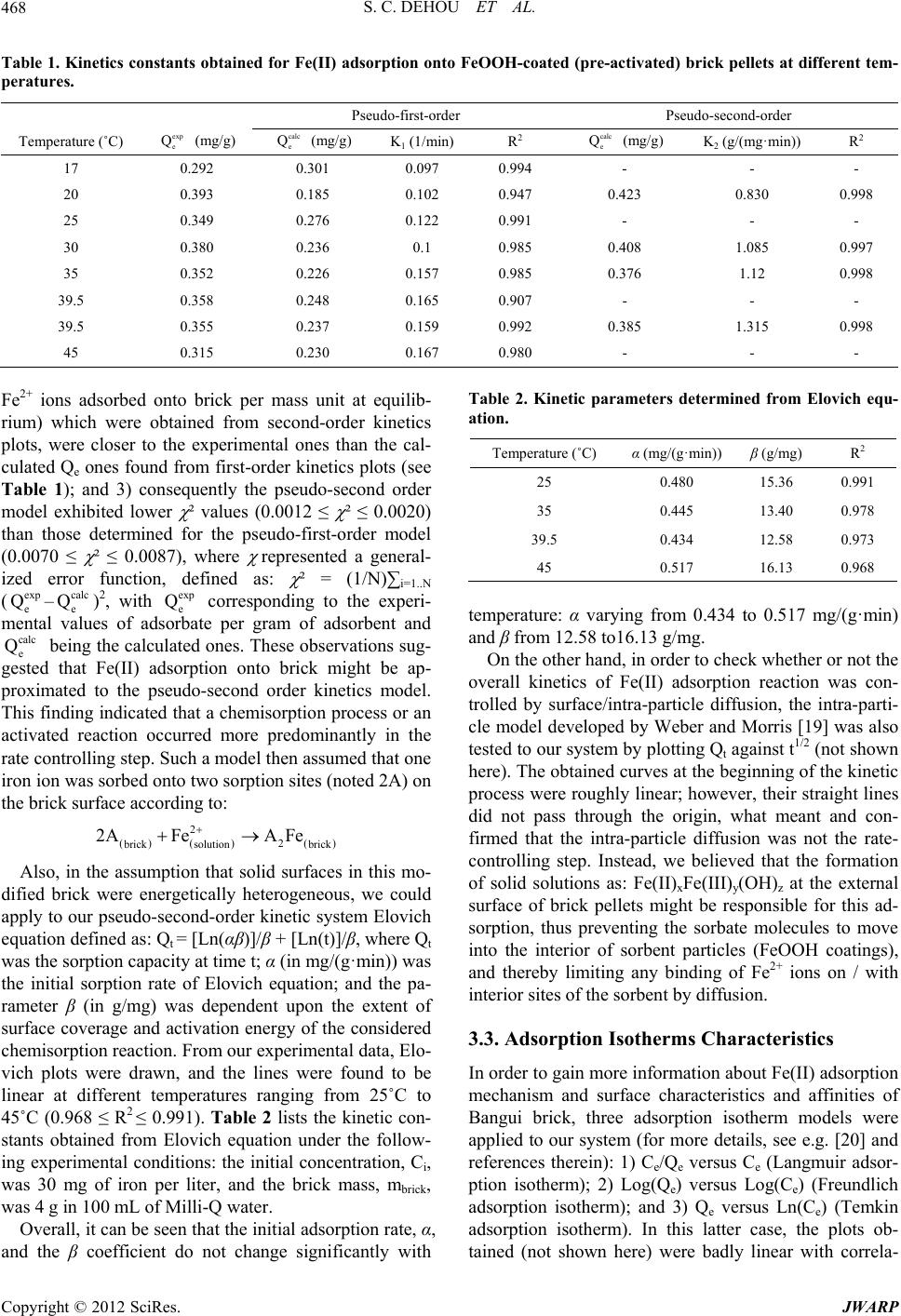 S. C. DEHOU ET AL. 468 Table 1. Kinetics constants obtained for Fe(II) adsorption onto FeOOH-coated (pre-activated) brick pellets at different tem- peratures. Pseudo-first-order Pseudo-second-order Temperature (˚C) exp e Q (mg/g) calc e Qcalc e Q (mg/g) K1 (1/min) R2 (mg/g) K2 (g/(mg·min)) R2 17 0.292 0.301 0.097 0.994 - - - 20 0.393 0.185 0.102 0.947 0.423 0.830 0.998 25 0.349 0.276 0.122 0.991 - - - 30 0.380 0.236 0.1 0.985 0.408 1.085 0.997 35 0.352 0.226 0.157 0.985 0.376 1.12 0.998 39.5 0.358 0.248 0.165 0.907 - - - 39.5 0.355 0.237 0.159 0.992 0.385 1.315 0.998 45 0.315 0.230 0.167 0.980 - - - Fe2+ ions adsorbed onto brick per mass unit at equilib- rium) which were obtained from second-order kinetics plots, were closer to the experimental ones than the cal- culated Qe ones found from first-order kinetics plots (see Table 1); and 3) consequently the pseudo-second order model exhibited lower ² values (0.0012 ≤ ² ≤ 0.0020) than those determined for the pseudo-first-order model (0.0070 ≤ ² ≤ 0.0087), where represented a general- ized error function, defined as: ² = (1/N)∑i=1..N (e Q–e)2, with e corresponding to the experi- mental values of adsorbate per gram of adsorbent and e being the calculated ones. These observations sug- gested that Fe(II) adsorption onto brick might be ap- proximated to the pseudo-second order kinetics model. This finding indicated that a chemisorption process or an activated reaction occurred more predominantly in the rate controlling step. Such a model then assumed that one iron ion was sorbed onto two sorption sites (noted 2A) on the brick surface according to: exp calc Qexp Q calc Q 2 2 b rick solutionbrick 2AFeA Fe Also, in the assumption that solid surfaces in this mo- dified brick were energetically heterogeneous, we could apply to our pseudo-second-order kinetic system Elovich equation defined as: Qt = [Ln(αβ)]/β + [Ln(t)]/β, where Qt was the sorption capacity at time t; α (in mg/(g·min)) was the initial sorption rate of Elovich equation; and the pa- rameter β (in g/mg) was dependent upon the extent of surface coverage and activation energy of the considered chemisorption reaction. From our experimental data, Elo- vich plots were drawn, and the lines were found to be linear at different temperatures ranging from 25˚C to 45˚C (0.968 ≤ R2 ≤ 0.991). Table 2 lists the kinetic con- stants obtained from Elovich equation under the follow- ing experimental conditions: the initial concentration, Ci, was 30 mg of iron per liter, and the brick mass, mbrick, was 4 g in 100 mL of Milli-Q water. Overall, it can be seen that the initial adsorption rate, α, and the β coefficient do not change significantly with Table 2. Kinetic parameters determined from Elovich equ- ation. Temperature (˚C) α (mg/(g·min)) β (g/mg) R2 25 0.480 15.36 0.991 35 0.445 13.40 0.978 39.5 0.434 12.58 0.973 45 0.517 16.13 0.968 temperature: α varying from 0.434 to 0.517 mg/(g·min) and β from 12.58 to16.13 g/mg. On the other hand, in order to check whether or not the overall kinetics of Fe(II) adsorption reaction was con- trolled by surface/intra-particle diffusion, the intra-parti- cle model developed by Weber and Morris [19] was also tested to our system by plotting Qt against t1/2 (not shown here). The obtained curves at the beginning of the kinetic process were roughly linear; however, their straight lines did not pass through the origin, what meant and con- firmed that the intra-particle diffusion was not the rate- controlling step. Instead, we believed that the formation of solid solutions as: Fe(II)xFe(III)y(OH)z at the external surface of brick pellets might be responsible for this ad- sorption, thus preventing the sorbate molecules to move into the interior of sorbent particles (FeOOH coatings), and thereby limiting any binding of Fe2+ ions on / with interior sites of the sorbent by diffusion. 3.3. Adsorption Isotherms Characteristics In order to gain more information about Fe(II) adsorption mechanism and surface characteristics and affinities of Bangui brick, three adsorption isotherm models were applied to our system (for more details, see e.g. [20] and references therein): 1) Ce/Qe versus Ce (Langmuir adsor- ption isotherm); 2) Log(Qe) versus Log(Ce) (Freundlich adsorption isotherm); and 3) Qe versus Ln(Ce) (Temkin adsorption isotherm). In this latter case, the plots ob- tained (not shown here) were badly linear with correla- Copyright © 2012 SciRes. JWARP 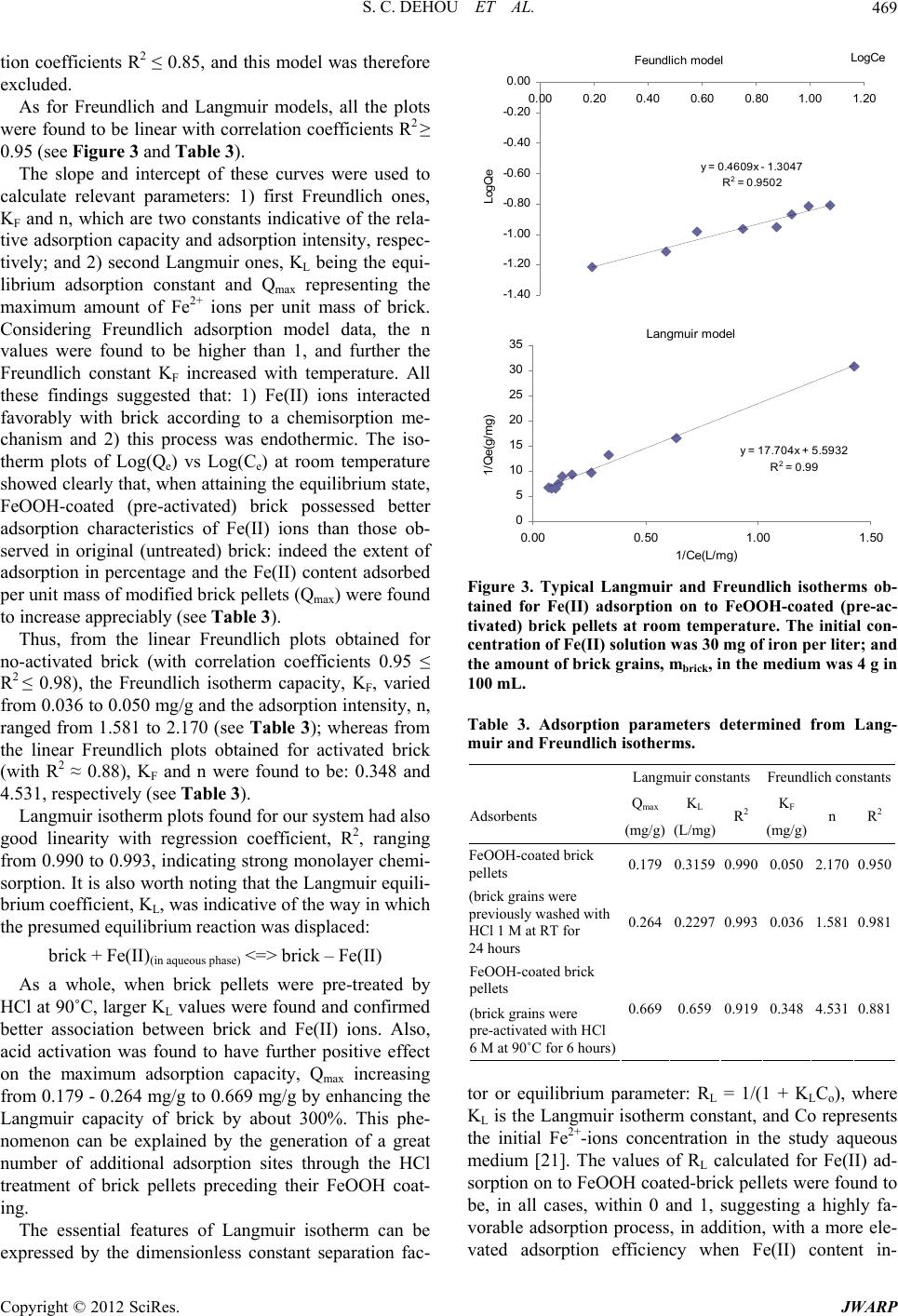 S. C. DEHOU ET AL. 469 tion coefficients R2 ≤ 0.85, and this model was therefore excluded. Feundli ch m odel y = 0.460 9x - 1.3047 R 2 = 0.9502 -1.40 -1.20 -1.00 -0.80 -0.60 -0.40 -0.20 0. 00 0.00 0.200.40 0.60 0.801.00 1.20 LogC e As for Freundlich and Langmuir models, all the plots were found to be linear with correlation coefficients R2 ≥ 0.95 (see Figure 3 and Table 3). The slope and intercept of these curves were used to calculate relevant parameters: 1) first Freundlich ones, KF and n, which are two constants indicative of the rela- tive adsorption capacity and adsorption intensity, respec- tively; and 2) second Langmuir ones, KL being the equi- librium adsorption constant and Qmax representing the maximum amount of Fe2+ ions per unit mass of brick. Considering Freundlich adsorption model data, the n values were found to be higher than 1, and further the Freundlich constant KF increased with temperature. All these findings suggested that: 1) Fe(II) ions interacted favorably with brick according to a chemisorption me- chanism and 2) this process was endothermic. The iso- therm plots of Log(Qe) vs Log(Ce) at room temperature showed clearly that, when attaining the equilibrium state, FeOOH-coated (pre-activated) brick possessed better adsorption characteristics of Fe(II) ions than those ob- served in original (untreated) brick: indeed the extent of adsorption in percentage and the Fe(II) content adsorbed per unit mass of modified brick pellets (Qmax) were found to increase appreciably (see Table 3). LogQe Thus, from the linear Freundlich plots obtained for no-activated brick (with correlation coefficients 0.95 ≤ R2 ≤ 0.98), the Freundlich isotherm capacity, KF, varied from 0.036 to 0.050 mg/g and the adsorption intensity, n, ranged from 1.581 to 2.170 (see Table 3); whereas from the linear Freundlich plots obtained for activated brick (with R2 ≈ 0.88), KF and n were found to be: 0.348 and 4.531, respectively (see Table 3). Langmuir isotherm plots found for our system had also good linearity with regression coefficient, R2, ranging from 0.990 to 0.993, indicating strong monolayer chemi- sorption. It is also worth noting that the Langmuir equili- brium coefficient, KL, was indicative of the way in which the presumed equilibrium reaction was displaced: brick + Fe(II)(in aqueous phase) <=> brick – Fe(II) As a whole, when brick pellets were pre-treated by HCl at 90˚C, larger KL values were found and confirmed better association between brick and Fe(II) ions. Also, acid activation was found to have further positive effect on the maximum adsorption capacity, Qmax increasing from 0.179 - 0.264 mg/g to 0.669 mg/g by enhancing the Langmuir capacity of brick by about 300%. This phe- nomenon can be explained by the generation of a great number of additional adsorption sites through the HCl treatment of brick pellets preceding their FeOOH coat- ing. The essential features of Langmuir isotherm can be expressed by the dimensionless constant separation fac- Langmuir m odel y = 17.704 x + 5.5932 R 2 = 0.99 0 5 10 15 20 25 30 35 0.00 0.501.00 1.50 1/ Ce(L/mg) 1/ Qe(g/m g) Figure 3. Typical Langmuir and Freundlich isotherms ob- tained for Fe(II) adsorption on to FeOOH-coated (pre-ac- tivated) brick pellets at room temperature. The initial con- centration of Fe(II) solution was 30 mg of iron per liter; and the amount of brick grains, mbrick, in the medium was 4 g in 100 mL. Table 3. Adsorption parameters determined from Lang- muir and Freundlich isotherms. Langmuir constants Freundlich constants Qmax KL K F Adsorbents (mg/g)(L/mg) R2 (mg/g) n R2 FeOOH-coated brick pellets 0.1790.3159 0.990 0.050 2.1700.950 (brick grains were previously washed with HCl 1 M at RT for 24 hours 0.2640.2297 0.993 0.036 1.5810.981 FeOOH-coated brick pellets (brick grains were pre-activated with HCl 6 M at 90˚C for 6 hours) 0.6690.659 0.919 0.348 4.5310.881 tor or equilibrium parameter: RL = 1/(1 + KLCo), where KL is the Langmuir isotherm constant, and Co represents the initial Fe2+-ions concentration in the study aqueous medium [21]. The values of RL calculated for Fe(II) ad- sorption on to FeOOH coated-brick pellets were found to be, in all cases, within 0 and 1, suggesting a highly fa- vorable adsorption process, in addition, with a more ele- vated adsorption efficiency when Fe(II) content in- Copyright © 2012 SciRes. JWARP 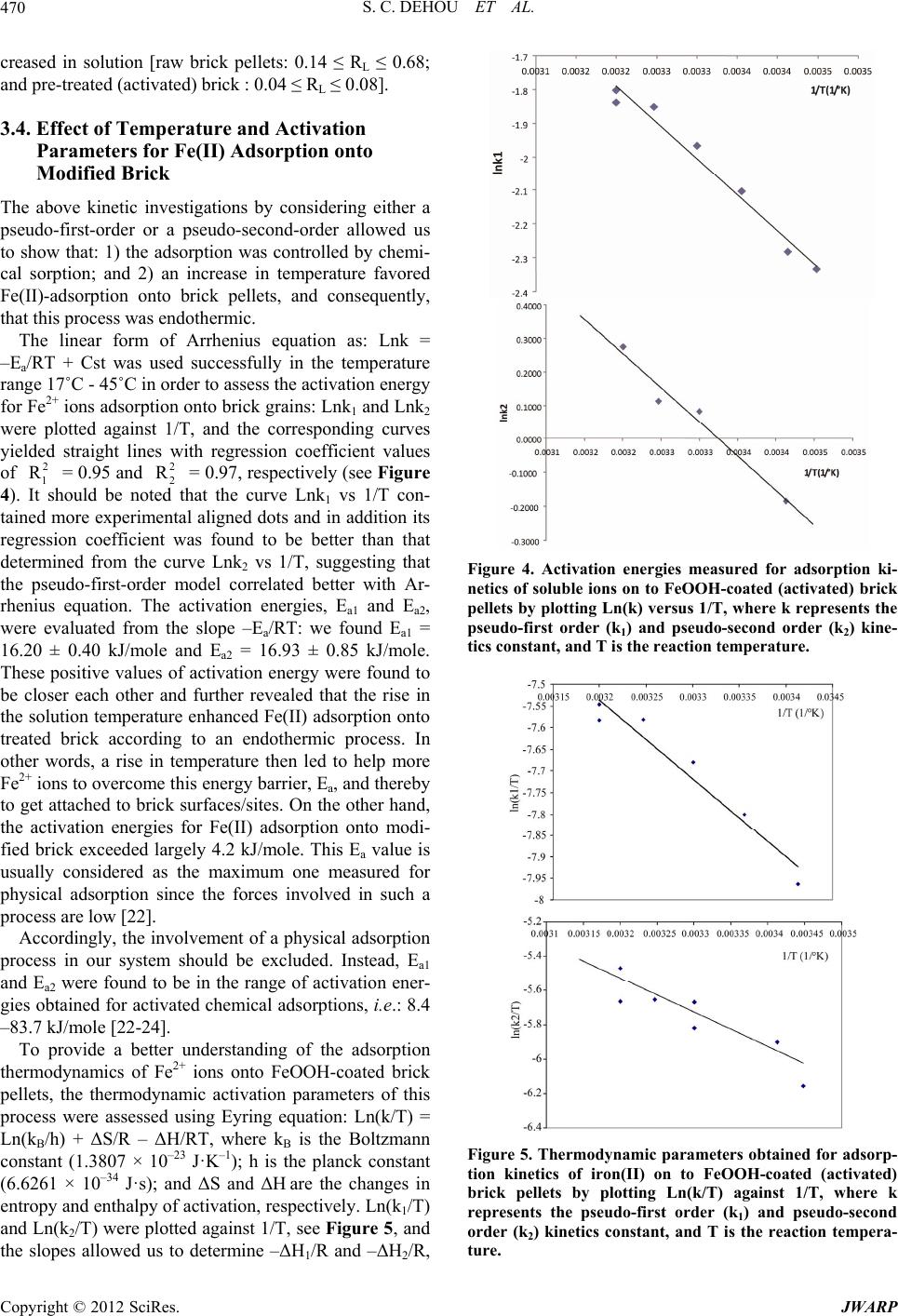 S. C. DEHOU ET AL. 470 creased in solution [raw brick pellets: 0.14 ≤ RL ≤ 0.68; and pre-treated (activated) brick : 0.04 ≤ RL ≤ 0.08]. 3.4. Effect of Temperature and Activation Parameters for Fe(II) Adsorption onto Modified Brick The above kinetic investigations by considering either a pseudo-first-order or a pseudo-second-order allowed us to show that: 1) the adsorption was controlled by chemi- cal sorption; and 2) an increase in temperature favored Fe(II)-adsorption onto brick pellets, and consequently, that this process was endothermic. The linear form of Arrhenius equation as: Lnk = –Ea/RT + Cst was used successfully in the temperature range 17˚C - 45˚C in order to assess the activation energy for Fe2+ ions adsorption onto brick grains: Lnk1 and Lnk2 were plotted against 1/T, and the corresponding curves yielded straight lines with regression coefficient values of = 0.95 and 2 = 0.97, respectively (see Figure 4). It should be noted that the curve Lnk1 vs 1/T con- tained more experimental aligned dots and in addition its regression coefficient was found to be better than that determined from the curve Lnk2 vs 1/T, suggesting that the pseudo-first-order model correlated better with Ar- rhenius equation. The activation energies, Ea1 and Ea2, were evaluated from the slope –Ea/RT: we found Ea1 = 16.20 ± 0.40 kJ/mole and Ea2 = 16.93 ± 0.85 kJ/mole. These positive values of activation energy were found to be closer each other and further revealed that the rise in the solution temperature enhanced Fe(II) adsorption onto treated brick according to an endothermic process. In other words, a rise in temperature then led to help more Fe2+ ions to overcome this energy barrier, Ea, and thereby to get attached to brick surfaces/sites. On the other hand, the activation energies for Fe(II) adsorption onto modi- fied brick exceeded largely 4.2 kJ/mole. This Ea value is usually considered as the maximum one measured for physical adsorption since the forces involved in such a process are low [22]. 2 1 R2 R Accordingly, the involvement of a physical adsorption process in our system should be excluded. Instead, Ea1 and Ea2 were found to be in the range of activation ener- gies obtained for activated chemical adsorptions, i.e.: 8.4 –83.7 kJ/mole [22-24]. To provide a better understanding of the adsorption thermodynamics of Fe2+ ions onto FeOOH-coated brick pellets, the thermodynamic activation parameters of this process were assessed using Eyring equation: Ln(k/T) = Ln(kB/h) + ΔS/R – ΔH/RT, where kB is the Boltzmann constant (1.3807 × 10⁻²³ J·K–1); h is the planck constant (6.6261 × 10⁻³⁴ J·s); and ΔS and ΔH are the changes in entropy and enthalpy of activation, respectively. Ln(k1/T) and Ln(k2/T) were plotted against 1/T, see Figure 5, and the slopes allowed us to determine –ΔH1/R and –ΔH2/R, Figure 4. Activation energies measured for adsorption ki- netics of soluble ions on to FeOOH-coated (activated) brick pellets by plotting Ln(k) versus 1/T, where k represents the pseudo-first order (k1) and pseudo-second order (k2) kine- tics constant, and T is the reaction temperature. Figure 5. Thermodynamic parameters obtained for adsorp- tion kinetics of iron(II) on to FeOOH-coated (activated) brick pellets by plotting Ln(k/T) against 1/T, where k represents the pseudo-first order (k1) and pseudo-second order (k2) kinetics constant, and T is the reaction tempera- ture. Copyright © 2012 SciRes. JWARP 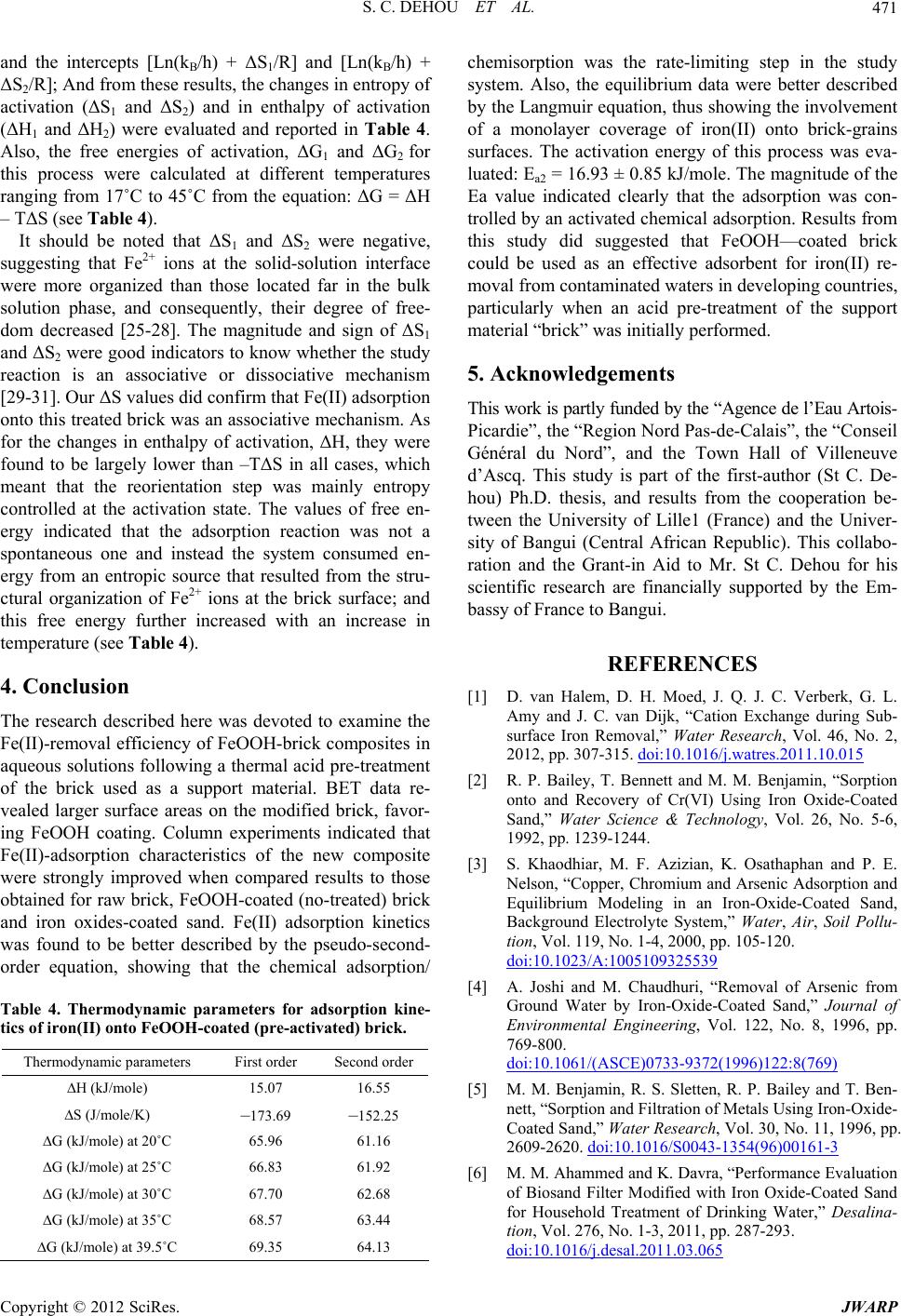 S. C. DEHOU ET AL. 471 and the intercepts [Ln(kB/h) + ΔS1/R] and [Ln(kB/h) + ΔS2/R]; And from these results, the changes in entropy of activation (ΔS1 and ΔS2) and in enthalpy of activation (ΔH1 and ΔH2) were evaluated and reported in Table 4. Also, the free energies of activation, ΔG1 and ΔG2 for this process were calculated at different temperatures ranging from 17˚C to 45˚C from the equation: ΔG = ΔH – TΔS (see Table 4). It should be noted that ΔS1 and ΔS2 were negative, suggesting that Fe2+ ions at the solid-solution interface were more organized than those located far in the bulk solution phase, and consequently, their degree of free- dom decreased [25-28]. The magnitude and sign of ΔS1 and ΔS2 were good indicators to know whether the study reaction is an associative or dissociative mechanism [29-31]. Our ΔS values did confirm that Fe(II) adsorption onto this treated brick was an associative mechanism. As for the changes in enthalpy of activation, ΔH, they were found to be largely lower than –TΔS in all cases, which meant that the reorientation step was mainly entropy controlled at the activation state. The values of free en- ergy indicated that the adsorption reaction was not a spontaneous one and instead the system consumed en- ergy from an entropic source that resulted from the stru- ctural organization of Fe2+ ions at the brick surface; and this free energy further increased with an increase in temperature (see Table 4). 4. Conclusion The research described here was devoted to examine the Fe(II)-removal efficiency of FeOOH-brick composites in aqueous solutions following a thermal acid pre-treatment of the brick used as a support material. BET data re- vealed larger surface areas on the modified brick, favor- ing FeOOH coating. Column experiments indicated that Fe(II)-adsorption characteristics of the new composite were strongly improved when compared results to those obtained for raw brick, FeOOH-coated (no-treated) brick and iron oxides-coated sand. Fe(II) adsorption kinetics was found to be better described by the pseudo-second- order equation, showing that the chemical adsorption/ Table 4. Thermodynamic parameters for adsorption kine- tics of iron(II) onto FeOOH-coated (pre-activated) brick. Thermodynamic parameters First order Second order ∆H (kJ/mole) 15.07 16.55 ∆S (J/mole/K) –173.69 –152.25 ∆G (kJ/mole) at 20˚C 65.96 61.16 ∆G (kJ/mole) at 25˚C 66.83 61.92 ∆G (kJ/mole) at 30˚C 67.70 62.68 ∆G (kJ/mole) at 35˚C 68.57 63.44 ∆G (kJ/mole) at 39.5˚C 69.35 64.13 chemisorption was the rate-limiting step in the study system. Also, the equilibrium data were better described by the Langmuir equation, thus showing the involvement of a monolayer coverage of iron(II) onto brick-grains surfaces. The activation energy of this process was eva- luated: Ea2 = 16.93 ± 0.85 kJ/mole. The magnitude of the Ea value indicated clearly that the adsorption was con- trolled by an activated chemical adsorption. Results from this study did suggested that FeOOH—coated brick could be used as an effective adsorbent for iron(II) re- moval from contaminated waters in developing countries, particularly when an acid pre-treatment of the support material “brick” was initially performed. 5. Acknowledgements This work is partly funded by the “Agence de l’Eau Artois- Picardie”, the “Region Nord Pas-de-Calais”, the “Conseil Général du Nord”, and the Town Hall of Villeneuve d’Ascq. This study is part of the first-author (St C. De- hou) Ph.D. thesis, and results from the cooperation be- tween the University of Lille1 (France) and the Univer- sity of Bangui (Central African Republic). This collabo- ration and the Grant-in Aid to Mr. St C. Dehou for his scientific research are financially supported by the Em- bassy of France to Bangui. REFERENCES [1] D. van Halem, D. H. Moed, J. Q. J. C. Verberk, G. L. Amy and J. C. van Dijk, “Cation Exchange during Sub- surface Iron Removal,” Water Research, Vol. 46, No. 2, 2012, pp. 307-315. doi:10.1016/j.watres.2011.10.015 [2] R. P. Bailey, T. Bennett and M. M. Benjamin, “Sorption onto and Recovery of Cr(VI) Using Iron Oxide-Coated Sand,” Water Science & Technology, Vol. 26, No. 5-6, 1992, pp. 1239-1244. [3] S. Khaodhiar, M. F. Azizian, K. Osathaphan and P. E. Nelson, “Copper, Chromium and Arsenic Adsorption and Equilibrium Modeling in an Iron-Oxide-Coated Sand, Background Electrolyte System,” Water, Air, Soil Pollu- tion, Vol. 119, No. 1-4, 2000, pp. 105-120. doi:10.1023/A:1005109325539 [4] A. Joshi and M. Chaudhuri, “Removal of Arsenic from Ground Water by Iron-Oxide-Coated Sand,” Journal of Environmental Engineering, Vol. 122, No. 8, 1996, pp. 769-800. doi:10.1061/(ASCE)0733-9372(1996)122:8(769) [5] M. M. Benjamin, R. S. Sletten, R. P. Bailey and T. Ben- nett, “Sorption and Filtration of Metals Using Iron-Oxide- Coated Sand,” Water Research, Vol. 30, No. 11, 1996, pp. 2609-2620. doi:10.1016/S0043-1354(96)00161-3 [6] M. M. Ahammed and K. Davra, “Performance Evaluation of Biosand Filter Modified with Iron Oxide-Coated Sand for Household Treatment of Drinking Water,” Desalina- tion, Vol. 276, No. 1-3, 2011, pp. 287-293. doi:10.1016/j.desal.2011.03.065 Copyright © 2012 SciRes. JWARP  S. C. DEHOU ET AL. 472 [7] B. Rusch, K. Hanna and B. Humbert, “Coating of Quartz Silica with Iron Oxides: Characterization and Surface Reactivity of Iron Coating Phases,” Colloids and Surfaces A: Physicochemical and Engineering Aspects, Vol. 353, No. 2-3, 2010, pp. 172-180. doi:10.1016/j.colsurfa.2009.11.009 [8] M. M. Ahammed and V. Meera, “Metal Oxide/Hydro- xide-Coated Dual-Media Filter for Simultaneous Re- moval of Bacteria and Heavy Metals from Natural Wa- ters,” Journal of Hazardous Materials, Vol. 181, No. 1-3, 2010, pp. 788-793. doi:10.1016/j.jhazmat.2010.05.082 [9] C.-S. Jeon, K. Back, J.-K. Park, Y.-K. Oh and S.-D. Lee, “Adsorption Characteristics of As(V) on Iron-Coated Zeolite,” Journal of Hazardous Materials, Vol. 163, No. 2-3, 2009, pp. 804-808. doi:10.1016/j.jhazmat.2008.07.052 [10] R. Han, L. Zou, X. Hao, Y. Xu, F. Xu, Y. Li and Y. Wang, “Characterization and Properties of Iron-Oxide- Coated Zeolite as Adsorbent for Removal of Copper(II) from Solution in Fixed Bed Column,” Chemical Engi- neering Journal, Vol. 149, No. 1-3, 2009, pp. 123-139. doi:10.1016/j.cej.2008.10.015 [11] E. Eren and H. Gumus, “Characterization of the Struc- tural Properties and Pb(II) Adsorption Behavior of Iron Oxide Coated Sepiolite,” Desalination, Vol. 273, No. 2-3, 2011, pp. 276-284. doi:10.1016/j.desal.2011.01.004 [12] S. C. Dehou, M. Wartel, P. Recourt, B. Revel, J. Mabin- gui, A. Montiel and A. Boughriet, “Physicochemical, Crystalline, and Morphological Characteristics of Bricks Used for Ground Waters Purification in Bangui Region (Central African Republic),” Applied Clay Science, Vol. 59-60, 2012, pp. 69-75. doi:10.1016/j.clay.2012.02.009 [13] G. Wang, X. Wang, X. Chai, J. Liu and N. Deng, “Ad- sorption of Uranium(VI) from Aqueous Solution on Cal- cined and Acid-Activated Kaolin,” Applied Clay Science, Vol. 47, No. 3-4, 2010, pp. 448-451. doi:10.1016/j.clay.2009.11.003 [14] A. G. San Cristobal, R. Castello, M. A. M. Luengo and C. Viscayno, “Acid Activation of Mechanically and Ther- mally Modified Kaolins,” Materials Research Bulletin, Vol. 44, No. 11, 2009, pp. 2103-2111. doi:10.1016/j.materresbull.2009.07.016 [15] K. Bhattacharyya and S. S. Gupta, “Removal of Cu(II) by Natural and Acid-Activated Clays: An insight of Adsorp- tion Isotherm, Kinetic and Thermodynamics,” Desalina- tion, Vol. 272, No. 1-3, 2011, pp. 66-75. doi:10.1016/j.desal.2011.01.001 [16] G. Suraj, C. S. P. Lyer and M. Lalithambika, “Adsorption of Cadmium and Copper by Modified Kaolinites,” Ap- plied Clay Science, Vol. 13, No. 4, 1998, pp. 293-306. doi:10.1016/S0169-1317(98)00043-X [17] S. C. Dehou, “Etude des Propriétés d’Adsorption des Oxyhydroxydes de fer Déposés sur un Support Naturel (la Brique): Application à l’Elimination du fer dans les eaux de Forages en République Centrafricaine,” Thesis, Univer- sity of Lillel, France, 2011, p. 157. [18] S. S. Gupta and K. G. Bhattacharyya, “Kinetics of Ad- sorption of Metal Ions on Inorganic Materials: A Re- view,” Advances in Colloid and Interface Science, Vol. 162, No. 1-2, 2011, pp. 39-58. [19] W. J. Weber and J. C. Morris, “Kinetics of Adsorption on Carbon from Solutions,” Journal of the Sanitary Engi- neering Division, Vol. 89, No. 2, 1963, pp. 31-63. [20] K. Y. Foo and B. H. Hameed, “Insights into the Modeling of Adsorption Isotherm Systems,” Chemical Engineering Journal, Vol. 156, No. 1, 2010, pp. 2-10. doi:10.1016/j.cej.2009.09.013 [21] K. R. Hall, L. C. Eagleton, A. Acrivos and T. Vermeulen, “Pore- and Solid-Diffusion Kinetics in Fixed-Bed Ad- sorption under Constant-Pattern Conditions,” Industrial & Engineering Chemistry Fundamentals, Vol. 5, No. 2, 1966, pp. 212-213. doi:10.1021/i160018a011 [22] W. Zou, R. Han, Z. Chen, Z. Jinghna and J. Shi, “Kinetic Study of Adsorption of Cu(II) and Pb(II) from Aqueous Solution Using Manganese Oxide Coated Zeolite in Batch Mode,” Colloids and Surfaces A: Physicochemical and Engineering Aspects, Vol. 279, No. 1-3, 2006, pp. 238- 246. doi:10.1016/j.colsurfa.2006.01.008 [23] Z. Aksu, “Determination of the Equilibrium, Kinetic and Thermodynamic Parameters of the Batch Adsorption of Lead(II) Ions onto Chlorella Vulgaris,” Process Bioche- mistry, Vol. 38, No. 1, 2002, pp. 89-99. doi:10.1016/S0032-9592(02)00051-1 [24] R. Han, W. Zou, Z. Thang, J. Shi and J. Yang, “Removal of Copper(II) and Lead(II) from Aqueous Solution by Manganese Oxide-Coated-Sand: I. Characterization and Kinetic Study,” Journal of Hazardous Materials, Vol. 137, No. 1, 2006, pp. 384-393. doi:10.1016/j.jhazmat.2006.02.021 [25] M. M. Abu-Mesalam, “Sorption Kinetics of Copper, Zinc, Cadmium and Nickel Ions on Synthesized Silico-Anti- monate Ion Exchanger,” Colloids and Surfaces A: Phys- icochemical and Engineering Aspects, Vol. 225, No. 1-3, 2003, pp. 85-94. doi:10.1016/S0927-7757(03)00191-2 [26] R. S. Juang and J. Y. Chung, “Equilibrium Sorption of Heavy Metals and Phosphate from Single- and Binary- Sorbate Solutions on Goethite,” Journal of Colloid and Interface Science, Vol. 275, No. 1, 2004, pp. 53-60. doi:10.1016/j.jcis.2004.01.035 [27] Z. Elouear, J. Bouzid, N. Boujelben, M. Feki, F. Jamoussi and A. Montiel, “Heavy Metal Removal from Aqueous Solutions by Activated Phosphate Rock,” Journal of Ha- zardous Materials, Vol. 156, 2008, pp. 412-420. doi:10.1016/j.jhazmat.2007.12.036 [28] M. Waseem, S. Mustafa, A. Naeem, G. J. M. Koper and K. H. Shah, “Cd2+ Sorption Characteristics of Iron Coated Silica,” Desalination, Vol. 277, No. 1-3, 2011, pp. 221- 226.doi:10.1016/j.desal.2011.04.034 [29] M. Doĝan and M. Alkan, “Adsorption Kinetics of Methyl Violet onto Perlite,” Chemisorption, Vol. 50, No. 4, 2003, pp. 517-528. [30] K. G. Scheckel and D. C. Sparks, “Temperature Effect on Nickel Sorption Kinetics of the Mineral-Water Interface,” Soil Science Society of America Journal, Vol. 65, No. 3, 2008, pp. 719-728. doi:10.2136/sssaj2001.653719x [31] M. Mohapatra, S. Khatun and S. Amand, “Kinetics and Thermodynamics of Lead(II) Adsorption on Lateritic Copyright © 2012 SciRes. JWARP  S. C. DEHOU ET AL. Copyright © 2012 SciRes. JWARP 473 Nickel Ores of Indian Origin,” Chemical Engineering Journal, Vol. 155, No. 1-2, 2009, pp. 184-190. doi:10.1016/j.cej.2009.07.035 |