

Paper Menu >>
Journal Menu >>
 Creative Education 2012. Vol.3, No.3, 281-289 Published Online June 2012 in SciRes (http://www.SciRP.org/journal/ce) http://dx.doi.org/10.4236/ce.2012.33044 Copyright © 2012 SciRe s . 281 The Epistemological Aspects of Curriculum Development and Implementation for the Medical Laboratory Technology Diploma in Uganda Wilson Rwandembo Mugisha1, Christopher B. Mugimu2 1Ministry of Educat io n an d Sp orts, Param edical Schools, Kampala, Uganda 2Department of Foundatio ns and Curriculum Studies, College of Ed ucation and External Studies, Makerere University, Kampala, Uganda Email: [email protected], rwandem bo @yahoo.co.uk Received March 31st, 20 1 2; revised April 29th, 2012; accepted May 12th, 2012 A study was conducted to investigate the epistemological aspects found in the curriculum, teaching, learning and practice of Medical Laboratory Technology (MLT) in Uganda. The study involved the analy- sis of the curriculum document for the diploma in MLT implemented at Mulago Paramedical Schools (MPS) in Kampala Uganda. It further involved getting the views of learners, educators and clinical super- visors of the MLT diploma programme. The results of the study revealed that various epistemological as- pects were applied during the development and implementation of the MLT curriculum as well as during the practice of MLT in Uganda. Application of these aspects during curriculum development and imple- mentation led to acquisition of various types of knowledge. It further led to the development of different and appropriate ways of knowing that is necessary for the training and practice of MLT. Keywords: Curriculum Development; Implementation; Epistemological Aspects Introduction Medical Laboratory Technology (MLT) training in Uganda has been going on since the late 1920s. This study investigated whether epistemological curricula issues have been applied in the training practices and processes as well as professional MLT practices. Epistemology refers to knowledge generation, acquisition, and justification. The notion of epistemology is central in curriculum development and implementation. It is against this background that this study focused on establishing whether the epistemological aspects of curriculum exist in the MLT training in Uganda. This paper presents current research on epistemology in relation to curriculum development and implementation. We also present results to highlight how vari- ous epistemological aspects have been applied in the curricu- lum development and implementation processes at the school of MLT at Mulago Paramedical Schools in Uganda. We discuss the manner in which the different types of knowledge and ways of knowing have been reflected in the training processes and practices of MLT, drawing on the Ugandan experience. The Concept of Epistemology Epistemology is concerned with the nature of knowledge and knowing, and the validity of knowledge claims (Zais, 2010). It also deals with the question of discovering the truth and authenticity of knowledge as well as limits of knowledge. Re- cent developments in epistemology have now shifted from the belief that knowledge is absolute and static to the current post- modern views, which emphasise its continuous development and evolutionary nature. Therefore, epistemology and curricu- lum are interrelated. Figure 1 reflects our conceptualization of the epistemological aspects of curriculum development and im- plementation. Curriculum contents exist in order to transmit knowledge and to lay a foundation to facilitate knowing or meaning construc- tion. Ornstein and Levine (1993) consider epistemology to be at the pillar of curriculum development. Curriculum development entails decision-making on the nature and the level of content, level of skills, values and attitudes that learners should acquire through education (Okello & Ocheng, 1996). Educators’ under- standing of the various forms of knowledge and patterns of knowing influence their decisions concerning content selection and its organization during curriculum design and implementa- tion. The curriculum implementation processes may include teach- ing, learning and assessment of learning (Sowell, 2010). Knowledge Knowledge is what is perceived to be reality or truth (Higgs & Smith, 2006; Russell, 1996). Nickols (2000a) argues that knowledge is a mix of framed experiences, values, contextual information, and expert insight (pp. 12-2 1). The notion of know- ledge can be objective, observable and communicable to one individual and likewise knowledge can be subjective, unique, and internal to another individual. Figure 1 shows knowledge as being explicit, implicit, tacit, procedural, declarative, strate- gic, conceptual, logical-mathematical, physical, automatized, semantic and social (Ein-Dor, 2008; Kikuchi & Simmons, 1992; Ree & Urmson, 2005). The term knowledge has various uses depending on the perspective in which it is used. From this perspective, when discussing knowledge, it should be done in context. The critical theory paradigm asserts that truth is cre- ated and uncreated by human beings. In this context there is no 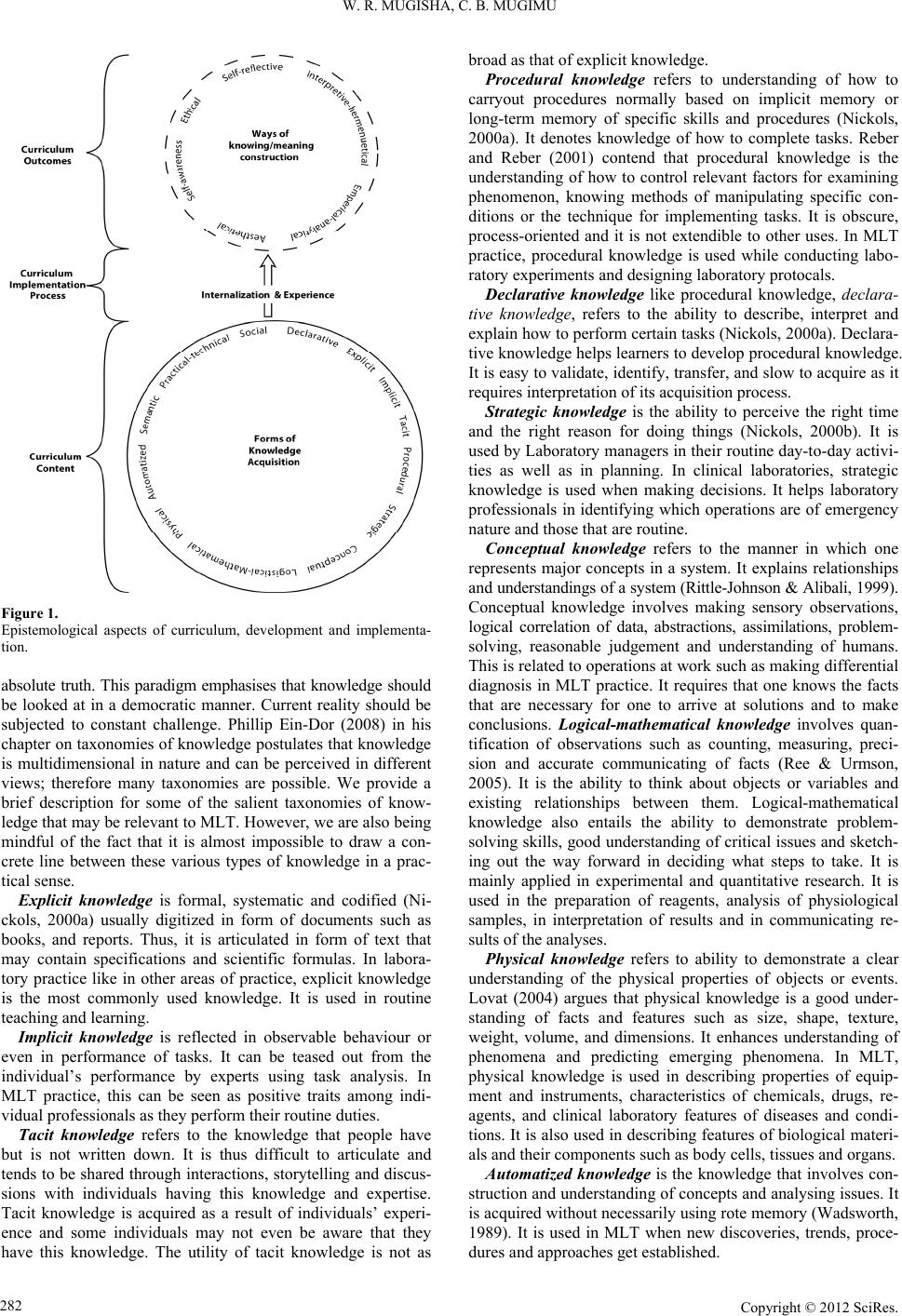 W. R. MUGISHA, C. B. MUGIMU Figure 1. Epistemological aspects of curriculum, development and implementa- tion. absolute truth. This paradig m emphasises that kno wledge should be looked at in a democratic manner. Current reality should be subjected to constant challenge. Phillip Ein-Dor (2008) in his chapter on taxonomies of knowledge postulates that knowledge is multidimensional in nature and can be perceived in different views; therefore many taxonomies are possible. We provide a brief description for some of the salient taxonomies of know- ledge that may be relevant to MLT. However, we are also being mindful of the fact that it is almost impossible to draw a con- crete line between these various types of knowledge in a prac- tical sense. Explicit knowledge is formal, systematic and codified (Ni- ckols, 2000a) usually digitized in form of documents such as books, and reports. Thus, it is articulated in form of text that may contain specifications and scientific formulas. In labora- tory practice like in other areas of practice, explicit knowledge is the most commonly used knowledge. It is used in routine teaching and learning. Implicit knowledge is reflected in observable behaviour or even in performance of tasks. It can be teased out from the individual’s performance by experts using task analysis. In MLT practice, this can be seen as positive traits among indi- vidual professionals as they perform their routine duties. Tacit knowledge refers to the knowledge that people have but is not written down. It is thus difficult to articulate and tends to be shared through interactions, storytelling and discus- sions with individuals having this knowledge and expertise. Tacit knowledge is acquired as a result of individuals’ experi- ence and some individuals may not even be aware that they have this knowledge. The utility of tacit knowledge is not as broad as that of explicit knowledge. Procedural knowledge refers to understanding of how to carryout procedures normally based on implicit memory or long-term memory of specific skills and procedures (Nickols, 2000a). It denotes knowledge of how to complete tasks. Reber and Reber (2001) contend that procedural knowledge is the understanding of how to control relevant factors for examining phenomenon, knowing methods of manipulating specific con- ditions or the technique for implementing tasks. It is obscure, process-oriented and it is not extendible to other uses. In MLT practice, procedural knowledge is used while conducting labo- ratory experiments and designing laboratory protocals. Declarative knowledge like procedural knowledge, declara- tive knowledge, refers to the ability to describe, interpret and explain how to perform certain tasks (Nickols, 2000a). Declara- tive knowledge helps learners to develop procedural knowledge. It is easy to validate, identify, transfer, and slow to acquire as it requires interpretation of its acqui s i tion process. Strategic knowledge is the ability to perceive the right time and the right reason for doing things (Nickols, 2000b). It is used by Laboratory managers in their routine day-to-day activi- ties as well as in planning. In clinical laboratories, strategic knowledge is used when making decisions. It helps laboratory professionals in identifying which operations are of emergency nature and those that are routine. Conceptual knowledge refers to the manner in which one represents major concepts in a system. It explains relationships an d understandings of a sy stem (Rittle-Johnson & Alibali, 1999). Conceptual knowledge involves making sensory observations, logical correlation of data, abstractions, assimilations, problem- solving, reasonable judgement and understanding of humans. This is related to operations at work such as making differential diagnosis in MLT practice. It requires that one knows the facts that are necessary for one to arrive at solutions and to make conclusions. Logical-mathematical knowledge involves quan- tification of observations such as counting, measuring, preci- sion and accurate communicating of facts (Ree & Urmson, 2005). It is the ability to think about objects or variables and existing relationships between them. Logical-mathematical knowledge also entails the ability to demonstrate problem- solving skills, good understanding of critical issues and sketch- ing out the way forward in deciding what steps to take. It is mainly applied in experimental and quantitative research. It is used in the preparation of reagents, analysis of physiological samples, in interpretation of results and in communicating re- sults of the analyses. Physical knowledge refers to ability to demonstrate a clear understanding of the physical properties of objects or events. Lovat (2004) argues that physical knowledge is a good under- standing of facts and features such as size, shape, texture, weight, volume, and dimensions. It enhances understanding of phenomena and predicting emerging phenomena. In MLT, physical knowledge is used in describing properties of equip- ment and instruments, characteristics of chemicals, drugs, re- agents, and clinical laboratory features of diseases and condi- tions. It is also used in describing features of biological materi- als and their components such as body cells, tissues and organs. Automatized knowledge is the knowledge that involves con- struction and understanding of concepts and analysing issues. It is acquired without necessarily using rote memory (Wadsworth, 1989). It is used in MLT when new discoveries, trends, proce- dures and approaches get established. Copyright © 2012 SciRe s . 282  W. R. MUGISHA, C. B. MUGIMU Semantic knowledge refers to highly organised knowledge found in long-term memory and includes major concepts, vo- cabulary, facts and relationships (Ree & Urmson, 2005; Wads- worth, 1989). In MLT semantic knowledge is applied when results of analyses of patient’s samples are compared with the results of known standards. It is also applied in new terms, concepts and facts that are established and integrated into rou- tine professional use. Practical-technical knowledge refers to what people know and can do (Clancey, 1997). It includes the understanding of the structure of work activities in organizations. It is the knowledge that individual use when deciding to take some action basing on their beliefs and values. Practical-technical knowledge is learned on the job through experience and adaptation to the working environment. The technical knowledge includes the ability to demonstrate the expertise while performing the tasks (de Vries, 2003; Lovat, Holbrook, Bourke, Dally, & Morrison, 2003). It requires technical analytical skills. It helps laboratory managers to relate with different laboratory departments and hospitals in general. Social knowledge involves the enhancement of cultural or social groups to come to agree by convention. It is based on the belief that knowledge can be acquired through social interaction especially when people engage into dialogue, conversation, copying, practicing, having feelings and establishing connec- tions and relationships with others. Social knowledge is there- fore socially mediated and is community bound. It promotes shared meaning and creation of new knowledge as a result of agreement between people of different backgrounds. Profe- ssions are in themselves specialised communities or societies. The senior professionals influence the young ones who copy good practices as they grow into the profession. Figure 1 shows that, curriculum content provides a founda- tion for the acquisitions of various forms of knowledge and that through internalization and experiences based on the curricu- lum implementation processes and strategies, an individual is able to undergo a state of knowing or constructing their own meaning. Knowing The notion of knowing refers to one’s ability to construct meaning as a result of internalization and experiences (see Fig- ure 1). It involves internal mental cognitive changes within the individual as a result of learning. Knowing emerges through various forms such as empirical-analytical, interpretive-her- meneutical, self-awareness, ethical, self-reflective, and aesthe- tic. Higgs and Smith (2006) argue that empirical-analytical perspective assumes that knowing is acquired after observation and documentation of situations in an objective and timely manner. It is objective, abstract and provides theoretical expla- nations for phenomena (Kikuchi & Simmons, 1992). It entails acquisition of factual subject matter in the natural sciences, biological sciences and human sciences. This way of knowing is of particular importance in the health sciences in general, including the medical laboratory sciences. Empirical knowing informs health professionals in their scientific decisions, choices, and practices. On the other hand, the interpretive-hermeneutic perspective emphasises that knowing is acquired through self-discovery of the learner. It assumes that it is humans who create knowledge and understanding; therefore, it is based on knowing of what has been created by human beings. Furthermore, it entails hav- ing constructed meanings through the processes of critical in- terpretation of issues or personal experiences, which often in- volves interpersonal dialogue. As such, through dialogue indi- viduals attain insights to convey the underlying meanings that are inherent in what was studied or experienced (Higgs & Smith, 2006). Indeed through practices of professionals new meanings emerge thus acquiring interpretive-hermeneutic ways of knowing. The concept of knowing is also linked to moral issues to be transmitted to learners (Kikuchi & Simmons, 1994). The ethi- cal perspective assumes that individuals acquire knowledge to enable them make moral decisions. It is concerned with ques- tions on what is good, valuable and desirable in society. The ethical way of knowing entails developing ethical decision- making skills and ability to resolve ethical dilemmas. The moral decisions are made as informed choices in accordance with societal or professional norms and values. To obtain ethi- cal knowledge, it is necessary to study content that is related to morality, professional ethical codes, legislation and human rights. Individuals with ethical knowledge act professionally and responsibly and become ethically and morally accountable for their actions. Ethical practice entails demonstrating will- ingness to doing the right and responsible things and in accor- dance with the value system of the health professions (Kikuchi & Simmons, 1994). Kikuchi and Simmons (1994) argue that personal way of knowing refers to achieving self-awareness and knowing one- self, thus, the individual gains self-consciousness. Self-con- sciousness allows one to discover oneself and to know one’s own strength and weaknesses. Self-consciousness is acquired through participation in self-awareness and self-evaluation activities (Engebretson, 1997; Lovat, 2004). This way of know- ing is gained through exposure to content and learning experi- ences through which learners can discover their preconceived ideas, attitudes and fears. People who possess self-conscious- ness/self-knowledge are better able to relate with other people. Thus, educational institutions should develop among learners an understanding of self and others in order to make them de- velop practical ways of knowing. In MLT education and practice, personal way of knowing is acquired by learners and professionals in the process of receiv- ing feedback of their individual contributions, as they work with colleagues on joint project. The process also applies as they get the feedback out of their participation in meetings, seminars and conferences. The aesthetical perspective assumes that knowing entails synthesis of acquired knowledge and establishing relationships in general. The knowledge in this case is intuitive, contextual and subjective. It enables an individual to intuitively grasp the meanings inherent in particular clinical situations, and to crea- tively contribute towards transforming the situation. Another perspective of knowing is the personal way of knowing. The aesthetical perspective assumes that knowing entails synthesis of acquired knowledge and establishing rela- tionships in general. The knowledge in this case is intuitive, contextual and subjective. It enables an individual to intuitively grasp the meanings inherent in particular clinical situations, and to creatively contribute towards transforming the situation. Thomasson (2005) contends that aesthetic knowing is char- acterised by empathetic awareness and morality in interpersonal relationships, emphasizing humanity and dignity. It is required Copyright © 2012 SciRe s . 283  W. R. MUGISHA, C. B. MUGIMU for healthcare professionals in order for them to effectively practice the art of their professions. Learners acquire aesthetic knowledge when they participate in activities, which need a combination of knowledge, experience, intuition and under- standing (Chinn & Kramer, 1999). This is the corner stone of the ethical code of conduct practiced in health care delivery of which MLT practice is part and parcel. Self-reflective perspective of knowing assumes that knowing is emancipatory in the sense that one will have appraised the adequacy of information and evaluated its meaning for oneself. It entails having moved beyond the conceptual and semantic product level of the human mind by understanding the universal patterns underlying what has been taught. Self-reflective in- volves the critique of ideological “truth” as presented by domi- nant forces in society. And by doing so, it enhances the ability to challenge the status quo and acts as an agent of change in the interest of a more just dispensation (Lovat et al., 2003). Methods The study utilized both quantitative and qualitative methods. Available documents on MLT training and practices were gath- ered and analyzed for curriculum objectives, implementation strategies, and teaching methods. This document analysis was conducted using structured observational checklists in order to compare the curriculum intentions, content, and strategies in the curriculum documents. The checklists contained standard de- scription of the expected status. This was done in reference to the characteristics of various types of knowledge and knowing that existed in literature and was relevant to MLT training and practice. The observations were categorized, described, quanti- fied, and recorded. The survey questionnaires were also developed and self-ad- ministered to different key stakeholders including learners, educators and supervisors. Each of the survey questionnaire consisted of 34 closed-ended questions. The questionnaires probed for views of stakeholders regarding the types of knowl- edge and knowing that learners encountered/developed as a result of curriculum implementation processes. The question- naires were filled and returned. The responses were analyzed and recorded. The study used 10 educators (100%) (both full- time and part-time) on the MLT because they are few and highly specialized in their subjects, 30 clinical supervisors (100%) who were involved in the supervision of the MLT stu- dents during practicum attachment as well as individual learner’s projects and 63 learners (64%) were randomly se- lected. The learner’s eligibility for inclusion in the study was such that one should have completed one year of study at the institution and was not yet in the specialized part of the pro- gram. Two successive groups of learners at the MPS were in- cluded. Focus group discussions for learners, educators and clinical supervisors were conducted using semi-structured open-ended interview guides comprised of 25 questions. For purposes of triangulation, separate focus groups for educators, clinical su- pervisors and learners were conducted. Focus group discussions were conducted using 10 learners and 10 clinical supervisors randomly selected and all the 10 educators participated. The focus group discussions lasted between one and half hours and two hours each. The aim of focus group discussions was to get verbatim responses and explanations of the written responses. A check list of issues to be covered during the focus group interview was developed based on issues which had been inves- tigated in curriculum document analysis and the questionnaire survey. Results from Curriculum Document Analysis and Interpretation The study found that the MLT curriculum focused on acqui- sition of various types of knowledge reflected in Table 1. It is clearly shown that curriculum content provided for the critical types of knowledge required for the modest learning and prac- tice o f MLT program. Results on Types of Knowing The analysis of implementation strategies, observations, and purposes of a particular curriculum area based on the curricu- lum documents are presented in Table 2. From Table 2, it is clear that the curriculum implementation process had appropri- ate strategies to make learners acquire different ways of know- ing. These strategies in addition assessed the acquisition of the ways of knowing. Results of th e Que st ionnaire Survey The results in the Table 3 show that most of the items tested had compliance at 100 percent, even for the item which ranked low had a high percentage of 90. Table 3 results also indicate that the curriculum was epistemologically relevant because it followed established principles of curriculum development and development of content. They further show that professional issues were considered as a relevant curriculum antecedent. The results in Table 4 indicate that most of the tested items showed high compliance between 82 and 100 percent. Table 5 shows that there was a reliable assessment process which was recommended at the design stage and followed during the curriculum implementa- tion. The educators and clinical supervisors as a category of respondents rated the following assessment recommendations at 90 percent. It further shows that the assessment process had institutional administrative support. The respondents rated it at 100 percent. Epistemologically assessment is an important component of curriculum because it checks to establish whether teaching led to acquisition of knowledge and knowing. Results of the Focus Group D iscuss ion The educators during focus group discussions described dif- ferent health facilities where they sent their learners for attach- ment to acquire the different types of knowledge and knowing. Educators also revealed that the health care organization struc- ture in Uganda helps them in making learners acquire necessary knowledge and knowing needed for practice at each level of health care delivery thus making training relevant. The quota- tions that follow indicate opinions of respondents: The structure of the Health Care System in Uganda makes it easy to relevantly attach learners. The procedures and equip- ment increases in complexity as one goes up in the structure. (Educator 1) The caliber of clinical supervisors and the quality of learning can be predicated depending of the level of the health facility. (Educator 2) As indicated in the quotations above, it is quite clear that Copyright © 2012 SciRe s . 284 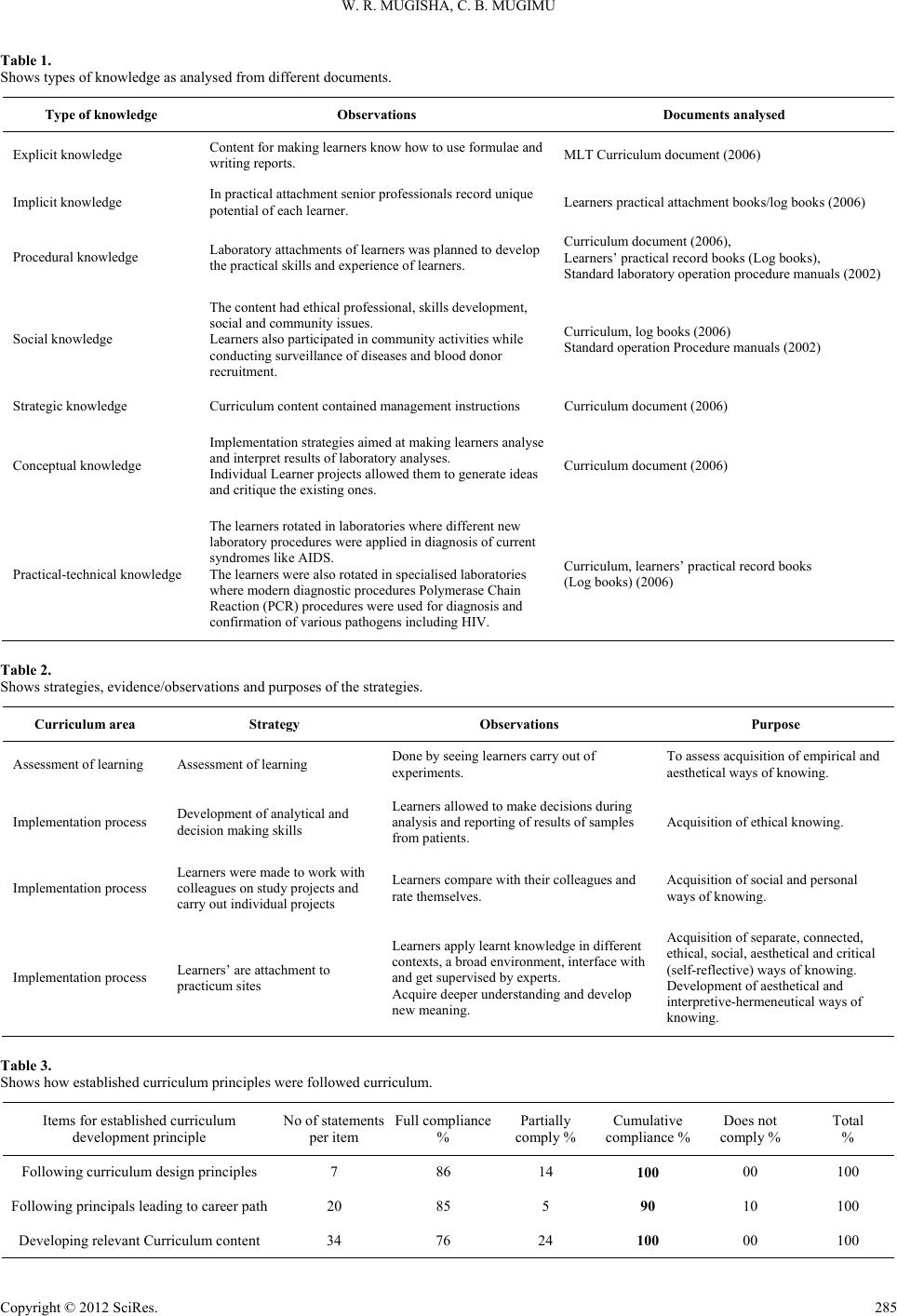 W. R. MUGISHA, C. B. MUGIMU Copyright © 2012 SciRe s . 285 Table 1. Shows types of knowledge as analysed from different documents. Type of knowledge Observatio ns Documents analysed Explicit knowle dge Content for making learners know how to use formulae an d writing reports. MLT Curriculum document (2006) Implicit kn ow ledge In practical attachment senior professionals record unique potential of each learner. Learners pra ctical attachment books/log books (2006) Procedural knowledge Laboratory attachmen ts o f learners was planned to develop the practical skills and experience of learners. Curriculum document (2006), Learners’ practical record books (Log books), Standard laboratory operation procedure manuals (2002) Social knowledge The content had ethical pro f essional, skills development, social and community issues. Learners also participated in community activities while conducting surveillance of diseases a nd blood donor recruitment. Curriculum, log books (2006) Standard operation Procedure manuals (2002) Strategic knowledge Curriculum content contained management instructions Curriculum document (2006) Conceptual knowledge Implementation strategies aimed at making learners analyse and interpret results of laboratory analyses. Individual Learner projects allowed them to generate ideas and critique the existin g on es. Curriculum document (2006) Practical-technical knowledge The learners rotated in labor atories where different new laboratory procedures were a pp li ed in diagno s i s of current syndromes like AIDS. The learne r s were also rotated in specialised laboratories where modern diagnostic procedures Polymerase Cha i n Reaction (PC R) procedures were u sed for diagnosis and confirm ation of various pathogens including HI V. Curriculum, learners’ practical record books (Log books) (2006) Table 2. Shows strategies, evidence/observations and purposes of the strateg ies. Curriculum area Strategy Observations Purpose Assessme nt of learning Assessme nt of learning Done by se eing learners carry out of experiments. To assess ac quisition of em pirical and aesthetical ways of knowing. Impleme ntation process Development of analytical and decision m aking skills Learners allowed to make decisions during analysis and reporting of results of samples from patients. Acquisition of ethical knowing. Impleme ntation process Learners were made to work with colleagues o n study proj ects and carry out individual pr ojects Learners compare with their colleagues and rate themselves. Acquisition of social and personal ways of knowing. Impleme ntation process Learners’ are attachment to practicum sites Learners a ppl y learnt knowledge in different contexts, a broad environment, interface with and get supervised by experts. Acquire de eper unders tanding and develop new meaning. Acquisition of separate, connected, ethical, social, aesthetical and critical (self-reflective) ways of knowing. Development of aesthetical and interpretive-hermeneutical ways of knowing. Table 3. Shows how established curriculum principles were followed curriculum. Items for established curriculum development pri n c iple No of statements per item Full compliance % Partially comply % Cumulative compliance % Does not comply % Total % Following curriculum d es i gn p rinciples 7 86 14 100 00 100 Following principals lea di n g to ca reer path 20 85 5 90 10 100 Developing relevant Curriculum content 34 76 24 100 00 100 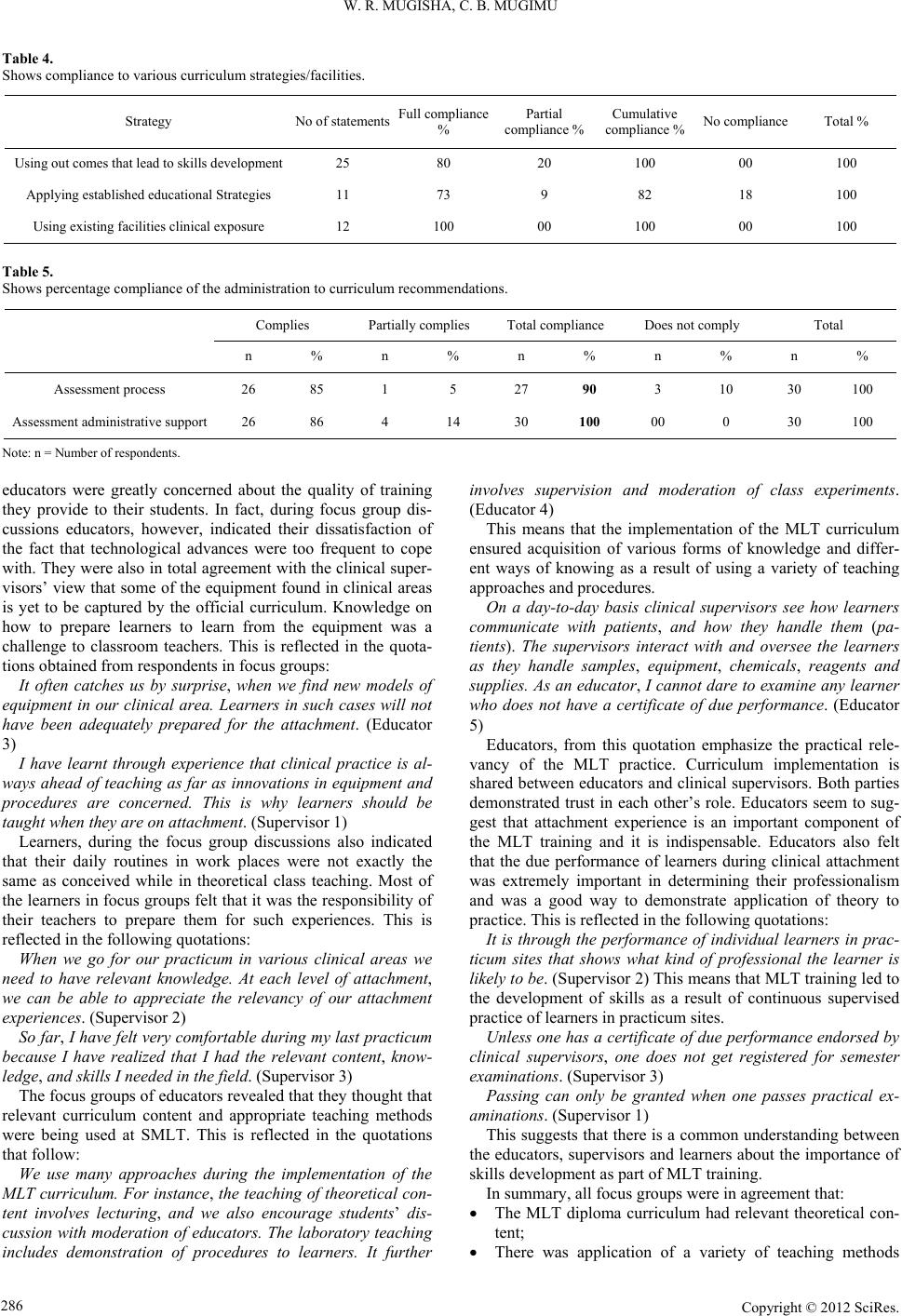 W. R. MUGISHA, C. B. MUGIMU Table 4. Shows compliance to various curriculum strategies/facilities. Strategy No of statementsFull compliance % Partial compliance %Cumulative compliance % No compliance Total % Using out comes that lead to skills development 25 80 20 100 00 100 Applying established educational Strategies 11 73 9 82 18 100 Using existing facilities clinical exposure 12 100 00 100 00 100 Table 5. Shows percentage compliance of the administration to curriculum recommendations. Complies Partially complies Total compliance Does not comply Total n % n % n % n % n % Assessment process 26 85 1 5 27 90 3 10 30 100 Assessment administrative support 26 86 4 14 30 100 00 0 30 100 Note: n = Number of respondents. educators were greatly concerned about the quality of training they provide to their students. In fact, during focus group dis- cussions educators, however, indicated their dissatisfaction of the fact that technological advances were too frequent to cope with. They were also in total agreement with the clinical super- visors’ view that some of the equipment found in clinical areas is yet to be captured by the official curriculum. Knowledge on how to prepare learners to learn from the equipment was a challenge to classroom teachers. This is reflected in the quota- tions obtained from respondents in focus groups: It often catches us by surprise, when we find new models of equipment in our clinical area. Learners in such cases will not have been adequately prepared for the attachment. (Educator 3) I have learnt through experience that clinical practice is al- ways ahead of teaching as far as innovations in equipment and procedures are concerned. This is why learners should be taught when they are on attachment. (Supervisor 1) Learners, during the focus group discussions also indicated that their daily routines in work places were not exactly the same as conceived while in theoretical class teaching. Most of the learners in focus groups felt that it was the responsibility of their teachers to prepare them for such experiences. This is reflected in the following quotations: When we go for our practicum in various clinical areas we need to have relevant knowledge. At each level of attachment, we can be able to appreciate the relevancy of our attachment experiences. (Supervisor 2) So far, I have felt very comfortable during my last practicum because I have realized that I had the relevant content, know- ledge, and skills I needed in the field. (Supervisor 3) The focus groups of educators revealed that they thought that relevant curriculum content and appropriate teaching methods were being used at SMLT. This is reflected in the quotations that follow: We use many approaches during the implementation of the MLT curriculum. For instance, the teaching of theoretical con- tent involves lecturing, and we also encourage students’ dis- cussion with moderation of educators. The laboratory teaching includes demonstration of procedures to learners. It further involves supervision and moderation of class experiments. (Educator 4) This means that the implementation of the MLT curriculum ensured acquisition of various forms of knowledge and differ- ent ways of knowing as a result of using a variety of teaching approaches and procedures. On a day-to-day basis clinical supervisors see how learners communicate with patients, and how they handle them (pa- tients). The supervisors interact with and oversee the learners as they handle samples, equipment, chemicals, reagents and supplies. As an educator, I cannot dare to examine any learner who does not have a certificate of due performance. (Educator 5) Educators, from this quotation emphasize the practical rele- vancy of the MLT practice. Curriculum implementation is shared between educators and clinical supervisors. Both parties demonstrated trust in each other’s role. Educators seem to sug- gest that attachment experience is an important component of the MLT training and it is indispensable. Educators also felt that the due performance of learners during clinical attachment was extremely important in determining their professionalism and was a good way to demonstrate application of theory to practice. This is reflected in the following quotations: It is through the performance of individual learners in prac- ticum sites that shows what kind of professional the learner is likely to be. (Supervisor 2) This means that MLT training led to the development of skills as a result of continuous supervised practice of learners in practicum sites. Unless one has a certificate of due performance endorsed by clinical supervisors, one does not get registered for semester examinations. (Supervisor 3) Passing can only be granted when one passes practical ex- aminations. (Supervisor 1) This suggests that there is a common understanding between the educators, supervisors and learners about the importance of skills development as part of MLT training. In summary, all focus groups were in agreement that: The MLT diploma curriculum had relevant theoretical con- tent; There was application of a variety of teaching methods Copyright © 2012 SciRe s . 286 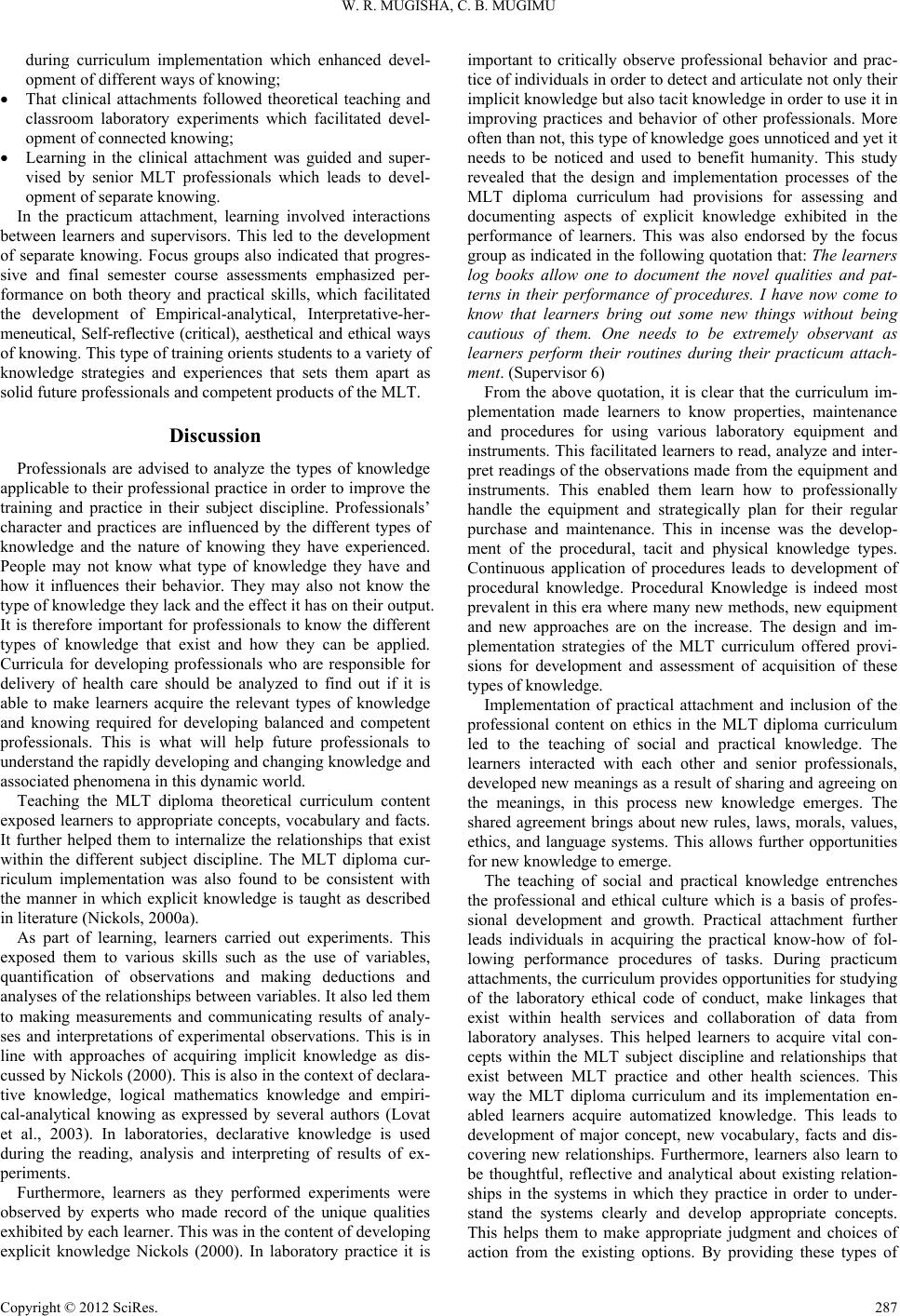 W. R. MUGISHA, C. B. MUGIMU during curriculum implementation which enhanced devel- opment of different ways of knowing; That clinical attachments followed theoretical teaching and classroom laboratory experiments which facilitated devel- opment of connected knowing; Learning in the clinical attachment was guided and super- vised by senior MLT professionals which leads to devel- opment of separate knowing. In the practicum attachment, learning involved interactions between learners and supervisors. This led to the development of separate knowing. Focus groups also indicated that progres- sive and final semester course assessments emphasized per- formance on both theory and practical skills, which facilitated the development of Empirical-analytical, Interpretative-her- meneutical, Self-reflective (critical), aesthetical and ethical ways of knowing. This type of training orients students to a variety of knowledge strategies and experiences that sets them apart as solid future professionals and competent products of the MLT. Discussion Professionals are advised to analyze the types of knowledge applicable to their professional practice in order to improve the training and practice in their subject discipline. Professionals’ character and practices are influenced by the different types of knowledge and the nature of knowing they have experienced. People may not know what type of knowledge they have and how it influences their behavior. They may also not know the type of knowledge they lack and the effect it has on their output. It is therefore important for professionals to know the different types of knowledge that exist and how they can be applied. Curricula for developing professionals who are responsible for delivery of health care should be analyzed to find out if it is able to make learners acquire the relevant types of knowledge and knowing required for developing balanced and competent professionals. This is what will help future professionals to understand the rapidly developing and changing knowledge and associated phenomena in this dynamic world. Teaching the MLT diploma theoretical curriculum content exposed learners to appropriate concepts, vocabulary and facts. It further helped them to internalize the relationships that exist within the different subject discipline. The MLT diploma cur- riculum implementation was also found to be consistent with the manner in which explicit knowledge is taught as described in literature (Nickols, 2000a). As part of learning, learners carried out experiments. This exposed them to various skills such as the use of variables, quantification of observations and making deductions and analyses of the relationships between variables. It also led them to making measurements and communicating results of analy- ses and interpretations of experimental observations. This is in line with approaches of acquiring implicit knowledge as dis- cussed by Nickols (2000). This is also in the context of declara- tive knowledge, logical mathematics knowledge and empiri- cal-analytical knowing as expressed by several authors (Lovat et al., 2003). In laboratories, declarative knowledge is used during the reading, analysis and interpreting of results of ex- periments. Furthermore, learners as they performed experiments were observed by experts who made record of the unique qualities exhibited by each learner. This was in the content of developing explicit knowledge Nickols (2000). In laboratory practice it is important to critically observe professional behavior and prac- tice of individuals in order to detect and articulate not only their implicit knowledge but also tacit knowledge in order to use it in improving practices and behavior of other professionals. More often than not, this type of knowledge goes unnoticed and yet it needs to be noticed and used to benefit humanity. This study revealed that the design and implementation processes of the MLT diploma curriculum had provisions for assessing and documenting aspects of explicit knowledge exhibited in the performance of learners. This was also endorsed by the focus group as indicated in the following quotation that: The learners log books allow one to document the novel qualities and pat- terns in their performance of procedures. I have now come to know that learners bring out some new things without being cautious of them. One needs to be extremely observant as learners perform their routines during their practicum attach- ment. (Supervisor 6) From the above quotation, it is clear that the curriculum im- plementation made learners to know properties, maintenance and procedures for using various laboratory equipment and instruments. This facilitated learners to read, analyze and inter- pret readings of the observations made from the equipment and instruments. This enabled them learn how to professionally handle the equipment and strategically plan for their regular purchase and maintenance. This in incense was the develop- ment of the procedural, tacit and physical knowledge types. Continuous application of procedures leads to development of procedural knowledge. Procedural Knowledge is indeed most prevalent in this era where many new methods, new equipment and new approaches are on the increase. The design and im- plementation strategies of the MLT curriculum offered provi- sions for development and assessment of acquisition of these types of knowledge. Implementation of practical attachment and inclusion of the professional content on ethics in the MLT diploma curriculum led to the teaching of social and practical knowledge. The learners interacted with each other and senior professionals, developed new meanings as a result of sharing and agreeing on the meanings, in this process new knowledge emerges. The shared agreement brings about new rules, laws, morals, values, ethics, and language systems. This allows further opportunities for new knowledge to emerge. The teaching of social and practical knowledge entrenches the professional and ethical culture which is a basis of profes- sional development and growth. Practical attachment further leads individuals in acquiring the practical know-how of fol- lowing performance procedures of tasks. During practicum attachments, the curriculum provides opportunities for studying of the laboratory ethical code of conduct, make linkages that exist within health services and collaboration of data from laboratory analyses. This helped learners to acquire vital con- cepts within the MLT subject discipline and relationships that exist between MLT practice and other health sciences. This way the MLT diploma curriculum and its implementation en- abled learners acquire automatized knowledge. This leads to development of major concept, new vocabulary, facts and dis- covering new relationships. Furthermore, learners also learn to be thoughtful, reflective and analytical about existing relation- ships in the systems in which they practice in order to under- stand the systems clearly and develop appropriate concepts. This helps them to make appropriate judgment and choices of action from the existing options. By providing these types of Copyright © 2012 SciRe s . 287  W. R. MUGISHA, C. B. MUGIMU knowledge, the MLT diploma curriculum taught learners how to construct knowledge. The findings of this study also revealed that laboratory train- ing in the practicum sites involves learning how to meet daily and periodic targets. We also found that the practicum sites training aims at making learners internalize the strategic focus of MLT practice in the Health Care System. This learning therefore gave learners strategic knowledge. In one of focus groups, indicated that “It became evident that learners were making strategic requisition of supplies, planning their work well ahead of time. While discussing with them, it became clear that they were developing a forward looking approach in the work.” (Supervisor 6) MLT curriculum thus ensured that the teaching of various subject disciplines was comprehensive and hence practice of the MLT was consistent with established literature to the effect that strategic knowledge is about knowing right time and the right reason for doing things (Nickols, 2000). The findings of this study also revealed that MLT curriculum focused on teaching essentially the knowledge of principles, steps, rationale and interpretation of results of analyses per- formed during routine laboratory practice. Implying that MLT teaching in this respect, gives learners mainly declarative knowledge. A curriculum that fosters acquisition of declarative knowledge is consistent with Nickols’ (2000) view. Further- more, declarative knowledge is about following procedures, using high quality data and making interpretations. This type of knowledge is essential in the common practice of MLT. App- lying basic principles is important in ethical practice as well as in practicing scientific skills. All developments in science and technology are based on the knowledge of basic principles. Knowing the necessary steps and principles of carrying out analyses, on the other hand, is consistent with development of procedural knowledge and knowing as described in literature (De Vries, 1994; Reber & Reber, 2001). Having knowledge to interpret results of analysis is in conformity that learners ac- quire the interpretative-hermeneutical way of knowing at MLT, which is part of Haberma’s ways of knowing discussed in lit- erature (Higgs & Smith, 2005). From the results of the focus group discussions with educa- tors and supervisors, it was clear that the practical part of MLT curriculum was being implemented at different levels of the health care system. The health care system is designed in such a way that the higher one goes in the system the more one meets complex approaches to health care delivery. Learners were attached at each level for a specified period. This helped learn- ers acquire different types of knowledge and knowing. This was consistent with the focus group responses reflected in the quo- tations that follow: Learners at different levels of their learning require different facilities for their practicum attachment. It takes deliberate effort to prepare learners for different levels of practicum attachment. It requires different scopes of knowledge and understanding. (Educator 8) Mentoring senior learners is comparatively easy. You can see them progressively getting closer to you in performance. One can confidently delegate some functions to them at differ- ent levels of the health care system. Senior students in their final year of study can safely man sections of the clinical labo- ratories, (Supervisor 7) From these quotations, it is clear that as learners progress in the training, they gain proficiency and sen- ior professionals progressively trust them. Learner focus groups revealed that when they worked in practicum sites they developed better understanding of the learnt knowledge. They in addition appreciated the fact that practicum sites were not all alike. This broadened their knowl- edge and knowing. This is reflected in the quotation that fol- lows: In practice some situations look different from the way they are taught in theory. If one misses practicum attachment, one cannot easily comprehend MLT knowledge and practice. All the knowledge is rooted in the practice in clinical areas. (Learner 3) Conclusion From the results of this study and the discussions in the pre- vious section it is clear that different types of knowledge con- tribute to development of MLT professionals. The MLT di- ploma curriculum provided a supportive environment for ac- quisition of various types of knowledge and knowing in order to make learners develop the required attributes through their educational experiences. The curriculum therefore catered for the relevant epistemological issues of MLT training and educa- tion. It is evident that the curriculum was ideal for development of quality competent MLT professionals. What comes out clearly is the fact that a good understanding of relevant and appropriate curriculum content as well as curriculum imple- mentation processes is critical on the part of educators to ensure the quality of their products. Recommendations 1) As different professional training programs aim at provid- ing different traits in learners, it is important that educators attempt to study and know the types of knowledge and knowing that may lead to the development of the needed traits; 2) Educators need to evaluate their curricula in order to as- certain whether their design and implementation have provi- sions to make learners acquire knowledge and knowing. REFERENCES Chinn, P. L., & Kramer, M. K. (1999). Theory and nursing: Integrated knowledge development. St. Louis: Mosby. Clancey, W. J. (1997). Situated cognition: On human knowledge and computer representation. Cambrigde: Cambridge University Press. De Vries, E. (1994). Structuring in formation for design proble m solving. Eindhoven: Eindhoven University of Tec hn ol o gy. De Vries, E. (2003). Educational technology and multimedia from cog- nitive perspective: Knowledge from inside computer, onto the screen, and into our heads? In H. van Oostendorp (Ed.), Cognition in the di- gital world (pp. 135-150). Mahwah, NJ: Lawrence Erlbaum Associa- tes, Inc. Publishers. Engebretson, J. (1997). A multiparadigm approach to nursing. Advances in Nursing Science, 20 , 21-33. Ein-Dor, P. (2008). Taxonomies of knowledge. In M. E. Jennex (Ed.), Knowledge management: Concepts, methodologies , tools, and app lica- tions (pp. 162-170). Hershey, PA: Information Science Reference, IGI Global. Higgs, P., & Smith, J. (2006). Rethinking truth (2nd ed.). Cape Town: Juta & Co. Ltd. Kikuchi, J. F., & Simmons, H. (1992). Philosophic inquiry in nursing. London: Sage. Kikuchi, J. F., & Simmons, H. (1994). Developing a philosophy of nur- sing. Thousand Oaks, CA: Sage. Lovat, T., Holbrook, A., Bourke, S., Dally, K., & Morrison, K. (2003). Ways of knowing in assessing the PhD ramifications for the role of the supervisor . International Education Research Conference NZAR E/ Copyright © 2012 SciRe s . 288  W. R. MUGISHA, C. B. MUGIMU Copyright © 2012 SciRe s . 289 AARE, Auckland, 29 November-3 December 2003. Lovat, T. J. (2004). Aristotelian ethics and Habermasian critical theory: A conjoined force for proportionism in ethical discourse and Roman Catholic moral theology. Australian e Journal of Theology, 3, 1-14. Makerere University (2006). Mulago laboratory technical curriculum document. Kampala: Makerere University. Ministry of Health Uganda (2002). Standard labaratory procedures ma- nual. Kampala: MOH. Mulago Paramedical Schools (2006). Learner’s practical record books (Logbooks). Kampala: M ini stry of E duc atio n a nd S port s. Nickols, F. (2000a). The tacit and explicit nature of knowledge, the know- ledge in knowledge management. In J. W. Cortada, & J. A. Woods (Eds.), The knowledge management yearbook 2000-2001 (pp. 12-21). Woburn, MA : Butt erworth-Heinemann. Nickols, F. (2000b). “What is” in the world of work and working: Some implications of the shift to knowledge work. In J. W. Cortada, & J. A. Woods (Eds.), The knowledge management yearbook 2000-2001 (pp. 3-11). Woburn, MA: Butterw orth-Heinemann. Okello, V., & Ocheng, M. K. (1996). Curriculum studies. Kampala: Makerere University. Orn stein, A. C., & Levine, D. U. (1993). Foundations of education. Bos- ton, MA: Houghton Mifflin. Reber, A. S., & Reber, E. S. (2001). The penguin disctionary of psy- chology. London: Penguin Bo oks. Ree, J., & Urmson, J. O. (2005). The concise encyclopedia of western philosophy (3rd ed.). London & New York: Routledge/Taylor & Fran- cis Group. Rittle-Johnson, B., & Alibali, M. W. (1999). Conceptual and procedural knowledge of mathematics: Does one lead to the other? Journal of Educational Psycholo g y , 91, 175-189. doi:10.1037/0022-0663.91.1.175 Rus sell, B. (1996). History of western philosophy and its connection with political and social circumustances from the earliest times to present day. New York: Routledge. Sowell, E. J. (2010). Curriculum an integrated introduction. Upper Saddle River, NJ: Prentice Hall. Zais, R. S. (2010). Curriculum Principles and Foundations. New York: Harper & Row. |