

Paper Menu >>
Journal Menu >>
 Journal of Water Resource and Protection, 2012, 4, 460-463 http://dx.doi.org/10.4236/jwarp.2012.47053 Published Online July 2012 (http://www.SciRP.org/journal/jwarp) Super critical Water Technology Applied to the Purification of Waters Contaminated by Toxic Micro-Polluting Organic Compounds Gabriele Di Giacomo, Luca Taglieri Department of Chemistry, Chemical Engineering and Materials, University of L’Aquila, L’Aquila, Italy Email: gabriele.dig[email protected] Received April 12, 2012; revised May 15, 2012; accepted June 3, 2012 ABSTRACT Purification of water contaminated by toxic organic compounds at low and very low concentration is a quite in teresting challenge from both the technical and the economical point of view. In fact, the direct destruction of organic com- pounds dissolved in very diluted aqueous solution is very costly and hardly achievable. To overcome this problems it was studied and developed a new water purification process which is made of three step s: 1) removal of the diluted and toxic polluting compounds by adsorption on activated carbon beds operating at ambient P ant T; 2) regeneration of the exhausted carbon bed with supercritical water in order to obtain a mixture of water and polluting compounds signifi- cantly more concentrated than the contaminated liquid water; 3) destruction of the toxic compounds in a continuous Supercritical Water Oxidation Reactor. Step 1) was studied at laboratory scale in order to obtain all the required infor- mation for modeling the adsorption operation; step 2) was modeled by using literature experimental data and, step 3) was validated at pilot plant scale. In all the above mentioned steps, phenol was used as representative o f polluting com- pounds. Keywords: Supercritical Water Oxidation; Water Purification Pr ocess; S ol i d-Liquid Adsorpt i o n; Gas- Sol i d Regeneration 1. Introduction Millions of tons of organic compounds are manufactured each year. Most of these compounds are toxic, poorly biodegradable, and persistent, sometimes give biological magnification. An important class among these chemi- cals is aromatic chlorinated hydrocarbons such as chlo- robenzene, chloronitrobenzene, poly-chlorinated biphen- yls (PCB), polycyclic aromatic hydrocarbons (PAH) and dioxins. These chemicals contaminate very large amount of wastewater (often originated from chemical process industry both using and producing organic compounds) and drinking water (when spills or soil pollutants reach the groundwater lev el). A process co mmonly us ed for the purification of waste waters contaminated by low con- centrations of organic compounds is the adsorption on activated carbon beds [1,2]. Two main problems arise from this process: the regeneration of activated carbon and the ultimate disposal of polluting organic compounds. It has been demonstrated [3,4] that the Supercritical Wa- ter (SCW) can be efficiently used for regenerating the spent activated carbon bed; coherently with the fact that SCW behaves as an organic liquid solvent. In addition, many researchers have shown the effectiveness and the wide range of applicability o f Supercritical Water Oxida- tion (SCWO) in destroying toxic organic compounds [5-9]. The purpose of this paper is to develop and to de- scribe a new process (obtained by properly combining an adsorption section with a SCWO section) characterized by high efficiency in both water purification and destruc- tion of polluting materials without producing any haz- ardous by-product. 2. Materials and Methods Activated carbon and phenol, as representative polluting compound, were purchased from SICAV (Chieti, Italy) and Aldrich, respectively. All the thermodynamic and kinetic details related to the adsorption section were studied at laboratory scale and reported in previous pa- pers [1,2], while all the details related to the regeneration of the spent activated carbon bed with SCW were re- ported by [3] and [4]. The SCWO of the gaseous stream containing the pol- lutants removed from the activated carbon bed was vali- dated by using a pilot plant which can operate at pressure up to 80 MPa and at temperature up to 1000 K. The con- tinuous SCWO plant was made by a 0.9 m, 9/16” OD, C opyright © 2012 SciRes. JWARP 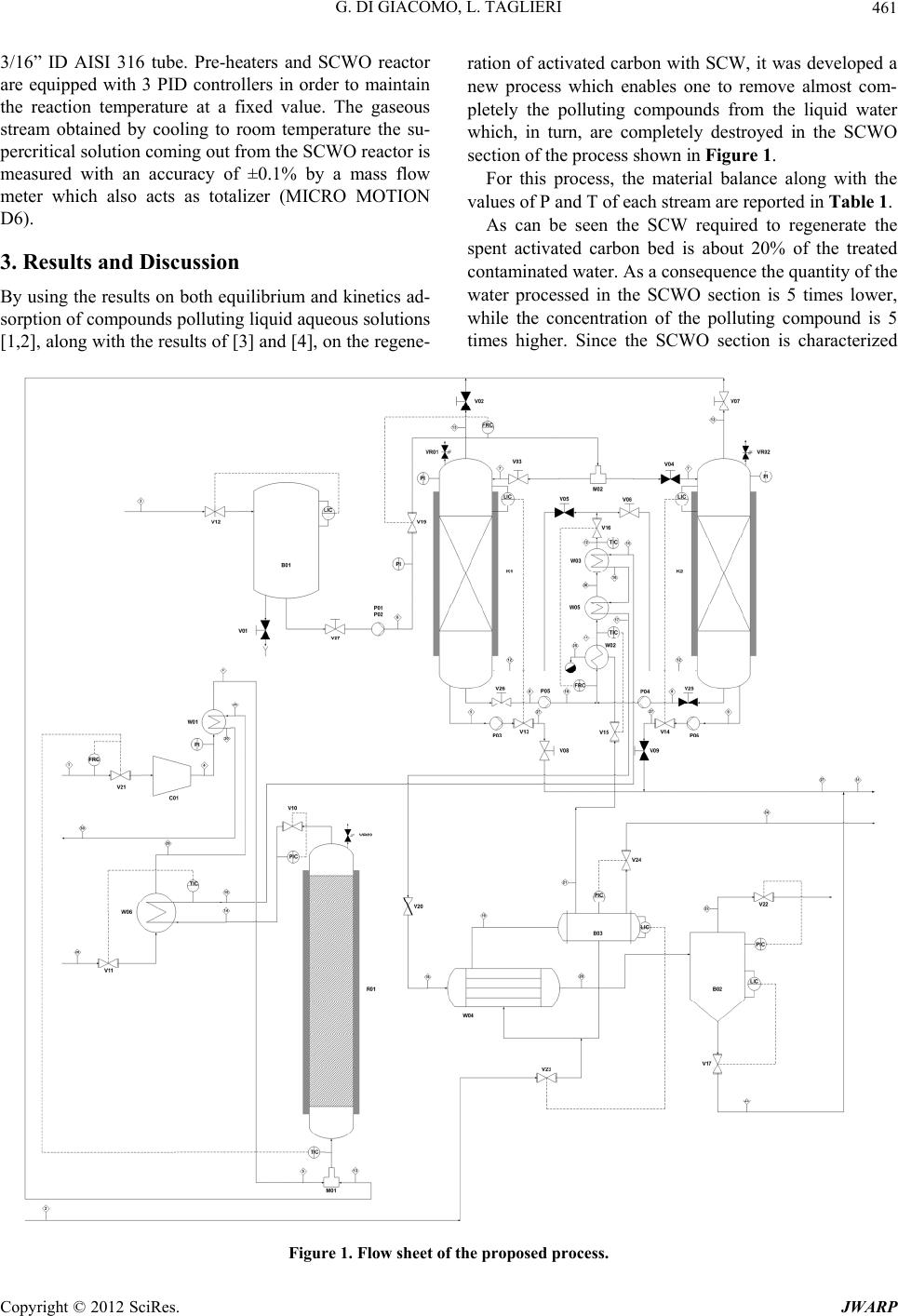 G. DI GIACOMO, L. TAGLIERI 461 3/16” ID AISI 316 tube. Pre-heaters and SCWO reactor are equipped with 3 PID controllers in order to maintain the reaction temperature at a fixed value. The gaseous stream obtained by cooling to room temperature the su- percritical solution coming out from the SCWO reactor is measured with an accuracy of ±0.1% by a mass flow meter which also acts as totalizer (MICRO MOTION D6). 3. Results and Discussion By using the results on both equilibrium and kinetics ad- sorption of compounds polluting liquid aqueous solutions [1,2], alo ng with the results of [3] and [4], on th e regene- ration of activated carbon with SCW, it was developed a new process which enables one to remove almost com- pletely the polluting compounds from the liquid water which, in turn, are completely destroyed in the SCWO section of the process shown in Figure 1. For this process, the material balance along with the values of P and T of each stream are reported in Table 1. As can be seen the SCW required to regenerate the spent activated carbon bed is about 20% of the treated contaminated water. As a consequence the quantity of th e water processed in the SCWO section is 5 times lower, while the concentration of the polluting compound is 5 times higher. Since the SCWO section is characterized Figure 1. Flow sheet of the proposed process. Copyright © 2012 SciRes. JWARP 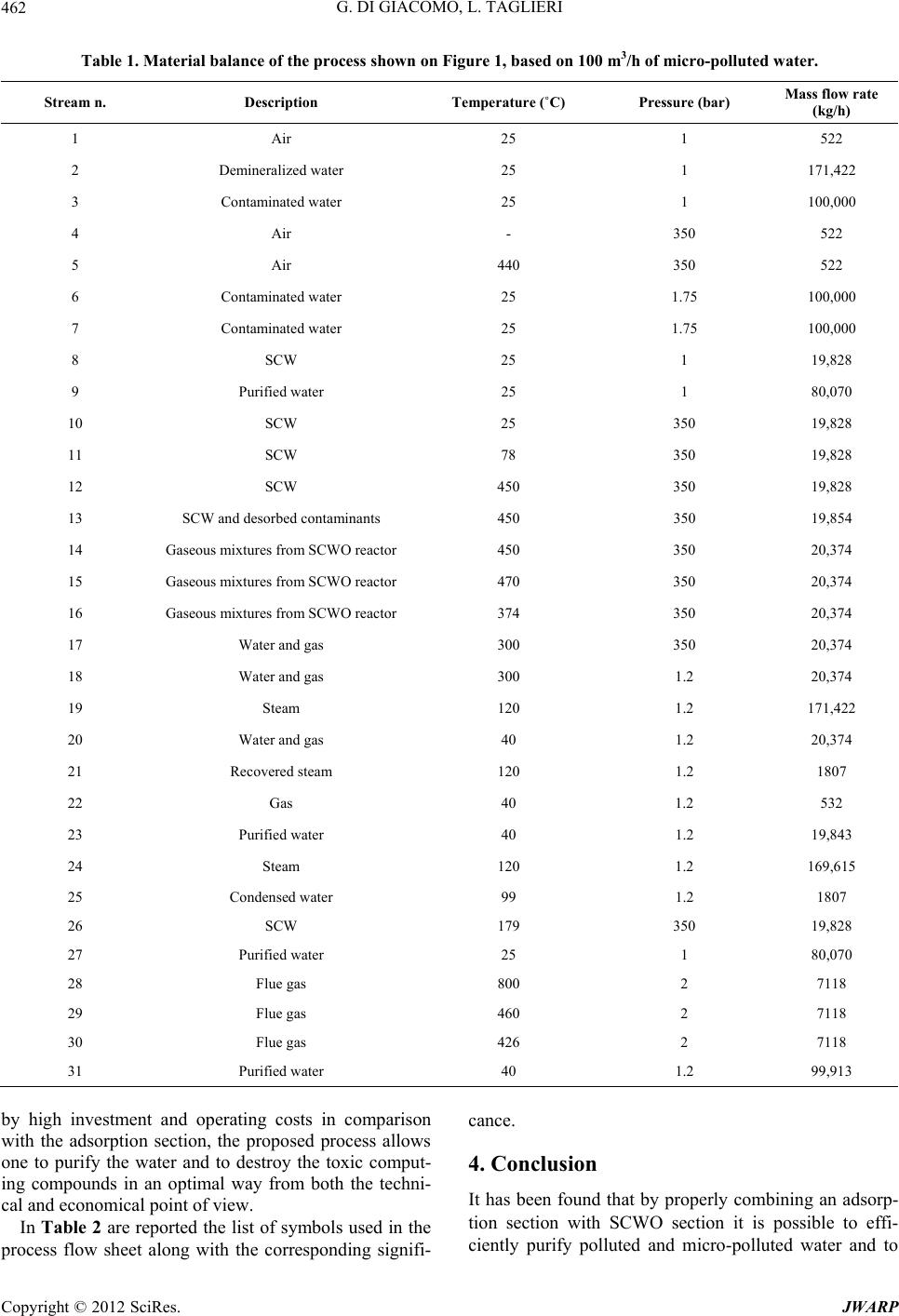 G. DI GIACOMO, L. TAGLIERI 462 Table 1. Material balance of the process shown on Figure 1, based on 100 m3/h of micro-polluted water. Stream n. Description Temperature (˚C) Pressure (bar) Mass flow rate (kg/h) 1 Air 25 1 522 2 Demineralized water 25 1 171,422 3 Contaminated water 25 1 100,000 4 Air - 350 522 5 Air 440 350 522 6 Contaminated water 25 1.75 100,000 7 Contaminated water 25 1.75 100,000 8 SCW 25 1 19,828 9 Purified water 25 1 80,070 10 SCW 25 350 19,828 11 SCW 78 350 19,828 12 SCW 450 350 19,828 13 SCW and desorbed contaminants 450 350 19,854 14 Gaseous mixtures from SCWO reactor 450 350 20,374 15 Gaseous mixtures from SCWO reactor 470 350 20,374 16 Gaseous mixtures from SCWO reactor 374 350 20,374 17 Water and gas 300 350 20,374 18 Water and gas 300 1.2 20,374 19 Steam 120 1.2 171,422 20 Water and gas 40 1.2 20,374 21 Recovered steam 120 1.2 1807 22 Gas 40 1.2 532 23 Purified water 40 1.2 19,843 24 Steam 120 1.2 169,615 25 Condensed water 99 1.2 1807 26 SCW 179 350 19,828 27 Purified water 25 1 80,070 28 Flue gas 800 2 7118 29 Flue gas 460 2 7118 30 Flue gas 426 2 7118 31 Purified water 40 1.2 99,913 by high investment and operating costs in comparison with the adsorption section, the proposed process allows one to purify the water and to destroy the toxic comput- ing compounds in an optimal way from both the techni- cal and economical point of view. In Table 2 are reported the list of symbols used in the process flow sheet along with the corresponding signifi- cance. 4. Conclusion It has been found that by properly combining an adsorp- tion section with SCWO section it is possible to effi- ciently purify polluted and micro-polluted water and to Copyright © 2012 SciRes. JWARP 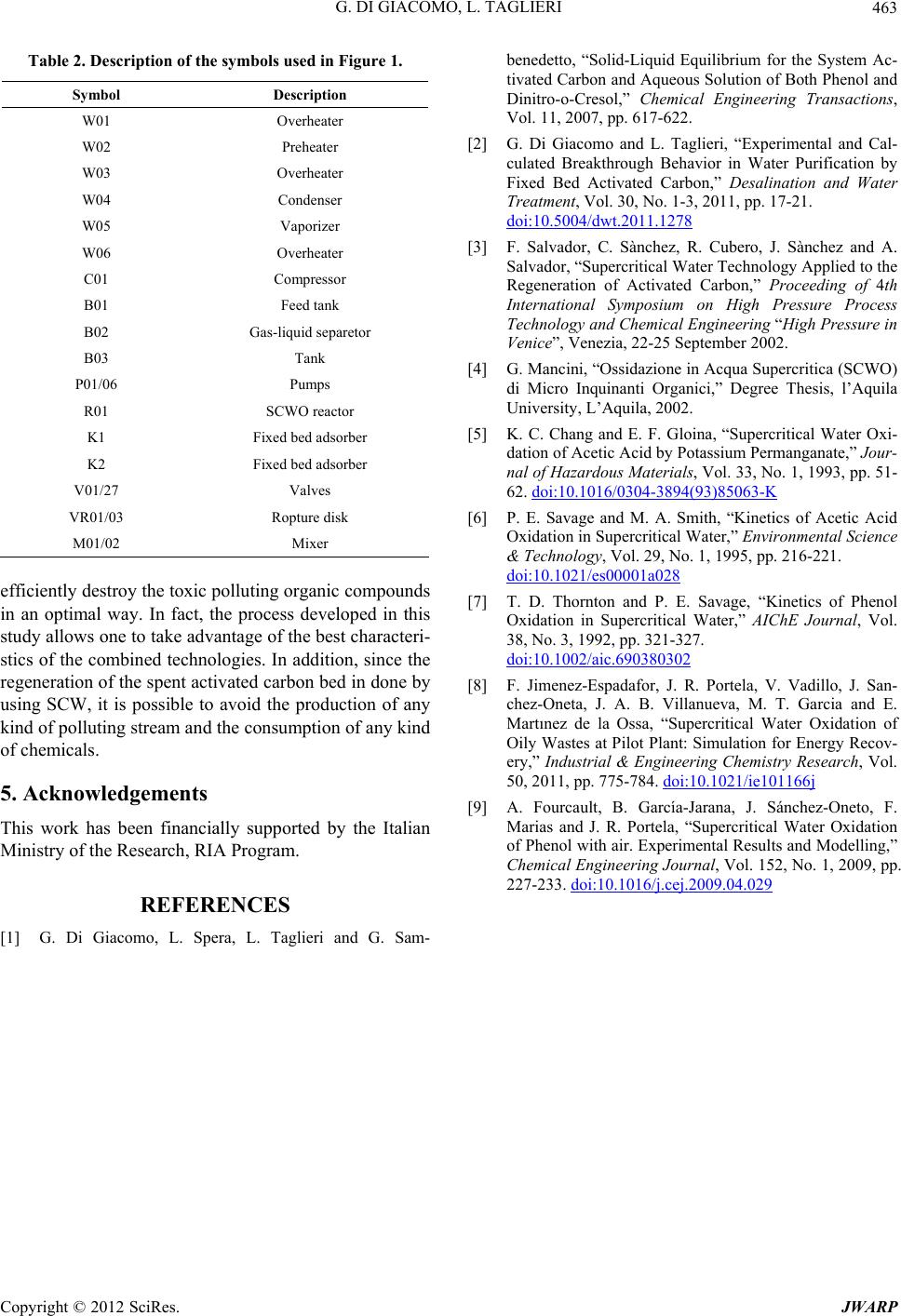 G. DI GIACOMO, L. TAGLIERI 463 Table 2. Description of the symbols used in Figure 1. Symbol Description W01 Overheater W02 Preheater W03 Overheater W04 Condenser W05 Vaporizer W06 Overheater C01 Compressor B01 Feed tank B02 Gas-liquid separetor B03 Tank P01/06 Pumps R01 SCWO reactor K1 Fixed bed adsorber K2 Fixed bed adsorber V01/27 Valves VR01/03 Ropture disk M01/02 Mixer efficiently destroy the toxic polluting organic compounds in an optimal way. In fact, the process developed in this study allows one to take advantage of the best characteri- stics of the combined techn ologies. In addition, since the regeneration of the spent activated carbon bed in done by using SCW, it is possible to avoid the production of any kind of polluting stream and the consumption of any kind of chemicals. 5. Acknowledgements This work has been financially supported by the Italian Ministry of the Research, RIA Program. REFERENCES [1] G. Di Giacomo, L. Spera, L. Taglieri and G. Sam- benedetto, “Solid-Liquid Equilibrium for the System Ac- tivated Carbon and Aqueous Solution of Both Phenol and Dinitro-o-Cresol,” Chemical Engineering Transactions, Vol. 11, 2007, pp. 617-622. [2] G. Di Giacomo and L. Taglieri, “Experimental and Cal- culated Breakthrough Behavior in Water Purification by Fixed Bed Activated Carbon,” Desalination and Water Treatment, Vol. 30, No. 1-3, 2011, pp. 17-21. doi:10.5004/dwt.2011.1278 [3] F. Salvador, C. Sànchez, R. Cubero, J. Sànchez and A. Salvador, “Supercritical Water Technology Applied to the Regeneration of Activated Carbon,” Proceeding of 4th International Symposium on High Pressure Process Technology and Chemical Engineering “High Pressure in Venice”, Venezia, 22-25 September 2002. [4] G. Mancini, “Ossidazione in Acqua Supercritica (SCWO) di Micro Inquinanti Organici,” Degree Thesis, l’Aquila University, L’Aquila, 2002. [5] K. C. Chang and E. F. Gloina, “Supercritical Water Oxi- dation of Acetic Acid by Potassium Permanganate,” Jour- nal of Hazardous Materials, Vol. 33, No. 1, 1993, pp. 51- 62. doi:10.1016/0304-3894(93)85063-K [6] P. E. Savage and M. A. Smith, “Kinetics of Acetic Acid Oxidation in Supercritical Water,” Environmental Science & Technology, Vol. 29, No. 1, 1995, pp. 216-221. doi:10.1021/es00001a028 [7] T. D. Thornton and P. E. Savage, “Kinetics of Phenol Oxidation in Supercritical Water,” AIChE Journal, Vol. 38, No. 3, 1992, pp. 321-327. doi:10.1002/aic.690380302 [8] F. Jimenez-Espadafor, J. R. Portela, V. Vadillo, J. San- chez-Oneta, J. A. B. Villanueva, M. T. Garcia and E. Martınez de la Ossa, “Supercritical Water Oxidation of Oily Wastes at Pilot Plant: Simulation for Energy Recov- ery,” Industrial & Engineering Chemistry Research, Vol. 50, 2011, pp. 775-784. doi:10.1021/ie101166j [9] A. Fourcault, B. García-Jarana, J. Sánchez-Oneto, F. Marias and J. R. Portela, “Supercritical Water Oxidation of Phenol with air. Experimental Results and Modelling,” Chemical Engineering Journal, Vol. 152, No. 1, 2009, pp. 227-233. doi:10.1016/j.cej.2009.04.029 Copyright © 2012 SciRes. JWARP |