

Paper Menu >>
Journal Menu >>
 Journal of Water Resource and Protection, 2012, 4, 493-496 http://dx.doi.org/10.4236/jwarp.2012.47057 Published Online July 2012 (http://www.SciRP.org/journal/jwarp) Biochemical Approach to Assess Groundwater Pollution by Petroleum Hydrocarbons (Case Skikda Algeria) Sofiane Labar1, Azzedine Hani2, Larbi Djabri2 1Institute of Sciences of Nature and Life, University of El-Tarf, El-Tarf, Algeria 2Department of Geology, University of Annaba, Annaba, Algeria Email: [email protected] Received February 3, 2012; revised March 10, 2012; accepted April 16, 2012 ABSTRACT Due to the accelerated population growth and development in all sectors especially industry, more water has been pumped and more effluents have been rejected to the natural system. In the coastal Skikda Valley; Petrochemical indus- try is practiced along the year and almost groundwater are threatened. This work is referred to the characterization of the environmental hydrobiochemistry in the coastal petrochemical industrial area. The study has investigated the groundwater pollution by hydrocarbons using biochemical approach and assessing the nature and extent of contamina- tion of groundwater in relation to petroleum industrial activities surrounding tank, channel and pipe. At site of this in- dustrial zone, groundwater circulates on slight deep in the mio-pliocene alluviums (sand and gravel) which is character- ized by an important permeability. Groundwater quality analysis proved that groundwater quality is largely polluted with respect to BOD5, COD, TPH and TSS. So, a narrow relationship between BOD and TPH and important qualitative degradation of the groundwater is shown, especially in the parts situated in the down gradient area and in direct prox- imity of tank, channel and pipe. The extent of groundwater contamination is influencing by the depth of the water table, permeability of the soil and therefore infiltratio n rate. In order to prevent further pollu tion of groundwater, o il must be stored and transported via impervious tank, pipe and channel. So, effluents must be treated prior to discharge. Keywords: Groundwater; TPH; Biochemical Parameters; BOD5; Algeria 1. Introduction Groundwater is one of the most precious natural re- sources in the north east of Algeria as it is the principal source of drinking water for the majority of the popula- tion. The groundwater aquifer of Skikda region is ex- tremely susceptible to surface-derived contamination be- cause of the high permeability of sands and gravels that compose the soil profile of East Skikda region [1-3]. Se- veral studies in Skikda region reported various degrada- tions levels of groundwater as one of the major concerns among the public and governmental decision makers [1-4], but these studies did not include a biochemical approach to evaluate groundwater contamination. Skikda city is located in the northeast of Algeria and occupies an area of around 4138 km2. The population has increased greatly to some 800,000 inhabitants. The de- mographical development and the intensification of the economic industrial activities in Skikda have been ac- companied by an increase in demand for water. There are about 135 groundwater wells in the Skikda region and the amount of groundwater abstracted from these wells has been estimated to be about 52 hm3 per year with 12 hm3 per year being abstracted from the industrial zone. Such large industrial demands on groundwater have caused water quality and the contamination of ground- water in this coastal zone to become an extremely im- portant issue for industrial groundwater supply. Ground- water contamination should be largely dependent on pe- troleum industrial waste and effluents of channel, tank and or pipe. This study was designed to elucidate the hy- drobiochemical characteristics and the contamination of groundwater by hydrocarbons by using a biochemical approach according to industrialization and land use pat- terns. The remainder of this paper is organized as follows. In Section 2 we present an overview of the general charac- teristics of the study site. Section 3 presents materiel and methods and how biohemical approach is used. Related work and results is discussed in Section 4, and finally, the paper is conclud ed with an outlook on future work in Section 5. 2. Site Characteristics The study of the vulnerability of groundwater to pollu- tion using natural characteristics by means of the DRASTIC method [5] has sho wn that our area is located C opyright © 2012 SciRes. JWARP 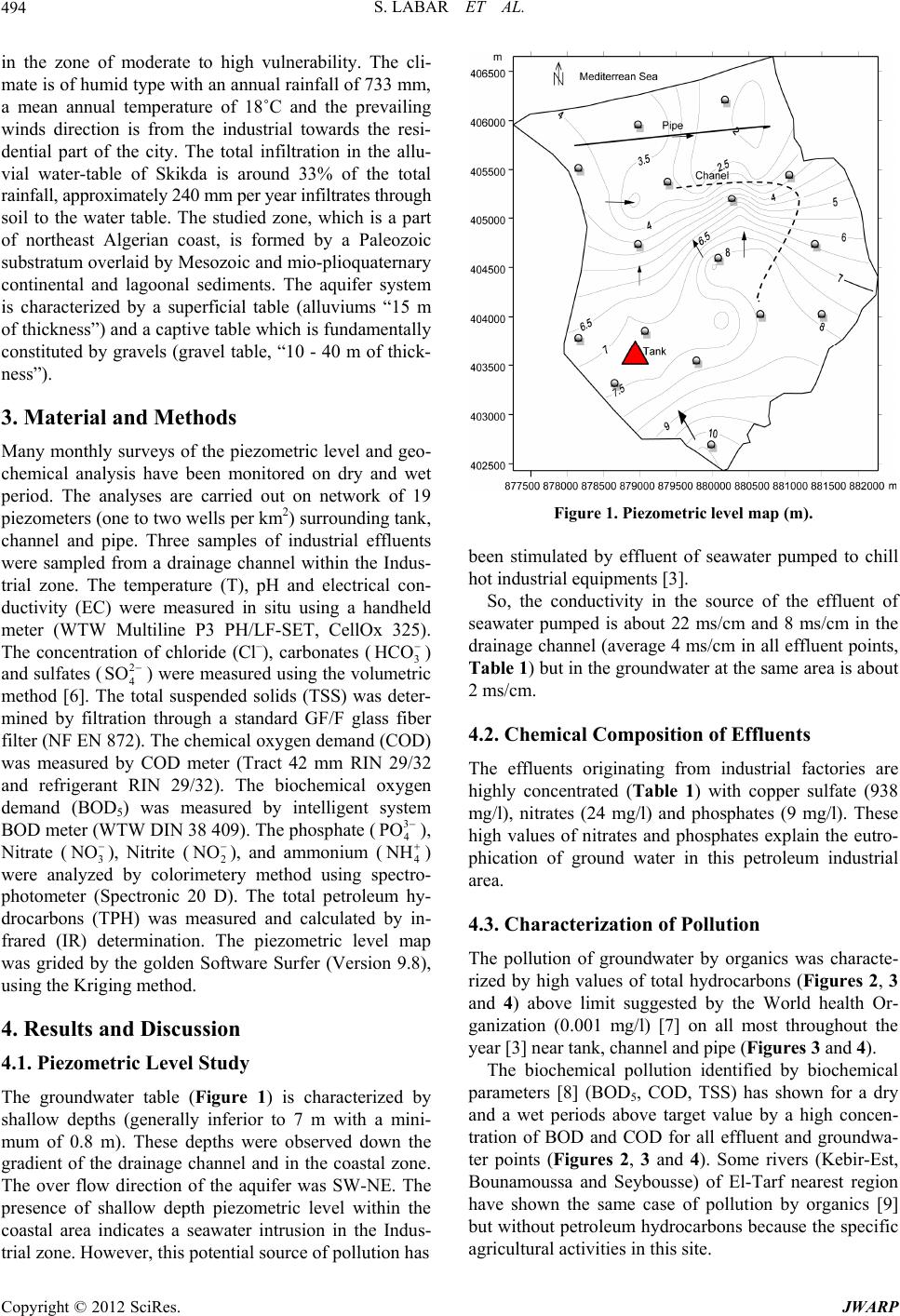 S. LABAR ET AL. 494 in the zone of moderate to high vulnerability. The cli- mate is of humid type with an annual rainfall of 733 mm, a mean annual temperature of 18˚C and the prevailing winds direction is from the industrial towards the resi- dential part of the city. The total infiltration in the allu- vial water-table of Skikda is around 33% of the total rainfall, approximat ely 240 mm per year infiltrates t hrough soil to the water table. The studied zone, which is a part of northeast Algerian coast, is formed by a Paleozoic substratum overlaid by Mesozoic and mio-plioquaternary continental and lagoonal sediments. The aquifer system is characterized by a superficial table (alluviums “15 m of thickness”) and a captiv e table which is fundamentally constituted by gravels (gravel table, “10 - 40 m of thick- ness”). 3. Material and Methods Many monthly surveys of the piezometric level and geo- chemical analysis have been monitored on dry and wet period. The analyses are carried out on network of 19 piezometers (one to two wells per km2) surrounding tank , channel and pipe. Three samples of industrial effluents were sampled from a drainage channel within the Indus- trial zone. The temperature (T), pH and electrical con- ductivity (EC) were measured in situ using a handheld meter (WTW Multiline P3 PH/LF-SET, CellOx 325). The concentration of chloride (Cl–), carbonates (3 HCO ) and sulfates (4) were measured using the volumetric method [6]. The total suspended solids (TSS) was deter- mined by filtration through a standard GF/F glass fiber filter (NF EN 872). The chemical o xyg en demand (COD) was measured by COD meter (Tract 42 mm RIN 29/32 and refrigerant RIN 29/32). The biochemical oxygen demand (BOD5) was measured by intelligent system BOD meter (W TW DIN 38 4 09). Th e pho sph a te ( 2 SO 3 4 PO ), Nitrate (3), Nitrite (2), and ammonium (4 NONONH ) were analyzed by colorimetery method using spectro- photometer (Spectronic 20 D). The total petroleum hy- drocarbons (TPH) was measured and calculated by in- frared (IR) determination. The piezometric level map was grided by the golden Software Surfer (Version 9.8), using the Kriging method. 4. Results and Discussion 4.1. Piezometric Level Study The groundwater table (Figure 1) is characterized by shallow depths (generally inferior to 7 m with a mini- mum of 0.8 m). These depths were observed down the gradient of the drainage channel and in the coastal zone. The over flow direction of the aquifer was SW-NE. The presence of shallow depth piezometric level within the coastal area indicates a seawater intrusion in the Indus- trial zone. However, this potential source of pollution has Figure 1. Piezometric level map (m). been stimulated by effluent of seawater pumped to chill hot industrial equipments [3]. So, the conductivity in the source of the effluent of seawater pumped is about 22 ms/cm and 8 ms/cm in the drainage channel (average 4 ms/cm in all effluent points, Table 1) but in the groun dwater at the same area is about 2 ms /cm. 4.2. Chemical Composition of Effluents The effluents originating from industrial factories are highly concentrated (Table 1) with copper sulfate (938 mg/l), nitrates (24 mg/l) and phosphates (9 mg/l). These high values of nitrates and phosphates explain the eutro- phication of ground water in this petroleum industrial area. 4.3. Characterization of Pollution The pollution of groundwater by organics was characte- rized by high values of total hydrocarbons (Figures 2, 3 and 4) above limit suggested by the World health Or- ganization (0.001 mg/l) [7] on all most throughout the year [3] near tank, channel and pipe (Figures 3 and 4). The biochemical pollution identified by biochemical parameters [8] (BOD5, COD, TSS) has shown for a dry and a wet periods above target value by a high concen- tration of BOD and COD for all effluent and groundwa- ter points (Figures 2, 3 and 4). Some rivers (Kebir-Est, Bounamoussa and Seybousse) of El-Tarf nearest region have shown the same case of pollution by organics [9] but without petroleum hydrocarbons because the specific agricultural activities in this site. Copyright © 2012 SciRes. JWARP 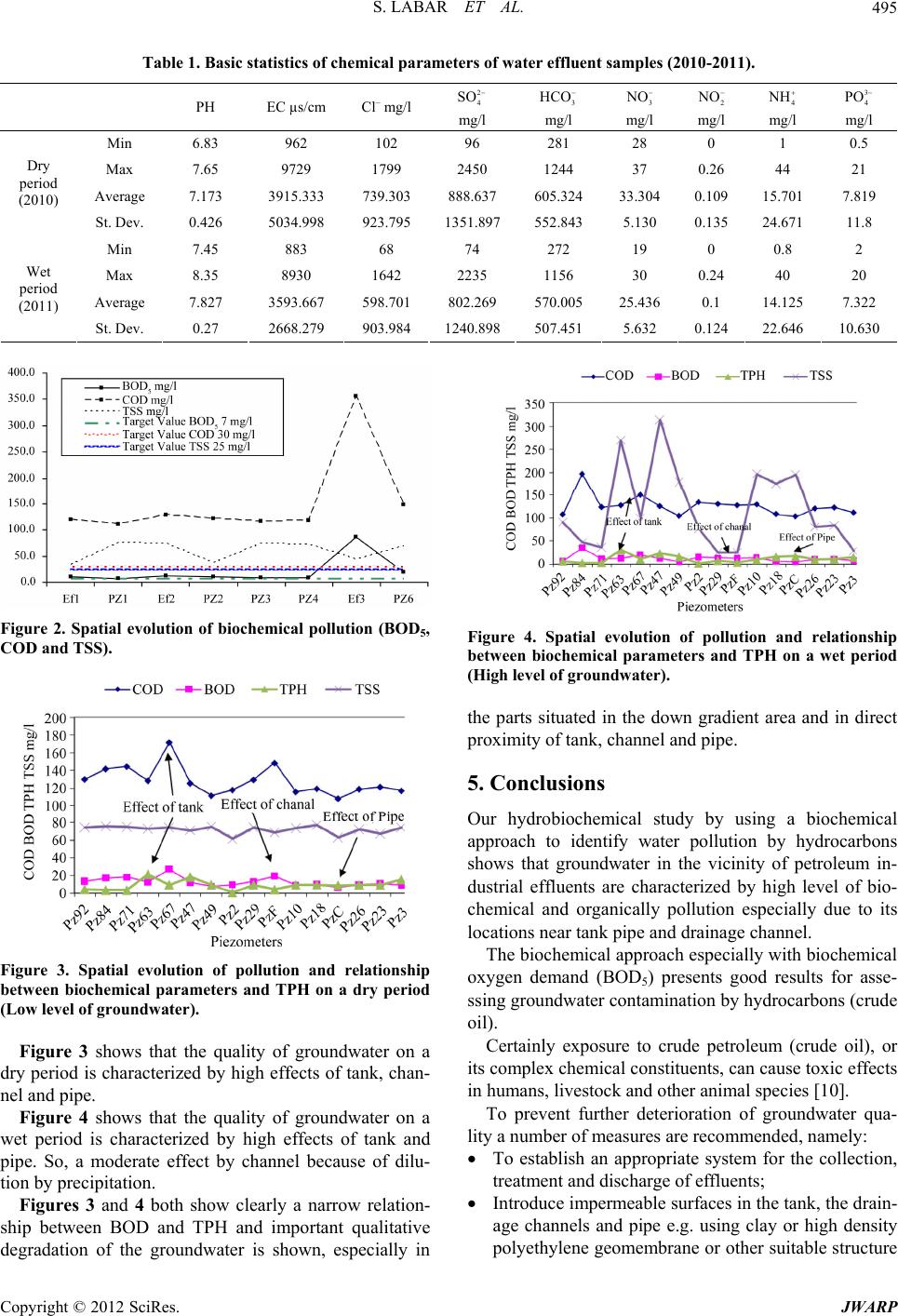 S. LABAR ET AL. JWARP 495 Table 1. Basic statistics of chemical parameters of water effluent samples (2010-2011). Copyright © 2012 SciRes. PH EC µs/cm Cl– mg/l 2 4 SO mg/l 3 OHC mg/l 2 NO 4 NH3 4 PO mg/l mg/l 3 NO mg/l mg/l Min 6.83 962 102 96 281 28 0 1 0.5 Max 7.65 9729 1799 2450 1244 37 0.26 44 21 Average 7.173 3915.333 739.303 888.637 605.324 33.304 0.109 15.701 7.819 Dry period (2010) St. Dev. 0.426 5034.998 923.795 1351.897 552.843 5.130 0.135 24.671 11.8 Min 7.45 883 68 74 272 19 0 0.8 2 Max 8.35 8930 1642 2235 1156 30 0.24 40 20 Average 7.827 3593.667 598.701 802.269 570.005 25.436 0.1 14.125 7.322 Wet period (2011) St. Dev. 0.27 2668.279 903.984 1240.898 507.45 1 5.632 0.124 22.646 10.630 Figure 2. Spatial evolution of biochemical pollution (BOD5, COD and TSS). Figure 4. Spatial evolution of pollution and relationship between biochemical parameters and TPH on a wet period (High level of groundw ater ). the parts situated in the down gradient area and in direct proximity of tank, channel and pipe. 5. Conclusions Our hydrobiochemical study by using a biochemical approach to identify water pollution by hydrocarbons shows that groundwater in the vicinity of petroleum in- dustrial effluents are characterized by high level of bio- chemical and organically pollution especially due to its locations near tank pipe and drainage channel. The biochemical approach especially with biochemical oxygen demand (BOD5) presents good results for asse- ssing groundwater contamination by hydrocarbons (crude oil). Figure 3. Spatial evolution of pollution and relationship between biochemical parameters and TPH on a dry period (Low level of groundwater ). Certainly exposure to crude petroleum (crude oil), or its complex chemical constituents, can cau se to xic effects in humans, livestock and other animal species [10]. Figure 3 shows that the quality of groundwater on a dry period is characterized by high effects of tank, chan- nel and pipe. To prevent further deterioration of groundwater qua- lity a number of measures are recommended, namely: Figure 4 shows that the quality of groundwater on a wet period is characterized by high effects of tank and pipe. So, a moderate effect by channel because of dilu- tion by precipitat i o n. To establish an appropriate system for the collection, treatment and discharge of effluents; Introduce impermeable surfaces in the tank, the drain- age channels and pipe e.g. using clay or high density polyethylene geomembrane or other suitable structure Figures 3 and 4 both show clearly a narrow relation- ship between BOD and TPH and important qualitative degradation of the groundwater is shown, especially in 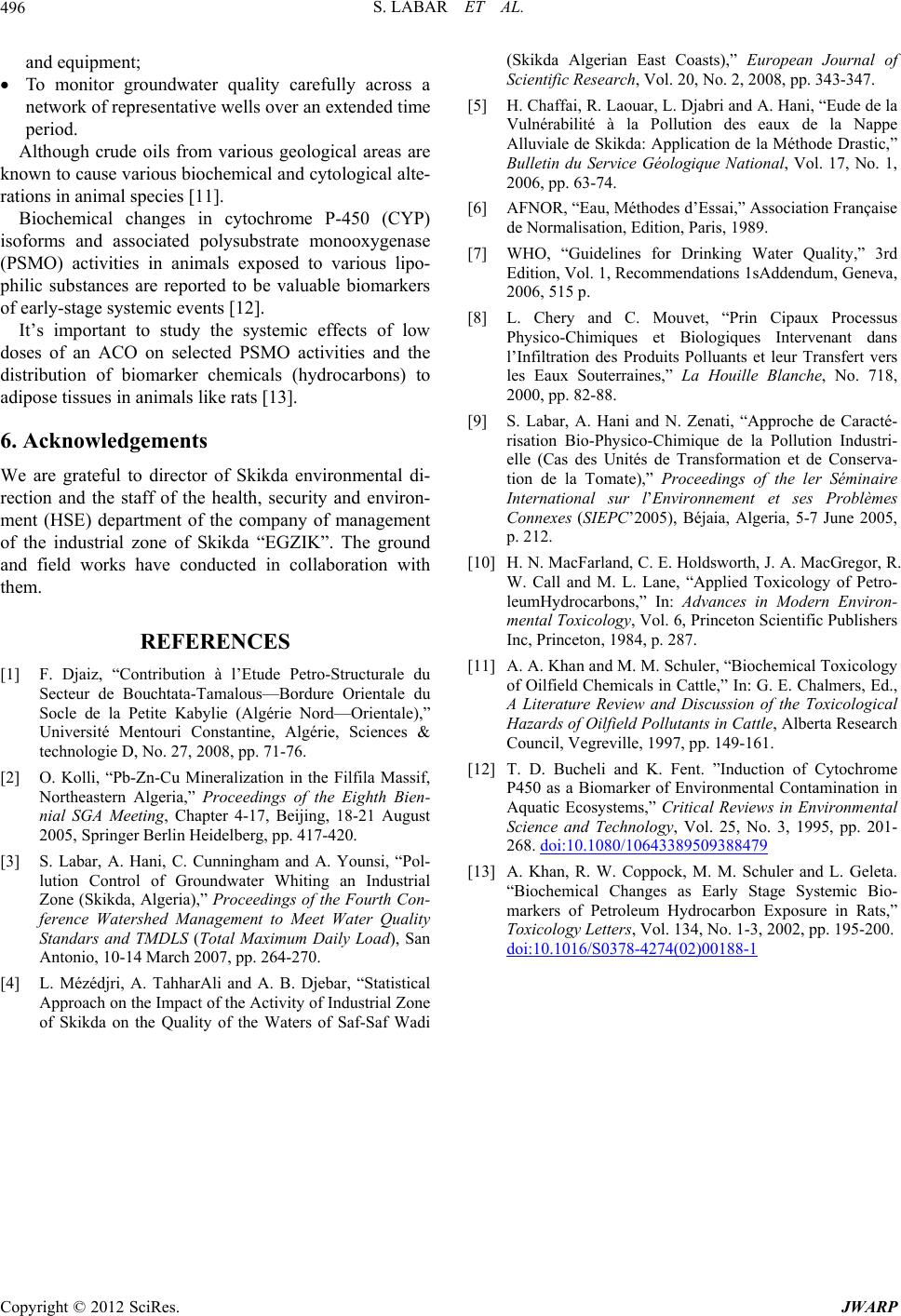 S. LABAR ET AL. 496 and equipment; To monitor groundwater quality carefully across a network of representative wells over an extended time period. Although crude oils from various geological areas are known to cause various biochemical and cytological alte- rations in animal species [11]. Biochemical changes in cytochrome P-450 (CYP) isoforms and associated polysubstrate monooxygenase (PSMO) activities in animals exposed to various lipo- philic substances are reported to be valuable biomarkers of early-stage systemic events [12]. It’s important to study the systemic effects of low doses of an ACO on selected PSMO activities and the distribution of biomarker chemicals (hydrocarbons) to adipose tissues in animals like rats [13]. 6. Acknowledgements We are grateful to director of Skikda environmental di- rection and the staff of the health, security and environ- ment (HSE) department of the company of management of the industrial zone of Skikda “EGZIK”. The ground and field works have conducted in collaboration with them. REFERENCES [1] F. Djaiz, “Contribution à l’Etude Petro-Structurale du Secteur de Bouchtata-Tamalous—Bordure Orientale du Socle de la Petite Kabylie (Algérie Nord—Orientale),” Université Mentouri Constantine, Algérie, Sciences & technologie D, No. 27, 2008, pp. 71-76. [2] O. Kolli, “Pb-Zn-Cu Mineralization in the Filfila Massif, Northeastern Algeria,” Proceedings of the Eighth Bien- nial SGA Meeting, Chapter 4-17, Beijing, 18-21 August 2005, Springer Berlin Heidelberg, pp. 417-420. [3] S. Labar, A. Hani, C. Cunningham and A. Younsi, “Pol- lution Control of Groundwater Whiting an Industrial Zone (Skikda, Algeria),” Proceedings of the Fourth Con- ference Watershed Management to Meet Water Quality Standars and TMDLS (Total Maximum Daily Load), San Antonio, 10-14 March 2007, pp. 264-270. [4] L. Mézédjri, A. TahharAli and A. B. Djebar, “Statistical Approach on the Impact of the Activity of Industrial Zone of Skikda on the Quality of the Waters of Saf-Saf Wadi (Skikda Algerian East Coasts),” European Journal of Scientifi c R e se a rch, Vol. 20, No. 2, 2008, pp. 343-347. [5] H. Chaffai, R. Laouar, L. Djabri and A. Hani, “Eude de la Vulnérabilité à la Pollution des eaux de la Nappe Alluviale de Skikda: Application de la Méthode Drastic,” Bulletin du Service Géologique National, Vol. 17, No. 1, 2006, pp. 63-74. [6] AFNOR, “Eau, Méthodes d’Essai,” Association Française de Normalisation, Edition, Paris, 1989. [7] WHO, “Guidelines for Drinking Water Quality,” 3rd Edition, Vol. 1, Recommendations 1sAddendum, Geneva, 2006, 515 p. [8] L. Chery and C. Mouvet, “Prin Cipaux Processus Physico-Chimiques et Biologiques Intervenant dans l’Infiltration des Produits Polluants et leur Transfert vers les Eaux Souterraines,” La Houille Blanche, No. 718, 2000, pp. 82-88. [9] S. Labar, A. Hani and N. Zenati, “Approche de Caracté- risation Bio-Physico-Chimique de la Pollution Industri- elle (Cas des Unités de Transformation et de Conserva- tion de la Tomate),” Proceedings of the ler Séminaire International sur l’Environnement et ses Problèmes Connexes (SIEPC’2005), Béjaia, Algeria, 5-7 June 2005, p. 212. [10] H. N. MacFarland, C. E. Holdsworth, J. A. MacGregor, R. W. Call and M. L. Lane, “Applied Toxicology of Petro- leumHydrocarbons,” In: Advances in Modern Environ- mental Toxicology, Vol. 6, Princeton Scientific Publishers Inc, Princeton, 1984, p. 287. [11] A. A. Khan and M. M. Schuler, “Biochemical Toxicology of Oilfield Chemicals in Cattle,” In: G. E. Chalmers, Ed., A Literature Review and Discussion of the Toxicological Hazards of Oilfield Pollutants in Cattle, Alberta Research Council, Vegreville, 1997, pp. 149-161. [12] T. D. Bucheli and K. Fent. ”Induction of Cytochrome P450 as a Biomarker of Environmental Contamination in Aquatic Ecosystems,” Critical Reviews in Environmental Science and Technology, Vol. 25, No. 3, 1995, pp. 201- 268. doi:10.1080/10643389509388479 [13] A. Khan, R. W. Coppock, M. M. Schuler and L. Geleta. “Biochemical Changes as Early Stage Systemic Bio- markers of Petroleum Hydrocarbon Exposure in Rats,” Toxicology Letters, Vol. 134, No. 1-3, 2002, pp. 195-200. doi:10.1016/S0378-4274(02)00188-1 Copyright © 2012 SciRes. JWARP |