

Paper Menu >>
Journal Menu >>
 Chinese Studies 2012. Vol.1, No.1, 1-4 Published Online May 2012 in SciRes (http://www.SciRP.org/journal/chnstd) http://dx.doi.org/10.4236/chnstd.2012.11001 Copyright © 2012 SciRes. 1 Dual Land Market and Rapid China’s Urbanization: Problems and Solutions Huachun Wang1*, Chunxue Zhao2, Maerhaba Xiaokaiti1, Yue Zhou1, Rui Zhao1 1Academy of Governme n t, Beijing Normal University, Beijing, China 2Research Institute for Fiscal Science, Ministry of Finance, Beijing, China Email: *[email protected] Received March 15th, 20 12 ; revised April 29th, 2012; accepted May 15th, 2012 The dual land market has greatly encouraged the economy and urban development and created far-reach- ing effects on excessive land expropriation and land finance. Using an analytical framework of dual mar- ket structure model, this paper investigates the relationship between local land finance and China’s rapid urbanization. Low-cost land expropriation is the main reason why extensive urbanization goes so fast in recent China. Granting farmers the complete land rights, implementing property tax to consolidate local tax bases, unifying the dual land market are helpful to achieve both social equity and land use efficiency in Chinese rapid urbanization process. Keywords: Dual Land Market; Land Expropriation; Land Finance; Urbanization; China Introduction A new land development process was introduced in China upon the adoption of economic reforms since the early 1980’s. Land use rights could be transferred as a transaction of owner- ship. China has been undergoing a rapid urbanization since then, the urbanization rate rose from 37.66 to 51.27 percent between 2001 and 2011 (NBS, 2012). Rapid urbanization has resulted in much arable land being used for non-agricultural purposes through land expropriation. Land distribution and its impact have been given less attention compared with the rapid gross domestic product (GDP) growth. Through the investigation of the formation of dual land market in the rapid urbanization, it can be observed that the formation of the dual land market is a complicated process involving conflicts of interests. The legal frame work for land expropriation is defined by the Land Administration Law (LAL) enforced in 1998. The state may expropriate land for public interest. However, public in- terest has not been clearly defined. In fact, both the land for urban infrastructural and the land for commercial purpose are satisfied by land expropriation. Neither the rural collectives nor farmers can negotiate with the urban land users about the prices or other requirements (Qu, Heerink, & Wang, 1995). The compensation for arable land constitutes three compo- nents according to the LAL. The compensation for land is six to ten times the derived land productivity, which is the monetary value of the annual average agricultural output value over the past three years. The compensation for resettlement is four to six times the derived land productivity. The last item is the compensation for accessory assets in land. The maximum compensation for land expropriation cannot exceed 30 times the derived land productivity. However, when the land is leased out for commercial pur- pose, the price will be much higher. The fair market value of the land and the negative impacts of land expropriations have not been considered. The dispossessed farmers are largely ex- cluded from sharing the land value appreciation resulting from land development projects (Wang & Scott, 2008). There are currently over 40 million dispossessed farmers and 70 percent of them are related to rural land expropriation in urbanization (UIE, 2007a). Low compensation provoked dispossessed farm- ers into violent clashes with local authorities (Zhu & Proster- man, 2007). Land-related issues have recently become the top cause of rural grievance, local social unrest and political insta- bility (Carl, 2006; UIE, 2007b). What is the relationship between land expropriation and ur- ban expansion? Why the central government cannot curb local land expropriation? What further measures should be taken? This paper aims to address these questions. Based on an ana- lytical framework of dual market structure theory, this paper focuses on the formation and operating framework of the dual land market, reveals its influence on the behaviours of local land finance and excessive land expropriation. The paper is organized as the following. After a brief introduction of the formation of dual land market in part two, part three describes the public land leasing strategies adopted by local governments in China. Part four rationalizes local land finance in a wider context of economic and political institutions in China. Part five examines the central government’s response to local land expropriation. Policy implications are discussed regarding fu- ture reform of the land market. The Formation of the Dual Land Market and the Dynamics of Land Transactions As one of the pillars of Chinese public ownership, land is state-owned or collectively-owned, which emphasises that the government should monopolise the supply of land (Ho & Spoor, 2006). Rural land can only be expropriated by the local gov- ernment to ensure that all urban land belongs to the state. A dual land market emerged with the coexistence of market-ori- *Corresponding author. 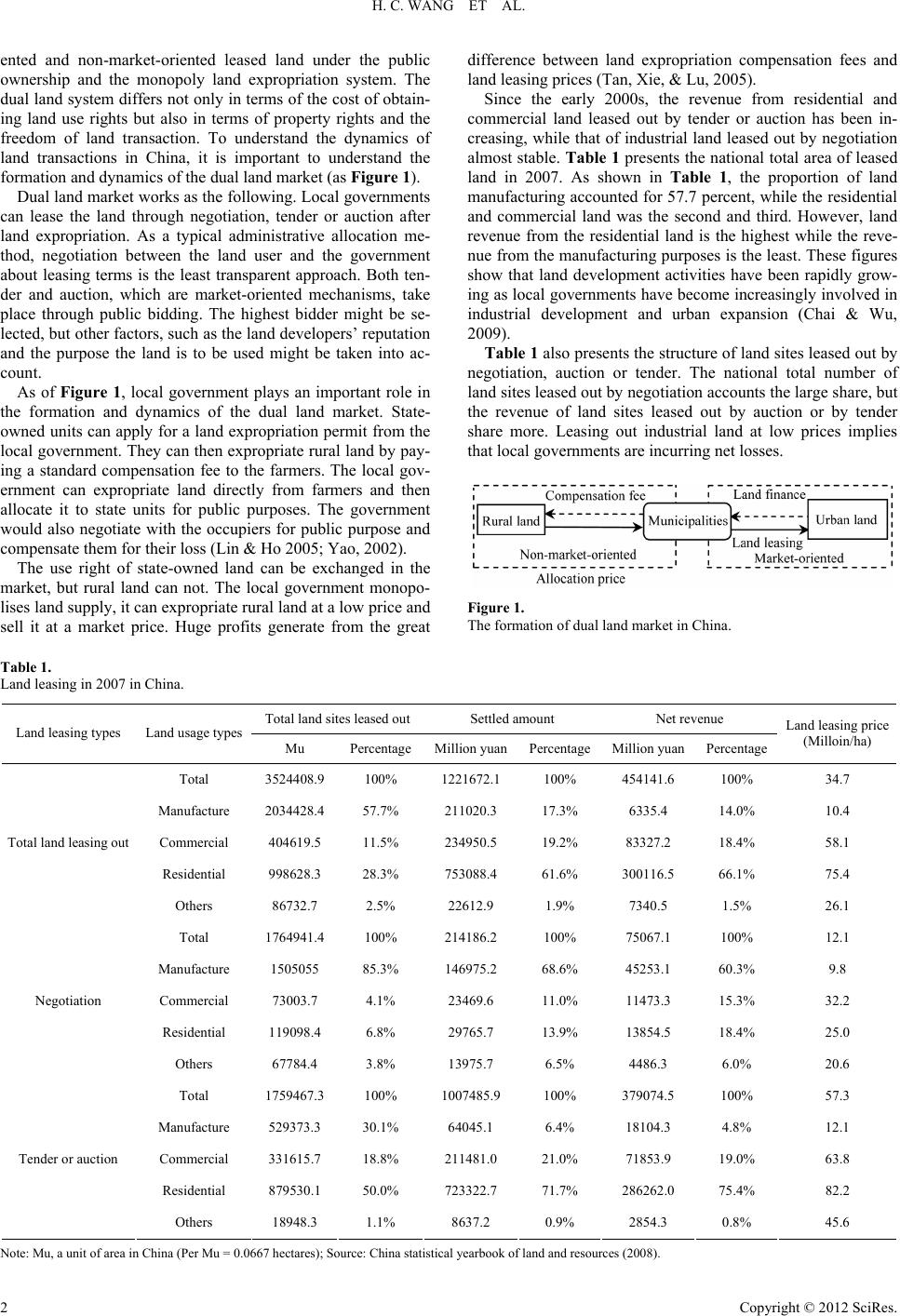 H. C. WANG ET AL. ented and non-market-oriented leased land under the public ownership and the monopoly land expropriation system. The dual land system differs not only in terms of the cost of obtain- ing land use rights but also in terms of property rights and the freedom of land transaction. To understand the dynamics of land transactions in China, it is important to understand the formation and dynamics of the dual land market (as Figure 1). Dual land market works as the following. Local governments can lease the land through negotiation, tender or auction after land expropriation. As a typical administrative allocation me- thod, negotiation between the land user and the government about leasing terms is the least transparent approach. Both ten- der and auction, which are market-oriented mechanisms, take place through public bidding. The highest bidder might be se- lected, but other factors, such as the land developers’ reputation and the purpose the land is to be used might be taken into ac- count. As of Figure 1, local government plays an important role in the formation and dynamics of the dual land market. State- owned units can apply for a land expropriation permit from the local government. They can then expropriate rural land by pay- ing a standard compensation fee to the farmers. The local gov- ernment can expropriate land directly from farmers and then allocate it to state units for public purposes. The government would also negotiate with the occupiers for public purpose and compensate them for their loss (Lin & Ho 2005; Yao, 2002). The use right of state-owned land can be exchanged in the market, but rural land can not. The local government monopo- lises land supply, it can expropriate rural land at a low price and sell it at a market price. Huge profits generate from the great difference between land expropriation compensation fees and land leasing prices (Tan, Xie, & Lu, 2005). Since the early 2000s, the revenue from residential and commercial land leased out by tender or auction has been in- creasing, while that of industrial land leased out by negotiation almost stable. Table 1 presents the national total area of leased land in 2007. As shown in Table 1, the proportion of land manufacturing accounted for 57.7 percent, while the residential and commercial land was the second and third. However, land revenue from the residential land is the highest while the reve- nue from the manufacturing purposes is the least. These figures show that land development activities have been rapidly grow- ing as local governments have become increasingly involved in industrial development and urban expansion (Chai & Wu, 2009). Table 1 also presents the structure of land sites leased out by negotiation, auction or tender. The national total number of land sites leased out by negotiation accounts the large share, but the revenue of land sites leased out by auction or by tender share more. Leasing out industrial land at low prices implies that local governments are incurring net losses. Figure 1. The formation of dual land market in China. Table 1. Land leasing in 2007 in China. Total land sites leased outSettled amount Net reven u e Land leas ing t ypes Land usage types Mu PercentageMillion yuanPercentageMillion yuan Percentage Land lea si n g price (Milloin/ha) Total 3524408.9 100% 1221672.1 100% 454141.6 100% 34.7 Manufacture 2034428.4 57.7% 211020.3 17.3% 6335.4 14.0% 10.4 Commercial 404619.5 11.5% 234950.5 19.2% 83327.2 18.4% 58.1 Residential 998628.3 28.3% 753088.4 61.6% 300116.5 66.1% 75.4 Total land leasing out Others 86732.7 2.5% 22612.9 1.9% 7340.5 1.5% 26.1 Total 1764941.4 100% 214186.2 100% 75067.1 100% 12.1 Manufacture 1505055 85.3% 146975.2 68.6% 45253.1 60.3% 9.8 Commercial 73003.7 4.1% 23469.6 11.0% 11473.3 15.3% 32.2 Residential 119098.4 6.8% 29765.7 13.9% 13854.5 18.4% 25.0 Negotiation Others 67784.4 3.8% 13975.7 6.5% 4486.3 6.0% 20.6 Total 1759467.3 100% 1007485.9 100% 379074.5 100% 57.3 Manufacture 529373.3 30.1% 64045.1 6.4% 18104.3 4.8% 12.1 Commercial 331615.7 18.8% 211481.0 21.0% 71853.9 19.0% 63.8 Residential 879530.1 50.0% 723322.7 71.7% 286262.0 75.4% 82.2 Tender or auction Others 18948.3 1.1% 8637.2 0.9% 2854.3 0.8% 45.6 N ote: Mu, a unit of ar ea in China (Per Mu = 0.0667 hectares); Source: China statistical yearbook of land and resources (2008). Copyright © 2012 SciRes. 2 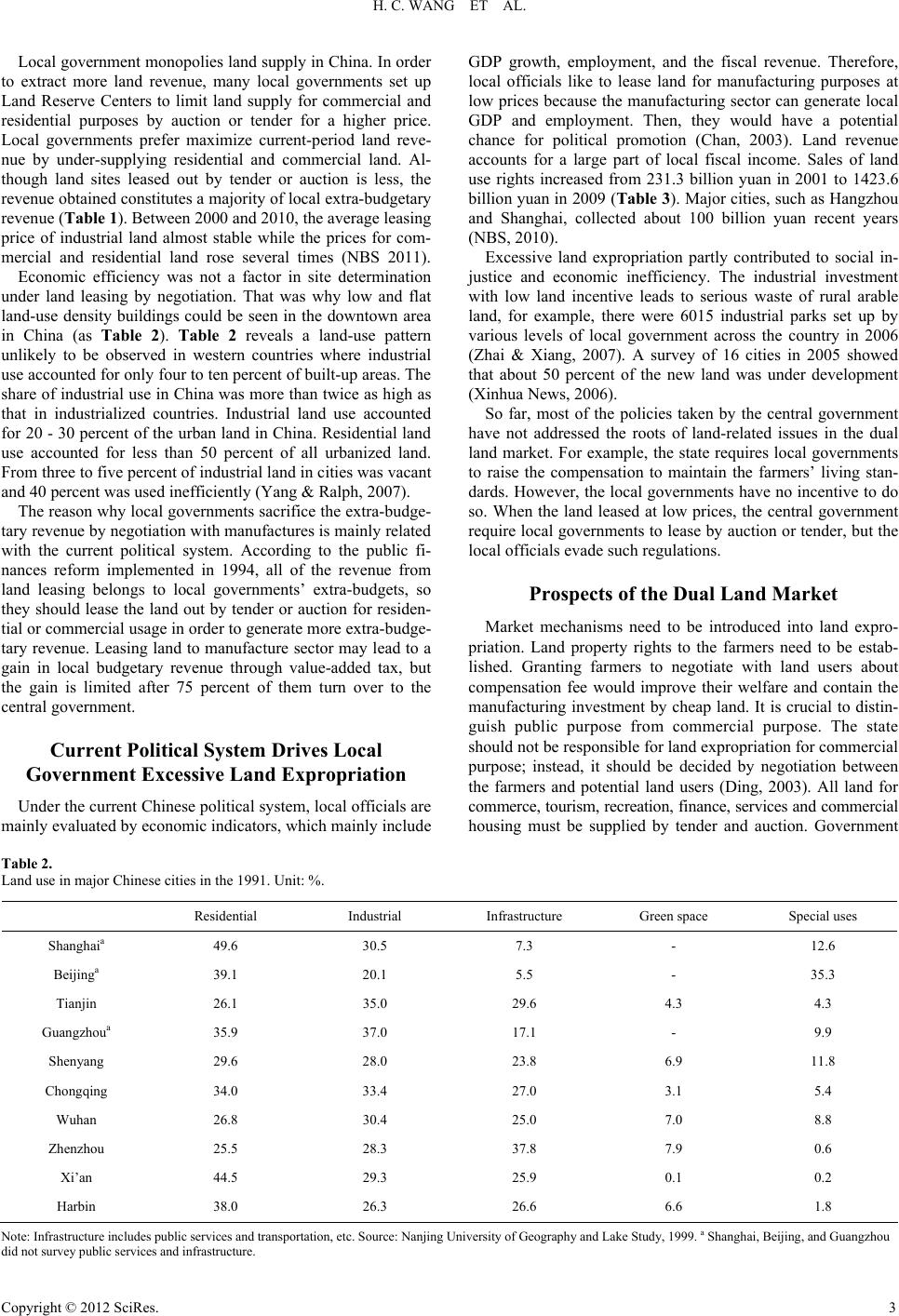 H. C. WANG ET AL. Local government monopolies land supply in China. In order to extract more land revenue, many local governments set up Land Reserve Centers to limit land supply for commercial and residential purposes by auction or tender for a higher price. Local governments prefer maximize current-period land reve- nue by under-supplying residential and commercial land. Al- though land sites leased out by tender or auction is less, the revenue obtained constitutes a majority of local extra-budgetary revenue (Table 1). Between 2000 and 2010, the average leasing price of industrial land almost stable while the prices for com- mercial and residential land rose several times (NBS 2011). Economic efficiency was not a factor in site determination under land leasing by negotiation. That was why low and flat land-use density buildings could be seen in the downtown area in China (as Table 2). Table 2 reveals a land-use pattern unlikely to be observed in western countries where industrial use accounted for only four to ten percent of built-up areas. The share of industrial use in China was more than twice as high as that in industrialized countries. Industrial land use accounted for 20 - 30 percent of the urban land in China. Residential land use accounted for less than 50 percent of all urbanized land. From three to five percent of industrial land in cities was vacant and 40 percent was used inefficiently (Yang & Ralph, 2007). The reason why local governments sacrifice the extra-budge- tary revenue by negotiation with manufactures is mai nly rela ted with the current political system. According to the public fi- nances reform implemented in 1994, all of the revenue from land leasing belongs to local governments’ extra-budgets, so they should lease the land out by tender or auction for residen- tial or commercial usage in order to generate more extra-budge- tary revenue. Leasing land to manufacture sector may lead to a gain in local budgetary revenue through value-added tax, but the gain is limited after 75 percent of them turn over to the central government. Current Political System Drives Local Government Excessive Land Expropriation Under the current Chinese political system, local officials are mainly evaluated by economic indicators, which mainly include GDP growth, employment, and the fiscal revenue. Therefore, local officials like to lease land for manufacturing purposes at low prices because the manufacturing sector can generate local GDP and employment. Then, they would have a potential chance for political promotion (Chan, 2003). Land revenue accounts for a large part of local fiscal income. Sales of land use rights increased from 231.3 billion yuan in 2001 to 1423.6 billion yuan in 2009 (Table 3). Major cities, such as Hangzhou and Shanghai, collected about 100 billion yuan recent years (NBS, 2010). Excessive land expropriation partly contributed to social in- justice and economic inefficiency. The industrial investment with low land incentive leads to serious waste of rural arable land, for example, there were 6015 industrial parks set up by various levels of local government across the country in 2006 (Zhai & Xiang, 2007). A survey of 16 cities in 2005 showed that about 50 percent of the new land was under development (Xinhua News, 2006). So far, most of the policies taken by the central government have not addressed the roots of land-related issues in the dual land market. For example, the state requires local governments to raise the compensation to maintain the farmers’ living stan- dards. However, the local governments have no incentive to do so. When the land leased at low prices, the central government require local governments to lease by auction or tender, but the local officials evade such regulations. Prospects of the Dual Land Market Market mechanisms need to be introduced into land expro- priation. Land property rights to the farmers need to be estab- lished. Granting farmers to negotiate with land users about compensation fee would improve their welfare and contain the manufacturing investment by cheap land. It is crucial to distin- guish public purpose from commercial purpose. The state should not be responsible for land expropriation for commercial purpose; instead, it should be decided by negotiation between the farmers and potential land users (Ding, 2003). All land for commerce, tourism, recreation, finance, services and commercial housing must be supplied by tender and auction. Government Table 2. Land use in major Chinese cities in the 1991. Unit: %. Residential Industrial Infrastruc tur e Green space Special uses Shanghaia 49.6 30.5 7.3 - 12.6 Beijinga 39.1 20.1 5.5 - 35.3 Tianjin 26.1 35.0 29.6 4.3 4.3 Guangzhoua 35.9 37.0 17.1 - 9.9 Shenyang 29.6 28.0 23.8 6.9 11.8 Chongqing 34.0 33.4 27.0 3.1 5.4 Wuhan 26.8 30.4 25.0 7.0 8.8 Zhenzhou 25.5 28.3 37.8 7.9 0.6 Xi’an 44.5 29.3 25.9 0.1 0.2 Harbin 38.0 26.3 26.6 6.6 1.8 Note: Infrastructure includes public services a nd transport a tion, etc. Source: Nanj ing University of Geography and Lake Study, 1999. a Shanghai, Beijing, and Guangzhou id not survey public services and infrastructure. d Copyright © 2012 SciRes. 3 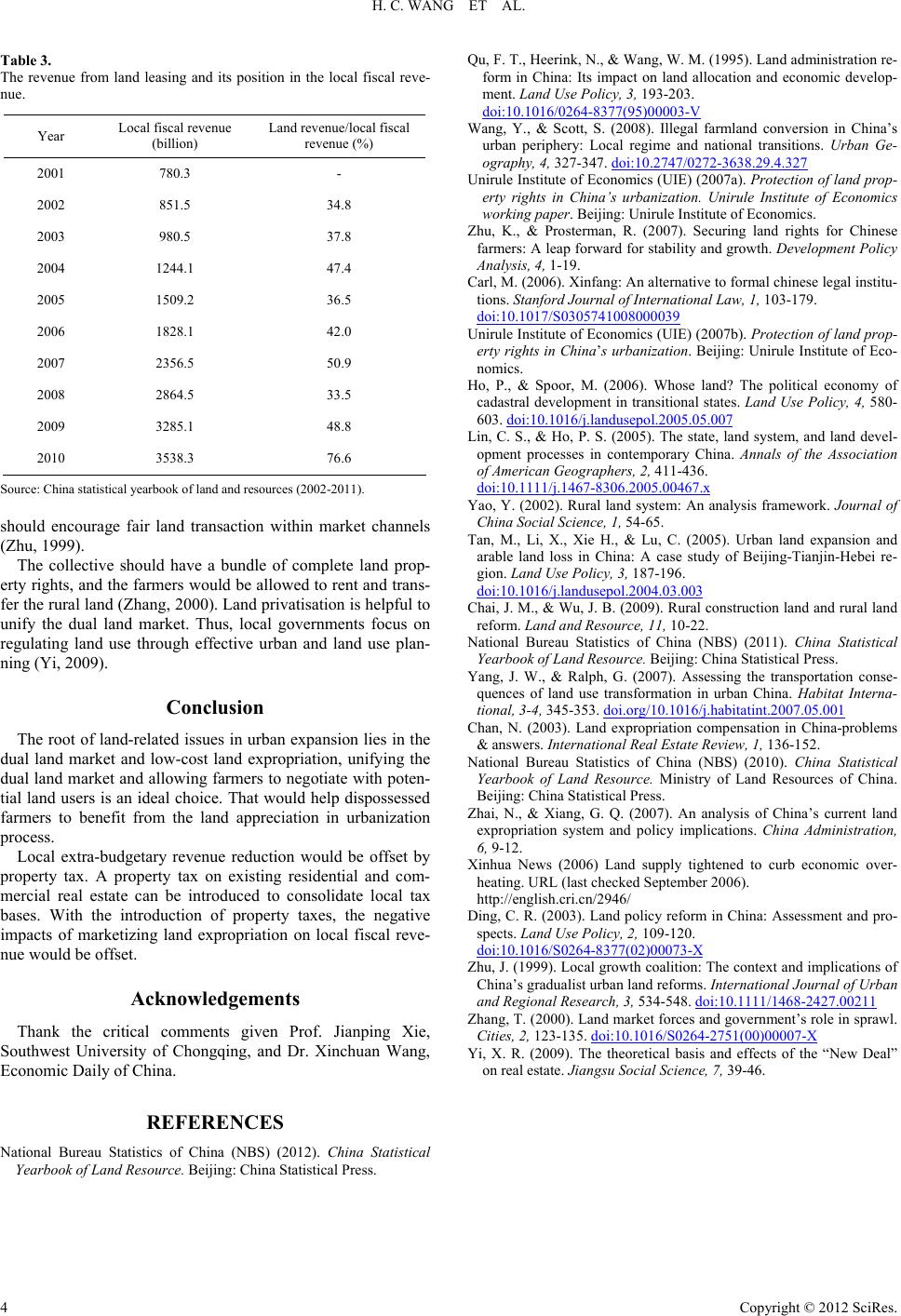 H. C. WANG ET AL. Table 3. The revenue from land leasing and its position in the local fiscal reve- nue. Year Local fiscal revenue (billion) Land revenu e/local fisc al revenue (%) 2001 780.3 - 2002 851.5 34.8 2003 980.5 37.8 2004 1244.1 47.4 2005 1509.2 36.5 2006 1828.1 42.0 2007 2356.5 50.9 2008 2864.5 33.5 2009 3285.1 48.8 2010 3538.3 76.6 Source: China statistical yearbook of land and resources (2002-2011). should encourage fair land transaction within market channels (Zhu, 1999). The collective should have a bundle of complete land prop- erty rights, and the farmers would be allowed to rent and trans- fer the rural land (Zhang, 2000). Land privatisation is helpful to unify the dual land market. Thus, local governments focus on regulating land use through effective urban and land use plan- ning (Yi, 2009). Conclusion The root of land-related issues in urban expansion lies in the dual land market and low-cost land expropriation, unifying the dual land market and allowing farmers to negotiate with poten- tial land users is an ideal choice. That would help dispossessed farmers to benefit from the land appreciation in urbanization process. Local extra-budgetary revenue reduction would be offset by property tax. A property tax on existing residential and com- mercial real estate can be introduced to consolidate local tax bases. With the introduction of property taxes, the negative impacts of marketizing land expropriation on local fiscal reve- nue would be offset. Acknowledgements Thank the critical comments given Prof. Jianping Xie, Southwest University of Chongqing, and Dr. Xinchuan Wang, Economic Daily of China. REFERENCES National Bureau Statistics of China (NBS) (2012). China Statistical Yearbook of Land Reso urc e. Beijing: China Statistical Press. Qu, F. T., Heerink, N., & Wang, W. M. (1995). Land administration re- form in China: Its impact on land allocation and economic develop- ment. Land Use Policy, 3, 193-203. doi:10.1016/0264-8377(95)00003-V Wang, Y., & Scott, S. (2008). Illegal farmland conversion in China’s urban periphery: Local regime and national transitions. Urban Ge- ography, 4, 327-347. doi:10.2747/0272-3638.29.4.327 Unirule Institute of Economics (UIE) (2007a). Protection of land prop- erty rights in China’s urbanization. Unirule Institute of Economics working paper. Beijing: Unirule Institute of Eco nomics. Zhu, K., & Prosterman, R. (2007). Securing land rights for Chinese farmers: A leap forward for stability and growth. Development Policy Analysis, 4, 1-19. Carl, M. (2006). Xinfang: An alternative to formal chinese legal institu- tions. Stanford Journal of International Law, 1, 103-179. doi:10.1017/S0305741008000039 Unirule Institute of Economics (UIE) (2007b). Protection of land prop- erty rights in China’s urbanization. Beijing: Unirule Institute of Eco- nomics. Ho, P., & Spoor, M. (2006). Whose land? The political economy of cadastral development in transitional states. Land Use Policy, 4, 580- 603. doi:10.1016/j.landusepol.2005.05.007 Lin, C. S., & Ho, P. S. (2005). The state, land system, and land devel- opment processes in contemporary China. Annals of the Association of American Geographers, 2, 411-436. doi:10.1111/j.1467-8306.2005.00467.x Yao, Y. (2002). Rural land system: An analysis framework. Journal of China Social Science, 1 , 54-65. Tan, M., Li, X., Xie H., & Lu, C. (2005). Urban land expansion and arable land loss in China: A case study of Beijing-Tianjin-Hebei re- gion. Land Use P olicy, 3, 187-196. doi:10.1016/j.landusepol.2004.03.003 Chai, J. M., & Wu, J. B. (2009). Rural construction land and rural land reform. Land and Resource, 11, 10-22. National Bureau Statistics of China (NBS) (2011). China Statistical Yearbook of Land Reso urc e. Beijing: China Statistical Press. Yang, J. W., & Ralph, G. (2007). Assessing the transportation conse- quences of land use transformation in urban China. Habitat Interna- tional, 3-4, 345-353. doi.org/10.1016/j.habitatint.2007.05.001 Chan, N. (2003). Land expropriation compensation in China-problems & answers. International Real Estate Review, 1, 136-152. National Bureau Statistics of China (NBS) (2010). China Statistical Yearbook of Land Resource. Ministry of Land Resources of China. Beijing: China Statistical Press. Zhai, N., & Xiang, G. Q. (2007). An analysis of China’s current land expropriation system and policy implications. China Administration, 6, 9-12. Xinhua News (2006) Land supply tightened to curb economic over- heating. URL (last checked Septembe r 2006). http://english.cri.cn/2946/ Ding, C. R. (2003). Land policy reform in China: Assessment and pro- spects. Land Use Policy, 2, 109-120. doi:10.1016/S0264-8377(02)00073-X Zhu, J. (1999). Local growth coalition: The context and implications of China’s gradualist urban land reforms. International Journal of Urban and Regional Research, 3, 534-548. doi:10.1111/1468-2427.00211 Zhang, T. (2000). Land market forces and government’s role in sprawl. Cities, 2, 123-135. doi:10.1016/S0264-2751(00)00007-X Yi, X. R. (2009). The theoretical basis and effects of the “New Deal” on real estate. Jiangsu Social Science, 7 , 39-46. Copyright © 2012 SciRes. 4 |