

Paper Menu >>
Journal Menu >>
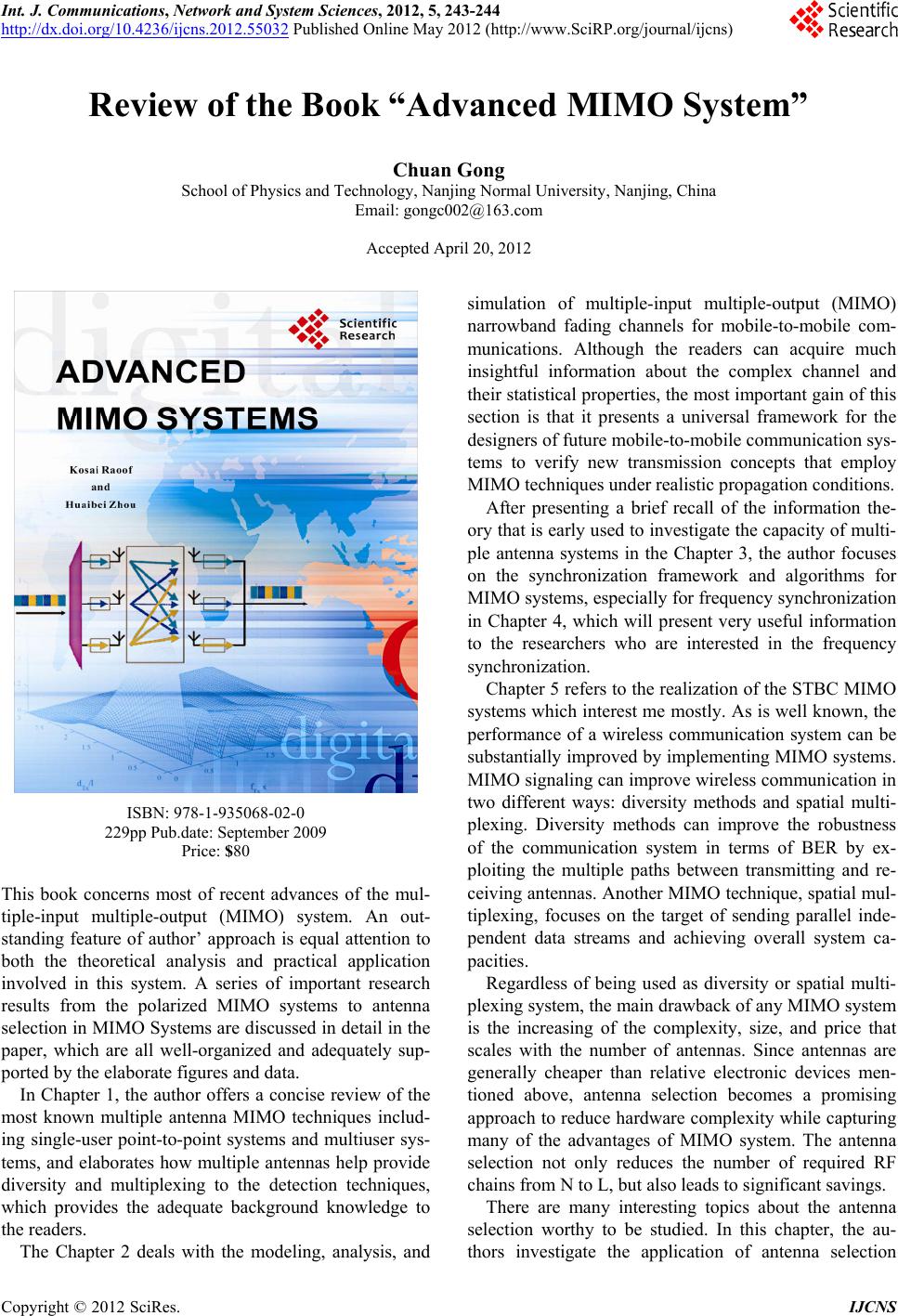 Int. J. Communications, Network and System Sciences, 2012, 5, 243-244 http://dx.doi.org/10.4236/ijcns.2012.55032 Published Online May 2012 (http://www.SciRP.org/journal/ijcns) Review of the Book “Advanced MIMO System” Chuan Gong School of Physics and Technology, Nanjing Normal University, Nanjing, China Email: [email protected] Accepted April 20, 2012 ISBN: 978-1-935068-02-0 229pp Pub.date: September 2009 Price: $80 This book concerns most of recent advances of the mul- tiple-input multiple-output (MIMO) system. An out- standing feature of author’ approach is equal attention to both the theoretical analysis and practical application involved in this system. A series of important research results from the polarized MIMO systems to antenna selection in MIMO Systems are discu ssed in detail in the paper, which are all well-organized and adequately sup- ported by the elaborate figures and data. In Chapter 1, the author offers a concise review of the most known multiple antenna MIMO techniques includ- ing single-user point-to-point systems and multiuser sys- tems, and elaborates how multiple antennas help provide diversity and multiplexing to the detection techniques, which provides the adequate background knowledge to the readers. The Chapter 2 deals with the modeling, analysis, and simulation of multiple-input multiple-output (MIMO) narrowband fading channels for mobile-to-mobile com- munications. Although the readers can acquire much insightful information about the complex channel and their statistical properties, the most important g ain of this section is that it presents a universal framework for the designers of future mobile-to-mobile communicatio n sys- tems to verify new transmission concepts that employ MIMO techniques under realistic propagation conditions. After presenting a brief recall of the information the- ory that is early used to inv estigate the capacity of multi- ple antenna systems in the Chapter 3, the author focuses on the synchronization framework and algorithms for MIMO systems, especially for frequency synchronization in Chapter 4, which will present very useful information to the researchers who are interested in the frequency synchronization. Chapter 5 refers to the realization of th e STBC MIMO systems which interest me mostly. As is well known, th e performance of a wireless communication system can be substantially improved by implementing MIMO systems. MIMO signaling can improve wireless communication in two different ways: diversity methods and spatial multi- plexing. Diversity methods can improve the robustness of the communication system in terms of BER by ex- ploiting the multiple paths between transmitting and re- ceiving antennas. Another MIMO technique, spatial mul- tiplexing, focuses on the target of sending parallel inde- pendent data streams and achieving overall system ca- pacities. Regardless of being used as diversity or spatial multi- plexing system, the main drawback of any MIMO system is the increasing of the complexity, size, and price that scales with the number of antennas. Since antennas are generally cheaper than relative electronic devices men- tioned above, antenna selection becomes a promising approach to reduce hardware complexity while capturing many of the advantages of MIMO system. The antenna selection not only reduces the number of required RF chains from N to L, but also leads to significant savings. There are many interesting topics about the antenna selection worthy to be studied. In this chapter, the au- thors investigate the application of antenna selection C opyright © 2012 SciRes. IJCNS  C. GONG 244 technique into STBC MIMO wireless communication systems over Rayleigh fading channels and then provide the performance analysis of such as MIMO systems. The authors also carry out Monte Carlo simulation to further detect the accuracy of both analytical expressions. All of these materials are clear and understandable with the elaborate figures and detailed discussion, which will help the readers greatly to capture the major progress of this area. Subsequent chapters refer to the other topics of the MIMO-OFDM channel estimation, polarization diversity, Cooperative Systems for Sensor Networks and discus- sion that concerns the impact of using MIMO physical channel on the MAC and network layers. I believe the book will present many interesting con- tents to the readers and help them follow the recent pro- gress of this new and booming area. To order: http://www.scirp.org/book/ Copyright © 2012 SciRes. IJCNS |