

Paper Menu >>
Journal Menu >>
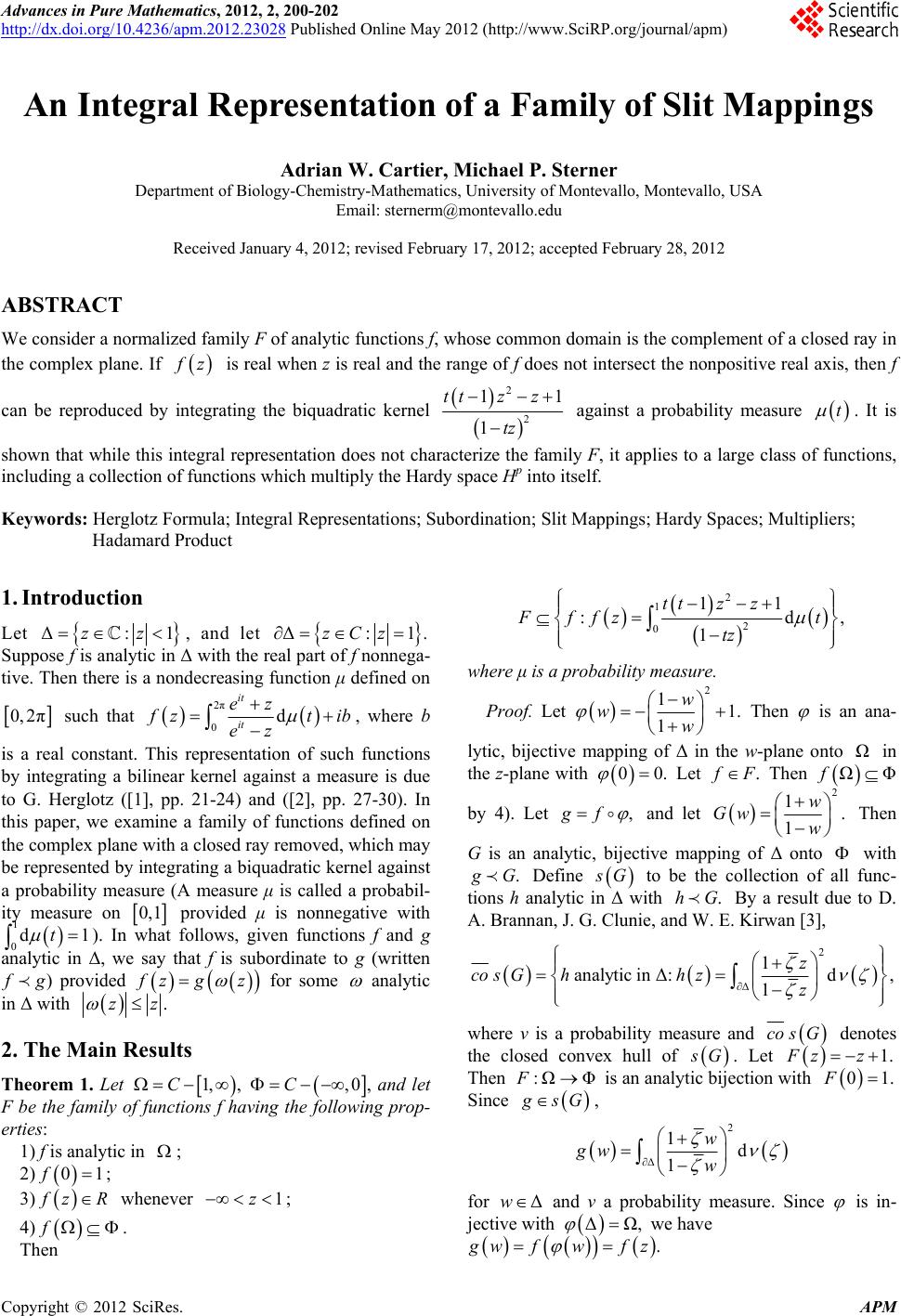 Advances in Pure Mathematics, 2012, 2, 200-202 http://dx.doi.org/10.4236/apm.2012.23028 Published Online May 2012 (http://www.SciRP.org/journal/apm) An Integral Representation of a Family of Slit Mappings Adrian W. Cartier, Michael P. Sterner Department of Biology-Chemistry-Mathematics, University of Montevallo, Montevallo, USA Email: [email protected] Received January 4, 2012; revised February 17, 2012; accepted February 28, 2012 ABSTRACT We consider a normalized family F of analytic functions f, whose common domain is the complement of a closed ray in the complex plane. If f z is real when z is real and the range of f does not intersect the nonpositive real axis, then f can be reproduced by integrating the biquadratic kernel 2 2 11 1 z z tz tt against a probability measure t . It is shown that while this integral representation does not characterize the family F, it applies to a large class of functions, including a collection of functions which multiply the Hardy space Hp into itself. Keywords: Herglotz Formula; Integral Representations; Subordination; Slit Mappings; Hardy Spaces; Multipliers; Hadamard Product 1. Introduction Let :z 1zΔ, and let :1.zCz Δ Suppose f is analytic in Δ with the real part of f nonnega- tive. Then there is a nondecreasing function μ defined on 0, 2π such that d ez 2π 0 it it f z tib ez , where b is a real constant. This representation of such functions by integrating a bilinear kernel against a measure is due to G. Herglotz ([1], pp. 21-24) and ([2], pp. 27-30). In this paper, we examine a family of functions defined on the complex plane with a closed ray removed, which may be represented by integrating a biquadratic kernel against a probability measure (A measure μ is called a probabil- ity measure on 0, 1 11 provided μ is nonnegative with 0). In what follows, given functions f and g analytic in Δ, we say that f is subordinate to g (written dt f g) provided f zg z for some analytic in Δ with . zz 2. The Main Results Theorem 1. Let , 1,C ,0C 01f , and let F be the family of functions f having the following prop- erties: 1) f is analytic in ; 2) ; 3) f z1z f R whenever ; 4) . Then 2 1 2 0 11 :d, 1 ttz z F ffz t tz where μ is a probability measure. Proof. Let 2 11. 1 w ww Then is an ana- lytic, bijective mapping of Δ in the w-plane onto in the z-plane with Ω 00. Let . Then fF ΩΦf , gf by 4). Let and let 2 1. 1 w w Gw Then G is an analytic, bijective mapping of Δ onto with s g .G Define G .hG to be the collection of all func- tions h analytic in Δ with By a result due to D. A. Brannan, J. G. Clunie, and W. E. Kirwan [3], 2 Δ 1 analytic inΔ:d 1 z co sGhhzz , where v is a probability measure and co sG denotes the closed convex hull of G 1.Fz z. Let s :ΩΦF Then is an analytic bijection with 01.F Since g sG , 2 Δ 1d 1 w gw w Δw and v a probability measure. Since for is in- jective with ΔΩ, we have g wf wfz . C opyright © 2012 SciRes. APM 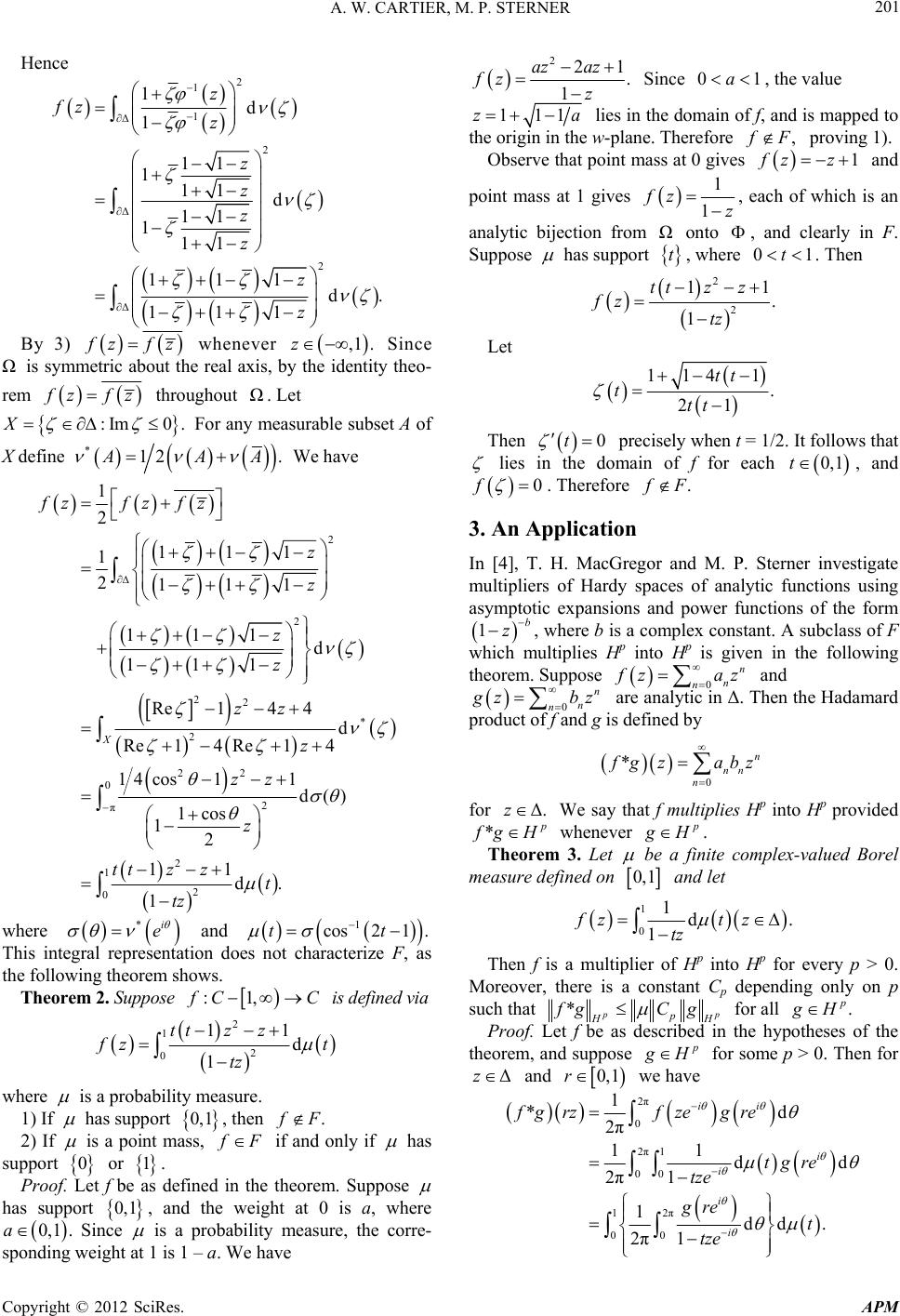 A. W. CARTIER, M. P. STERNER 201 Hence 2 1 d. 1 z z 2 1 1 Δ 2 Δ Δ 1d 1 11 111 d 11 111 11 11 z fz z z z z z By 3) f zf ,1 .z z whenever Since is symmetric about the real axis, by the identity theo- Ω rem fz fz :Im 0 throughout Ω. Let .X For any measurable subset A of X define *12 . A AA We have 2 22 2 22 0 2 π 2 1 2 0 1 2 11 1 211 111 111 Re1 4 Re 14Re 1 14 cos11 1cos 12 11 d. 1 X fzfz fz z z zz zz z ttz zt tz 2 * 1 1 d 4 d 4 d() z z z where *i e and 1 cos21 .tt :1, This integral representation does not characterize F, as the following theorem shows. Theorem 2. Suppose f CC is defined via 2 11 d 1 ttz z fz t tz 2 1 0 where is a probability measure. 1) If has support , then 0,1 .fF 2) If is a point mass, fF if and only if has support 0 or . 1 Proof. Let f be as defined in the theorem. Suppose has support , and the weight at 0 is a, where 0,1 1 0, . a Since is a probability measure, the corre- sponding weight at 1 is 1 – a. We have 221 . 1 az az fz z Since 0, the value 1a 111za ,fF 1 lies in the domain of f, and is mapped to the origin in the w-plane. Therefore proving 1). f Observe that point mass at 0 gives zz and point mass at 1 gives 1 1 fz z , each of which is an analytic bijection from Ω onto , and clearly in F. Suppose has support t01t , where . Then 2 2 11 . 1 ttz z fz tz Let 1141 . 21 tt ttt 0t precisely when t = 1/2. It follows that Then 0, 1t, and lies in the domain of f for each 0f f F . Therefore . 3. An Application In [4], T. H. MacGregor and M. P. Sterner investigate multipliers of Hardy spaces of analytic functions using asymptotic expansions and power functions of the form 1b z n , where b is a complex constant. A subclass of F which multiplies Hp into Hp is given in the following theorem. Suppose 0n n f zaz n and 0n n g zbz 0 * n nn n are analytic in Δ. Then the Hadamard product of f and g is defined by f gz abz Δ.z We say that f multiplies Hp into Hp provided for *p gHp whenever f g H. Theorem 3. Let be a finite complex-valued Borel measure defined on 0, 1 and let 1 0 1d. 1 fztz tz Then f is a multiplier of Hp into Hp for every p > 0. Moreover, there is a constant Cp depending only on p such that * p p p H H fgC g . p g H for all Proof. Let f be as described in the hypotheses of the theorem, and suppose p g H Δz for some p > 0. Then for and 0,1 r we have 2π 0 2π1 00 12π 00 1 *d 2π 11 dd 2π1 1dd . 2π1 ii i i i i fgrzfzegre tgre tze gre t tze Copyright © 2012 SciRes. APM 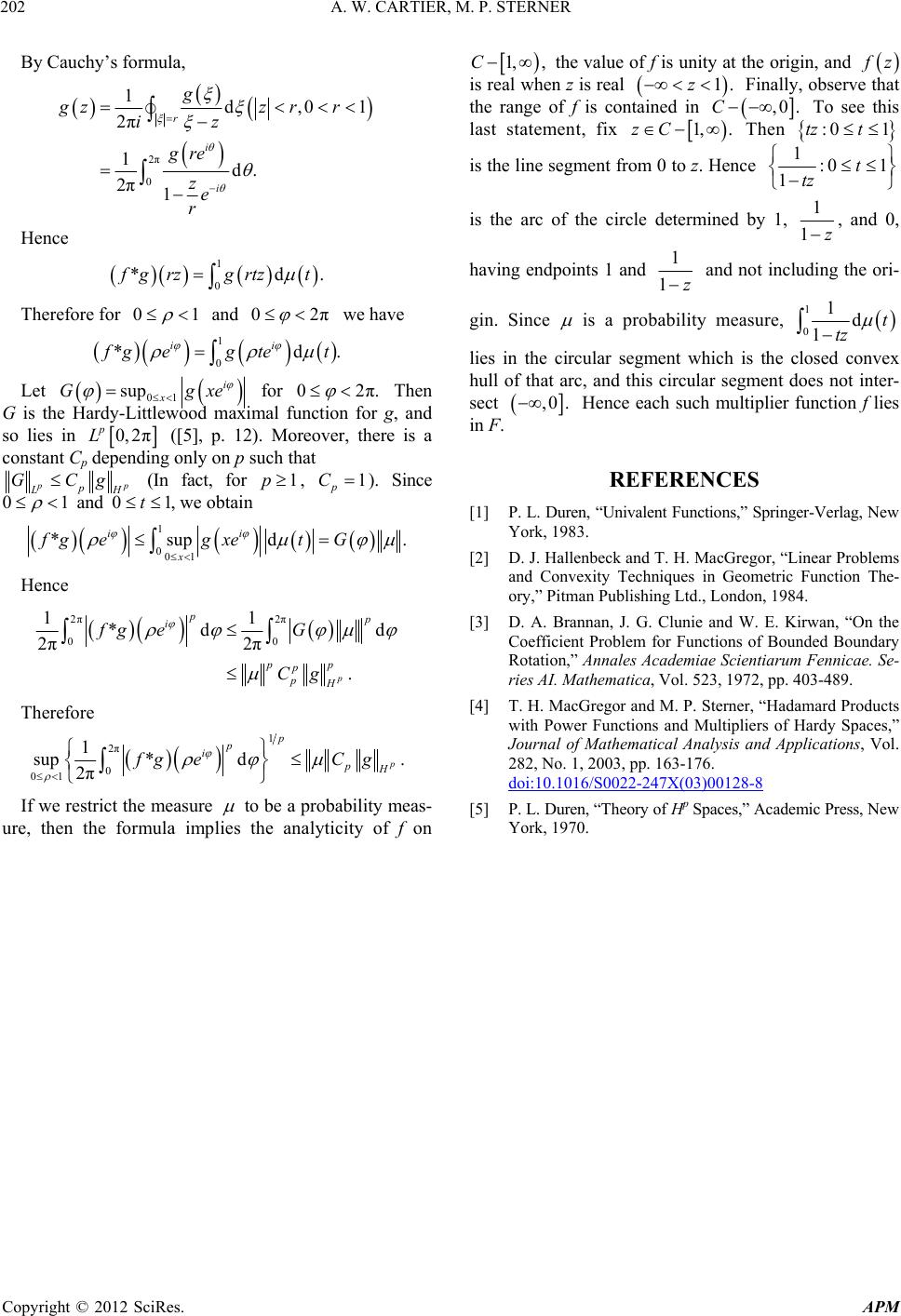 A. W. CARTIER, M. P. STERNER Copyright © 2012 SciRes. APM 202 1,C, f the value of f is unity at the origin, and By Cauchy’s formula, 2π 0 1 2π 1d. 2π1 r i i g gz z iz gre ze r d, 01 r r *d. z is real when z is real 1z. Finally, observe that the range of f is contained in ,0 .C 1, .zC To see this last statement, fix :0 1tz t Then Hence 1 0 f grzgrtz t Therefore for 01 and 02π we have d. ii 1 0 * f gegte t Let 01 x for sup i Ggxe 02π. Then G is the Hardy-Littlewood maximal function for g, and so lies in 0, 2π p L ([5], p. 12). Moreover, there is a constant Cp depending only on p such that p p p L H GCg (In fact, for , ). Since 11 p Cp 01 and 0, we obtain 1t 1 001 *sup ii x fg egxet d .G Hence 2π2π 00 11 *d 2π2π p i p p fg e d . p p pp H G Cg Therefore 1 2π 0 01 1 sup* d 2π. p p p i fge pH C g If we restrict the measure to be a probability meas- ure, then the formula implies the analyticity of f on is the line segment from 0 to z. Hence 1:01 1t tz is the arc of the circle determined by 1, 1 1z, and 0, having endpoints 1 and 1 1z and not including the ori- gin. Since is a probability measure, 1 0 1d 1t tz lies in the circular segment which is the closed convex hull of that arc, and this circular segment does not inter- sect ,0 . Hence each such multiplier function f lies in F. REFERENCES [1] P. L. Duren, “Univalent Functions,” Springer-Verlag, New York, 1983. [2] D. J. Hallenbeck and T. H. MacGregor, “Linear Problems and Convexity Techniques in Geometric Function The- ory,” Pitman Publishing Ltd., London, 1984. [3] D. A. Brannan, J. G. Clunie and W. E. Kirwan, “On the Coefficient Problem for Functions of Bounded Boundary Rotation,” Annales Academiae Scientiarum Fennicae. Se- ries AI. Mathematica, Vol. 523, 1972, pp. 403-489. [4] T. H. MacGregor and M. P. Sterner, “Hadamard Products with Power Functions and Multipliers of Hardy Spaces,” Journal of Mathematical Analysis and Applications, Vol. 282, No. 1, 2003, pp. 163-176. doi:10.1016/S0022-247X(03)00128-8 [5] P. L. Duren, “Theory of Hp Spaces,” Academic Press, New York, 1970. |