

Paper Menu >>
Journal Menu >>
 Open Journal of Organ Transplant Surgery, 2012, 2, 5-7 http://dx.doi.org/10.4236/ojots.2012.22002 Published Online May 2012 (http://www.SciRP.org/journal/ojots) 5 De Novo Techniques that Facilitate the Transplant of Short Right Allograft Kidney Vein as Left Allograft Kidney from Live Donor Afshar Zomorrodi, Farzad Kakaei, Shar Zomorrodi Kidney Transplant Ward Imam Reza Hospital, Tabriz Medical Science University, Tabriz, Iran Email: [email protected] Received December 26, 2011; revised February 13, 2012; accepted February 25, 2012 ABSTRACT The Kidney transplant is preferred option for treatment of chronic renal failure because with this modality treatment the life quality of patient is like normal also this modality is cost effective. The left allog raft is cho ice for tran splan t because the short right renal vein predisposes this allograft for more complication. We introduce methods, which facilitate the anastomosing the short right allograft vein and probably reduce the vascular complication. Methods: In 20 right al- lograft kidneys after irrigation, with dissection between vein and artery near the hilum at the back table, placing the al- lograft kidney with inversion position and external iliac artery selection an d first vein anastomosing and h eparin injec- tion transplan tation is carried ou t and all the recipients are treated with three drugs (predniso lone, cyclosporine cellcept) and follow up is conducted . Results: In these cases, with at least six months follow up , f low of the u r ine an d cir culatio n of blood were normal. Conclusion: With regarding the results it may be concluded that with this technique it may re- duces the vessel complication and facilitates the vessel anasto mosing of the right allograft kidney. Keywords: Right Side Allograft; Surgical Complication; Renal Vein; Vein Thrombosis 1. Introduction Still, the kidney transplant is the best option for the chronic renal failure patien ts, because with this treatment the reaching of two important goals (normal lifestyle and cost effective) is possible. The survival of recipient and the graft survival have been improved by the time it is due to improving immunosuppressive and technique. The important obstacle with kidney transplant is shortage of the kidney donor, at challenging for the short ag ing of the donors some centers not only accepting the deceased donors but also they accept relative and unrelative live donor for transplant. The success rate of the transplant center depends on many factors, including: center de- pending, the recipient depending and donor depending [1]. The donor factors including: age and gender and side of nephrectomy [2]. Many studies have done for the effect of side at the outcome of kidney transplant, and they concluded that there is not any different between right and left allograft kidney, but the most importing point in these studies is that the study is about a deceased donor and the late complication but not about live donor and early compli- cation [3-6]. But in the live donor, the side of nephrec- tomy is effective in the outcome of the transplant and early surgical complication. At the live donor, the selection of side depends on the function and the anatomy of kidney. First of all the kid- ney with the best function is remained for the donor and second if the function of two kidneys comparable the anatomic selection is a choice. Sometimes the right side kidney must be selected so in that case, there is the surgical problem which depends on the short length of a vein if it doesn’t be a good job, there will be an early surgical problem as thrombosis of the vein. With techniqu es that we introduce in this article the anastomosing of the short length of the right renal vein may be comparable with the left long renal vein. 2. Methods and Material Twenty kidney recipients (15 males, five females since 2008) with age rang 55 - 65 in them right allograft kid- ney has been selected for placement in the right iliac fosse. First in the back table, the vein and the artery of kidney carefully separated and some small connection in the vessel of artery and vein carefully liquated this care- ful dissection causes some increase the length of the vein. In the recipient before clamping vessel heparin in a dose C opyright © 2012 SciRes. OJOTS 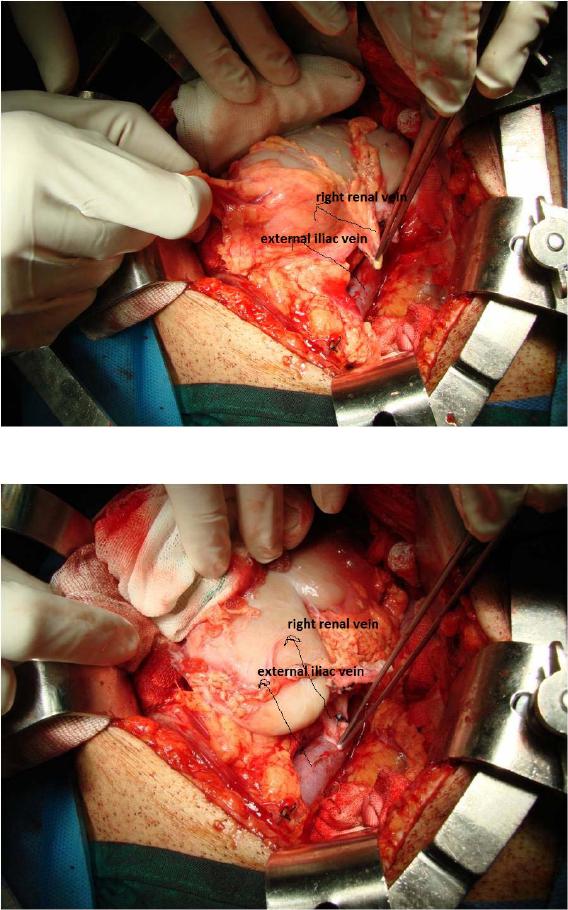 A. ZOMORRODI ET AL. 6 of 30 units per kilogram are injected. Right allograft kidney placed in the right iliac fosse in the inversion po- sition, and both the external iliac vessels (artery and vein) are selected for anastomosing, and at first the renal vein is anastomosed to the extern al iliac, and second the renal artery anastomosed to external iliac artery, consequently. Post operation all the recipients are controlled with cal- cineurin inhibitor and cellcepts and corticosteroid. 3. Results Post operation all the patient were followed with color Doppler ultrasound and Para clinical evaluation, urinary flow and blood circulation follow were normal (at least 6 months they were followed). 4. Discussions Still the right side allograft kidney from a live related or unrelated donor has a more complications than left-side allograft kidney [2]. But in deceased donor study (with using vena cava for elongation of the short vein) the re- sults of the left and the right allograft kidney were re- ported as comparable [3-6] but in the live donor due to the limited vena cava the prob lem of the short renal vein is remained and this problem predisposes the vein for thrombosis [7,8] in our suggestion method, it can be found easily that without inversion of the right allograft kidney Figure 1 the renal vein is reached to the external iliac vein under the tension and post inversion of the right kidney allograft Figure 2 the renal vein is reached Figure 1. Right allograft vein reaches with tension to the external iliac vein. Figure 2. Right allograft post inversion the vein reaches to the external iliac vein without tension. Copyright © 2012 SciRes. OJOTS  A. ZOMORRODI ET AL. 7 to the external iliac vein without more tension. Previ- ously In our kidney transplant center there was a few cases of kidney transplant that in them the allograft has been placed in inversion position unknowingly but in follow up they have not any urologic problem so it was understood that inversion position from urologic stand- point is safe. selection the external iliac artery support the length of the renal vein because it causes the renal vein of right allograft kidney placing directly in the front of the external iliac vein without any deviation and first anastomosing the renal vein support the length of renal vein because in this condition the selection of place for anastomosing on the external iliac vein is done freely and unlimitedly (artery is long and free withou t leathering the vein). Injection heparin is important in reducing throm- bosis. 4. Conclusion Our suggestion technique facilitates the right allograft vein anastomosing and overall it seems to reduce the early complication of the right allograft kidney trans- plantation it is necessary to continue these techniques with more cases to definitive finding. REFERENCES [1] D. W. Gjertson, “Multifactorial Analysis of Renal Trans- plants Reported to the United Network for Organ Sharing Registry,” Clinical Transplantation, 1992, pp. 299-317. [2] N. J. Feduska, Jr. and J. M. Cecka, “Donor Factors,” Clinical Transplantation, 1994, pp. 381-394. [3] S.Hariharan, C. P. Johnson, B. A. Bresnahan, S. E. Tar- nanto, M. J. McIntosh and D. Stablein, “Improved Graft Survival after Renal Transplantation in the United States, 1988 to 1996,” New England Journal of Medicine, Vol. 342, No. 9, 2000, pp. 605-612. [4] P. J. Phelan, W.Shields, P. O’Kelly, M.Pendergrass, J. Holian, J. J. Walshe, C. Magee, D. Little, D. Hickey and P. J. Conlon, “Left versus Right Deceased Donor Renal Allograft Outcome,” Transplant International, 2009, Vol. 22, No. 12, pp. 1159-1163. doi:10.1111/j.1432-2277.2009.00933.x [5] M. Salehipour, A. Bahador, H. Jalaeian, H. Salahi, S. Ni- keghbalian, F. Khajehee and S. A. Malek-Ho sseini, “C om- parison of Right and Left Grafts in Renal Transplanta- tion,” Saudi Journal of Kidney Diseases and Transplan- tation, Vol. 19, No. 2, 2008, pp. 222-226. [6] D. W. Johnson, D. W. Mudge, M. O. Kaisar, S. B. Camp- bell, C. M. Hawley, N. M. Isbel, D. Wall, A. Griffin, J. Preston and D. L. Nicol, “Deceased Donor Renal Trans- plantation—Does Side Matter?” Nephrology Dialysis Tran s- plantation, Vol. 21, No. 9, 2006, pp. 2583-2588. doi:10.1093/ndt/gfl268 [7] E. D. Brown, M. Y. Chen, N. T. Wolfffian, D. J. Ott and N. E. Watson, Jr., “Complications of Renal Transplanta- tion: Evaluation with US and Radionuclide Imaging,” RadioGraphics, Vol. 20, No. 3, 2000, pp. 607-622. [8] A. K. Mandal, C. Cohen, R. A. Montgomery, L. R. Kavoussi and L. E. Ratner, “Should the Indi cations for Lap ara sc op ic Live Donor Nephrectomy of the Right Kidney Be the Same as for the Open Procedure?” Transplantation, Vol. 71, No. 5, 2001, pp. 660-664. Copyright © 2012 SciRes. OJOTS |