

Paper Menu >>
Journal Menu >>
 Open Journal of Ophthalmology, 2012, 2, 21-25 http://dx.doi.org/10.4236/ojoph.2012.22005 Published Online May 2012 (http://www.SciRP.org/journal/ojoph) 21 The Causes of Distress in Paediatric Outpatients Receiving Dilating Drops* Nashila Hirji#, Sophie Jones, Graham Thompson St. George’s Hospital, London, England. Email: #[email protected] Received January 1st, 2012; revised February 19th, 2012; accepted March 4th, 2012 ABSTRACT Background/Aims: Paediatric outpatients are often dilated with cyclopentolate drops. These cause discomfort and dis- tress, which may impede subsequent examination. We aimed to determine the distress caused by cyclopentolate drops, and other factors in the clinic environment. Methods: Over an 8 week period, questionnaires were issued to guardians of all paediatric outpatients aged under 10 years receiving cyclopentolate. The childrens’distress was graded on a scale of 1 - 10 (1 = no distress, 10 = severe distress). Waiting time and ease of examination were recorded. Data was analysed using Stata statistics, and significant differences were reported at the P < 0.05 level. Results: The 72 children were g r o up e d a s u n d er 4 y e ar s ( n = 4 3 , G ro u p A ), a g e d 4 - 7 y e ar s ( n = 1 9 , G r ou p B ), a n d a ge d 7 - 10 years (n = 10, G roup C) . Median distress levels at home (baseline), on arrival, on dilation, and on examination were as follows: Group A; 1, 2, 7, 6 respectively; Group B; 1, 1, 6, 2 and Group C; 1, 1, 4.5, 1. All age groups were significantly more distressed on ex- amination compar ed to baseline. D istress scores on examination were significantly greater for Group A, in keeping with the greatest number of suboptimal examinations. Guardians reported that a prolonged waiting time and bright examina- tion lights also contributed to distress. Conclusions: This study confirms th at cyclopentolate causes significant distress in young children, and in 45% of very young children, the examination is difficult. Proxymetacaine prior to cyclopento- late is a possible solution, but other distressing factors should also be addressed for optimal outcomes. Keywords: Paediatric; Cyclopentolate; Proxymetacaine Hydrochloride; Dilating Drops 1. Introduction Cycloplegic examination is a key element in the assess- ment of children presenting to ophthalmology outpatients. It is most often achieved using cyclopentolate 0.5% or 1% depending on age. However, this drug is disliked by children due to the stinging it produces on instillation. Children receiving the drop commonly become dis- tressed, and their resultant tearful and uncooperative be- haviour can lead to significant difficulty in subsequent examination. Additionally, paediatric distress can con- tribute to a frightening env ironment in the clinical settin g, and may have long-term harmful effects on the doc- tor-patient rel a t i onship. A previous study demonstrated that instillation of proxymetacaine hydrochloride 0.5% prior to cyclopento- late resulted in less traumatic cyclopleg ia in children [1]. This was further supported by a second study, which showed a significant reduction in the total discomfort with cyclopentolate administered after premedication with proxymetacaine, compared with the use of cyclo- pentolate instilled after placebo [2]. However, the authors of this study suggested that other factors may also con- tribute to the distress experienced by children attending ophthalmology outpatien ts, and until now, this aspect has remained unexplored. Since the use of proxymetacaine prior to cyclopento- late is often not standard practice, our study aimed to determine the degree of distress caused by cyclopentolate drops. In addition, we investigated other factors that may lead to distress in the pa ediatric outpatient setting. 2. Patients and Methods Over an 8 week period, all children under the age of 10 years requiring cycloplegic examination in a paediatric ophthalmology outpatient clinic were assessed. Each re- ceived our standard dilating regime of cyclopentolate drops 0.5% or 1% (Minims, Smith and Nephew Pharma- ceuticals, UK), and phenylephrine 2.5% drops (Minims, Smith and Nephew Pharmaceuticals, UK) in addition for those children with very dark eyes. Questionnaires were *This study received no specific grant from any funding agency in the p ublic, commercial or no t -for-profit sectors. The authors declare no competing interests. #Corresponding author. Copyright © 2012 SciRes. OJOph 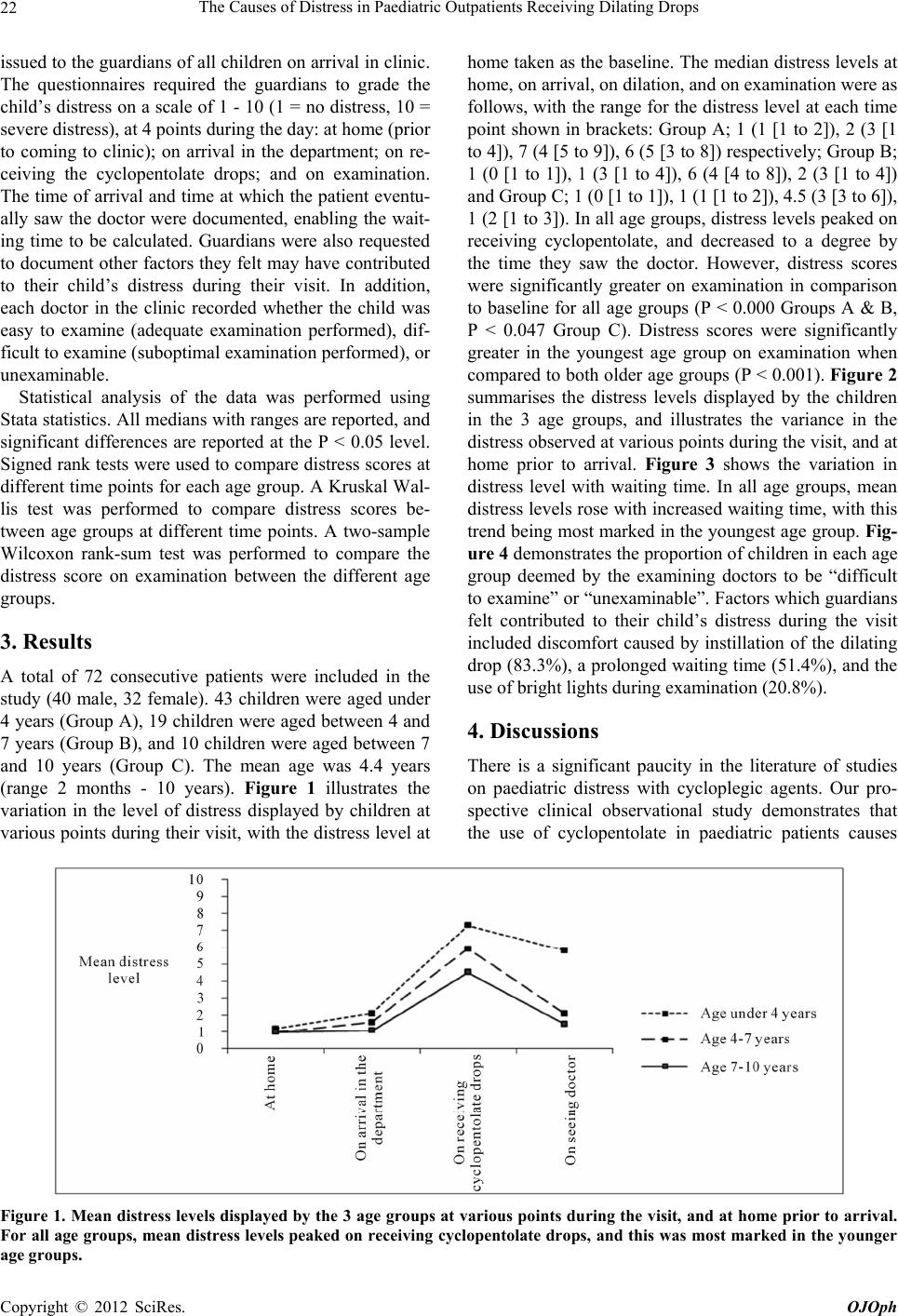 The Causes of Distress in Paediatric Outpatients Receiving Dilating Drops 22 issued to the guardians of all children on arrival in clinic. The questionnaires required the guardians to grade the child’s distress on a scale of 1 - 10 (1 = no distress, 10 = severe distress), at 4 points during the day: at home (prior to coming to clinic); on arrival in the department; on re- ceiving the cyclopentolate drops; and on examination. The time of arrival and time at which the patient eventu- ally saw the doctor were documented, enabling the wait- ing time to be calculated. Guardians were also requested to document other factors they felt may have contributed to their child’s distress during their visit. In addition, each doctor in the clinic recorded whether the child was easy to examine (adequate examination performed), dif- ficult to examine (subop timal ex aminatio n perfor med) , or unexaminable. Statistical analysis of the data was performed using Stata statistics. All medians with ranges are repo rted, and significant differences are reported at the P < 0.05 level. Signed rank tests were used to compare distress scores at different time points for each age group. A Kruskal Wal- lis test was performed to compare distress scores be- tween age groups at different time points. A two-sample Wilcoxon rank-sum test was performed to compare the distress score on examination between the different age groups. 3. Results A total of 72 consecutive patients were included in the study (40 male, 32 female). 43 children were aged under 4 years (Group A), 19 ch ildren were aged between 4 and 7 years (Group B), and 10 ch ildren were aged between 7 and 10 years (Group C). The mean age was 4.4 years (range 2 months - 10 years). Figure 1 illustrates the variation in the level of distress displayed by children at various points during their visit, with the distress level at home taken as the baseline. The median distress levels at home, on arrival, on dilation, and on examination were as follows, with the range for the distress level at each time point shown in brackets: Group A; 1 (1 [1 to 2]), 2 (3 [1 to 4]), 7 (4 [5 to 9]), 6 (5 [3 to 8]) respectively; Group B; 1 (0 [1 to 1]), 1 (3 [1 to 4]), 6 (4 [4 to 8]), 2 (3 [1 to 4]) and Group C; 1 (0 [1 to 1]), 1 (1 [1 to 2]), 4.5 (3 [3 to 6]), 1 (2 [1 to 3]). In all age groups, distress levels peaked on receiving cyclopentolate, and decreased to a degree by the time they saw the doctor. However, distress scores were significantly greater on examination in comparison to baseline for all age groups (P < 0.000 Groups A & B, P < 0.047 Group C). Distress scores were significantly greater in the youngest age group on examination when compared to both older ag e groups (P < 0.001). Figure 2 summarises the distress levels displayed by the children in the 3 age groups, and illustrates the variance in the distress observed at various points during the visit, and at home prior to arrival. Figure 3 shows the variation in distress level with waiting time. In all age groups, mean distress levels rose with increased waiting time, with this trend being most marked in the youngest age group . Fig- ure 4 demonstrates the proportion of children in each age group deemed by the examining doctors to be “difficult to examine” or “unexaminable”. Factors which guardians felt contributed to their child’s distress during the visit included discomfort caused by instillation of the dilating drop (83.3%), a prolonged waiting time (51.4%), and the use of bright lights during examination (20.8%). 4. Discussions There is a significant paucity in the literature of studies on paediatric distress with cycloplegic agents. Our pro- spective clinical observational study demonstrates that the use of cyclopentolate in paediatric patients causes Figure 1 . Mean distress levels displayed by the 3 a ge groups at various points during the visit, and at home prior to arrival. For all age groups, mean distress levels peaked on receiving cyclo pentolate drops, and this w as most marked in t he younger age groups. Copyright © 2012 SciRes. OJOph 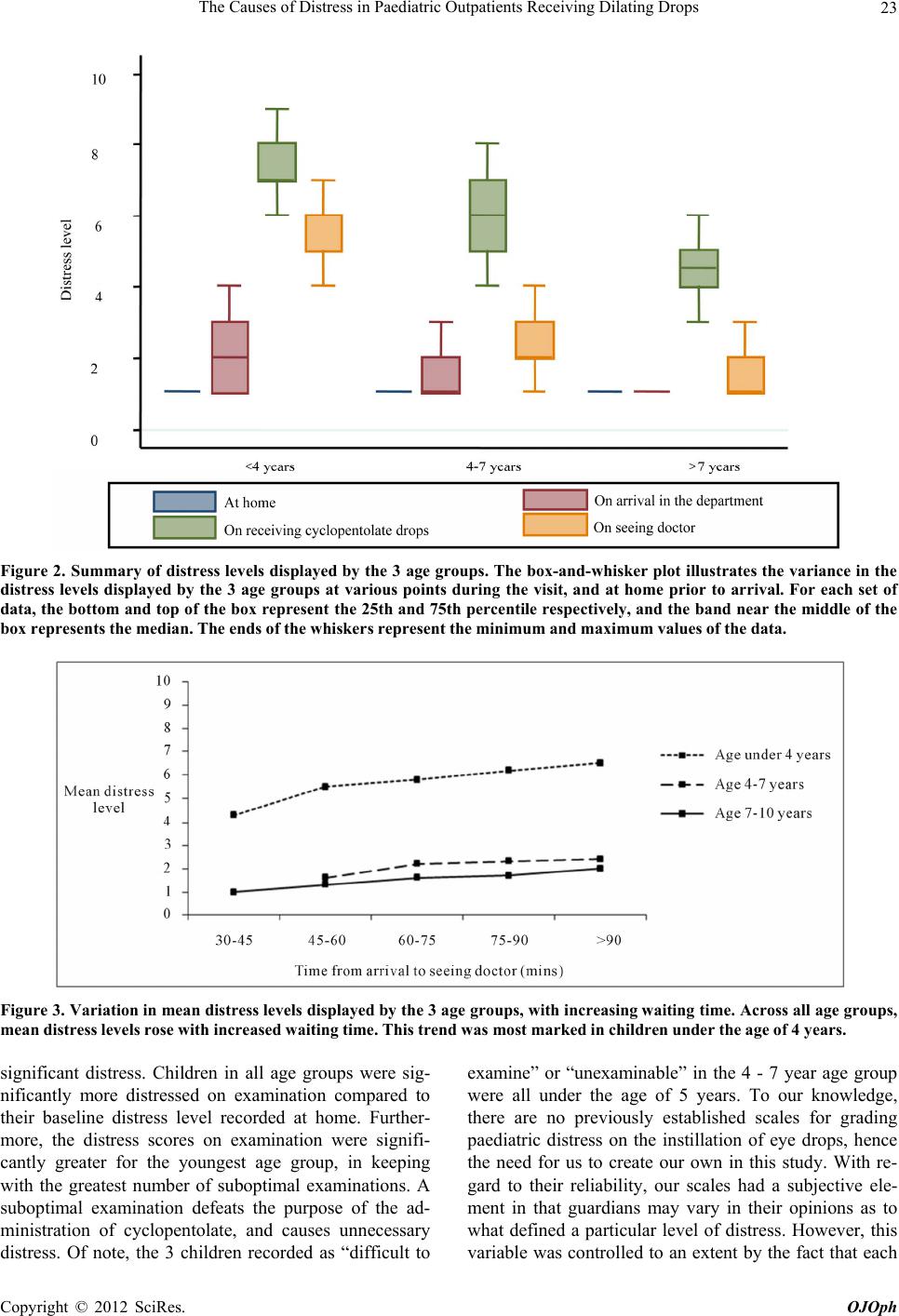 The Causes of Distress in Paediatric Outpatients Receiving Dilating Drops 23 Figure 2. Summary of distress levels displayed by the 3 age groups. The box-and-whisker plot illustrates the variance in the distress levels displayed by the 3 age groups at various points during the visit, and at home prior to arrival. For each set of data, the bo ttom and top of the box represen t the 25th and 75th perc entile respective ly, and the ba nd near the middle of the box represents the median. Th e ends of the whis k ers r ep res ent th e m in imu m a nd ma ximum valu es of the data. Figure 3. Variation in mean distress levels displayed by the 3 age gro ups, with increasing waiting time. Across all age groups, mean distress levels rose wit h increased waiting tim e. This trend was most marked in children und er the age of 4 years. significant distress. Children in all age groups were sig- nificantly more distressed on examination compared to their baseline distress level recorded at home. Further- more, the distress scores on examination were signifi- cantly greater for the youngest age group, in keeping with the greatest number of suboptimal examinations. A suboptimal examination defeats the purpose of the ad- ministration of cyclopentolate, and causes unnecessary distress. Of note, the 3 children recorded as “difficult to examine” or “unexaminable” in the 4 - 7 year age group were all under the age of 5 years. To our knowledge, there are no previously established scales for grading paediatric distress on the instillation of eye drops, hence the need for us to create our own in this study. With re- gard to their reliability, our scales had a subjective ele- ment in that guardians may vary in their opinions as to what defined a particular level of distress. However, this variable was controlled to an extent by the fact that each Copyright © 2012 SciRes. OJOph 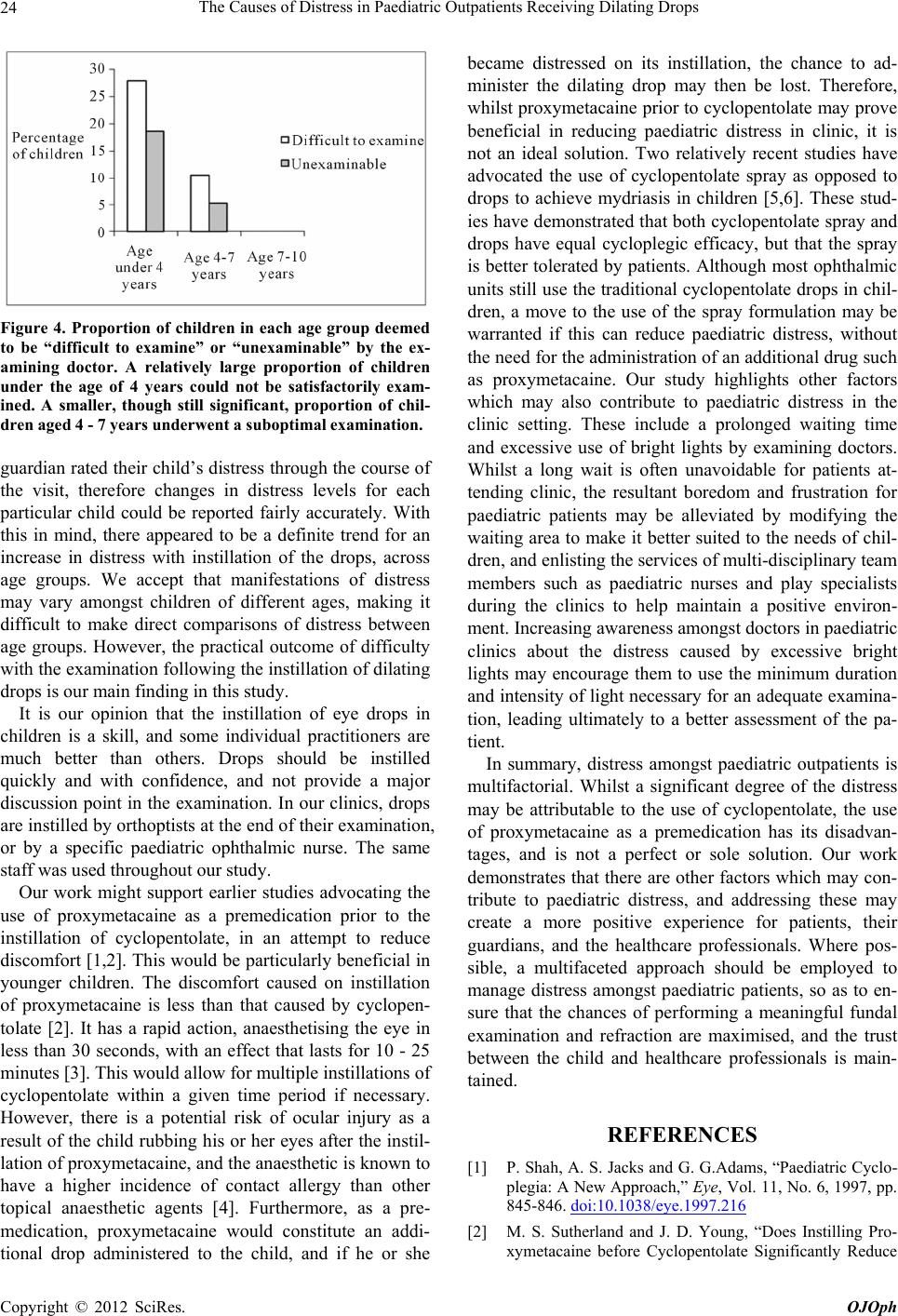 The Causes of Distress in Paediatric Outpatients Receiving Dilating Drops 24 Figure 4. Proportion of children in each age group deemed to be “difficult to examine” or “unexaminable” by the ex- amining doctor. A relatively large proportion of children under the age of 4 years could not be satisfactorily exam- ined. A smaller, though still significant, proportion of chil- dren aged 4 - 7 years underwent a suboptimal examination. guardian rated their child’s distress through the course of the visit, therefore changes in distress levels for each particular child could be reported fairly accurately. With this in mind, there appeared to be a definite trend for an increase in distress with instillation of the drops, across age groups. We accept that manifestations of distress may vary amongst children of different ages, making it difficult to make direct comparisons of distress between age groups. However, the practical outcome of difficulty with the examination followin g the instillation of dilating drops is our main finding in this study. It is our opinion that the instillation of eye drops in children is a skill, and some individual practitioners are much better than others. Drops should be instilled quickly and with confidence, and not provide a major discussion point in the examination. In our clinics, drops are instilled by orthoptists at th e end of their examination, or by a specific paediatric ophthalmic nurse. The same staff was used throughout our study. Our work might support earlier studies advocating the use of proxymetacaine as a premedication prior to the instillation of cyclopentolate, in an attempt to reduce discomfort [1,2]. This would be particularly beneficial in younger children. The discomfort caused on instillation of proxymetacaine is less than that caused by cyclopen- tolate [2]. It has a rapid action, anaesthetising the eye in less than 30 seconds, with an effect that lasts for 10 - 25 minutes [3]. This would allow for multiple instillatio ns of cyclopentolate within a given time period if necessary. However, there is a potential risk of ocular injury as a result of the child rubbing h is or her eyes after the instil- lation of proxymetacaine, and the anaesthetic is known to have a higher incidence of contact allergy than other topical anaesthetic agents [4]. Furthermore, as a pre- medication, proxymetacaine would constitute an addi- tional drop administered to the child, and if he or she became distressed on its instillation, the chance to ad- minister the dilating drop may then be lost. Therefore, whilst proxymetacaine prior to cyclopentolate may prove beneficial in reducing paediatric distress in clinic, it is not an ideal solution. Two relatively recent studies have advocated the use of cyclopentolate spray as opposed to drops to achieve mydriasis in children [5,6]. These stud- ies have demonstrated that both cyclopentolate spray and drops have equal cycloplegic efficacy, but that the spray is better tolerated by patients. Although most oph thalmic units still use th e traditional cyclopentolate drops in ch il- dren, a move to the use of the spray formulation may be warranted if this can reduce paediatric distress, without the need for the administration of an additional drug such as proxymetacaine. Our study highlights other factors which may also contribute to paediatric distress in the clinic setting. These include a prolonged waiting time and excessive use of bright lights by examining doctors. Whilst a long wait is often unavoidable for patients at- tending clinic, the resultant boredom and frustration for paediatric patients may be alleviated by modifying the waiting area to make it better suited to the needs of chil- dren, and en listin g th e services of multi-disciplinary team members such as paediatric nurses and play specialists during the clinics to help maintain a positive environ- ment. Increasing awareness amongst doctors in paediatric clinics about the distress caused by excessive bright lights may encourage them to use the minimum duration and intensity of light necessary fo r an adequate examina- tion, leading ultimately to a better assessment of the pa- tient. In summary, distress amongst paediatric outpatients is multifactorial. Whilst a significant degree of the distress may be attributable to the use of cyclopentolate, the use of proxymetacaine as a premedication has its disadvan- tages, and is not a perfect or sole solution. Our work demonstrates that there are other factors which may con- tribute to paediatric distress, and addressing these may create a more positive experience for patients, their guardians, and the healthcare professionals. Where pos- sible, a multifaceted approach should be employed to manage distress amongst paediatric patients, so as to en- sure that the chances of performing a meaningful fundal examination and refraction are maximised, and the trust between the child and healthcare professionals is main- tained. REFERENCES [1] P. Shah, A. S. Jacks and G. G.Adams, “Paediatric Cyclo- plegia: A New Approach,” Eye, Vol. 11, No. 6, 1997, pp. 845-846. doi:10.1038/eye.1997.216 [2] M. S. Sutherland and J. D. Young, “Does Instilling Pro- xymetacaine before Cyclopentolate Significantly Reduce Copyright © 2012 SciRes. OJOph  The Causes of Distress in Paediatric Outpatients Receiving Dilating Drops Copyright © 2012 SciRes. OJOph 25 Stinging? The Implications of Paediatric Cycloplegia,” British Journal of Ophthalmology, Vol. 85, No. 2, 2001, pp. 244-245. doi:10.1136/bjo.85.2.238g [3] C. W. Boozan and I. J. Cohen, “Ophthaine, a New Topi- cal Anesthetic for the Eye,” American Journal of Oph- thalmology, Vol. 36, No. 11, 1953, pp. 1619-1621. [4] G. O. Rosenwasser, “Complications of Topical Ocular Anesthetics,” International Ophthalmology Clinics, Vol. 29, No. 3, 1989, pp. 153-158. doi:10.1097/00004397-198902930-00005 [5] C. Y. Wong, D. S. Fan, C. B. Yu and D. S. Lam, “Topical Mydriatic and Cycloplegic Spray for Chinese Children,” Journal of Pediatric Ophthalmology and Strabismus, Vol. 40, No. 6, 2003, pp. 349-352. [6] A. Chafai, S. Ajdnik, L. Lejeune and M. Cordonnier, “Comparative Study of Cyclopentolate Drops versus Spray in Cycloplegia in Children,” Journal Français d’Oph- talmologie, Vol. 29, No. 8, 2006, pp. 896-899. doi:10.1016/S0181-5512(06)70110-3 |