

Paper Menu >>
Journal Menu >>
 Open Journal of Ophthalmology, 2012, 2, 9-13 http://dx.doi.org/10.4236/ojoph.2012.22003 Published Online May 2012 (http://www.SciRP.org/journal/ojoph) 9 Vision Screening in the Pediatrician’s Office* Natario L. Couser, Fatema Q. Esmail, Amy K. Hutchinson# The Department of Ophthalmology, Emory University School of Medicine, Atlanta, USA. Email: #[email protected] Received January 13th, 2012; revised February 16th, 2012; accepted March 10th, 2012 ABSTRACT Objective: To assess current practices, attitudes, and perceived barriers toward pediatric vision screening. Patients and Methods: A link to a 9-question survey was electronically distributed to a national sample of 6000 pediatricians through Medical Marketing Services Inc. Data were collected using Survey Monkey. Results: Email open rate was 11%; 37% of those who opened the email responded (225 respondents). Over ninety percent of respondents perform some type of vision screening at least yearly, although age at which screening began varied, with two thirds of respondents instituting formal v ision screen ing after three years. Fifty eight percent of respondents were either extremely u nsatisfied, unsatisfied or only somewhat satisfied with their current screening method. Preferred methods of screening and confi- dence of pediatricians in their ability to detect pathology varied for children under versus over age three. The least fre- quently used methods for all age groups were autorefraction and photoscreening. The most commonly reported barriers to screening were inadequate training (48%), time required for exam (42%), and inadequate reimbursement (32%). Conclusions: Perceived barriers to vision screening in the pediatrician office have been previously identified, and pho- toscreening and autorefraction h ave been identified as a possible means to circumvent them. In spite of the addition of new procedural codes, pediatricians continue to report similar barriers to screening. Keywords: Pediatric Vision Screening; Barriers; Reimbursement; Pediatricians; Photoscreening; Autorefraction; US Preventative Services Task Force; CPT 99174 1. Introduction Early detection of ocular disorders can prevent lifelong visual impairment. The US Preventative Services Task Force (USPSTF) has concluded that vision screening for children ages 3 to 5 is beneficial, and recommends vision screening at least once between the ages of 3 and 5 years to detect the presence of amblyopia or its risk factors [1]. The USPSTF has also concluded that “the current evi- dence is insufficien t to assess the balance of benefits and harms of vision screening for children <3 years of age”; [1] however, the evidence base for vision screening in children under 3 is limited by a paucity of studies evalu- ating the screening techniqu es that are feasible in this ag e group of children, such as red reflex testing, and objec- tive vision screening such as photoscreening and autore- fraction [2]. In 2006, Kemper and Clark surveyed a national sample of pediatricians to evaluate their preschool vision scr een- ing practices, and reported that common barriers to screening included perceptions that screening was con- sidered too time consuming, children were uncooperative, and that reimbursement was not adequate [3]. The au- thors suggested that financial incentives and emerging screening technologies might be important to ensure the delivery of preschool vision screening. In January 2008 a current procedural terminology (CPT) code 99174 was established, and in November 2008 a relative value unit (RVU) of 0.69 was assigned for objective screening us- ing a photoscreener. We designed our survey to revisit the practices and perceptions of vision screening among pediatricians, and to determine whether these practices and perceptions differed for patients below and above age 3. 2. Patients and Methods This study was approved by the Institutional Review Board at Emory University. We designed a 9-question survey with an additional section for general comments to assess pediatricians’ current practices, attitudes, and perceived barriers toward pediatric vision screening. A link to the survey was electronically distributed to a na- tional sample of 6000 pediatricians through Medical Marketing Services Inc. (MMS) with a broadcast subject line reading: “Help Us Improve Pediatric Vision Screen- *Conflict of interest and disclosure statement: None of the authors have a conflict of interest or a financial interest in any of the methods or p roducts described in this manuscript. #Corresponding author. Copyright © 2012 SciRes. OJOph 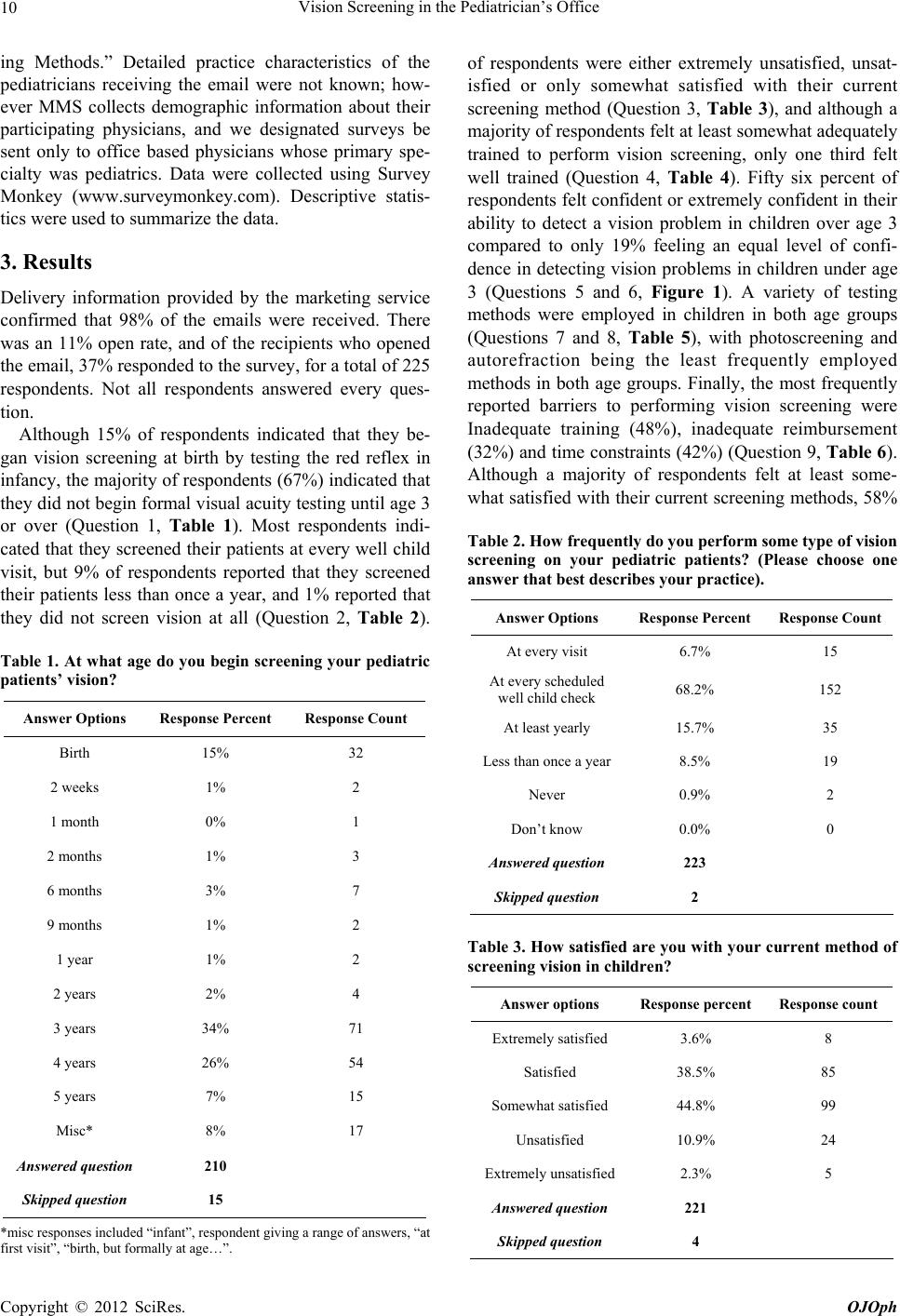 Vision Screening in the Pediatrician’s Office 10 ing Methods.” Detailed practice characteristics of the pediatricians receiving the email were not known; how- ever MMS collects demographic information about their participating physicians, and we designated surveys be sent only to office based physicians whose primary spe- cialty was pediatrics. Data were collected using Survey Monkey (www.surveymonkey.com). Descriptive statis- tics were used to summarize the data. 3. Results Delivery information provided by the marketing service confirmed that 98% of the emails were received. There was an 11% open rate, and of the recipients who opened the email, 37% responded to the survey, for a total of 225 respondents. Not all respondents answered every ques- tion. Although 15% of respondents indicated that they be- gan vision screening at birth by testing the red reflex in infancy, the majority of respondents (67%) indicated that they did not begin formal visual acuity testing until age 3 or over (Question 1, Table 1). Most respondents indi- cated that they screened their patients at every well child visit, but 9% of respondents reported that they screened their patients less than once a year, and 1% reported that they did not screen vision at all (Question 2, Table 2). Table 1. At what age do you begin screening your pediatric patients’ vision? Answer Options Response Percent Response Count Birth 15% 32 2 weeks 1% 2 1 month 0% 1 2 months 1% 3 6 months 3% 7 9 months 1% 2 1 year 1% 2 2 years 2% 4 3 years 34% 71 4 years 26% 54 5 years 7% 15 Misc* 8% 17 Answered question 210 Skipped question 15 *misc respo ns es include d “infant”, respondent giving a range of answers, “ at first visit”, “birth, but formally at age…”. of respondents were either extremely unsatisfied, unsat- isfied or only somewhat satisfied with their current screening method (Question 3, Table 3), and although a majority of respondents felt at least so mewhat adequately trained to perform vision screening, only one third felt well trained (Question 4, Table 4). Fifty six percent of respondents felt confident or extremely confident in their ability to detect a vision problem in children over age 3 compared to only 19% feeling an equal level of confi- dence in detecting vision problems in children under age 3 (Questions 5 and 6, Figure 1). A variety of testing methods were employed in children in both age groups (Questions 7 and 8, Table 5), with photoscreening and autorefraction being the least frequently employed methods in both age groups. Finally, the most frequently reported barriers to performing vision screening were Inadequate training (48%), inadequate reimbursement (32%) and time constraints (42%) (Question 9, Table 6 ). Although a majority of respondents felt at least some- what satisfied with their current screening methods, 58% Table 2. How frequently do y ou perform some type of vision screening on your pediatric patients? (Please choose one answer that best describes your practice) . Answer Options Response Percent Response Count At every visit 6.7% 15 At every scheduled well child check 68.2% 152 At least yearly 15.7% 35 Less than once a year8.5% 19 Never 0.9% 2 Don’t know 0.0% 0 Answered question 223 Skipped question 2 Table 3. How satisfied are you with your current method of screening vision in children? Answer options Response percent Response cou n t Extremely s a t i s f i e d 3.6% 8 Satisfied 38.5% 85 Somewhat satisfied 44.8% 99 Unsatisfied 10.9% 24 Extremel y u nsatisfied2.3% 5 Answered question 221 Skipped question 4 Copyright © 2012 SciRes. OJOph 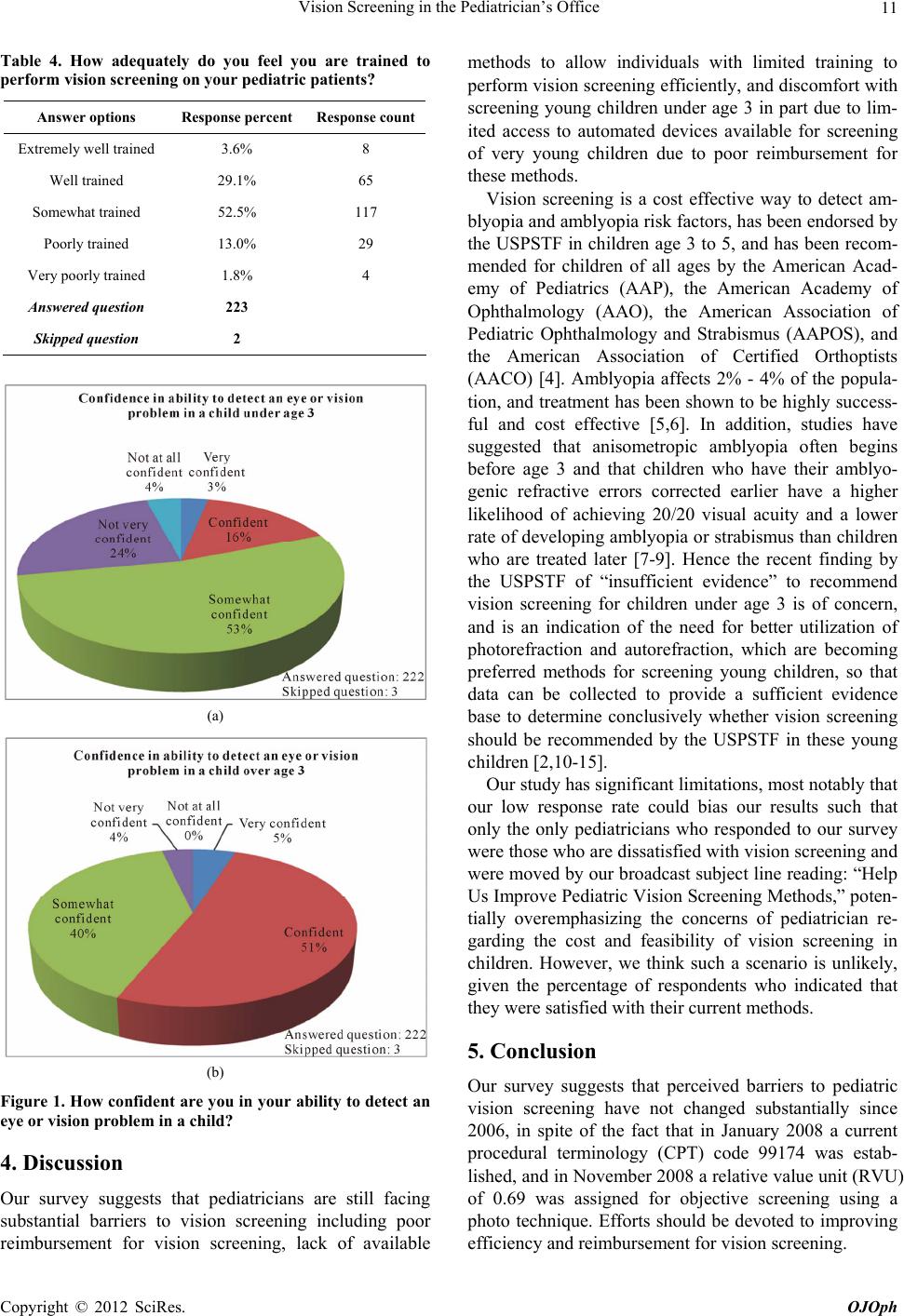 Vision Screening in the Pediatrician’s Office 11 Table 4. How adequately do you feel you are trained to perform vision screening on your pediatric patients? Answer options Response percent Response count Extremely w el l t rained 3.6% 8 Well trained 29.1% 65 Somewhat trained 52.5% 117 Poorly trained 13.0% 29 Very poorly tra ined 1.8% 4 Answered question 223 Skipped question 2 (a) (b) Figure 1. How confident are you in your ability to detect an eye or vision problem in a child? 4. Discussion Our survey suggests that pediatricians are still facing substantial barriers to vision screening including poor reimbursement for vision screening, lack of available methods to allow individuals with limited training to perform vision screening efficiently, and discomfort with screening young children under age 3 in part due to lim- ited access to automated devices available for screening of very young children due to poor reimbursement for these methods. Vision screening is a cost effective way to detect am- blyopia and amblyopia risk factors, has been endorsed by the USPSTF in children age 3 to 5, and has been recom- mended for children of all ages by the American Acad- emy of Pediatrics (AAP), the American Academy of Ophthalmology (AAO), the American Association of Pediatric Ophthalmology and Strabismus (AAPOS), and the American Association of Certified Orthoptists (AACO) [4]. Amblyopia affects 2% - 4% of the popula- tion, and treatment has been shown to be highly success- ful and cost effective [5,6]. In addition, studies have suggested that anisometropic amblyopia often begins before age 3 and that children who have their amblyo- genic refractive errors corrected earlier have a higher likelihood of achieving 20/20 visual acuity and a lower rate of developing amblyopia or strabismus than children who are treated later [7-9]. Hence the recent finding by the USPSTF of “insufficient evidence” to recommend vision screening for children under age 3 is of concern, and is an indication of the need for better utilization of photorefraction and autorefraction, which are becoming preferred methods for screening young children, so that data can be collected to provide a sufficient evidence base to determine conclusively whether vision screening should be recommended by the USPSTF in these young children [2,1 0 -15]. Our study has significant limitations, most notably that our low response rate could bias our results such that only the only pediatricians who responded to our survey were those who are dissatisfied with vision screening and were moved by our broadcast subj ect line reading: “Help Us Improve Pediatric Vision Screening Methods,” po ten- tially overemphasizing the concerns of pediatrician re- garding the cost and feasibility of vision screening in children. However, we think such a scenario is unlikely, given the percentage of respondents who indicated that they were satisfied with their current methods. 5. Conclusion Our survey suggests that perceived barriers to pediatric vision screening have not changed substantially since 2006, in spite of the fact that in January 2008 a current procedural terminology (CPT) code 99174 was estab- lished, and in November 2008 a relative value unit (RVU) of 0.69 was assigned for objective screening using a photo technique. Efforts should be devoted to improving efficiency and reimbursement for vision screening. Copyright © 2012 SciRes. OJOph 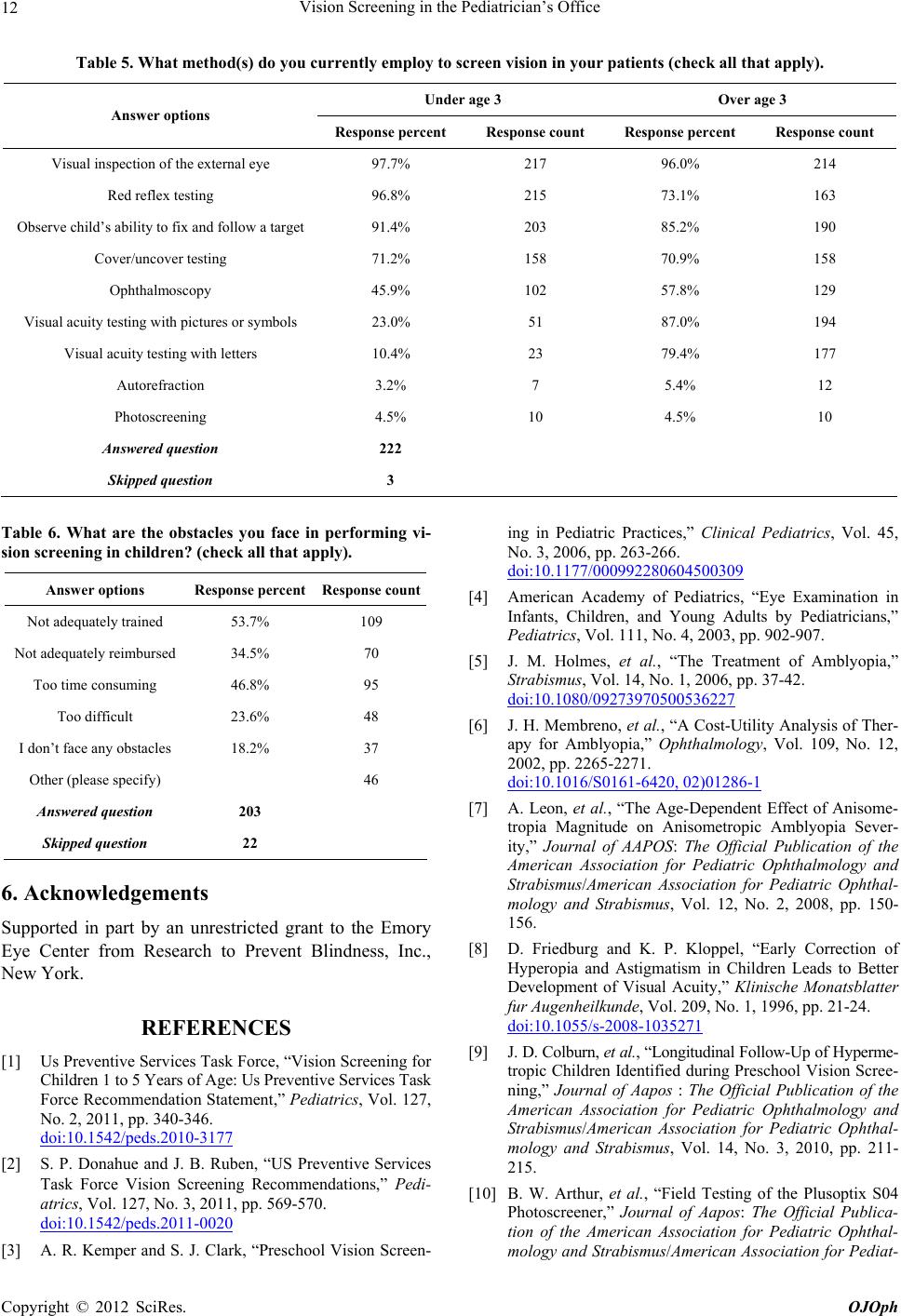 Vision Screening in the Pediatrician’s Office Copyright © 2012 SciRes. OJOph 12 Table 5. What method(s) do you currently employ to screen vision in your patients (check all that apply). Under age 3 Over age 3 Answer options Response percent Response count Response percent Response count Visual inspection of the external eye 97.7% 217 96.0% 214 Red reflex testing 96.8% 215 73.1% 163 Observe child’s ability to fix and follow a target 91.4% 203 85.2% 190 Cover/uncover testing 71.2% 158 70.9% 158 Ophthalmoscopy 45.9% 102 57.8% 129 Visual acuity testing with pictures or symbols 23.0% 51 87.0% 194 Visual acuity testing with letters 10.4% 23 79.4% 177 Autorefraction 3.2% 7 5.4% 12 Photoscreening 4.5% 10 4.5% 10 Answered question 222 Skipped question 3 Table 6. What are the obstacles you face in performing vi- sion screening in children? (check all that apply). Answer options Response p e r cent Res p o n se c o u n t Not adequately trai ned 53.7% 109 Not adequately reimbursed 34.5% 70 Too time consum ing 46.8% 95 Too difficult 23.6% 48 I don’t face any obstacles 18.2% 37 Other (please specify) 46 Answered question 203 Skipped question 22 6. Acknowledgements Supported in part by an unrestricted grant to the Emory Eye Center from Research to Prevent Blindness, Inc., New York. REFERENCES [1] Us Preventive Services Task Force, “Vision Screening for Children 1 to 5 Years of Age: Us Preventive Services Task Force Recommendation Statement,” Pediatrics, Vol. 127, No. 2, 2011, pp. 340-346. doi:10.1542/peds.2010-3177 [2] S. P. Donahue and J. B. Ruben, “US Preventive Services Task Force Vision Screening Recommendations,” Pedi- atrics, Vol. 127, No. 3, 2011, pp. 569-570. doi:10.1542/peds.2011-0020 [3] A. R. Kemper and S. J. Clark, “Preschool Vision Screen- ing in Pediatric Practices,” Clinical Pediatrics, Vol. 45, No. 3, 2006, pp. 263-266. doi:10.1177/000992280604500309 [4] American Academy of Pediatrics, “Eye Examination in Infants, Children, and Young Adults by Pediatricians,” Pediatrics, Vol. 111, No. 4, 2003, pp. 902-907. [5] J. M. Holmes, et al., “The Treatment of Amblyopia,” Strabismus, Vol. 14, No. 1, 2006, pp. 37-42. doi:10.1080/09273970500536227 [6] J. H. Membreno, et al., “A Cost-Utility Analysis of Ther- apy for Amblyopia,” Ophthalmology, Vol. 109, No. 12, 2002, pp. 2265-2271. doi:10.1016/S0161-6420, 02)01286-1 [7] A. Leon, et al., “The Age-Dependent Effect of Anisome- tropia Magnitude on Anisometropic Amblyopia Sever- ity,” Journal of AAPOS: The Official Publication of the American Association for Pediatric Ophthalmology and Strabismus/American Association for Pediatric Ophthal- mology and Strabismus, Vol. 12, No. 2, 2008, pp. 150- 156. [8] D. Friedburg and K. P. Kloppel, “Early Correction of Hyperopia and Astigmatism in Children Leads to Better Development of Visual Acuity,” Klinische Monatsblatter fur Augenheilkunde, Vol. 209, No. 1, 1996, pp. 21-24. doi:10.1055/s-2008-1035271 [9] J. D. Colburn, et al., “Longitudinal Follow-Up of Hyperme- tropic Children Identified during Preschool Vision Scree- ning,” Journal of Aapos : The Official Publication of the American Association for Pediatric Ophthalmology and Strabismus/American Association for Pediatric Ophthal- mology and Strabismus, Vol. 14, No. 3, 2010, pp. 211- 215. [10] B. W. Arthur, et al., “Field Testing of the Plusoptix S04 Photoscreener,” Journal of Aapos: The Official Publica- tion of the American Association for Pediatric Ophthal- mology and Strabismus/American Association for Pediat-  Vision Screening in the Pediatrician’s Office 13 ric Ophthalmology and Strabismus, Vol. 13, No. 1, 2009, pp. 51-57. [11] N. S. Matta, et al., “Comparison between the PlusoptiX and MTI Photoscreeners,” Archives of Ophthalmology, Vol. 127, No. 12, 2009, pp. 1591-1595. doi:10.1001/archophthalmol.2009.294 [12] N. S. Matta, E. L. Singman and D. I. Silbert, “Perform- ance of The Plusoptix S04 Photoscreener for the Detec- tion of Amblyopia Risk Factors in Children Aged 3 to 5,” Journal of Aapos: The Official Publication of the Ameri- can Association for Pediatric Ophthalmology and Stra- bismus/American Association for Pediatric Ophthalmol- ogy and Strabismus, Vol. 14, No. 2, 2010, pp. 147-149. [13] S. P. Donahue, et al., “Lions Clubs International Founda- tion Core Four Photoscreening: Results from 17 Programs and 400,000 Preschool Children,” Journal of Aapos: The Official Publication of the American Association for Pe- diatric Ophthalmology and Strabismus/American Asso- ciation for Pediatric Ophthalmology and Strabismus, Vol. 10, No. 1, 2006, pp. 44-48. [14] A. J. Rowatt, et al., “Field Evaluation of the Welch Allyn Suresight Vision Screener: Incorporating the Vision in Preschoolers Study Recommendations,” Journal of Aapos: The Official Publication of the American Association for Pediatric Ophthalmology and Strabismus/American As- sociation for Pediatric Ophthalmology and Strabismus, Vol. 11, No. 3, 2007, pp. 243-248. [15] S. Q. Longmuir, et al., “Nine-Year Results of a Volunteer Lay Network Photoscreening Program of 147 809 Chil- dren Using a Photoscreener in Iowa,” Ophthalmology, Vol. 117, No. 10, 2010, pp. 1869-1875. doi:10.1016/j.ophtha.2010.03.036 Copyright © 2012 SciRes. OJOph |