

Paper Menu >>
Journal Menu >>
 Psychology 2012. Vol.3, No.5, 424-427 Published Online May 2012 in SciRes (http://www.SciRP.org/journal/psych) http://dx.doi.org/10.4236/psych.2012.35060 Copyright © 2012 SciRes. 424 Development of a Child’s Semiotic Activity with the Help of Psychological Tools: A Vygotsky’s Cultural-Historical Perspective Jensamut Saengpun1, Maitree Inprasitha2 1Department Doctoral Program in Mathematics Education, Faculty of Education, Khon Kaen University, Khon Kaen, Thailand 2Center for Research in Mathematics Education, Facu lty of Education, Khon Kaen University, Khon Kaen, Thailand Email: [email protected], [email protected] Received February 22nd, 2012; revised March 20th, 2012; accepted April 25th, 2012 This research aims to interpret Vygotsky’s theory in development of a child’s semiotic activity in first grade mathematics classroom taught by open approach. This study focuses on investigate how first grade students construct signs and symbols in solving addition problems with the help of psychological tools in a mathematics classroom taught by open approach. The research was carried out in one first grade mathematics classroom including 32 students aged 6 - 7 years old and an internship student who was classroom teacher. Ethnographic methods were employed for collecting and analyzing data through classroom observation with audio-video tape recordings on 17 consecutive lessons on addition, students’ written works, field note taking and interviewing the classroom teacher. The result showed that the learn- ing and instructional materials and drawing schematic diagrams and students’ language use are psycho- logical tools that play a crucial role in development of first grade students’ semiotic activity in solving addition problems. Students used units blocks and base ten blocks to operate addition with two numbers by decomposing and making ten strategies. Then, students drew schematic diagrams as symbol with their words to represent how to add two numbers corresponds to the meaning and the strategies they used. Keywords: Semiotic Activity; Psychological Tool; Cultural-Historical Perspective; Lesson Study and Open Approach Introduction Vygotsky’s (1986, 1998) theory stipulates that the develop- ment of the child’s higher mental processes depends on the presence of mediating agents in the child’s interaction with the environment. Vygotsky himself primary emphasized symbolic tool-mediators appropriated by children in the context of par- ticular sociocultural activities, the most important of which he considered to be formal education (Kinard & Kozulin, 2008). Cultural-historical development of human kind created a wide range of higher order symbolic tools, including different signs, symbols, writing, formulae, and graphic organizes. Individual cognitive development and the progress in learning depend, according to Vygotsky (1978), on the student’s mastery of symbolic mediators and their appropriation and internalization in the form of inner psychological tools. In Vygotsky’s cultural historical theory cognitive development and learning are opera- tionalized through the notion of psychological tools. Psycho- logical tools first appear as external symbolic tools available in a given culture (Kinard & Kozulin, 2008). Vygotsky (1929: p. 145) described that the culture develop- ment consists in mastering method of behavior which are based on the use of signs as a means of accomplishing any particular psychological operation. In this context culture has a special meaning for Vygotsky. As van der Veer and Valsiner (1991) mentioned, Vygotsky identified culture as sign systems-writing systems, counting systems, and language. Such sign systems- the key to a cultural-historical development of human behavior are explained as psychological tools by Vygotsky. Psychologi- cal tools are artificial instruments directed toward control over human behavior and they are the products of historical devel- opment of human behavior (Vygotsky, 1930/1997). Moreover, psychological tools are differentiated from technical tools be- cause the technical tools change the object but influence human behavior or mind (Yoshida, 2006). Based on Vygotsky’s cultural-historical perspective discus- sion above, psychological tools play a crucial role in human behavior and cognition by “transforming the natural human abilities and skills into higher mental functions” (Vygotsky, 1986: p. xxv). Semiotic activity (van Oers, 2000) is one of higher mental activity of inventing symbols and attributing meanings explored by the children already from an early age. van Oers (2000: p. 147) defined the term semiotic activity as “the (inter or intra)mental activity of creating meanings and signs, by reflecting on the interrelationships between (changes in) signs and (changes in) their corresponding meanings, and of adjusting signs and meanings accordingly”. Semiotic activity (van Oers, 2000) in young children is one of mediated activity focused on supporting student to get involve in mathematical activity with the help of appropriated symbolic tool as psycho- logical tool. The problem in teaching mathematics in classroom that is children are often introduced to mathematics as a formal disci- 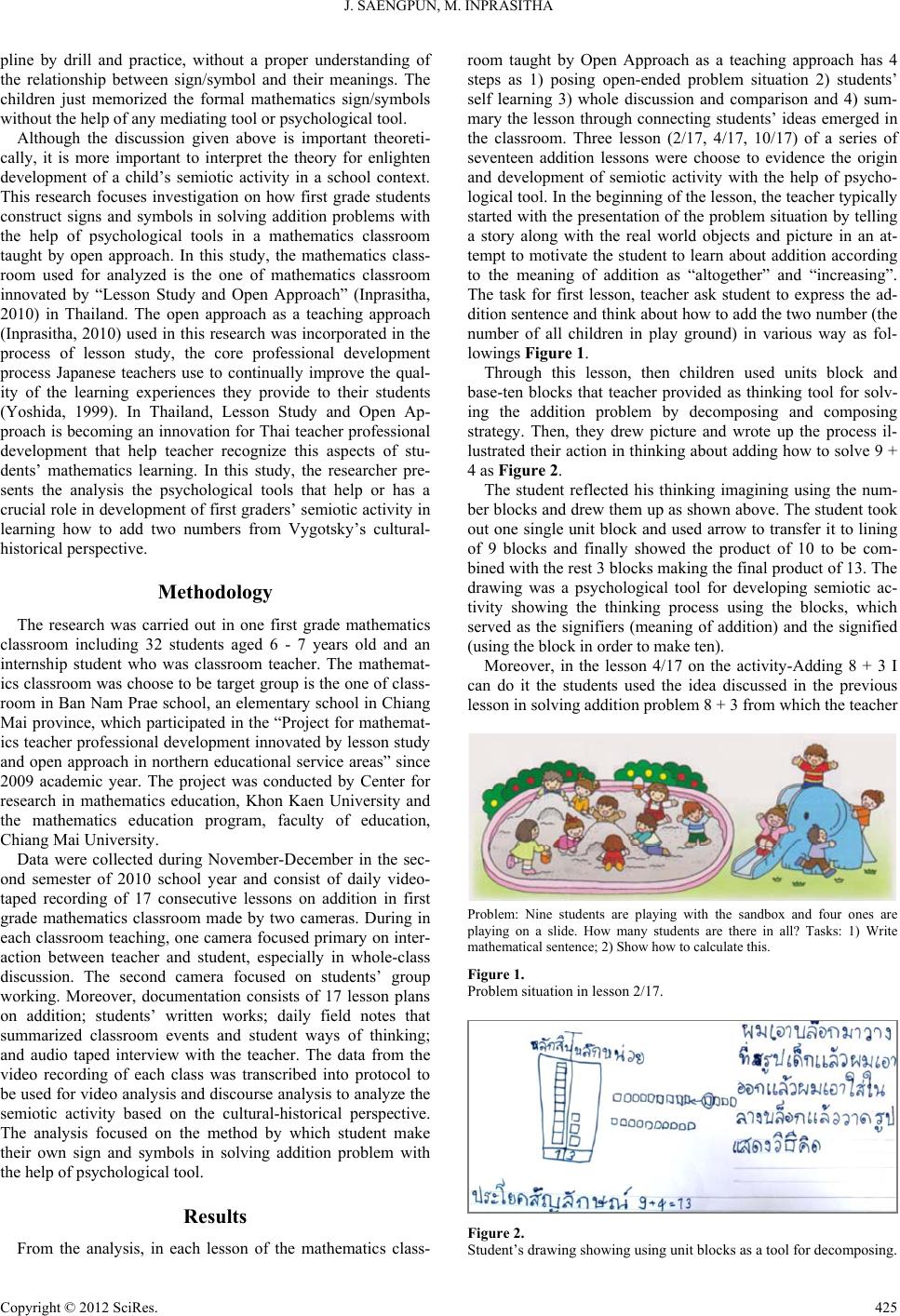 J. SAENGPUN, M. INPRASITHA pline by drill and practice, without a proper understanding of the relationship between sign/symbol and their meanings. The children just memorized the formal mathematics sign/symbols without the help of any mediating tool or psychological tool. Although the discussion given above is important theoreti- cally, it is more important to interpret the theory for enlighten development of a child’s semiotic activity in a school context. This research focuses investigation on how first grade students construct signs and symbols in solving addition problems with the help of psychological tools in a mathematics classroom taught by open approach. In this study, the mathematics class- room used for analyzed is the one of mathematics classroom innovated by “Lesson Study and Open Approach” (Inprasitha, 2010) in Thailand. The open approach as a teaching approach (Inprasitha, 2010) used in this research was incorporated in the process of lesson study, the core professional development process Japanese teachers use to continually improve the qual- ity of the learning experiences they provide to their students (Yoshida, 1999). In Thailand, Lesson Study and Open Ap- proach is becoming an innovation for Thai teacher professional development that help teacher recognize this aspects of stu- dents’ mathematics learning. In this study, the researcher pre- sents the analysis the psychological tools that help or has a crucial role in development of first graders’ semiotic activity in learning how to add two numbers from Vygotsky’s cultural- historical perspective. Methodology The research was carried out in one first grade mathematics classroom including 32 students aged 6 - 7 years old and an internship student who was classroom teacher. The mathemat- ics classroom was choose to be target group is the one of class- room in Ban Nam Prae school, an elementary school in Chiang Mai province, which participated in the “Project for mathemat- ics teacher professional development innovated by lesson study and open approach in northern educational service areas” since 2009 academic year. The project was conducted by Center for research in mathematics education, Khon Kaen University and the mathematics education program, faculty of education, Chiang Mai University. Data were collected during November-December in the sec- ond semester of 2010 school year and consist of daily video- taped recording of 17 consecutive lessons on addition in first grade mathematics classroom made by two cameras. During in each classroom teaching, one camera focused primary on inter- action between teacher and student, especially in whole-class discussion. The second camera focused on students’ group working. Moreover, documentation consists of 17 lesson plans on addition; students’ written works; daily field notes that summarized classroom events and student ways of thinking; and audio taped interview with the teacher. The data from the video recording of each class was transcribed into protocol to be used for video analysis and discourse analysis to analyze the semiotic activity based on the cultural-historical perspective. The analysis focused on the method by which student make their own sign and symbols in solving addition problem with the help of psychological tool. Results From the analysis, in each lesson of the mathematics class- room taught by Open Approach as a teaching approach has 4 steps as 1) posing open-ended problem situation 2) students’ self learning 3) whole discussion and comparison and 4) sum- mary the lesson through connecting students’ ideas emerged in the classroom. Three lesson (2/17, 4/17, 10/17) of a series of seventeen addition lessons were choose to evidence the origin and development of semiotic activity with the help of psycho- logical tool. In the beginning of the lesson, the teacher typically started with the presentation of the problem situation by telling a story along with the real world objects and picture in an at- tempt to motivate the student to learn about addition according to the meaning of addition as “altogether” and “increasing”. The task for first lesson, teacher ask student to express the ad- dition sentence and think about how to add the two number (the number of all children in play ground) in various way as fol- lowings Figure 1. Through this lesson, then children used units block and base-ten blocks that teacher provided as thinking tool for solv- ing the addition problem by decomposing and composing strategy. Then, they drew picture and wrote up the process il- lustrated their action in thinking about adding how to solve 9 + 4 as Figure 2. The student reflected his thinking imagining using the num- ber blocks and drew them up as shown above. The student took out one single unit block and used arrow to transfer it to lining of 9 blocks and finally showed the product of 10 to be com- bined with the rest 3 blocks making the final product of 13. The drawing was a psychological tool for developing semiotic ac- tivity showing the thinking process using the blocks, which served as the signifiers (meaning of addition) and the signified (using the block in order to make ten). Moreover, in the lesson 4/17 on the activity-Adding 8 + 3 I can do it the students used the idea discussed in the previous lesson in solving addition problem 8 + 3 from which the teacher Problem: Nine students are playing with the sandbox and four ones are playing on a slide. How many students are there in all? Tasks: 1) Write mathematic al sentence; 2) Show how to calculate t his. Figure 1. Problem situation in lesson 2/17. Figure 2. Student’s drawing showing using unit blocks as a tool for decomposing. Copyright © 2012 SciRes. 425 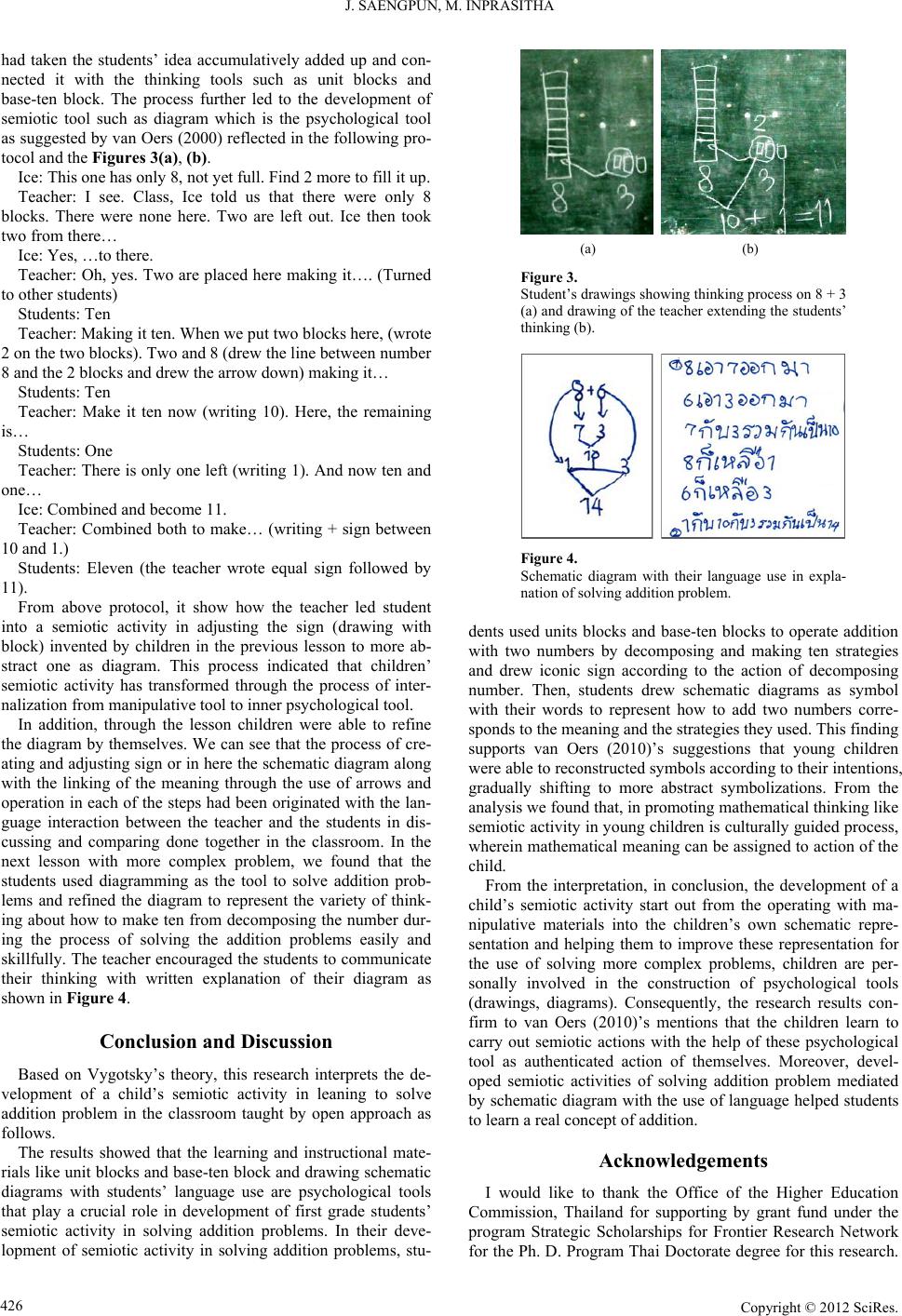 J. SAENGPUN, M. INPRASITHA had taken the students’ idea accumulatively added up and con- nected it with the thinking tools such as unit blocks and base-ten block. The process further led to the development of semiotic tool such as diagram which is the psychological tool as suggested by van Oers (2000) reflected in the following pro- tocol and the Figures 3(a), (b). Ice: This one has only 8, not yet full. Find 2 more to fill it up. Teacher: I see. Class, Ice told us that there were only 8 blocks. There were none here. Two are left out. Ice then took two from there… Ice: Yes, …to there. Teacher: Oh, yes. Two are placed here making it…. (Turned to other students) Students: Ten Teacher: Making it ten. When we put two blocks here, (wrote 2 on the two blocks). Two and 8 (drew the line between number 8 and the 2 blocks and drew the arrow down) making it… Students: Ten Teacher: Make it ten now (writing 10). Here, the remaining is… Students: One Teacher: There is only one left (writing 1). And now ten and one… Ice: Combined and become 11. Teacher: Combined both to make… (writing + sign between 10 and 1.) Students: Eleven (the teacher wrote equal sign followed by 11). From above protocol, it show how the teacher led student into a semiotic activity in adjusting the sign (drawing with block) invented by children in the previous lesson to more ab- stract one as diagram. This process indicated that children’ semiotic activity has transformed through the process of inter- nalization from mani p ulative tool to inner psychological tool. In addition, through the lesson children were able to refine the diagram by themselves. We can see that the process of cre- ating and adjusting sign or in here the schematic diagram along with the linking of the meaning through the use of arrows and operation in each of the steps had been originated with the lan- guage interaction between the teacher and the students in dis- cussing and comparing done together in the classroom. In the next lesson with more complex problem, we found that the students used diagramming as the tool to solve addition prob- lems and refined the diagram to represent the variety of think- ing about how to make ten from decomposing the number dur- ing the process of solving the addition problems easily and skillfully. The teacher encouraged the students to communicate their thinking with written explanation of their diagram as shown in Figure 4. Conclusion and Discussion Based on Vygotsky’s theory, this research interprets the de- velopment of a child’s semiotic activity in leaning to solve addition problem in the classroom taught by open approach as follows. (a) (b) Figure 3. Student’s drawings showing thinking process on 8 + 3 (a) and drawing of the teacher extending the students’ thinking (b). Figure 4. Schematic diagram with their language use in expla- nation of solving addition problem. dents used units blocks and base-ten blocks to operate addition with two numbers by decomposing and making ten strategies and drew iconic sign according to the action of decomposing number. Then, students drew schematic diagrams as symbol with their words to represent how to add two numbers corre- sponds to the meaning and the strategies they used. This finding supports van Oers (2010)’s suggestions that young children were able to reconstructed symbols according to their intentions, gradually shifting to more abstract symbolizations. From the analysis we found that, in promoting mathematical thinking like semiotic activity in young children is culturally guided process, wherein mathematical meaning can be assigned to action of the child. From the interpretation, in conclusion, the development of a child’s semiotic activity start out from the operating with ma- nipulative materials into the children’s own schematic repre- sentation and helping them to improve these representation for the use of solving more complex problems, children are per- sonally involved in the construction of psychological tools (drawings, diagrams). Consequently, the research results con- firm to van Oers (2010)’s mentions that the children learn to carry out semiotic actions with the help of these psychological tool as authenticated action of themselves. Moreover, devel- oped semiotic activities of solving addition problem mediated by schematic diagram with the use of language helped students to learn a real concept of addition. The results showed that the learning and instructional mate- rials like unit blocks and base-ten block and drawing schematic diagrams with students’ language use are psychological tools that play a crucial role in development of first grade students’ semiotic activity in solving addition problems. In their deve- lopment of semiotic activity in solving addition problems, stu- Acknowledgements I would like to thank the Office of the Higher Education Commission, Thailand for supporting by grant fund under the program Strategic Scholarships for Frontier Research Network for the Ph. D. Program Thai Doctorate degree for this research. Copyright © 2012 SciRes. 426  J. SAENGPUN, M. INPRASITHA Copyright © 2012 SciRes. 427 This work was also granted by Graduate School granting, Khon Kaen University, Thailand. Additionally, this work was sup- ported by Center for Research in Mathematics Education, Khon Kaen University, Thailand. REFERENCES Inprasitha, M. (2010). One feature of adaptive lesson study in Thailand —Designing learning unit. Proceedings of the 45th Korean National Meeting of Mathematics Education, Dongkook University, Gyeongju. 193-206. Kinard, J.T. & Kozulin, A. (2008). Rigorous mathematical thinking: Conceptual formation in the mathematics classroom. New York: Cambridge University Press. Kozulin, A. (1998). Psychological tools: A sociocultural approach to education. Cambridge: Harvard University Press. Van der Veer, R. & Valsiner, J. (1991). Understanding vygotsky: A quest for synthesis. Cambridge, MA: Blackwell. van Oers, B. (2000). The appropriation of mathematical symbols: A psychosemiotic approach to mathematics learning. In P. Cobb, E. Yackel, & K. McClain (eds.), Symbolizing and communicating in mathematics classrooms (pp. 133-176). Mahwah: Erlbaum. van Oers, B. (2010). Emergent mathematical thinking in the context of play. Educational Studies in Mathematics, 74, 23-37. doi:10.1007/s10649-009-9225-x van Oers, B. & Poland, M. (2007). Schematising activities as a means for young children to think abstractly. Mathematics Education Re- search Journal, 19, 10-22. doi:10.1007/BF03217453 Vygotsky, L.S. (1929). The problem of the cultural development of the child. The Pedagogical Seminary and Journal of genetic psychology, 36, 415-434. Vygotsky, L.S. (1978). Mind in society: The development of higher psychological proc e s s es. Cambridge: Harvard Univ ersity Press. Yohida, K. (2006). Developments of child’s fraction concepts with the help of psychological tools: A Vygotsky’s cultural-historical per- spective. Proceedings of the 30th Conference of the International Group for the Psychology of Mathematics Education, 5, 449-456. Yoshida, M. (1999). Lesson study: A case study of a Japanese approach to improving instruction through school-based teacher development. Ph.D. Dissertation, Chicago. IL: The University of Chicago. |