

Paper Menu >>
Journal Menu >>
 Psychology 2012. Vol.3, No.5, 379-383 Published Online May 2012 in SciRes (http://www.SciRP.org/journal/psych) http://dx.doi.org/10.4236/psych.2012.35053 Copyright © 2012 SciRes. 379 Automatic and Controlled Attentional Processes in Amnestic Mild Cognitive Impairment: The Use of a Mini-Verbal Test Jonas Jardim de Paula1, Danielle de Souza Costa1, Edgar Nunes de Moraes2, Rodrigo Nicolato3, Manuel Sedó4, Leandro Fernandes Malloy-Diniz1,3 1Neuropsychological Investigations Laboratory, Universidade Federal de Minas Gerais, Belo Horizonte, Brazil 2Internal Medicine Department, Universidade Federal de Minas Gerais, Belo Horizonte, Brazil 3Mental Health Department, Universidade Federal de Minas Gerais, Belo Horizonte, Brazil 4Mini-Verbal Tests, Boston, US Email: [email protected] Received December 19th, 2011; revised January 20th, 2012; accepted February 23rd, 2012 Recent finding suggests that in Amnestic Mild Cognitive Impairment (MCI) executive functions deficits may be a frequent clinical finding. Automatic and Controlled attentional processes are related to the allo- cation of cognitive resources in different stimuli, being important to executive functioning. The present study aims at assessing the hypothesis of executive dysfunction deficits in MCI patients. Method: forty five MCI patients and forty five normal aging controls (NC) were assessed with the Five Digits Test (5D), a Mini-Verbal test version of the Stroop Test. Group comparisons were performed by t tests and the non-parametric Mann-Whitney test. Results: comparisons indicates significant differences between NC and MCI in efficiency measures of controlled attentional processes, with moderate effect sizes, but not in automatic attentional processes or processing speed. Conclusion: the present work shows a selective pat- tern of impairment in MCI, indicating specific deficits in executive functioning with spared processing speed. Keywords: Executive Functions; Selective Attention; Five Digit Test; MCI; Attentional Process Introduction Mild Cognitive Impairment (MCI) is an intermediate clinical condition between normal aging and dementia (Petersen et al., 2001). MCI patients show deficits in specific cognitive func- tions, do not fill the criteria for dementia diagnosis and have none or mild impairment in daily life activities. The impairment may occur in only one cognitive domain (Amnestic or Non- Amnestic MCI) or multiple domains (Multiple Domain Amnes- tic MCI or Multiple Domain Non-Amnestic MCI) (Petersen & Negash, 2008). Some neuropathological markers (Apostolova et al., 2006) and cognitive-behavioral patterns are being inves- tigated as possible predictors for MCI to be converted into de- mentia (Palmer et al., 2010). One possible cognitive profile which may play a role in this conversion is the executive func- tions impairment (Balota et al., 2010). Executive functions are a group of cognitive processes in- volving abstraction, inhibition, fluency, set shifting, problem solving and self-regulation. One of the most consensual defini- tions of this construct is the one proposed by Lezak, Howieson and Loring (2005): “capacities that enable a person to engage successfully in independent, purposive, self-serving behavior”. In a developmental perspective the executive functions show an inverted “U” shaped curve (Zelazo, Craik, & Booth, 2004), associated with the maturation of cortico-subcortical connec- tions of the Prefrontal Cortex, Basal Ganglia, Thalamus and Cerebellum (Fuster, 2009). The executive changes across the lifespan seem to be mediated by a significant slowness in proc- essing speed and a reduced working memory capacity (Salthouse & Meinz, 1995). Education is an important factor for executive performance. Lin and Col. (2007) suggest that the decline of some components of executive functions such as attention allocation, planning, and initiation are more related to the aging process whereas educational level is more prone to explain the decline of initiation, switching, flexibility, and online updating. Recent research indicated that even in Amnes- tic MCI (MCI) patients might show executive functions im- pairment. Kramer and Col. (2007) found significant differences between MCI and normal aging controls in neuropsychological tests of executive functioning, like the Stroop Color-Word Test, the Wisconsing Card Sorting Test, Verbal Fluency and Draw- ing Fluency. The similar results were shown by Traykov and Col. (2007) using the Stroop Color Word Test and the Modified Card Test, but not the Trail Making. These findings indicate that different aspects of executive functioning may be impaired in MCI, like cognitive shifting, fluency, planning abilities and selective attention. Executive impairment may be a frequent finding in these patients and might play a role in the conversion into dementia. Usually the assessment of executive functions is carried out with classic neuropsychological tests such as the Stroop Color-Word Test (Stroop, 1935) and the Trail Making Test (Reiten, 1955). These measures are adequate for the detection of executive dysfunction in subjects with dementia and MCI (Fisher et al., 1990; Koss et al., 1984; Kramer et al., 2007). Nonetheless, these tasks are greatly influenced by formal edu- cation and reading abilities (Johnson, Flicker & Lichtenberg, 2006; Lucas et al., 2005). An alternative in these situations is the Mini-Verbal Tests (MVT) which try to be as independent as possible from school learning and culturally-acquired routines 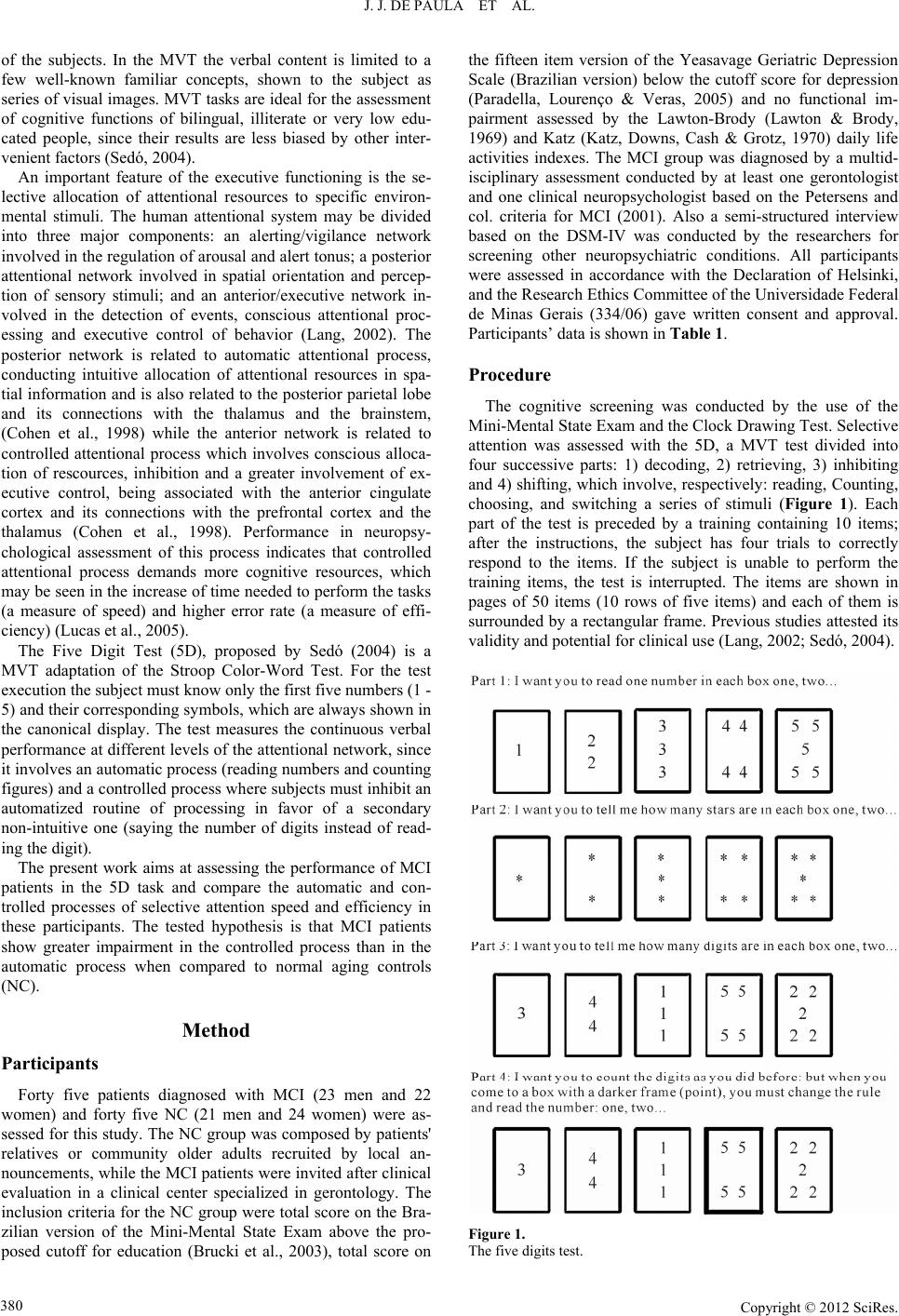 J. J. DE PAULA ET AL. of the subjects. In the MVT the verbal content is limited to a few well-known familiar concepts, shown to the subject as series of visual images. MVT tasks are ideal for the assessment of cognitive functions of bilingual, illiterate or very low edu- cated people, since their results are less biased by other inter- venient factors (Sedó, 2004). An important feature of the executive functioning is the se- lective allocation of attentional resources to specific environ- mental stimuli. The human attentional system may be divided into three major components: an alerting/vigilance network involved in the regulation of arousal and alert tonus; a posterior attentional network involved in spatial orientation and percep- tion of sensory stimuli; and an anterior/executive network in- volved in the detection of events, conscious attentional proc- essing and executive control of behavior (Lang, 2002). The posterior network is related to automatic attentional process, conducting intuitive allocation of attentional resources in spa- tial information and is also related to the posterior parietal lobe and its connections with the thalamus and the brainstem, (Cohen et al., 1998) while the anterior network is related to controlled attentional process which involves conscious alloca- tion of rescources, inhibition and a greater involvement of ex- ecutive control, being associated with the anterior cingulate cortex and its connections with the prefrontal cortex and the thalamus (Cohen et al., 1998). Performance in neuropsy- chological assessment of this process indicates that controlled attentional process demands more cognitive resources, which may be seen in the increase of time needed to perform the tasks (a measure of speed) and higher error rate (a measure of effi- ciency) (Lucas et al., 2005). The Five Digit Test (5D), proposed by Sedó (2004) is a MVT adaptation of the Stroop Color-Word Test. For the test execution the subject must know only the first five numbers (1 - 5) and their corresponding symbols, which are always shown in the canonical display. The test measures the continuous verbal performance at different levels of the attentional network, since it involves an automatic process (reading numbers and counting figures) and a controlled process where subjects must inhibit an automatized routine of processing in favor of a secondary non-intuitive one (saying the number of digits instead of read- ing the digit). The present work aims at assessing the performance of MCI patients in the 5D task and compare the automatic and con- trolled processes of selective attention speed and efficiency in these participants. The tested hypothesis is that MCI patients show greater impairment in the controlled process than in the automatic process when compared to normal aging controls (NC). Method Participants Forty five patients diagnosed with MCI (23 men and 22 women) and forty five NC (21 men and 24 women) were as- sessed for this study. The NC group was composed by patients' relatives or community older adults recruited by local an- nouncements, while the MCI patients were invited after clinical evaluation in a clinical center specialized in gerontology. The inclusion criteria for the NC group were total score on the Bra- zilian version of the Mini-Mental State Exam above the pro- posed cutoff for education (Brucki et al., 2003), total score on the fifteen item version of the Yeasavage Geriatric Depression Scale (Brazilian version) below the cutoff score for depression (Paradella, Lourenço & Veras, 2005) and no functional im- pairment assessed by the Lawton-Brody (Lawton & Brody, 1969) and Katz (Katz, Downs, Cash & Grotz, 1970) daily life activities indexes. The MCI group was diagnosed by a multid- isciplinary assessment conducted by at least one gerontologist and one clinical neuropsychologist based on the Petersens and col. criteria for MCI (2001). Also a semi-structured interview based on the DSM-IV was conducted by the researchers for screening other neuropsychiatric conditions. All participants were assessed in accordance with the Declaration of Helsinki, and the Research Ethics Committee of the Universidade Federal de Minas Gerais (334/06) gave written consent and approval. Participants’ data is shown in Table 1. Procedure The cognitive screening was conducted by the use of the Mini-Mental State Exam and the Clock Drawing Test. Selective attention was assessed with the 5D, a MVT test divided into four successive parts: 1) decoding, 2) retrieving, 3) inhibiting and 4) shifting, which involve, respectively: reading, Counting, choosing, and switching a series of stimuli (Figure 1). Each part of the test is preceded by a training containing 10 items; after the instructions, the subject has four trials to correctly respond to the items. If the subject is unable to perform the training items, the test is interrupted. The items are shown in pages of 50 items (10 rows of five items) and each of them is surrounded by a rectangular frame. Previous studies attested its validity and potential for clinical use (Lang, 2002; Sedó, 2004). Figure 1. The five digits test. Copyright © 2012 SciRes. 380 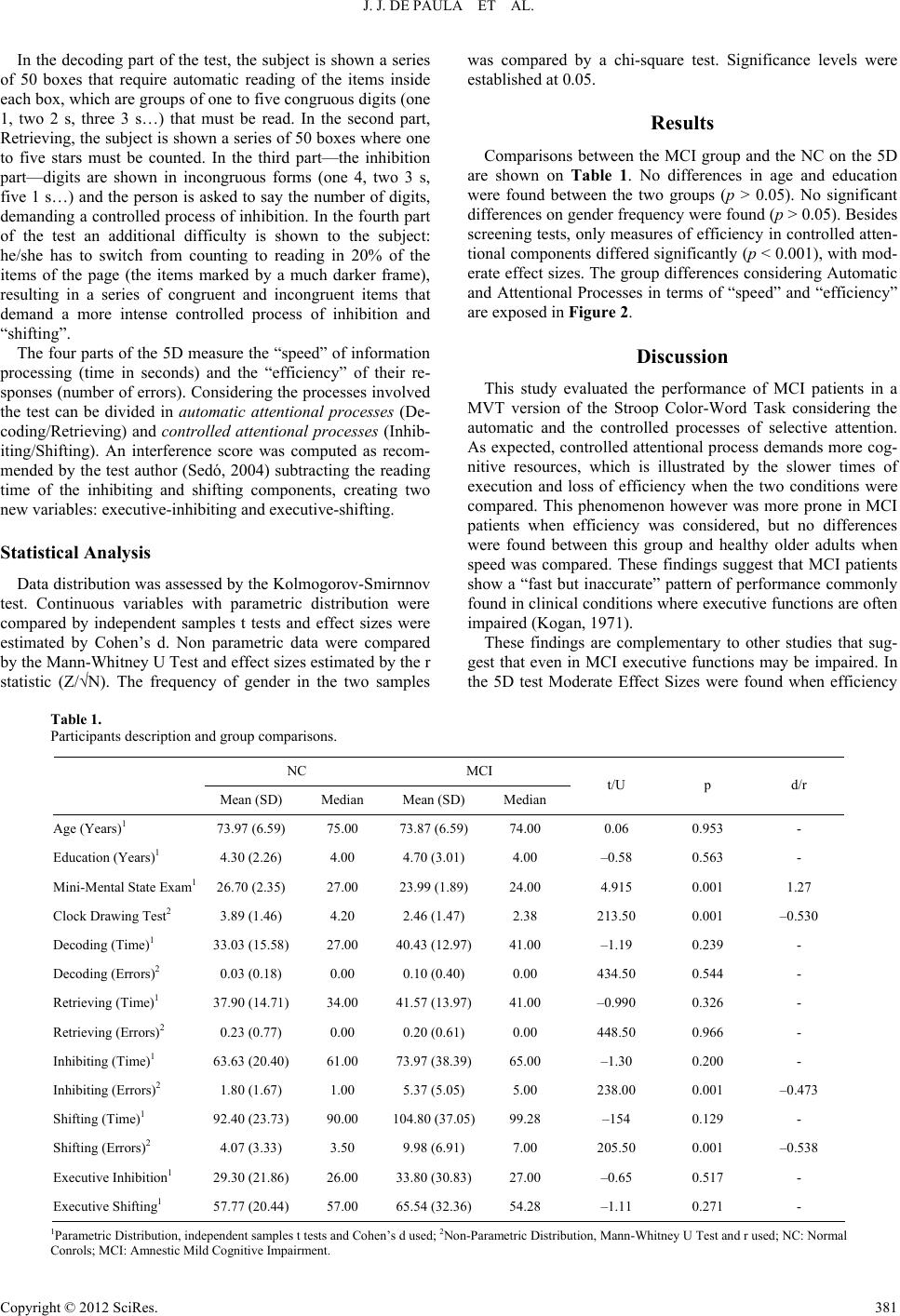 J. J. DE PAULA ET AL. Copyright © 2012 SciRes. 381 In the decoding part of the test, the subject is shown a series of 50 boxes that require automatic reading of the items inside each box, which are groups of one to five congruous digits (one 1, two 2 s, three 3 s…) that must be read. In the second part, Retrieving, the subject is shown a series of 50 boxes where one to five stars must be counted. In the third part—the inhibition part—digits are shown in incongruous forms (one 4, two 3 s, five 1 s…) and the person is asked to say the number of digits, demanding a controlled process of inhibition. In the fourth part of the test an additional difficulty is shown to the subject: he/she has to switch from counting to reading in 20% of the items of the page (the items marked by a much darker frame), resulting in a series of congruent and incongruent items that demand a more intense controlled process of inhibition and “shifting”. The four parts of the 5D measure the “speed” of information processing (time in seconds) and the “efficiency” of their re- sponses (number of errors). Considering the processes involved the test can be divided in automatic attentional processes (De- coding/Retrieving) and controlled attentional processes (Inhib- iting/Shifting). An interference score was computed as recom- mended by the test author (Sedó, 2004) subtracting the reading time of the inhibiting and shifting components, creating two new variables: executive-inhibiting and executive-shifting. Statistical Analysis Data distribution was assessed by the Kolmogorov-Smirnnov test. Continuous variables with parametric distribution were compared by independent samples t tests and effect sizes were estimated by Cohen’s d. Non parametric data were compared by the Mann-Whitney U Test and effect sizes estimated by the r statistic (Z/√N). The frequency of gender in the two samples was compared by a chi-square test. Significance levels were established at 0.05. Results Comparisons between the MCI group and the NC on the 5D are shown on Table 1. No differences in age and education were found between the two groups (p > 0.05). No significant differences on gender frequency were found (p > 0.05). Besides screening tests, only measures of efficiency in controlled atten- tional components differed significantly (p < 0.001), with mod- erate effect sizes. The group differences considering Automatic and Attentional Processes in terms of “speed” and “efficiency” are exposed in Figure 2. Discussion This study evaluated the performance of MCI patients in a MVT version of the Stroop Color-Word Task considering the automatic and the controlled processes of selective attention. As expected, controlled attentional process demands more cog- nitive resources, which is illustrated by the slower times of execution and loss of efficiency when the two conditions were compared. This phenomenon however was more prone in MCI patients when efficiency was considered, but no differences were found between this group and healthy older adults when speed was compared. These findings suggest that MCI patients show a “fast but inaccurate” pattern of performance commonly found in clinical conditions where executive functions are often impaired (Kogan, 1971). These findings are complementary to other studies that sug- gest that even in MCI executive functions may be impaired. In the 5D test Moderate Effect Sizes were found when efficiency Table 1. Participants description and group comparisons. NC MCI Mean (SD) Median Mean (SD)Median t/U p d/r Age (Years)1 73.97 (6.59) 75.00 73.87 (6.59)74.00 0.06 0.953 - Education (Years)1 4.30 (2.26) 4.00 4.70 (3.01) 4.00 –0.58 0.563 - Mini-Mental State Exam1 26.70 (2.35) 27.00 23.99 (1.89)24.00 4.915 0.001 1.27 Clock Drawing Test2 3.89 (1.46) 4.20 2.46 (1.47) 2.38 213.50 0.001 –0.530 Decoding (Time)1 33.03 (15.58) 27.00 40.43 (12.97)41.00 –1.19 0.239 - Decoding (Errors)2 0.03 (0.18) 0.00 0.10 (0.40) 0.00 434.50 0.544 - Retrieving (Time)1 37.90 (14.71) 34.00 41.57 (13.97) 41.00 –0.990 0.326 - Retrieving (Errors)2 0.23 (0.77) 0.00 0.20 (0.61) 0.00 448.50 0.966 - Inhibiting (Time)1 63.63 (20.40) 61.00 73.97 (38.39) 65.00 –1.30 0.200 - Inhibiting (Errors)2 1.80 (1.67) 1.00 5.37 (5.05) 5.00 238.00 0.001 –0.473 Shifting (Time)1 92.40 (23.73) 90.00 104.80 (37.05)99.28 –154 0.129 - Shifting (Errors)2 4.07 (3.33) 3.50 9.98 (6.91) 7.00 205.50 0.001 –0.538 Executive Inhibition1 29.30 (21.86) 26.00 33.80 (30.83)27.00 –0.65 0.517 - Executive Shifting1 57.77 (20.44) 57.00 65.54 (32.36)54.28 –1.11 0.271 - 1Parametric Distribution, independent samples t tests and Cohen’s d used; 2Non-Parametric Distribution, Mann-Whitney U Test and r used; NC: Normal Conrols; MCI: Amnestic Mild Cognitive Impairment. 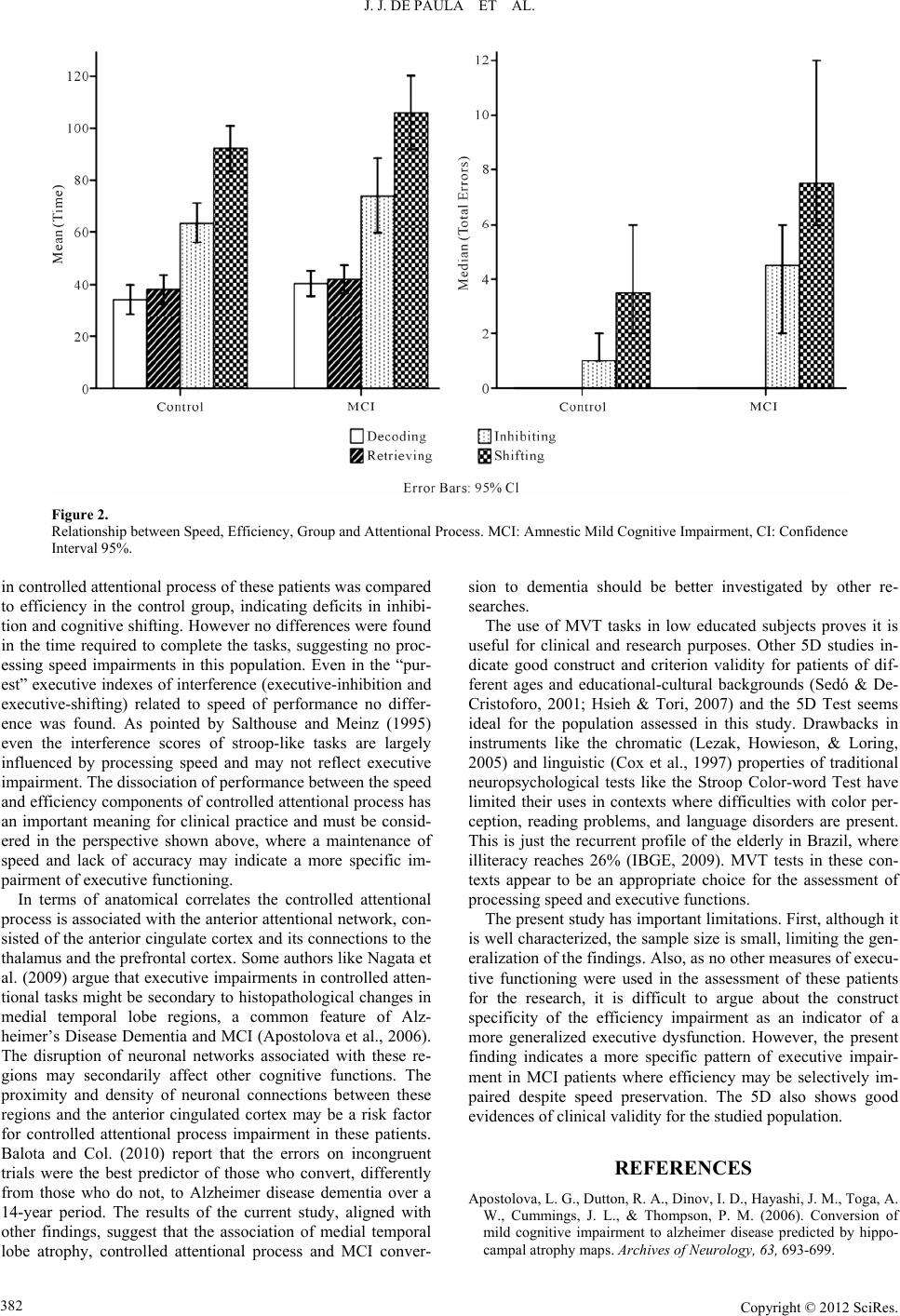 J. J. DE PAULA ET AL. Figure 2. Relationship between Speed, Efficiency, Group and Attentional Process. MCI: Amnestic Mild Cognitive Impairment, CI: Confidence Interval 95%. in controlled attentional process of these patients was compared to efficiency in the control group, indicating deficits in inhibi- tion and cognitive shifting. However no differences were found in the time required to complete the tasks, suggesting no proc- essing speed impairments in this population. Even in the “pur- est” executive indexes of interference (executive-inhibition and executive-shifting) related to speed of performance no differ- ence was found. As pointed by Salthouse and Meinz (1995) even the interference scores of stroop-like tasks are largely influenced by processing speed and may not reflect executive impairment. The dissociation of performance between the speed and efficiency components of controlled attentional process has an important meaning for clinical practice and must be consid- ered in the perspective shown above, where a maintenance of speed and lack of accuracy may indicate a more specific im- pairment of executive functioning. In terms of anatomical correlates the controlled attentional process is associated with the anterior attentional network, con- sisted of the anterior cingulate cortex and its connections to the thalamus and the prefrontal cortex. Some authors like Nagata et al. (2009) argue that executive impairments in controlled atten- tional tasks might be secondary to histopathological changes in medial temporal lobe regions, a common feature of Alz- heimer’s Disease Dementia and MCI (Apostolova et al., 2006). The disruption of neuronal networks associated with these re- gions may secondarily affect other cognitive functions. The proximity and density of neuronal connections between these regions and the anterior cingulated cortex may be a risk factor for controlled attentional process impairment in these patients. Balota and Col. (2010) report that the errors on incongruent trials were the best predictor of those who convert, differently from those who do not, to Alzheimer disease dementia over a 14-year period. The results of the current study, aligned with other findings, suggest that the association of medial temporal lobe atrophy, controlled attentional process and MCI conver- sion to dementia should be better investigated by other re- searches. The use of MVT tasks in low educated subjects proves it is useful for clinical and research purposes. Other 5D studies in- dicate good construct and criterion validity for patients of dif- ferent ages and educational-cultural backgrounds (Sedó & De- Cristoforo, 2001; Hsieh & Tori, 2007) and the 5D Test seems ideal for the population assessed in this study. Drawbacks in instruments like the chromatic (Lezak, Howieson, & Loring, 2005) and linguistic (Cox et al., 1997) properties of traditional neuropsychological tests like the Stroop Color-word Test have limited their uses in contexts where difficulties with color per- ception, reading problems, and language disorders are present. This is just the recurrent profile of the elderly in Brazil, where illiteracy reaches 26% (IBGE, 2009). MVT tests in these con- texts appear to be an appropriate choice for the assessment of processing speed and executive functions. The present study has important limitations. First, although it is well characterized, the sample size is small, limiting the gen- eralization of the findings. Also, as no other measures of execu- tive functioning were used in the assessment of these patients for the research, it is difficult to argue about the construct specificity of the efficiency impairment as an indicator of a more generalized executive dysfunction. However, the present finding indicates a more specific pattern of executive impair- ment in MCI patients where efficiency may be selectively im- paired despite speed preservation. The 5D also shows good evidences of clinical validity for the studied population. REFERENCES Apostolova, L. G., Dutton, R. A., Dinov, I. D., Hayashi, J. M., Toga, A. W., Cummings, J. L., & Thompson, P. M. (2006). Conversion of mild cognitive impairment to alzheimer disease predicted by hippo- campal atrophy maps. Archives of Neurology, 63, 693-699. Copyright © 2012 SciRes. 382  J. J. DE PAULA ET AL. doi:10.1001/archneur.63.5.693 Balota, D. A., Tse, C. S., Hutchison, K. A., Spieler, D. H., Duchek, J. M., & Morris, J. C. (2010). Predicting conversion to dementia of the Alzheimer type in a healthy control sample: The power of errors in Stroop color naming. Psychology and Aging, 25, 208-218. doi:10.1037/a0017474 Bondi, M. W., Serody, A. B., Chan, A. S., Eberson-Schumate, S. C., Delis, D. C., Hansen, L. A., & Salmon, D. P. (2002). Cognitive and neuropathologic correlates of stroop color-word test performance in Alzheimer’s disease. Neuropsychology, 16, 335-343. doi:10.1037/0894-4105.16.3.335 Brucki, S. M. D, Nitrini, R., Caramelli, P., Bertolluci, P. H. F., & Oka- moto, I. H. (2003). Sugestões para o uso do Mini-Exame do estado mental no Brasil. Arquivos de Neuropsiquiatria, 61, 777-781. doi:10.1590/S0004-282X2003000500014 Cohen, R. A., Malloy, P. F., & Jenkins, M. A. (1998). Disorders of attention. In P. J Snyder, & P. D. Nussbaum (Eds.), Clinical neuro- psychology: A pocket handbook for assessment. Washington DC: American Psychological Association. Cox, C. S., Chee, E., Chase, G. A., Baumgardner, T. L., Schuerholz, L. J., Reader, M. J., Mohr, J. & Denkla, M. B. (1997). Reading profi- ciency affects the construct validity of the Stroop test interference score. The Clinical Ne u ro p s yc h o logist, 11, 105-110. doi:10.1080/13854049708407039 Fisher, L. M., Freed, D. M., & Corkin, S. (1990). Stroop color-word test performance in patients with Alzheimer’s disease. Journal of Clinical and Experimental N europ sychology, 12, 745-758. doi:10.1080/01688639008401016 Fuster, J. M. (2008). The prefrontal cortex. London: Academic Press/ Elsevier. Hervey, A. S., Epstein, J. N., & Curry, J. F. (2004). Neuropsychology of adults with attention Deficit/hyperactivity disorder: A meta-ana- lytic review. Neuropsychology, 18, 485-503. doi:10.1037/0894-4105.18.3.485 Hsieh, S. J., & Tori, C. D. (2007). Normative data on cross-cultural neuropsychological tests obtained from mandarin-speaking adults across the life span. Archives of Clinical Neuropsychology, 22, 283- 296. doi:10.1016/j.acn.2007.01.004 Instituto Brasileiro de Geografia e Estatística (IBGE) (2007). Síntese de Indicadores Sociais—2007. [Internet]. [cited 2 February 2012]. Available from: http://www.ibge.gov.br/home/presidencia/noticia=987 Katz, S., Downs, T. D., Cash, H. R., & Grotz, R. C. (1970). Progress in the development of the index of ADL. Gerontologist, 10, 20-30. doi:10.1093/geront/10.1_Part_1.20 Kogan, M. (1971). Educational implications of cognitive styles. In G. L. Lesser (Ed.), Psychology and educational practice. Glenview: Scott Foresman. Koss, E., Ober, B. A., Delis, D. C. & Friedland, R. P. (1984). The stroop color-word test: Indicator of dementia severity. International Journal of Neuroscience, 24, 53-61. doi:10.3109/00207458409079534 Kramer, J. H., Nelson, A., Johnson, J. K., Yaffe, K., Glenn, S., Rosen, H. J., & Miller, B. L. (2006). Multiple cognitive deficits in amnestic mild cognitive impairment. Dementia and Geriatric Cognitive Dis- orders, 22, 306-311. doi:10.1159/000095303 Johnson, A. S., Flicker, L. J., & Lichtenberg, P. A. (2006). Reading ability mediates the relationship between education and executive function tasks. Journal of the International Neuropsychological So- ciety, 12, 64-71. doi:10.1017/S1355617706060073 Lang, J. A. (2002). Validation of the five digit test in a clinical sample: an alternative to the stroop color-word with possible cultural impli- cations. Doctoral Dissertation, Alliant International University. Lawton, M. P., & Brody, E. M. (1969). Assessment of older people: Self-monitoring and instrumental activities of daily living. Geron- tologist, 9, 179-186. doi:10.1093/geront/9.3_Part_1.179 Lezak, M. D., Howieson, D. B., & Loring, D. W. (2004). Neuropsy- chological assessment. New York: Oxford University Press. Lin, H., Chan, R.C.K., Zheng, L., Yang, T., & Wang, Y. (2007). Ex- ecutive functioning in healthy elderly Chinese people. Archives of Clinical Neuropsychology, 22, 501-511. doi:10.1016/j.acn.2007.01.028 Lucas, J. A, Ivnik R. J., Smith, G. E., Ferman, T. J., Willis, F. B., Pe- tersen, R. C., & Graff-Radford, N. R. (2005). Mayo’s older African Americans normative studies: Norms for Boston naming test, con- trolled oral word association, category fluency, animal naming, token test, wrat-3 reading, trail making test, stroop test, and judgement of line orientation. The Clinical Neuropsychologist, 19, 243-269. doi:10.1080/13854040590945337 Palmer, K., Iulio, D. V., Varsi, A. E., Gianni, W., Sancesario, G., Calta- gione, C., & Spalleta, G. (2010). Neuropsychiatric predictor of pro- gression from amnestic-mild cognitive impairment to Alzheimer’s disease: The role of depression and apathy. Journal of the Alzheimer Disease, 20, 175-183. Paradela, E. M. P., Lourenço, R. A., & Veras, R. P. (2005). Validation of geriatric depression scale in a general outpatient clinic. Revista de SaúdePública, 39, 918-923. Petersen, R., Doody, R., Kurz, A., et al. (2001). Current concepts in mild cognitive impairment. Arquives of Neurology, 58, 1985-1992. doi:10.1001/archneur.58.12.1985 Petersen, R.C., & Negash, S. (2008). Mild cognitive impairment: An overview. CNS Spectrums, 13, 45-53. Reiten, R. M. (1955). The relation of trail making test to organic brain damage. Jo urna l of Con sul ting Psychology, 10, 76-88. Salthouse, T. A., & Meinz, E. J. (1995). Aging, inhibition, working memory, and speed. Journal of Gerontology, 508, 297-306. Sedó, M. A., & DeCristoforo, L. (2001). All-language verbal tests free from linguistics barriers. Revista Española de Neuropsicología, 3, 68-82. Sedó, M. A. (2007). FDT—Test de los cinco digitos. Madrid, Spain: TEA Ediciones. Sedó, M. A. (2004). Test de las cinco cifras: Una alternativa multilin- güe y no lectora al test de Stroop. Revista Española de Neurología, 38, 824-828. Stroop, J. R. (1935). Studies of interference in serial verbal reaction. Journal of Experimental Ps ych olog y, 18, 643-662. doi:10.1037/h0054651 Traykov, L., Raoux, N., Latour, F., Gallo, L., Hanon, O., Baudic, S., Bayle, C., Wenisch, E., Remy, P., & Rigaud, A. S. (2007). Executive functions deficits in mild cognitive impairment. Cognitive & Behav- ioral Neurology, 20, 219-224. doi:10.1097/WNN.0b013e31815e6254 Zelazo, P. D., Craik, F. I. M., & Booth, L. (2004). Executive function across the life span. Acta Psychologica, 115, 167-184. doi:10.1016/j.actpsy.2003.12.005 Copyright © 2012 SciRes. 383 |