

Paper Menu >>
Journal Menu >>
 International Journal of Geosciences, 2012, 3, 333-338 http://dx.doi.org/10.4236/ijg.2012.32036 Published Online May 2012 (http://www.SciRP.org/journal/ijg) Dominant Factors of the Nature Regulating CO2 Release from Boreal Forest Land Ryunosuke Kikuchi1,2, Tamara T. Gorbacheva3 1Faculty of Science and Technology, Ryukoku University, Otsu, Japan 2CERNAS-ESAC, Polytechnic Institute of Coimbra Bencanta, Coimbra, Portugal 3Institute of the North Industrial Ecology Problems, Kola Science Center, Murmansk, Russia Email: [email protected]. jp Received December 22, 2011; revised February 17, 2012; accepted March 14, 2012 ABSTRACT Temperature is often considered as a primary factor for microbial decomposition of soil organic carbon. Boreal forests are the large terrestrial carbon pool: if carbon stored in this region is transferred to the atmosphere as CO2 by a warm- ing-induced acceleration of its decomposition, there will be positive feedback to global warming. It is reported that real issue regarding the release of carbon from soils to the atmosphere is how natural factors interact to influence decom- position of soil organic matter, so we observed mass losses (indicating decomposition rates) from litter and litterfall in a Northern Fennoscandia forest over 3 years under natural conditions. Our field survey has demonstrated that mass losses from most kinds of sample had moderate correlation with the temperature. Of the various samples, the canopy-gap litter alone had a greater rate (~70%) of mass loss. It is at least necessary to make a clear distinction of monitoring sites (un- der the canopy and in the canopy gap) when discussing the effect of climate on soil CO2 release from high-latitude for- ests. Though temperature, soil moisture and soil properties are prioritized in the issue of soil CO2 release, our results suggest that the fungi/bacteria rate and the wind-related mix/fragmentation are also important factors to be considered; however, this speculation is just tentative, and more detail research is called for. Keywords: Fragmentation; Global Warming; High-Latitude Forest; Microbial Decomposition; Wind 1. Introduction The conversion of litter carbon (i.e. young soil carbon above the mineral soil) to CO2 by microbial respiration is one of the major processes controlling the terrestrial car- bon budget [1], and most ecosystem models assume that the temperature sensitivity of decomposition is identical for all types of organic matter (review in [2]). Global warming may trigger an unbalance between carbon sinks provided by plants and carbon sources from decomposi- tion, potentially causing an acceleration in CO2 release from the terrestrial ecosystem. Nearly half of the carbon stored in forested ecosystems is in boreal forests, and it is a source of anxiety that a notable characteristic of boreal forest soils is surface accumulations (~500 giga tons C) of organic carbon [3]. Since high-latitude regions have warmed faster than other parts in recent decades [4] and these regions will be intensively subjected to a warming climate in the future [5], the effect of warming tempera- tures on boreal forests may result in a dramatic increase in terrestrial carbon flux to the atmosphere. Soil organic carbon (SOM) is mainly divided into min- eral soil and litter (cf. [6]); as degradation of litter pro- ceeds, SOM is transformed to organic acids and humins which accumulate in mineral soil. According to the data from 82 sites on five continents [7], increased tempera- ture does not stimulate the decomposition of forest- derived carbon in mineral soil. The dependence of mi- crobial decomposition on temperature is only known for young organic soil [8]. Yet another experiment suggests that SOM decomposition is affected by soil depth and experiment method, and the temperature sensitivity for passive SOM does not differ from that for labile SOM [9]. Anyway, the carbon input to the young organic soil from biomass is easily released to the atmosphere ac- cording to the current model- and observation-based con- cepts [2,8,9]. Not only temperature and soil properties but also soil moisture are also prioritized in the issue of soil CO2 re- lease [10]; e.g. there are drying/wetting cycles in natural conditions [11]. Nevertheless, the real issue regarding the release of carbon from soils to the atmosphere is how temperature, soil water content and other factors interact to influence decomposition of soil organic matter [12]. The climate effect on microbial decomposition of soil C opyright © 2012 SciRes. IJG 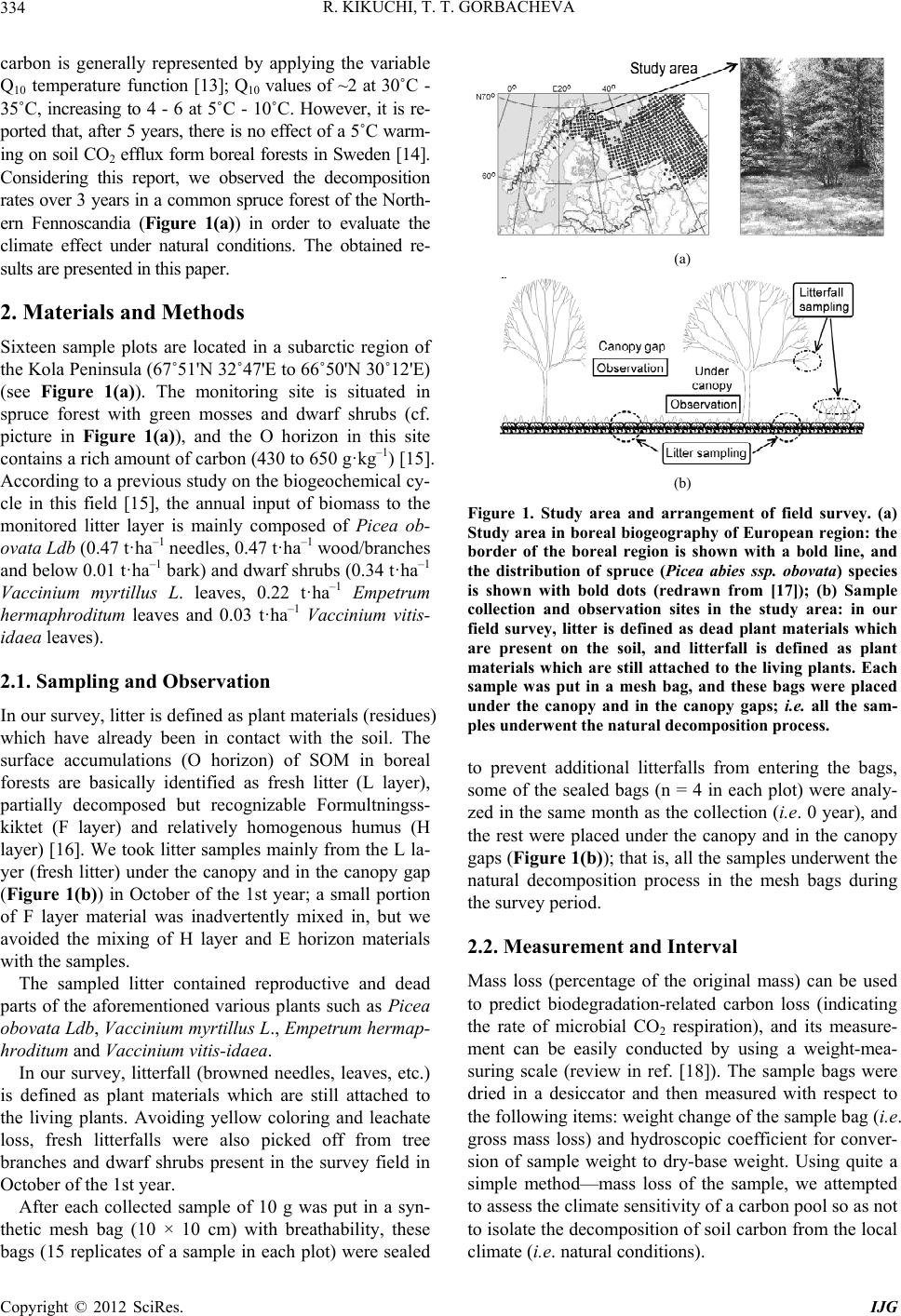 R. KIKUCHI, T. T. GORBACHEVA 334 carbon is generally represented by applying the variable Q10 temperature function [13]; Q10 values of ~2 at 30˚C - 35˚C, increasing to 4 - 6 at 5˚C - 10˚C. However, it is re- ported that, after 5 years, there is no effect of a 5˚C warm- ing on soil CO2 efflux form boreal forests in Sweden [14]. Considering this report, we observed the decomposition rates over 3 years in a common spruce forest of the North- ern Fennoscandia (Figure 1(a)) in order to evaluate the climate effect under natural conditions. The obtained re- sults are presented in this paper. 2. Materials and Methods Sixteen sample plots are located in a subarctic region of the Kola Peninsula (67˚51'N 32˚47'E to 66˚50'N 30˚12'E) (see Figure 1(a)). The monitoring site is situated in spruce forest with green mosses and dwarf shrubs (cf. picture in Figure 1(a)), and the O horizon in this site contains a rich amount of carbon (430 to 650 g·kg–1) [15]. According to a previous study on the biogeochemical cy- cle in this field [15], the annual input of biomass to the monitored litter layer is mainly composed of Picea ob- ovata Ldb (0.47 t·ha–1 needles, 0.47 t·ha–1 wood/branches and below 0.01 t·ha–1 bark) and dwarf shrubs (0.34 t·ha–1 Vaccinium myrtillus L. leaves, 0.22 t·ha–1 Empetrum hermaphroditum leaves and 0.03 t·ha–1 Vaccinium vitis- idaea leaves). 2.1. Sampling and Observation In our survey, litter is defined as plant materials (residues) which have already been in contact with the soil. The surface accumulations (O horizon) of SOM in boreal forests are basically identified as fresh litter (L layer), partially decomposed but recognizable Formultningss- kiktet (F layer) and relatively homogenous humus (H layer) [16]. We took litter samples mainly from the L la- yer (fresh litter) under the canopy and in the canopy gap (Figure 1(b)) in October of the 1st year; a small portion of F layer material was inadvertently mixed in, but we avoided the mixing of H layer and E horizon materials with the samples. The sampled litter contained reproductive and dead parts of the aforementioned various plants such as Picea obovata Ldb, Vaccinium myrtillus L., Empetrum hermap- hroditum and Vaccinium vitis-idaea. In our survey, litterfall (browned needles, leaves, etc.) is defined as plant materials which are still attached to the living plants. Avoiding yellow coloring and leachate loss, fresh litterfalls were also picked off from tree branches and dwarf shrubs present in the survey field in October of the 1st year. After each collected sample of 10 g was put in a syn- thetic mesh bag (10 × 10 cm) with breathability, these bags (15 replicates of a sample in each plot) were sealed (a) (b) Figure 1. Study area and arrangement of field survey. (a) Study area in boreal biogeogr aphy of European region: the border of the boreal region is shown with a bold line, and the distribution of spruce (Picea abies ssp. obovata) species is shown with bold dots (redrawn from [17]); (b) Sample collection and observation sites in the study area: in our field survey, litter is defined as dead plant materials which are present on the soil, and litterfall is defined as plant materials which are still attached to the living plants. Each sample was put in a mesh bag, and these bags were placed under the canopy and in the canopy gaps; i.e. all the sam- ples underwent the natural decomposition pr ocess. to prevent additional litterfalls from entering the bags, some of the sealed bags (n = 4 in each plot) were analy- zed in the same month as the collection (i.e. 0 year), and the rest were placed under the canopy and in the canopy gaps (Figure 1(b)); that is, all the samples underwent the natural decomposition process in the mesh bags during the survey period. 2.2. Measurement and Interval Mass loss (percentage of the original mass) can be used to predict biodegradation-related carbon loss (indicating the rate of microbial CO2 respiration), and its measure- ment can be easily conducted by using a weight-mea- suring scale (review in ref. [18]). The sample bags were dried in a desiccator and then measured with respect to the following items: weight change of the sample bag (i.e. gross mass loss) and hydroscopic coefficient for conver- sion of sample weight to dry-base weight. Using quite a simple method—mass loss of the sample, we attempted to assess the climate sensitivity of a carbon pool so as not to isolate the decomposition of soil carbon from the local climate (i.e. natural conditions). Copyright © 2012 SciRes. IJG 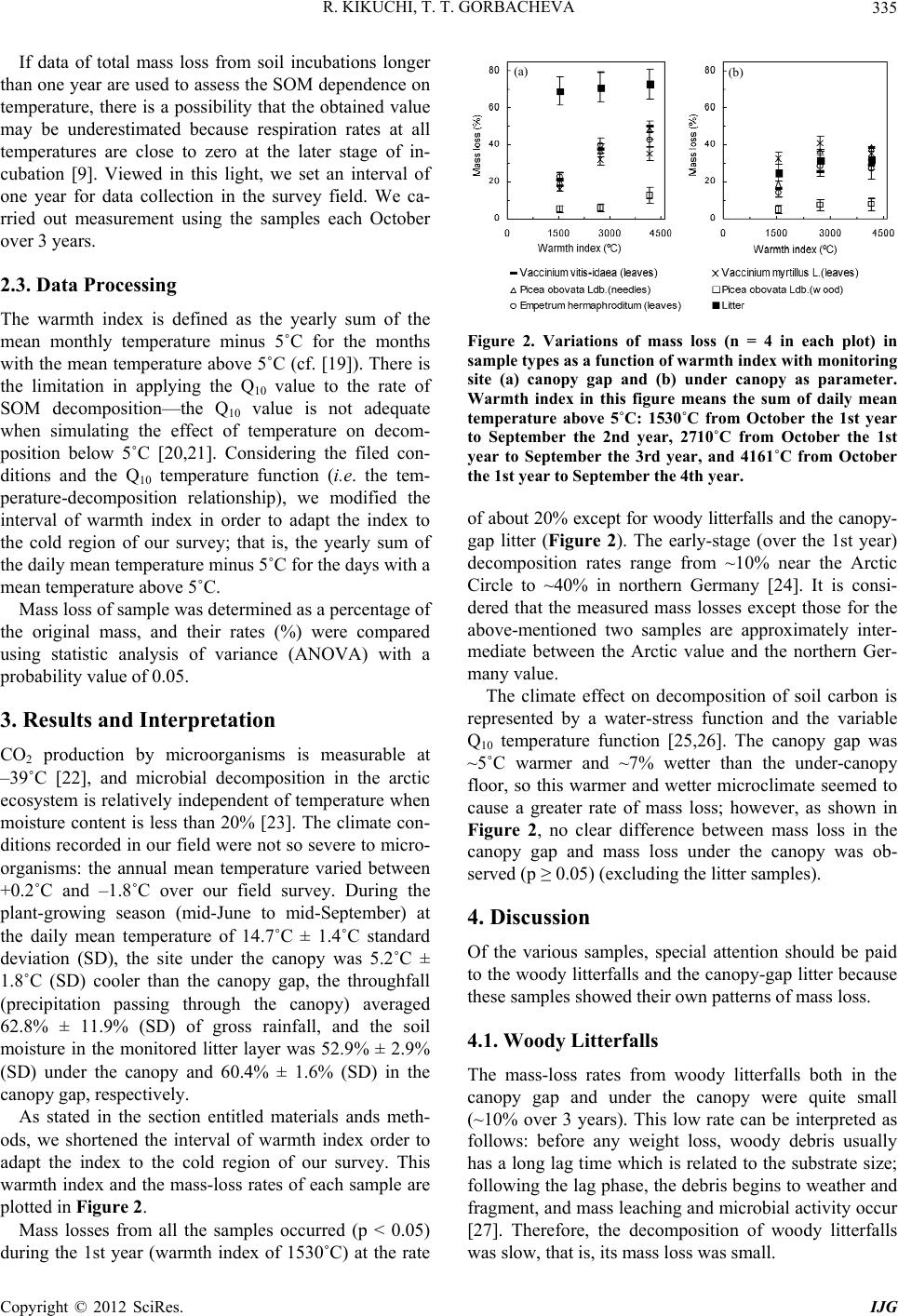 R. KIKUCHI, T. T. GORBACHEVA 335 If data of total mass loss from soil incubations longer than one year are used to assess the SOM dependence on temperature, there is a possibility that the obtained value may be underestimated because respiration rates at all temperatures are close to zero at the later stage of in- cubation [9]. Viewed in this light, we set an interval of one year for data collection in the survey field. We ca- rried out measurement using the samples each October over 3 years. (a) (b) 2.3. Data Processing The warmth index is defined as the yearly sum of the mean monthly temperature minus 5˚C for the months with the mean temperature above 5˚C (cf. [19]). There is the limitation in applying the Q10 value to the rate of SOM decomposition—the Q10 value is not adequate when simulating the effect of temperature on decom- position below 5˚C [20,21]. Considering the filed con- ditions and the Q10 temperature function (i.e. the tem- perature-decomposition relationship), we modified the interval of warmth index in order to adapt the index to the cold region of our survey; that is, the yearly sum of the daily mean temperature minus 5˚C for the days with a mean temperature above 5˚C. Mass loss of sample was determined as a percentage of the original mass, and their rates (%) were compared using statistic analysis of variance (ANOVA) with a probability value of 0.05. 3. Results and Interpretation CO2 production by microorganisms is measurable at –39˚C [22], and microbial decomposition in the arctic ecosystem is relatively independent of temperature when moisture content is less than 20% [23]. The climate con- ditions recorded in our field were not so severe to micro- organisms: the annual mean temperature varied between +0.2˚C and –1.8˚C over our field survey. During the plant-growing season (mid-June to mid-September) at the daily mean temperature of 14.7˚C ± 1.4˚C standard deviation (SD), the site under the canopy was 5.2˚C ± 1.8˚C (SD) cooler than the canopy gap, the throughfall (precipitation passing through the canopy) averaged 62.8% ± 11.9% (SD) of gross rainfall, and the soil moisture in the monitored litter layer was 52.9% ± 2.9% (SD) under the canopy and 60.4% ± 1.6% (SD) in the canopy gap, respectively. As stated in the section entitled materials ands meth- ods, we shortened the interval of warmth index order to adapt the index to the cold region of our survey. This warmth index and the mass-loss rates of each sample are plotted in Figure 2. Mass losses from all the samples occurred (p < 0.05) during the 1st year (warmth index of 1530˚C) at the rate Figure 2. Variations of mass loss (n = 4 in each plot) in sample types as a function of warmth index with monitoring site (a) canopy gap and (b) under canopy as parameter. Warmth index in this figure means the sum of daily mean temperature above 5˚C: 1530˚C from October the 1st year to September the 2nd year, 2710˚C from October the 1st year to September the 3rd year, and 4161˚C from October the 1st year to September the 4th year. of about 20% except for woody litterfalls and the canopy- gap litter (Figure 2). The early-stage (over the 1st year) decomposition rates range from ~10% near the Arctic Circle to ~40% in northern Germany [24]. It is consi- dered that the measured mass losses except those for the above-mentioned two samples are approximately inter- mediate between the Arctic value and the northern Ger- many value. The climate effect on decomposition of soil carbon is represented by a water-stress function and the variable Q10 temperature function [25,26]. The canopy gap was ~5˚C warmer and ~7% wetter than the under-canopy floor, so this warmer and wetter microclimate seemed to cause a greater rate of mass loss; however, as shown in Figure 2, no clear difference between mass loss in the canopy gap and mass loss under the canopy was ob- served (p ≥ 0.05) (excluding the litter samples). 4. Discussion Of the various samples, special attention should be paid to the woody litterfalls and the canopy-gap litter because these samples showed their own patterns of mass loss. 4.1. Woody Litterfalls The mass-loss rates from woody litterfalls both in the canopy gap and under the canopy were quite small (~10% over 3 years). This low rate can be interpreted as follows: before any weight loss, woody debris usually has a long lag time which is related to the substrate size; following the lag phase, the debris begins to weather and fragment, and mass leaching and microbial activity occur [27]. Therefore, the decomposition of woody litterfalls was slow, that is, its mass loss was small. Copyright © 2012 SciRes. IJG 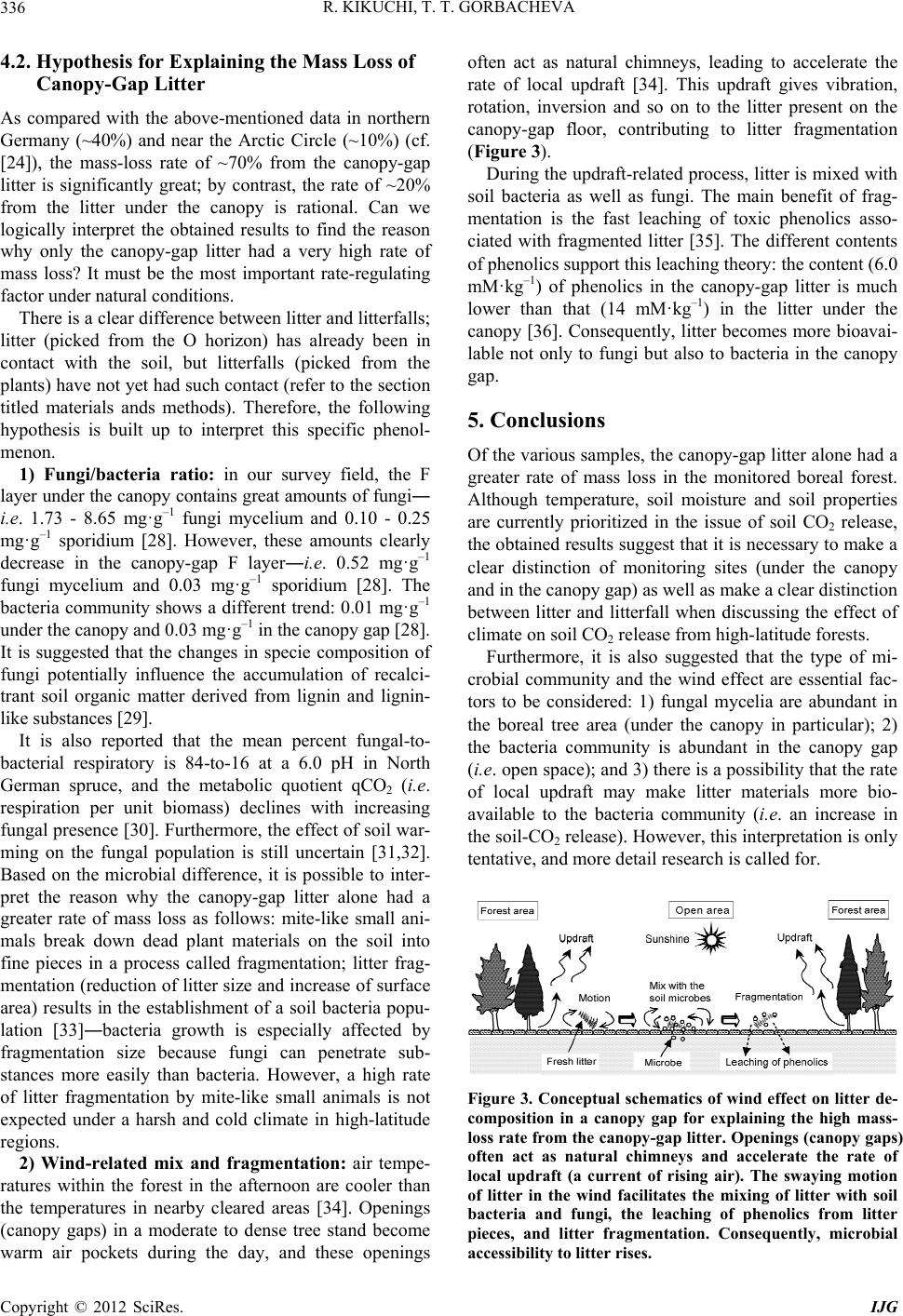 R. KIKUCHI, T. T. GORBACHEVA 336 4.2. Hypothesis for Explaining the Mass Loss of Canopy-Gap Litter As compared with the above-mentioned data in northern Germany (~40%) and near the Arctic Circle (~10%) (cf. [24]), the mass-loss rate of ~70% from the canopy-gap litter is significantly great; by contrast, the rate of ~20% from the litter under the canopy is rational. Can we logically interpret the obtained results to find the reason why only the canopy-gap litter had a very high rate of mass loss? It must be the most important rate-regulating factor under natural conditions. There is a clear difference between litter and litterfalls; litter (picked from the O horizon) has already been in contact with the soil, but litterfalls (picked from the plants) have not yet had such contact (refer to the section titled materials ands methods). Therefore, the following hypothesis is built up to interpret this specific phenol- menon. 1) Fungi/bacteria ratio: in our survey field, the F layer under the canopy contains great amounts of fungi― i.e. 1.73 - 8.65 mg·g–1 fungi mycelium and 0.10 - 0.25 mg· g –1 sporidium [28]. However, these amounts clearly decrease in the canopy-gap F layer―i.e. 0.52 mg·g–1 fungi mycelium and 0.03 mg·g–1 sporidium [28]. The bacteria community shows a different trend: 0.01 mg·g–1 under the canopy and 0.03 mg·g–1 in the canopy gap [28]. It is suggested that the changes in specie composition of fungi potentially influence the accumulation of recalci- trant soil organic matter derived from lignin and lignin- like substances [29]. It is also reported that the mean percent fungal-to- bacterial respiratory is 84-to-16 at a 6.0 pH in North German spruce, and the metabolic quotient qCO2 (i.e. respiration per unit biomass) declines with increasing fungal presence [30]. Furthermore, the effect of soil war- ming on the fungal population is still uncertain [31,32]. Based on the microbial difference, it is possible to inter- pret the reason why the canopy-gap litter alone had a greater rate of mass loss as follows: mite-like small ani- mals break down dead plant materials on the soil into fine pieces in a process called fragmentation; litter frag- mentation (reduction of litter size and increase of surface area) results in the establishment of a soil bacteria popu- lation [33]―bacteria growth is especially affected by fragmentation size because fungi can penetrate sub- stances more easily than bacteria. However, a high rate of litter fragmentation by mite-like small animals is not expected under a harsh and cold climate in high-latitude regions. 2) Wind-related mix and fragmentation: air tempe- ratures within the forest in the afternoon are cooler than the temperatures in nearby cleared areas [34]. Openings (canopy gaps) in a moderate to dense tree stand become warm air pockets during the day, and these openings often act as natural chimneys, leading to accelerate the rate of local updraft [34]. This updraft gives vibration, rotation, inversion and so on to the litter present on the canopy-gap floor, contributing to litter fragmentation (Figure 3). During the updraft-related process, litter is mixed with soil bacteria as well as fungi. The main benefit of frag- mentation is the fast leaching of toxic phenolics asso- ciated with fragmented litter [35]. The different contents of phenolics support this leaching theory: the content (6.0 mM·kg–1) of phenolics in the canopy-gap litter is much lower than that (14 mM·kg–1) in the litter under the canopy [36]. Consequently, litter becomes more bioavai- lable not only to fungi but also to bacteria in the canopy gap. 5. Conclusions Of the various samples, the canopy-gap litter alone had a greater rate of mass loss in the monitored boreal forest. Although temperature, soil moisture and soil properties are currently prioritized in the issue of soil CO2 release, the obtained results suggest that it is necessary to make a clear distinction of monitoring sites (under the canopy and in the canopy gap) as well as make a clear distinction between litter and litterfall when discussing the effect of climate on soil CO2 release from high-latitude forests. Furthermore, it is also suggested that the type of mi- crobial community and the wind effect are essential fac- tors to be considered: 1) fungal mycelia are abundant in the boreal tree area (under the canopy in particular); 2) the bacteria community is abundant in the canopy gap (i.e. open space); and 3) there is a possibility that the rate of local updraft may make litter materials more bio- available to the bacteria community (i.e. an increase in the soil-CO2 release). However, this interpretation is only tentative, and more detail research is called for. Figure 3. Conceptual schematics of wind effect on litter de- composition in a canopy gap for explaining the high mass- loss rate from the canopy-gap litter. Openings (canopy gaps) often act as natural chimneys and accelerate the rate of local updraft (a current of rising air). The swaying motion of litter in the wind facilitates the mixing of litter with soil bacteria and fungi, the leaching of phenolics from litter pieces, and litter fragmentation. Consequently, microbial accessibility to litter rises. Copyright © 2012 SciRes. IJG 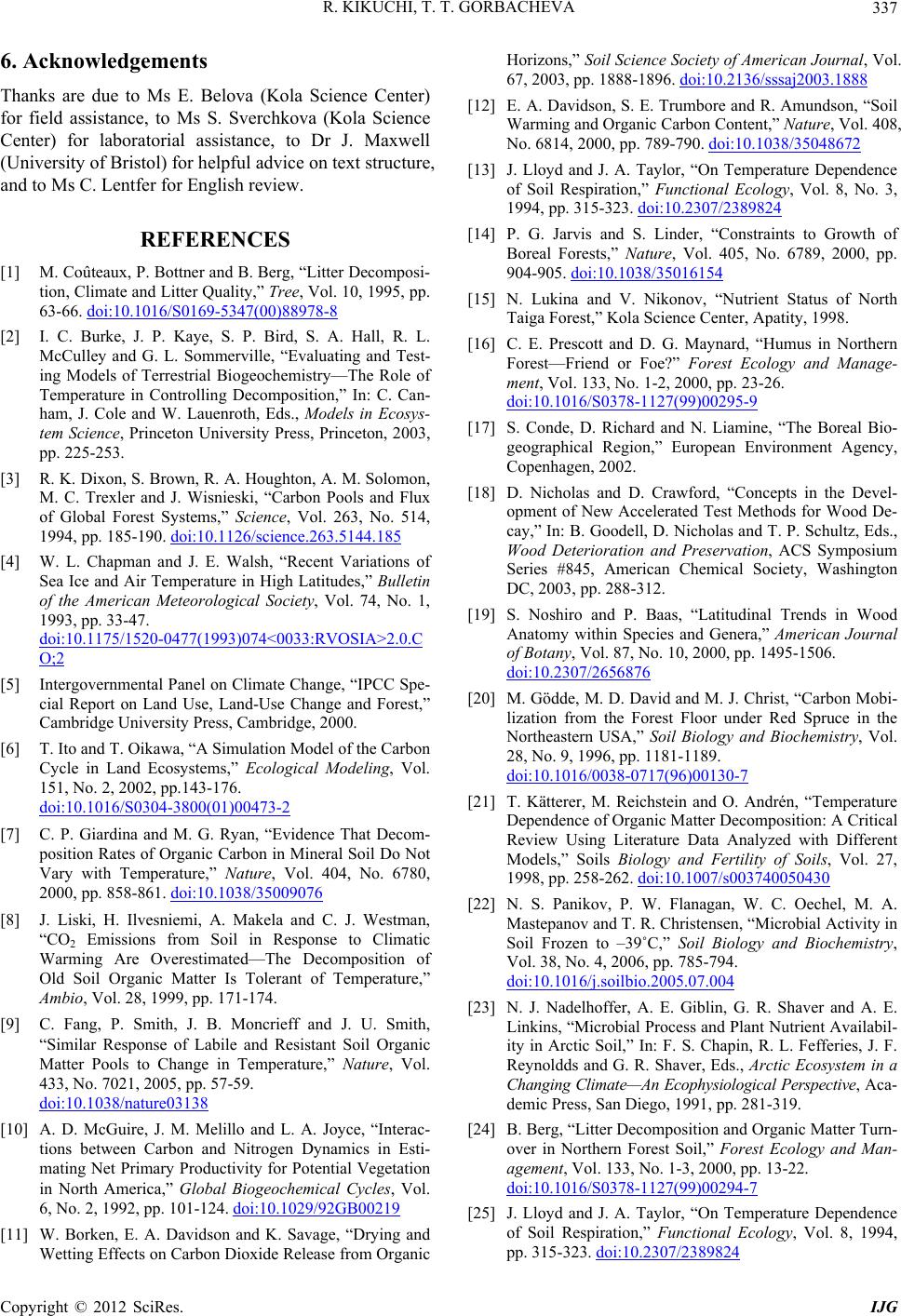 R. KIKUCHI, T. T. GORBACHEVA 337 6. Acknowledgements Thanks are due to Ms E. Belova (Kola Science Center) for field assistance, to Ms S. Sverchkova (Kola Science Center) for laboratorial assistance, to Dr J. Maxwell (University of Bristol) for helpful advice on text structure, and to Ms C. Lentfer for English review. REFERENCES [1] M. Coûteaux, P. Bottner and B. Berg, “Litter Decomposi- tion, Climate and Litter Quality,” Tree, Vol. 10, 1995, pp. 63-66. doi:10.1016/S0169-5347(00)88978-8 [2] I. C. Burke, J. P. Kaye, S. P. Bird, S. A. Hall, R. L. McCulley and G. L. Sommerville, “Evaluating and Test- ing Models of Terrestrial Biogeochemistry—The Role of Temperature in Controlling Decomposition,” In: C. Can- ham, J. Cole and W. Lauenroth, Eds., Models in Ecosys- tem Science, Princeton University Press, Princeton, 2003, pp. 225-253. [3] R. K. Dixon, S. Brown, R. A. Houghton, A. M. Solomon, M. C. Trexler and J. Wisnieski, “Carbon Pools and Flux of Global Forest Systems,” Science, Vol. 263, No. 514, 1994, pp. 185-190. doi:10.1126/science.263.5144.185 [4] W. L. Chapman and J. E. Walsh, “Recent Variations of Sea Ice and Air Temperature in High Latitudes,” Bulletin of the American Meteorological Society, Vol. 74, No. 1, 1993, pp. 33-47. doi:10.1175/1520-0477(1993)074<0033:RVOSIA>2.0.C O;2 [5] Intergovernmental Panel on Climate Change, “IPCC Spe- cial Report on Land Use, Land-Use Change and Forest,” Cambridge University Press, Cambridge, 2000. [6] T. Ito and T. Oikawa, “A Simulation Model of the Carbon Cycle in Land Ecosystems,” Ecological Modeling, Vol. 151, No. 2, 2002, pp.143-176. doi:10.1016/S0304-3800(01)00473-2 [7] C. P. Giardina and M. G. Ryan, “Evidence That Decom- position Rates of Organic Carbon in Mineral Soil Do Not Vary with Temperature,” Nature, Vol. 404, No. 6780, 2000, pp. 858-861. doi:10.1038/35009076 [8] J. Liski, H. Ilvesniemi, A. Makela and C. J. Westman, “CO2 Emissions from Soil in Response to Climatic Warming Are Overestimated—The Decomposition of Old Soil Organic Matter Is Tolerant of Temperature,” Ambio, Vol. 28, 1999, pp. 171-174. [9] C. Fang, P. Smith, J. B. Moncrieff and J. U. Smith, “Similar Response of Labile and Resistant Soil Organic Matter Pools to Change in Temperature,” Nature, Vol. 433, No. 7021, 2005, pp. 57-59. doi:10.1038/nature03138 [10] A. D. McGuire, J. M. Melillo and L. A. Joyce, “Interac- tions between Carbon and Nitrogen Dynamics in Esti- mating Net Primary Productivity for Potential Vegetation in North America,” Global Biogeochemical Cycles, Vol. 6, No. 2, 1992, pp. 101-124. doi:10.1029/92GB00219 [11] W. Borken, E. A. Davidson and K. Savage, “Drying and Wetting Effects on Carbon Dioxide Release from Organic Horizons,” Soil Science Society of American Journal, Vol. 67, 2003, pp. 1888-1896. doi:10.2136/sssaj2003.1888 [12] E. A. Davidson, S. E. Trumbore and R. Amundson, “Soil Warming and Organic Carbon Content,” Nature, Vol. 408, No. 6814, 2000, pp. 789-790. doi:10.1038/35048672 [13] J. Lloyd and J. A. Taylor, “On Temperature Dependence of Soil Respiration,” Functional Ecology, Vol. 8, No. 3, 1994, pp. 315-323. doi:10.2307/2389824 [14] P. G. Jarvis and S. Linder, “Constraints to Growth of Boreal Forests,” Nature, Vol. 405, No. 6789, 2000, pp. 904-905. doi:10.1038/35016154 [15] N. Lukina and V. Nikonov, “Nutrient Status of North Taiga Forest,” Kola Science Center, Apatity, 1998. [16] C. E. Prescott and D. G. Maynard, “Humus in Northern Forest—Friend or Foe?” Forest Ecology and Manage- ment, Vol. 133, No. 1-2, 2000, pp. 23-26. doi:10.1016/S0378-1127(99)00295-9 [17] S. Conde, D. Richard and N. Liamine, “The Boreal Bio- geographical Region,” European Environment Agency, Copenhagen, 2002. [18] D. Nicholas and D. Crawford, “Concepts in the Devel- opment of New Accelerated Test Methods for Wood De- cay,” In: B. Goodell, D. Nicholas and T. P. Schultz, Eds., Wood Deterioration and Preservation, ACS Symposium Series #845, American Chemical Society, Washington DC, 2003, pp. 288-312. [19] S. Noshiro and P. Baas, “Latitudinal Trends in Wood Anatomy within Species and Genera,” American Journal of Botany, Vol. 87, No. 10, 2000, pp. 1495-1506. doi:10.2307/2656876 [20] M. Gödde, M. D. David and M. J. Christ, “Carbon Mobi- lization from the Forest Floor under Red Spruce in the Northeastern USA,” Soil Biology and Biochemistry, Vol. 28, No. 9, 1996, pp. 1181-1189. doi:10.1016/0038-0717(96)00130-7 [21] T. Kätterer, M. Reichstein and O. Andrén, “Temperature Dependence of Organic Matter Decomposition: A Critical Review Using Literature Data Analyzed with Different Models,” Soils Biology and Fertility of Soils, Vol. 27, 1998, pp. 258-262. doi:10.1007/s003740050430 [22] N. S. Panikov, P. W. Flanagan, W. C. Oechel, M. A. Mastepanov and T. R. Christensen, “Microbial Activity in Soil Frozen to –39˚C,” Soil Biology and Biochemistry, Vol. 38, No. 4, 2006, pp. 785-794. doi:10.1016/j.soilbio.2005.07.004 [23] N. J. Nadelhoffer, A. E. Giblin, G. R. Shaver and A. E. Linkins, “Microbial Process and Plant Nutrient Availabil- ity in Arctic Soil,” In: F. S. Chapin, R. L. Fefferies, J. F. Reynoldds and G. R. Shaver, Eds., Arctic Ecosystem in a Changing Climat e—An Ecophysiological Pe rspective, Aca- demic Press, San Diego, 1991, pp. 281-319. [24] B. Berg, “Litter Decomposition and Organic Matter Turn- over in Northern Forest Soil,” Forest Ecology and Man- agement, Vol. 133, No. 1-3, 2000, pp. 13-22. doi:10.1016/S0378-1127(99)00294-7 [25] J. Lloyd and J. A. Taylor, “On Temperature Dependence of Soil Respiration,” Functional Ecology, Vol. 8, 1994, pp. 315-323. doi:10.2307/2389824 Copyright © 2012 SciRes. IJG  R. KIKUCHI, T. T. GORBACHEVA Copyright © 2012 SciRes. IJG 338 [26] A. D. McGuire, J. M. Melillo, L. A. Joyce, D. W. Kick- lighter, A. L. Grace, B. Moore and C. J. Vorosmarty, “In- teractions between Carbon and Nitrogen Dynamics in Es- timating Net Primary Productivity for Potential Vegeta- tion in North America,” Global Biogeochemcal Cycles, Vol. 6, No. 2, 1992, pp. 101-124. doi:10.1029/92GB00219 [27] P. Sollins, “Input and Decay of Coarse Woody Debris on Coniferous Stands in Western Oregon and Washington,” Canadian Journal of Forest Research, Vol. 12, No. 1, 1982, pp. 18-28. doi:10.1139/x82-003 [28] V. V. Nikonov, N. V. Lukina and L. M. Polyanskaya, “Distribution of Microorganisms in the Al-Fe-Humus Podzols of Natural and Anthropogenically-Impacted Bo- real Spruce Forests,” Microbiology, Vol. 70, No. 3, 2001, p. 319. doi:10.1023/A:1010459512590 [29] T. Osono and H. Takeda, “Fungal Decomposition of Abies Needle and Betula Leaf Litter,” Mycologia, Vol. 98, No. 2, 2006, pp. 172-179. doi:10.3852/mycologia.98.2.172 [30] E. V. Blagodatskaya and T. H. Anderson, “Interactive Effects of pH and Substrate Quality on the Fungal- to-Bacterial Ratio and qCO2 of Microbial Communities in Forest Soils,” Soil Biology and Biochemistry, Vol. 30, No. 10-11, 1998, pp. 1269-1274. doi:10.1016/S0038-0717(98)00050-9 [31] K. E. Clemmensen, A. Michelsen, S. Jonasson and G. R. Shaver, “Increased Ectomycorrhizal Fungal Abundance after Long-Term Fertilization and Warming of Two Arc- tic Tundra Ecosystems,” New Phytologist, Vol. 171, No. 2, 2006, pp. 391-404. doi:10.1111/j.1469-8137.2006.01778.x [32] M. N. Thormann, S. E. Bayley and R. S. Currah, “Mi- crocosm Tests of the Effects of Temperature and Micro- bial Species Number on the Decomposition of Sedge and Bryophyte Litter from Southern Boreal Peatlands,” Ca- nadian Journal of Microbiology, Vol. 50, 2004, pp. 793- 802. doi:10.1139/w04-064 [33] R. D. G. Hanlon, “Some Factors Influencing Microbial Growth on Soil Animal Faeces II—Bacterial and Fungal Growth on Soil Animal Faeces,” Pedobiologia, Vol. 21, 1981, pp. 264-270. [34] M. J. Schroeder and C. C. Buck, “Fire Weather—A Guide for Application of Meteorological Information to Forest Fire Control Operations,” US Department of Agriculture Forest Service, Washington DC, 1979. [35] T. Gunnarsson, P. Sundin and A. Tunlid, “Importance of Leaf Litter Fragmentation for Bacterial Growth,” Oikos, Vol. 52, 1988, pp. 303-308. doi:10.2307/3565203 [36] T. Gorbacheva and R. Kikuchi, “Plant-to-Soil Pathways in the Subarctic—Qualitative and Quantitative Changes of Different Vegetative Fluxes,” Environmental Biotech- nology, Vol. 2, No. 1, 2006, pp. 26-30. |