

Paper Menu >>
Journal Menu >>
 Advances in Physical Education 2012. Vol.2, No.2, 73-75 Published Online May 2012 in SciRes (http://www.SciRP.org/journal/ape) http://dx.doi.org/10.4236/ape.2012.22013 Copyright © 2012 SciRes. 73 Translation and Reliability of the Preliminary Spanish Version of the Sport Imagery Questionnaire Montse C. Ruiz1, Anthony P. Watt2 1Department of Sport Sciences, University of Jyväskylä, Jyväskylä, Finland 2School of Education, Institute for Sport, Exercise and Active Living, Victoria University, Melbourne, Australia Email: [email protected] Received January 13th, 2012; revised February 16th, 2012; accepted February 27th, 2012 The purpose of this study was to examine the reliability of the preliminary Spanish version of the Sport Imagery Questionnaire (SIQ). The SIQ was developed to examine five cognitive and motivational func- tions of imagery use. Participants were 81 athletes competing in soccer (n = 43) and roller skating (n = 38), ranging in age from 14 to 29 years (M = 18.10, SD = 3.16). Reliability was evaluated through internal consistency analyses of the scale. Cronbach’s alpha coefficients were high indicating that the scale is a re- liable instrument for the measurement of imagery use in Spanish athletes. Further psychometric research should now examine factor structure and imagery use across competitive level and type of sport in a lar- ger sample of Spanish athletes. Keywords: Imagery Use; Psychometrics; Reliability; Sport Imagery Introduction Mental imagery is recognized as a valuable psychological technique in the preparation of athletes (Hall, Mack, Paivio, & Hausenblas, 1998). It is also a popular tool used by athletes, coaches and sport psychology practitioners for skill learning and performance enhancement purposes (MacIntyre & Moran, 2007). Imagery has been defined as “the creation or re-creation of an experience generated from memorial information, involv- ing quasi-sensorial, quasi-perceptual, and quasi-affective char- acteristics, that is under the volitional control of the imager, and which may occur in the absence of the real stimulus antecedents normally associated with the actual experience” (Morris, Spittle, & Watt, 2005, p. 19). Morris et al. also described imagery use as the manner in which individuals employ imagery to learn and develop skills, and to facilitate performance of those skills. Imagery researchers focusing on the examination of when and why athletes use imagery in sport have typically applied Paivio’s (1985) general analytical framework. Thus, it is assumed that imagery can mediate behavior through either a cognitive or motivation role, with each role operating at a general or specific level. Hall et al. (1998) developed the Sport Imagery Question- naire (SIQ) on the basis of Paivio’s perspectives. The SIQ evaluates the following five types of imagery use: 1) cognitive general (CG), representing imagery related to competitive strategies; 2) cognitive specific (CS), representing imagery directed toward skill development or production; 3) motiva- tional general arousal (MG-A), representing imagery related to arousal, relaxation, and competitive anxiety; 4) motivational general mastery (MG-M), representing imagery associated with effective coping and confidence in challenging situations; and 5) motivational specific (MS), representing imagery that con- cerns achieving specific goals and goal-oriented behavior. Previous research has supported the factorial validity and re- liability of the SIQ (Abma, Fry, Li, & Relyea, 2002; Hall et al., 1998, Hall, Stevens, & Paivio, 2005; Weinberg, Butt, Knight, Burke, & Jackson, 2003; Watt, Jaakkola, & Morris 2006; Watt, Spittle, Jaakkola, & Morris, 2008). Watt et al. (2006) developed a Finnish version of the SIQ and used a mixed sport and age sample of 231 athletes to determine that the translated version of the measure was internally consistent and demonstrated adequate replication of the original factor structure. Recently, Gregg, Hall, McGowan, and Hall (2011) reported continuing strong indicators of reliability for the SIQ for a sample of 432 athletes from a broad range of sports and age groups. These findings indicate that the SIQ constitutes a measure that can serve as a viable indicator of the imagery use skills of athletes. Continuing interest in the measurement qualities of the SIQ, make it crucial to evaluate the psychometric properties of this test of sport imagery use in countries where English is not the major spoken language. Additionally, it remains an important aim of sport psychology practitioners in non-English speaking populations to acquire a clearer understanding of the imagery use characteristics of their athletes (e.g., Murphy & Martin, 2002). Currently, in Spain there are a number of measures translated into Spanish to assess general imagery characteristics (Campos & Pérez-Fabello, 2009) however, no Spanish versions of measures of sport imagery were found. Thus, the aim of this study was to examine the reliability of the preliminary Spanish version of the SIQ. Methods Participants Participants were 81 (63 males and 18 females) athletes rep- resenting soccer (n = 43) and roller skating (n = 38), ranging in age from 14 to 29 years (M = 18.10 ± 3.16). The participants were involved in organized sport from three to twenty-five years and were currently competing at national (n = 60) and regional (n = 21) level. 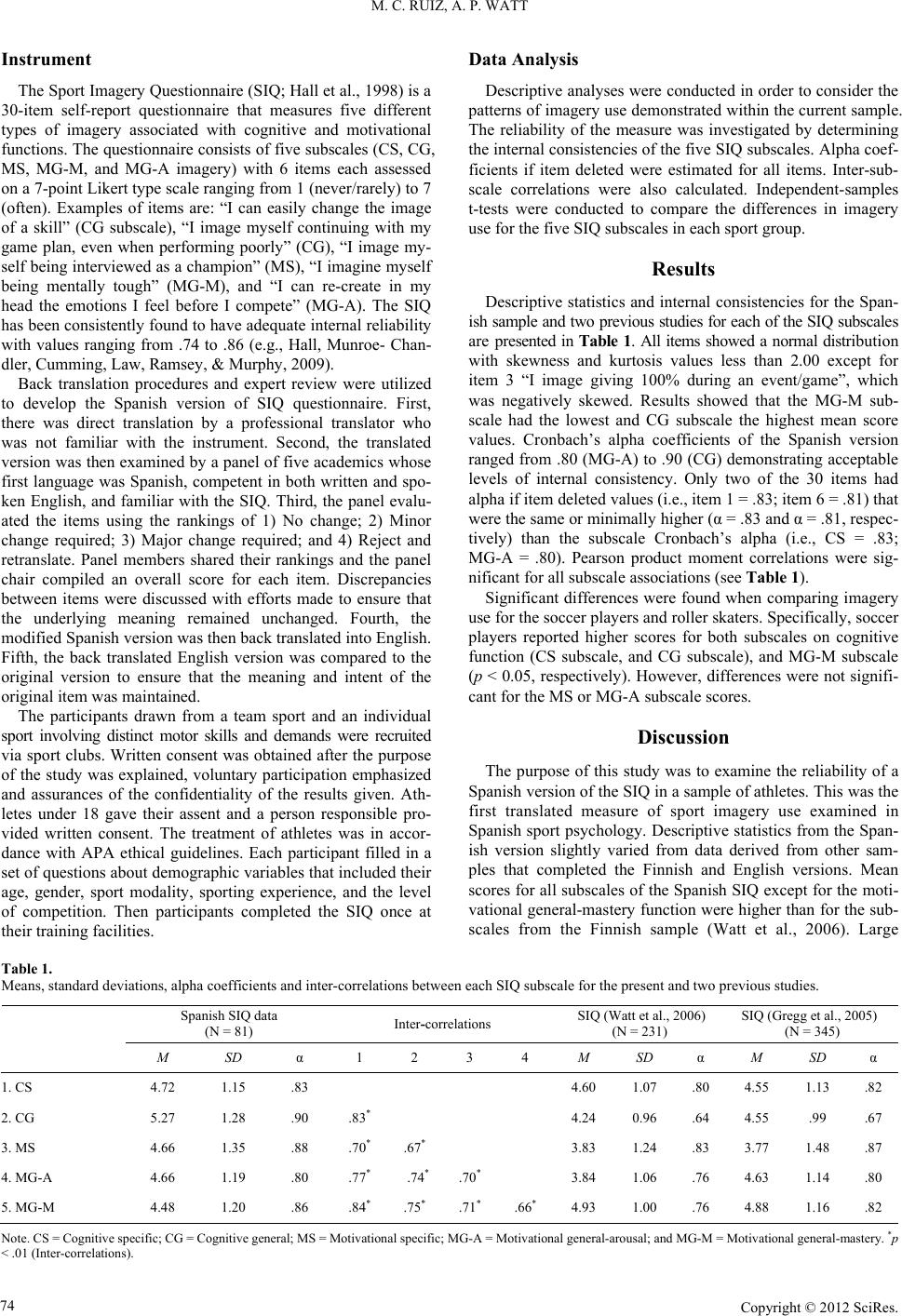 M. C. RUIZ, A. P. WATT Instrument The Sport Imagery Questionnaire (SIQ; Hall et al., 1998) is a 30-item self-report questionnaire that measures five different types of imagery associated with cognitive and motivational functions. The questionnaire consists of five subscales (CS, CG, MS, MG-M, and MG-A imagery) with 6 items each assessed on a 7-point Likert type scale ranging from 1 (never/rarely) to 7 (often). Examples of items are: “I can easily change the image of a skill” (CG subscale), “I image myself continuing with my game plan, even when performing poorly” (CG), “I image my- self being interviewed as a champion” (MS), “I imagine myself being mentally tough” (MG-M), and “I can re-create in my head the emotions I feel before I compete” (MG-A). The SIQ has been consistently found to have adequate internal reliability with values ranging from .74 to .86 (e.g., Hall, Munroe- Chan- dler, Cumming, Law, Ramsey, & Murphy, 2009). Back translation procedures and expert review were utilized to develop the Spanish version of SIQ questionnaire. First, there was direct translation by a professional translator who was not familiar with the instrument. Second, the translated version was then examined by a panel of five academics whose first language was Spanish, competent in both written and spo- ken English, and familiar with the SIQ. Third, the panel evalu- ated the items using the rankings of 1) No change; 2) Minor change required; 3) Major change required; and 4) Reject and retranslate. Panel members shared their rankings and the panel chair compiled an overall score for each item. Discrepancies between items were discussed with efforts made to ensure that the underlying meaning remained unchanged. Fourth, the modified Spanish version was then back translated into English. Fifth, the back translated English version was compared to the original version to ensure that the meaning and intent of the original item was maintained. The participants drawn from a team sport and an individual sport involving distinct motor skills and demands were recruited via sport clubs. Written consent was obtained after the purpose of the study was explained, voluntary participation emphasized and assurances of the confidentiality of the results given. Ath- letes under 18 gave their assent and a person responsible pro- vided written consent. The treatment of athletes was in accor- dance with APA ethical guidelines. Each participant filled in a set of questions about demographic variables that included their age, gender, sport modality, sporting experience, and the level of competition. Then participants completed the SIQ once at their training facilities. Data Analysis Descriptive analyses were conducted in order to consider the patterns of imagery use demonstrated within the current sample. The reliability of the measure was investigated by determining the internal consistencies of the five SIQ subscales. Alpha coef- ficients if item deleted were estimated for all items. Inter-sub- scale correlations were also calculated. Independent-samples t-tests were conducted to compare the differences in imagery use for the five SIQ subscales in each sport group. Results Descriptive statistics and internal consistencies for the Span- ish sample and two previous studies for each of the SIQ subscales are presented in Table 1. All items showed a normal distribution with skewness and kurtosis values less than 2.00 except for item 3 “I image giving 100% during an event/game”, which was negatively skewed. Results showed that the MG-M sub- scale had the lowest and CG subscale the highest mean score values. Cronbach’s alpha coefficients of the Spanish version ranged from .80 (MG-A) to .90 (CG) demonstrating acceptable levels of internal consistency. Only two of the 30 items had alpha if item deleted values (i.e., item 1 = .83; item 6 = .81) that were the same or minimally higher (α = .83 and α = .81, respec- tively) than the subscale Cronbach’s alpha (i.e., CS = .83; MG-A = .80). Pearson product moment correlations were sig- nificant for all subscale associations (see Table 1). Significant differences were found when comparing imagery use for the soccer players and roller skaters. Specifically, soccer players reported higher scores for both subscales on cognitive function (CS subscale, and CG subscale), and MG-M subscale (p < 0.05, respectively). However, differences were not signifi- cant for the MS or MG-A subscale scores. Discussion The purpose of this study was to examine the reliability of a Spanish version of the SIQ in a sample of athletes. This was the first translated measure of sport imagery use examined in Spanish sport psychology. Descriptive statistics from the Span- ish version slightly varied from data derived from other sam- ples that completed the Finnish and English versions. Mean scores for all subscales of the Spanish SIQ except for the moti- vational general-mastery function were higher than for the sub- scales from the Finnish sample (Watt et al., 2006). Large Table 1. Means, standard deviations, alpha coefficients and inter-correlations between each SIQ subscale for the present and two previous studies. Spanish SIQ data (N = 81) Inter-correlations SIQ (Watt et al., 2006) (N = 231) SIQ (Gregg et al., 2005) (N = 345) M SD α 1 2 3 4 M SD α M SD α 1. CS 4.72 1.15 .83 4.60 1.07 .80 4.55 1.13 .82 2. CG 5.27 1.28 .90 .83* 4.24 0.96 .64 4.55 .99 .67 3. MS 4.66 1.35 .88 .70* .67* 3.83 1.24 .83 3.77 1.48 .87 4. MG-A 4.66 1.19 .80 .77* .74*.70* 3.84 1.06 .76 4.63 1.14 .80 5. MG-M 4.48 1.20 .86 .84* .75* .71* .66* 4.93 1.00 .76 4.88 1.16 .82 Note. CS = Cognitive specific; CG = Cognitive general; MS = Motivational specific; MG-A = Motivational general-arousal; and MG-M = Motivational general-mastery. *p < .01 (Inter-correlations). Copyright © 2012 SciRes. 74  M. C. RUIZ, A. P. WATT differences were found for mean scores for the cognitive gen- eral imagery function (Table 1). Higher mean values for the cognitive general imagery subscale were also observed when comparing the Spanish sample and previous studies that used English versions (Gregg, Hall, & Nederhof, 2005; Hall et al., 2009). This finding suggests a possible cultural or conceptual difference in the response behaviors to certain imagery use questions (particularly those related to feeling confident or mentally tough). Spanish data (i.e., item 3 in particular) had a negative skew indicating a bias toward high scores of imagery ability. How- ever, these patterns are in line with those found in previous studies (Gregg et al., 2011). Reliability scores of the Spanish version ( > 0.80) were higher than those drawn from the Fin- nish study for all subscales indicating acceptable levels of in- ternal consistency. The inter-subscale correlations were in the moderate to strong range, which is the typical pattern reported in previous research (Gregg & Hall, 2006; Nordin & Cumming, 2008). Overall, these findings provide support for the use and continued development of the Spanish version. Limitations of this exploratory study are related to the small sample size. Thus, future research should now assess other estimates of reliabilities and the factor structure of the Spanish version of the SIQ using a larger sample of athletes. In addition, this study examined imagery use characteristics in athletes from only two sports. Further research investigating imagery use functions across different types of sport (i.e., team vs. individ- ual) as well as different situations (i.e., practice vs. competition) and levels of experience (i.e., elite vs. novice) is also warranted. Additional examination of the reliability and factor structure of the Spanish SIQ are necessary to further validate this version of the measure. REFERENCES Abma, C. L., Fry, M. D., Li, Y., & Relyea, G. (2002). Differences in imagery content and imagery ability between high and low confident track and field athletes. Journal of Applied Sport Psychology, 14, 67- 75. doi.org/10.1080/10413200252907743 Campos, A., & Pérez-Fabello, M. J. (2009). Psychometric quality of a revised version vividness of visual imagery questionnaire. Percep- tual and Motor Skills, 108, 798-802. doi.org/10.2466/pms.108.3.798-802 Gregg, M., Hall, C., & Nederhof, E. (2005). The imagery ability, im- agery use and performance relationship. The Sport Psychologist, 19, 93-99. Gregg, M., & Hall, C. (2006). The relationship of skill level and age to the use of Imagery by golfers. Journal of Applied Sport Psychology, 18, 363-375. doi.org/10.1080/10413200600944140 Gregg, M., Hall, C., McGowan, E., & Hall, N. (2011). The relationship between imagery ability and imagery use among athletes. Journal of Applied Sport Psychology, 2 3 , 129-141. doi.org/10.1080/10413200.2010.544279 Hall, C. R., Mack, D. E., Paivio, A., & Hausenblas, H. A. (1998). Im- agery use by athletes: Development of the Sport Imagery Question- naire. International Journa l of Sport Psychology, 29, 73-89. Hall, C. R., Munroe-Chandler, K. J., Cumming, J., Law, B, Ramsey, R., & Murphy, L. (2009). Imagery and observational learning use and their relationship to sport confidence. Journal of Sports Sciences, 27, 327-337. doi.org/10.1080/02640410802549769 Hall, C. R., Stevens, D. E., & Paivio, A. (2005). Sport Imagery Ques- tionnaire test manual. Morgantown, WV: Fitness Information Tech- nology. MacIntyre, T. E., & Moran, A. P. (2007). A qualitative investigation of imagery use and meta-imagery processes among elite canoe-slalom competitors. Journal of Imagery Research in Sport and Physical Ac- tivity, 2, 3. Morris, T., Spittle, M., & Watt, A.P. (2005). Imagery in sport. Cham- paign: Human Kinetics. Murphy, S. M., & Martin, K. A. (2002). The use of imagery in sport. In T. S. Horn (Ed.), Advances in sport psychology (2nd ed., pp. 405-439). Champaign, IL: Human Kinetics. Nordin, S. M., & Cumming, J. (2008). Comparison of dancers and aesthetic sport athletes’ imagery use. Journal of Applied Sport Psy- chology, 20, 1-17. Paivio, A. (1985). Cognitive and motivational functions of imagery in human performance. Canadian Journal of Applied Sport Sciences, 10, 22-28. Watt, A. P., Jaakkola, T. T., & Morris, T. (2006). Reliability and factor structure of the Finnish version of the Sport Imagery Questionnaire. Perceptual and Motor Skills, 103, 107-114. doi.org/10.2466/pms.103.1.107-114 Watt, A. P., Spittle, M., Jaakkola, T. T., & Morris, T. (2008). Adopting Paivio’s general analytic framework to examine imagery use in sport. Journal of Imagery Research in Sport and Physical Activity, 3, 4. Weinberg, R., Butt, J., Knight, B., Burke, K. L., & Jackson, A. (2003). The relationship between the use and effectiveness of imagery: An exploratory investigation. Journal of Applied Sport Psychology, 15, 26-40. doi.org/10.1080/10413200305398. Copyright © 2012 SciRes. 75 |