

Paper Menu >>
Journal Menu >>
 Advances in Physical Education 2012. Vol.2, No.2, 39-43 Published Online May 2012 in SciRes (http://www.SciRP.org/journal/ape) http://dx.doi.org/10.4236/ape.2012.22007 Copyright © 2012 SciRes. 39 Effects of Habitual Low-Impact Dance on the Balance and Torque of the Knees of Older Female Individuals Huiying Wu1, Jungsheng Gau2, Chin Hsing Hsu1, Jui Hung Tu3, Te Hung Tsao4 1Department of Rec reation Sport and Health Promotion, National Pingtung University of Science & Technology, Pingtung, Chinese Taipei 2Office of Physical E ducation, Chang Gung Unive rsity of Science and Technology, Tauyau, Chinese Taipei 3Department of Phys ical Education, National Pingtung University of Education, Pingtung, Chinese Taipei 4Physical Education Section of General Education, National Sun Ya t-sen University, Kaohsiung, Chinese Tai pei Email: [email protected], [email protected] Received March 22nd, 2012; revised April 18th, 2012; accepted May 2nd, 2012 Backgroud: Despite of many people engaging in aerobic dance activities, little knowledge was reported regarding the effects of low-impact dance on the balance, torque and range of motion (ROM) of joints of the lower extremities. Thus, the aim of this study was to examine whether any differences existed in terms of the aforementioned variables between older females who regularly engaged in low-impact dance and those who were physically inactive. Method: In total, 38 older females comprised the subjects of this study, which consisted of a dance group (DG) and a control group (CG). The extension torque of the knees, dynamic and static balance, and ROMs of the hip and ankles of all participants were measured. Results: Dynamic balance in the DG was significantly higher than that in the CG (13.0 ± 4.7 vs. 5.5 ± 7.8 times, p < 0.05). Although the knee extension torque for both legs was higher in the DG than in the CG, a significant difference was only found in the non-dominant leg. A few ROMs of lower-extremities joints in the dominant leg, ankle inversion, plantiflexion and dorsiflexion were significantly higher in the DG than the CG (p < 0.05). In addition, ankle inversion of the non-dominant leg in the DG was also significantly higher than that in the CG. Conclusions: Compared to their physically inactive counterparts, older fe- males who habitually engage in low-impact dance had significantly higher dynamic balance, knee exten- sion in the non-dominant leg, and ROMs of several joints of the lower extremities. Although this research was not an intervention study, these positive results should encourage further studies, because the afore- mentioned parameters are associated with risk factors for and reductions in falls. Keywords: Low-Impact Dance; Fall; Balance; Knee Joint Torque Introduction Similar to many countries worldwide, the aging population (over 65 years) is increasing, and a “silver society” seems to be an unavoidable trend in Taiwan. The aging population is esti- mated to be 10% of the population in Taiwan. Negative phe- nomena with respect to physiology and psychology, such as weak muscular strength, a decline in the balance capacity, slower metabolism, and depression, become more prevalent in aging individuals. Everyone alive will face the aging pheno- menon; however, these negative influences of aging can be somewhat attenuated through regular physical activities and exercise (American College of Sports Medicine (ACSM), 1998; Steffen et al., 2002). As a result, the American Collage of Sports Medicine (ACSM) and American Heart Association (AHA) jointly recommend that older adults under 65 years of age need a minimum of 30 min of moderate-intensity aerobic phy sical activity 5 days a week or a minimum of 20 min of vi g o r- ous-intensity aerobic activity 3 days a week to promote and maintain health (Haskell et al., 2007). Although the majority of exercises are beneficial for mental and physical health, extra attention should be paid to older adults engaged in physical activities, especially older women. The reason is that they are close to or in the period of meno- pause (Asikainen et al., 2004; Roberts, 2007). Due to loss of estrogen during menopause, a declines in balance and muscle strength in female adults might be faster compared to premeno- pausal women. Menopause is associated with loss of estrogen (Greeves et al., 1999; Hammar et al., 1996). Loss of balance and weak strength in the lower extremities are risk factors for falls in older individuals (Rubenstein, 2006; Yokoya et al., 2008). As a result, in addition to improving those negative phe- nomena by hormone replacement therapy (Carville et al., 2006; Götherström et al., 2010), interventions with of a battery of physical activities or exercises are effective in reducing of fall risk factors and fall cases (Bocalini et al., 2009; Shigematsu et al., 2008). Among a variety of physical activities, aerobic dance is one of the recommended physical activities and is widely enjoyed by women. Although aerobic dance can enhance and improve cardiorespiratory fitness, the maximal oxygen capability, and submaximal aerobic power of older adults (Dowdy et al., 1985), higher peak impact forces, higher mean loading rate, and a higher mean impact impulse with aerobic dance pose potential risks to the strength, joints, and soft tissues of the lower extremities of participants (Ricard & Veatch, 1990; Janis, 1990). As a result, older or sedentary women who wish to engage in this activity should carefully consider the risks. On the other hand, several studies (Hopkins et al., 1990; Shimamoto et al., 1998) reported that low-impact dance can improve cardiopulmonary fitness, and muscular strength and endurance. In addition to lower-impact  H. Y. WU ET AL. forces on the lower extremities with low-impact dance, an obvious difference between low- and high-impact dance is that with low-impact aerobic dance, one foot maintains contact with the floor at all times, which differs from both feet sometimes syn- chronously leaving the ground in high-impact dance (Ricard & Veatch, 1990). Consequently, as long as the influences of impact on the lower extremities is considered, the characteristics of low-impact dance seem to be more appropriate for those who are weak strength in the lower extremities or sedentary when they begin an exercise program. Despite the benefits ascer- tained in previous studies and seemingly positive features from our assumptions, there are few studies of the effects of low-impac t dance on balance, torque, and ROM of joints of the lower ex- tremities. However, those parameters are significantly related to risk factors for falling. As a result, the aim of this study was to investigate the effects of low-impact dance on balance and knee torque in participants and to compare the above-mentioned parameters with those of a physically inactive cohort. In addi- tion, the ROM of several joints in the lower extremities, such as the hip and ankles, were also measured and analyzed in this study. We hypothesized that these parameters in women who engage in regular low-impact dance would significantly differ compared to those of their physically inactive counterparts. Methods Participants The design of this research was a comparative of cross-sectional study. The age range of participating females in this study was 50 - 70 years. All female participants were screened by a physi- cian to ensure that they had no cardiovascular, metabolic, or pulmonary diseases. In addition, individuals who had such problems or diseases related to the musculoskeletal system and had taken any hormone-related medicine for menopause within 6 months before the study were excluded. Individuals who had engaged in low-impact aerobic dance for at least 3 years, 30 min each time, five times per week were included in the dance group (DG). These conditions with respect to regular physical activity matched recommendations of the ACSM (Haskell et al., 2007). On the other hand, individuals who did not exceed 20 min of structured physical activity at most in a week and those who did not engage in physical labor in their occupations were included in the control group (CG). Originally, numbers of individuals with the intention of participating in this research were 33 in t he DG and 19 in the CG, resp ectively. After scr eening all of these potential persons for their regular low-impact dance habits and health conditions in the DG and whether they had engaged in regular exercise or physical activity within the last 6 months in the CG, 26 low-impact dancers in the DG and 12 individuals in the CG matched the conditions of the study. However, those who were not subjects in this study did not differ from participants in age or BMI. All eligible subjects provided written informed consent before they were allowed to participate in the study. According to the instructor’s records, the compliance rate for low-impact dance participants exceeded 85% in each month. Approval for this study was obtained from the Human Subject Internal Review Board of the local hospital. All measurements in the present study were conducted in a sports biomechanics laboratory. Participants’ Anthropometric Measurements The height and weight of all participants were measured with an electronic stadiometer (Seca, Model 242, Hanover, MD) and digital scale (Tanita, Model BWB-627A, Hong Kong, China), respectively. The BMI was calculated by dividing the weight (kg) by the height (m) squared (kg/m2). In addition, the percent body fat was measured by InBody 720 (BIOSPACE, Seoul, South Korea). The measurement was carried out in the morning after an overnight fast. The Program of Low-Impact Aerobic Dance The general program of low-impact dance consisted of three parts: warming up, reviewing actions in the previous sessions and practicing all of the actions with the music, and teaching new actions. Of these, reviewing and practicing occupied the most time in a given program. The main exercises for the lower extremities were side-stepping, walking forward and backward, circling, lifting the legs, tiptoeing with the foot to the front, side, and rear, and heel rises. The main exercises for the upper extremi- ties were stretching, circling, shrugging, abduction, adduction, and circumduction. Balance The balance measurement was divided into two parts: dy- namic and static balance. The former was measured with a stabilometer (Model 1630, Lafayette Instrument Inc., IN). A participant stood on the stabilometer with a fixed width be- tween the medial borders of the feet, and balance was deter- mined by maintaining one’s position within ± 5° relative to the horizontal plane. The balance times in 30 s were calculated and recorded by the program of the stabilometer. Static balance was measured by balancing on one leg with eyes closed. The time for this measurement was recorded from when one foot left the ground to when the person touched a support (wall, chair, or protectors). The time interval between measurements on the two legs was 1 min. Knee-Joint Extension Torque Test The mean peak torque for each knee extension of all partici- pants was determined by averaging peak torque values from three maximal trials with an intervening 2-min rest period be- tween trials. Subjects were tightly secured to a fixed chair using waist, chest, and thigh straps. The knee was positioned in 120° of flexion and the hip in 90˚ flexion. The lateral condyle of the tibia was aligned with the axis of the torque sensor. The force measurement device can measure the force generated by the knee extension using a torque sensor (Jihsense RT-100, Taipei, Taiwan). When the knee torque measurement of one leg was completed, the assessment for the other leg began after a 3-min rest period. This torque instrument was calibrated according to the manufacturer’s instructions before the measurement. The inter- and intra-individual coefficients of variation for all vari- ables in this study were <7%. ROM of the Hip and Ankle Joints Parameters related to the lower extremities in the current study were separately analyzed for the dominant and non-domi- nant legs in order to examine differences between legs for those who were habitual low-impact dancers because some actions, for example, being supported by a single leg, circling, and step- ping to the side, might subconsciously be executed using the do minant leg. To identify the domi nant leg, we asked partici pa nt s Copyright © 2012 SciRes. 40 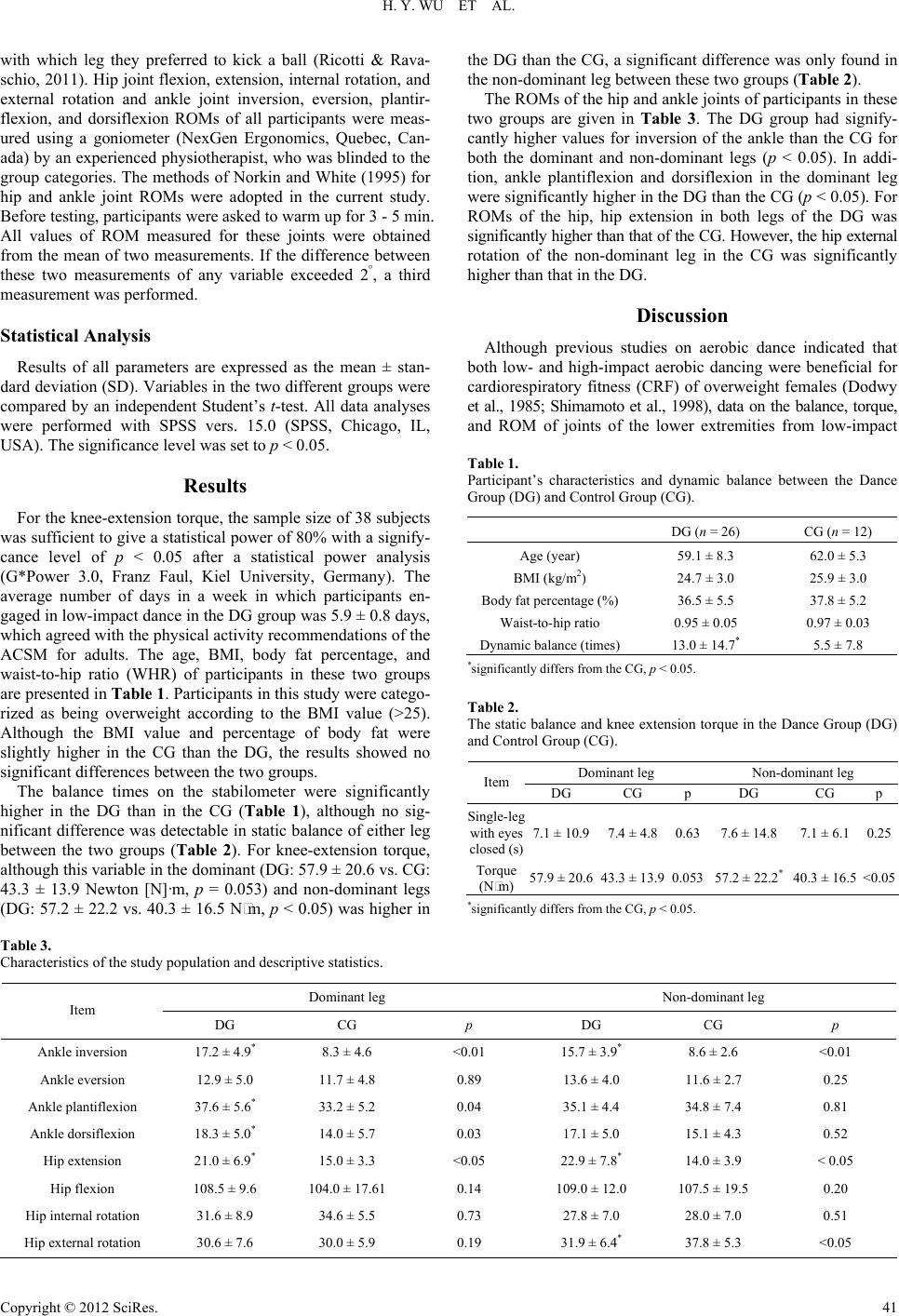 H. Y. WU ET AL. Copyright © 2012 SciRes. 41 with which leg they preferred to kick a ball (Ricotti & Rava- schio, 2011). Hip joint flexion, extension, internal rotation, and external rotation and ankle joint inversion, eversion, plantir- flexion, and dorsiflexion ROMs of all participants were meas- ured using a goniometer (NexGen Ergonomics, Quebec, Can- ada) by an experienced physiotherapist, who was blinded to the group categories. The methods of Norkin and White (1995) for hip and ankle joint ROMs were adopted in the current study. Before testing, participants were asked to warm up for 3 - 5 min. All values of ROM measured for these joints were obtained from the mean of two measurements. If the difference between these two measurements of any variable exceeded 2°, a third measurement was performed. Statistical Analysis Results of all parameters are expressed as the mean ± stan- dard deviation (SD). Variables in the two different groups were compared by an independent Student’s t-test. All data analyses were performed with SPSS vers. 15.0 (SPSS, Chicago, IL, USA). The significance level was set to p < 0.05. Results For the knee-extension torque, the sample size of 38 subjects was sufficient to give a statistical power of 80% with a signify- cance level of p < 0.05 after a statistical power analysis (G*Power 3.0, Franz Faul, Kiel University, Germany). The average number of days in a week in which participants en- gaged in low-impact dance in the DG group was 5.9 ± 0.8 days, which agreed with the physical activity recommendations of the ACSM for adults. The age, BMI, body fat percentage, and waist-to-hip ratio (WHR) of participants in these two groups are presented in Table 1. Participants in this study were catego- rized as being overweight according to the BMI value (>25). Although the BMI value and percentage of body fat were slightly higher in the CG than the DG, the results showed no significant differences between the two groups. The balance times on the stabilometer were significantly higher in the DG than in the CG (Table 1), although no sig- nificant difference was detectable in static balance of either leg between the two groups (Table 2). For knee-extension torque, although this variable in the dominant (DG: 57.9 ± 20.6 vs. CG: 43.3 ± 13.9 Newton [N]·m, p = 0.053) and non-dominant legs (DG: 57.2 ± 22.2 vs. 40.3 ± 16.5 N·m, p < 0.05) was higher in the DG than the CG, a significant difference was only found in the non-dominant leg between these two groups (Table 2). The ROMs of the hip and ankle joints of participants in these two groups are given in Table 3. The DG group had signify- cantly higher values for inversion of the ankle than the CG for both the dominant and non-dominant legs (p < 0.05). In addi- tion, ankle plantiflexion and dorsiflexion in the dominant leg were significantly higher in the DG than the CG (p < 0.05). For ROMs of the hip, hip extension in both legs of the DG was significantly higher than that of the CG. However, the hip external rotation of the non-dominant leg in the CG was significantly higher than that in the DG. Discussion Although previous studies on aerobic dance indicated that both low- and high-impact aerobic dancing were beneficial for cardiorespiratory fitness (CRF) of overweight females (Dodwy et al., 1985; Shimamoto et al., 1998), data on the balance, torque, and ROM of joints of the lower extremities from low-impact Table 1. Participant’s characteristics and dynamic balance between the Dance Group (DG) and Control Group (CG). DG (n = 26) CG (n = 12) Age (year) 59.1 ± 8.3 62.0 ± 5.3 BMI (kg/m2) 24.7 ± 3.0 25.9 ± 3.0 Body fat percentage (% ) 36.5 ± 5.5 37.8 ± 5.2 Waist-to-hip ratio 0.95 ± 0.05 0.97 ± 0.03 Dynamic balance (times)13.0 ± 14.7* 5.5 ± 7.8 *significa ntly differs from the CG, p < 0.05. Table 2. The static balance and knee extension torque in the Dance Group (DG) and Control Group (C G ) . Dominant l eg Non-dominant leg Item DG CG p DG CG p Single-leg with eyes closed (s)7.1 ± 10.97.4 ± 4.80.63 7.6 ± 14.8 7.1 ± 6.10.25 Torque (N·m) 57.9 ± 20.643.3 ± 13.90.05 3 57.2 ± 22.2* 40.3 ± 16.5<0.05 *significa ntly differs from the CG, p < 0.05. Table 3. Characteristics of the study population and descriptive statistics. Dominant l eg Non-domin ant leg Item DG CG p DG CG p Ankle inversion 17.2 ± 4.9* 8.3 ± 4.6 <0.01 15.7 ± 3.9* 8.6 ± 2.6 <0.01 Ankle eversion 12.9 ± 5.0 11.7 ± 4.8 0.89 13.6 ± 4.0 11.6 ± 2.7 0.25 Ankle plantiflexion 37.6 ± 5.6* 33.2 ± 5.2 0.04 35.1 ± 4.4 34.8 ± 7.4 0.81 Ankle dorsi f l exion 18.3 ± 5.0* 14.0 ± 5.7 0.03 17.1 ± 5.0 15.1 ± 4.3 0.52 Hip extensi o n 21.0 ± 6.9* 15.0 ± 3.3 <0.05 22.9 ± 7.8* 14.0 ± 3.9 < 0.05 Hip flexion 108.5 ± 9.6 104.0 ± 17.61 0.14 109.0 ± 12.0 107.5 ± 19.5 0.20 Hip internal rotation 31. 6 ± 8.9 34.6 ± 5.5 0.73 27.8 ± 7.0 28.0 ± 7.0 0.51 Hip external r otation 30.6 ± 7.6 30.0 ± 5.9 0.19 31.9 ± 6.4* 37.8 ± 5.3 <0.05  H. Y. WU ET AL. dance are scarce. Results of the current study support older females who habitually engage in low-impact dance having a higher dynamic balance capacity, greater knee extension torque, and larger ROMs of most of the lower-extremities joints com- pared to those who are physically inactive. Longitudinal and cross-sectional studies reported that main- tenance or interventions with physical activities or exercise that enhance muscle strength and balance in older individuals (Bird et al., 2009; Chandler et al., 1998; Hortobágyi et al., 2001), even exercises of low intensity such as walking, cycling, and tai chi (Huang et al., 2011; Macaluso et al., 2003; Melzer et al., 2003; Qin et al., 2005), were also corroborated with effective- ness in improvement in muscle strength and balance. In this study, the knee extension torque of the non-dominant leg in the DG was significantly higher than that in the CG. Moreover, the knee torque of the dominant leg tended to be higher in the DG than in the CG, even though not statistically significant (p = 0.053). We know that low-impact dance practitioners perform their dance steps by maintaining contact with the ground. These repetitive movements reinforce muscle groups of the lower extremities through the impact of hitting the ground in addition to increasing muscle contractions. We suggest that this model of low-impact dance is a possible reason for the significant difference in the non-dominant leg between the DG and CG. In fact, the above-mentioned stimulations resemble weight-bearing exercises in several studies (Bravo et al., 1996; Kukuljan et al., 2009), which supported the beneficial effects of impact from exercise on muscles. On the other hand, previous literature (Engels et al., 1998; Hopkins et al., 1990) reported that low-impact dance benefited balance and muscle strength of the lower extremities. From the results of dynamic balance, this study also supports conclusions of the related studies on low-impact dance. However, no signi- ficant differences were evident in the static balance of the dominant or non-dominant leg between these two groups. In addition, after associations between knee extension torque and static balance of the dominant and non-dominant legs in the respect- tive groups were further analyzed, no significant relationships were evident. As a result, although low-impact dance displayed a positive result on dynamic balance, further studies regarding the influence of low-impact dance on balance are warranted, because the results for static balance seemed counter to the hypothesis of this study. Several studies indicated that the ROMs of joints in the lower extremities of women and men decrease with age (James & Parker, 1989; Sepic et al., 1986), and the ROMs of these joints in women, such as the ankles, knees and hips, declined more obviously and faster than those of men (Vandervoort et al., 1992). These negative developments, of reduced ROMs of joints in the lower extremities, are likely to increase the chances of losing one’s balance and lead to falls (Mecagni et al., 2000; Vandervoort et al., 1990). Several studies reported that the in- tervention of a battery of physical activities or exercises im- proved the ROMs of joints, and those positive changes could contribute to a decline in the incidence of falls (Cao et al., 2007; Katzman et al., 2007). In the current study, in addition to a few ROMs of joints in the non-dominant leg of the DG tending to be higher compared to those of the CG, most ROMs of joints in the dominant leg, ankle inversion, plantiflexion, and dorsiflex- ion, were significantly higher in the DG than the CG. These results are in agreement with a study by Cao et al., (2007), which supported the positive influence of exercise on ROMs of joints in the lower extremities. We inferred that diverse dance steps, such as side-stepping, walking forward and backward, circling, lifting the legs, tiptoeing with the foot to the front, side, and rear, and raising the heels, were frequently executed with the fixed dominant leg. This bias of utilization is likely to be the reason for the difference between the two groups. On the other hand, although a few movements, such as side-stepping and circling, seem to be useful for the ROM of these joints, no significant difference was found in the ROMs of the hips be- tween the DG and the CG, except for hip external rotation. It is difficult for us to speculate on the reason for this. Accordingly, further studies are needed to explore possible reasons why the ROMs of these joints were higher in the DG than the CG ac- cording to the current results. However, maintaining a certain degree of ROMs of lower-extremity joints from low-impact dance is a novel finding in this study, especially of the domi- nant leg, compared to sedentary counterparts. Studies on older persons reported that maintenance or improvement of the ROM of the lower extremities with exercise can boost the perform- ance of activities of daily living (Alexander et al., 2001; Stan- ziano et al., 2009). Low-impact dancers enjoy this benefit fea- ture because the ROMs of their lower limbs are superior to those of physically inactive individuals. Limitations A few limitations exist in this study. The data regarding fall cases in this study were not investigated, although the parame- ters were related to risk factors for falls. In addition, because this study was not an intervention type of experiment, we can- not infer causality from the aforementioned results, such as balance and torque of knee extension. As a result, further stud- ies are warranted to examine associations between falls and related parameters for regular participants of low-impact dance and the comparisons between low-impact dancers and seden- tary individuals. Conclusion Regular low-impact dancers showed positive features com- pared to individuals who were physically inactive, such as sig- nificantly higher torque and ROM of the lower extremities. In addition, the balance capacity, especially dynamic balance, was obviously higher in participants of low-impact dance. These promising findings should prompt further direct studies to in- vestigate changes in related parameters and fall cases in the elderly who participate in low-impact dance interventions. REFERENCES Alexander, N. B., Gross, M. M., Medell, J. L., & Hofmeyer, M. R. (2001). Effects of functional ability and training on chair-rise bio- mechanics in older adults. The Journals of Gerontology, Series A: Biological Sciences an d Medical Sciences, 56, M538-M547. doi:10.1093/gerona/56.9.M538 American College of Sports Medicine (1998). American college of sports medicine position stand: Exercise and physical activity for older adults. Medicine and Science inSports and Exercise, 30, 992- 1008. Asikainen, T. M., Kukkonen-Harjula, K., & Miilunpalo, S. (2004). Exer- cise for health for early postmenopausal women. Sports Medic ine, 34, 753-778. doi:10.2165/00007256-200434110-00004 Bird, M. L., Hill, K., Ball, M., & Williams, A. D. (2009). Effects of resistance- and flexibility-exercise interventions on balance and re- Copyright © 2012 SciRes. 42  H. Y. WU ET AL. lated measures in older adults. Journal of Aging and Physical Activ- ity, 17, 444-454. Bocalini, D. S., Serra, A. J., dos Santos, L., Murad, N., & Levy, R. F. (2009). Strength training preserves the bone mineral density of post- menopausal women without hormone replacement therapy. Journal of Aging and Health, 21, 519-527. doi:10.1177/0898264309332839 Bravo, G., Gauthier, P., Roy, P. M., Payette, H., Gaulin, P., Harvey, M., Péloquin, L., & Dubois, M. F. (1996). Impact of a 12-month exercise program on the physical and psychological health of osteopenic women. Journal of the American Geriatrics Society, 44, 756-762. Cao, Z. B., Maeda, A., Shima, N., Kurata, H., & Nishizono, H. (2007). The effect of a 12-week combined exercise intervention program on physical performance and gait kinematics in community-dwelling elderly women. Journal of Physio l o gical Anthropology, 26, 325-332. doi:10.2114/jpa2.26.325 Carville, S. F., Rutherford, O. M., & Newham, D. J. (2006). Power output, isometric strength and steadiness in the leg muscles of pre- and postmenopausal women; the effects of hormone replacement therapy. European Journal of Applied Physiology, 96, 292-298. doi:10.1007/s00421-005-0078-4 Chandler, J. M., Duncan, P. W., Kochersberger, G., & Studenski, S. (1998). Is lower extremity strength gain associated with improve- ment in physical performance and disability in frail, community- dwelling elders? Archives of Physical Medicine and Rehabilitation, 79, 24-30. doi:10.1016/S0003-9993(98)90202-7 Dowdy, D. B., Cureton, K. J., DuVal, H. P., & Ouzts, H. G. (1985). Effects of aerobic dance on physical work capacity cardiovascular function and body composition of middle-aged obese women. Re- search Quarterly for Ex ercise and Sport, 56, 227-233. Engels, H. J., Drouin, J., Zhu, W., & Kazmierski, J. F. (1998). Effects of low-impact, moderate-intensity exercise training with and without wrist weights on functional capacities and mood states in older adults. Gerontology, 44, 239-244. doi:10.1159/000022018 Götherström, G., Elbornsson, M., Stibrant-Sunnerhagen, K., Bengtsson, B. A., Johannsson, G., & Svensson, J. (2010). Muscle strength in elderly adults with GH deficiency after 10 years of GH replacement. European Journal of E ndoc rino logy, 163, 207-215. doi:10.1530/EJE-10-0009 Greeves, J. P., Cable, N. T., Reilly, T., & Kingsland , C. (1999). C ha ng es in muscle strength in women following the menopause: A longitudi- nal assessment of the efficacy of hormone replacement therapy. Cli- nical Science, 97, 79-84. doi:10.1042/CS19980406 Hammar, M. L., Lindgren, R., Berg, G. E., Moller, C. G., & Niklasson, M. K. (1996). Effects of hormonal replacement therapy on the pos- tural balance among postmenopausal women. Obstetrics and Gyne- cology, 88, 955-960. doi:10.1016/S0029-7844(96)00356-0 Haskell, W. L., Lee, I. M., Pate, R. R., Powell, K. E., Blair, S. N., Franklin, B. A., Macera, C. A., Heath, G. W., Thompson, P. D., & Bauman, A. (2007). Physical activity and public health: Updated recommendation for adults from the American College of Sports Me- dicine and the American Heart Association. Medicine and Science in Sports and Exercise, 3 9, 1423-1434. doi:10.1249/mss.0b013e3180616b27 Hopkins, D. R., Murrah, B., Hoeger, W. W., & Rhodes, R. C. (1990). Effect of low-impact aerobic dance on the functional fitness of eld- erly women. The Gerontologist, 30, 189-192. doi:10.1093/geront/30.2.189 Hortoba´gyi, T., Tunnel, D., Moody, J., Beam, S., & DeVita, P. (2001). Low- or high-intensity strength training partially restores impaired quadriceps force accuracy and steadiness in aged adults. The Jour- nals of Gerontology, Series A: Biological Sciences and Medical Sci- ences, 56, B38-B47. doi:10.1093/gerona/56.1.B38 Huang, T. T., Yang, L. H., & Liu, C. Y. (2011). Reducing the fear of falling among community-dwelling elderly adults through cogni- tive-behavioural strategies and intense Tai Chi exercise: A random- ized controlled trial. Journal of Advanced Nursing, 67, 961-971. doi:10.1111/j.1365-2648.2010.05553.x James, B., & Parker, A. W. (1989). Active and passive mobility of lower limb joints in elderly men and women. American Journal of Physical Medicine & Rehabilitation, 68, 162-167. doi:10.1097/00002060-198908000-00002 Janis, L. R. (1990). Aerobic dance survey. A study of high-impact versus low-impact injuries. Journal of the American Podiatric Medi- cal Association, 80, 419-423. Katzman, W. B., Sell meyer, D. E., St ewart, A. L ., Wanek , L., & Ha mel, K. A. (2007). Chan ges in flexed posture, musculoskeletal i mpairment s, and physical performance after group exercise in community-dwell- ing older women. Archives of Physical Medicine and Rehabilitation, 88, 192-199. doi:10.1016/j.apmr.2006.10.033 Kukuljan, S., Nowson, C. A., Sanders, K., & Daly, R. M. (2009). Ef- fects of resistan ce exercise and fortif ied milk on skeletal muscle mass, muscle size, and functional perfor mance in middle-aged and older men: An 18-mo randomized controlled trial. Journal of Applied Physiol- ogy, 107, 1864-1873. doi:10.1152/japplphysiol.00392.2009 Macaluso, A., Young, A., Gibb, K. S., Rowe, D. A., & De Vito, G. (2003). Cycling as a novel approach to resistance training increases muscle strength, power, and selected functional abilities in healthy older women. Journal of Applied Physiology, 95, 2544-2553. Mecagni, C., Smith, J. P., Roberts, K. E., & O’Sullivan, S. B. (2000). Balance and ankle range of motion in community-dwelling women aged 64 to 87 years: A correlational study. Physical Therapy, 80, 1004- 1011. Melzer, I., Benjuya, N., & Kaplanski, J. (2003). Effects of regular walking on postural stability in the elderly. Gerontology, 49, 240- 245. doi:10.1159/000070404 Norkin, C. W., & White, D. J. (1995). Measurement of joint motion (2nd ed.). P hiladelphia, FA: Davis . Qin, L., Choy, W., Leung, K., Leung, P. C., Au, S., Hung, W., Dam- bacher, M., & Chan, K. (2005). Beneficial effects of regular Tai Chi exercise on musculoskeletal system. Journal of Bone and Mineral Metabolism, 23, 186-190. doi:10.1007/s00774-004-0559-2 Ricard, M. D., & Veatch, S. (1990). Comparison of impact forces in high and low impact aerobic dance movements. International Jour- nal of Sport Biomechanics, 6, 67-77. Ricotti, L., & Ravaschio, A. (2011). Break dance significantly increases static balance in 9 years-old soccer players. Gait Posture, 33, 462- 465. doi:10.1016/j.gaitpost.2010.12.026 Roberts, H. (2007). Managing the menopause. British Medical Journal, 334, 736-741. doi:10.1136/bmj.39153.522535.BE Rubenstein, L. Z. (2006). Falls in older people: Epidemiology, risk fac- tors and strategies for prevention. Age and A geing, 35, ii37-ii41. doi:10.1093/ageing/afl084 Sepic, S. B., Murray, M. P., Mollinger, L. A., Spu rr, G. B., & Gardner, G. M. (1986). Strength and range of motion in the ankle in two age groups of men and women. American Journal of Physical Medicine, 65, 75-84. Shigematsu, R., Okura, T., Sakai, T., & Rantanen, T. (2008). Square- stepping exercise versus strength and balance training for fall risk factors. Aging Clinical and Experimental Research, 2 0 , 19-24. Shimamoto, H., Adachi, Y., Takahashi, M., & Tanaka, K. (1998). Low impact aerobic dance as a useful exercise mode for reducing body mass in mildly obese middle-aged women. Journal of Physiological Anthropology, 17, 109-114. Stanziano, D. C., Roos, B. A., Perry, A. C., Lai, S., & Signorile, J. F. (2009). The effects of an active-assisted stretching program on func- tional performance in elderly persons: A pilot study. Clinical Inter- ventions in Aging, 4, 115-120. Steffen, T. M., Hacker, T. A., & Mollinger, L. (2002). Age- and gender-related test performance in community-dwelling elderly peo- ple: Six-minute walk test, Berg balance scale, timed up & go test, an d gait speeds. Physical Therapy, 82, 128-137. Vandervoort, A. A., Chesworth, B. M., Cunningham, D. A., Rechnitzer, P. A., Paterson, D. H., & Koval, J. J. (1992). An outcome measure to quantify passive stiffness of the ankle. Canadian Journal of Public Health, 83, S19-S23. Vandervoort, A. A., Hill, K., Sandrin, M., & Vyse, V. M. (1990). Mo- bility impairment and falling in the elderly. Physiotherapy Canada, 42, 99-107. Yokoya, T., Demura, S., & Sato, S. (2008). Fall risk characteristics of the elderly in an exercise class. Journal of Physiological Anthropol- ogy, 27, 25-32. doi:10.2114/jpa2.27.25 Copyright © 2012 SciRes. 43 |