

Paper Menu >>
Journal Menu >>
 Vol.2, No.5, 450-456 (2010) Natural Science http://dx.doi.org/10.4236/ns.2010.25055 Copyright © 2010 SciRes. OPEN ACCESS Wettability alteration by magnesium ion binding in heavy oil/brine/chemical/sand systems—analysis of hydration forces Qiang Liu1, Ming-Zhe Dong2*, Koorosh Asghari1, Yun Tu3 1Faculty of Engineering, University of Regina, Regina, Canada; 2Department of Chemical and Petroleum Engineering, University of Calgary, Calgary, Canada; *Corresponding Author: [email protected] 3Institute for Chemical Process and Environmental Technology, National Research Council, Ottawa, Canada Received 17 November 2009; revised 13 January 2010; accepted 28 February 2010. ABSTRACT In laboratory sandpack tests for heavy oil re- covery by alkaline flooding, it was found that wettability alteration of the sand had a signifi- cant impact on oil recovery. In this work, a heavy oil of 14 API was used to examine the effect of organic acids in the oil and water che- mistry on wettability alteration. From interfacial tension measurements and sand surface com- position analysis, it was concluded that the water-wet sand became preferentially oil-wet by magnesium ion binding. The presence of Mg2+ in the heavy oil/Na2CO3 solution/sand system in- creased the oil/water interfacial tension. This confirmed the hypothesis that magnesium ion combined with the ionized organic acids to form magnesium soap at oil/water interface. Under alkaline condition, the ionized organic acids in the oil phase partition into the water phase and subsequently adsorb on the sand surfaces. The analysis of sand surface composition sugg- ested that more ionized organic acids adsorb- ed on the sand surface through magnesium ion binding. The attachment of more organic acids on the sand surface changed hydration forces, making the sand surface more oil-wet. Keywords: Wettability Alteration; Alkaline Flooding; Magnesium Ion Binding; Interfacial Tension; Organic Acids 1. INTRODUCTION Wettability plays an important role in determining the distribution and flow of fluids in the pores of a reservoir [1]. Whether the pore surface of reservoir rock is water- wet or oil-wet is determined by the thickness of the wa- ter film between the rock surface and the oil [2]. For very thick films, the system is stable and remains water- wet. If it is unstable, the film will break, resulting in direct contact of oil to the rock surface and adsorption of polar components on pore walls. The stability of a thick water film is dependent on the magnitude of the disjoin- ing pressure. The disjoining pressure that tends to disjoin or separate the oil/water and water/rock interfaces are identified as a combination of van der Waals, electro- static and hydration forces. The van der Waals forces are attractive, while electrostatic forces are repulsive be- tween the interfaces. The hydration forces can be either a hydrophilic effect for a surface such as clean quartz or a hydrophobic effect for a surface with an organic coating. If the magnitude of repulsive forces is greater than the attractive forces, the water film is stable, and the surface remains water-wet. The hydrophobic effect of hydration forces can be caused by the adsorption of polar compounds that were originally in crude oils [3-5]. These compounds have a polar end and a hydrocarbon chain. The polar end con- tacts the rock surface and the hydrocarbon chain exposes to the liquid phase, making the surface more oil-wet [6]. Some of the polar compounds are soluble in water so that they can diffuse through the thin water film to ad- sorb onto the rock surface [7]. It has been found that, even when a surface active compound has a very low solubility in water, it could reach the solid surface by diffusion through the water film [8]. This will make the attractive force greater and the water film could be drained to result in an oil-wet surface. Kowalewski et al. [9] conducted wettability tests us- ing Berea sandstone, brine (NaCl) and n-decane with different concentrations of hexadecylamine. The wet- tability of the sandstone samples was changed from wa- ter-wet to neutral due to the adsorption of hexade- cylamine on the rock surface. Ashayer et al. [10] studied  Q. Liu et al. / Natural Science 2 (2010) 450-456 Copyright © 2010 SciRes. OPEN ACCESS 451 451 the influence of surfactant molecules (alkyl ether car- boxylic acid) on wetting phenomena with a glass mi- cromodel. It has been found that the solid surface attracts the polar head group of the surfactant molecules and the tail of the surfactant is free at the water/glass interface. The attractive force between the hydrophobic tail of the surfactant and the oil chain causes the formation of a “hydrophobic bond”, which changes the wettability of the surface from water-wet to oil-wet. Buckley et al. [11] believed that when the brine phase contained divalent cations, wettability could be altered by ion binding me- chanism. The divalent ions combined the oil with min- eral surface, making the mineral less water-wet. Wettability alteration is one of the mechanisms of en- hanced oil recovery by alkaline flooding. Cooke et al. [12] studied wettability in alkaline flooding in glass mi- cro-model by acidic oils and formation waters. They observed that the wettability of the matrix of the glass micro-model changed from strongly water-wet to pref- erentially oil-wet after alkaline flooding. They believed that the wettability alteration was caused by the adsorp- tion of ionized acids onto the solid surface. Waterflooding of heavy oil reservoirs exhibits very poor sweep efficiency mainly due to a adverse mobility ratio and water channeling [13]. Ma et al. [14] conducted channeled sandpack flood tests of alkaline flooding for a Western Canadian heavy oil sample. It was found that wettability alteration of sand led to oil re-distribution, blockage of existing water channel in porous media and improvement in oil recovery. Liu et al. [15] studied wet- tability alteration in a heavy oil/water/sand system by analyzing the electronic forces at oil-water and water- sand interfaces through ζ-potential measurements. They found that the presence of either Na2CO3 or Mg2+ alone in the water phase could not induce wettability alteration. When the water phase contained both Na2CO3 and Mg2+, the water-wet sand became preferentially oil-wet by magnesium ion binding. The reduction in zeta ()-po- tential at both oil-water and water-sand interfaces due to the addition of Mg2+ to the heavy oil/Na2CO 3 solu- tion/sand system confirmed the combination of Mg2+ and ionized organic acids at the oil/water interface. They concluded that the reduction of repulsive electrostatic forces between oil drops and sand surfaces contributed to the wettability change of the sand from water-wet to oil-wet. The objective of this paper is to examine the contribu- tion of hydration forces at oil-water interface to the wet- tability alteration in the heavy oil/water/sand system used by Liu et al. [15]. The magnesium ion binding was investigated by measuring oil-water interfacial tension (IFT) and water surface tension and analyzing sand sur- face composition. These results provide insight into the partition of polar compounds in heavy oil/water system and their adsorption onto the sand surface as well as the relation between the magnesium ion binding and wet- tability alteration. 2. EXPERIMENTAL In this study, micro-slide and micro-model tests were conducted to observe wettability alteration during the oil displacement process. Heavy oil/brine interfacial ten- sions and surface tension of water phase were measured for different systems to investigate the interactions be- tween heavy oil, brine and sand. Sand surface composi- tions under different conditions were analyzed to evalu- ate the adsorption of polar substances onto sand surface after oil/water/sand interaction. All tests were conducted at ambient temperature (22 0.5C) except specified. 2.1. Materials A heavy oil of 14API collected from a reservoir in Alberta, Canada was used in this study. The oil sample was centrifuged at 10,000 rpm at 35C for two hours to remove water and solids. The viscosity, density and acid numbers of the oil were analyzed and are shown in Ta- ble 1. The oil had a viscosity of 1,800 mPas and a den- sity of 0.964 g/cm3 at 22C. In this study, the effect of divalent ions (mainly Ca2+ and Mg2+) on the wettability of the sand in oil/brine/sand system was examined. Solution of 1.0 wt% NaCl in de- ionized water other than the formation brine was used as water phase for the anaysis of hydration forces [15]. MgCl2 was added to adjust Mg2+ concentration in water phase. Na2CO3 was used to neutralize the organic acids (polar compounds) in the oil. Varsol (a commercial solvent containing kerosene as the main component) and ethanol were used to clean the micromodel. The sand used in this work was from U.S. Silica Company and was originally water-wet. 2.2. Wettability Tests with Micro-Slide and Micro-Model In this paper, two methods are employed to examine the wettability of a solid surface in porous media: mi- cro-slide test and micro-model test. For the details of the micro-slide and micro-model tests, readers are referred to a previous work by Liu et al. [15]. Micro-slide tests were conducted for observing the wettability of sands in different oil/alkaline solution sys- tems. The oil and water were equilibrated for 50 hours Table 1. Viscosity, density and acid number of the heavy oil sample. Acid number, mg KOH per gram of sample Viscosity, mPas Density, g/cm3 Strong Weak Total 1,800 0.964 0.89 0.43 1.32  Q. Liu et al. / Natural Science 2 (2010) 450-456 Copyright © 2010 SciRes. OPEN ACCESS 452 and separated for micro-slide tests. Sand was added into the water phase for adsorption for 50 hours and sepa- rated for preparing the micro-slide models. Then a monolayer of the sand was sandwiched between two micro-slides and saturated with the equilibrium oil phase. The equilibrium water phase was introduced to the mo- del for an imbibition-type displacement of oil. A glass micro-model was used to conduct alkaline flooding. The transparent nature of the micro-model al- lows the pore-scale multi-phase displacement and wet- tability of the pore surfaces to be visually observed [16]. The displacement procedure for a micro-model test was as follows: 1) Saturate the micromodel with the water phase (1.0 wt% NaCl); 2) Inject the heavy oil or kerosene; 3) Conduct waterflood (1.0 wt% NaCl) for two pore volumes (PV); 4) Conduct alkaline flood by injecting 0.20 wt% Na2CO3 in brine with or without Mg2+ for one PV. Microphotographs were taken at different stages of the displacement tests to observe the wettability of the pore surface. 2.3. IFT Measurement The spinning drop tensiometer (Model 510, Temco, USA) was employed to measure the water surface tension and oil/water interfacial tension. For surface tension meas- urement, an air bubble was injected into a glass tube filled with a water solution; for IFT measurement, an oil droplet was injected into the glass capillary tube. The IFTs and surface tensions are determined using the fol- lowing equation: 327 )(1042694.3 D dh L/D ≥ 4 (1) where σ is interfacial tension (dyne/cm), h is the density of heavy (outer) phase (g/cm3), d is the density of light (drop) phase (g/cm3), is rotational velocity (rpm), D is measured drop width (diameter) (mm), and L is the length of the oil drop (mm). 2.4. Analysis of Sand Surface Composition In the heavy oil/brine/sand systems, some of the ionized organic acids in the oil phase will partition into the water phase and subsequently adsorb on the sand surface. The adsorption of ionized organic acids on the sand surface was investigated by analyzing the surface compositions of the sand before and after it was brought to contact the water phase. Because the sand surface was easily con- taminated by oil drops in the water phase, the sand was equilibrated with the heavy oil/brine system as follows. 1) The water phase was equilibrated with the heavy oil; 2) The water phase was filtered to remove oil droplets before it was mixed with the sand; 3) The sand sample was mixed with the water phase for two weeks for ad- sorption; 4) The sand was separated from the water us- ing a stainless steel sieve and dried in an oven at 60C for one hour. The compositions of the top 7-nm surface layer of the sand was analyzed by using a Kratos AXIS Ultra X-Ray photoelectron spectrometer (XPS), equip- ped with a hemispherical analyzer, a delay line detector, charge neutralizer and monochromated Al Kα X-ray source. 3. RESULTS AND DISCUSSION 3.1. Onset Na2CO3 and Mg2+ Concentrations for Wettability Alteration In the previous wettability study by Liu et al. [15], the heavy oil was equilibrated with water phases of different compositions by adding Na2CO3 or NaOH to react with the organic acids in the oil and CaCl2 and MgCl2 to ad- just Ca2+ or Mg2+ in the water phase. It was found that the presence of Na2CO3 and Mg2+ could cause wettabil- ity alteration in the heavy oil/water/sand systems. In order to examine the effect of Na2CO3 and Mg2+ on wet- tability alteration, micro-slide tests were conducted with various Na2CO3 and Mg2+ concentrations. Table 2 shows the results of micro-slide tests at dif- ferent Na2CO3 concentrations with or without the pres- ence of Mg2+. No wettability alteration was observed for the samples of Series A, which contained only Na2CO3. In the presence of 100 mg/L Mg2+, wettability alteration occurred when Na2CO3 concentration reached a specific value; 0.10 wt% for Series B in which 100 mg/L Mg2+ was added after the water phase was equilibrated with the oil; 0.20 wt% for Series C in which 100 mg/L Mg2+ was added before the water phase was equilibrated with the oil. The onset Mg2+ concentration for wettability altera- tion was investigated by using micro-slide tests with 0.20 wt% Na2CO3 and various Mg2+ concentrations (named as Series D in Table 3). Magnesium ions were added into the water phase before oil-water equilibration. As shown in Table 3, wettability alteration was initiated at a concentration of 50 mg/L Mg2+. 3.2. Effect of Organic Acids on Wettability Alteration To investigate the effect of organic acids in oil on wet- tability alteration, two micro-model tests were conducted to observe wettability alteration during alkaline flooding displacement. In one test, the heavy oil was used; in the other test, kerosene was used as the oil phase which was free of organic acids. The same water phase (1.0 wt% NaCl + 0.20 wt% Na2CO3 + 100 mg/L Mg2+) was used for both tests. Figure 1 shows the pore-level microphotographs of the micro-model taken during the test with the heavy oil,  Q. Liu et al. / Natural Science 2 (2010) 450-456 Copyright © 2010 SciRes. OPEN ACCESS 453 453 Table 2. Wettability of sand in microslide tests at different Na2CO3 concentration with or without the presence of Mg2+. Na2CO3 concentration, wt% Test series Method of Mg2+ addition 0.020 0.050 0.10 0.20 0.50 A No Mg2+ No No No No No B 100 mg/L Mg2+ added after water equilibrated with oil No No Yes Yes Yes C 100 mg/L Mg2+ added before water equilibrated with oil No No Partial Yes Yes Note: Yeswettability alteration; Nono wettability alteration; Partialpartial wettability alteration. Table 3. Effect of Mg2+ on wettability in microslide tests, Na2CO3: 0.20 wt% (Test series D). Concentration of Mg2+, mg/L 0 10 20 50 100 200 Wettability alteration No No No Yes Yes Yes showing oil and water distribution at different displace- ment stages. Water films between the oil and the pore walls exist before the injection of alkaline solution. After alkaline flooding, oil films exist between the water and pore walls, indicating that the pore walls have became preferentially oil-wet. The oil/water menisci in Figures 1(b) to 1(d) are convex to the oil phase, suggesting that the glass pore is oil-wet. It is also shown from the dis- tribution of oil and water phase in the pores that the glass model has become preferentially oil-wet. The re- sults in Figure 1 are consistent with those in micro-slide tests. Figure 2 shows the wettability of glass pores at dif- ferent stages of the micro-model test with kerosene. The glass pores remained water-wet after alkaline flooding. The difference between crude oil and kerosene is that the heavy oil contains organic acids and kerosene does not. The results of the two micro-model tests suggest that the organic acids in the oil phase are the origin of wettability alteration in alkaline flooding. 3.3. Heavy Oil/Brine/Sand Interactions As reviewed in the introduction, hydration forces can have a hydrophobic effect for a surface with an organic coating. In this section, the effect of heavy oil/brine/sand interaction on the hydration forces is investigated. The samples of Series A through D listed in Tables 2 and 3 were used for the following measurements and tests. 3.3.1. IFT Variation Caused by the Presence of Mg2+ The combination of magnesium and ionized organic acids deactivate the ionized acids at the oil/water inter- face and, therefore, increases the oil/water interfacial tension. To see the interaction of Mg2+ and ionized or- ganic acids at oil/water interface, interfacial tensions of the heavy oil and water phase were measured for sys- tems with and without Mg2+. Figure 3 shows the inter- facial tensions as a function of Na2CO3 concentration for two water solutions: one did not contain Mg2+ and the other contained 20 mg/L Mg2+. The addition of Na2CO 3 in the water phase reduced the IFT of the heavy oil and water from its original value (approximately 25 dyne/cm) to 2.13, 1.12, and 0.38 dyne/cm at 0.02, 0.05, and 0.1 wt% Na2CO3, respectively. In the presence of 20 ml/L Mg2+, the IFTs were raised to 12.0, 7.5, and 4.5 at the above three Na2CO3 concentrations, respectively, and to approximately one order magnitude higher at Na2CO3 concentrations between 0.1 and 0.5 wt%. Figure 4 shows the IFT of the heavy oil and brine at 0.20 wt% Na2CO3 and different Mg2+ concentrations. The IFT was increased dramatically with Mg2+ concentration between 0 to 20 mg/L and then increased slightly with Mg2+ con- centration in the water phase. This indicates that the sur- face activity of the ionized organic acids was decreased significantly by the presence of Mg2+. The divalent cation, Mg2+, could be concentrated at the oil/water in- terface; therefore, only 20 mg/L Mg2+ could make the ionized organic acids incapable in reducing the IFT be- tween the oil and water. The dynamic IFTs of the heavy oil with three water samples of Series D (0, 5, and 10 mg/L Mg2+) were also (a) (b) (c) (d) Figure 1. Pictures of one location of micromodel at four stages of oil displacement process. Oil phase: heavy oil, Na2CO3 concentration in alkaline slug: 0.20 wt%, Mg2+ concentration in water: 100 mg/L. (a) After water flooding; (b) after alkaline flooding; (c) 50 hours after alkaline flooding; (d) 150 hours after alkaline flooding. 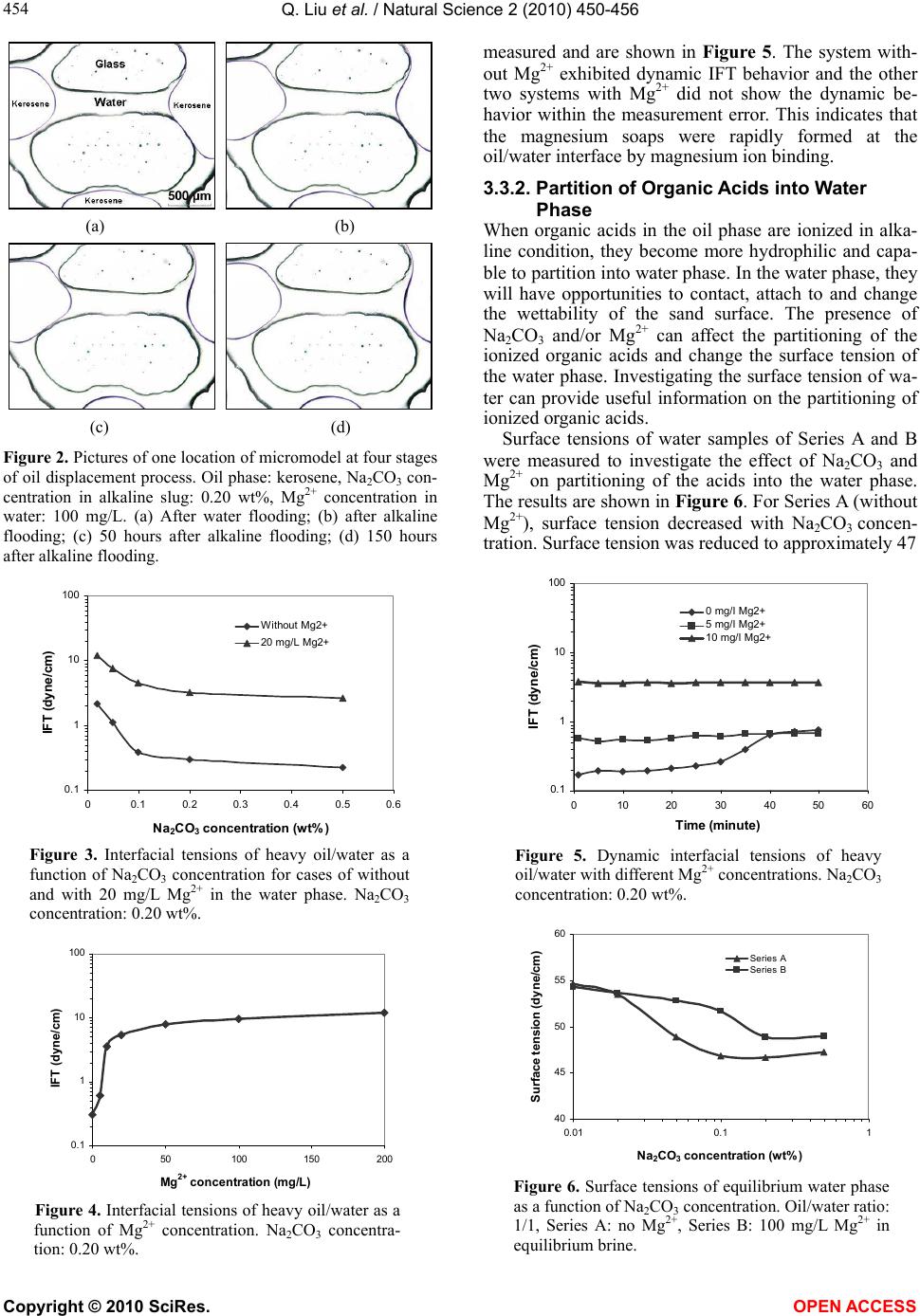 Q. Liu et al. / Natural Science 2 (2010) 450-456 Copyright © 2010 SciRes. OPEN ACCESS 454 (a) (b) (c) (d) Figure 2. Pictures of one location of micromodel at four stages of oil displacement process. Oil phase: kerosene, Na2CO3 con- centration in alkaline slug: 0.20 wt%, Mg2+ concentration in water: 100 mg/L. (a) After water flooding; (b) after alkaline flooding; (c) 50 hours after alkaline flooding; (d) 150 hours after alkaline flooding. 0.1 1 10 100 00.10.2 0.3 0.40.5 0.6 Na 2 CO 3 concentration (wt%) IFT (dyne/cm) Without Mg2+ 20 mg/L Mg2+ Figure 3. Interfacial tensions of heavy oil/water as a function of Na2CO3 concentration for cases of without and with 20 mg/L Mg2+ in the water phase. Na2CO3 concentration: 0.20 wt%. 0. 1 1 10 100 050100 150200 Mg 2+ concentration (mg/L) IFT (dyne/cm) Figure 4. Interfacial tensions of heavy oil/water as a function of Mg2+ concentration. Na2CO3 concentra- tion: 0.20 wt%. measured and are shown in Figure 5. The system with- out Mg2+ exhibited dynamic IFT behavior and the other two systems with Mg2+ did not show the dynamic be- havior within the measurement error. This indicates that the magnesium soaps were rapidly formed at the oil/water interface by magnesium ion binding. 3.3.2. Partition of Organic Acids into Water Phase When organic acids in the oil phase are ionized in alka- line condition, they become more hydrophilic and capa- ble to partition into water phase. In the water phase, they will have opportunities to contact, attach to and change the wettability of the sand surface. The presence of Na2CO3 and/or Mg2+ can affect the partitioning of the ionized organic acids and change the surface tension of the water phase. Investigating the surface tension of wa- ter can provide useful information on the partitioning of ionized organic acids. Surface tensions of water samples of Series A and B were measured to investigate the effect of Na2CO3 and Mg2+ on partitioning of the acids into the water phase. The results are shown in Figure 6. For Series A (without Mg2+), surface tension decreased with Na2CO3 concen- tration. Surface tension was reduced to approximately 47 0.1 1 10 100 0 102030405060 Time (minute) IFT (dyne/cm) 0 mg/l Mg2+ 5 mg/l Mg2+ 10 mg/l Mg2+ Figure 5. Dynamic interfacial tensions of heavy oil/water with different Mg2+ concentrations. Na2CO3 concentration: 0.20 wt%. 40 45 50 55 60 0.01 0.11 Na 2 CO 3 concentration (wt%) Surface tension (dyne/cm) Series A Series B Figure 6. Surface tensions of equilibrium water phase as a function of Na2CO3 concentration. Oil/water ratio: 1/1, Series A: no Mg2+, Series B: 100 mg/L Mg2+ in equilibrium brine. 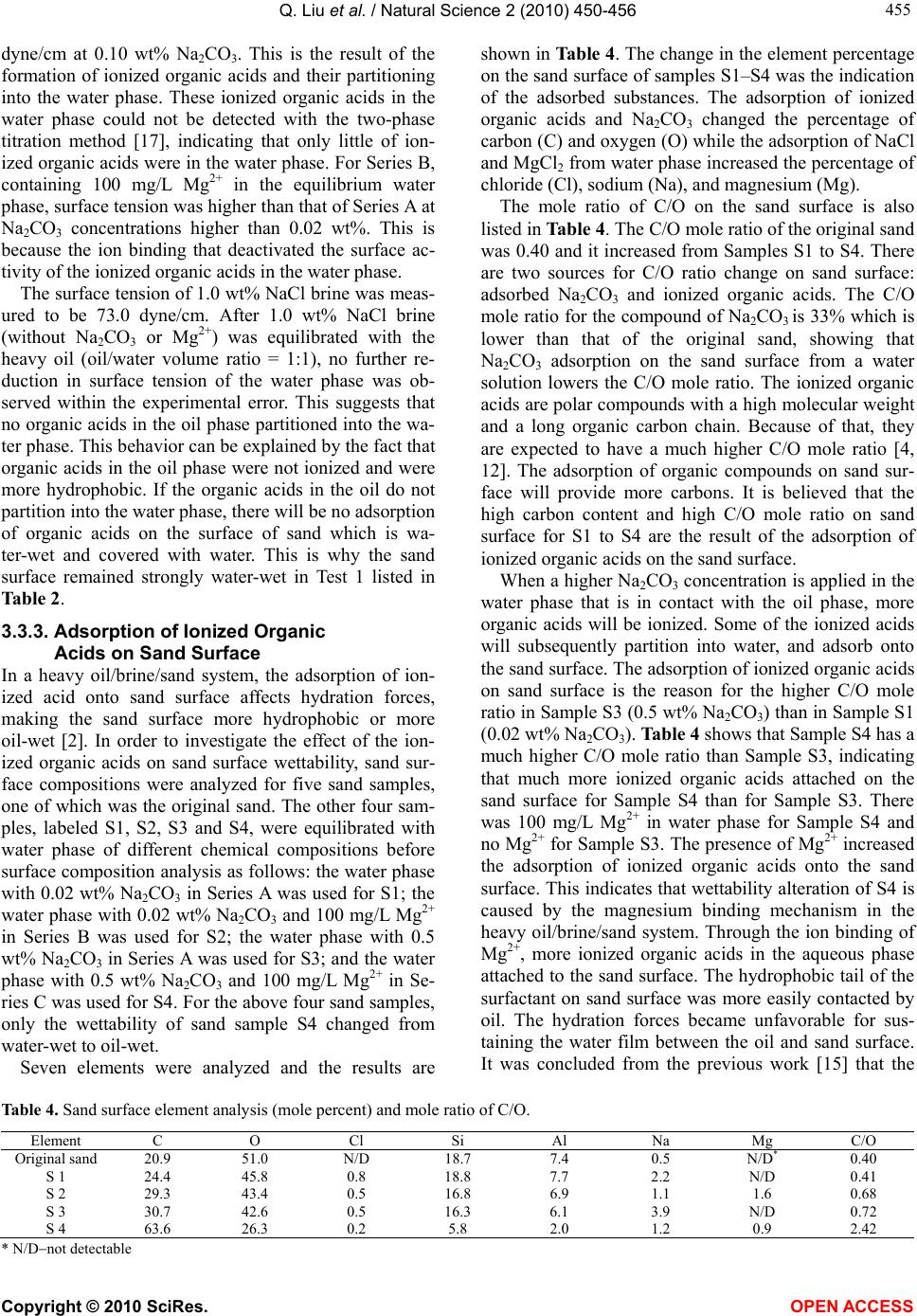 Q. Liu et al. / Natural Science 2 (2010) 450-456 Copyright © 2010 SciRes. OPEN ACCESS 455 455 dyne/cm at 0.10 wt% Na2CO3. This is the result of the formation of ionized organic acids and their partitioning into the water phase. These ionized organic acids in the water phase could not be detected with the two-phase titration method [17], indicating that only little of ion- ized organic acids were in the water phase. For Series B, containing 100 mg/L Mg2+ in the equilibrium water phase, surface tension was higher than that of Series A at Na2CO3 concentrations higher than 0.02 wt%. This is because the ion binding that deactivated the surface ac- tivity of the ionized organic acids in the water phase. The surface tension of 1.0 wt% NaCl brine was meas- ured to be 73.0 dyne/cm. After 1.0 wt% NaCl brine (without Na2CO3 or Mg2+) was equilibrated with the heavy oil (oil/water volume ratio = 1:1), no further re- duction in surface tension of the water phase was ob- served within the experimental error. This suggests that no organic acids in the oil phase partitioned into the wa- ter phase. This behavior can be explained by the fact that organic acids in the oil phase were not ionized and were more hydrophobic. If the organic acids in the oil do not partition into the water phase, there will be no adsorption of organic acids on the surface of sand which is wa- ter-wet and covered with water. This is why the sand surface remained strongly water-wet in Test 1 listed in Table 2. 3.3.3. Adsorption of Ionized Organic Acids on Sand Surface In a heavy oil/brine/sand system, the adsorption of ion- ized acid onto sand surface affects hydration forces, making the sand surface more hydrophobic or more oil-wet [2]. In order to investigate the effect of the ion- ized organic acids on sand surface wettability, sand sur- face compositions were analyzed for five sand samples, one of which was the original sand. The other four sam- ples, labeled S1, S2, S3 and S4, were equilibrated with water phase of different chemical compositions before surface composition analysis as follows: the water phase with 0.02 wt% Na2CO3 in Series A was used for S1; the water phase with 0.02 wt% Na2CO3 and 100 mg/L Mg2+ in Series B was used for S2; the water phase with 0.5 wt% Na2CO3 in Series A was used for S3; and the water phase with 0.5 wt% Na2CO3 and 100 mg/L Mg2+ in Se- ries C was used for S4. For the above four sand samples, only the wettability of sand sample S4 changed from water-wet to oil-wet. Seven elements were analyzed and the results are shown in Table 4. The change in the element percentage on the sand surface of samples S1–S4 was the indication of the adsorbed substances. The adsorption of ionized organic acids and Na2CO3 changed the percentage of carbon (C) and oxygen (O) while the adsorption of NaCl and MgCl2 from water phase increased the percentage of chloride (Cl), sodium (Na), and magnesium (Mg). The mole ratio of C/O on the sand surface is also listed in Table 4. The C/O mole ratio of the original sand was 0.40 and it increased from Samples S1 to S4. There are two sources for C/O ratio change on sand surface: adsorbed Na2CO3 and ionized organic acids. The C/O mole ratio for the compound of Na2CO3 is 33% which is lower than that of the original sand, showing that Na2CO3 adsorption on the sand surface from a water solution lowers the C/O mole ratio. The ionized organic acids are polar compounds with a high molecular weight and a long organic carbon chain. Because of that, they are expected to have a much higher C/O mole ratio [4, 12]. The adsorption of organic compounds on sand sur- face will provide more carbons. It is believed that the high carbon content and high C/O mole ratio on sand surface for S1 to S4 are the result of the adsorption of ionized organic acids on the sand surface. When a higher Na2CO3 concentration is applied in the water phase that is in contact with the oil phase, more organic acids will be ionized. Some of the ionized acids will subsequently partition into water, and adsorb onto the sand surface. The adsorption of ionized organic acids on sand surface is the reason for the higher C/O mole ratio in Sample S3 (0.5 wt% Na2CO3) than in Sample S1 (0.02 wt% Na2CO3). Table 4 shows that Sample S4 has a much higher C/O mole ratio than Sample S3, indicating that much more ionized organic acids attached on the sand surface for Sample S4 than for Sample S3. There was 100 mg/L Mg2+ in water phase for Sample S4 and no Mg2+ for Sample S3. The presence of Mg2+ increased the adsorption of ionized organic acids onto the sand surface. This indicates that wettability alteration of S4 is caused by the magnesium binding mechanism in the heavy oil/brine/sand system. Through the ion binding of Mg2+, more ionized organic acids in the aqueous phase attached to the sand surface. The hydrophobic tail of the surfactant on sand surface was more easily contacted by oil. The hydration forces became unfavorable for sus- taining the water film between the oil and sand surface. It was concluded from the previous work [15] that the Table 4. Sand surface element analysis (mole percent) and mole ratio of C/O. Element C O Cl Si Al Na Mg C/O Original sand 20.9 51.0 N/D 18.7 7.4 0.5 N/D* 0.40 S 1 24.4 45.8 0.8 18.8 7.7 2.2 N/D 0.41 S 2 29.3 43.4 0.5 16.8 6.9 1.1 1.6 0.68 S 3 30.7 42.6 0.5 16.3 6.1 3.9 N/D 0.72 S 4 63.6 26.3 0.2 5.8 2.0 1.2 0.9 2.42 * N/Dnot detectable 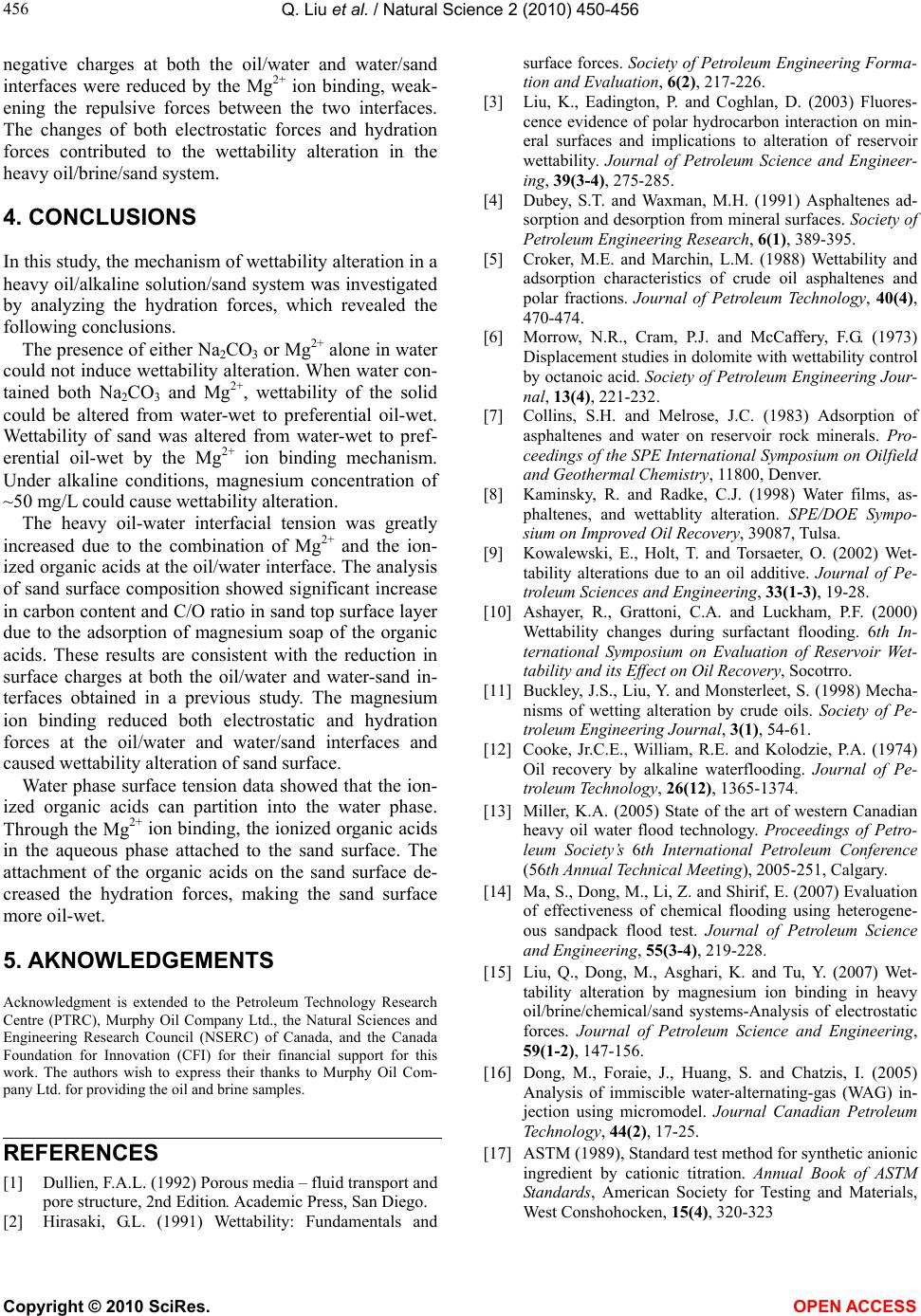 Q. Liu et al. / Natural Science 2 (2010) 450-456 Copyright © 2010 SciRes. OPEN ACCESS 456 negative charges at both the oil/water and water/sand interfaces were reduced by the Mg2+ ion binding, weak- ening the repulsive forces between the two interfaces. The changes of both electrostatic forces and hydration forces contributed to the wettability alteration in the heavy oil/brine/sand system. 4. CONCLUSIONS In this study, the mechanism of wettability alteration in a heavy oil/alkaline solution/sand system was investigated by analyzing the hydration forces, which revealed the following conclusions. The presence of either Na2CO3 or Mg2+ alone in water could not induce wettability alteration. When water con- tained both Na2CO3 and Mg2+, wettability of the solid could be altered from water-wet to preferential oil-wet. Wettability of sand was altered from water-wet to pref- erential oil-wet by the Mg2+ ion binding mechanism. Under alkaline conditions, magnesium concentration of ~50 mg/L could cause wettability alteration. The heavy oil-water interfacial tension was greatly increased due to the combination of Mg2+ and the ion- ized organic acids at the oil/water interface. The analysis of sand surface composition showed significant increase in carbon content and C/O ratio in sand top surface layer due to the adsorption of magnesium soap of the organic acids. These results are consistent with the reduction in surface charges at both the oil/water and water-sand in- terfaces obtained in a previous study. The magnesium ion binding reduced both electrostatic and hydration forces at the oil/water and water/sand interfaces and caused wettability alteration of sand surface. Water phase surface tension data showed that the ion- ized organic acids can partition into the water phase. Through the Mg2+ ion binding, the ionized organic acids in the aqueous phase attached to the sand surface. The attachment of the organic acids on the sand surface de- creased the hydration forces, making the sand surface more oil-wet. 5. AKNOWLEDGEMENTS Acknowledgment is extended to the Petroleum Technology Research Centre (PTRC), Murphy Oil Company Ltd., the Natural Sciences and Engineering Research Council (NSERC) of Canada, and the Canada Foundation for Innovation (CFI) for their financial support for this work. The authors wish to express their thanks to Murphy Oil Com- pany Ltd. for providing the oil and brine samples. REFERENCES [1] Dullien, F.A.L. (1992) Porous media – fluid transport and pore structure, 2nd Edition. Academic Press, San Diego. [2] Hirasaki, G.L. (1991) Wettability: Fundamentals and surface forces. Society of Petroleum Engineering Forma- tion and Evaluation, 6(2), 217-226. [3] Liu, K., Eadington, P. and Coghlan, D. (2003) Fluores- cence evidence of polar hydrocarbon interaction on min- eral surfaces and implications to alteration of reservoir wettability. Journal of Petroleum Science and Engineer- ing, 39(3-4), 275-285. [4] Dubey, S.T. and Waxman, M.H. (1991) Asphaltenes ad- sorption and desorption from mineral surfaces. Society of Petroleum Engineering Research, 6(1), 389-395. [5] Croker, M.E. and Marchin, L.M. (1988) Wettability and adsorption characteristics of crude oil asphaltenes and polar fractions. Journal of Petroleum Technology, 40(4), 470-474. [6] Morrow, N.R., Cram, P.J. and McCaffery, F.G. (1973) Displacement studies in dolomite with wettability control by octanoic acid. Society of Petroleum Engineering Jour- nal, 13(4), 221-232. [7] Collins, S.H. and Melrose, J.C. (1983) Adsorption of asphaltenes and water on reservoir rock minerals. Pro- ceedings of the SPE International Symposium on Oilfield and Geothermal Chemistry, 11800, Denver. [8] Kaminsky, R. and Radke, C.J. (1998) Water films, as- phaltenes, and wettablity alteration. SPE/DOE Sympo- sium on Improved Oil Recovery, 39087, Tulsa. [9] Kowalewski, E., Holt, T. and Torsaeter, O. (2002) Wet- tability alterations due to an oil additive. Journal of Pe- troleum Sciences and Engineering, 33(1-3), 19-28. [10] Ashayer, R., Grattoni, C.A. and Luckham, P.F. (2000) Wettability changes during surfactant flooding. 6th In- ternational Symposium on Evaluation of Reservoir Wet- tability and its Effect on Oil Recovery, Socotrro. [11] Buckley, J.S., Liu, Y. and Monsterleet, S. (1998) Mecha- nisms of wetting alteration by crude oils. Society of Pe- troleum Engineering Journal, 3(1), 54-61. [12] Cooke, Jr.C.E., William, R.E. and Kolodzie, P.A. (1974) Oil recovery by alkaline waterflooding. Journal of Pe- troleum Technology, 26(12), 1365-1374. [13] Miller, K.A. (2005) State of the art of western Canadian heavy oil water flood technology. Proceedings of Petro- leum Society’s 6th International Petroleum Conference (56th Annual Technical Meeting), 2005-251, Calgary. [14] Ma, S., Dong, M., Li, Z. and Shirif, E. (2007) Evaluation of effectiveness of chemical flooding using heterogene- ous sandpack flood test. Journal of Petroleum Science and Engineering, 55(3-4), 219-228. [15] Liu, Q., Dong, M., Asghari, K. and Tu, Y. (2007) Wet- tability alteration by magnesium ion binding in heavy oil/brine/chemical/sand systems-Analysis of electrostatic forces. Journal of Petroleum Science and Engineering, 59(1-2), 147-156. [16] Dong, M., Foraie, J., Huang, S. and Chatzis, I. (2005) Analysis of immiscible water-alternating-gas (WAG) in- jection using micromodel. Journal Canadian Petroleum Technology, 44(2), 17-25. [17] ASTM (1989), Standard test method for synthetic anionic ingredient by cationic titration. Annual Book of ASTM Standards, American Society for Testing and Materials, West Conshohocken, 15(4), 320-323 |