

Paper Menu >>
Journal Menu >>
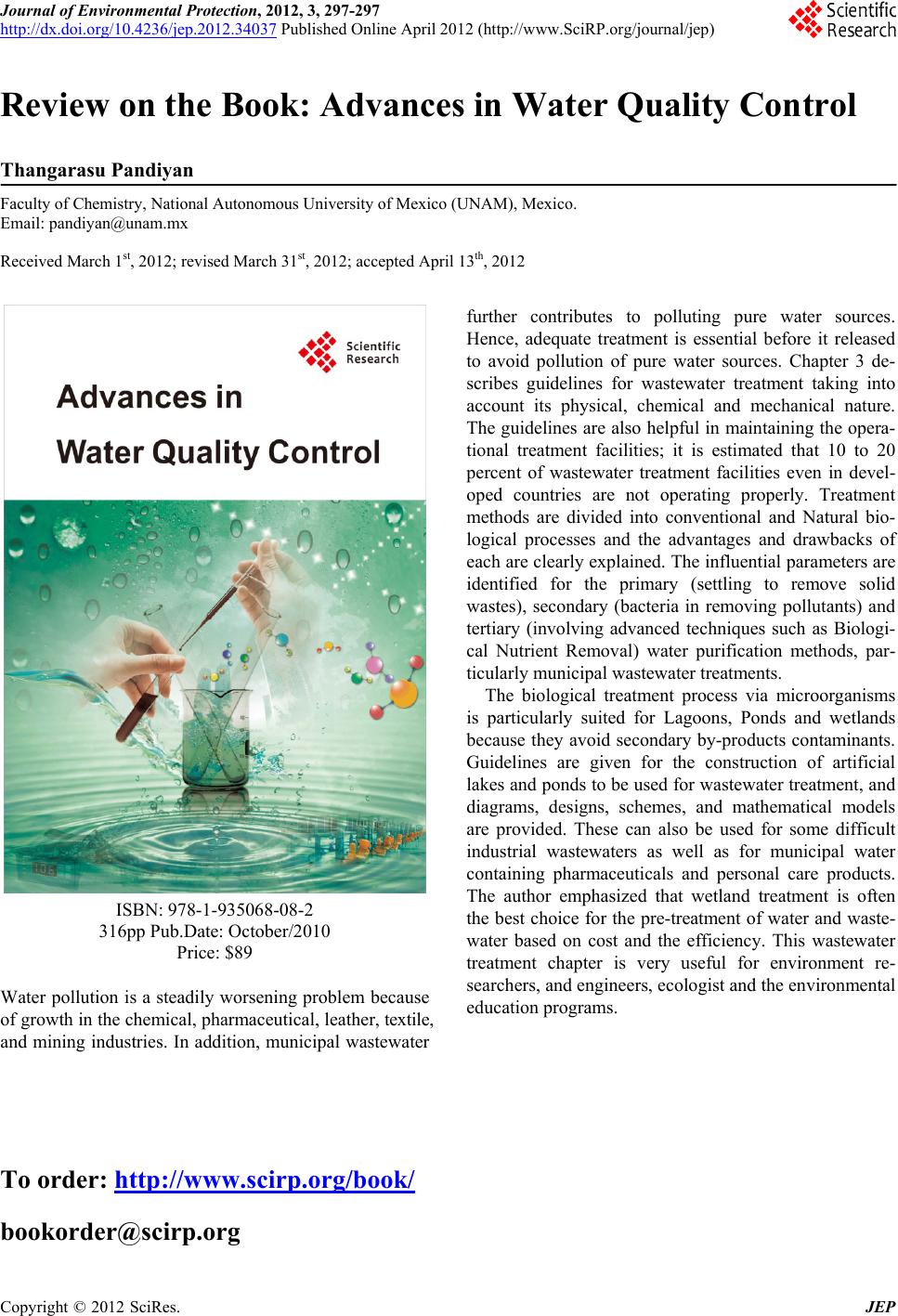 Journal of Environmental Protection, 2012, 3, 297-297 http://dx.doi.org/10.4236/jep.2012.34037 Published Online April 2012 (http://www.SciRP.org/journal/jep) 297 Review on the Book: Advances in Water Quality Control Thangarasu Pandiyan Faculty of Chemistry, National Autonomous University of Mexico (UNAM), Mexico. Email: [email protected] Received March 1st, 2012; revised March 31st, 2012; accepted April 13th, 2012 ISBN: 978-1-935068-08-2 316pp Pub.Da te: October/2010 Price: $89 Water pollution is a steadily worsening problem because of growth in the chemical, pharmaceutical, leather, textile, and mining industries. In addition, municipal wastewater further contributes to polluting pure water sources. Hence, adequate treatment is essential before it released to avoid pollution of pure water sources. Chapter 3 de- scribes guidelines for wastewater treatment taking into account its physical, chemical and mechanical nature. The guidelines are also helpful in maintaining the opera- tional treatment facilities; it is estimated that 10 to 20 percent of wastewater treatment facilities even in devel- oped countries are not operating properly. Treatment methods are divided into conventional and Natural bio- logical processes and the advantages and drawbacks of each are clearly explained. The influential parameters are identified for the primary (settling to remove solid wastes), secondary (bacteria in removing pollutants) and tertiary (involving advanced techniques such as Biologi- cal Nutrient Removal) water purification methods, par- ticularly municipal wastewater treatments. The biological treatment process via microorganisms is particularly suited for Lagoons, Ponds and wetlands because they avoid secondary by-products contaminants. Guidelines are given for the construction of artificial lakes and ponds to be used for wastewater treatment, and diagrams, designs, schemes, and mathematical models are provided. These can also be used for some difficult industrial wastewaters as well as for municipal water containing pharmaceuticals and personal care products. The author emphasized that wetland treatment is often the best choice for the pre-treatment of water and waste- water based on cost and the efficiency. This wastewater treatment chapter is very useful for environment re- searchers, and engineers, ecologist and the environmental education programs. To order: http://www.scirp.org/book/ Copyright © 2012 SciRes. JEP |