

Paper Menu >>
Journal Menu >>
 Open Journal of Leadership 2012. Vol.1, No.1, 1-4 Published Online March 2012 in SciRes (http://www.SciRP.org/journal/ojl) http://dx.doi.org/10.4236/ojl.2012.11001 Copyright © 2012 SciRes. 1 Gender Differences and Leadership Styles in a Non Secular Setting Judith Corbett Carter SEEK Department, Brooklyn College, Ci ty University of New York, New York, USA Email: jccarte [email protected] Received February 2nd, 2012; revised Marc h 7 th, 2012; accepted March 17th, 2012 Women are increasingly taking on the role of religious leaders despite some institutional barriers. Do ef- fective female clergy lead differently than effective male clergy? The focus of this study was to examine gender differences in the context of non secular leadership. The Multifactor Leadership Questionnaire (MLQ) styles and NEO-Five Factor Inventory (FFI) was used to measure leadership and personal charac- teristics of female and male pastors. Limited findings indicate that female pastors were higher in Open- ness and Charisma than male pastors. Keywords: Gender and Leadership, Transformational Leadership, Pastoral Leaders, Non Secular Leaders Introduction Women are assuming a greater number of leadership roles in religious organizations and for some “gender equality is becom- ing the accepted norm” (Fielder, 2010). The number of women in the pastorate has doubled since the 1990’s along with the number of female seminarians who pursue ordination (Barna Study, 2009). However, some church leadership use Timothy 2:12 “I do not permit a woman to teach or to have authority over a man; she must be silent (NIV)”, as justification for de- nying women the role of pastoral leader. Paul wrote about equality in the sight of God in this passage of scripture You are all sons of God through faith in Christ Jesus, for all of you who were baptized into Christ have clothed yourselves with Christ. There is neither Jew nor Greek, slave nor free, male nor female, for you are all one in Christ Jesus (NIV, Ga- latians 3: pp. 26-28). In addition, several women in leadership are noted in both Old and New Testament. For example, Deborah, mother of Israel and national leader, was a prophet and judge who pro- vided strong leadership (Judges 4 & 5; Belleville, 2000). Noriko (2000) argued that women not only in the Christian Church suffer injustice, but “institutionalized religion is inher- ently and irrecoverably patriarchal and can be detrimental to women’s attainment of liberation and power” (p. 85). Therefore, women are denied positions of power in many religious or- ganizations and in the US 50% of US churches do not grant women the privilege of ordination (Chaves, 1997). Furt her, those in ministry are restricted to entry level positions (1997), or smaller churches if permitted to be head pastor, and have li- mited appointment opportunities for prestigious assignments (Sullins, 2000) despite the fact that female clergy are more highly educated; approximately 77% earn seminary degrees while only 2/3 of their male counterparts receive degrees (Ba- rna Study, 2009). In this article female pastoral leaders who were perceived as effective by congregants participated in this study along with male pastoral leaders. Gender differences in personality, trans- formational, and transactional leadership style in the context of church leadership was explored. Gender and Leadership The perception of effective leadership is influenced by vari- ables such as race, culture, gender, (Lorber, 1994), however, race will not be the focus of this paper. Gender is a social con- struct specifying the socially and culturally prescribed roles that men and women are to follow (Collins, 1990; Hooks, 2000; Lorber, 1994; Meade, 1935). It is also one of the ways human beings organize their lives (Lorber, 1994). According to social role theory sexual differences are based on a division of labor between the sexes that fosters the development of gender roles by which each sex is expected to have characteristics that equip it for the work roles that are typical for people of this sex (Eagly & Wood, 1987). In other words, gender roles are rules about how females and males should behave. Gender roles are also central to gender centered theory of leadership which focuses on individual differences. This appro- ach purports that there are female and male personal character- istics as they relate to leadership. Eagly, Wood, and Diekman, (2000) identify gendered attributes as agentic and communal. Agentic traits such as aggressive, ambitious, dominant, forceful, independent, daring, self-confident and competitive have been closely associated with men in leadership (Eagly & Johanne- sen-Schmidt, 2001). Communal traits such as affectionate, help- ful, kind, sympathetic, interpersonally sensitive, nuturant, and gentle have been identified with women in leadership (Eagly & Johannesen-Schmidt, 2001). In a non secular context Zikmund and Lummis (1998) find- ings that women pastors were considered more caring, sensitive, and personable than their male counterparts were similar to Eagly et al. (2000). In another study, however, findings were different, female pastors were viewed as more radical, emo- tionally stable, dominate, expedient, non conforming, and self assured than male pastors (Musson, 2001). Early gender centered theorists believed that men and women possessed personality characteristics that were incongruent with effective leadership skills (Cheung, 1997; Fagenson, 1990). How-  J. C. CARTER ever, social role expectations were a more plausible explanation that accounted for gender differences in most studies (Yukl, 1998). The emphasis on gender differences, some argue, has been used to exclude women from secular and non secular lead- ership positions (Cheung, 1997; Stelter, 2002). Gender and Transformational and Transactional Leadership Styles Transformational and transactional behaviors are also associ- ated with leadership style studies. The transformational (a.k.a. charismatic) leaders are those who articulate a vision of the future and share it with peers and followers (Bass, 1998; Burns, 1978; Judge & Bono, 2000; Lowe et al., 1996). The emphasis of this model is the connection between leader and follower as it relates to organizational development (Bass, 1985). These leaders regard leadership as a social process and partnership (Alimo-Metcalf, 2010). They are also risk takers who attempt to reshape and create new opportunities for employee involve- ment (Bass, 1985; Lowe et al., 1996). In addition, they intel- lectually stimulate followers and pay attention to individual differences and seek new and creative ways to solve problems. Transactional leaders tend to operate within an existing sys- tem by maintaining status quo and avoid taking risks (Bass, 1985; Lowe et al., 1996; Madzar, 2001). An effective transact- tional leader is able to work in a stable predictable environment (Lowe et al., 1996) and is good at negotiating deals for com- pliance and satisfactory performance (Burns, 1978). Researchers have found that women exhibit more transfor- mational leadership qualities such as establishing a vision, finding creative ways of problem solving, and developing fol- lower’s leadership skills (Bass & Avolio, 1994). In Eagly and Johannesen-Schmidt (2001) analysis and women and men’s leadership style they found women rated slightly higher on three of the transformational leadership scales. Men were found to be higher in transactional leadership scales. In terms of church leaders and leadership style, Ukeritis (1993) found “that church leaders were rated more consistently as transformational leaders than transactional leaders” (p. 168). Additionally, they explained this in linking “transformational leadership qualities such as charisma and intellectual stimula- tion as consistent with the values of religious life” (p. 168). The female leaders operated more democratically, collaboratively, and participatively. In addition, women found innovative ways to accomplish goals and objectives (Wallace, 1992). Results showed that women used a collaborative leadership style and fostered a sense of community. Summary As the research cited indicates, traits’ impact on the way that women and men lead is inconclusive. However, in both secular and non secular leadership style studies women exhibit more transformational leadership style qualities than men. More em- pirical evidence is necessary to validate the assumption that effective female and male clergy lead differently. Method Pastors were recruited for the study via referral and online church directories and they were contacted by telephone, elec- tronic mail, and mail. Of the full-time pastors who participated in the study, 13 were female and 80 were male. The mean age of females was 49 years, and males, 50 years. Pastors submitted names and contact information of congregants and/or staff members who could serve as raters. There were a total of 124 raters. Sixty six percent of the raters were female and 34% were male. The average for the age of participants was 51 years. Measures The Multifactor Leadership Questionnaire (MLQ) was used to measure leadership style. It assesses three dimensions of transformational leadership style: Charismatic Leadership, In- dividual Consideration, and Intellectual Stimulation. The MLQ also assesses transactional leadership style: Contingent Re ward and Man agement by Exception. The NEO Five Factor Inventory (NEO FFI). Developed by Costa and McCrae (1992), it is a 60-item questionnaire that op- erationalizes the five major dimensions of personality seen in the Five-Factor Model (FFM) (NEO FFI; Costa & McCrae, 1992). Neuroticism, Extraversion, Openness, Agreeableness, and Con- scientiousness. The PLES was designe d by the author. The 23-item pool items were answered on a five-point scale ranging from 1 (strongly disagree) to 5 (strongly agree). Results Descriptive statistics on all variables are presented in Table 1. Participating female and male pastors scored high in extra- version and agreeableness (T-scores > 55) and average in neu- roticism, and conscientiousness (T-scores between 45 - 55). Female pastors scored high in openness (T-scores > 55). In Table 1, observer rated MLQ transformational leadership scores (idealized influence attributed, idealized influence be- havior, inspirational motivation, intellectual stimulation, indi- vidual consideration) were above normative means for these scales established by Bass and Avolio (1995). The normative means for idealized influence attributed, idealized influence behavior, inspirational motivation, intellectual stimulation, and individual consideration were 2.56, 2.64, 2.64, 2.51, and 2.26 respectively. Observer rated transactional leadership scores were above the mean in contingent reward and below the mean in management by exception active and management by excep- tion passive, as established by Bass and Avolio (1995). The normative means for contingent reward, management by excep- tion active, and management by exceptionpassive are 2.20, 1.75, and 1.11, respectively. In Table 2 Combined observer-rated transformational idealized influence attributed and behavior, inspirational motivation, intellectual stimulation and individual consideration scores revealed positive moderate correlations with observer ratings in the PLES. Additionally, a positive mo- derate correlation with contingent reward was also noted. Discussion The purpose of this study was to examine differences in fe- male and male pastors’ personality and leadership style as it relates to pastoral leader effectiveness. Female pastors Open- ness mean scores were slightly higher than male pastors. Indi- viduals high in Openness are characterized as being more will- ing to entertain novel ideas and interests and open to new ex- periences, such as new ideas, emotions, actions, and creative thought (Callister, 1999). Leaders high in Openness can also be described as intelligent, original, imaginative, broad interests, Copyright © 2012 SciRes. 2 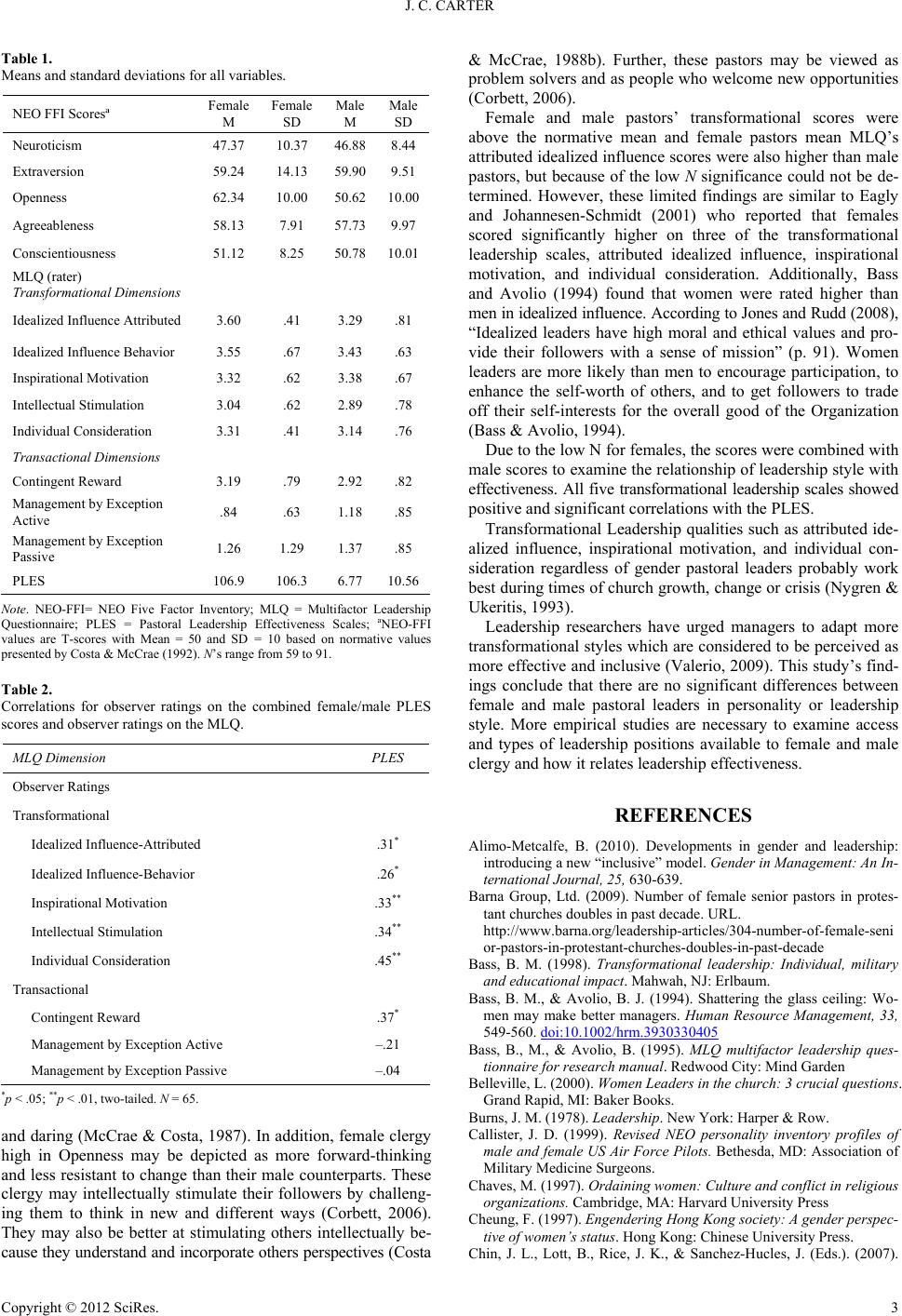 J. C. CARTER Table 1. Means and standard deviations for all variables. NEO FFI Scoresª Female M Female SD Male M Male SD Neuroticism 47.37 10.37 46.888.44 Extraversion 59.24 14.13 59.909.51 Openness 62.34 10.00 50.6210.00 Agreeableness 58.13 7.91 57.739.97 Conscientiousness 51.12 8.25 50.7810.01 MLQ (rater) Transformational Dim ensions Idealized Inf luence Attributed 3.60 .41 3.29 .81 Idealized Inf luence Behavior 3.55 .67 3.43 .63 Inspirational Motiva t ion 3.32 .62 3.38 .67 Intellectual Stimula tio n 3.04 .62 2.89 .78 Individual Consideration 3.31 .41 3.14 .76 Transactiona l Dimensions Contingent Reward 3.19 .79 2.92 .82 Management by Exception Active .84 .63 1.18 .85 Management by Exception Passive 1.26 1.29 1.37 .85 PLES 106.9 106.3 6.77 10.56 Note. NEO-FFI= NEO Five Factor Inventory; MLQ = Multifactor Leadership Questionnaire; PLES = Pastoral Leadership Effectiveness Scales; aNEO-FFI values are T-scores with Mean = 50 and SD = 10 based on normative values presented by Costa & McCrae (1992). N’s range from 59 to 91. Table 2. Correlations for observer ratings on the combined female/male PLES scores and observer ratings on the MLQ. MLQ Dimension PLES Observer Ratings Transformational Idealized Influence-Attrib ut ed .31* Idealized Influence-Behavior .26* Inspirationa l M otivation .33** Intellectual Stimulation .34** Individual Consideration .45** Transactional Contingent Re ward .37* Management by Exception Active –.21 Management by Exce p tion Passive –.04 *p < .05; **p < .01, two-tailed. N = 65. and daring (McCrae & Costa, 1987). In addition, female clergy high in Openness may be depicted as more forward-thinking and less resistant to change than their male counterparts. These clergy may intellectually stimulate their followers by challeng- ing them to think in new and different ways (Corbett, 2006). They may also be better at stimulating others intellectually be- cause they understand and incorp orate others perspectives (Costa & McCrae, 1988b). Further, these pastors may be viewed as problem solvers and as people who welcome new opportunities (Corbett, 2006). Female and male pastors’ transformational scores were above the normative mean and female pastors mean MLQ’s attributed idealized influence scores were also higher than male pastors, but because of the low N significance could not be de- termined. However, these limited findings are similar to Eagly and Johannesen-Schmidt (2001) who reported that females scored significantly higher on three of the transformational leadership scales, attributed idealized influence, inspirational motivation, and individual consideration. Additionally, Bass and Avolio (1994) found that women were rated higher than men in idealized influence. According to Jones and Rudd (2008 ), “Idealized leaders have high moral and ethical values and pro- vide their followers with a sense of mission” (p. 91). Women leaders are more likely than men to encourage participation, to enhance the self-worth of others, and to get followers to trade off their self-interests for the overall good of the Organization (Bass & Avolio, 1994). Due to the low N for females, the scores were combined with male scores to examine the relationship of leadership style with effectiveness. All five transformational leadership scales showed positive and significant correlations with the PLES. Transformational Leadership qualities such as attributed ide- alized influence, inspirational motivation, and individual con- sideration regardless of gender pastoral leaders probably work best during times of church growth, change or crisis (Nygren & Ukeritis, 1993). Leadership researchers have urged managers to adapt more transformational styles which are considered to be perceived as more effective and inclusive (Valerio, 2009). This study’s find- ings conclude that there are no significant differences between female and male pastoral leaders in personality or leadership style. More empirical studies are necessary to examine access and types of leadership positions available to female and male clergy and how it relates leadership effectiveness. REFERENCES Alimo-Metcalfe, B. (2010). Developments in gender and leadership: introducing a new “inclusive” model. Gender in Management: An In- ternational Journal, 2 5, 630-639. Barna Group, Ltd. (2009). Number of female senior pastors in protes- tant churches doubles in past d e c a d e . URL. http://www.barna.org/leadership-articles/304-number-of-female-seni or-pastors-in-protestant-churches-doubles-in-past-decade Bass, B. M. (1998). Transformational leadership: Individual, military and educational impact . Mahwah, NJ: Erlbaum. Bass, B. M., & Avolio, B. J. (1994). Shattering the glass ceiling: Wo- men may make better managers. Human Resource Management, 33, 549-560. doi:10.1002/hrm.3930330405 Bass, B., M., & Avolio, B. (1995). MLQ multifactor leadership ques- tionnaire for research manual. Redwood City: Mind Garden Belleville, L. (2000). Women Leaders in the church: 3 crucial questions. Grand Rapid, MI: Baker Books. Burns, J. M. (1978). Leadership. New York: Harper & Row. Callister, J. D. (1999). Revised NEO personality inventory profiles of male and female US Air Force Pilots. Bethesda, MD: Association of Military Medicine Surgeons. Chaves, M. (1997). Ordaining women: Culture and conflict in religious organizations. Cambridge, MA: Harvard University Press Cheung, F. (1997). Engendering Hong Kong society: A gender perspec- tive of women’s status. Hong Kong: Chinese University Pr ess. Chin, J. L., Lott, B., Rice, J. K., & Sanchez-Hucles, J. (Eds.). (2007). Copyright © 2012 SciRes. 3  J. C. CARTER Copyright © 2012 SciRes. 4 Women and Leadership: Transforming vision and diverse voices. Malden, MA: Blackwell Collins, P. H. (1990). Black feminist thought. New York: Routledge. Corbett, J. (2006). The personal and spiritual characteristics of effec- tive pastoral leaders. Doctoral Dissertation, Baltimore, MD: Loyola College in Maryland, Accession Order No. AAT 3437177. Costa, P. T., & McCrae, R. R. (1992). NEO PI-R professional manual. Odessa: Psychological Assessment Resources, Inc. Eagly, A. H., & Johnson, B. (1990). Gender and leadership style: A meta-analysis. Psychological Bulletin , 108, 233-256. doi:10.1037/0033-2909.108.2.233 Eagly, A. H., & Johannesen-Schmidt, M. C. (2001). The leadership styles of women and men. Journal of Social Issues, 57, 781-797. doi:10.1111/0022-4537.00241 Eagly, A. H., Wood, W., & Diekman, A. B. (2000). Social role theory of sex differences and similarities: A current appraisal. In T. Eckes, & H. M. Trautner (Eds.), The developmental social psychology of gender (pp. 123-174). Mahwah, NJ: Erlbaum. Fagenson, E. (1990). At the heart of women in management research: Theoretical and methodological approaches and their biases. Journal of Business Ethics, 9, 267-274. doi:10.1007/BF00380326 Hooks, B. (2000). Feminist theory: From margin to center. Cambridge, MA: South End Press. Jones, D. & Rudd, R. (2008). Journal of Agricultural Education, 49, 88-97. doi:10.5032/jae.2008.02088 Lorber, J. (1994). Paradoxes of gender. New Haven: Yale University Press. Meade, M. (1935). Sex and temperament in three primitive societies. London: William Morrow. Musson, D. (2001). Male and female anglican clergy: Gender reversal on the 16PF5? Review of Religious Res ea rc h, 43, 175-183. doi:10.2307/3512061 Noriko, K. (2000). Seven hindrances of women? A popular discourse on Okinawan women. Japanese Journal of Religious Studies, 27, 85- 97. Nygren, D., & Ukeritis, M. (1993). The future of religious orders in the United States: Transformation and commitment. Westport, CT: Pra- eger Publishers. Stelter, N. (2002). Gender differences in leadership: Current social is- sues and future organizational implications. Journal of Leadership & Organizational Studies, 8, 88-99. doi:10.1177/107179190200800408 Sullins, P. (2000). The stained glass ceiling: Career attainment for wo- men clergy. Sociology of Religion, 61, 243-266. doi:10.2307/3712578 Wallace, R. A. (1992). Women and religion: The transformation of leadership roles. Journal for the Scientific Study of Religion, 39, 496-508. doi:10.1111/j.1468-5906.2000.tb00011.x Yukl, G. (1998). An evaluation of conceptual weaknesses in transfor- mational and charismatic leadership theories. The Leadership Quar- terly, 10, 285-305. doi:10.1016/S1048-9843(99)00013-2 Zikmund, B. B. & Lumnis, A. T., Chang, P. T. (1998). Clergy women: An uphill calling. Louisville, KY: Westminster J o hn Knox Pres s . |