

Paper Menu >>
Journal Menu >>
 Engineering, 2010, 2, 322-327 doi:10.4236/eng.2010.25042 Published Online May 2010 (http://www.SciRP.org/journal/eng) Copyright © 2010 SciRes. ENG Corrosion Behavior of Laser Remelted CoNiCrAlY Based Composite Coatings Dragos Utu1, Gabriela Marginean2, Viorel-Aurel Serban1, Cosmin Codrean1 1University “Politehnica” Timisoara, Faculty of Mechanical Engineering, Timisoara, Romania 2University of Applied Sciences Gelsenkirchen, Gelsenkirchen, Germany E-mail: [email protected] Received November 27, 2009; revised February 5, 2010; accepted February 12, 2010 Abstract The corrosion behavior of High-Velocity Oxygen Fuel (HVOF) sprayed MCrAlY coatings obtained from CoNiCrAlY particles (wt. 8% Al) mechanically doped with Al2O3 nanopowder was investigated before and after laser remelting. The latter process was applied in order to achieve a homogeneous structure as well as better mechanical properties for the coating (reduced brittleness offered by the presence of the Al2O3 nanoparticles). Another important task of the laboratory investigations was the investigation of the corrosion behavior of the modified coatings. The results obtained from the potentiodynamic polarization measurements carried out in a chloride environment revealed an enhanced corrosion resistance of the laser remelted coat- ings comprising a refined microstructure. Microhardness measurements of the modified coatings revealed lower values in comparison with that of the samples in as-sprayed status. This observation leads to the as- sumption that a concomitant improvement of coatings ductility occurred as well. Keywords: Laser Remelting, Conicraly Coatings, Corrosion Behaviour 1. Introduction In the turbine blades section of the engines, the overall operating conditions became progressively more hostile in terms of temperature and mechanical environment. A solution in order to solve this problem is applying of protective thermal barriers consisting of a ceramic insu- lating layer bonded to an oxidation resistant MCrAlY coating. The latter one belongs to the family of high temperature coatings (around 850-1200C), where M is selected from one or a combination of iron, nickel and cobalt [1,2]. Cr and Al are present in the MCrAlY chemical composition because they are able to form highly tenacious protective oxide scales [3], whilst Y promotes formation of these stable oxides [4]. Their pro- tection role is given by the formation of a compact, sta- ble, and adherent oxide layer (usually α-A2O3) on the surface, which exhibits any interaction between the base material and the corrosive medium. Without this protec- tive scale, the coating and ultimately the substrate, would come under rapid oxidation and/or corrosion attack [5]. The durability or service life of the MCrAlY coating depends mainly on the stability of the formed alumina scale [6]. The microstructure of the grown oxide scales depends strongly on the coating properties, the manufacturing process and the operating conditions. In a previous research work it has been demonstrated that the mechanical alloying of MCrAlY powders with nano-Al2O3 leads o a better high temperature oxidation behavior of the HVOF-sprayed coating in comparison with the conventional MCrAlY coating. This conclusion is based mainly on the reduced oxidation rate of the Al2O3 doped MCrAlY coating, which is a very important parameter concerning the kinetics of the oxide scale growth [7,8]. Therefore, another supplementary task should be settled in the coatings investigation, namely their behavior under mechanical loadings. Doping of the MCrAlY coatings with ceramic particles which are uni- formly distributed along the grain boundaries between the MCrAlY particles, showed the main disadvantage concerning its negative influence on the coating ductility (due to the presence of brittle compounds). Rapid melting and solidifying of the MCrAlY coatings achieved using a laser beam can offer good mechanical behavior of the whole system (coating-substrate). 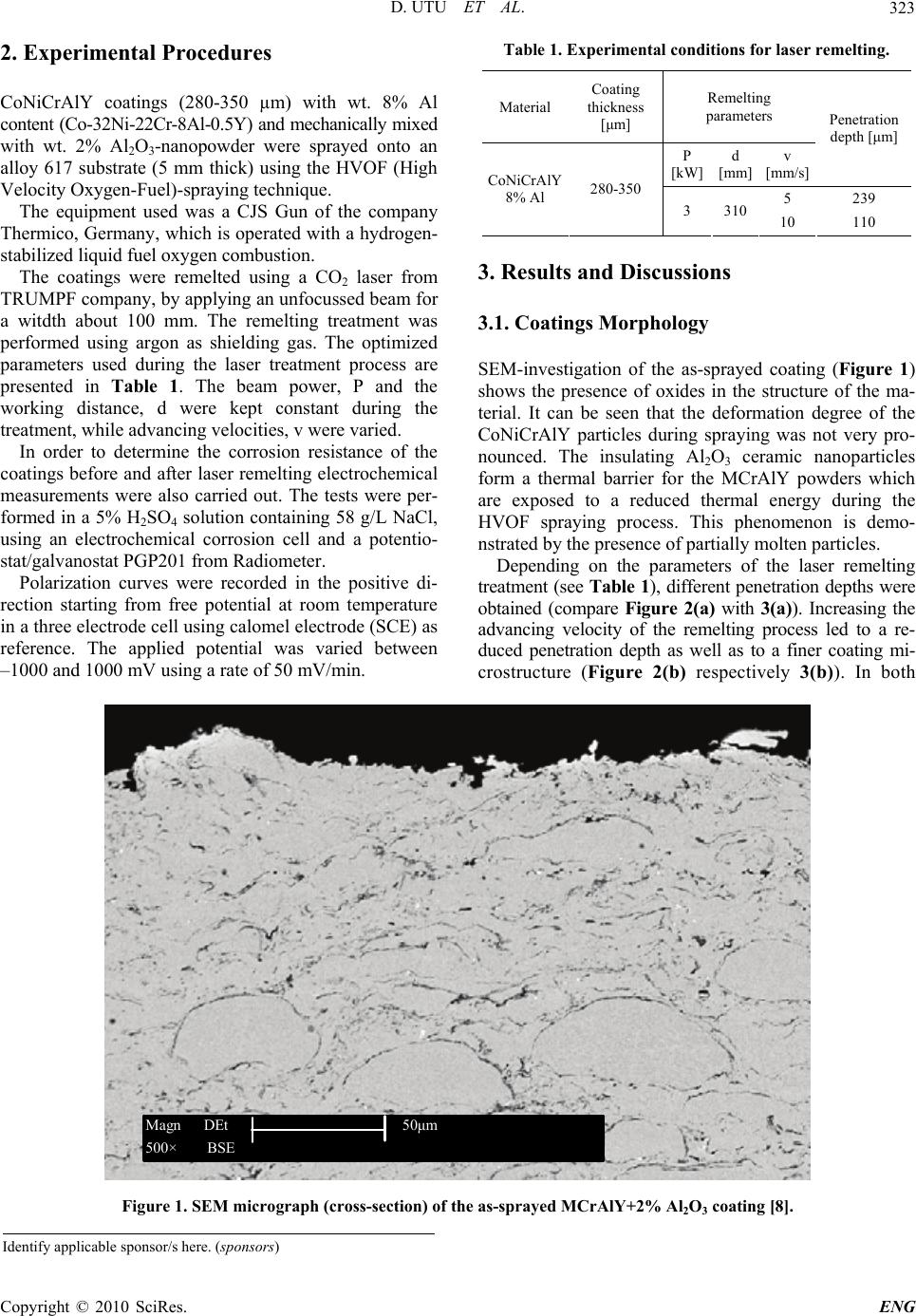 D. UTU ET AL.323 2. Experimental Procedures CoNiCrAlY coatings (280-350 µm) with wt. 8% Al content (Co-32Ni-22Cr-8Al-0.5Y) and mechanically mixed with wt. 2% Al2O3-nanopowder were sprayed onto an alloy 617 substrate (5 mm thick) using the HVOF (High Velocity Oxygen-Fuel)-spraying technique. The equipment used was a CJS Gun of the company Thermico, Germany, which is operated with a hydrogen- stabilized liquid fuel oxygen combustion. The coatings were remelted using a CO2 laser from TRUMPF company, by applying an unfocussed beam for a witdth about 100 mm. The remelting treatment was performed using argon as shielding gas. The optimized parameters used during the laser treatment process are presented in Table 1. The beam power, P and the working distance, d were kept constant during the treatment, while advancing velocities, v were varied. In order to determine the corrosion resistance of the coatings before and after laser remelting electrochemical measurements were also carried out. The tests were per- formed in a 5% H2SO4 solution containing 58 g/L NaCl, using an electrochemical corrosion cell and a potentio- stat/galvanostat PGP201 from Radiometer. Polarization curves were recorded in the positive di- rection starting from free potential at room temperature in a three electrode cell using calomel electrode (SCE) as reference. The applied potential was varied between –1000 and 1000 mV using a rate of 50 mV/min. Table 1. Experimental conditions for laser remelting. Material Coating thickness [μm] Remelting parameters P [kW] d [mm] v [mm/s] Penetration depth [μm] 5 239 CoNiCrAlY 8% Al 280-350 3 310 10 110 3. Results and Discussions 3.1. Coatings Morphology SEM-investigation of the as-sprayed coating (Figure 1) shows the presence of oxides in the structure of the ma- terial. It can be seen that the deformation degree of the CoNiCrAlY particles during spraying was not very pro- nounced. The insulating Al2O3 ceramic nanoparticles form a thermal barrier for the MCrAlY powders which are exposed to a reduced thermal energy during the HVOF spraying process. This phenomenon is demo- nstrated by the presence of partially molten particles. Depending on the parameters of the laser remelting treatment (see Table 1), different penetration depths were obtained (compare Figure 2(a) with 3(a)). Increasing the advancing velocity of the remelting process led to a re- duced penetration depth as well as to a finer coating mi- crostructure (Figure 2(b) respectively 3(b)). In both Magn DEt 50μm 500× BSE Figure 1. SEM micrograph (cross-section) of the as-sprayed MCrAlY+2% Al2O3 coating [8]. Identify applicable sponsor/s here. (sponsors) Copyright © 2010 SciRes. ENG 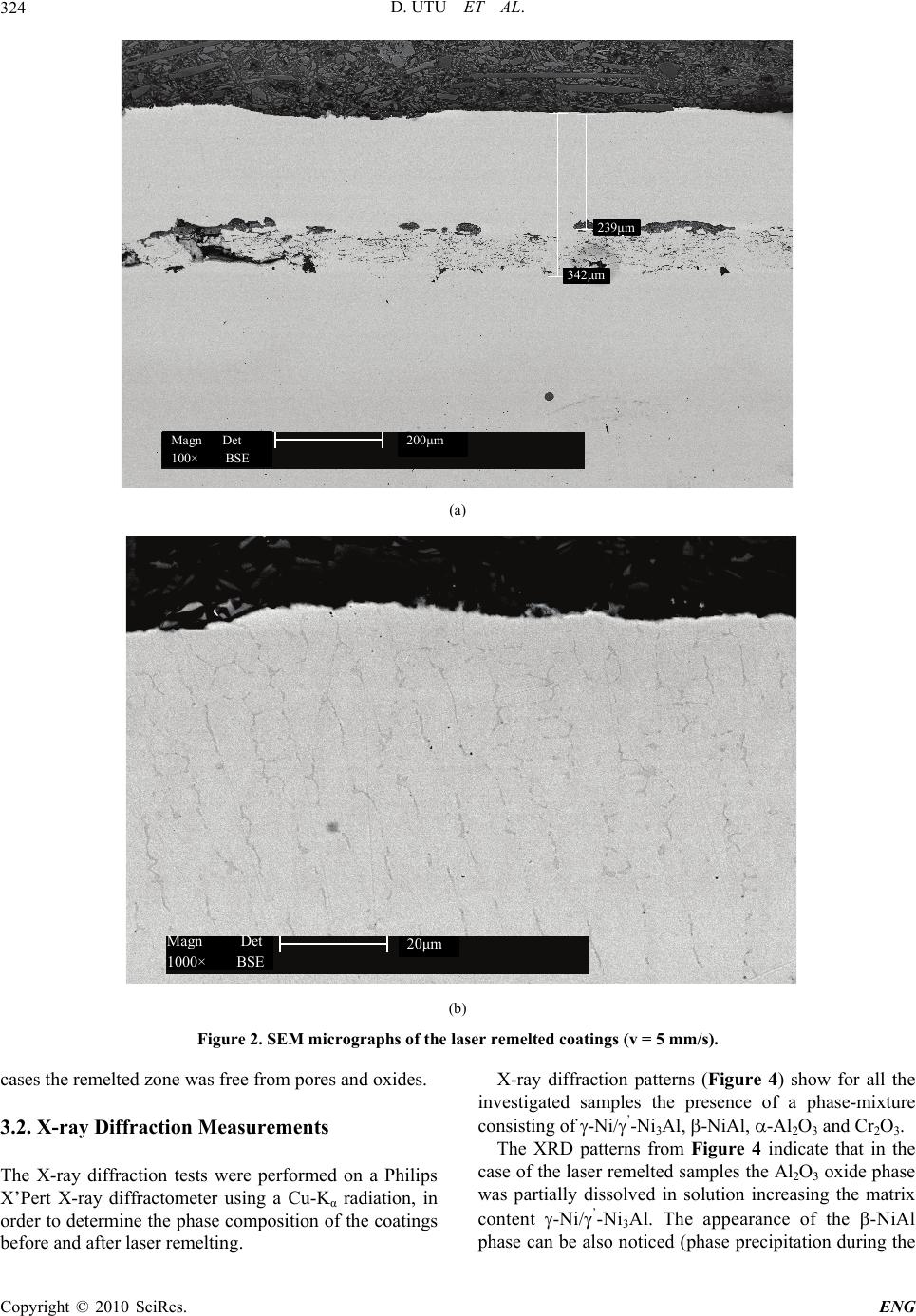 D. UTU ET AL. 324 200μm Magn Det 100× BSE 342μm 239μm (a) 20μm Magn Det 1000× BSE (b) Figure 2. SEM micrographs of the laser remelted coatings (v = 5 mm/s). cases the remelted zone was free from pores and oxides. 3.2. X-ray Diffraction Measurements The X-ray diffraction tests were performed on a Philips X’Pert X-ray diffractometer using a Cu-Kα radiation, in order to determine the phase composition of the coatings before and after laser remelting. X-ray diffraction patterns (Figure 4) show for all the investigated samples the presence of a phase-mixture consisting of -Ni/’-N i3Al, -NiAl, -Al2O3 and Cr2O3. The XRD patterns from Figure 4 indicate that in the case of the laser remelted samples the Al2O3 oxide phase was partially dissolved in solution increasing the matrix content -Ni/’-Ni3Al. The appearance of the -NiAl phase can be also noticed (phase precipitation during the Copyright © 2010 SciRes. ENG 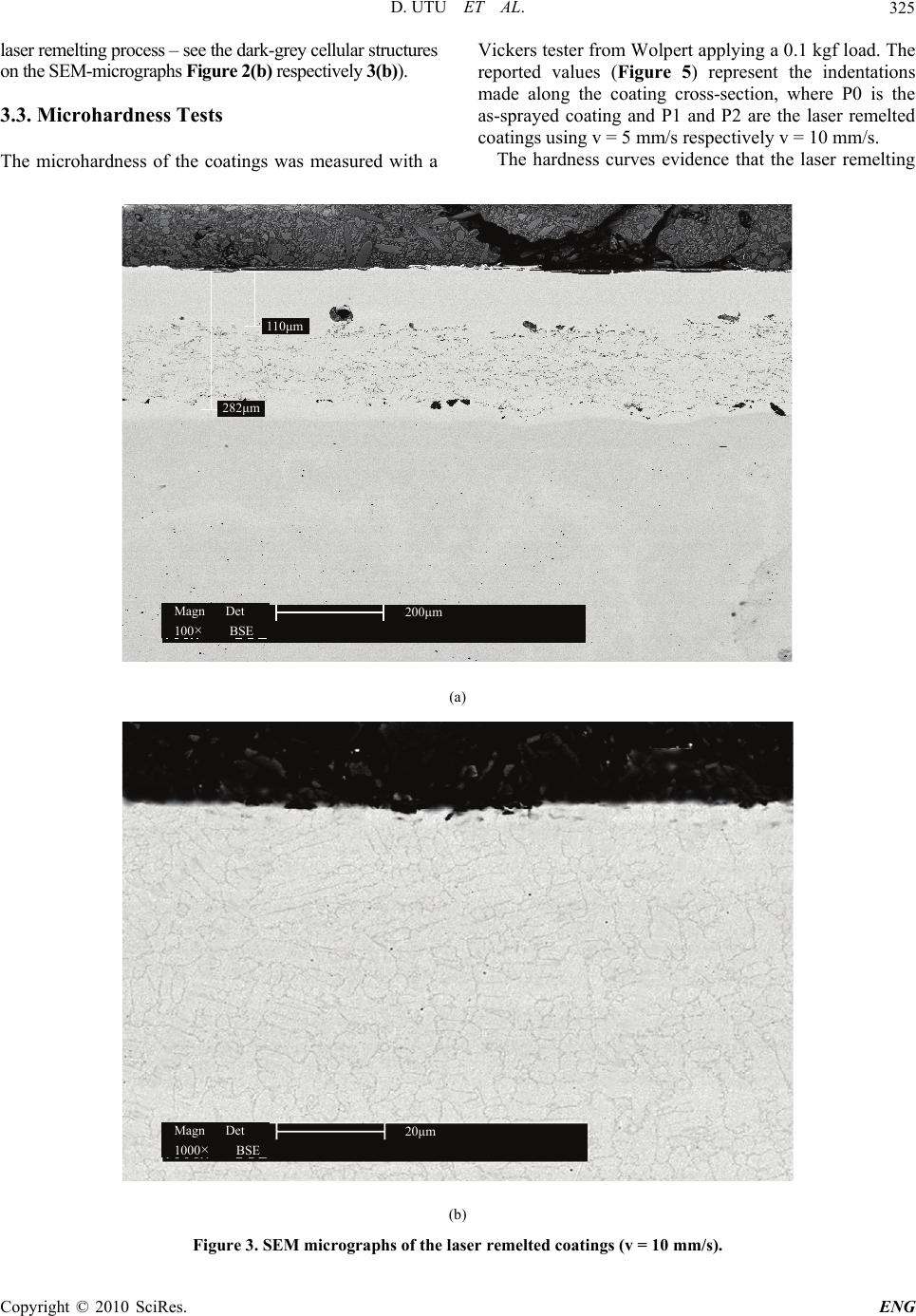 D. UTU ET AL.325 laser remelting process – see the dark-grey cellular structures on the SEM-micrographs Figure 2(b) respectively 3(b)). 3.3. Microhardness Tests The microhardness of the coatings was measured with a Vickers tester from Wolpert applying a 0.1 kgf load. The reported values (Figure 5) represent the indentations made along the coating cross-section, where P0 is the as-sprayed coating and P1 and P2 are the laser remelted coatings using v = 5 mm/s respectively v = 10 mm/s. The hardness curves evidence that the laser remelting 200μm Magn Det 100 × BSE 282μm 110μm (a) 20μm Magn Det 1000 × BSE (b) Figure 3. SEM micrographs of the laser remelted coatings (v = 10 mm/s). Copyright © 2010 SciRes. ENG 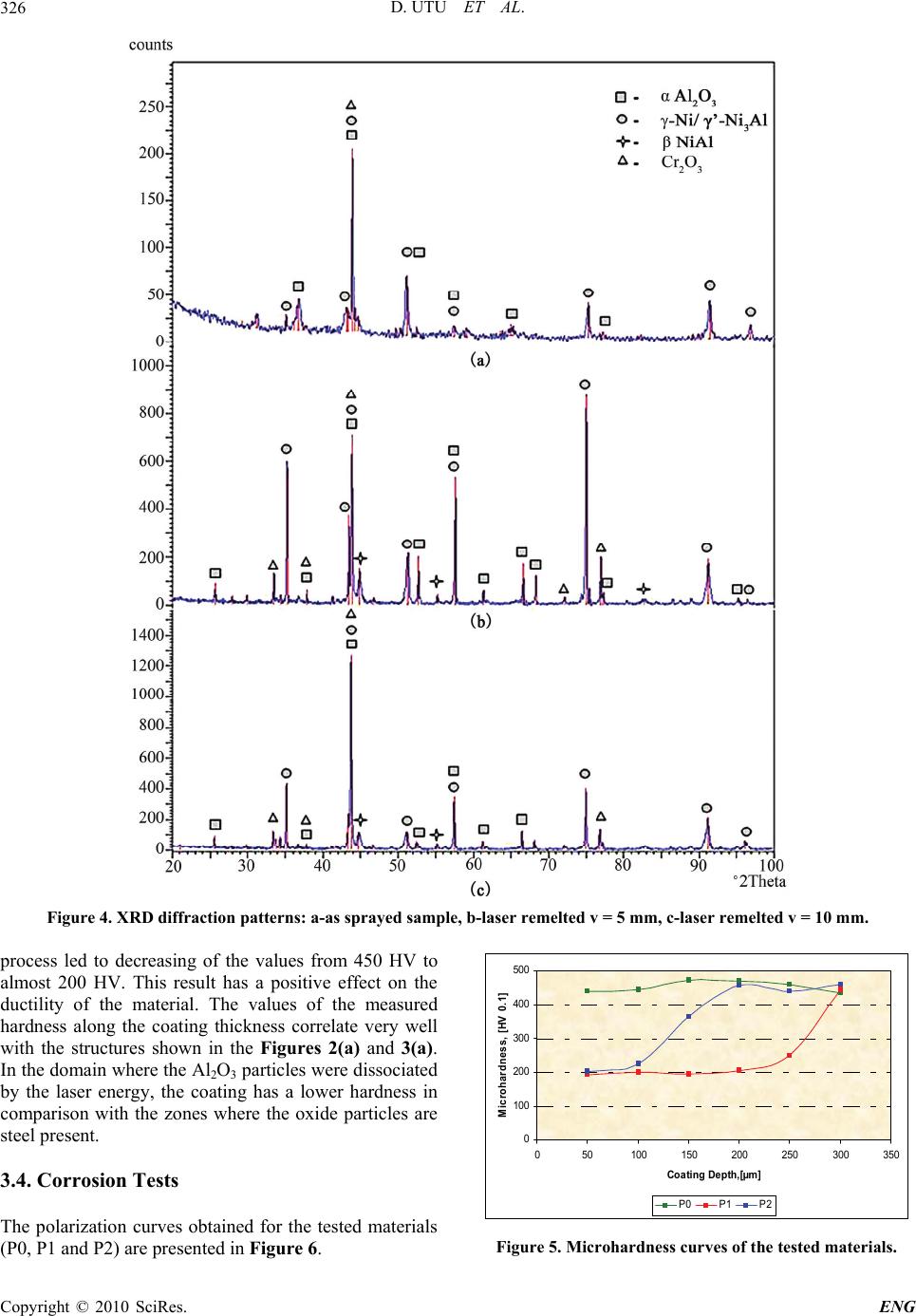 D. UTU ET AL. 326 Figure 4. XRD diffraction patterns: a-as sprayed sample, b-laser remelted v = 5 mm, c-laser remelted v = 10 mm. process led to decreasing of the values from 450 HV to almost 200 HV. This result has a positive effect on the ductility of the material. The values of the measured hardness along the coating thickness correlate very well with the structures shown in the Figures 2(a) and 3(a). In the domain where the Al2O3 particles were dissociated by the laser energy, the coating has a lower hardness in comparison with the zones where the oxide particles are steel present. 3.4. Corrosion Tests The polarization curves obtained for the tested materials (P0, P1 and P2) are presented in Figure 6. 0 100 200 300 400 500 050100 150 200 250 300 350 Coating Depth,[µm] Microhardness, [HV 0.1] P0 P1 P2 Figure 5. Microhardness curves of the tested materials. Copyright © 2010 SciRes. ENG 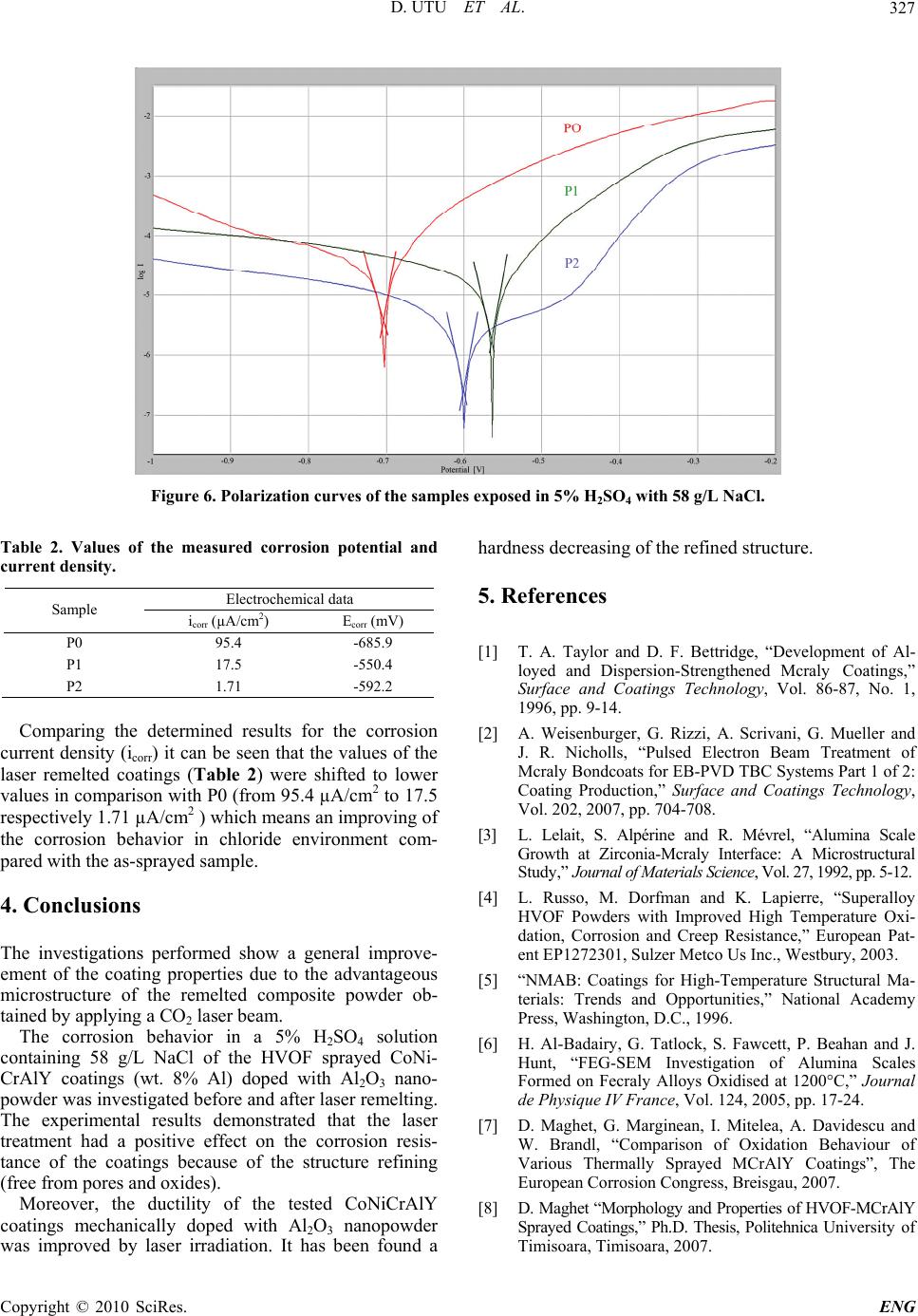 D. UTU ET AL.327 Figure 6. Polarization curves of the samples exposed in 5% H2SO4 with 58 g/L NaCl. Table 2. Values of the measured corrosion potential and current density. Electrochemical data Sample icorr (µA/cm2) Ecorr (mV) P0 95.4 -685.9 P1 17.5 -550.4 P2 1.71 -592.2 Comparing the determined results for the corrosion current density (icorr) it can be seen that the values of the laser remelted coatings (Table 2) were shifted to lower values in comparison with P0 (from 95.4 µA/cm2 to 17.5 respectively 1.71 µA/cm2 ) which means an improving of the corrosion behavior in chloride environment com- pared with the as-sprayed sample. 4. Conclusions The investigations performed show a general improve- ement of the coating properties due to the advantageous microstructure of the remelted composite powder ob- tained by applying a CO2 laser beam. The corrosion behavior in a 5% H2SO4 solution containing 58 g/L NaCl of the HVOF sprayed CoNi- CrAlY coatings (wt. 8% Al) doped with Al2O3 nano- powder was investigated before and after laser remelting. The experimental results demonstrated that the laser treatment had a positive effect on the corrosion resis- tance of the coatings because of the structure refining (free from pores and oxides). Moreover, the ductility of the tested CoNiCrAlY coatings mechanically doped with Al2O3 nanopowder was improved by laser irradiation. It has been found a hardness decreasing of the refined structure. 5. References [1] T. A. Taylor and D. F. Bettridge, “Development of Al- loyed and Dispersion-Strengthened McralyCoatings,” Surface and Coatings Technology, Vol. 86-87, No. 1, 1996, pp. 9-14. [2] A. Weisenburger, G. Rizzi, A. Scrivani, G. Mueller and J. R. Nicholls, “Pulsed Electron Beam Treatment of Mcraly Bondcoats for EB-PVD TBC Systems Part 1 of 2: Coating Production,” Surface and Coatings Technology, Vol. 202, 2007, pp. 704-708. [3] L. Lelait, S. Alpérine and R. Mévrel, “Alumina Scale Growth at Zirconia-Mcraly Interface: A Microstructural Study,” Journal of Materials Science, Vol. 27, 1992, pp. 5-12. [4] L. Russo, M. Dorfman and K. Lapierre, “Superalloy HVOF Powders with Improved High Temperature Oxi- dation, Corrosion and Creep Resistance,” European Pat- ent EP1272301, Sulzer Metco Us Inc., Westbury, 2003. [5] “NMAB: Coatings for High-Temperature Structural Ma- terials: Trends and Opportunities,” National Academy Press, Washington, D.C., 1996. [6] H. Al-Badairy, G. Tatlock, S. Fawcett, P. Beahan and J. Hunt, “FEG-SEM Investigation of Alumina Scales Formed on Fecraly Alloys Oxidised at 1200°C,” Journal de Physique IV France, Vol. 124, 2005, pp. 17-24. [7] D. Maghet, G. Marginean, I. Mitelea, A. Davidescu and W. Brandl, “Comparison of Oxidation Behaviour of Various Thermally Sprayed MCrAlY Coatings”, The European Corrosion Congress, Breisgau, 2007. [8] D. Maghet “Morphology and Properties of HVOF-MCrAlY Sprayed Coatings,” Ph.D. Thesis, Politehnica University of Timisoara, Timisoara, 2007. Copyright © 2010 SciRes. ENG |