

Paper Menu >>
Journal Menu >>
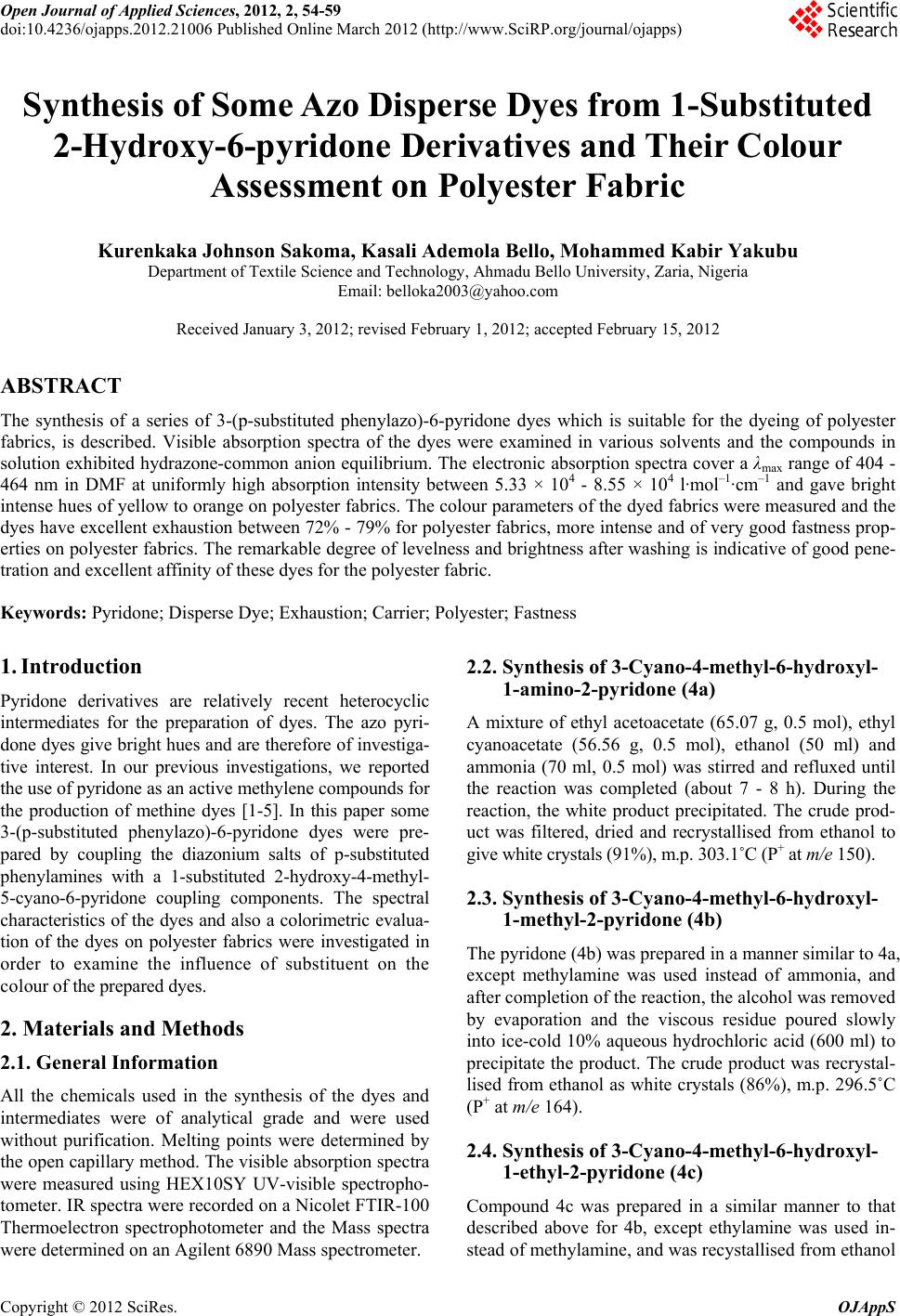 Open Journal of Applied Sciences, 2012, 2, 54-59 doi:10.4236/ojapps.2012.21006 Published Online March 2012 (http://www.SciRP.org/journal/ojapps) Synthesis of Some Azo Disperse Dyes from 1-Substituted 2-Hydroxy-6-pyridone Derivatives and Their Colour Assessment on Polyester Fabric Kurenkaka Johnson Sakoma, Kasali Ademola Bello, Mohammed Kabir Yakubu Department of Textile Science and Technology, Ahmadu Bello University, Zaria, Nigeria Email: [email protected] Received January 3, 2012; revised February 1, 2012; accepted February 15, 2012 ABSTRACT The synthesis of a series of 3-(p-substituted phenylazo)-6-pyridone dyes which is suitable for the dyeing of polyester fabrics, is described. Visible absorption spectra of the dyes were examined in various solvents and the compounds in solution exhibited hydrazone-common anion equilibrium. The electronic absorption spectra cover a λmax range of 404 - 464 nm in DMF at uniformly high absorption intensity between 5.33 × 10⁴ - 8.55 × 10⁴ l·mol–1·cm–1 and gave bright intense hues of yellow to orange on polyester fabrics. The colour parameters of the dyed fabrics were measured and the dyes have excellent exhaustion between 72% - 79% for polyester fabrics, more intense and of very good fastness prop- erties on polyester fabrics. The remarkable degree of levelness and brightness after washing is indicative of good pene- tration and excellent affinity of these dyes for the polyester fabric. Keywords: Pyridone; Disperse Dye; Exhaustion; Carrier; Polyester; Fastness 1. Introduction Pyridone derivatives are relatively recent heterocyclic intermediates for the preparation of dyes. The azo pyri- done dyes give bright hues and are therefore of investiga- tive interest. In our previous investigations, we reported the use of pyridone as an active methylene compounds for the production of methine dyes [1-5]. In this paper some 3-(p-substituted phenylazo)-6-pyridone dyes were pre- pared by coupling the diazonium salts of p-substituted phenylamines with a 1-substituted 2-hydroxy-4-methyl- 5-cyano-6-pyridone coupling components. The spectral characteristics of the dyes and also a colorimetric evalua- tion of the dyes on polyester fabrics were investigated in order to examine the influence of substituent on the colour of the prepared dyes. 2. Materials and Methods 2.1. General Information All the chemicals used in the synthesis of the dyes and intermediates were of analytical grade and were used without purification. Melting points were determined by the open capillary method. The visible absorption spectra were measured using HEX10SY UV-visible spectropho- tometer. IR spectra were recorded on a Nicolet FTIR-100 Thermoelectron spectrophotometer and the Mass spectra were determined on an Agilent 6890 Mass spectrometer. 2.2. Synthesis of 3-Cyano-4-methyl-6-hydroxyl- 1-amino-2-pyridone (4a) A mixture of ethyl acetoacetate (65.07 g, 0.5 mol), ethyl cyanoacetate (56.56 g, 0.5 mol), ethanol (50 ml) and ammonia (70 ml, 0.5 mol) was stirred and refluxed until the reaction was completed (about 7 - 8 h). During the reaction, the white product precipitated. The crude prod- uct was filtered, dried and recrystallised from ethanol to give white crystals (91%), m.p. 303.1˚C (P+ at m/e 150). 2.3. Synthesis of 3-Cyano-4-methyl-6-hydroxyl- 1-methyl-2-pyridone (4b) The pyridone (4b) was prepared in a manner similar to 4a, except methylamine was used instead of ammonia, and after completion of the reaction, the alcohol was removed by evaporation and the viscous residue poured slowly into ice-cold 10% aqueous hydrochloric acid (600 ml) to precipitate the product. The crude product was recrystal- lised from ethanol as white crystals (86%), m.p. 296.5˚C (P+ at m/e 164). 2.4. Synthesis of 3-Cyano-4-methyl-6-hydroxyl- 1-ethyl-2-pyridone (4c) Compound 4c was prepared in a similar manner to that described above for 4b, except ethylamine was used in- stead of methylamine, and was recystallised from ethanol Copyright © 2012 SciRes. OJAppS 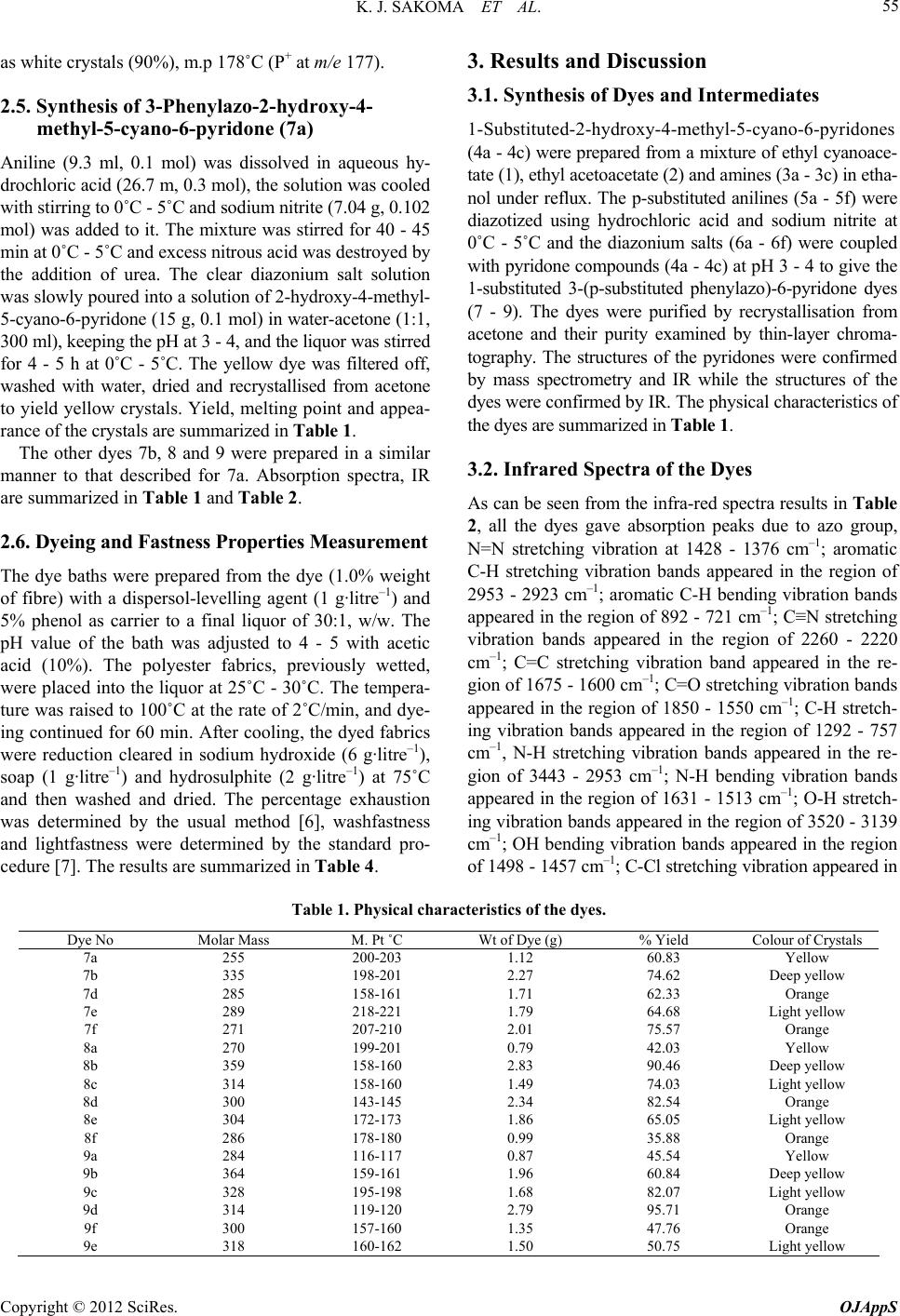 K. J. SAKOMA ET AL. 55 as white crystals (90%), m.p 178˚C (P+ at m/e 177). 2.5. Synthesis of 3-Phenylazo-2-hydroxy-4- methyl-5-cyano-6-pyridone (7a) Aniline (9.3 ml, 0.1 mol) was dissolved in aqueous hy- drochloric acid (26.7 m, 0.3 mol), the solution was cooled with stirring to 0˚C - 5˚C and sodium nitrite (7.04 g, 0.102 mol) was added to it. The mixture was stirred for 40 - 45 min at 0˚C - 5˚C and excess nitrous acid was destroyed by the addition of urea. The clear diazonium salt solution was slowly poured into a solution of 2-hydroxy-4-methyl- 5-cyano-6-pyridone (15 g, 0.1 mol) in water-acetone (1:1, 300 ml), keeping the pH at 3 - 4, and the liquor was stirred for 4 - 5 h at 0˚C - 5˚C. The yellow dye was filtered off, washed with water, dried and recrystallised from acetone to yield yellow crystals. Yield, melting point and appea- rance of the crystals are summarized in Table 1. The other dyes 7b, 8 and 9 were prepared in a similar manner to that described for 7a. Absorption spectra, IR are summarized in Table 1 and Table 2. 2.6. Dyeing and Fastness Properties Measurement The dye baths were prepared from the dye (1.0% weight of fibre) with a dispersol-levelling agent (1 g·litre–1) and 5% phenol as carrier to a final liquor of 30:1, w/w. The pH value of the bath was adjusted to 4 - 5 with acetic acid (10%). The polyester fabrics, previously wetted, were placed into the liquor at 25˚C - 30˚C. The tempera- ture was raised to 100˚C at the rate of 2˚C/min, and dye- ing continued for 60 min. After cooling, the dyed fabrics were reduction cleared in sodium hydroxide (6 g·litre–1), soap (1 g·litre–1) and hydrosulphite (2 g·litre–1) at 75˚C and then washed and dried. The percentage exhaustion was determined by the usual method [6], washfastness and lightfastness were determined by the standard pro- cedure [7]. The results are summarized in Table 4. 3. Results and Discussion 3.1. Synthesis of Dyes and Intermediates 1-Substituted-2-hydroxy-4-methyl-5-cyano-6-pyridones (4a - 4c) were prepared from a mixture of ethyl cyanoace- tate (1), ethyl acetoacetate (2) and amines (3a - 3c) in etha- nol under reflux. The p-substituted anilines (5a - 5f) were diazotized using hydrochloric acid and sodium nitrite at 0˚C - 5˚C and the diazonium salts (6a - 6f) were coupled with pyridone compounds (4a - 4c) at pH 3 - 4 to give the 1-substituted 3-(p-substituted phenylazo)-6-pyridone dyes (7 - 9). The dyes were purified by recrystallisation from acetone and their purity examined by thin-layer chroma- tography. The structures of the pyridones were confirmed by mass spectrometry and IR while the structures of the dyes were confirmed by IR. The physical characteristics of the dyes are summarized in Table 1. 3.2. Infrared Spectra of the Dyes As can be seen from the infra-red spectra results in Table 2, all the dyes gave absorption peaks due to azo group, N=N stretching vibration at 1428 - 1376 cm–1; aromatic C-H stretching vibration bands appeared in the region of 2953 - 2923 cm–1; aromatic C-H bending vibration bands appeared in the region of 892 - 721 cm–1; C≡N stretching vibration bands appeared in the region of 2260 - 2220 cm–1; C=C stretching vibration band appeared in the re- gion of 1675 - 1600 cm–1; C=O stretching vibration bands appeared in the region of 1850 - 1550 cm–1; C-H stretch- ing vibration bands appeared in the region of 1292 - 757 cm–1, N-H stretching vibration bands appeared in the re- gion of 3443 - 2953 cm–1; N-H bending vibration bands appeared in the region of 1631 - 1513 cm–1; O-H stretch- ing vibration bands appeared in the region of 3520 - 3139 cm–1; OH bending vibration bands appeared in the region f 1498 - 1457 cm–1; C-Cl stretching vibration appeared in o Table 1. Physical characteristics of the dyes. Dye No Molar Mass M. Pt ˚C Wt of Dye (g) % Yield Colour of Crystals 7a 255 200-203 1.12 60.83 Yellow 7b 335 198-201 2.27 74.62 Deep yellow 7d 285 158-161 1.71 62.33 Orange 7e 289 218-221 1.79 64.68 Light yellow 7f 271 207-210 2.01 75.57 Orange 8a 270 199-201 0.79 42.03 Yellow 8b 359 158-160 2.83 90.46 Deep yellow 8c 314 158-160 1.49 74.03 Light yellow 8d 300 143-145 2.34 82.54 Orange 8e 304 172-173 1.86 65.05 Light yellow 8f 286 178-180 0.99 35.88 Orange 9a 284 116-117 0.87 45.54 Yellow 9b 364 159-161 1.96 60.84 Deep yellow 9c 328 195-198 1.68 82.07 Light yellow 9d 314 119-120 2.79 95.71 Orange 9f 300 157-160 1.35 47.76 Orange 9e 318 160-162 1.50 50.75 Light yellow Copyright © 2012 SciRes. OJAppS 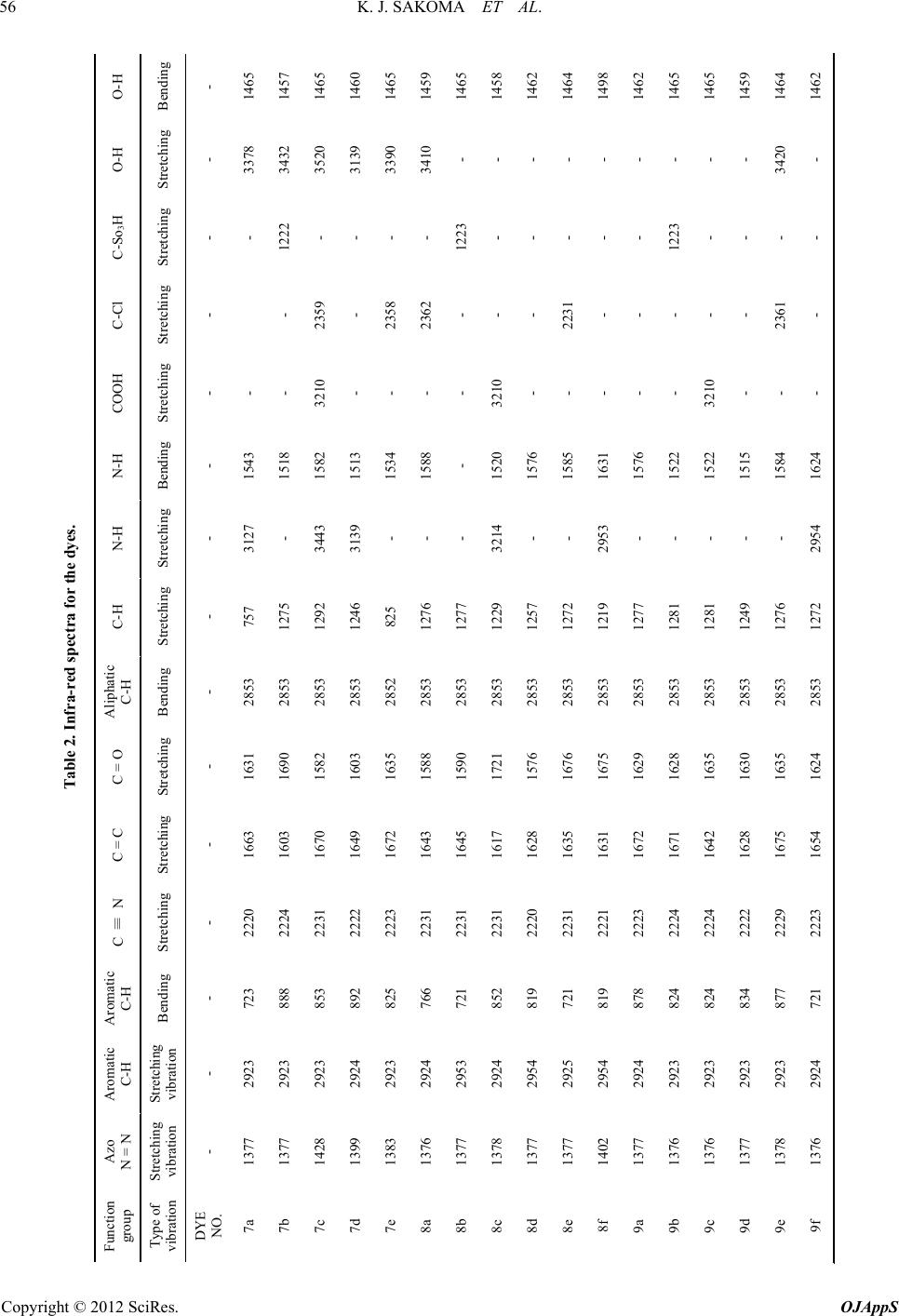 K. J. SAKOMA ET AL. 56 Fun c ti on group Azo N=N Ar om a t ic C-H Ar om a t ic C-H C≡NC=CC=O Aliphatic C-H C-HN-HN-H COOHC-ClC-So 3 HO-H O-H Typeof vibrati on Stretching vibration Stretching vibration BendingStretching Stretching StretchingBendingStretching Stretching Bending Stretching Stretching Stretching Stretching Bending DYE NO. --------------- 7a1377 29237232220 1663 16312853 75731271543--33781465 7b1377 29238882224 1603 169028531275-1518--1222 34321457 7c1428 29238532231 1670 158228531292344315823210 2359-35201465 7d1399 29248922222 1649 160328531246 31391513---31391460 7e1383 29238252223 1672 16352852825-1534-2358-33901465 8a1376 29247662231 1643 158828531276-1588-2362-34101459 8b1377 29537212231 1645 159028531277----1223-1465 8c13782924852223116171721285312293214 1520 3210---1458 8d1377 29548192220 1628 157628531257-1576----1462 8e1377 29257212231 1635 167628531272-1585-2231--1464 8f1402 29548192221 1631 167528531219 29531631----1498 9a1377 29248782223 1672 162928531277-1576----1462 9b1376 29238242224 1671 162828531281-1522--1223-1465 9c1376 29238242224 1642 163528531281-15223210---1465 9d1377 29238342222 1628 163028531249-1515----1459 9e1378 29238772229 1675 163528531276-1584-2361-34201464 9f1376 29247212223 1654 162428531272 29541624----1462 Table 2. Infra-red spectra for the dyes. Copyright © 2012 SciRes. OJAppS 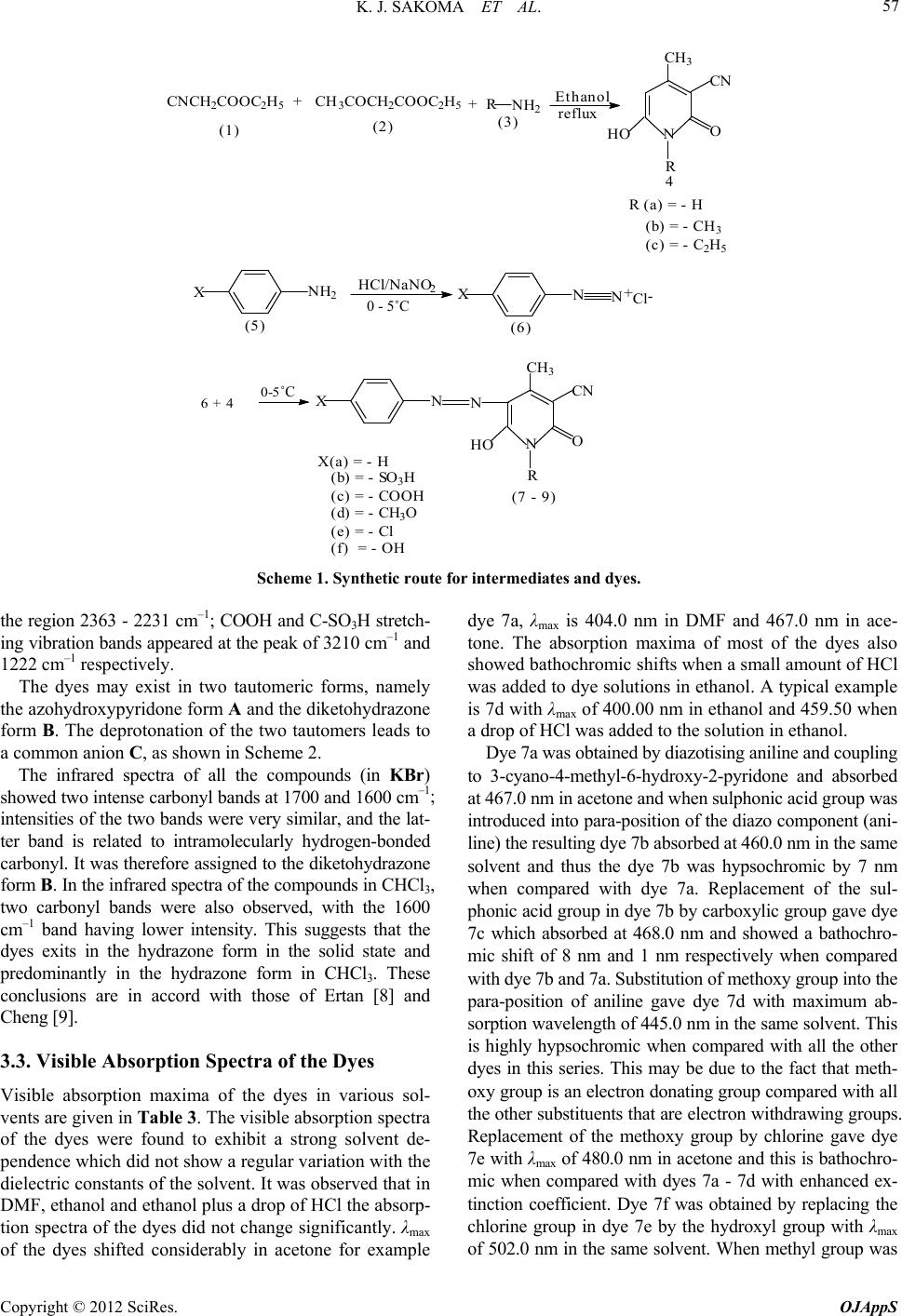 K. J. SAKOMA ET AL. Copyright © 2012 SciRes. OJAppS 57 CNCH 2 COOC 2 H 5 + CH 3 COCH 2 COOC 2 H 5 (1) (2) + RNH 2 Ethanol reflux (3) N CH 3 C N O R HO 4 NH 2 HCl/NaNO 2 0-5 oC XN+Cl- N X (5) (6) 6 + 40-5oC XN N R O CN CH 3 N HO (7 - 9) R (a) = - H (b) = - CH 3 (c) = - C 2 H 5 X(a) = - H (b) = - SO 3 H (c) = - COOH (d) = - CH 3 O (e) = - Cl (f) = - OH ˚C 0 - 5˚C Scheme 1. Synthetic route for intermediates and dye s. the region 2363 - 2231 cm–1; COOH and C-SO3H stretch- ing vibration bands appeared at the peak of 3210 cm–1 and 1222 cm–1 respectively. The dyes may exist in two tautomeric forms, namely the azohydroxypyridone form A and the diketohydrazone form B. The deprotonation of the two tautomers leads to a common anion C, as shown in Scheme 2. The infrared spectra of all the compounds (in KBr) showed two intense carbonyl bands at 1700 and 1600 cm–1; intensities of the two bands were very similar, and the lat- ter band is related to intramolecularly hydrogen-bonded carbonyl. It was therefore assigned to the diketohydrazone form B. In the infrared spectra of the compounds in CHCl3, two carbonyl bands were also observed, with the 1600 cm–1 band having lower intensity. This suggests that the dyes exits in the hydrazone form in the solid state and predominantly in the hydrazone form in CHCl3. These conclusions are in accord with those of Ertan [8] and Cheng [9]. 3.3. Visible Absorption Spectra of the Dyes Visible absorption maxima of the dyes in various sol- vents are given in Table 3. The visible absorption spectra of the dyes were found to exhibit a strong solvent de- pendence which did not show a regular variation with the dielectric constants of the solvent. It was observed that in DMF, ethanol and ethanol plus a drop of HCl the absorp- tion spectra of the dyes did not change significantly. λmax of the dyes shifted considerably in acetone for example dye 7a, λmax is 404.0 nm in DMF and 467.0 nm in ace- tone. The absorption maxima of most of the dyes also showed bathochromic shifts when a small amount of HCl was added to dye solutions in ethanol. A typical example is 7d with λmax of 400.00 nm in ethanol and 459.50 when a drop of HCl was added to the solution in ethanol. Dye 7a was obtained by diazotising aniline and coupling to 3-cyano-4-methyl-6-hydroxy-2-pyridone and absorbed at 467.0 nm in acetone and when sulphonic acid group was introduced into para-position of the diazo component (ani- line) the resulting dye 7b absorbed at 460.0 nm in the same solvent and thus the dye 7b was hypsochromic by 7 nm when compared with dye 7a. Replacement of the sul- phonic acid group in dye 7b by carboxylic group gave dye 7c which absorbed at 468.0 nm and showed a bathochro- mic shift of 8 nm and 1 nm respectively when compared with dye 7b and 7a. Substitution of methoxy group into the para-position of aniline gave dye 7d with maximum ab- sorption wavelength of 445.0 nm in the same solvent. This is highly hypsochromic when compared with all the other dyes in this series. This may be due to the fact that meth- oxy group is an electron donating group compared with all the other substituents that are electron withdrawing groups. Replacement of the methoxy group by chlorine gave dye 7e with λmax of 480.0 nm in acetone and this is bathochro- mic when compared with dyes 7a - 7d with enhanced ex- tinction coefficient. Dye 7f was obtained by replacing the chlorine group in dye 7e by the hydroxyl group with λmax of 502.0 nm in the same solvent. When methyl group was 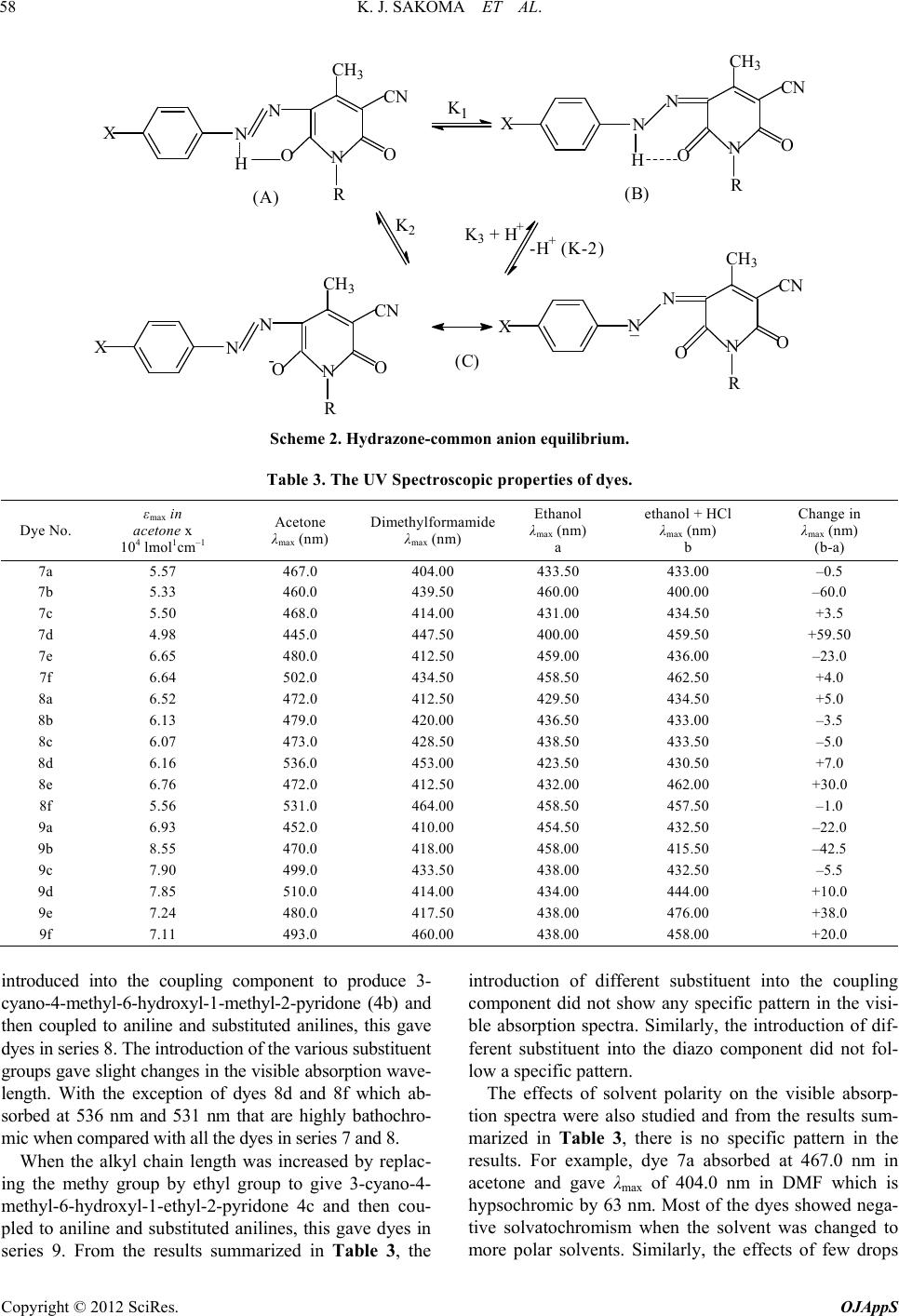 K. J. SAKOMA ET AL. 58 N CH 3 CN O R N N XXN N R O CN CH 3 N K1 O H O H (A) (B) (C) O XN N R O CN CH 3 N -O N CH 3 CN O R N N _ X K 2 K 3 + H + -H + (K-2) 1 Scheme 2. Hydrazone-common anion equilibrium. Table 3. The UV Spectroscopic properties of dyes. Dye No. εmax in acetone x 104 lmol1cm–1 Acetone λmax (nm) Dimethylformamide λmax (nm) Ethanol λmax (nm) a ethanol + HCl λmax (nm) b Change in λmax (nm) (b-a) 7a 5.57 467.0 404.00 433.50 433.00 –0.5 7b 5.33 460.0 439.50 460.00 400.00 –60.0 7c 5.50 468.0 414.00 431.00 434.50 +3.5 7d 4.98 445.0 447.50 400.00 459.50 +59.50 7e 6.65 480.0 412.50 459.00 436.00 –23.0 7f 6.64 502.0 434.50 458.50 462.50 +4.0 8a 6.52 472.0 412.50 429.50 434.50 +5.0 8b 6.13 479.0 420.00 436.50 433.00 –3.5 8c 6.07 473.0 428.50 438.50 433.50 –5.0 8d 6.16 536.0 453.00 423.50 430.50 +7.0 8e 6.76 472.0 412.50 432.00 462.00 +30.0 8f 5.56 531.0 464.00 458.50 457.50 –1.0 9a 6.93 452.0 410.00 454.50 432.50 –22.0 9b 8.55 470.0 418.00 458.00 415.50 –42.5 9c 7.90 499.0 433.50 438.00 432.50 –5.5 9d 7.85 510.0 414.00 434.00 444.00 +10.0 9e 7.24 480.0 417.50 438.00 476.00 +38.0 9f 7.11 493.0 460.00 438.00 458.00 +20.0 introduced into the coupling component to produce 3- cyano-4-methyl-6-hydroxyl-1-methyl-2-pyridone (4b) and then coupled to aniline and substituted anilines, this gave dyes in series 8. The introduction of the various substituent groups gave slight changes in the visible absorption wave- length. With the exception of dyes 8d and 8f which ab- sorbed at 536 nm and 531 nm that are highly bathochro- mic when compared with all the dyes in series 7 and 8. When the alkyl chain length was increased by replac- ing the methy group by ethyl group to give 3-cyano-4- methyl-6-hydroxyl-1-ethyl-2-pyridone 4c and then cou- pled to aniline and substituted anilines, this gave dyes in series 9. From the results summarized in Table 3, the introduction of different substituent into the coupling component did not show any specific pattern in the visi- ble absorption spectra. Similarly, the introduction of dif- ferent substituent into the diazo component did not fol- low a specific pattern. The effects of solvent polarity on the visible absorp- tion spectra were also studied and from the results sum- marized in Table 3, there is no specific pattern in the results. For example, dye 7a absorbed at 467.0 nm in acetone and gave λmax of 404.0 nm in DMF which is hypsochromic by 63 nm. Most of the dyes showed nega- tive solvatochromism when the solvent was changed to more polar solvents. Similarly, the effects of few drops Copyright © 2012 SciRes. OJAppS 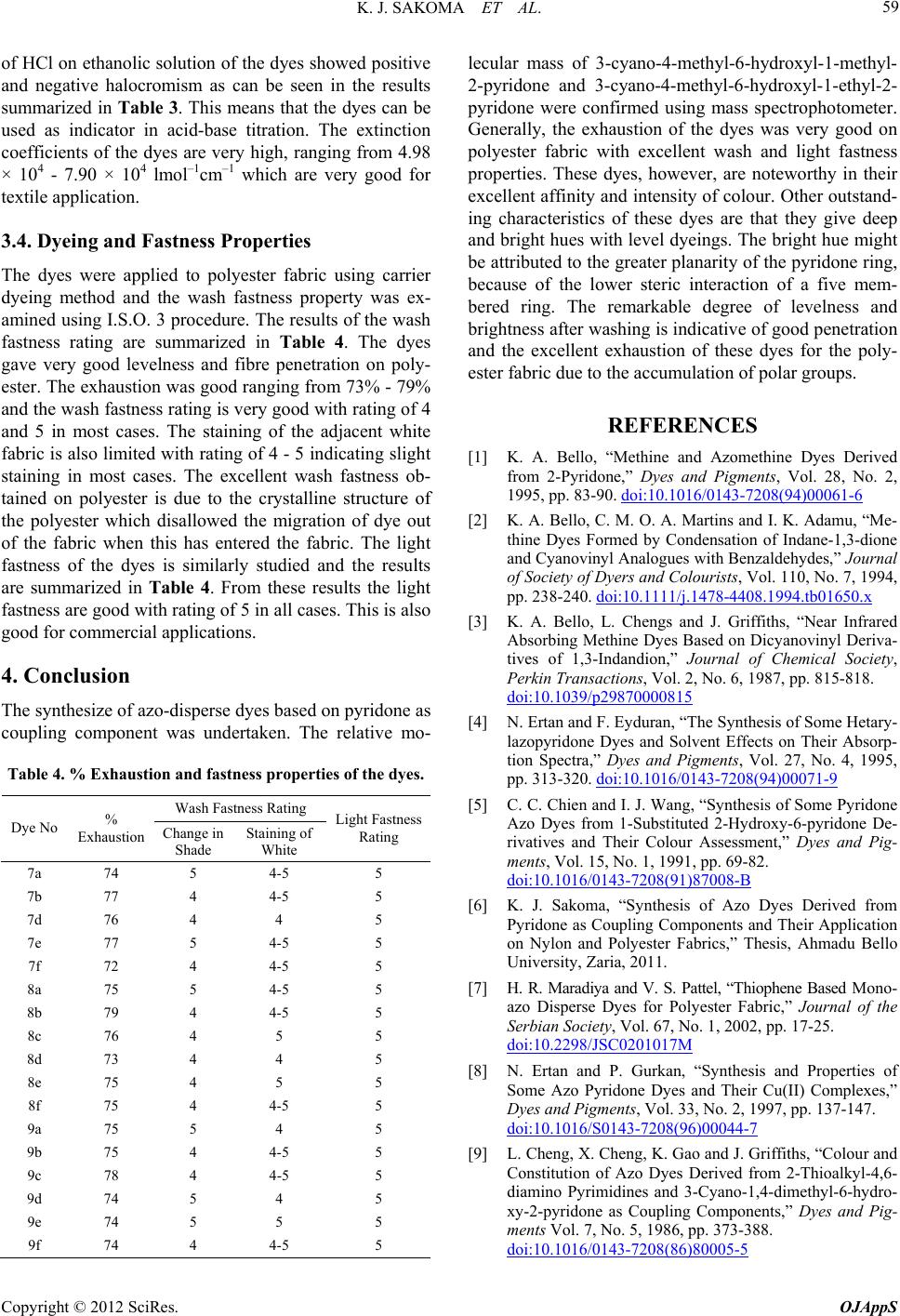 K. J. SAKOMA ET AL. 59 of HCl on ethanolic solution of the dyes showed positive and negative halocromism as can be seen in the results summarized in Table 3. This means that the dyes can be used as indicator in acid-base titration. The extinction coefficients of the dyes are very high, ranging from 4.98 × 10⁴ - 7.90 × 10⁴ lmol–1cm–1 which are very good for textile application. 3.4. Dyeing and Fastness Properties The dyes were applied to polyester fabric using carrier dyeing method and the wash fastness property was ex- amined using I.S.O. 3 procedure. The results of the wash fastness rating are summarized in Table 4. The dyes gave very good levelness and fibre penetration on poly- ester. The exhaustion was good ranging from 73% - 79% and the wash fastness rating is very good with rating of 4 and 5 in most cases. The staining of the adjacent white fabric is also limited with rating of 4 - 5 indicating slight staining in most cases. The excellent wash fastness ob- tained on polyester is due to the crystalline structure of the polyester which disallowed the migration of dye out of the fabric when this has entered the fabric. The light fastness of the dyes is similarly studied and the results are summarized in Table 4. From these results the light fastness are good with rating of 5 in all cases. This is also good for commercial applications. 4. Conclusion The synthesize of azo-disperse dyes based on pyridone as coupling component was undertaken. The relative mo- Table 4. % Exhaustion and fastness proper tie s of the dye s. Wash Fastness Rating Dye No % Exhaustion Change in Shade Staining of White Light Fastness Rating 7a 74 5 4-5 5 7b 77 4 4-5 5 7d 76 4 4 5 7e 77 5 4-5 5 7f 72 4 4-5 5 8a 75 5 4-5 5 8b 79 4 4-5 5 8c 76 4 5 5 8d 73 4 4 5 8e 75 4 5 5 8f 75 4 4-5 5 9a 75 5 4 5 9b 75 4 4-5 5 9c 78 4 4-5 5 9d 74 5 4 5 9e 74 5 5 5 9f 74 4 4-5 5 lecular mass of 3-cyano-4-methyl-6-hydroxyl-1-methyl- 2-pyridone and 3-cyano-4-methyl-6-hydroxyl-1-ethyl-2- pyridone were confirmed using mass spectrophotometer. Generally, the exhaustion of the dyes was very good on polyester fabric with excellent wash and light fastness properties. These dyes, however, are noteworthy in their excellent affinity and intensity of colour. Other outstand- ing characteristics of these dyes are that they give deep and bright hues with level dyeings. The bright hue might be attributed to the greater planarity of the pyridone ring, because of the lower steric interaction of a five mem- bered ring. The remarkable degree of levelness and brightness after washing is indicative of good penetration and the excellent exhaustion of these dyes for the poly- ester fabric due to the accumulation of polar groups. REFERENCES [1] K. A. Bello, “Methine and Azomethine Dyes Derived from 2-Pyridone,” Dyes and Pigments, Vol. 28, No. 2, 1995, pp. 83-90. doi:10.1016/0143-7208(94)00061-6 [2] K. A. Bello, C. M. O. A. Martins and I. K. Adamu, “Me- thine Dyes Formed by Condensation of Indane-1,3-dione and Cyanovinyl Analogues with Benzaldehydes,” Journal of Society of Dyers and Colourists, Vol. 110, No. 7, 1994, pp. 238-240. doi:10.1111/j.1478-4408.1994.tb01650.x [3] K. A. Bello, L. Chengs and J. Griffiths, “Near Infrared Absorbing Methine Dyes Based on Dicyanovinyl Deriva- tives of 1,3-Indandion,” Journal of Chemical Society, Perkin Transactions, Vol. 2, No. 6, 1987, pp. 815-818. doi:10.1039/p29870000815 [4] N. Ertan and F. Eyduran, “The Synthesis of Some Hetary- lazopyridone Dyes and Solvent Effects on Their Absorp- tion Spectra,” Dyes and Pigments, Vol. 27, No. 4, 1995, pp. 313-320. doi:10.1016/0143-7208(94)00071-9 [5] C. C. Chien and I. J. Wang, “Synthesis of Some Pyridone Azo Dyes from 1-Substituted 2-Hydroxy-6-pyridone De- rivatives and Their Colour Assessment,” Dyes and Pig- ments, Vol. 15, No. 1, 1991, pp. 69-82. doi:10.1016/0143-7208(91)87008-B [6] K. J. Sakoma, “Synthesis of Azo Dyes Derived from Pyridone as Coupling Components and Their Application on Nylon and Polyester Fabrics,” Thesis, Ahmadu Bello University, Zaria, 2011. [7] H. R. Maradiya and V. S. Pattel, “Thiophene Based Mono- azo Disperse Dyes for Polyester Fabric,” Journal of the Serbian Society, Vol. 67, No. 1, 2002, pp. 17-25. doi:10.2298/JSC0201017M [8] N. Ertan and P. Gurkan, “Synthesis and Properties of Some Azo Pyridone Dyes and Their Cu(II) Complexes,” Dyes and Pigments, Vol. 33, No. 2, 1997, pp. 137-147. doi:10.1016/S0143-7208(96)00044-7 [9] L. Cheng, X. Cheng, K. Gao and J. Griffiths, “Colour and Constitution of Azo Dyes Derived from 2-Thioalkyl-4,6- diamino Pyrimidines and 3-Cyano-1,4-dimethyl-6-hydro- xy-2-pyridone as Coupling Components,” Dyes and Pig- ments Vol. 7, No. 5, 1986, pp. 373-388. doi:10.1016/0143-7208(86)80005-5 Copyright © 2012 SciRes. OJAppS |