

Paper Menu >>
Journal Menu >>
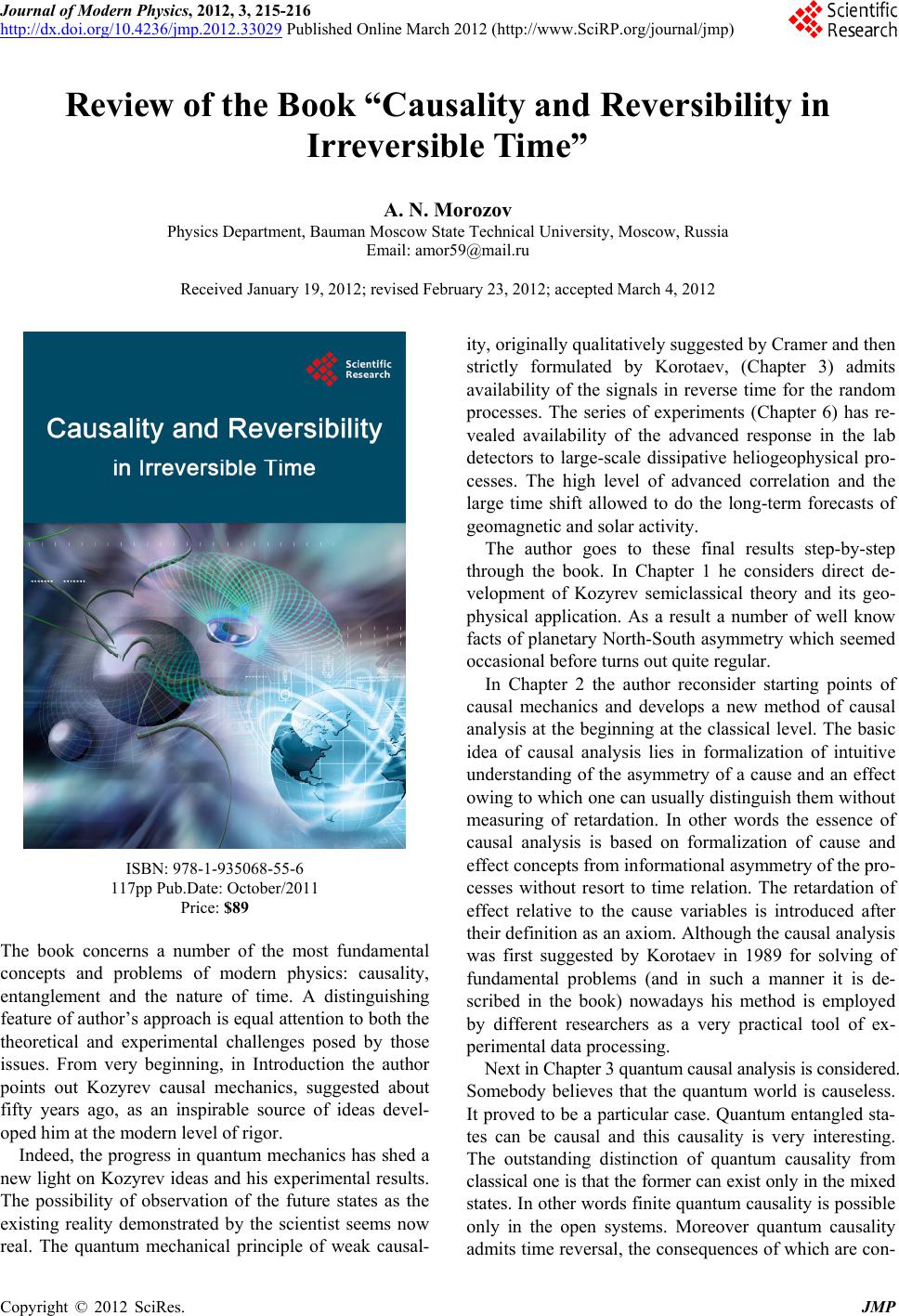 Journal of Modern Physics, 2012, 3, 215-216 http://dx.doi.org/10.4236/jmp.2012.33029 Published Online March 2012 (http://www.SciRP.org/journal/jmp) Review of the Book “Causality and Reversibility in Irr eversible T ime” A. N. Morozov Physics Depa rtme nt, Bauman Moscow State Technical University, Moscow, Russia Email: [email protected] Received January 19, 2012; revised February 23, 2012; accepted March 4, 2012 ISBN: 978-1-935068-55-6 117pp Pub.Date: October/2011 Price: $89 The book concerns a number of the most fundamental concepts and problems of modern physics: causality, entanglement and the nature of time. A distinguishing feature of author’s approach is equal attention to both th e theoretical and experimental challenges posed by those issues. From very beginning, in Introduction the author points out Kozyrev causal mechanics, suggested about fifty years ago, as an inspirable source of ideas devel- oped him at the modern level of rigor. Indeed, the progress in quantum mechanics has shed a new light on Kozyrev ideas and his experimental results. The possibility of observation of the future states as the existing reality demonstrated by the scientist seems now real. The quantum mechanical principle of weak causal- ity, originally qualitativ ely su ggested by Cra mer and then strictly formulated by Korotaev, (Chapter 3) admits availability of the signals in reverse time for the random processes. The series of experiments (Chapter 6) has re- vealed availability of the advanced response in the lab detectors to large-scale dissipative heliogeophysical pro- cesses. The high level of advanced correlation and the large time shift allowed to do the long-term forecasts of geomagnetic and solar activity. The author goes to these final results step-by-step through the book. In Chapter 1 he considers direct de- velopment of Kozyrev semiclassical theory and its geo- physical application. As a result a number of well know facts of planetary North-South asymmetry which seemed occasional before turns out quite regular. In Chapter 2 the author reconsider starting points of causal mechanics and develops a new method of causal analysis at the beginning at the classical level. The basic idea of causal analysis lies in formalization of intuitive understanding of the asymmetry of a cause and an effect owing to which one can usually distinguish them without measuring of retardation. In other words the essence of causal analysis is based on formalization of cause and effect concepts from informational asymmetry of the pro- cesses without resort to time relation. The retardation of effect relative to the cause variables is introduced after their definition as an axiom. Althoug h the causal analysis was first suggested by Korotaev in 1989 for solving of fundamental problems (and in such a manner it is de- scribed in the book) nowadays his method is employed by different researchers as a very practical tool of ex- perimental data processing. Next in Chapter 3 quantum causal analy sis is considered. Somebody believes that the quantum world is causeless. It proved to be a particular case. Quantu m entangled sta- tes can be causal and this causality is very interesting. The outstanding distinction of quantum causality from classical one is that the for mer can exist only in the mixed states. In other words finite quantum causality is possib le only in the open systems. Moreover quantum causality admits time reversal, the consequences of which are con- C opyright © 2012 SciRes. JMP  A. N. MOROZ OV 216 sidered in the following chapters. In Chapter 3 causal analysis application is demonstrated by the wide series of entangled states. Again, although quantum causal analy- sis was suggested in connection with a basic problem of time, its application proves to be quite practical. For in- stance the interesting interrelatio n s between causality an d decoherence are discovered, which can be used in the entanglement protection tasks. The Chapter 4 represents a theoretical-heuristic step to the macroscopic experiment. In spite of the recent pro- gress, development of successive theory of macroscopic entanglement (which has to resemble classical thermo- dynamics, i.e. to operate with the macroscopic parame- ters) is difficult prolem and such a theory is absent at present. The author, leaning on action-at-a-distance ele- ctrodynamics and on the known fact of constructive role of dissipation in entanglement generation, suggests a rea- sonable equation of macroscopic entanglement. The equ- ation predicts both retarded and advanced correlation and admits the experimental verification which is done in the last chapter. The model verification author demonstrates as soon as the equation has been introduced. At last Bell- type inequality is derived, violation of which is an evi- dence of nonlocal nature of predicted macroscopic cor- relation. In Chapter 5 the experimental approach to the detec- tion of above correlations is carefully discussed. The the- ories of different detectors are described and various sources of interferences and errors are analyzed. At last in Chapter 6 the results of wide series of long- term experiments are presented. These results are surpri- sing. Really nonlocal (quantum) correlation under some conditions can be measured at the macro-level. And re- ally time reversal causal connection is observed. More- over the observed advanced correlation can be utilized for the random processes forecasting. Due to careful at- tention paid by the author to cleanness of the experiment these unusual results are convicting. I think the book will attract widespread interest in ba- sic physics community. REFERENCE [1] S. M. Korotaev, “Causality and Reversibility in Ir- revers ible Time ,” Scientific Reseach Publishing, USA, 2011. To order: http://www.scirp.org/book/ Copyright © 2012 SciRes. JMP |