

Paper Menu >>
Journal Menu >>
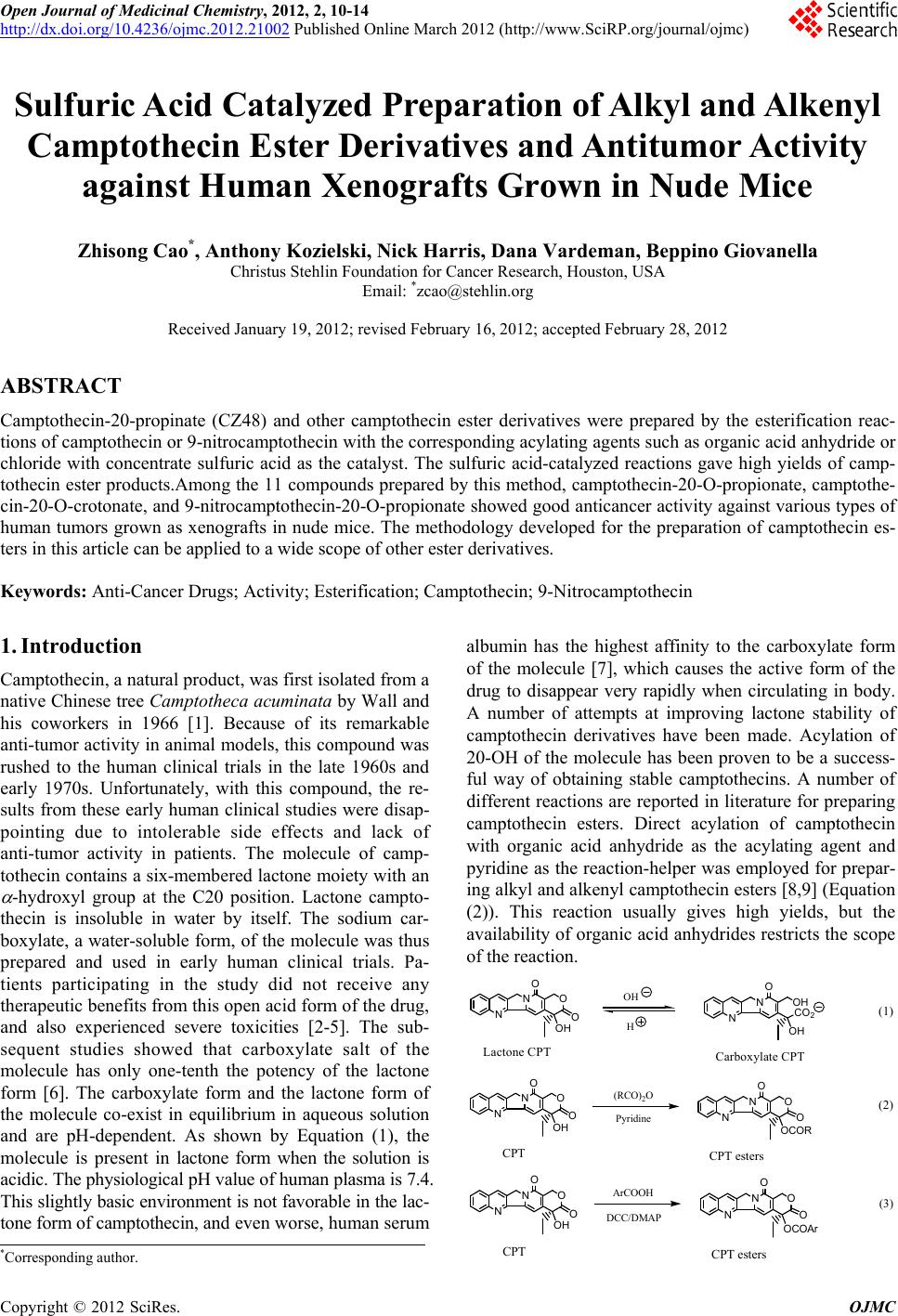 Open Journal of Medicinal Chemistry, 2012, 2, 10-14 http://dx.doi.org/10.4236/ojmc.2012.21002 Published Online March 2012 (http://www.SciRP.org/journal/ojmc) Sulfuric Acid Catalyzed Preparation of Alkyl and Alkenyl Camptothecin Ester Derivatives and Antitumor Activity against Human Xenografts Grown in Nude Mice Zhisong Cao*, Anthony Kozielski, Nick Harris, Dana Vardeman, Beppino Giovanella Christus Stehlin Foundation for Cancer Research, Houston, USA Email: *[email protected] Received January 19, 2012; revised February 16, 2012; accepted February 28, 2012 ABSTRACT Camptothecin-20-propinate (CZ48) and other camptothecin ester derivatives were prepared by the esterification reac- tions of camptothecin or 9-nitrocamptothecin with the corresponding acylating agents such as organic acid anhydride or chloride with concentrate sulfuric acid as the catalyst. The sulfuric acid-catalyzed reactions gave high yields of camp- tothecin ester products.Among the 11 compounds prepared by this method, camptothecin-20-O-propionate, camptothe- cin-20-O-crotonate, and 9-nitrocamptothecin-20-O-propionate showed good anticancer activity against various types of human tumors grown as xenografts in nude mice. The methodology developed for the preparation of camptothecin es- ters in this article can be applied to a wide scope of other ester derivatives. Keywords: Anti-Cancer Drugs; Activity; Esterification; Camptothecin; 9-Nitrocamptothecin 1. Introduction Camptothecin, a natural product, was first isolated from a native Chinese tree Camptotheca acuminata by Wall and his coworkers in 1966 [1]. Because of its remarkable anti-tumor activity in animal models, this compound was rushed to the human clinical trials in the late 1960s and early 1970s. Unfortunately, with this compound, the re- sults from these early human clinical studies were disap- pointing due to intolerable side effects and lack of anti-tumor activity in patients. The molecule of camp- tothecin contains a six-membered lactone moiety with an -hydroxyl group at the C20 position. Lactone campto- thecin is insoluble in water by itself. The sodium car- boxylate, a water-soluble form, of the molecule was thus prepared and used in early human clinical trials. Pa- tients participating in the study did not receive any therapeutic benefits from this open acid form of the drug, and also experienced severe toxicities [2-5]. The sub- sequent studies showed that carboxylate salt of the molecule has only one-tenth the potency of the lactone form [6]. The carboxylate form and the lactone form of the molecule co-exist in equilibrium in aqueous solution and are pH-dependent. As shown by Equation (1), the molecule is present in lactone form when the solution is acidic. The physiological pH value of human plasma is 7.4. This slightly basic environment is not favorable in the lac- tone form of camptothecin, and even worse, human serum albumin has the highest affinity to the carboxylate form of the molecule [7], which causes the active form of the drug to disappear very rapidly when circulating in body. A number of attempts at improving lactone stability of camptothecin derivatives have been made. Acylation of 20-OH of the molecule has been proven to be a success- ful way of obtaining stable camptothecins. A number of different reactions are reported in literature for preparing camptothecin esters. Direct acylation of camptothecin with organic acid anhydride as the acylating agent and pyridine as the reaction-helper was employed for prepar- ing alkyl and alkenyl camptothecin esters [8,9] (Equation (2)). This reaction usually gives high yields, but the availability of organic acid anhydrides restricts the scope of the reaction. N NO O O OH OH HN NOH O OH CO2(1) Lactone CPTCarboxylate CPT N NO O O OH (RCO)2O CPT N NO O OCOR O CPT es t e r s Pyridine (2) N NO O O OH ArCOOH CPT N NO O OCOAr O CPT este r s DCC/DMAP (3) *Corresponding autho r . C opyright © 2012 SciRes. OJMC 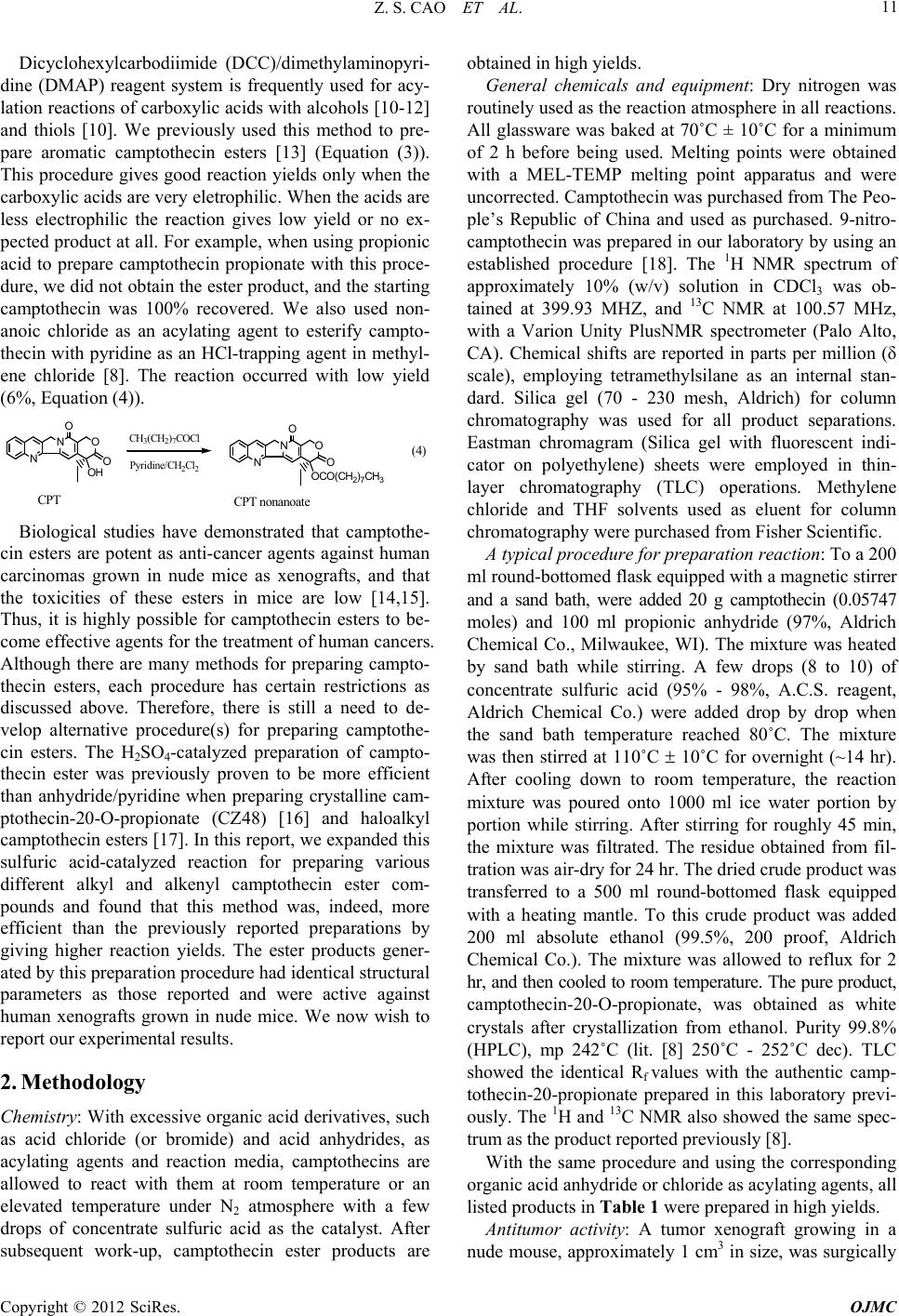 Z. S. CAO ET AL. 11 Dicyclohexylcarbodiimide (DCC)/dimethylaminopyri- dine (DMAP) reagent system is frequently used for acy- lation reactions of carboxylic acids with alcohols [10-12] and thiols [10]. We previously used this method to pre- are aromatic camptothecin esters [13] (Equation (3)). Th p is procedure gives good reaction yields only when the carboxylic acids are very eletrophilic. When the acids are less electrophilic the reaction gives low yield or no ex- pected product at all. For example, when using propionic acid to prepare camptothecin propionate with this proce- dure, we did not obtain the ester product, and the starting camptothecin was 100% recovered. We also used non- anoic chloride as an acylating agent to esterify campto- thecin with pyridine as an HCl-trapping agent in methyl- ene chloride [8]. The reaction occurred with low yield (6%, Equation (4)). N NO O O OH CH3(CH2)7COCl N NO O OCO(CH2)7CH3 O Pyridine/CH2Cl2 (4) CPT CPT nonanoate Biological studies have demonstrated that camptothe- cin esters are potent as anti-cancer agents against human carcinomas grown in nude mice as xenografts, and that the toxicities of these esters in mice are low [14,15] Thus, it is highly possible for camptothecin esters to be co edia, camptothecins are th them at room temperature or an under N atmosphere with a few lting point apparatus and were un by as surgically . - me effective agents for the treatment of human cancers. Although there are many methods for preparing campto- thecin esters, each procedure has certain restrictions as discussed above. Therefore, there is still a need to de- velop alternative procedure(s) for preparing camptothe- cin esters. The H2SO4-catalyzed preparation of campto- thecin ester was previously proven to be more efficient than anhydride/pyridine when preparing crystalline cam- ptothecin-20-O-propionate (CZ48) [16] and haloalkyl camptothecin esters [17]. In this report, we expanded this sulfuric acid-catalyzed reaction for preparing various different alkyl and alkenyl camptothecin ester com- pounds and found that this method was, indeed, more efficient than the previously reported preparations by giving higher reaction yields. The ester products gener- ated by this preparation procedure had identical structural parameters as those reported and were active against human xenografts grown in nude mice. We now wish to report our experimental results. 2. Methodology Chemistry: With excessive organic acid derivatives, such as acid chloride (or bromide) and acid anhydrides, as acylating agents and reaction m allowed to react wi elevated temperature2 drops of concentrate sulfuric acid as the catalyst. After subsequent work-up, camptothecin ester products are obtained in high yields. General chemicals and equipment: Dry nitrogen was routinely used as the reaction atmosphere in all reactions. All glassware was baked at 70˚C ± 10˚C for a minimum of 2 h before being used. Melting points were obtained with a MEL-TEMP me corrected. Camptothecin was purchased from The Peo- ple’s Republic of China and used as purchased. 9-nitro- camptothecin was prepared in our laboratory by using an established procedure [18]. The 1H NMR spectrum of approximately 10% (w/v) solution in CDCl3 was ob- tained at 399.93 MHZ, and 13C NMR at 100.57 MHz, with a Varion Unity PlusNMR spectrometer (Palo Alto, CA). Chemical shifts are reported in parts per million (δ scale), employing tetramethylsilane as an internal stan- dard. Silica gel (70 - 230 mesh, Aldrich) for column chromatography was used for all product separations. Eastman chromagram (Silica gel with fluorescent indi- cator on polyethylene) sheets were employed in thin- layer chromatography (TLC) operations. Methylene chloride and THF solvents used as eluent for column chromatography were purchased from Fisher Scientific. A typical procedure for preparation reaction: To a 200 ml round-bottomed flask equipped with a magnetic stirrer and a sand bath, were added 20 g camptothecin (0.05747 moles) and 100 ml propionic anhydride (97%, Aldrich Chemical Co., Milwaukee, WI). The mixture was heated sand bath while stirring. A few drops (8 to 10) of concentrate sulfuric acid (95% - 98%, A.C.S. reagent, Aldrich Chemical Co.) were added drop by drop when the sand bath temperature reached 80˚C. The mixture was then stirred at 110˚C 10˚C for overnight (~14 hr). After cooling down to room temperature, the reaction mixture was poured onto 1000 ml ice water portion by portion while stirring. After stirring for roughly 45 min, the mixture was filtrated. The residue obtained from fil- tration was air-dry for 24 hr. The dried crude product was transferred to a 500 ml round-bottomed flask equipped with a heating mantle. To this crude product was added 200 ml absolute ethanol (99.5%, 200 proof, Aldrich Chemical Co.). The mixture was allowed to reflux for 2 hr, and then cooled to room temperature. The pure product, camptothecin-20-O-propionate, was obtained as white crystals after crystallization from ethanol. Purity 99.8% (HPLC), mp 242˚C (lit. [8] 250˚C - 252˚C dec). TLC showed the identical Rf values with the authentic camp- tothecin-20-propionate prepared in this laboratory previ- ously. The 1H and 13C NMR also showed the same spec- trum as the product reported previously [8]. With the same procedure and using the corresponding organic acid anhydride or chloride as acylating agents, all listed products in Table 1 were prepared in high yields. Antitumor activity: A tumor xenograft growing in a nude mouse, approximately 1 cm3 in size, w Copyright © 2012 SciRes. OJMC 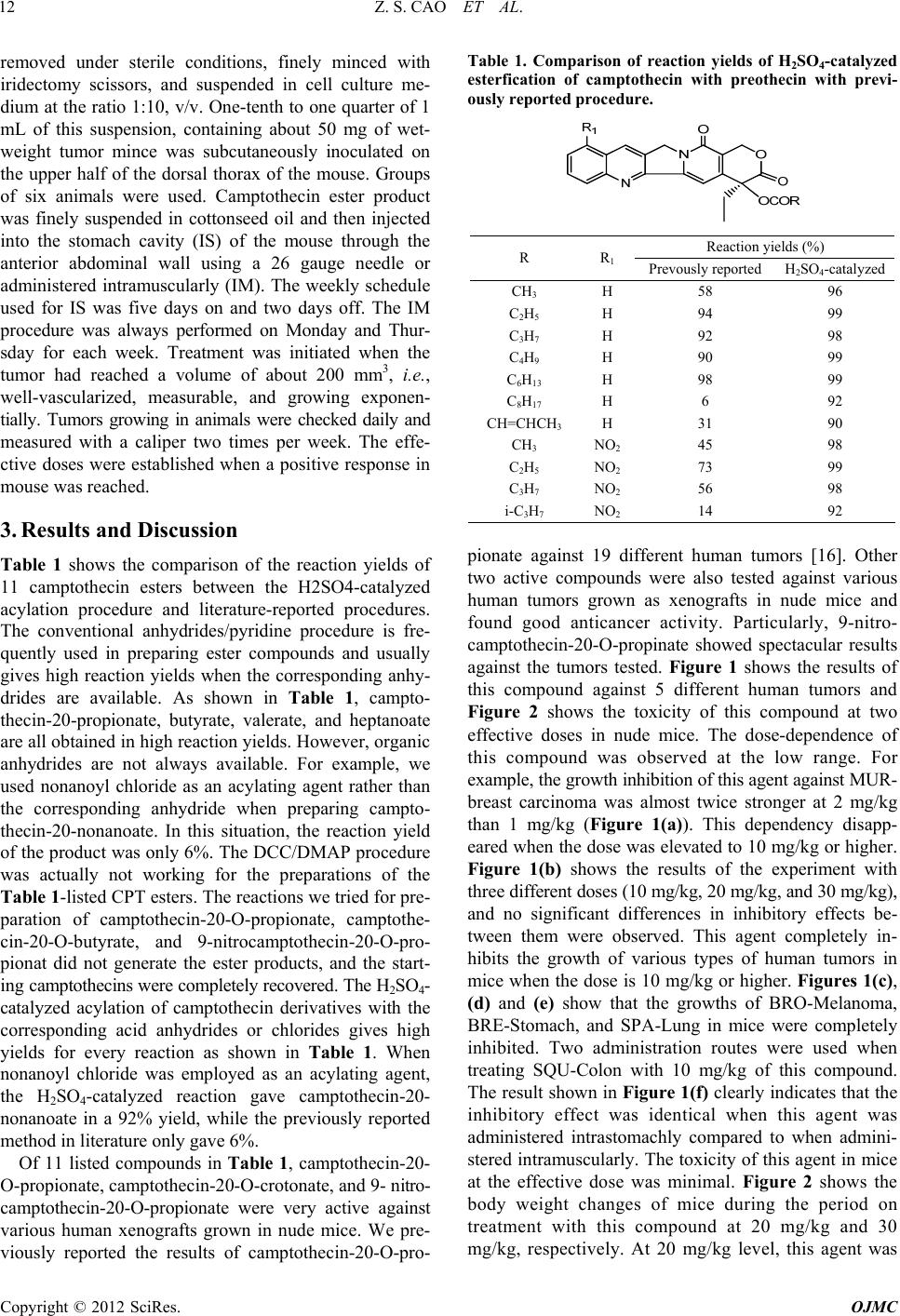 Z. S. CAO ET AL. 12 re m and literature-reported procedures. ridine procedure is fre- compounds and usually ptothecin-20-O-pro- Ta moved under sterile conditions, finely minced with iridectomy scissors, and suspended in cell culture me- dium at the ratio 1:10, v/v. One-tenth to one quarter of 1 L of this suspension, containing about 50 mg of wet- weight tumor mince was subcutaneously inoculated on the upper half of the dorsal thorax of the mouse. Groups of six animals were used. Camptothecin ester product was finely suspended in cottonseed oil and then injected into the stomach cavity (IS) of the mouse through the anterior abdominal wall using a 26 gauge needle or administered intramuscularly (IM). The weekly schedule used for IS was five days on and two days off. The IM procedure was always performed on Monday and Thur- sday for each week. Treatment was initiated when the tumor had reached a volume of about 200 mm3, i.e. , well-vascularized, measurable, and growing exponen- tially. Tumors growing in animals were checked daily and measured with a caliper two times per week. The effe- ctive doses were established when a positive response in mouse was reached. 3. Results and Discussion Table 1 shows the comparison of the reaction yields of 11 camptothecin esters between the H2SO4-catalyzed acylation procedure The conventional anhydrides/py quently used in preparing ester gives high reaction yields when the corresponding anhy- drides are available. As shown in Table 1, campto- thecin-20-propionate, butyrate, valerate, and heptanoate are all obtained in high reaction yields. However, organic anhydrides are not always available. For example, we used nonanoyl chloride as an acylating agent rather than the corresponding anhydride when preparing campto- thecin-20-nonanoate. In this situation, the reaction yield of the product was only 6%. The DCC/DMAP procedure was actually not working for the preparations of the Table 1-listed CPT esters. The reactions we tried for pre- paration of camptothecin-20-O-propionate, camptothe- cin-20-O-butyrate, and 9-nitrocamptothecin-20-O-pro- pionat did not generate the ester products, and the start- ing camptothecins were completely recovered. The H2SO4- catalyzed acylation of camptothecin derivatives with the corresponding acid anhydrides or chlorides gives high yields for every reaction as shown in Table 1. When nonanoyl chloride was employed as an acylating agent, the H2SO4-catalyzed reaction gave camptothecin-20- nonanoate in a 92% yield, while the previously reported method in literature only gave 6%. Of 11 listed compounds in Table 1, camptothecin-20- O-propionate, camptothecin-20-O-crotonate, and 9- nitro- camptothecin-20-O-propionate were very active against various human xenografts grown in nude mice. We pre- viously reported the results of cam ble 1. Comparison of reaction yields of H2SO4-catalyzed esterfication of camptothecin with preothecin with previ- ously reported procedure. Reaction yields (%) R R1 Prevously reported H2SO4-catalyzed CH3 H 58 96 C2H5 H 94 99 C3H7 H 92 98 C H 9 C613 CH=CHCH3 H N 45 N 73 N 56 N 14 4H9 H 0 99 H 98 99 C8H17 H 6 92 31 90 CH3 O298 C2H5 O299 C3H7 O298 i-C3H7 O292 pionatainst ifferent an tumors [1Other two a comwere tested againarious human tumors grown as xenafts in nude found ancer activ Particularlynitro- amptothecin-20-O-propinate showed spectacular results e ag19 dhum6]. ctivepounds alsost v ogrmice and d gooticanity., 9- c against the tumors tested. Figure 1 shows the results of this compound against 5 different human tumors and Figure 2 shows the toxicity of this compound at two effective doses in nude mice. The dose-dependence of this compound was observed at the low range. For example, the growth inhibition of this agent against MUR- breast carcinoma was almost twice stronger at 2 mg/kg than 1 mg/kg (Figure 1(a)). This dependency disapp- eared when the dose was elevated to 10 mg/kg or higher. Figure 1(b) shows the results of the experiment with three different doses (10 mg/kg, 20 mg/kg, and 30 mg/kg), and no significant differences in inhibitory effects be- tween them were observed. This agent completely in- hibits the growth of various types of human tumors in mice when the dose is 10 mg/kg or higher. Figures 1(c), (d) and (e) show that the growths of BRO-Melanoma, BRE-Stomach, and SPA-Lung in mice were completely inhibited. Two administration routes were used when treating SQU-Colon with 10 mg/kg of this compound. The result shown in Figure 1(f) clearly indicates that the inhibitory effect was identical when this agent was administered intrastomachly compared to when admini- stered intramuscularly. The toxicity of this agent in mice at the effective dose was minimal. Figure 2 shows the body weight changes of mice during the period on treatment with this compound at 20 mg/kg and 30 mg/kg, respectively. At 20 mg/kg level, this agent was Copyright © 2012 SciRes. OJMC 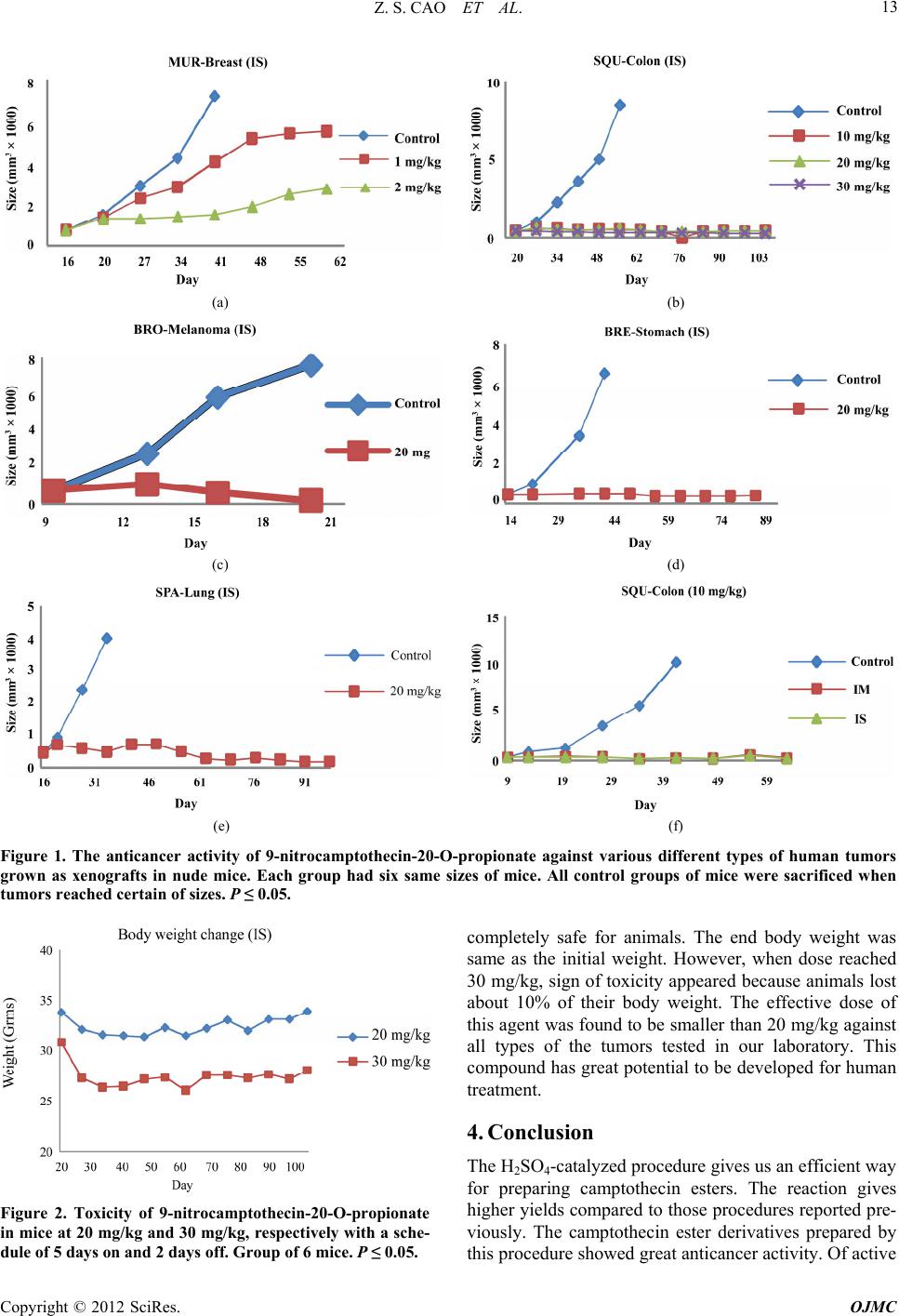 Z. S. CAO ET AL. Copyright © 2012 SciRes. OJMC 13 (a) (b) (c) (d) (e) (f) Figure 1. The anticancer activity of 9-nitrocamptothecin-20-opionate against various different types of human tumor grown as xenografts in nude mice. Each group had six sames of mice. All control groups of mice were sacrificed whe tumors reached certain of siz O-prs sizen es. P ≤ 0.05. Figure 2. Toxicity of 9-nitrocamptothecin-20-O-propionate in mice at 20 mg/kg and 30 mg/kg, respectively with a sche- dule of 5 days on and 2 days off. Group of 6 mice. P ≤ 0.05. same as the initial weight. However, when dose reached 30 mg/kg, sign of toxicity appeared because animals lost e camptothecin ester derivatives prepared by this procedure showed great anticancer activity. Of active completely safe for animals. The end body weight was about 10% of their body weight. The effective dose of this agent was found to be smaller than 20 mg/kg against all types of the tumors tested in our laboratory. This compound has great potential to be developed for human treatment. 4. Conclusion The H2SO4-catalyzed procedure gives us an efficient way for preparing camptothecin esters. The reaction gives higher yields compared to those procedures reported pre- viously. Th  Z. S. CAO ET AL. 14 compounds, 9-nitrocamptothecin-20-O-propionate hlin Fo ged. amptotheca acuminata Journal of the American Chemical Society, Vol. 88, 16,1966, pp. 300968a057 pos- sesses great potential to be further developed for human treatment. This procedure would also be applicable to the acylation reactions of other alcohols or thiols. 5. Acknowledgements The authors wish to thank Mr. Edward Ezell at the Uni- versity of Texas Medical Branch for NMR data. Sup- porting funds from the CHRISTUS Stehlin Foundation for Cancer Research and the Friends of the Steun- dation are greatly acknowled REFERENCES [1] M. Wall, M. Wani, C. Cook, K. Palmer, A. McPhail and G. Sim, “Plant Antitumor Agents. I. The Isolation and Structure of Camptothecin, a Novel Alkaloidal Leukemia and Tumor Inhibitor from C,” No. 888-3890. doi:10.1021/ja [2] J. Gottlieb, A.verio and J. Block, eclinical Studies,” Cancer Chemotherapy Reports n of Medicinal Chemis- Guarino, J. Call, V. Oli “Preliminary Pharmacologic and Clinical Evaluation of Camptothecin Sodium (NSC-100880),” Cancer Chemo- therapy Reports: Part 1, Vol. 54, No. 6, 1970, pp. 461- 470. [3] J. Gottlieb and J. Luce, “Treatment of Malignant Mela- noma with Camptothecin (NSC-100880),” Cancer Che- motherapy Reports, Vol. 56, No. 1, 1972, pp. 103-105. [4] F. Muggia, P. Creaven, H. Hansen, M. Cohen and O. Selawry, “Phase I Clinical Trial of Weekly and Daily Treatment with Camptothecin (NSC-100880): Correlation with Pr, t Vol. 56, No. 4, 1972, pp. 515-521. [5] C. Moertel, A. Schutt, R. Reitemeier and R. Hahn, “Phase II Study of Camptothecin (NSC-100880) in the Treatme of Advanced Gastrointestinal Cancer,” Cancer Chemo- therapy Reports , Vol. 56, No. 1, 1972, pp. 95-101. [6] M. Wani, P. Ronman, L. Lindley and M. Wall, “Plant Antitumor Agents. 18. Synthesis and Biological Activity of Camptothecin Analogs,” Journal try, Vol. 23, No. 5, 1980, pp. 554-560. doi:10.1021/jm00179a016 [7] T. Burke, “Chemistry of the Camptothecins in the Blood- stream: Drug Stabilization and Optimization of Activity eman, J. Stehlin Esters of Camptothecin and in the Camptothecins—From Discovery to Patients,” An- nals of the New York Academy of Sciences, Vol. 903, 1993, pp. 29-31. [8] Z. Cao, N. Harris, A. Kozielski, D. Vard and B. Giovanella, “Alkyl 9-Nitrocamptothecin: Synthesis, in Vitro Pharmacokinet- ics, Toxicity, and Antitumor Activity,” Journal of Me- dicinal Chemistry, Vol. 41, No. 1, 1998, pp. 31-37. doi:10.1021/jm9607562 [9] Z. Cao, J. Mendoza, A. DeJesus and B. Giovanella, “Syn- thesis and Antitumor Activity of Alkenyl Camptoth Esters,” Acta Pharmacoecin logica Sinica, Vol. 26, No. 2, 2005, pp. 235-241. doi:10.1111/j.1745-7254.2005.00031.x [10] B. Neises and W. Steglich, “Simple Method for the Esterification of Carboxylic Acids,” Angewandte Ch International Edition, Vol. 17, No. 7, 19 emie 78, pp. 522-524. doi:10.1002/anie.197805221 [11] A. Hassner and V. Alexanian, “Direct Room Temperature Esterification of Carboxylic Acids,” Tetrahedron Letters, Vol. 19, No. 46, 1978, pp. 4475-4478 doi:10.1016/S0040-4039(01)95256-6 [12] F. Ziegler and G. Berger, “A Mild Method for the Esteri- fication of Fatty Acids,” Synthetic Com 9, No. 6, 1979, pp. 539-543. munications, Vol. doi:10.1080/00397917908060958 [13] Z. Cao, J. Mendoza, A. DeJusus, D. Vardeman and B. Giovanella, “Synthesis and Antit matic Camptothecin Esters,” International Jo umor Activity of Aro- urnal of - p- Molecular Medicine, Vol. 21, No. 4, 2008, pp. 477-487. [14] Z. Cao, P. Pantazis, J. Mendoza, J. Early, A. Kozielski, N. Harris and B. Giovanella, “Structure-Activity Relation- ship of Alkyl 9-Nitrocamptothecin Esters,” Acta Phar macologica Sinica, Vol. 24, No. 2, 2003, pp. 109-119. [15] Z. Cao, P. Pantazis, J. Mendoza, J. Early, A. Kozielski, N. Harris, D. Vardeman, J. Liehr, J. Stehlin and B. Gio- vanella, “Structure-Activity Relationship of Alkyl Cam tothecin Esters,” Annals of the New York Academy of Sciences, Vol. 922, 2000, pp. 122-135. doi:10.1111/j.1749-6632.2000.tb07031.x [16] Z. Cao, A. Kozielski, X. Liu, Y. Wang, D. Vardeman and B. Giovaniella, “Crystalline Camptothe pionate Hydrate: A Novel Anticancer Ag cin-20(S)-Opro- ent with Strong Activity against 19 Human Tumor Xenograts,” Cancer Research, Vol. 69, No. 11, 2009, pp. 4742-4749. doi:10.1158/0008-5472.CAN-08-4452 [17] Z. Cao, J. Mendoza, A. Kozielski, X. Liu, A. DeJesus, Y. Wang, C. Zhan, D. Vardeman and B. Giovanella cancer Activity of New Haloalkyl Ca , “Anti- mptothecin Esters w Prepa- against Human Cancer Cell Lines and Human Tumor Xenografts Grown in Nude Mice,” Submission. [18] Z. Cao, K. Armstrong, M. Shaw, E. Petry and N. Harris, “Nitration of Camptothecin with Various Inorganic Ni- trate Salts in Concentrated Sulfuric Acid: A Ne ration of Anticancer Drug 9-Nitrocamptothecin,” Synthe- sis, Vol. 1998, No. 12, 1998, pp. 1724-1730. doi:10.1055/s-1998-2207 Copyright © 2012 SciRes. OJMC |