

Paper Menu >>
Journal Menu >>
 Open Journal of Internal Medicine, 2012, 2, 37-39 OJIM http://dx.doi.org/10.4236/ojim.2012.21009 Published Online March 2012 (http://www.SciRP.org/journal/ojim/) Anticardiolipin antibodies do not mediate macrovascular complications of type 2 d i a betes Caroline Eickhoff Copetti1, Myriam Perreynoud2, Melissa Claudia Bisi1, Henrique Luiz Staub1* 1Rheumatology Department, São Lucas Hospital, Faculty of Medicine, Pontifical Catholic University of Rio Grande do Sul (PUCRS), Porto Alegre, Brazil 2Clinical Pathology Laboratory, São Lucas Hospital, PUCRS, Porto Alegre, Brazil Email: *[email protected] Received 7 September 2011; revised 11 November 2011; accepted 22 November 2011 ABSTRACT The relationship of anticardiolipin antibodies (ACA), markers of the antiphospholipid syndrome, with vas- cular complications of diabetes mellitus is polemic. This cross-sectional study assessed the frequency of IgG, IgM, and IgA ACA in type 2 diabetics with and without history of vascular events for the last 5 years, and in healthy controls. ACA were detected by en- zyme immunoassay. A total of 73 type 2 diabetics (33 with history of vascular events) and 54 healthy con- trols were tested. Most diabetics were female (p = 0.003), and older than controls (p < 0.001). Mean du- ration of disease was 10 years. The prevalence of a positive ACA test was 7.4% in controls and 9.5% in diabetics (p = 0.910). Comparison of healthy controls and diabetics with and without history of macrovas- culopathy, after adjusting for gender and age, showed no significant differences as to the presence of ACA (p > 0.09). ACA positivity rates were also similar when diabetics with and without history of vasculo- pathy were compared (p > 0.47). After adjusting for gender, age, hypertension, and smoking status, a weak but statistically insignificant association between IgM ACA and diabetics with vasculopathy was found (ad- justed OR 2.7; 9 5% CI 0.2 - 34.2; p = 0.441). Overall, levels of IgG (r = 0.25 ; p = 0.005) and IgM ( r = 0.23; p = 0.010) ACA were associated with increasing age. In short, the frequency of a positive ACA test in type 2 diabetics (with or without previous macrovasculopa- thy) was not significant as compared to healthy con- trols. There was no association of ACA with vascular events in patients with type 2 diabetes. Keywords: Anticardiolipin Antibodies; Type 2 Diabetes Mellitus; Myocardial Infarction; Cerebrovascular Infarction Anticardiolipin antibodies (ACA), as well as the lupus anticoagulant and antibodies to beta2-glycoprotein (beta2- gpI), are classical markers of the antiphospholipid syn- drome (APS) [1]. The relationship of ACA with vascular complications of diabetes is rather unclear. This cross-sectional study assessed the frequency of IgG, IgM, and IgA ACA in type 2 diabetics [2] with and without history of macrovascular events (myocardial and/or cerebral infarction) for the last 5 years, and in healthy controls. ACA were detected by enzyme immu- noassay (ORGENTEC Diagnostika GmbH—Anti-Car- diolipin). Titers were considered as positive when above 10 GPL f or I g G ACA, 10 MPL for IgM ACA, and 7 u n it s for IgA ACA [3]. The study was approved by the local ethics committee. Chi-square analysis were used for comparison of categorical variables, and the Student’s t test was used for comparison of continuous variables. A level of 5% (p < 0.05) was considered significant. Odds ratios (OR) with 95% confidence intervals (95% CI) were calculated for univariate analysis. Logistic regression with 95% CI was performed to adjust the effects of gender, age, hyperten- sion [4], and current smoking [5] in the OR. When needed, Agresti correction was employed to obtain non- adjusted OR. To co-relate quantitative variables, the Pearson coefficient was utilized. All analyses used pro- cedures of the SPSS for Windows, versi on 11.5, Chicago, IL. A total of 73 type 2 diabetics (33 with history of vas- cular events) and 54 healthy controls were tested. Most diabetics were female (p = 0.003), and older than con- trols (p < 0.001). Mean dur ation of disease was 10 years. The prevalence of a po sitive ACA test (any isotyp e) was 7.4% in controls (5.6% IgA ACA) and 9.5% in diabetics (p = 0.910). Comparison of healthy controls and diabetics with or without history of macrov asculopathy, after ad justing for gender and age, showed no significant differences in ACA positivity (p > 0.09). ACA frequency rates were *Corresponding a uthor. OPEN ACCESS 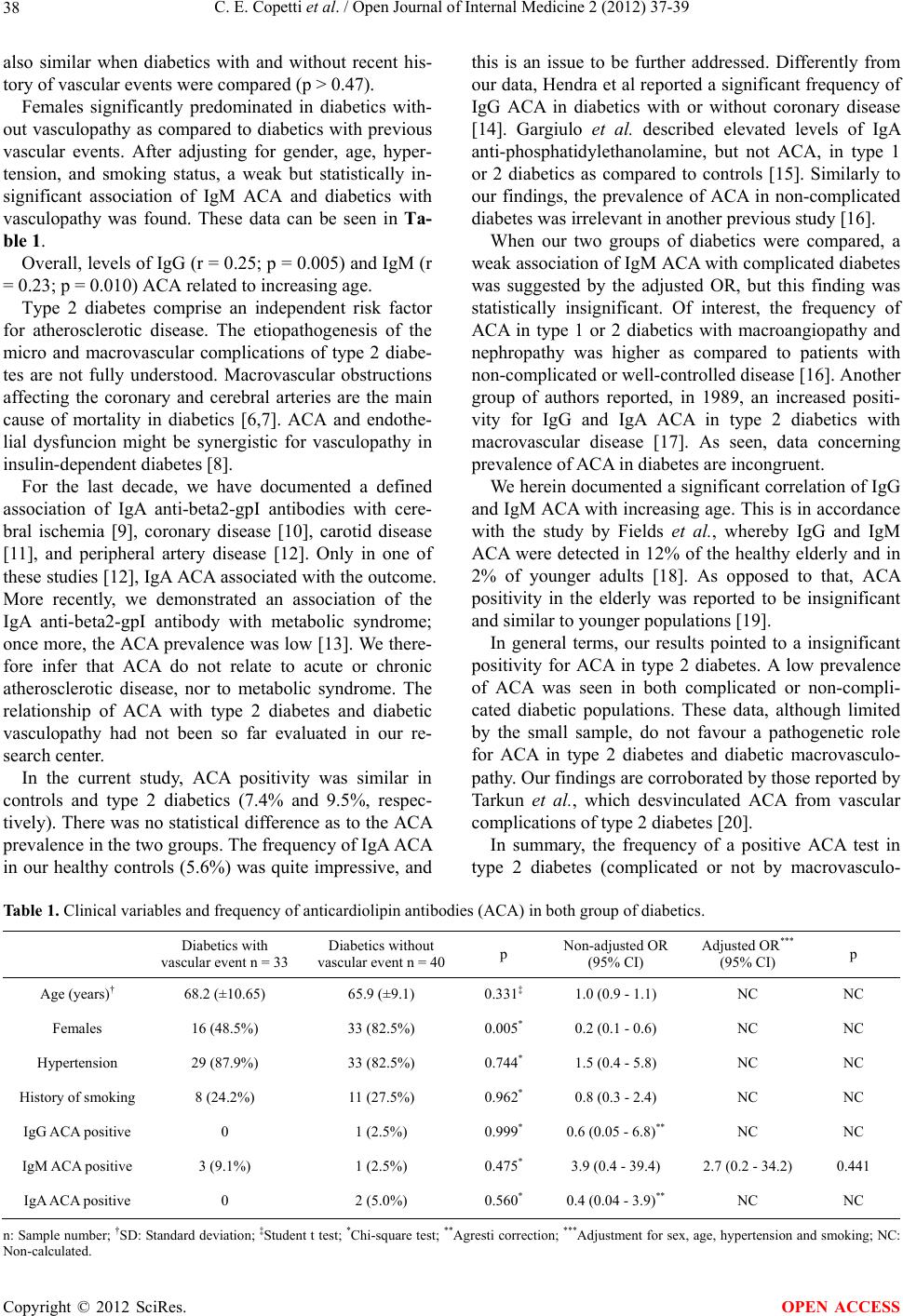 C. E. Copetti et al. / Open Journal of Internal Medicine 2 (2012) 37-39 38 also similar when diabetics with and without recent his- tory of vascular e ve nts were c ompared (p > 0.47). Females significantly predominated in diabetics with- out vasculopathy as compared to diabetics with previous vascular events. After adjusting for gender, age, hyper- tension, and smoking status, a weak but statistically in- significant association of IgM ACA and diabetics with vasculopathy was found. These data can be seen in Ta- ble 1. Overall, leve ls of IgG (r = 0.25; p = 0.005) and IgM (r = 0.23; p = 0.010) ACA related to increasing age. Type 2 diabetes comprise an independent risk factor for atherosclerotic disease. The etiopathogenesis of the micro and macrovascular complications of type 2 diabe- tes are not fully understood. Macrovascular obstructions affecting the coronary and cerebral arteries are the main cause of mortality in diabetics [6,7]. ACA and endothe- lial dysfuncion might be synergistic for vasculopathy in insulin- dependent diabe t es [8]. For the last decade, we have documented a defined association of IgA anti-beta2-gpI antibodies with cere- bral ischemia [9], coronary disease [10], carotid disease [11], and peripheral artery disease [12]. Only in one of these studies [12], IgA ACA associated with the outcome. More recently, we demonstrated an association of the IgA anti-beta2-gpI antibody with metabolic syndrome; once more, the ACA prevalence was low [13]. We there- fore infer that ACA do not relate to acute or chronic atherosclerotic disease, nor to metabolic syndrome. The relationship of ACA with type 2 diabetes and diabetic vasculopathy had not been so far evaluated in our re- search center. In the current study, ACA positivity was similar in controls and type 2 diabetics (7.4% and 9.5%, respec- tively). There was no statistical difference as to the ACA prevalence in the two groups. The frequency of IgA ACA in our healthy co ntrols (5.6%) was quite impressive, and this is an issue to be further addressed. Differently from our data, Hendra et al reported a significant frequency of IgG ACA in diabetics with or without coronary disease [14]. Gargiulo et al. described elevated levels of IgA anti-phosphatidylethanolamine, but not ACA, in type 1 or 2 diabetics as compared to controls [15]. Similarly to our findings, the prevalence of ACA in non-complicated diabetes was irrelevant in another previous study [16]. When our two groups of diabetics were compared, a weak association of IgM ACA with complicated diabetes was suggested by the adjusted OR, but this finding was statistically insignificant. Of interest, the frequency of ACA in type 1 or 2 diabetics with macroangiopathy and nephropathy was higher as compared to patients with non-complicated or well-controlled disease [16]. Another group of authors reported, in 1989, an increased positi- vity for IgG and IgA ACA in type 2 diabetics with macrovascular disease [17]. As seen, data concerning prevalence of ACA in diabetes are incongruent. We herein documented a significant correlation of IgG and IgM ACA with increasing age. This is in accordance with the study by Fields et al., whereby IgG and IgM ACA were detected in 12% of the healthy elderly and in 2% of younger adults [18]. As opposed to that, ACA positivity in the elderly was reported to be insignificant and similar to younger populations [19]. In general terms, our results pointed to a insignificant positivity for ACA in type 2 diabetes. A low prevalence of ACA was seen in both complicated or non-compli- cated diabetic populations. These data, although limited by the small sample, do not favour a pathogenetic role for ACA in type 2 diabetes and diabetic macrovasculo- pathy. Our findings are corroborated by those reported by Tarkun et al., which desvinculated ACA from vascular complications of type 2 diabetes [20]. In summary, the frequency of a positive ACA test in type 2 diabetes (complicated or not by macrovasculo- Table 1. Clinical variables and frequency of anticardiolipin antibodies (ACA) in both group of diabetics. Diabetics with vascular event n = 33 Diabetics without vascular event n = 40 p Non-adjusted OR (95% CI) Adjusted OR*** (95% CI) p Age (years)† 68.2 (±10.65) 65.9 (±9.1) 0.331‡ 1.0 (0.9 - 1.1) NC NC Females 16 (48.5%) 33 (82.5%) 0.005* 0.2 (0.1 - 0.6) NC NC Hypertension 29 (87.9%) 33 (82.5%) 0.744* 1.5 (0.4 - 5.8) NC NC History of smoking 8 (24.2%) 11 (27.5%) 0.962* 0.8 (0.3 - 2 .4) NC NC IgG ACA positive 0 1 (2.5%) 0.999* 0.6 (0.05 - 6.8)** NC NC IgM ACA positive 3 (9.1%) 1 (2.5%) 0.475* 3.9 (0.4 - 39.4) 2.7 (0.2 - 34.2) 0.441 IgA ACA positive 0 2 (5.0%) 0.560* 0.4 (0.04 - 3.9)** NC NC n: Sample number; †SD: Standard deviation; ‡Student t test; *Chi-square test; **Agresti correction; ***Adjustment for sex, age, hypertension and smoking; NC: on-calculated. N Copyright © 2012 SciRes. OPEN ACCESS  C. E. Copetti et al. / Open Journal of Internal Medicine 2 (2012) 37-39 39 pathy) did not significantly differ from controls. There was no association of ACA with vascular events in patients with type 2 diabetes. ACA do not appear to be relevant in the pathogenesis of vascular complications of type 2 diabetes. REFERENCES [1] Miyakis, S., Lockshin, M.D., Atsumi, T., Branch, D.W., Brey, R.L., Cervera, R., et al. (2006) International con- sensus statement on an update of the classification criteria for definite antiphospholipid syndrome (APS). Journal of Thrombosis and Haemostasis, 4, 295-306. doi:10.1111/j.1538-7836.2006.01753.x [2] Grundy, S.M., Cleeman, J.I., Daniels, S.R., Donato, K.A., Eckel, R.H., Franklin, B.A., et al. (2005) Diagnosis and management of the metabolic syndrome. An American Heart Association/National Heart, Lung, and Blood In- stitute Scientific Statement. Executive summary. Cardi- ology in Review, 13, 322-327. [3] Gharavi, A.E., Harris, E.N., Asherson, R.A. and Hughes, G.R. (1987) Anticardiolipin antibodies: Isotype distribu- tion and phospholipid specificity. Annals of the Rheu- matic Diseases, 46, 1-6. doi:10.1136/ard.46.1.1 [4] Chobanian, A.V., Bakris, G.L., Black, H.R., Cushman, W.C., Green, L.A., Izzo, J.L. Jr., et al. (2003) The sev- enth report of the Joint National Committee on Preven- tion, Detection, Evaluation, and Treatment of High Blood Pressure: The JNC 7 report. Journal of the American Medical Association, 289, 2560-2572. doi:10.1001/jama.289.19.2560 [5] Filozof, C., Fernandez Pinill a, M.C. and Fernández-Cruz, A. (2004) Smoking cessation and weight gain. Obesity Research, 5, 95-103. doi:10.1111/j.1467-789X.2004.00131.x [6] King, H., Aubert, R.E. and Herman, W.H. (1998) Global burden of diabetes, 1995-2025: Prevalence, numerical es- timates, and projections. Diabetes Care, 21, 1414-1431. doi:10.2337/diacare.21.9.1414 [7] Kannel, W.B. and McGee, D.L. (1979) Diabetes and cardiovascular disease. The Framingham study. Journal of the American Medical Association, 241, 2035-2038. doi:10.1001/jama.1979.03290450033020 [8] Ciarla, M.V., Bocciarelli, A., Di Gregorio, S., Tordi, A., Cotroneo, P., Marra, G., et al. (2001) Autoantibodies and endothelial dysfunction in well-controlled, uncomplicated insulin-dependent diabetes mellitus patients. Atheroscle- rosis, 158, 241-246. doi:10.1016/S0021-9150(01)00440-3 [9] Staub, H.L., Norman, G.L., Crowther, T., Da Cunha, V.R., Polanczyk, A., Bohn, J.M., et al. (2003) Antibodies to the atherosclerotic plaque components beta2-glyco- protein I and heat-shock proteins as risk factors for acute cerebral ischemia. Arquivos De Neuro-Psiquitria, 61, 757- 763. doi:10.1590/S0004-282X2003000500010 [10] Ranzolin, A., Bohn, J.M., Norman, G.L., Manenti, E., Bodanese, L.C., Von Muhlen, C.A., et al. (2004) Anti- beta2-glycoprotein I antibodies as risk factors for acute myocardial infarction. Arquivos Brasileiros de Cardiolo- gia, 83, 141-144. [11] Recuero, M.L., Silva, J.B., Norman, G.L., Von Muhlen, C.A. and Staub, H.L. (2007) IgA antibodies to beta2- glycoprotein I and carotid disease. Israel Medical Asso- ciation Journal, 9, 495-496. [12] Franck, M., Staub, H.L., Petracco, J.B., Norman, G.L., Lassen, A.J., Schiavo, N., et al. (2007) Autoantibodies to the atheroma component beta2-glycoprotein I and risk of symptomatic peripheral artery disease. Angiology, 58, 295-302. doi:10.1177/0003319707302493 [13] Krás Borges, R., Bodanese, L., Von Mühlen, C., Repetto, G., Viehe, M., Norman, G., et al. (2011) Anti-beta2- glycoprotein I autoantibodies and metabolic syndrome. Arquivos Brasileiros de Cardiologia, 96, 272-276. [14] Hendra, T.J., Baguley, E., Harris, E.N., Khamashta, M. H., Trembath, R.C., Hughes, G.R., et al. (1989) Anticardi- olipin antibody levels in diabetic subjects with and with- out coronary artery disease. Postgraduate Medical Jour- nal, 65, 140-143. doi:10.1136/pgmj.65.761.140 [15] Gargiulo, P., Goldberg, J., Romani, B., Schiaffini, R., Ciampalini, P., Faulk, W.P., et al. (1999) Qualitative and quantitative studies of autoantibodies to phospholipids in diabetes mellitus. Clinical & Experimental Immunology, 118, 30-34. doi:10.1046/j.1365-2249.1999.01014.x [16] Galtier-Dereure, F., Biron, C., Vies, M., Bourgeois, V., Schved, J.F. and Bringer, J. (1998) Vascular complica- tions of diabetes mellitus: What role for phospholipid- binding antibodies? Lupus, 7, 469-474. doi:10.1191/096120398678920488 [17] Triolo, G., Giardina, E., Scarantino, G., Seddio, G. and Bompiani, G. (1989) Detection of anti-phospholipid (car- diolipin, phosphatidylserine) antibodies in the serum of patients with non insulin-dependent (type 2) diabetes mellitus and macroangiopathy. Coexistence of antipla- telet reactivity. Diabetes Research, 10, 63-67. [18] Fields, R.A., Toubbeh, H., Searles, R.P. and Bankhurst, A.D. (1989) The prevalence of anticardiolipin antibodies in a healthy elderly population and its association with antinuclear antibodies. Journal of Rheumatology, 16, 623-625. [19] Chakravarty, K.K., Gray, R. E., Webley, M., Byron, M.A. and Wozniak, J. (1991) Prevalence of anticardiolipin an- tibodies in the elderly British population. Postgraduate Medical Journal, 67, 358-361. doi:10.1136/pgmj.67.786.358 [20] Tarkun, I., Hacihanefioglu, A., Tarkun, P., Cetinarslan, B. and Canturk, Z. (2005) Anticardiolipin and anti-beta2 glycoprotein I antibody concentrations in patients with type 2 diabetes mellitus. Diabetes Research and Clinical Practice, 68, 181-187. doi:10.1016/j.diabres.2004.09.005 Copyright © 2012 SciRes. OPEN ACCESS |