

Paper Menu >>
Journal Menu >>
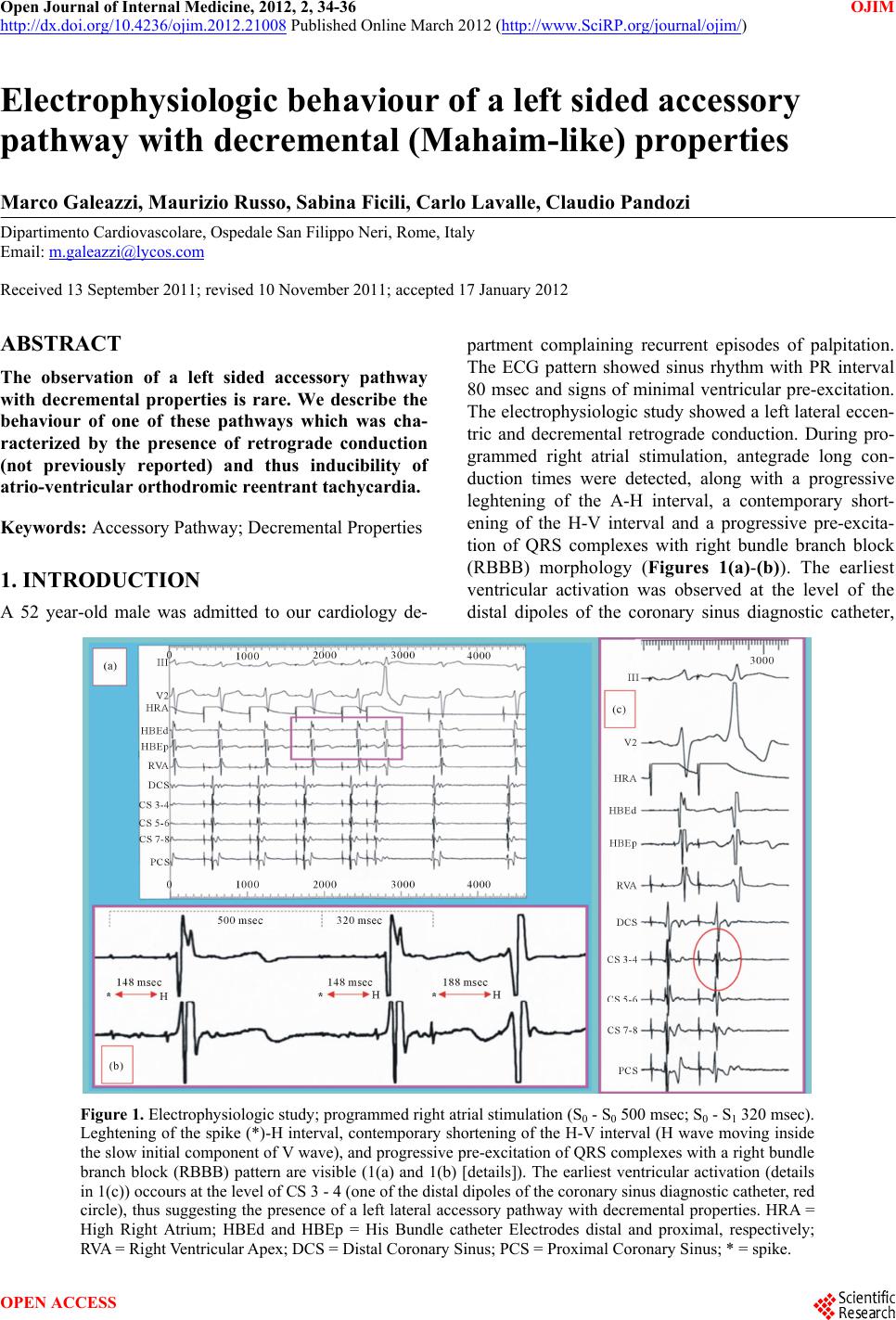 Open Journal of Internal Medicine, 2012, 2, 34-36 OJIM http://dx.doi.org/10.4236/ojim.2012.21008 Published Online March 2012 (http://www.SciRP.org/journal/ojim/) Electrophysiologic behaviour of a left sided accessory pathway with decremental (Mahaim-like) properties Marco Galeazzi, Maurizio Russo, Sabina Ficili, Carlo Lavalle, Claudio Pandozi Dipartimento Cardiovascolare, Ospedale San Filippo Neri, Rome, Italy Email: [email protected] Received 13 September 2011; revised 10 November 2011; accepted 17 January 2012 ABSTRACT The observation of a left sided accessory pathway with decremental properties is rare. We describe the behaviour of one of these pathways which was cha- racterized by the presence of retrograde conduction (not previously reported) and thus inducibility of atrio-ventricular orthodromic reentrant tachycardia. Keywords: Accessory Pathway; Decremental Properties 1. INTRODUCTION A 52 year-old male was admitted to our cardiology de- partment complaining recurrent episodes of palpitation. The ECG pattern showed sinus rhythm with PR interval 80 msec and signs of minimal ventricular pre-excitation. The electrophysiologic study showed a left lateral eccen- tric and decremental retrograde conduction. During pro- grammed right atrial stimulation, antegrade long con- duction times were detected, along with a progressive leghtening of the A-H interval, a contemporary short- ening of the H-V interval and a progressive pre-excita- tion of QRS complexes with right bundle branch block (RBBB) morphology (Figures 1(a)-(b)). The earliest ventricular activation was observed at the level of the distal dipoles of the coronary sinus diagnostic catheter, Figure 1. Electrophysiologic study; programmed right atrial stimulation (S0 - S0 500 msec; S0 - S1 320 msec). Leghtening of the spike (*)-H interval, contemporary shortening of the H-V interval (H wave moving inside the slow initial component of V wave), and progressive pre-excitation of QRS complexes with a right bundle branch block (RBBB) pattern are visible (1(a) and 1(b) [details]). The earliest ventricular activation (details in 1(c)) occours at the level of CS 3 - 4 (one of the distal dipoles of the coronary sinus diagnostic catheter, red circle), thus suggesting the presence of a left lateral accessory pathway with decremental properties. HRA = High Right Atrium; HBEd and HBEp = His Bundle catheter Electrodes distal and proximal, respectively; RVA = Right Ventricular Apex; DCS = Distal Coronary Sinus; PCS = Proximal Coronary Sinus; * = spike. OPEN ACCESS 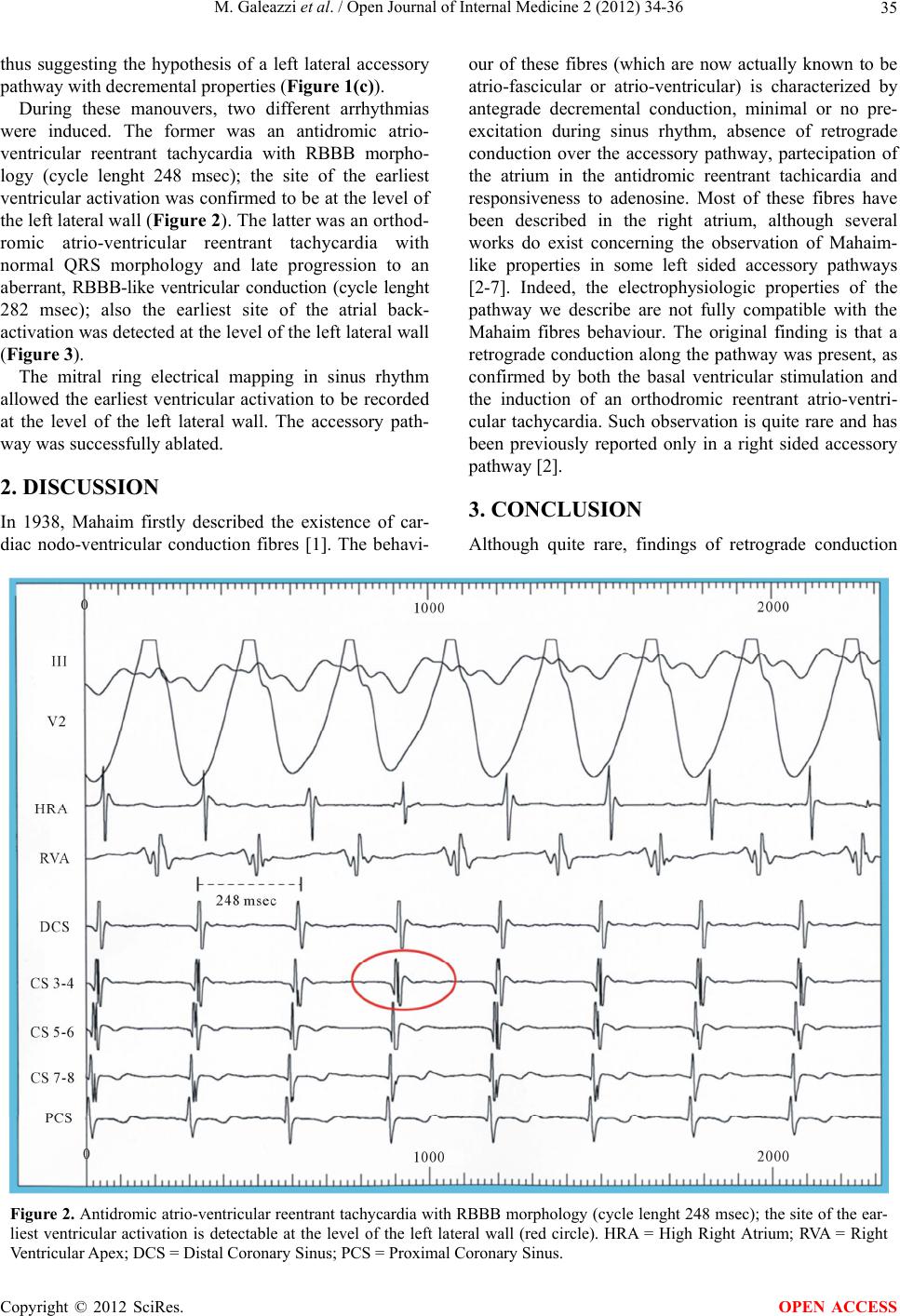 M. Galeazzi et al. / Open Journal of Internal Medicine 2 (2012) 34-36 35 thus suggesting the hypothesis of a left lateral accessory pathway with decremental properties (Figure 1(c)). During these manouvers, two different arrhythmias were induced. The former was an antidromic atrio- ventricular reentrant tachycardia with RBBB morpho- logy (cycle lenght 248 msec); the site of the earliest ventricular activation was confirmed to be at the level of the left lateral wal l ( Figure 2). The latter was an orthod- romic atrio-ventricular reentrant tachycardia with normal QRS morphology and late progression to an aberrant, RBBB-like ventricular conduction (cycle lenght 282 msec); also the earliest site of the atrial back- activation was detected at the level of the left lateral wall (Figure 3). The mitral ring electrical mapping in sinus rhythm allowed the earliest ventricular activation to be recorded at the level of the left lateral wall. The accessory path- way was successfully ablated. 2. DISCUSSION In 1938, Mahaim firstly described the existence of car- diac nodo-ventricular conduction fibres [1]. The behavi- our of these fibres (which are now actually known to be atrio-fascicular or atrio-ventricular) is characterized by antegrade decremental conduction, minimal or no pre- excitation during sinus rhythm, absence of retrograde conduction over the accessory pathway, partecipation of the atrium in the antidromic reentrant tachicardia and responsiveness to adenosine. Most of these fibres have been described in the right atrium, although several works do exist concerning the observation of Mahaim- like properties in some left sided accessory pathways [2-7]. Indeed, the electrophysiologic properties of the pathway we describe are not fully compatible with the Mahaim fibres behaviour. The original finding is that a retrograde conduction along the pathway was present, as confirmed by both the basal ventricular stimulation and the induction of an orthodromic reentrant atrio-ventri- cular tachycardia. Such observation is quite rare and has been previously reported only in a right sided accessory pathway [2]. 3. CONCLUSION Although quite rare, findings of retrograde conduction Figure 2. Antidromic atrio-ventricular reentrant tachycardia with RBBB morphology (cycle lenght 248 msec); the site of the ear- liest ventricular activation is detectable at the level of the left lateral wall (red circle). HRA = High Right Atrium; RVA = Right Ventricular Apex; DCS = Distal Coronary Sinus; PCS = Proximal Coronary Sinus. Copyright © 2012 SciRes. OPEN ACCESS 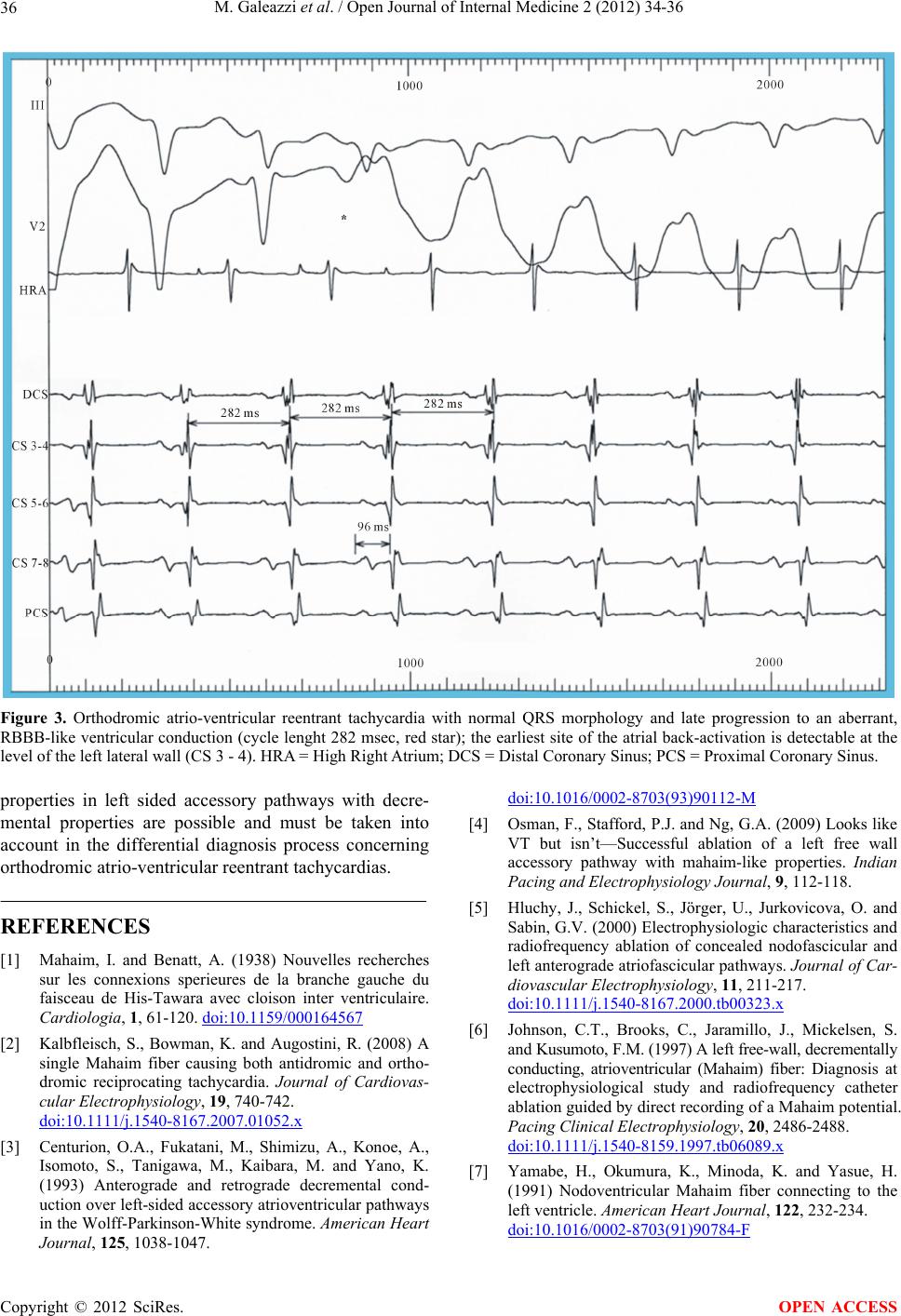 M. Galeazzi et al. / Open Journal of Internal Medicine 2 (2012) 34-36 36 Figure 3. Orthodromic atrio-ventricular reentrant tachycardia with normal QRS morphology and late progression to an aberrant, RBBB-like ventricular conduction (cycle lenght 282 msec, red star); the earliest site of the atrial back-activation is detectable at the level of the left lateral wall (CS 3 - 4). HRA = High Right Atrium; DCS = Distal Coronary Sinus; PCS = Proximal Coronary Sinus. properties in left sided accessory pathways with decre- mental properties are possible and must be taken into account in the differential diagnosis process concerning orthodromic atrio-ventricular reentrant tachycard ias. REFERENCES [1] Mahaim, I. and Benatt, A. (1938) Nouvelles recherches sur les connexions sperieures de la branche gauche du faisceau de His-Tawara avec cloison inter ventriculaire. Cardiologia, 1, 61-120. doi:10.1159/000164567 [2] Kalbfleisch, S., Bowman, K. and Augostini, R. (2008) A single Mahaim fiber causing both antidromic and ortho- dromic reciprocating tachycardia. Journal of Cardiovas- cular Electrophysiology, 19, 740-742. doi:10.1111/j.1540-8167.2007.01052.x [3] Centurion, O.A., Fukatani, M., Shimizu, A., Konoe, A., Isomoto, S., Tanigawa, M., Kaibara, M. and Yano, K. (1993) Anterograde and retrograde decremental cond- uction over left-sided accessory atrioventricular pathways in the Wolff-Parkinson-White syndrome. American Heart Journal, 125, 1038-1047. doi:10.1016/0002-8703(93)90112-M [4] Osman, F., Stafford, P.J. and Ng, G.A. (2009) Looks like VT but isn’t—Successful ablation of a left free wall accessory pathway with mahaim-like properties. Indian Pacing and Electrophysiology Journal, 9, 112-118. [5] Hluchy, J., Schickel, S., Jörger, U., Jurkovicova, O. and Sabin, G.V. (2000) Electrophysiologic characteristics and radiofrequency ablation of concealed nodofascicular and left anterograde atriofascicular pathways. Journal of Car- diovascular Electrophysiology, 11, 211-217. doi:10.1111/j.1540-8167.2000.tb00323.x [6] Johnson, C.T., Brooks, C., Jaramillo, J., Mickelsen, S. and Kusumoto, F.M. (1997) A left free-wall, decrementally conducting, atrioventricular (Mahaim) fiber: Diagnosis at electrophysiological study and radiofrequency catheter ablation guided by direct recording of a Mahaim potential. Pacing Clinical Electrophysiology, 20, 2486-2488. doi:10.1111/j.1540-8159.1997.tb06089.x [7] Yamabe, H., Okumura, K., Minoda, K. and Yasue, H. (1991) Nodoventricular Mahaim fiber connecting to the left ventricle. American Heart Journal, 122, 232-234. doi:10.1016/0002-8703(91)90784-F Copyright © 2012 SciRes. OPEN ACCESS |