

Paper Menu >>
Journal Menu >>
 Open Journal of Soil Science, 2012, 2, 20-27 http://dx.doi.org/10.4236/ojss.2012.21004 Published Online March 2012 (http://www.SciRP.org/journal/ojss) Morphological and Physico-Chemical Characteristics and Classification of Vertisol Developed on Deltaic Plain Orhan Dengiz*, Mustafa Sağlam, F. Esra Sarioğlu, Fikret Saygin, Çağla Atasoy Department of Soil Science and Plant Nutrition, Faculty of Agriculture, Ondokuz Mayıs University, Samsun, Turkey. Email: *[email protected] Received January 27th, 2012; revised February 24th, 2012; accepted March 8th, 2012 ABSTRACT The name of Vertisol is derived from Latin “vertere” meaning to invert. This case restricts development of soil horizons in profile. These soils have the cap acity to swell and sh rink, inducing cracks in the upp er parts of the soil and distinctiv e soil structure througho u t the soil. Th e fo rmation of these speci fic features are caused by a heavy texture, a dominance of swelling clay in the fine fraction and marked changes in moisture content. The swell-shrink behavior is attributed to the wetting and drying of the soil mass. In this study, morphology, physico-chemical characteristics and classification of vertisols that were formed on alluvial delta plains, were investigated. Those soils formed on the Bafra Plain found in the Kızılırmak Delta and located in the central Black Sea region of Turkey. All studied Vertisols are characterised by a dark colour in surface soil, a heavy clayey texture, hardpan formation under top soil (high bulk density a high compaction) and very high COLE values. In addition, they have deep wide-opened desiccation cracks at the surface, slickensides at the middle part of the profiles and a poor differentiation of their horizons. Physico-chemically, the studied soils are slightly basic to very basic, non-saline and poor in organic matter, which is slightly higher in the surface horizon. In addition, cation exchange capacity, sum of exchangeable bases and base saturation of soils are very high. On the basis of morphological and physicochemical analysis, soil profiles were classified as Sodic Haplustert, Typic Calciaquert, Sodic Calciustert according to Soil Taxonomy (Soil Survey Staff, 1975 and 1999) and as Sodic Vertisol and Calcic Vertisol according to FAO/ISRIC (2006) classification systems. Keywords: Vertisol; Soil Morphology; Soil Classification; Bafra Delta Plain 1. Introduction The materials that form vertisols can be either alloch- tonous or autochtonous in origin [1]. The former are geo- graphically more extensive and generally occur in the lo- wer parts of the landscape. Vertisols are known to de- velop on a wide variety of parent materials such as ba- salts in Australia [2], calcareous rocks in the West Indies [1], gneisses and sandstones in India [3], deltaic deposits in the United States of America [4], lacustrine deposits in Trinidad [5], glacio-lacustrine in Saskatchewan [6], ma- rine deposits in Guyana [7], and marls [8]. It is reported that in all cases (except fo r the vertisols developed on la- custrine deposits), the materials were recently deposited and that soil formation was still at its early stages [9]. In the case of vertisols developed from lacustrine deposits in Trinidad, it is believed that extensive weathering and clay-mineral synthesis had occurred prior to deposition [10]. The name of vertisol is derived from Latin “vertere” meaning to invert. This case restricts development of so il horizons in profile [9]. These soils have the capacity to swell and shrink, inducing cracks in the upper parts of the soil and distinctive soil structure throughout the soil [11]. The formation of these specific features are caused by a heavy texture, a dominance of swelling clay in the fine fraction and marked changes in moisture content [12]. The swell-shrink behaviour is attributed to the wetting and drying of the soil mass. Vertisols exhibit cracks a depth of 50 cm down that are at least 1 cm wide and ex- tend upward to the surface or the base of the plough layer or surface crust. These soils exhibit minimal horizon dif- ferentiation as a result of pedoturbation. They are also very plastic and sticky when wet [13]. Vertisols are de- scribed by Glossary of Soil Science Terms [14] as “min- eral soils that have 30% or more clay, deep wide cracks when dry and either gilgai microrelief, intersecting slicken- side or wedge-shaped structural aggregates tiled at an an- gle from the horizon. It was added as an order in US sys- tem of soil taxonomy. Depressions and level to undulating areas, mainly in *Corresponding a uthor. Copyright © 2012 SciRes. OJSS 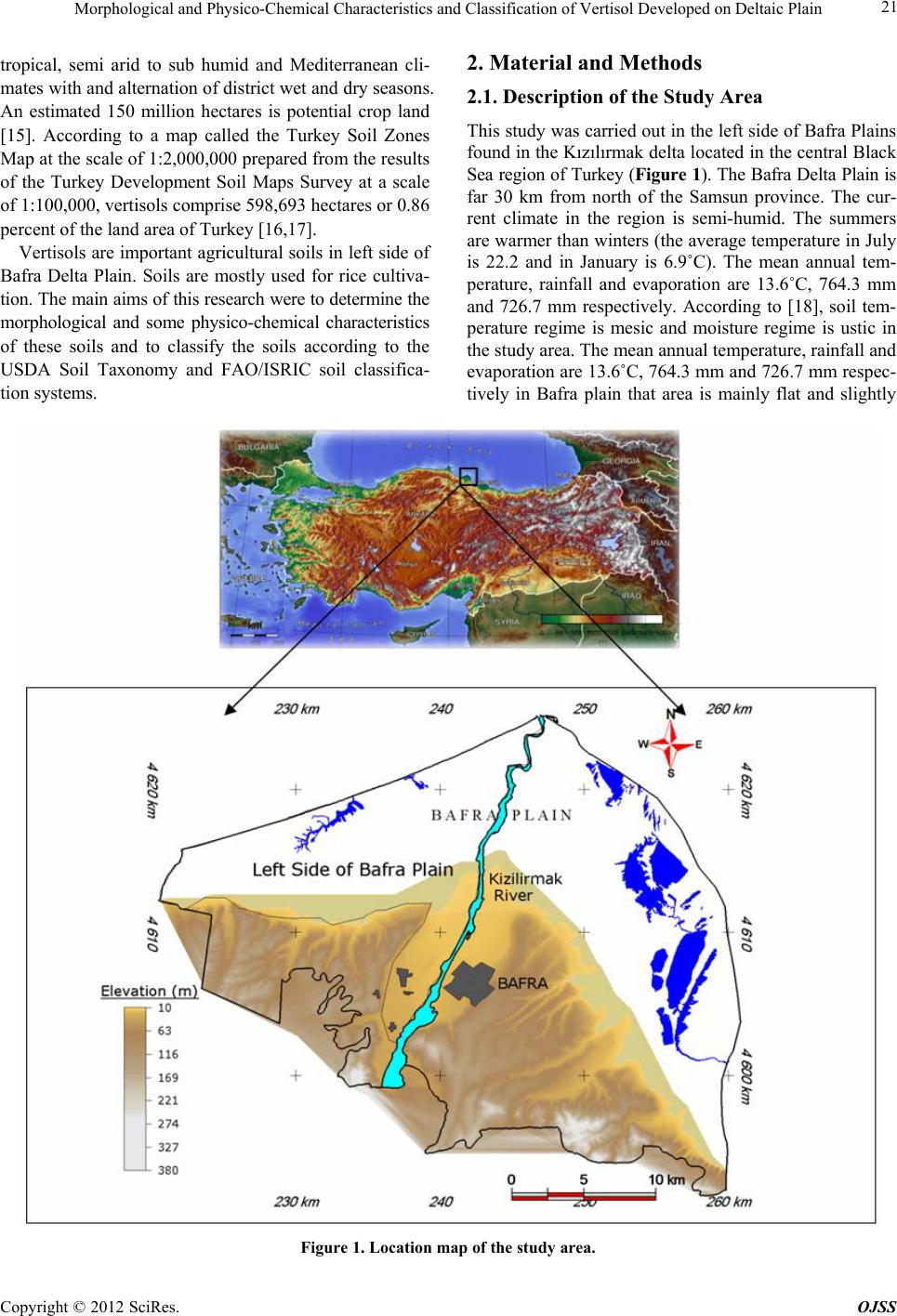 Morphological and Physico-Chemical Characteristics and Classification of Vertisol Developed on Deltaic Plain 21 tropical, semi arid to sub humid and Mediterranean cli- mates with and alternation of district wet and dry season s. An estimated 150 million hectares is potential crop land [15]. According to a map called the Turkey Soil Zones Map at the scale of 1:2,000,000 prepared from the results of the Turkey Development Soil Maps Survey at a scale of 1:100,000, vertisols comprise 598 ,693 hectar es or 0.86 percent of the land area of Turkey [16,17]. Vertisols are important agricultural soils in left side of Bafra Delta Plain. Soils are mostly used for rice cultiva- tion. The main ai ms of this research were to determine th e morphological and some physico-chemical characteristics of these soils and to classify the soils according to the USDA Soil Taxonomy and FAO/ISRIC soil classifica- tion systems. 2. Material and Methods 2.1. Description of the Study Area This study was carried out in the left side of Bafra Plains found in the Kızılırmak delta located in the central Black Sea region of Turkey (Figure 1). The Bafra Delta Plain is far 30 km from north of the Samsun province. The cur- rent climate in the region is semi-humid. The summers are warmer than winters (the average temperature in July is 22.2 and in January is 6.9˚C). The mean annual tem- perature, rainfall and evaporation are 13.6˚C, 764.3 mm and 726.7 mm respectively. According to [18], soil tem- perature regime is mesic and moisture regime is ustic in the study area. The mean annual temperature, rainfall and evaporation are 13.6˚C, 764.3 mm and 726.7 mm respec- tively in Bafra plain that area is mainly flat and slightly Figure 1. Location map of the study area. Copyright © 2012 SciRes. OJSS 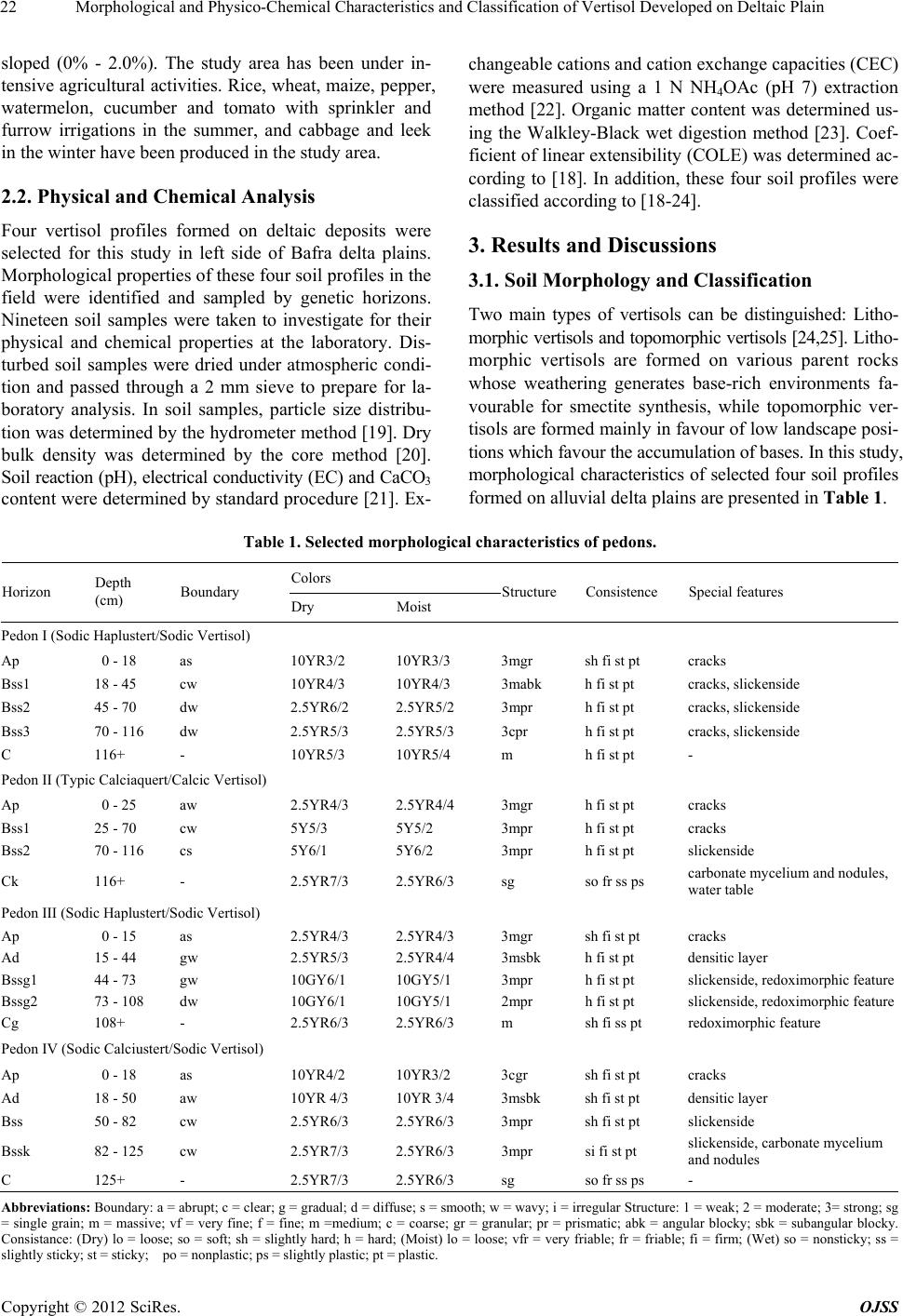 Morphological and Physico-Chemical Characteristics and Classification of Vertisol Developed on Deltaic Plain 22 sloped (0% - 2.0%). The study area has been under in- tensive agricultur al activities. Rice, wheat, maize, pepper, watermelon, cucumber and tomato with sprinkler and furrow irrigations in the summer, and cabbage and leek in the winter have been produced in the study area. 2.2. Physical and Chemical Analysis Four vertisol profiles formed on deltaic deposits were selected for this study in left side of Bafra delta plains. Morphological p roperties of these four soil pro files in the field were identified and sampled by genetic horizons. Nineteen soil samples were taken to investigate for their physical and chemical properties at the laboratory. Dis- turbed soil samples were dried under atmospheric condi- tion and passed through a 2 mm sieve to prepare for la- boratory analysis. In soil samples, particle size distribu- tion was determined by the hydrometer method [1 9]. Dry bulk density was determined by the core method [20]. Soil reaction (pH), electrical conductivity (EC) and CaCO3 content were determined by standard procedure [21]. Ex- changeable cation s an d cation ex chang e cap acities (CEC) were measured using a 1 N NH4OAc (pH 7) extraction method [22]. Organic matter content was determined us- ing the Walkley-Black wet digestion method [23]. Coef- ficient of linear extensib ility (COLE) was determined ac- cording to [18]. In addition, these four soil profiles were classified according to [18-24]. 3. Results and Discussions 3.1. Soil Morphology and Classification Two main types of vertisols can be distinguished: Litho- morphic vertisols and topomorph ic vertisols [24,25]. L itho - morphic vertisols are formed on various parent rocks whose weathering generates base-rich environments fa- vourable for smectite synthesis, while topomorphic ver- tisols are formed mainly in favour of low land scape posi- tions which favour the accumulation of bases. In this study, morphological characteristics of selected four soil profiles formed on alluvial delta plains are presented in Table 1. Table 1. Selected morphological characteristics of pedons. Colors Horizon Depth (cm) Boundary Dry Moist Structure Consistence Special features Pedon I (Sodic Haplustert/Sodic Vertisol) Ap 0 - 18 as 10YR3/2 10YR3/3 3mgr sh fi st pt cracks Bss1 18 - 45 cw 10YR4/3 10YR4/3 3mab k h fi st pt cracks, slickenside Bss2 45 - 70 dw 2.5YR6/2 2.5YR5/2 3mpr h fi st pt cracks, slickenside Bss3 70 - 116 dw 2.5YR5 /3 2.5YR5/3 3cpr h fi st pt cracks, slickenside C 116+ - 10YR5/3 10YR5/4 m h fi st pt - Pedon II (Typic Calciaquert/Calcic Vertisol) Ap 0 - 25 aw 2.5YR4/3 2.5YR4/4 3mgr h fi st pt cracks Bss1 25 - 70 cw 5Y5/3 5Y5/2 3mpr h fi st pt cracks Bss2 70 - 116 cs 5Y6/1 5Y6/2 3mpr h fi st pt slickenside Ck 116+ - 2.5YR7/3 2.5YR6/3 sg so fr ss ps carbonate mycelium and nodules, water table Pedon III (Sodic Haplustert/Sodic Vertisol) Ap 0 - 15 as 2.5YR4/3 2.5YR4/3 3mgr sh fi st pt cracks Ad 15 - 44 gw 2.5YR5/3 2.5YR4/4 3msbk h fi st pt densitic layer Bssg1 44 - 73 gw 10GY6/1 10GY5/1 3mpr h fi st pt slickenside, redoximorphic feature Bssg2 73 - 108 dw 10GY6/1 10GY5/1 2mpr h fi st pt slickenside, redoximorphic feature Cg 108+ - 2.5YR6/3 2.5YR6/3 m sh fi ss pt redoximorphic feature Pedon IV (Sodic Calciustert/Sodic Vertisol) Ap 0 - 18 as 10YR4/2 10YR3/2 3cgr sh fi st pt cracks Ad 18 - 50 aw 10YR 4/3 10YR 3/4 3msbk sh fi st pt densitic layer Bss 50 - 82 cw 2.5YR6/3 2.5YR6/3 3mpr sh fi st pt slickenside Bssk 82 - 125 cw 2.5YR7/3 2.5YR6/3 3mpr si fi st pt slickenside, carbonate mycelium and nodules C 125+ - 2.5YR7/3 2.5YR6/3 sg so fr ss ps - Abbreviations: Boundary: a = abrupt; c = clear; g = gradual; d = diffuse; s = smooth; w = wavy; i = irregular Structure: 1 = weak; 2 = moderate; 3= strong; sg = single grain; m = massive; vf = very fine; f = fine; m =medium; c = coarse; gr = granular; pr = prismatic; abk = angular blocky; sbk = subangular blocky. Consistance: (Dry) lo = loose; so = soft; sh = slightly hard; h = hard; (Moist) lo = loose; vfr = very friable; fr = friable; fi = firm; (Wet) so = nonsticky; ss = slightly sticky; st = sticky; po = nonplastic; ps = slightly plastic; pt = plastic. Copyright © 2012 SciRes. OJSS 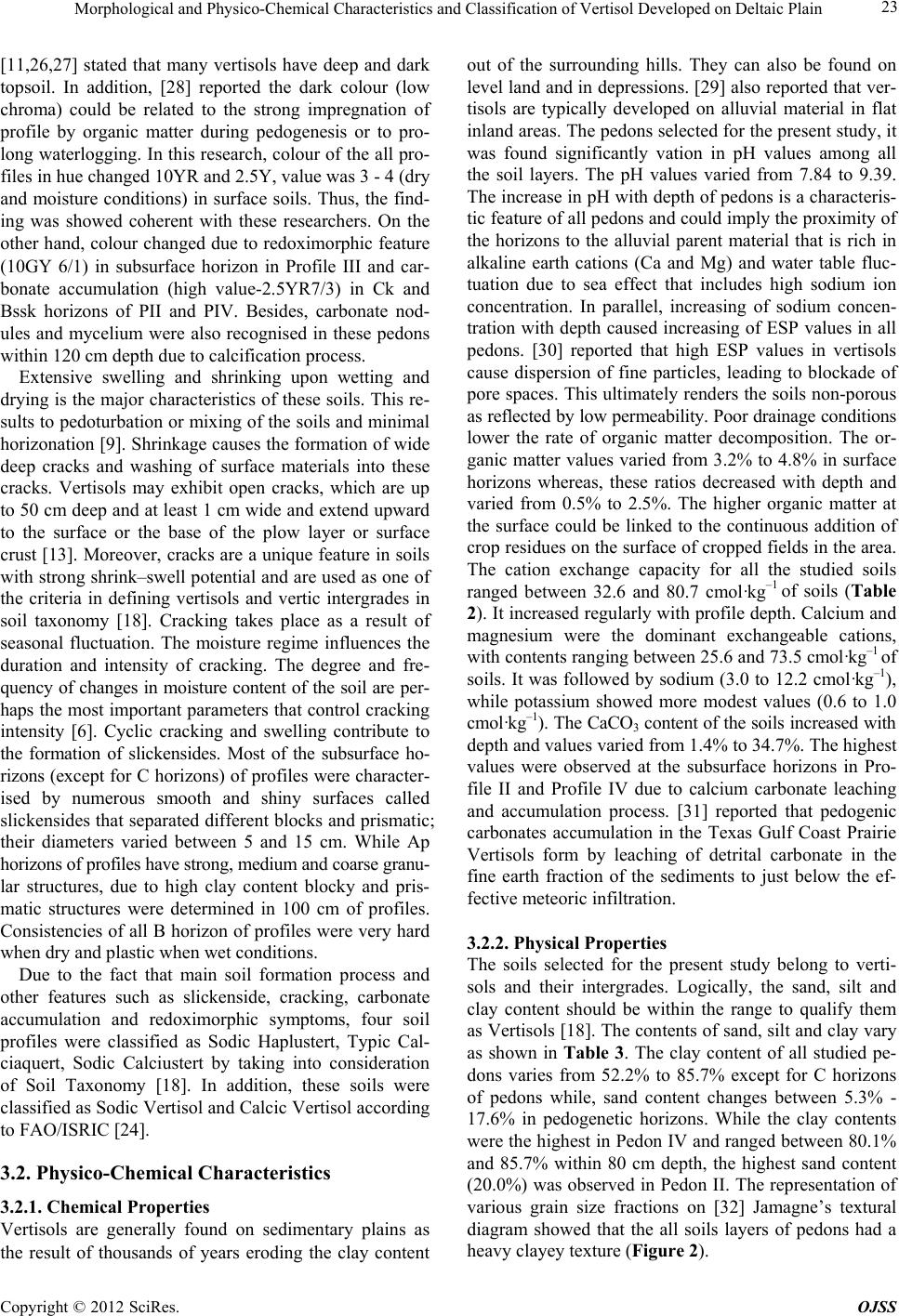 Morphological and Physico-Chemical Characteristics and Classification of Vertisol Developed on Deltaic Plain 23 [11,26,27] stated that many vertisols have deep and dark topsoil. In addition, [28] reported the dark colour (low chroma) could be related to the strong impregnation of profile by organic matter during pedogenesis or to pro- long waterlogging . In this research, colour of the all pro- files in hue changed 10YR and 2.5Y, value was 3 - 4 (dry and moisture conditions) in surface soils. Thus, the find- ing was showed coherent with these researchers. On the other hand, colo ur changed due to redoximorphic featur e (10GY 6/1) in subsurface horizon in Profile III and car- bonate accumulation (high value-2.5YR7/3) in Ck and Bssk horizons of PII and PIV. Besides, carbonate nod- ules and mycelium were also recognised in these pedons within 120 cm depth due to calcification process. Extensive swelling and shrinking upon wetting and drying is the major characteristics of these soils. This re- sults to pedoturbation or mixing of the soils and minimal horizonation [9]. Shrinkage causes the formation of wide deep cracks and washing of surface materials into these cracks. Vertisols may exhibit open cracks, which are up to 50 cm deep and at least 1 cm wide and extend upward to the surface or the base of the plow layer or surface crust [13]. Moreover, cracks are a unique feature in soils with strong shrink–swell potential and are used as one of the criteria in defining vertisols and vertic intergrades in soil taxonomy [18]. Cracking takes place as a result of seasonal fluctuation. The moisture regime influences the duration and intensity of cracking. The degree and fre- quency of changes in moisture content of the soil are per- haps the most important parameters th at control cracking intensity [6]. Cyclic cracking and swelling contribute to the formation of slickensides. Most of the subsurface ho- rizons (except for C horizons) of profiles were character- ised by numerous smooth and shiny surfaces called slickensides that separated different blocks and prismatic; their diameters varied between 5 and 15 cm. While Ap horizons of profiles have strong, medium and coarse granu- lar structures, due to high clay content blocky and pris- matic structures were determined in 100 cm of profiles. Consistencies of all B horizon of profiles wer e very hard when dry and plastic when wet conditions. Due to the fact that main soil formation process and other features such as slickenside, cracking, carbonate accumulation and redoximorphic symptoms, four soil profiles were classified as Sodic Haplustert, Typic Cal- ciaquert, Sodic Calciustert by taking into consideration of Soil Taxonomy [18]. In addition, these soils were classified as Sodic Vertisol and Calcic Vertisol according to FAO/ISRIC [24]. 3.2. Physico-Chemical Characteristics 3.2.1. Chemical Properties Vertisols are generally found on sedimentary plains as the result of thousands of years eroding the clay content out of the surrounding hills. They can also be found on level land and in d epressions. [29] also reported that v er- tisols are typically developed on alluvial material in flat inland areas. The pedons selected for the present study, it was found significantly vation in pH values among all the soil layers. The pH values varied from 7.84 to 9.39. The increase in pH with depth of pedons is a characteris- tic feature of all pedons and could imply the proximity of the horizons to the alluvial parent material that is rich in alkaline earth cations (Ca and Mg) and water table fluc- tuation due to sea effect that includes high sodium ion concentration. In parallel, increasing of sodium concen- tration with depth caused increasing of ESP values in all pedons. [30] reported that high ESP values in vertisols cause dispersion of fine particles, leading to blockade of pore spaces. This ultimately rend ers the soils non-porou s as reflected by low permeability. Poor drainage conditions lower the rate of organic matter decomposition. The or- ganic matter values varied from 3.2% to 4.8% in surface horizons whereas, these ratios decreased with depth and varied from 0.5% to 2.5%. The higher organic matter at the surface could be linked to the continuous addition of crop residues on the surface of cropped fields in the area. The cation exchange capacity for all the studied soils ranged between 32.6 and 80.7 cmol·kg–1 of soils (Table 2). It increased regularly with pro file depth. Calcium and magnesium were the dominant exchangeable cations, with contents ranging between 25.6 and 73.5 cmol·kg–1 of soils. It was followed by sodium (3.0 to 12.2 cmol·kg–1), while potassium showed more modest values (0.6 to 1.0 cmol·kg–1). The CaCO3 content of the soils increased with depth and values varied from 1.4% to 34.7%. The highest values were observed at the subsurface horizons in Pro- file II and Profile IV due to calcium carbonate leaching and accumulation process. [31] reported that pedogenic carbonates accumulation in the Texas Gulf Coast Prairie Vertisols form by leaching of detrital carbonate in the fine earth fraction of the sediments to just below the ef- fective meteoric infiltration. 3.2.2. Physical Properties The soils selected for the present study belong to verti- sols and their intergrades. Logically, the sand, silt and clay content should be within the range to qualify them as Vertisols [18]. The contents of sand, silt and clay vary as shown in Table 3. The clay content of all studied pe- dons varies from 52.2% to 85.7% except for C horizons of pedons while, sand content changes between 5.3% - 17.6% in pedogenetic horizons. While the clay contents were the highest in Pedon IV and ranged between 80.1% and 85.7% within 80 cm depth, the highest sand content (20.0%) was observed in Pedon II. The representation of various grain size fractions on [32] Jamagne’s textural diagram showed that the all soils layers of pedons had a heavy clayey texture (Figure 2). Copyright © 2012 SciRes. OJSS 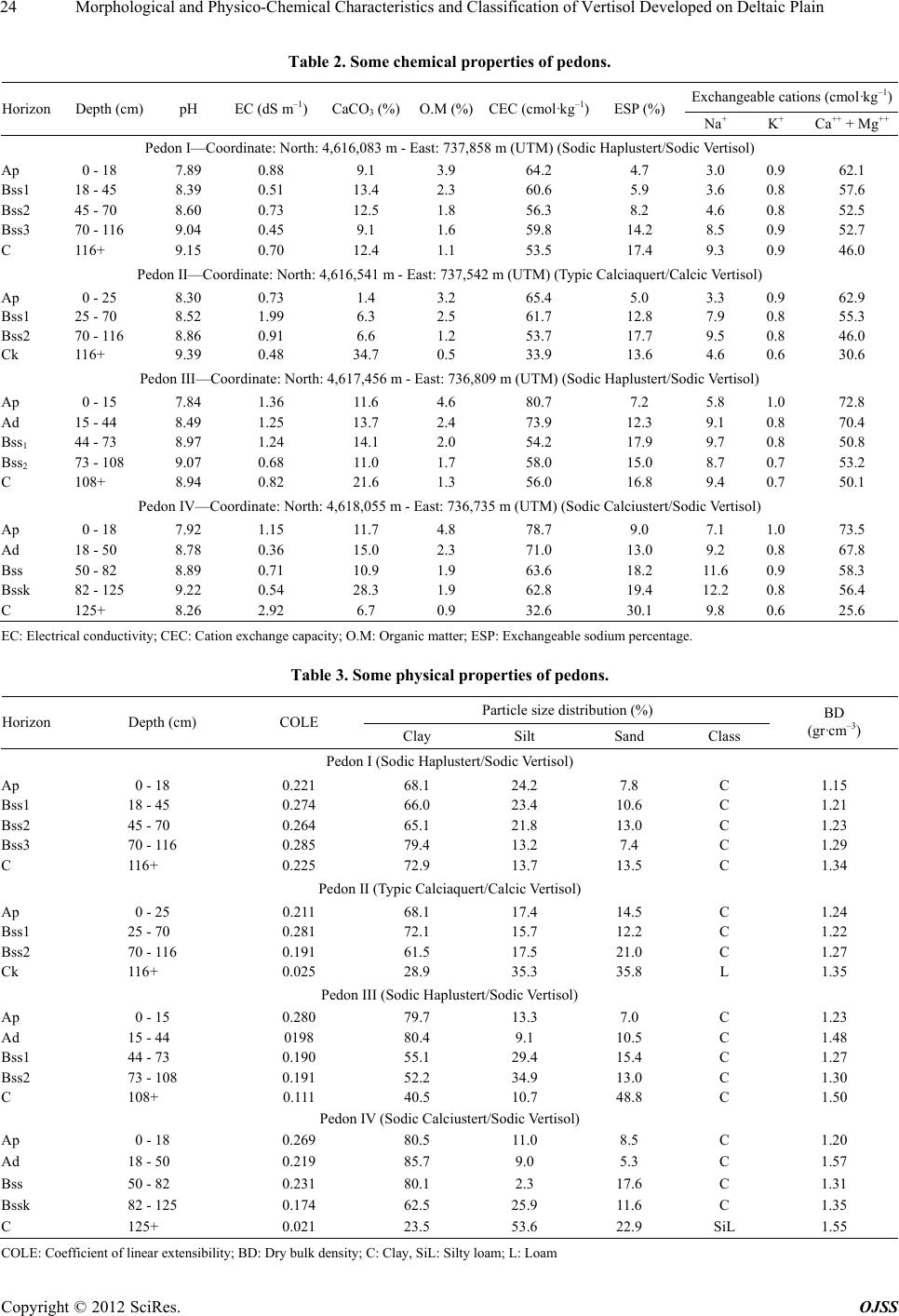 Morphological and Physico-Chemical Characteristics and Classification of Vertisol Developed on Deltaic Plain 24 Table 2. Some chemical properties of pedons. Exchangeable cations (cmol·kg–1) Horizon Depth (cm) pH EC (dS m–1) CaCO3 (%)O.M (%)CEC (cmol·kg–1) ESP (%) Na+ K + Ca++ + Mg++ Pedon I—Coordinate: North: 4,6 1 6,083 m - East: 73 7,858 m (UTM) (Sodic Haplustert/Sodic Vertisol) Ap 0 - 18 7.89 0.88 9.1 3.9 64.2 4.7 3.0 0.9 62.1 Bss1 18 - 45 8.39 0.51 13.4 2.3 60.6 5.9 3.6 0.8 57.6 Bss2 45 - 70 8.60 0.73 12.5 1.8 56.3 8.2 4.6 0.8 52.5 Bss3 70 - 1 16 9.04 0.45 9.1 1.6 59.8 14.2 8.5 0.9 52.7 C 116+ 9.15 0.70 12.4 1.1 53.5 17.4 9.3 0.9 46.0 Pedon II—Coordinate: North: 4,616,541 m - East: 737,542 m (UTM) (Typic Calciaquert/Calcic Vertisol) Ap 0 - 25 8.30 0.73 1.4 3.2 65.4 5.0 3.3 0.9 62.9 Bss1 25 - 70 8.52 1.99 6.3 2.5 6 1.7 12.8 7.9 0.8 55.3 Bss2 70 - 1 16 8.86 0.91 6.6 1.2 53.7 17.7 9.5 0.8 46.0 Ck 116+ 9.39 0.48 34.7 0.5 33.9 13.6 4.6 0.6 30.6 Pedon III—Coordinate: North: 4,617,456 m - East: 736,809 m (UTM) (Sodic Haplustert/Sodic Vertisol) Ap 0 - 15 7.84 1.36 11.6 4.6 80.7 7.2 5.8 1.0 72.8 Ad 15 - 44 8.49 1.25 13.7 2.4 73.9 12.3 9.1 0.8 70.4 Bss1 44 - 73 8.97 1.24 14.1 2.0 54.2 17.9 9.7 0.8 50.8 Bss2 73 - 108 9.07 0.68 11.0 1.7 58.0 15.0 8.7 0.7 53.2 C 108+ 8.94 0.82 21.6 1.3 56.0 16.8 9.4 0.7 50.1 Pedon IV—Coordi nate: North: 4,618,055 m - East: 736,735 m (UTM) (Sodic Calciustert/Sodic Vertisol) Ap 0 - 18 7.92 1.15 11.7 4.8 78.7 9.0 7.1 1.0 73.5 Ad 18 - 50 8.78 0.36 15.0 2.3 71.0 13.0 9.2 0.8 67.8 Bss 5 0 - 82 8.89 0.71 10.9 1.9 63.6 18.2 11.6 0.9 58.3 Bssk 82 - 125 9.22 0.54 28.3 1.9 62.8 19.4 12.2 0.8 56.4 C 125+ 8.26 2.92 6.7 0.9 32.6 30.1 9.8 0.6 25.6 EC: Electrical conductivity; CEC: Cation exchange capacity; O.M: Organic matter; ESP: Exchangeable sodium percentage. Table 3. Some physical properties of pedons. Particle size distribution (%) Horizon Depth (cm) COLE Clay Silt Sand Class BD (gr·cm–3) Pedon I (Sodic Haplustert/Sodic Vertisol) Ap 0 - 18 0.221 68.1 24. 2 7. 8 C 1.15 Bss1 18 - 45 0.274 66.0 23.4 10.6 C 1.21 Bss2 45 - 70 0.264 65.1 21.8 13.0 C 1.23 Bss3 70 - 116 0.285 79.4 13.2 7.4 C 1.29 C 116+ 0.225 72.9 13.7 13.5 C 1.34 Pedon II (Typic Calciaquert/Calcic Vertisol) Ap 0 - 25 0.211 68.1 17.4 14.5 C 1.24 Bss1 25 - 70 0.281 72.1 15.7 12.2 C 1.22 Bss2 70 - 116 0.191 61.5 17.5 21.0 C 1.27 Ck 116+ 0.025 28.9 35.3 35.8 L 1.35 Pedon III (Sodic Haplustert/Sodic Vertisol) Ap 0 - 15 0.280 79.7 13.3 7.0 C 1.23 Ad 15 - 44 0198 80.4 9.1 10.5 C 1.48 Bss1 44 - 73 0.190 55.1 29.4 15.4 C 1.27 Bss2 73 - 108 0.191 52.2 34.9 13.0 C 1.30 C 108+ 0.111 40.5 10.7 48.8 C 1.50 Pedon IV (Sodic Calciustert/Sodic Vertisol) Ap 0 - 18 0.269 80.5 11.0 8.5 C 1.20 Ad 18 - 50 0.219 85.7 9.0 5.3 C 1.57 Bss 50 - 82 0.231 80.1 2.3 17.6 C 1.31 Bssk 82 - 125 0.174 62.5 25.9 11.6 C 1.35 C 125+ 0.021 23.5 53.6 22.9 SiL 1.55 COLE: Coefficient of linear extensibility; BD: Dry bulk density; C: Clay, SiL: Silty loam; L: Loam Copyright © 2012 SciRes. OJSS 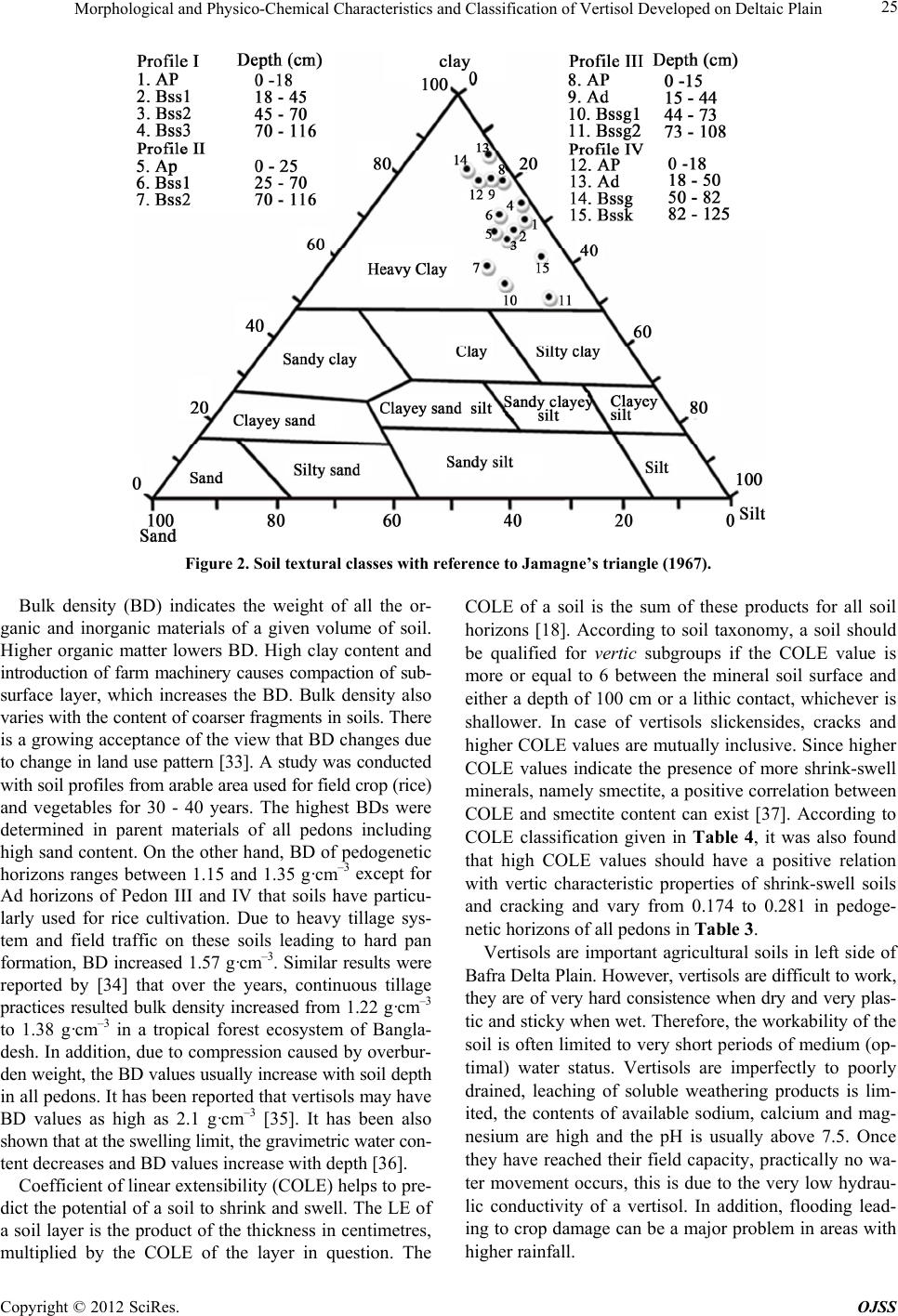 Morphological and Physico-Chemical Characteristics and Classification of Vertisol Developed on Deltaic Plain 25 Figure 2. Soil textural classes with reference to Jamagne’s triangle (1967). Bulk density (BD) indicates the weight of all the or- ganic and inorganic materials of a given volume of soil. Higher organic matter lowers BD. High clay content and introduction of farm machinery causes compaction of sub- surface layer, which increases the BD. Bulk density also varies with the content of coarser fragments in soils. There is a growing acceptance of the view that BD changes due to change in land use pattern [33]. A study was conducted with soil profil es from arable area used for field crop (rice) and vegetables for 30 - 40 years. The highest BDs were determined in parent materials of all pedons including high sand content. On the other hand, BD of pedogenetic horizons ranges between 1.15 and 1.35 g·cm–3 except for Ad horizons of Pedon III and IV that soils have particu- larly used for rice cultivation. Due to heavy tillage sys- tem and field traffic on these soils leading to hard pan formation, BD increased 1.57 g·cm–3. Similar results were reported by [34] that over the years, continuous tillage practices resulted bulk density increased from 1.22 g·cm–3 to 1.38 g·cm–3 in a tropical forest ecosystem of Bangla- desh. In additio n, due to compression caused by ov erbur- den weight, the BD values usually increase with soil depth in all pedons. It has been reported that vertisols may have BD values as high as 2.1 g·cm–3 [35]. It has been also shown that at the swelling limit, the gravimetric water con - tent decreases and BD values increase with depth [36]. Coefficient of linear ex tensibility (COLE) helps to p re- dict the potential of a so il to shrink and swell. The LE of a soil layer is the product of the thickness in cen timetres, multiplied by the COLE of the layer in question. The COLE of a soil is the sum of these products for all soil horizons [18]. According to soil taxonomy, a soil should be qualified for vertic subgroups if the COLE value is more or equal to 6 between the mineral soil surface and either a depth of 100 cm or a lithic contact, whichever is shallower. In case of vertisols slickensides, cracks and higher COLE values are mutually inclusive. Since higher COLE values indicate the presence of more shrink-swell minerals, namely smectite, a positive correlation between COLE and smectite content can exist [37]. According to COLE classification given in Table 4, it was also found that high COLE values should have a positive relation with vertic characteristic properties of shrink-swell soils and cracking and vary from 0.174 to 0.281 in pedoge- netic horizons of all pedons in Table 3. Vertisols are important agricultural soils in left side of Bafra Delta Plain. However, vertisols are difficult to work, they are of very hard consistence when dry and very plas- tic and sticky when wet. Therefore, th e workability of th e soil is often limited to very short period s of medium (op- timal) water status. Vertisols are imperfectly to poorly drained, leaching of soluble weathering products is lim- ited, the contents of available sodium, calcium and mag- nesium are high and the pH is usually above 7.5. Once they have reached their field capacity, practically no wa- ter movement occurs, this is due to the very low hydrau- lic conductivity of a vertisol. In addition, flooding lead- ing to crop damage can be a major problem in areas with higher rainfall. Copyright © 2012 SciRes. OJSS 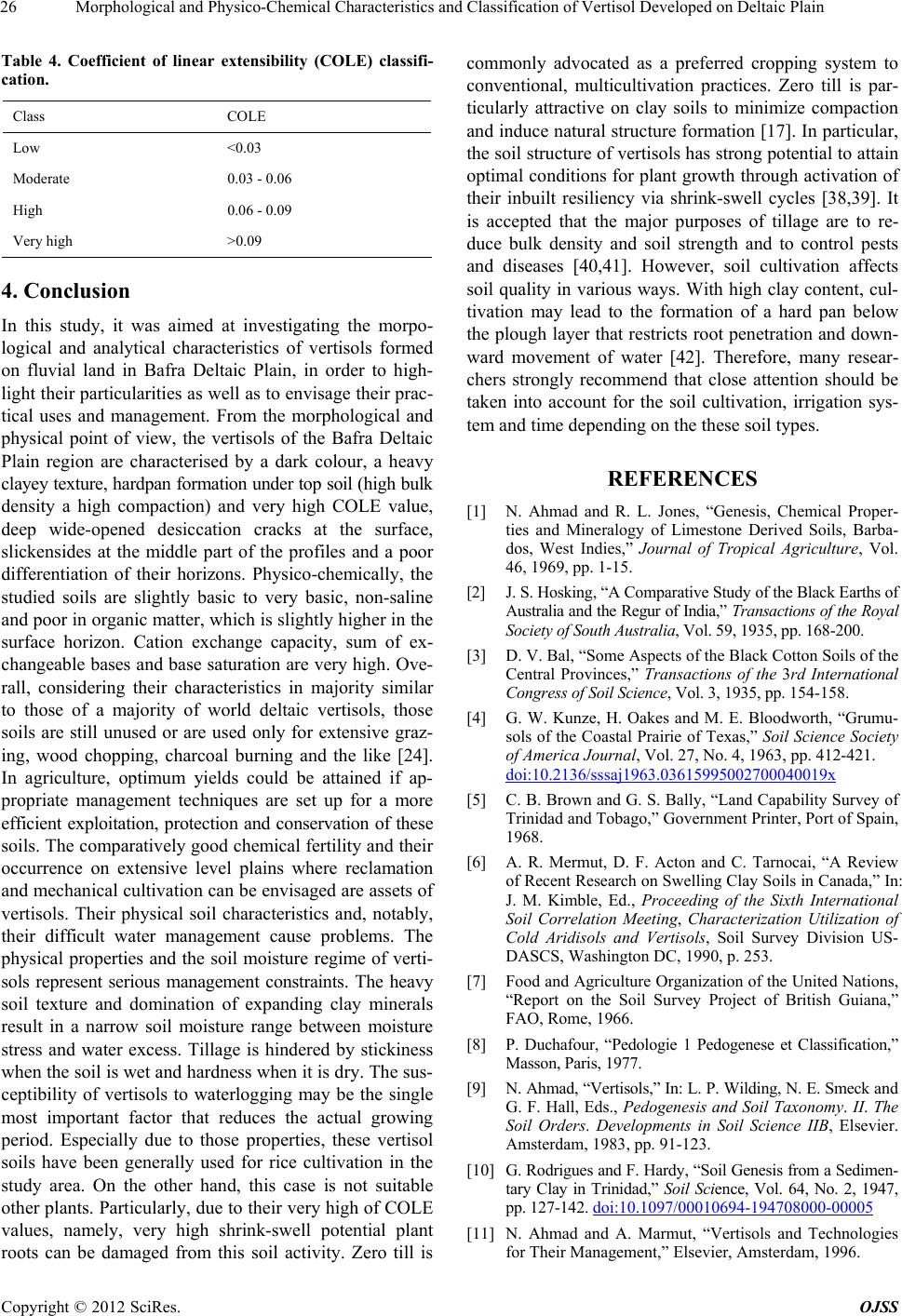 Morphological and Physico-Chemical Characteristics and Classification of Vertisol Developed on Deltaic Plain 26 Table 4. Coefficient of linear extensibility (COLE) classifi- cation. Class COLE Low <0.03 Moderate 0.03 - 0.06 High 0.06 - 0.09 Very high >0.09 4. Conclusion In this study, it was aimed at investigating the morpo- logical and analytical characteristics of vertisols formed on fluvial land in Bafra Deltaic Plain, in order to high- light their particularities as well as to envisage their prac- tical uses and management. From the morphological and physical point of view, the vertisols of the Bafra Deltaic Plain region are characterised by a dark colour, a heavy clayey texture, hardpan formation under top soil (high bulk density a high compaction) and very high COLE value, deep wide-opened desiccation cracks at the surface, slickensides at the middle part of the profiles and a poor differentiation of their horizons. Physico-chemically, the studied soils are slightly basic to very basic, non-saline and poor in organic matter, which is slightly higher in the surface horizon. Cation exchange capacity, sum of ex- changeable bases and base saturation are very high. Ove- rall, considering their characteristics in majority similar to those of a majority of world deltaic vertisols, those soils are still unused or are used only for extensive graz- ing, wood chopping, charcoal burning and the like [24]. In agriculture, optimum yields could be attained if ap- propriate management techniques are set up for a more efficient exploitation, protection and conservation of these soils. The comparatively good ch emical fertility and their occurrence on extensive level plains where reclamation and mechanical cultivation can be envisaged are assets of vertisols. Their physical soil characteristics and, notably, their difficult water management cause problems. The physical properties and the soil moisture regime of verti- sols represent serious management constraints. The heavy soil texture and domination of expanding clay minerals result in a narrow soil moisture range between moisture stress and water excess. Tillage is hindered by stickiness when the soil is wet and hardness when it is d ry. The su s- ceptibility of vertisols to waterlogging may be the single most important factor that reduces the actual growing period. Especially due to those properties, these vertisol soils have been generally used for rice cultivation in the study area. On the other hand, this case is not suitable other plants. Particularly, due to their very high of COLE values, namely, very high shrink-swell potential plant roots can be damaged from this soil activity. Zero till is commonly advocated as a preferred cropping system to conventional, multicultivation practices. Zero till is par- ticularly attractive on clay soils to minimize compaction and induce natural structure formation [17]. In particular, the soil stru cture of vertisols h as strong potential to attain optimal conditions for plant growth through activation of their inbuilt resiliency via shrink-swell cycles [38,39]. It is accepted that the major purposes of tillage are to re- duce bulk density and soil strength and to control pests and diseases [40,41]. However, soil cultivation affects soil quality in various ways. With high clay content, cul- tivation may lead to the formation of a hard pan below the plough layer that restricts root penetration and down- ward movement of water [42]. Therefore, many resear- chers strongly recommend that close attention should be taken into account for the soil cultivation, irrigation sys- tem and time depending on the these soil types. REFERENCES [1] N. Ahmad and R. L. Jones, “Genesis, Chemical Proper- ties and Mineralogy of Limestone Derived Soils, Barba- dos, West Indies,” Journal of Tropical Agriculture, Vol. 46, 1969, pp. 1-15. [2] J. S. Hosking, “A Comparative Study of the Black Earths of Australia and t he Regur of India,” Transactions of the Royal Society of South Australia, Vol. 59, 1935, pp. 168-200. [3] D. V. Bal, “Some Aspects of the Black Cotton Soils of the Central Provinces,” Transactions of the 3rd International Congress of Soil Science, Vol. 3, 1935, pp. 154-158. [4] G. W. Kunze, H. Oakes and M. E. Bloodworth, “Grumu- sols of the Coastal Prairie of Texas,” Soil Science Society of America Journal, Vol. 27, No. 4, 1963, pp. 412-421. doi:10.2136/sssaj1963.03615995002700040019x [5] C. B. Brown and G. S. Bally, “Land Capability Survey of Trinidad and Tobago,” Government Printer, Port of Spain, 1968. [6] A. R. Mermut, D. F. Acton and C. Tarnocai, “A Review of Recent Research on Swelling Clay Soils in Canada,” In: J. M. Kimble, Ed., Proceeding of the Sixth International Soil Correlation Meeting, Characterization Utilization of Cold Aridisols and Vertisols, Soil Survey Division US- DASCS, Washington DC, 1990, p. 253. [7] Food and Agriculture Organization of the United Nations, “Report on the Soil Survey Project of British Guiana,” FAO, Rome, 1966. [8] P. Duchafour, “Pedologie 1 Pedogenese et Classification,” Masson, Paris, 1977. [9] N. Ahmad, “Vertisols,” In: L. P. Wilding, N. E. Smeck and G. F. Hall, Eds., Pedogenesis and Soil Taxonomy. II. The Soil Orders. Developments in Soil Science IIB, Elsevier. Amsterdam, 1983, pp. 91-123. [10] G. Rodrigues and F. Hardy , “Soil Genesi s from a Sedi men- tary Clay in Trinidad,” Soil Science, Vol. 64, No. 2, 1947, pp. 127-142. doi:10.1097/00010694-194708000-00005 [11] N. Ahmad and A. Marmut, “Vertisols and Technologies for Their Management,” Elsevier, Amsterdam, 1996. Copyright © 2012 SciRes. OJSS 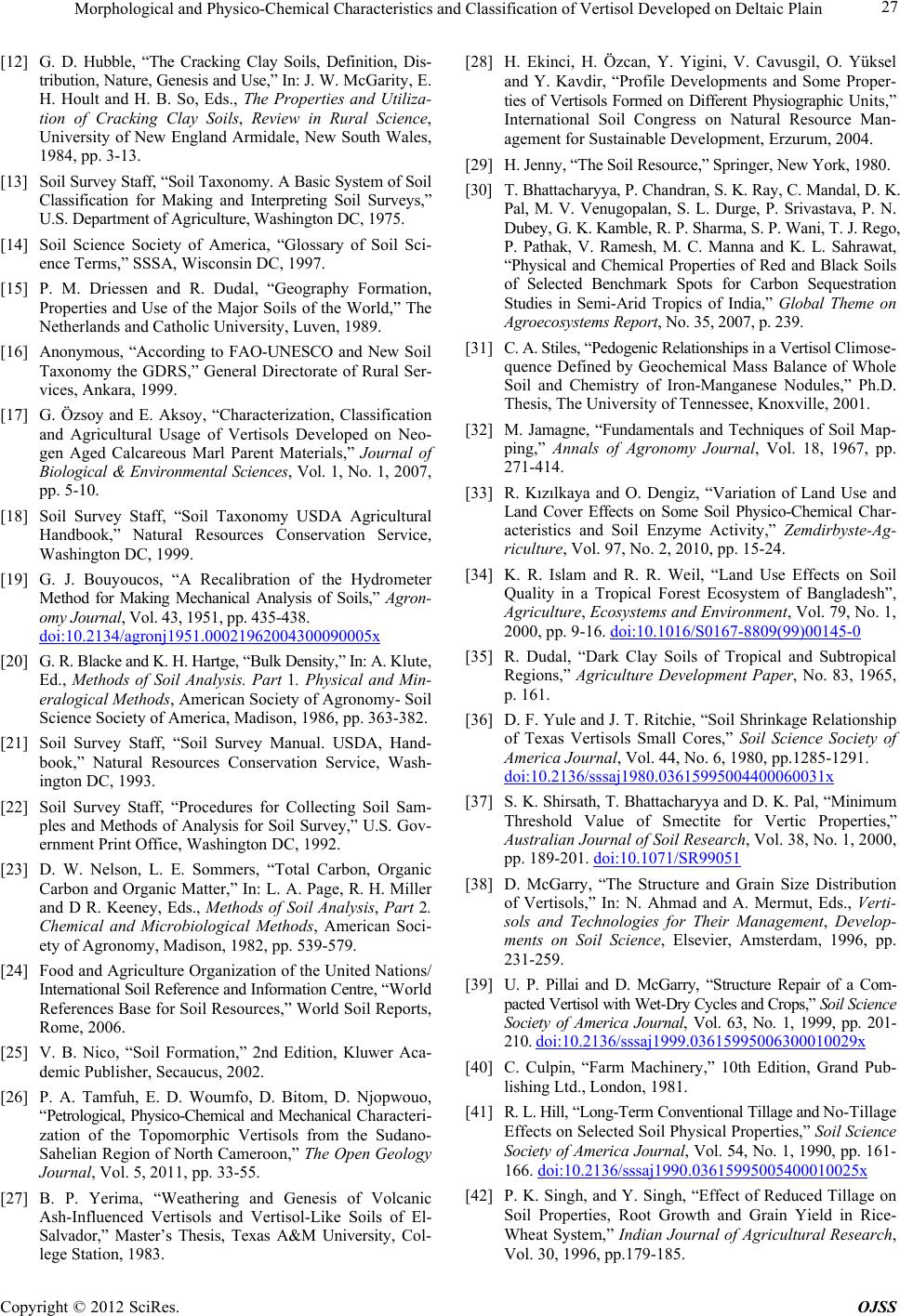 Morphological and Physico-Chemical Characteristics and Classification of Vertisol Developed on Deltaic Plain Copyright © 2012 SciRes. OJSS 27 [12] G. D. Hubble, “The Cracking Clay Soils, Definition, Dis- tribution, Nature, Genesis an d Use, ” In: J. W. M c G a r i ty, E . H. Hoult and H. B. So, Eds., The Properties and Utiliza- tion of Cracking Clay Soils, Review in Rural Science, University of New England Armidale, New South Wales, 1984, pp. 3-13. [13] Soil Survey Staff, “Soil Taxonomy. A Basic System of Soil Classification for Making and Interpreting Soil Surveys,” U.S. Department of Agriculture, Washington DC, 1975. [14] Soil Science Society of America, “Glossary of Soil Sci- ence Terms,” SSSA, Wisconsin DC, 1997. [15] P. M. Driessen and R. Dudal, “Geography Formation, Properties and Use of the Major Soils of the World,” The Netherlands and Catholic University, Luven, 1989. [16] Anonymous, “According to FAO-UNESCO and New Soil Taxonomy the GDRS,” General Directorate of Rural Ser- vices, Ankara, 1999. [17] G. Özsoy and E. Aksoy, “Characterization, Classification and Agricultural Usage of Vertisols Developed on Neo- gen Aged Calcareous Marl Parent Materials,” Journal of Biological & Environmental Sciences, Vol. 1, No. 1, 2007, pp. 5-10. [18] Soil Survey Staff, “Soil Taxonomy USDA Agricultural Handbook,” Natural Resources Conservation Service, Washington DC, 1999. [19] G. J. Bouyoucos, “A Recalibration of the Hydrometer Method for Making Mechanical Analysis of Soils,” Agron- omy Journal, Vol. 43, 1951, pp. 435-438. doi:10.2134/agronj1951.00021962004300090005x [20] G. R. Blacke and K. H. Hartge, “Bulk Density,” In: A. Klute, Ed., Methods of Soil Analysis. Part 1. Physical and Min- eralogical Methods, American Society of Agronomy- Soil Science Society of America, Madison, 1986, pp. 363-382. [21] Soil Survey Staff, “Soil Survey Manual. USDA, Hand- book,” Natural Resources Conservation Service, Wash- ington DC, 1993. [22] Soil Survey Staff, “Procedures for Collecting Soil Sam- ples and Methods of Analysis for Soil Survey,” U.S. Gov- ernment Print Office, Washington DC, 1992. [23] D. W. Nelson, L. E. Sommers, “Total Carbon, Organic Carbon and Organic Matter,” In: L. A. Page, R. H. Miller and D R. Keeney, Eds., Methods of Soil Analysis, Part 2. Chemical and Microbiological Methods, American Soci- ety of Agronomy, Madison, 1982, pp. 539-579. [24] Food and Agriculture Organization of the United Nations/ International Soil Reference and Information Centre, “W o r ld References Base for Soil Resources,” World Soil Reports, Rome, 2006. [25] V. B. Nico, “Soil Formation,” 2nd Edition, Kluwer Aca- demic Publisher, Secaucus, 2002. [26] P. A. Tamfuh, E. D. Woumfo, D. Bitom, D. Njopwouo, “Petrological, Physico-Chemical and Mechanical Characteri- zation of the Topomorphic Vertisols from the Sudano- Sahelian Region of North Cameroon,” The Open Geology Journal, Vol. 5, 2011, pp. 33-55. [27] B. P. Yerima, “Weathering and Genesis of Volcanic Ash-Influenced Vertisols and Vertisol-Like Soils of El- Salvador,” Master’s Thesis, Texas A&M University, Col- lege Station, 1983. [28] H. Ekinci, H. Özcan, Y. Yigini, V. Cavusgil, O. Yüksel and Y. Kavdir, “Profile Developments and Some Proper- ties of Vertisols Formed on Different Physiographic Units,” International Soil Congress on Natural Resource Man- agement for Sustainable Development, Erzurum, 2004. [29] H. Jenny, “The Soil Resource,” Springer, New York, 1980. [30] T. Bhattacharyya, P. Chandran, S. K. Ray, C. Mandal, D. K. Pal, M. V. Venugopalan, S. L. Durge, P. Srivastava, P. N. Dubey, G. K. Kamble, R. P. Sharma, S. P. Wani, T. J. Rego, P. Pathak, V. Ramesh, M. C. Manna and K. L. Sahrawat, “Physical and Chemical Properties of Red and Black Soils of Selected Benchmark Spots for Carbon Sequestration Studies in Semi-Arid Tropics of India,” Global Theme on Agroecosystems Report, No. 35, 2007, p. 239. [31] C. A. Stiles, “Pedogenic Relationship s in a Vertisol Climose- quence Defined by Geochemical Mass Balance of Whole Soil and Chemistry of Iron-Manganese Nodules,” Ph.D. Thesis, The University of Tennessee, Knoxville, 2001. [32] M. Jamagne, “Fundamentals and Techniques of Soil Map- ping,” Annals of Agronomy Journal, Vol. 18, 1967, pp. 271-414. [33] R. Kızılkaya and O. Dengiz, “Variation of Land Use and Land Cover Effects on Some Soil Physico-Chemical Char- acteristics and Soil Enzyme Activity,” Zemdirbyste-Ag- riculture, Vol. 97, No. 2, 2010, pp. 15-24. [34] K. R. Islam and R. R. Weil, “Land Use Effects on Soil Quality in a Tropical Forest Ecosystem of Bangladesh”, Agriculture, Ecosystems and Environment, Vol. 79, No. 1, 2000, pp. 9-16. doi:10.1016/S0167-8809(99)00145-0 [35] R. Dudal, “Dark Clay Soils of Tropical and Subtropical Regions,” Agriculture Development Paper, No. 83, 1965, p. 161. [36] D. F. Yule and J. T. Ritchie, “Soil Shrinkage Relationship of Texas Vertisols Small Cores,” Soil Science Society of America Journal, Vol. 44, No. 6, 1980, pp.1285-1291. doi:10.2136/sssaj1980.03615995004400060031x [37] S. K. Shirsath, T. Bhattacharyya and D. K. Pal, “Minimum Threshold Value of Smectite for Vertic Properties,” Australian Journal of Soil Research, Vol. 38, No. 1, 2000, pp. 189-201. doi:10.1071/SR99051 [38] D. McGarry, “The Structure and Grain Size Distribution of Vertisols,” In: N. Ahmad and A. Mermut, Eds., Verti- sols and Technologies for Their Management, Develop- ments on Soil Science, Elsevier, Amsterdam, 1996, pp. 231-259. [39] U. P. Pillai and D. McGarry, “Structure Repair of a Com- pacted Vertisol with Wet-Dry Cycles and Crops,” Soil Scie n ce Society of America Journal, Vol. 63, No. 1, 1999, pp. 201- 210. doi:10.2136/sssaj1999.03615995006300010029x [40] C. Culpin, “Farm Machinery,” 10th Edition, Grand Pub- lishing Ltd., London, 1981. [41] R. L. Hill, “Long-Term Conventional Tillage and No- Tillag e Effects on Selected Soil Phy sical Properties,” Soil Science Society of America Journal, Vol. 54, No. 1, 1990, pp. 161- 166. doi:10.2136/sssaj1990.03615995005400010025x [42] P. K. Singh, and Y. Singh, “Effect of Reduced Tillage on Soil Properties, Root Growth and Grain Yield in Rice- Wheat System,” Indian Journal of Agricultural Research, Vol. 30, 1996, pp.179-185. |