

Paper Menu >>
Journal Menu >>
 Vol.2, No.5, 454-457 (201 doi:10.4236/health.2010.25068 Copyright © 2010 SciRes. http://www.scirp.org/journalT / 0) Health Openly accessible at/HEAL H Association of the plasminogen activator inhibitor-1(PAI-1) gene 4G/5G promoter polymorphism in Buerger’s disease (Tromboangiitis obliterans) Sinasi Manduz1, Nurkay Katrancioglu1, Oguz Karahan1, Oztürk Ozdemir2* 1Department of Cardiovascular Surgery, Faculty of Medicine, Cumhuriyet University, Sivas, Turkey 2Department of Medical Genetics, Faculty of Medicine, Cumhuriyet University, Sivas and University of COMU, Faculty of Medicine, Canakkale, Turkey; *Corresponding Author: [email protected] Received 3 January 2010; revised 26 January 2010; accepted 27 January 2010. ABSTRACT Thromboangiitis obliterans (TAO) is an unusual tobacco-associated vasculopathy that is a non- atherosclerotic inflammatory disorder of unkn- own etiology that affects small and medium- sized vessels of the extremities. The single guanosine nucleotide deletion/insertion polym- orphism (4G/5G) at -675 bp in promoter region of the PAI-1 gene is the major genetic determi- nant of PAI-1 expression. Plasma PAI-1 level is higher in people with the homozygous 4G gen- otype than in those with the 5G/5G genotype and renders higher transcription activity. The aim of this study was to determine the status and the role of PAI-1 gene 4G/5G promoter pol- ymorphism in patients with Buerger’s disease (Thromboangiitis obliterans—TAO). The current case-control study included 30 consecutive pat- ients with Buerger’s disease (mean age 42.9 ± 14.3 years, 28 men and 2 women), and 30 heal- thy volunteers (mean age 40.9 ± 4.79 years, 27 men and 3 women) between January 2006 and September 2009. Patients and control cases were genotyped for the 4G/5G polymorphism using the multiplex PCR based stripassay reverse hybridisation technique. It was found that hete- rozygote PAI-1 gene polymorphisms (p < 0.05) was significantly more frequent in patients with TAO in the current results. There was a signif- icant difference in genotype distribution between the two groups (P < 0.001). The 4G allele occur- red more frequently in the patient group of heavy smokers (P = 0.05). The current study sh- ows the higher prevalence of of 4G allele in TAO patients in Sivas population means gene may predispose to TAO. Keywords: Thromboangiitis Obliterans; Genetic Polymorphisms; PAI-1 1. INTRODUCTION In 1908 Buerger suggested the name thromboangiitis obliterans (TAO) for a disease of the peripheral arteries which he had studied in eleven lower limbs amputated for “presenile spontaneous gangrene” [1]. TAO (Buerger’s syndrome) is an unusual tobacco-associated vasculopa- thy that is a nonatherosclerotic inflammatory disorder of unknown etiology that affects small and medium-sized vessels of the extremities [1-3]. Etiopathogenesis of dis- ease could not be evenly revealed. Researchers think that tobacco is rolled for starting and progressing of disease and by the way genetic factors, hipercoagulability, en- dothelium function and immune mechanisms etc. are suspicious factors that enrolled such as tobacco [1,2,4,5]. For example HLA-9 and HLA-B5 was excessively doc- umented in patients. This may sign that genetic factors likely play a role [5]. Highly cellular thrombus occludes much of the lumen and lymphocytes, giant cells, fibrous hyperplasia, inti- mae thickness have seen around vaso-vasorums in his- tological investigation of vessel that affected by TAO [5]. A highly cellular thrombus occludes much of the lumen. A multinucleate giant cell and microabscess are present within the thrombus [5]. Both genetic and thrombotic events, reminds that prothrombotic gene deletions might act a part in this disorder. Prothrombotic genes detected significantly in some studies about TAO [6]. Plasminogen is one of me- diators of fibrinolysis that synthesized in the liver and then circulates in plasma and other extracellular fluids. This respect presents in all tissues [7]. Urokinase-type plasminogen activator (uPA) and the tissue-type PA (tPA) are two regulative enzymes that directed the modulation of plasminogen to plasmin. The enzymatic activity of uPA can be inhibited plasminogen activator inhibitor 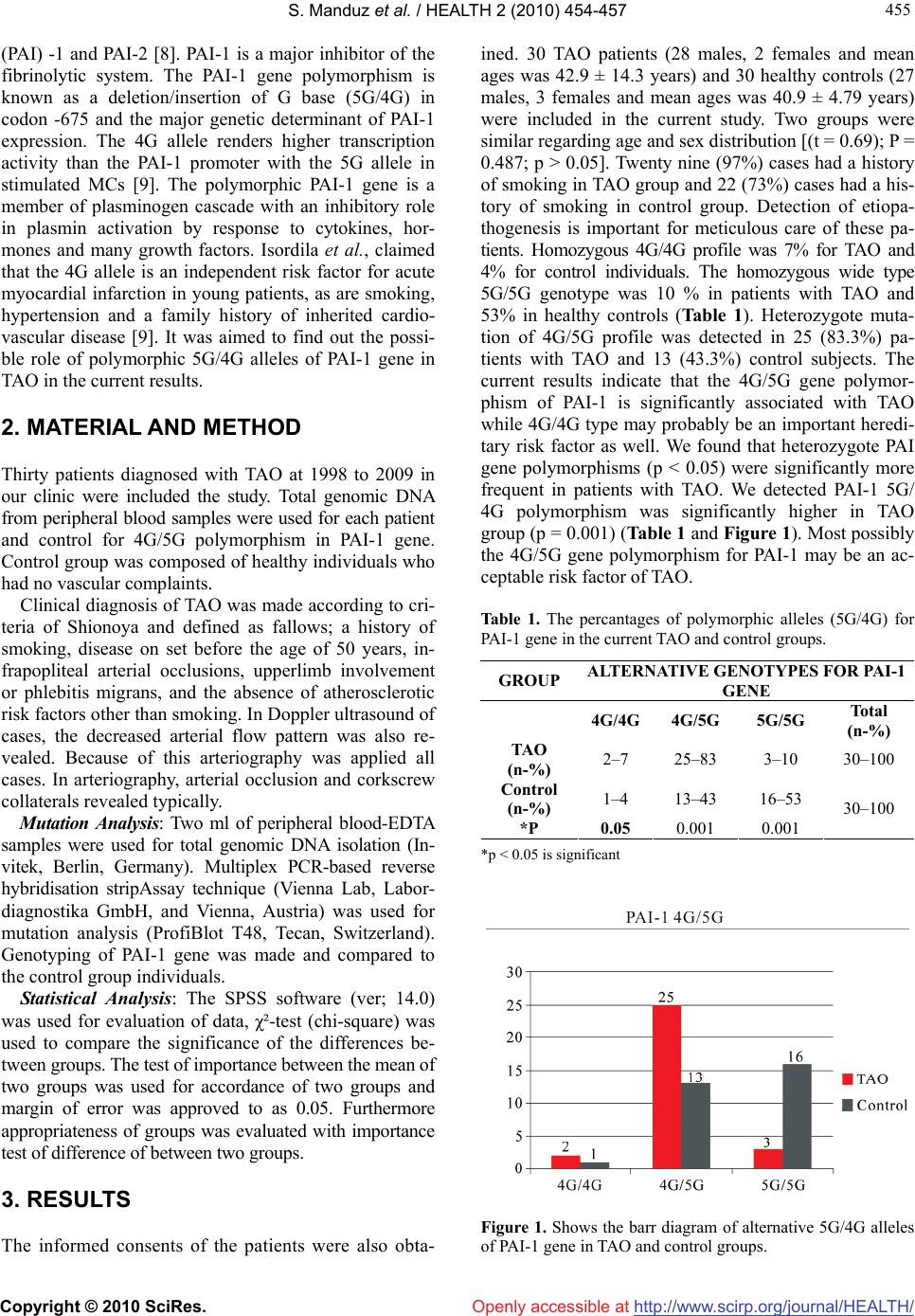 S. Manduz et al. / HEALTH 2 (2010) 454-457 Copyright © 2010 SciRes. http://www.scirp.org/journalT / 455 455 Openly accessible at/HEALH (PAI) -1 and PAI-2 [8]. PAI-1 is a major inhibitor of the fibrinolytic system. The PAI-1 gene polymorphism is known as a deletion/insertion of G base (5G/4G) in codon -675 and the major genetic determinant of PAI-1 expression. The 4G allele renders higher transcription activity than the PAI-1 promoter with the 5G allele in stimulated MCs [9]. The polymorphic PAI-1 gene is a member of plasminogen cascade with an inhibitory role in plasmin activation by response to cytokines, hor- mones and many growth factors. Isordila et al., claimed that the 4G allele is an independent risk factor for acute myocardial infarction in young patients, as are smoking, hypertension and a family history of inherited cardio- vascular disease [9]. It was aimed to find out the possi- ble role of polymorphic 5G/4G alleles of PAI-1 gene in TAO in the current results. 2. MATERIAL AND METHOD Thirty patients diagnosed with TAO at 1998 to 2009 in our clinic were included the study. Total genomic DNA from peripheral blood samples were used for each patient and control for 4G/5G polymorphism in PAI-1 gene. Control group was composed of healthy individuals who had no vascular complaints. Clinical diagnosis of TAO was made according to cri- teria of Shionoya and defined as fallows; a history of smoking, disease on set before the age of 50 years, in- frapopliteal arterial occlusions, upperlimb involvement or phlebitis migrans, and the absence of atherosclerotic risk factors other than smoking. In Doppler ultrasound of cases, the decreased arterial flow pattern was also re- vealed. Because of this arteriography was applied all cases. In arteriography, arterial occlusion and corkscrew collaterals revealed typically. Mutation Analysis: Two ml of peripheral blood-EDTA samples were used for total genomic DNA isolation (In- vitek, Berlin, Germany). Multiplex PCR-based reverse hybridisation stripAssay technique (Vienna Lab, Labor- diagnostika GmbH, and Vienna, Austria) was used for mutation analysis (ProfiBlot T48, Tecan, Switzerland). Genotyping of PAI-1 gene was made and compared to the control group individuals. Statistical Analysis: The SPSS software (ver; 14.0) was used for evaluation of data, χ²-test (chi-square) was used to compare the significance of the differences be- tween groups. The test of importance between the mean of two groups was used for accordance of two groups and margin of error was approved to as 0.05. Furthermore appropriateness of groups was evaluated with importance test of difference of between two groups. 3. RESULTS The informed consents of the patients were also obta- ined. 30 TAO patients (28 males, 2 females and mean ages was 42.9 ± 14.3 years) and 30 healthy controls (27 males, 3 females and mean ages was 40.9 ± 4.79 years) were included in the current study. Two groups were similar regarding age and sex distribution [(t = 0.69); P = 0.487; p > 0.05]. Twenty nine (97%) cases had a history of smoking in TAO group and 22 (73%) cases had a his- tory of smoking in control group. Detection of etiopa- thogenesis is important for meticulous care of these pa- tients. Homozygous 4G/4G profile was 7% for TAO and 4% for control individuals. The homozygous wide type 5G/5G genotype was 10 % in patients with TAO and 53% in healthy controls (Table 1). Heterozygote muta- tion of 4G/5G profile was detected in 25 (83.3%) pa- tients with TAO and 13 (43.3%) control subjects. The current results indicate that the 4G/5G gene polymor- phism of PAI-1 is significantly associated with TAO while 4G/4G type may probably be an important heredi- tary risk factor as well. We found that heterozygote PAI gene polymorphisms (p < 0.05) were significantly more frequent in patients with TAO. We detected PAI-1 5G/ 4G polymorphism was significantly higher in TAO group (p = 0.001) (Table 1 and Figure 1). Most possibly the 4G/5G gene polymorphism for PAI-1 may be an ac- ceptable risk factor of TAO. Table 1. The percantages of polymorphic alleles (5G/4G) for PAI-1 gene in the current TAO and control groups. GROUP ALTERNATIVE GENOTYPES FOR PAI-1 GENE 4G/4G 4G/5G 5G/5G Total (n-%) TAO (n-%) 2–7 25–83 3–10 30–100 Control (n-%) 1–4 13–43 16–53 *P 0.05 0.001 0.001 30–100 *p < 0.05 is significant Figure 1. Shows the barr diagram of alternative 5G/4G alleles of PAI-1 gene in TAO and control groups. 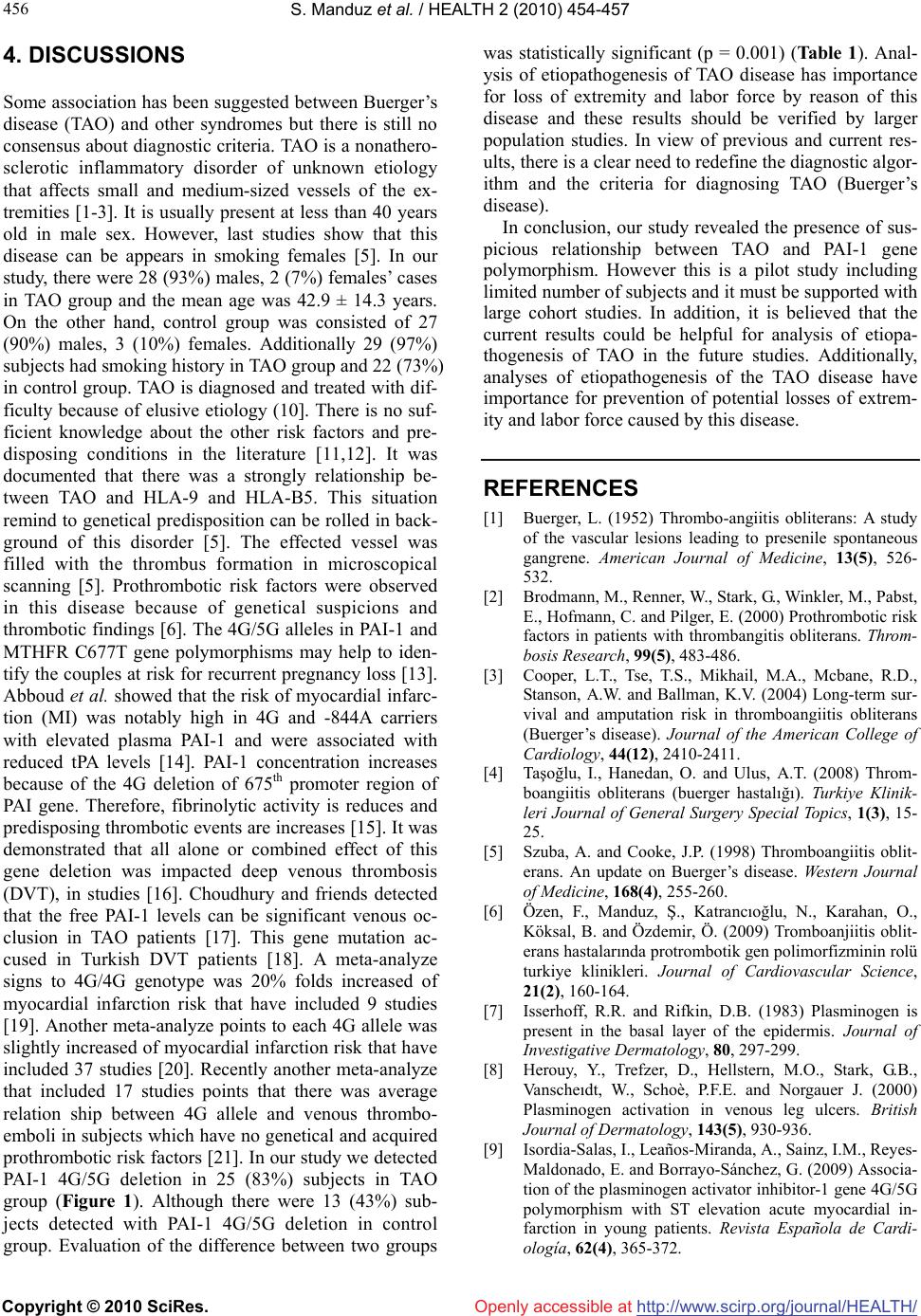 S. Manduz et al. / HEALTH 2 (2010) 454-457 Copyright © 2010 SciRes. http://www.scirp.org/journalT / 456 Openly accessible at/HEALH 4. DISCUSSIONS Some association has been suggested between Buerger’s disease (TAO) and other syndromes but there is still no consensus about diagnostic criteria. TAO is a nonathero- sclerotic inflammatory disorder of unknown etiology that affects small and medium-sized vessels of the ex- tremities [1-3]. It is usually present at less than 40 years old in male sex. However, last studies show that this disease can be appears in smoking females [5]. In our study, there were 28 (93%) males, 2 (7%) females’ cases in TAO group and the mean age was 42.9 ± 14.3 years. On the other hand, control group was consisted of 27 (90%) males, 3 (10%) females. Additionally 29 (97%) subjects had smoking history in TAO group and 22 (73%) in control group. TAO is diagnosed and treated with dif- ficulty because of elusive etiology (10]. There is no suf- ficient knowledge about the other risk factors and pre- disposing conditions in the literature [11,12]. It was documented that there was a strongly relationship be- tween TAO and HLA-9 and HLA-B5. This situation remind to genetical predisposition can be rolled in back- ground of this disorder [5]. The effected vessel was filled with the thrombus formation in microscopical scanning [5]. Prothrombotic risk factors were observed in this disease because of genetical suspicions and thrombotic findings [6]. The 4G/5G alleles in PAI-1 and MTHFR C677T gene polymorphisms may help to iden- tify the couples at risk for recurrent pregnancy loss [13]. Abboud et al. showed that the risk of myocardial infarc- tion (MI) was notably high in 4G and -844A carriers with elevated plasma PAI-1 and were associated with reduced tPA levels [14]. PAI-1 concentration increases because of the 4G deletion of 675th promoter region of PAI gene. Therefore, fibrinolytic activity is reduces and predisposing thrombotic events are increases [15]. It was demonstrated that all alone or combined effect of this gene deletion was impacted deep venous thrombosis (DVT), in studies [16]. Choudhury and friends detected that the free PAI-1 levels can be significant venous oc- clusion in TAO patients [17]. This gene mutation ac- cused in Turkish DVT patients [18]. A meta-analyze signs to 4G/4G genotype was 20% folds increased of myocardial infarction risk that have included 9 studies [19]. Another meta-analyze points to each 4G allele was slightly increased of myocardial infarction risk that have included 37 studies [20]. Recently another meta-analyze that included 17 studies points that there was average relation ship between 4G allele and venous thrombo- emboli in subjects which have no genetical and acquired prothrombotic risk factors [21]. In our study we detected PAI-1 4G/5G deletion in 25 (83%) subjects in TAO group (Figure 1). Although there were 13 (43%) sub- jects detected with PAI-1 4G/5G deletion in control group. Evaluation of the difference between two groups was statistically significant (p = 0.001) (Table 1). Anal- ysis of etiopathogenesis of TAO disease has importance for loss of extremity and labor force by reason of this disease and these results should be verified by larger population studies. In view of previous and current res- ults, there is a clear need to redefine the diagnostic algor- ithm and the criteria for diagnosing TAO (Buerger’s disease). In conclusion, our study revealed the presence of sus- picious relationship between TAO and PAI-1 gene polymorphism. However this is a pilot study including limited number of subjects and it must be supported with large cohort studies. In addition, it is believed that the current results could be helpful for analysis of etiopa- thogenesis of TAO in the future studies. Additionally, analyses of etiopathogenesis of the TAO disease have importance for prevention of potential losses of extrem- ity and labor force caused by this disease. REFERENCES [1] Buerger, L. (1952) Thrombo-angiitis obliterans: A study of the vascular lesions leading to presenile spontaneous gangrene. American Journal of Medicine, 13(5), 526- 532. [2] Brodmann, M., Renner, W., Stark, G., Winkler, M., Pabst, E., Hofmann, C. and Pilger, E. (2000) Prothrombotic risk factors in patients with thrombangitis obliterans. Throm- bosis Research, 99(5), 483-486. [3] Cooper, L.T., Tse, T.S., Mikhail, M.A., Mcbane, R.D., Stanson, A.W. and Ballman, K.V. (2004) Long-term sur- vival and amputation risk in thromboangiitis obliterans (Buerger’s disease). Journal of the American College of Cardiology, 44(12), 2410-2411. [4] Taşoğlu, I., Hanedan, O. and Ulus, A.T. (2008) Throm- boangiitis obliterans (buerger hastalığı). Turkiye Klinik- leri Journal of General Surgery Special Topics, 1(3), 15- 25. [5] Szuba, A. and Cooke, J.P. (1998) Thromboangiitis oblit- erans. An update on Buerger’s disease. Western Journal of Medicine, 168(4), 255-260. [6] Özen, F., Manduz, Ş., Katrancıoğlu, N., Karahan, O., Köksal, B. and Özdemir, Ö. (2009) Tromboanjiitis oblit- erans hastalarında protrombotik gen polimorfizminin rolü turkiye klinikleri. Journal of Cardiovascular Science, 21(2), 160-164. [7] Isserhoff, R.R. and Rifkin, D.B. (1983) Plasminogen is present in the basal layer of the epidermis. Journal of Investigative Dermatology, 80, 297-299. [8] Herouy, Y., Trefzer, D., Hellstern, M.O., Stark, G.B., Vanscheıdt, W., Schoè, P.F.E. and Norgauer J. (2000) Plasminogen activation in venous leg ulcers. British Journal of Dermatology, 143(5), 930-936. [9] Isordia-Salas, I., Leaños-Miranda, A., Sainz, I.M., Reyes- Maldonado, E. and Borrayo-Sánchez, G. (2009) Associa- tion of the plasminogen activator inhibitor-1 gene 4G/5G polymorphism with ST elevation acute myocardial in- farction in young patients. Revista Española de Cardi- ología, 62(4), 365-372.  S. Manduz et al. / HEALTH 2 (2010) 454-457 Copyright © 2010 SciRes. http://www.scirp.org/journalT / Openly accessible at /HEALH 457 457 [10] Foley, S. and Gibbs, H. (2008) Muir painful digital in- farction in a male smoker treated as Buerger’s disease. Australasian Journal of Dermatology, 49(2), 94-97. [11] Stammler, F., Diehm, C., Hsu, E., Stockinger, K. and Ame- ndt, K. (1996) The prevalence of hyperhomocysteinemia in thrombangitis obliterans. Does homocsteine play a role pathogenetically? Deutsche medizinische Wochenschrift, 121(46), 1417-1423. [12] Chenl, Z., Takahashi, M., Naruse, T., Nakajima, T., Chen, Y.W., Inoue, Y., Ishikawa, I., Iwail, T. and Kimura, A. (2007) Synergistic contribution of CD14 and HLA loci in the susceptibility to Buerger disease. Human Genetics, 122(3-4), 367-372. [13] Yenicesu, G.I., Cetin, M., Ozdemir, O., Cetin, A., Ozen, F., Yenicesu, C., Yildiz, C. and Kocak, N. (2009) A pro- spective case-control study analyzes 12 thrombophilic gene mutations in turkish couples with recurrent preg- nancy loss. American Journal of Reproductive Immuno- logy, 63(2), 126-136. [14] Abboud, N., Ghazouani, L., Saidi, S., Ben-Hadj-Khalifa, S., Addad, F., Almawi, W.Y. and Mahjoub, T. (2010) As- sociation of PAI-1 4G/5G and -844G/A gene polymor- phisms and changes in PAI-1/tissue plasminogen activa- tor levels in myocardial infarction: A case-control study. Genetic Testing and Molecular Biomarkers, 14(1), 23- 27. [15] Francis, C.W. (2002) Plasminogen activator inhibitor-1 le- vels and polymorphisms. Archives of Pathology & Labo- ratory Medicine, 126(11), 1401-1404. [16] Akar, N., et al. (2000) Effect of plasminogen activator inhibitor-1 4G/5G polymorphism in turkish deep vein thrombotic patients with and without FV1691 G-A. Thrombosis Research, 97, 227-230. [17] Choudhury, N.A., Pietraszek, M.H., Hachiya, T., Baba, S., Sakaguchi, S., Takada, Y. and Takada, A. (1992) Plasmi- nogen activators and plasminogen activator inhibitor 1 before and after venous occlusion of the upper limb in thromboangiitis obliterans (Buerger’s disease). Thrombo- sis Research, 66(4), 321-329. [18] Eroglu, A., Ulu, A. and Akar, N. (2006) Plasminogen activator inhibitor-1 gene 4G/5G polymorphism in cancer patients with and without thrombosis. Journal of Throm- bosis and Thrombolysis, 22(2), 111-112. [19] Boekholdt, S.M., Bijsterveld, N.R., Moons, A.H., Levi, M., Büller, H.R. and Peters, R.J. (2001) Genetic variation in coagulation and fibrinolytic proteins and their relation with acute myocardial infarction: A systematic review. Circulation, 104(25), 3063-3068. [20] Ye, Z., Liu, E.H., Higgins, J.P., Keavney, B.D., Lowe, G.D., Collins, R. and Danesh J. (2006) Seven haemostatic gene polymorphisms in coronary disease: Meta-analysis of 66, 155 cases and 91,307 controls. Lancet, 367(9511), 651- 658. [21] Tsantes, A.E., Nikolopoulos, G.K., Bagos, P.G., Rapti, E., Mantzios, G., Kapsimali, V. and Travlou, A. (2007) Association between the plasminogen activator inhibi- tor-1 4G/5G polymorphism and venous thrombosis. A meta-analysis. Journal of Thrombosis and Haemostasis, 97(6), 907-913. |