

Paper Menu >>
Journal Menu >>
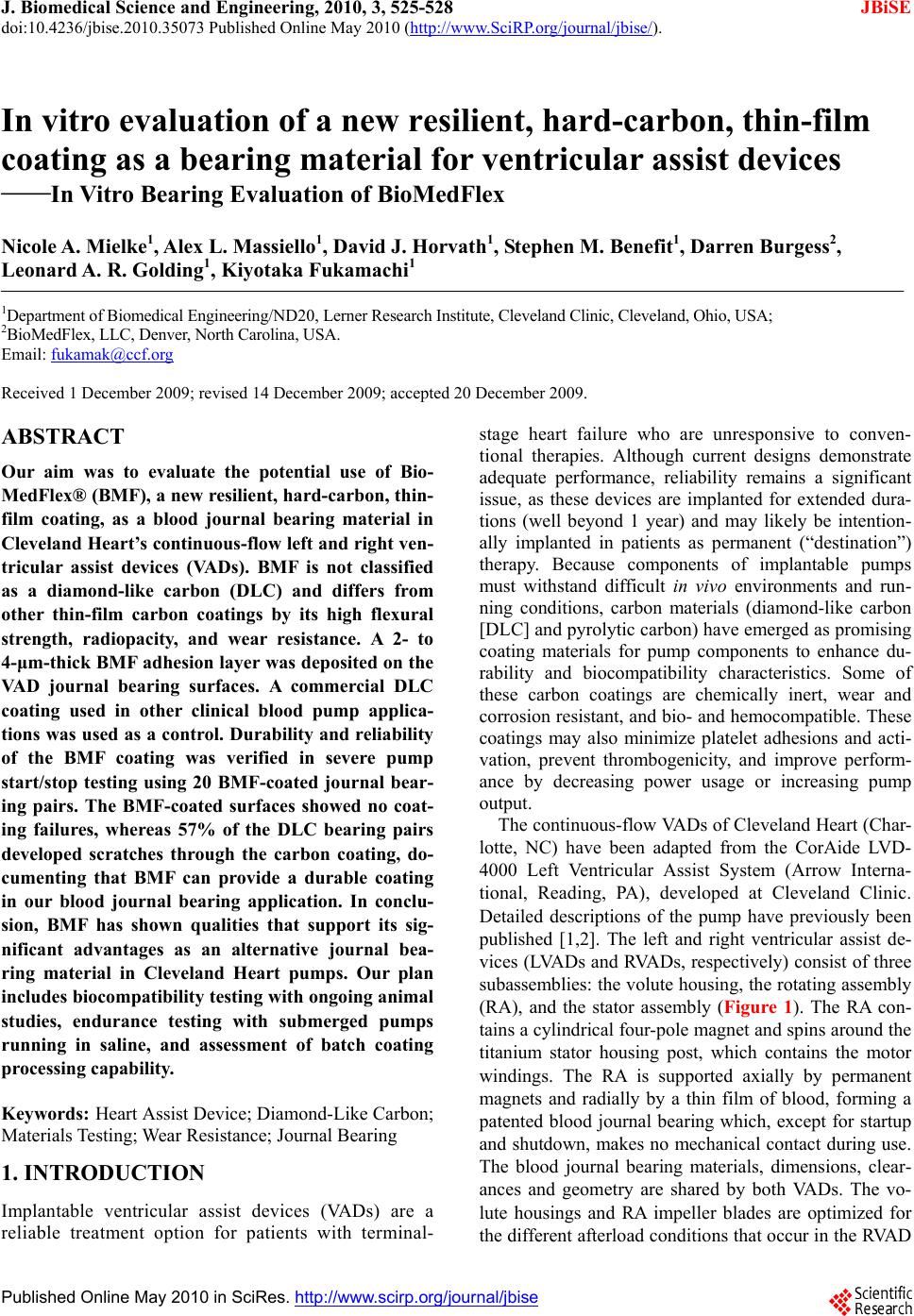 J. Biomedical Science and Engineering, 2010, 3, 525-528 doi:10.4236/jbise.2010.35073 Published Online May 2010 (http://www.SciRP.org/journal/jbise/ JBiSE ). Published Online May 2010 in SciRes. http://www.scirp.org/journal/jbise In vitro evaluation of a new resilient, hard-carbon, thin-film coating as a bearing material for ventricular assist devices ——In Vitro Bearing Evaluation of Bi oMedFlex Nicole A. Mielke1, Alex L. Massiello1, David J. Horvath1, Stephen M. Benefit1, Darren Burgess2, Leonard A. R. Golding1, Kiyotaka Fukamachi1 1Department of Biomedical Engineering/ND20, Lerner Research Institute, Cleveland Clinic, Cleveland, Ohio, USA; 2BioMedFlex, LLC, Denver, North Carolina, USA. Email: [email protected] Received 1 December 2009; revised 14 December 2009; accepted 20 December 2009. ABSTRACT Our aim was to evaluate the potential use of Bio- MedFlex® (BMF), a new resilient, hard-carbon, thin- film coating, as a blood journal bearing material in Cleveland Heart’s continuous-flow left and right ven- tricular assist devices (VADs). BMF is not classified as a diamond-like carbon (DLC) and differs from other thin-film carbon coatings by its high flexural strength, radiopacity, and wear resistance. A 2- to 4-μm-thick BMF adhesion layer was deposited on the VAD journal bearing surfaces. A commercial DLC coating used in other clinical blood pump applica- tions was used as a control. Durability and reliability of the BMF coating was verified in severe pump start/stop testing using 20 BMF-coated journal bear- ing pairs. The BMF-coated surfaces showed no coat- ing failures, whereas 57% of the DLC bearing pairs developed scratches through the carbon coating, do- cumenting that BMF can provide a durable coating in our blood journal bearing application. In conclu- sion, BMF has shown qualities that support its sig- nificant advantages as an alternative journal bea- ring material in Cleveland Heart pumps. Our plan includes biocompatibility testing with ongoing animal studies, endurance testing with submerged pumps running in saline, and assessment of batch coating processing capability. Keywords: Heart Assist Device; Diamond-Like Carbon; Materials Testing; Wear Resistance; Journal Bearing 1. INTRODUCTION Implantable ventricular assist devices (VADs) are a reliable treatment option for patients with terminal- stage heart failure who are unresponsive to conven- tional therapies. Although current designs demonstrate adequate performance, reliability remains a significant issue, as these devices are implanted for extended dura- tions (well beyond 1 year) and may likely be intention- ally implanted in patients as permanent (“destination”) therapy. Because components of implantable pumps must withstand difficult in vivo environments and run- ning conditions, carbon materials (diamond-like carbon [DLC] and pyrolytic carbon) have emerged as promising coating materials for pump components to enhance du- rability and biocompatibility characteristics. Some of these carbon coatings are chemically inert, wear and corrosion resistant, and bio- and hemocompatible. These coatings may also minimize platelet adhesions and acti- vation, prevent thrombogenicity, and improve perform- ance by decreasing power usage or increasing pump output. The continuous-flow VADs of Cleveland Heart (Char- lotte, NC) have been adapted from the CorAide LVD- 4000 Left Ventricular Assist System (Arrow Interna- tional, Reading, PA), developed at Cleveland Clinic. Detailed descriptions of the pump have previously been published [1,2]. The left and right ventricular assist de- vices (LVADs and RVADs, respectively) consist of three subassemblies: the volute housing, the rotatin g assembly (RA), and the stator assembly (Figure 1). The RA con- tains a cylindrical four-pole magnet and spins aroun d the titanium stator housing post, which contains the motor windings. The RA is supported axially by permanent magnets and radially by a thin film of blood, forming a patented blood journal bearing which, except for startup and shutdown, makes no mechanical contact during use. The blood journal bearing materials, dimensions, clear- ances and geometry are shared by both VADs. The vo- lute housings and RA impeller blades are optimized for the different afterload conditio ns that occur in the RVAD 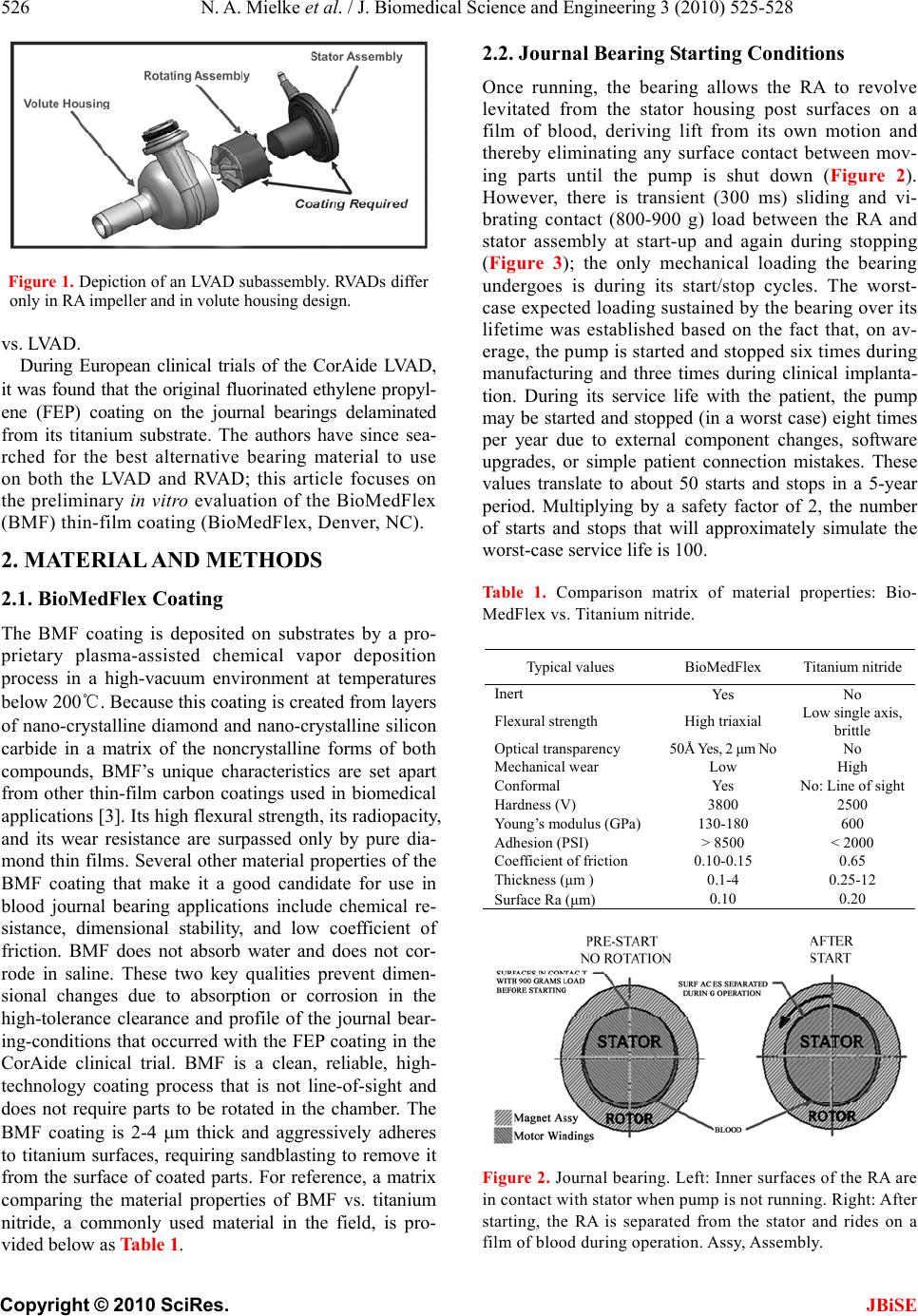 526 N. A. Mielke et al. / J. Biomedical Science and Engineering 3 (2010) 525-528 Copyright © 2010 SciRes. JBiSE Figure 1. Depiction of an LVAD subassembly. RVADs differ only in RA impeller and in volute housing design. vs. LVAD. During European clinical trials of the CorAide LVAD, it was found that the original fluorinated ethylene propyl- ene (FEP) coating on the journal bearings delaminated from its titanium substrate. The authors have since sea- rched for the best alternative bearing material to use on both the LVAD and RVAD; this article focuses on the preliminary in vitro evaluation of the BioMedFlex (BMF) thin-film coating (BioMedFlex, Denver, NC). 2. MATERIAL AND METHODS 2.1. BioMedFlex Coating The BMF coating is deposited on substrates by a pro- prietary plasma-assisted chemical vapor deposition process in a high-vacuum environment at temperatures below 200℃. Because this coating is created from layers of nano-crystalline diamond and nano-crystalline silicon carbide in a matrix of the noncrystalline forms of both compounds, BMF’s unique characteristics are set apart from other thin-film carbon coatings used in biomedical applications [3]. Its high flexural strength, its radiopacity, and its wear resistance are surpassed only by pure dia- mond thin films. Several other material properties of the BMF coating that make it a good candidate for use in blood journal bearing applications include chemical re- sistance, dimensional stability, and low coefficient of friction. BMF does not absorb water and does not cor- rode in saline. These two key qualities prevent dimen- sional changes due to absorption or corrosion in the high-tolerance clearance and profile of the journal bear- ing-conditions that occurred with the FEP coating in the CorAide clinical trial. BMF is a clean, reliable, high- technology coating process that is not line-of-sight and does not require parts to be rotated in the chamber. The BMF coating is 2-4 m thick and aggressively adheres to titanium surfaces, requiring sandblasting to remove it from the surface of coated parts. For reference, a matrix comparing the material properties of BMF vs. titanium nitride, a commonly used material in the field, is pro- vided bel ow as Table 1. 2.2. Journal B ea r in g Starting Conditions Once running, the bearing allows the RA to revolve levitated from the stator housing post surfaces on a film of blood, deriving lift from its own motion and thereby eliminating any surface contact between mov- ing parts until the pump is shut down (Figure 2). However, there is transient (300 ms) sliding and vi- brating contact (800-900 g) load between the RA and stator assembly at start-up and again during stopping (Figure 3); the only mechanical loading the bearing undergoes is during its start/stop cycles. The worst- case expected loading sustained by the bearing over its lifetime was established based on the fact that, on av- erage, the pump is started and stopped six times during manufacturing and three times during clinical implanta- tion. During its service life with the patient, the pump may be started and stopped (in a worst case) eight times per year due to external component changes, software upgrades, or simple patient connection mistakes. These values translate to about 50 starts and stops in a 5-year period. Multiplying by a safety factor of 2, the number of starts and stops that will approximately simulate the worst-case service life is 100. Table 1. Comparison matrix of material properties: Bio- MedFlex vs. Titanium nitride. Typical values BioMedFlex Titanium nitride Inert Yes No Flexural strength High triaxial Low single axis, brittle Optical transparency 50Å Yes, 2 μm No No Mechanical wear Low High Conformal Yes No: Line of sight Hardness (V) 3800 2500 Young’s modulus (GPa) 130-180 600 Adhesion (PSI) > 8500 < 2000 Coefficient o f friction 0.10-0.15 0.65 Thickness (μm ) 0.1-4 0.25-12 Surface Ra (μm) 0.10 0.20 Figure 2. Journal bearing. Le ft: Inner surfaces of t he RA are in contact with stator when pump is not running. Right: After starting, the RA is separated from the stator and rides on a film of blood dur ing operation. Assy, Asse mbly. 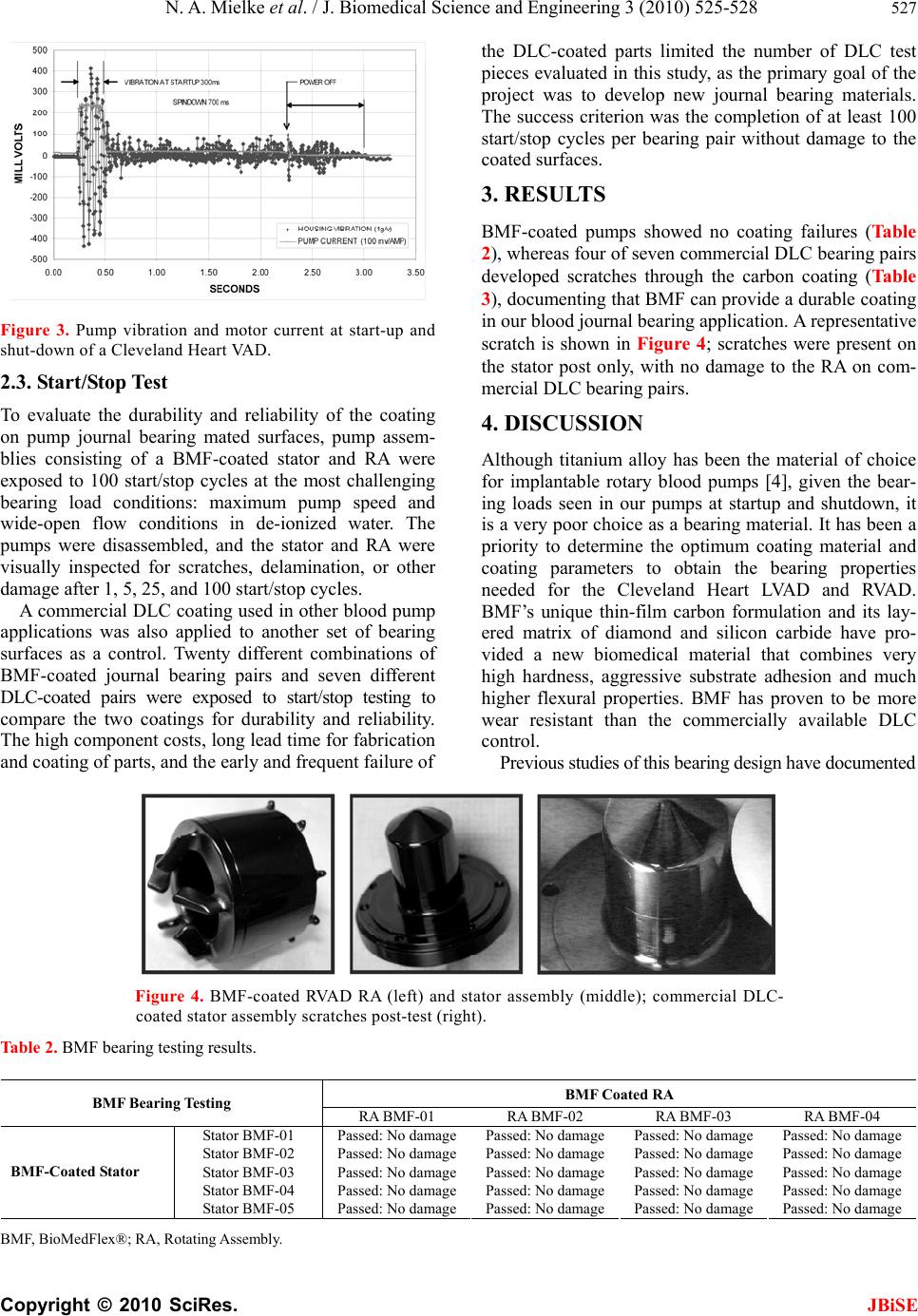 N. A. Mielke et al. / J. Biomedical Science and Engineering 3 (2010) 525-528 527 Copyright © 2010 SciRes. the DLC-coated parts limited the number of DLC test pieces evaluated in this study, as the primary goal of the project was to develop new journal bearing materials. The success criterion was the completion of at least 100 start/stop cycles per bearing pair without damage to the coated surfaces. 3. RESULTS BMF-coated pumps showed no coating failures (Table 2), whereas four of seven commercial DLC bearing pairs developed scratches through the carbon coating (Table 3), documenting that BMF can provide a durable coating in our blood jour nal beari n g application. A representative scratch is shown in Figure 4; scratches were present on the stator post only, with no damage to the RA on com- mercial DLC bearing pairs. Figure 3. Pump vibration and motor current at start-up and shut-down of a Cleveland Heart VAD. 2.3. Start/Stop Test To evaluate the durability and reliability of the coating on pump journal bearing mated surfaces, pump assem- blies consisting of a BMF-coated stator and RA were exposed to 100 start/stop cycles at the most challenging bearing load conditions: maximum pump speed and wide-open flow conditions in de-ionized water. The pumps were disassembled, and the stator and RA were visually inspected for scratches, delamination, or other damage after 1, 5, 25, and 100 start/stop cycles. 4. DISCUSSION Although titanium alloy has been the material of choice for implantable rotary blood pumps [4], given the bear- ing loads seen in our pumps at startup and shutdown, it is a very poor choice as a bearing material. It has been a priority to determine the optimum coating material and coating parameters to obtain the bearing properties needed for the Cleveland Heart LVAD and RVAD. BMF’s unique thin-film carbon formulation and its lay- ered matrix of diamond and silicon carbide have pro- vided a new biomedical material that combines very high hardness, aggressive substrate adhesion and much higher flexural properties. BMF has proven to be more wear resistant than the commercially available DLC control. A commercial DLC coating used in other blood pump applications was also applied to another set of bearing surfaces as a control. Twenty different combinations of BMF-coated journal bearing pairs and seven different DLC-coated pairs were exposed to start/stop testing to compare the two coatings for durability and reliability. The high component costs, long lead time for fabrication and coating of parts, and the early and frequent failure of Previous studies of this bearing design have documented Figure 4. BMF-coated RVAD RA (left) and stator assembly (middle); commercial DLC- coated stator assembly scratches post-test (right). Table 2. BMF bearing testing results. BMF Coated RA BMF Bearing Testing RA BMF-01 RA BMF-02 RA BMF-03 RA BMF-04 Stator BMF-01 Passed: No damagePassed: No damagePassed: No damage Passed: No damage Stator BMF-02 Passed: No damagePassed: No damagePassed: No damage Passed: No damage Stator BMF-03 Passed: No damagePassed: No damagePassed: No damage Passed: No damage Stator BMF-04 Passed: No damagePassed: No damagePassed: No damage Passed: No damage BMF-Coated Stator Stator BMF-05 Passed: No damagePassed: No damagePassed: No damage Passed: No damage BMF, BioMedFlex®; RA, Rotating Assembly. JBiSE 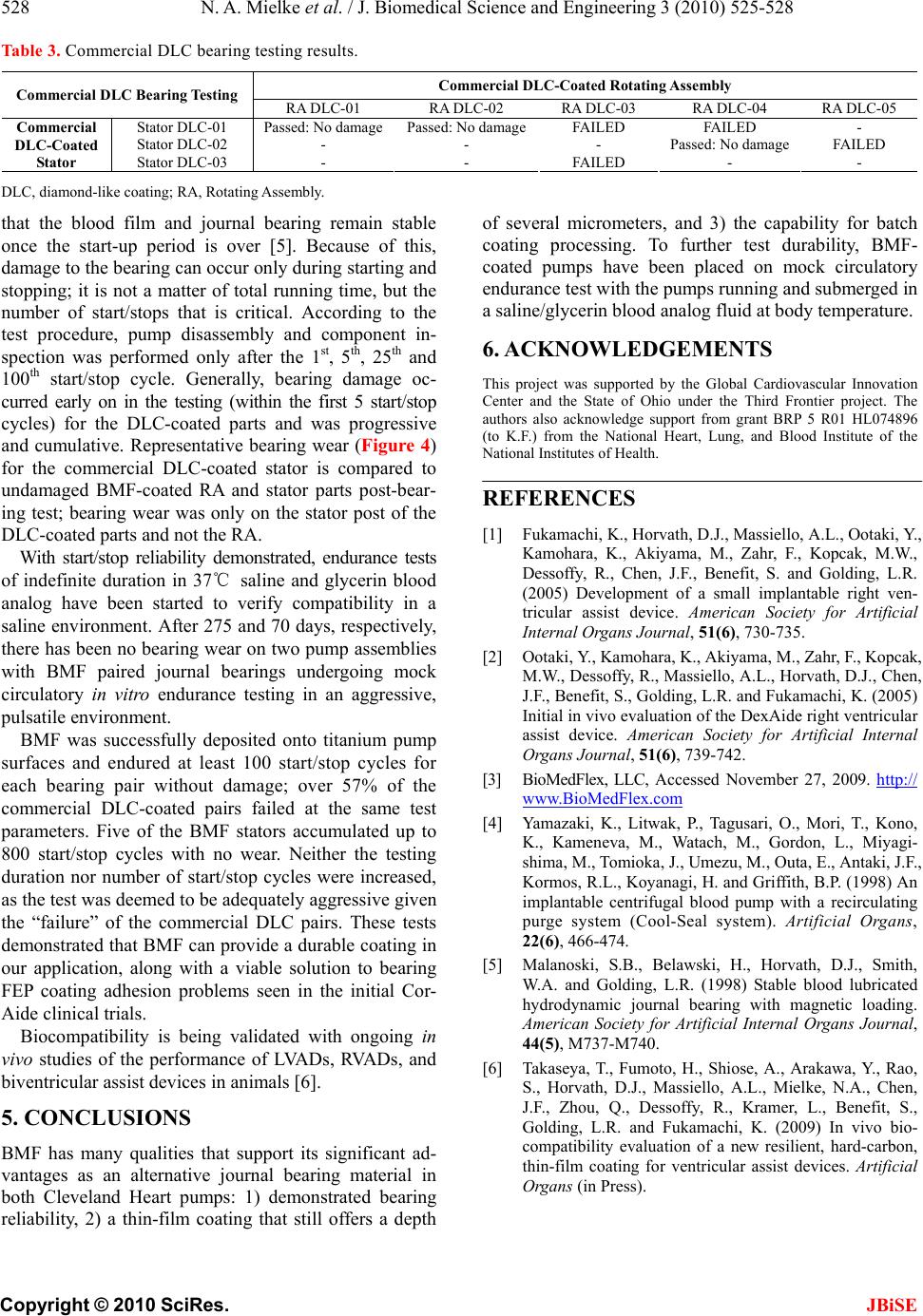 528 N. A. Mielke et al. / J. Biomedical Science and Engineering 3 (2010) 525-528 Copyright © 2010 SciRes. JBiSE Table 3. Commercial DLC bearing testing results. Commercial DLC-Coated Rotating Assembly Commercial DLC Bearing TestingRA DLC-01 RA DLC-02 RA DLC-03 RA DLC-04 RA DLC-05 Stator DLC-01 Passed: No damagePassed: No damageFAILED FAILED - Stator DLC-02 - - - Passed: No damage FAILED Commercial DLC-Coated Stator Stator DLC-03 - - FAILED - - DLC, diamond-like coating; RA, Rota ting Assembly. that the blood film and journal bearing remain stable once the start-up period is over [5]. Because of this, damage to the bearing can occur only dur ing startin g and stopping; it is not a matter of total running time, but the number of start/stops that is critical. According to the test procedure, pump disassembly and component in- spection was performed only after the 1st, 5th, 25th and 100th start/stop cycle. Generally, bearing damage oc- curred early on in the testing (within the first 5 start/stop cycles) for the DLC-coated parts and was progressive and cumulative. Representative bearing wear (Figure 4) for the commercial DLC-coated stator is compared to undamaged BMF-coated RA and stator parts post-bear- ing test; bearing wear was only on the stator post of the DLC-coated parts and not the RA. With start/stop reliability demonstrated, endurance tests of indefinite duration in 37℃ saline and glycerin blood analog have been started to verify compatibility in a saline environment. After 275 and 70 days, respectively, there has been no bearing wear on two pump assemblies with BMF paired journal bearings undergoing mock circulatory in vitro endurance testing in an aggressive, pulsatile environment. BMF was successfully deposited onto titanium pump surfaces and endured at least 100 start/stop cycles for each bearing pair without damage; over 57% of the commercial DLC-coated pairs failed at the same test parameters. Five of the BMF stators accumulated up to 800 start/stop cycles with no wear. Neither the testing duration nor number of start/stop cycles were increased, as the test was deemed to be adequately aggressive given the “failure” of the commercial DLC pairs. These tests demonstrated that BMF can provide a durable coating in our application, along with a viable solution to bearing FEP coating adhesion problems seen in the initial Cor- Aide clinical trials. Biocompatibility is being validated with ongoing in vivo studies of the performance of LVADs, RVADs, and biventricular assist devices in animals [6]. 5. CONCLUSIONS BMF has many qualities that support its significant ad- vantages as an alternative journal bearing material in both Cleveland Heart pumps: 1) demonstrated bearing reliability, 2) a thin-film coating that still offers a depth of several micrometers, and 3) the capability for batch coating processing. To further test durability, BMF- coated pumps have been placed on mock circulatory endurance test with the pumps running and su b merged in a saline/glycerin blood analog fluid at body temperature. 6. ACKNOWLEDGEMENTS This project was supported by the Global Cardiovascular Innovation Center and the State of Ohio under the Third Frontier project. The authors also acknowledge support from grant BRP 5 R01 HL074896 (to K.F.) from the National Heart, Lung, and Blood Institute of the National Institutes of Health. REFERENCES [1] Fukamachi, K., Horvath, D.J., Massiello, A.L., Ootaki, Y., Kamohara, K., Akiyama, M., Zahr, F., Kopcak, M.W., Dessoffy, R., Chen, J.F., Benefit, S. and Golding, L.R. (2005) Development of a small implantable right ven- tricular assist device. American Society for Artificial Internal Organs Journal, 51(6), 730-735. [2] Ootaki, Y., Kamohara, K., Akiyama, M., Zahr, F., Kopcak, M.W., De ssoffy, R., Massiello, A.L., Horvath, D.J., Chen, J.F., Benefit, S., Golding, L.R. and Fukamachi, K. (2005) Initial in vivo evaluation of the DexAide right ventricular assist device. American Society for Artificial Internal Organs Journal, 51(6), 739-742. [3] BioMedFlex, LLC, Accessed November 27, 2009. http:// www.BioMedFlex.com [4] Yamazaki, K., Litwak, P., Tagusari, O., Mori, T., Kono, K., Kameneva, M., Watach, M., Gordon, L., Miyagi- shima, M., Tomioka, J., Umezu, M., Outa, E., Antaki, J.F., Kormos, R.L., Koyanagi, H. and Griffith, B.P. (1998) An implantable centrifugal blood pump with a recirculating purge system (Cool-Seal system). Artificial Organs, 22(6), 466-474. [5] Malanoski, S.B., Belawski, H., Horvath, D.J., Smith, W.A. and Golding, L.R. (1998) Stable blood lubricated hydrodynamic journal bearing with magnetic loading. American Society for Artificial Internal Organs Journal, 44(5), M737-M740. [6] Takaseya, T., Fumoto, H., Shiose, A., Arakawa, Y., Rao, S., Horvath, D.J., Massiello, A.L., Mielke, N.A., Chen, J.F., Zhou, Q., Dessoffy, R., Kramer, L., Benefit, S., Golding, L.R. and Fukamachi, K. (2009) In vivo bio- compatibility evaluation of a new resilient, hard-carbon, thin-film coating for ventricular assist devices. Artificial Organs (in Press). |