

Paper Menu >>
Journal Menu >>
 J. Biomedical Science and Engineering, 2010, 3, 517-524 doi:10.4236/jbise.2010.35072 Published Online May 2010 (http://www.SciRP.org/journal/jbise/ JBiSE ). Published Online May 2010 in SciRes. http://www.scirp.org/journal/jbise Time dependent dispersion of nanoparticles in blood vessels Francesco Gentile1, Paolo Decuzzi2 1Center of Bio-Nanotechnology and -Engineering for Medicine, Università Magna Graecia, Catanzaro, Italy; 2Department of Nanomedicine and Biomedical Engineering, the University of Texas Health Science Center, Houston, USA. Email: [email protected] Received 25 September 2009; revised 20 October 2009; accepted 25 October 2009. ABSTRACT The dispersion of intravasculary injected nanoparti- cles can be efficiently described by introducing an effective diffusion coefficient Deff which quantifies the longitudinal mass transport in blood vessels. Here, the original work of Gill and Sankarasubramanian was modified and extended to include 1) the variati- on over time of Deff; 2) the permeability of the blood vessels and 3) non-Newtonian rheology of blood. A general solution was provided for Deff depending on space ( ), time ( ), plug radius ( c) and a subset of permeability parameters. It was shown that in- creasing the vessel plug radius (thus hematocrit) or permeability leads to a reduction in Deff, limiting the transport of nanoparticles across those vessels. It was also shown that the asymptotic time beyond which the solution attains the steady state behaviour is always independent of the plug radius and wall permeability. The analysis presented can more accu- rately predict the transport of nanoparticles in blood vessels, compared to previously developed models. Keywords: Nanoparticle Transport; Casson Fluid; Permeable Blood Vessels; Drug Delivery 1. INTRODUCTION The study of solute dispersion in capillaries dates back to the celebrated works of Taylor and Aris [1,2], who first studied the effect of shear stress on the transport in laminar flows. They provided a solution for the classic advection/diffusion equation 2 m CCD C t u (1) in the long term steady state limit, in terms of a constant effective coefficient of diffusion as 2 1 192 e eff m P DD , (2) which includes the molecular diffusion contribution ( Dm) and the convective contribution ( Pe). In the Eqs.1 and 2 above, Pe (Pe = Re × u0 / Dm) is the Peclet number for a capillary with radius Re and centerline velocity u0, C is the local solute concentration; u is the fluid velocity vector; Dm is the Brownian or molecular diffusion coef- ficient and and 2 are the gradient and Laplacian op- erators, respectively. The solution of Taylor and Aris is valid under the simplifying assumptions of 1) quasi-steady dispersion and 2) unidirectional flow. In particular, it is strictly valid beyond the asymptotic time tst = 1/2 × Re 2/Dm. Notice that sub-micrometric particles with a molecular diffusivity Dm typically ranging be- tween 10-11 and 10-9 m 2/s, in large vessels (Re 10-2 m) would have tst of the order of 105 -107 s, whereas in small capillaries (Re 10-6 m) tst would fall in the range 10-3-10-1 s. Considerable efforts were expended in the attempt of relaxing the above assumptions. Gill [3] extended Taylor’s formulation to obtain the local concentration C by means of a series expansion about the mean concen- tration, leading to the Generalized Dispersion Model (GDM), founding upon the rephrased convective- diffusive equation 0 () i m ii i Kt τς m (3) where Ki(t) are suitable functions of time; m is the normalized concentration averaged over a cross section of the capillary as explained in the sequel, and are the longitudinal and time coordinates respectively. San- karasubramanian and Gill [4] further developed the GD- M including the effect of wall permeability to the solute (i.e. nanoparticles). In 1993, Sharp derived explicit expr- essions for the constant steady state coefficient Deff for a non-Newtonian fluid considering, in particular, a Cas- son-like fluid [5]. Dash et al. [6] and Nagarani et al. [7] combined the model of Sharp and the GDM to obtain the unsteady dispersion in a Casson-like fluid, introducing solute adsorption to the walls. More recently, Decuzzi et al. [8] revisited the theory of Taylor and Aris incor- porating the effects of wall permeability for the working fluid (plasma) and deriving a novel and more general  518 F. Gentile et al. / J. Biomedical Science and Engineering 3 (2010) 517-524 Copyright © 2010 SciRes. JBiSE expression for Deff being 2 0 1, 192 e eff m P DDf z , (4) where P is the Peclet number at the entrance of the capillary ( 0 e 0 ~ z), and f is a function of the permeability parameter , pressure parameters , and longitudinal coordinate z ~ along the capillary, as described in the sequel. In 2008, Gentile et al. [9] expanded the solution in [8] to include a Casson-like model for the fluid. Noti- ceably, the models presented in [8] and [9] are valid in the limit of large times of dispersion or, equivalently, at the steady state. No explicit dependency on time was introduced and the solution was deduced in terms of the longitudinal space coordinate solely. In this work, the transport formulation proposed in [9] was further developed to account for the time dependency of the problem. The transport of nanoparticles was investigated and the effective diffusion coefficient Deff derived. Deff would in general depend upon the permeability of the capil- lary and the rheology of blood as in [9], but this dependency was extended to all times, thus also comprising the initial regime of dispersion. The model presented herein comprises, in the limits, well established schemes of diffusion. 2. MATERIALS AND METHODS A circular capillary with radius Re and length l was con- sidered as in Figure 1. A Casson-like fluid was conside- red with capillary walls permeable to the fluid, imperme- able and not adsorbent to the solute (i.e. nanoparticles). In the following of the paper, the Generalized Dispersion Model was recalled and revised. 2.1. The Governing Equations Following [4], the dispersion of a solute in a cylindrical capillary was described by the normalized advection-dif- fusion equation 2 2 2 0 11 eP (5) Figure 1. Longitudinal transport of molecules or nanoparticles in a blood capillary with a blunted velocity profile. with the non dimensional terms being 00 22 0 ;; ;; e mm ee Cu υρ Cu R Dz Dt ςτ Ru R ; r (6) where C is the local concentration of the solute and C0 a reference concentration, u0 is the initial center line velo- city at the inlet and u the velocity distribution within the capillary with radius Re, Dm is the molecular diffusivity of the solute, r and z are the radial and longitudinal co- ordinates as from the frame of reference in Figure 1, and t stays for the dimensional time. In Eq.6 P (= Re × u0/Dm) is the characteristic Peclet number defined as above. It was assumed that the particles are sufficiently small to have the same velocity of the dislodging fluid so that the diffusion/advection problem and the fluid-dy- namic problem may be treated separately. The solution of Eq.5 for can be derived exactly as 0 e 0 ,; i m ii i fρςτς (7) where the functions fi were related to the i-th derivative of m as shown in the sequel. The mean concentration m was defined as .2 1 0 d m (8) From Eqs.5 and 7, it follows that m has to satisfy the relation i m i i i mK 0 (9) where the dispersion coefficients Ki were defined prop- erly as function of time as to give 2 2 0 1 1 0 (,)2(1,;) 2(,;)(,) ii i e i δf Kςτ ςτ ρP fρςτυρς ρd ρ (10) with the understanding that f0 = 1 and f1 = 0. Here i2 denotes the delta of Kronecker. The dispersion problem was thus reduced to estimating fi and Ki for each i. The auxiliary functions fi must satisfy the differential equa- tions . 1 0 2 2 1 0 ini i e n n nn fK P f f ff (11) Relations Eq.10 and Eq.11 are coupled, and their so- lution becomes untractable of i > 2. Nevertheless it was shown [10] that all terms involving a coefficient higher than i = 2 in Eq. 10 can be neglected, in that K2 is more than two orders of magnitude greater than K3. Eq.9 thus 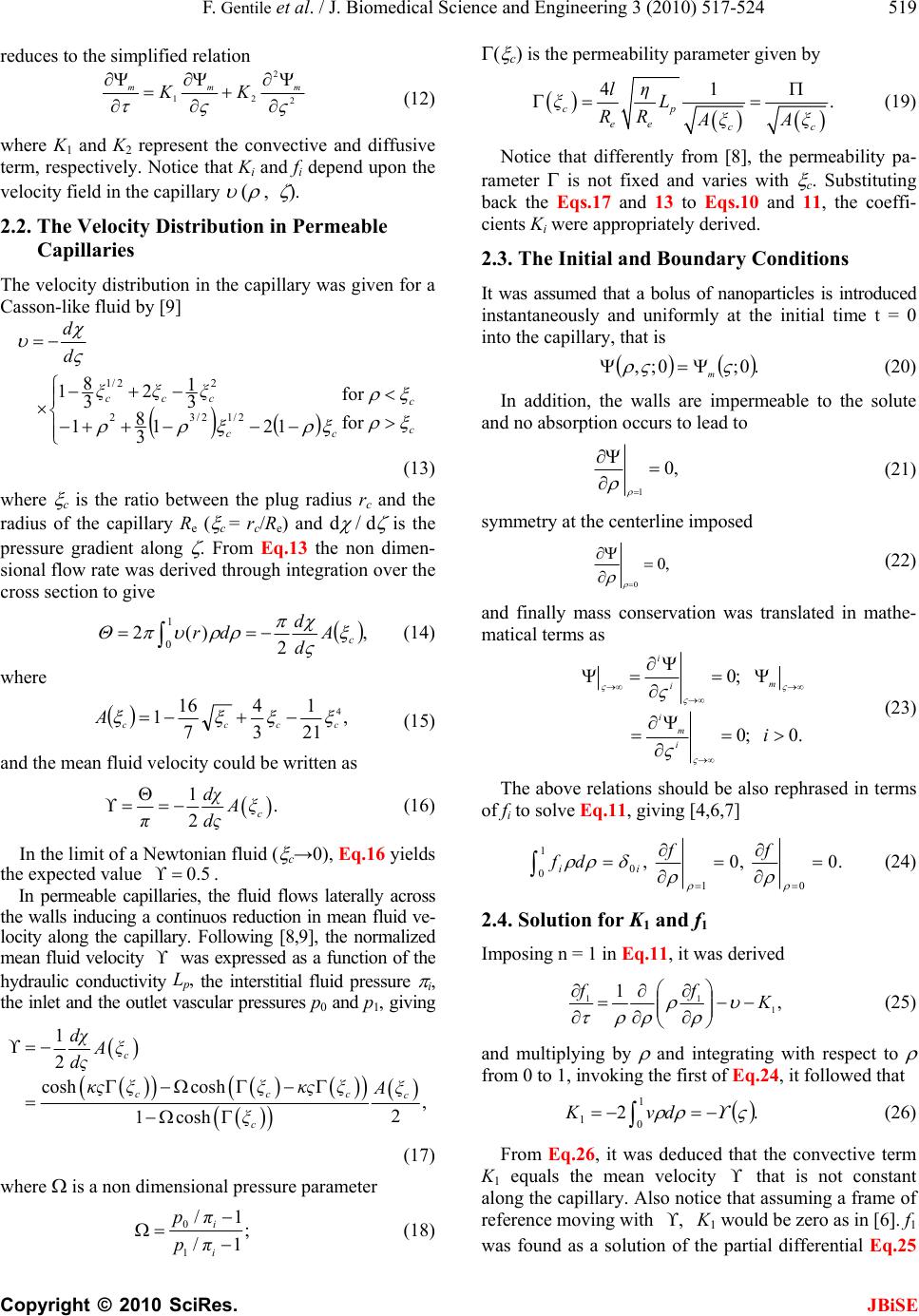 F. Gentile et al. / J. Biomedical Science and Engineering 3 (2010) 517-524 519 Copyright © 2010 SciRes. JBiSE reduces to the simplified relation 2 2 21 mm KK m (12) where K1 and K2 represent the convective and diffusive rmeable The ution in the capillary was given for a term, respectively. Notice that Ki and fi depend upon the velocity field in the capillary . 2.2. The Velocity Distribution in Pe Capillaries velocity distrib Casson-like fluid by [9] c c cc ccc ξξξ d d for for 121 3 8 1 3 1 2 3 8 1 2/12/32 22/1 (13) where c is the ratio between the plug radius rc and the radius of the capillary Re ( c = rc/Re) and d d is the pressure gradient along . From Eq.13 the non dimen- sional flow rate was derived through integration over the cross section to give , 2 )(2 1 0c A d d dr (14) where , 21 1 3 4 7 16 14 cccc A (15) and the mean fluid velocity could be written as 1. dχAξ 2c πdς (16) In the limit of a Newtonian fluid ( c→0), Eq.1 6 yields th aries, e expected value 0.5 . In permeable capillthe fluid flows laterally across the walls inducing a continuos reduction in mean fluid ve- locity along the capillary. Following [8,9], the normalized mean fluid velocity was expressed as a function of the hydraulic conductivity Lp, the interstitial fluid pressure i, the inlet and the outlet vascular pressures p0 and p1, giving 1dχ 2 cosh cosh, 2 1cosh c ccc c c Aξ dς κς ξξκς ξAξ ξ (17) where is a non dimensional pressure parameter 0/1 ; i pπ 1/1 i pπ (18) ( c) is the permeability parameter given by 41 . lη (19) Notice that differently from [8], the perme rameter is not fixed and varies with c. Substituting ba rticles is introduced e t = 0 cp ee cc ξL RR AξAξ ability pa- ck the Eqs.17 and 13 to Eqs.10 and 11, the coeffi- cients Ki were appropriately derived. 2.3. The Initial and Boundary Conditions It was assumed that a bolus of nanopa instantaneously and uniformly at the initial tim into the capillary, that is .0;0;, m (20) In addition, the walls are impermeable to the solute and no absorption occurs to lead to ,0 1 (21) symmetry at the centerline imposed ,0 0 (22) and finally mass conser matical terms as vation was translated in mathe- .0;0 ;0 m i i i i m i (23) The above relations should be also rephrased in terms of fi to solve Eq.11 , giving [4,6,7] .0 ,0 , 0 1 0 ff df ii 01 (24) 2.4. Solution for K1 and f1 Imposing n = 1 in Eq.11, it was derived , 1 11 K 1ff (25) and multiplying by and integrating w from 0 to 1, invoking the first of Eq.24, it From Eq.26, it was deduced that K1 equals the mean velocity al ith respect to followed that .2 1 0 1 dvK (26) the convective term that is not constant ong the capillary. Also notice that assuming a frame of reference moving with , K1 would be zero as in [6]. f1 was found as a solution of the partial differential Eq.25  520 F. Gentile et al. / J. Biomedical Science and Engineering 3 (2010) 517-524 Copyright © 2010 SciRes. JBiSE that can be decomposed as the sum the steady state solu- tion f1s( ) and the transient term f1t( ). .;,,;, 111 ts fff (27) Substitution of the steady state term f1s in to Eq.25 yield ; 11 s f (28) which holds in the core of the capillary ( < ), where the velocity is blunted, and in the where the velocity varies with . At the interface, = , c cell free layer ( > c), c continuity imposed that f1s ( = c-) = f1s ( = c +) which, together with the boundary conditions Eq.24, allowed the deconvolution of f1s as c c c ccc s f C B cosh1 coshcosh , 1 for for )( )( (2) where B and C are solely functions of : 9 , 194040 )ln(2310 194040 )14566421(1155147 194040 143015092216008085 );( 4 2422/16 42/1 cc ccccc ccc c B (30) ).ln( 841320 336 )32( ))32(107( )8815445( 1617 4 362 48 1 );( 46 4 2 2 2/12/72 42 r Cc (31) The transient term f1t depends upon f1s and was readily derived as [6] n sn nJe J dfJ n 0 2 10 0 2 (32) n0 , where J0 and J1 are the Bessel function of first type and order zero and one, respectively, and the were found as the roots of the equation J ( ) = 0. 0 to 1, K2 was obtained as eigenvalues n 1n 2.5. Solution for K2 Imposing n = 2 in Eq.11, multiplying by and integrat- ing with respect to from df Pe K,;,2 1 ;1 1 0 2 0 2 (33) notice that, differently from the original formu Gill and Sankarasubramanian [4,10], the auxil lation by iary func- tions K2 would in general depend also on the longitudi- nal coordinate and, in particular, the problem would be determined if the velocity field in the capillary is known. In the limit of large time K2 is found as cccccc cccc cccc cccc c cc Pe ln 147 8 147 4 1155 872 21 64 147 512 66885 430331 165 6976 1155 55808 165 11464 21 4096 2205 385312 3773 272128 21 244 45 128 715 6144 56595 558368 1555 5888 1 cosh1192 8121092/17 872/136 2/1152/94 22/32/1 2 0 (34) thus recovering the results derived in [9]. Incidentally notice that Eq.34 represents the most general form ient for estimating the transp- ive diffusion c K coshcosh11 2 ula- n K tion for the non dimensional coefficient of diffusio2 in that it comprises an extensive subset of solutions, de- pending on the rheological parameters c, and . In particular, as (or, equivalently, ) goes to zero (im- permeable capillary) Eq.34 coincides with the relation given in [5], whereas as the rheological parameter c goes to zero the result given by [8] is recovered. The classical solution of Taylor and Aris [1,2] is found when both () and c are null. 3. RESULTS AND DISCUSSION The most important coeffic ort of nanoparticles is the normalized effect coefficient 2 2 2 2 2 1AA D Kcc eff (35) 0 Pe A Dc m in that it gives a measure of the propensit cles to spread about their center of mass a y of the parti- long the capil- lary. Differently from all the schemes proposed so far, the K2 presented in Eq.35 changes with due to the variation of the mean fluid velocity along the permeable vessel. In Figure 2 the relation 192(K2 – Pe -2) was plot- ted as a function of and in the case of large perme- ability of the walls (= 8, = –2) and for a Newtonian 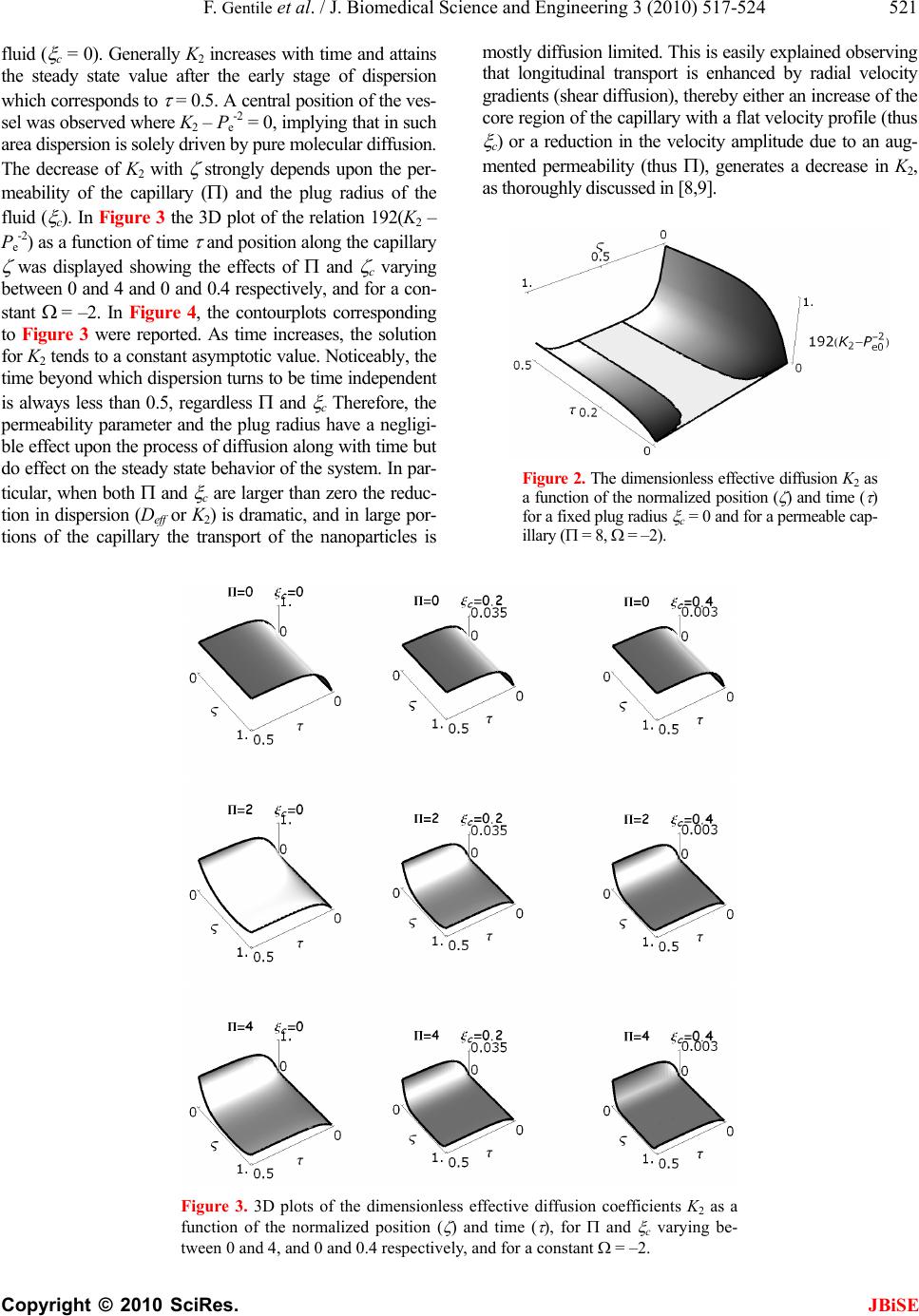 F. Gentile et al. / J. Biomedical Science and Engineering 3 (2010) 517-524 521 Copyright © 2010 SciRes. t a fluid ( c = 0). Generally K2 increases with time and attains the steady state value after the early stage of dispersion which corresponds to = 0.5. A central position of the ves- sel was observed where K2 – Pe -2 = 0, implying that in such area dispersion is solely driven by pure molecular diffusion. The decrease of K2 with strongly depends upon the per- meability of the capillary () and the plug radius of the fluid ( c). In Figure 3 the 3D plot of the relation 192(K2 – Pe -2) as a function of time and position along the capillary was displayed showing the effects of and c varying between 0 and 4 and 0 and 0.4 respectively, and for a con- stant = –2. In Figure 4, the contourplots corresponding o Figure 3 were reported. As time increases, the solution for K2 tends to a constant asymptotic value. Noticeably, the time beyond which dispersion turns to be time independent is always less than 0.5, regardless and c Therefore, the permeability parameter and the plug radius have a negligi- ble effect upon the process of diffusion along with time but do effect on the steady state behavior of the system. In par- ticular, when both and c are larger than zero the reduc- tion in dispersion (Deff or K2) is dramatic, and in large por- tions of the capillary the transport of the nanoparticles is mostly diffusion limited. This is easily explained observing that longitudinal transport is enhanced by radial velocity gradients (shear diffusion), thereby either an increase of the core region of the capillary with a flat velocity profile (thus c) or a reduction in the velocity amplitude due to an aug- mented permeability (thus ), generates a decrease in K2, s thoroughly discussed in [8,9]. Figure 2. The dimensionless effective diffusion K2 as a function of the normalized position ( ) and time ( ) for a fixed plug radius c = 0 and for a permeable cap- illary (= 8, = –2). Figure 3. 3D plots of the dimensionless effective diffusion coefficients K2 as a function of the normalized position ( ) and time ( ), for and varying be - c tween 0 and 4, and 0 and 0.4 respectively, and for a constant = –2. JBiSE 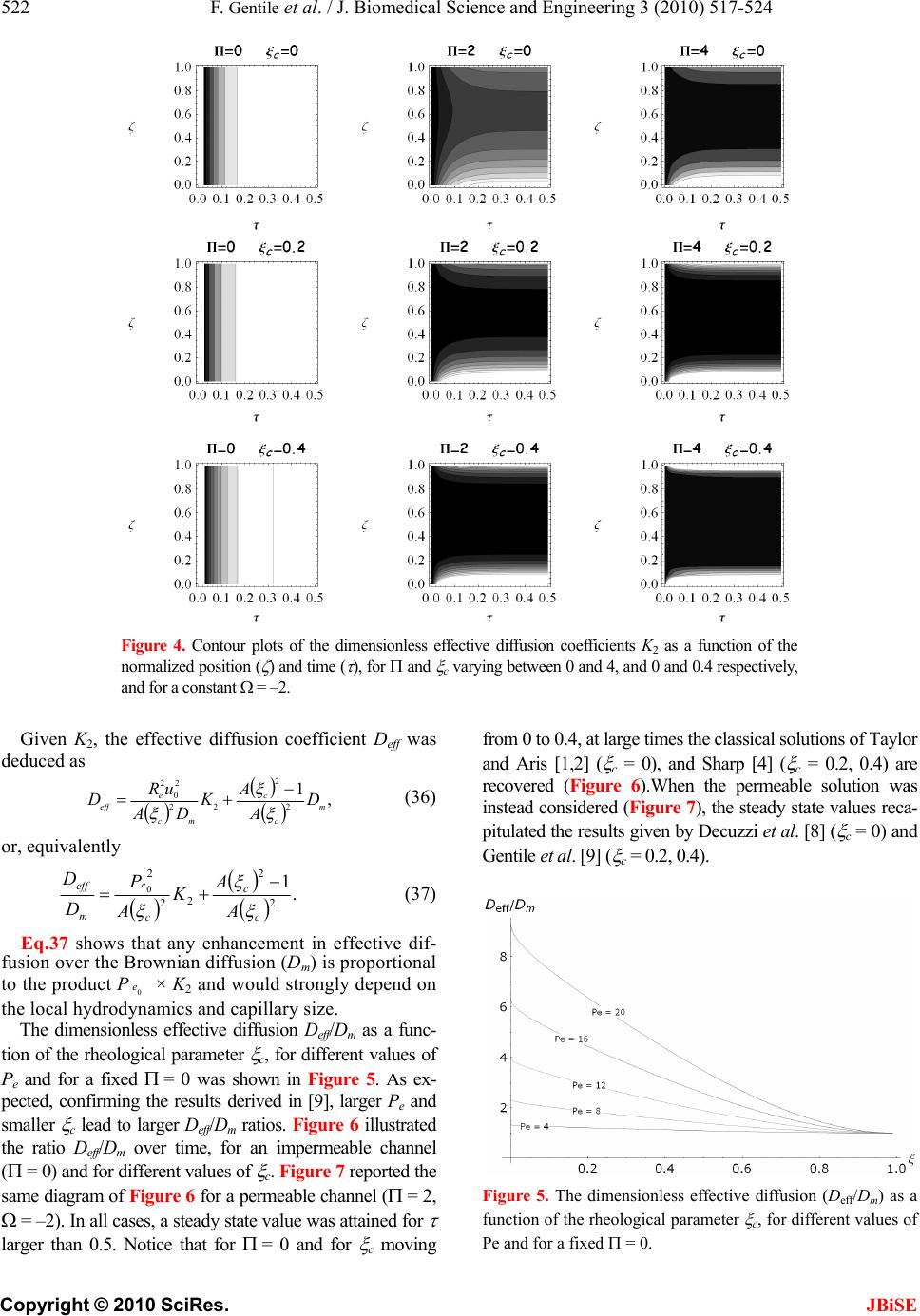 522 F. Gentile et al. / J. Biomedical Science and Engineering 3 (2010) 517-524 Copyright © 2010 SciRes. JBiSE Figure 4. Contour plots of the dimensionless effective diffusion coefficients K2 as a function of the normalized position ( ) and time ( ), for and c varying between 0 and 4, and 0 and 0.4 respectively, Given K2, thefficient Deff was educed as and for a constant = –2. e effective diffusion co d , 2 2 2m cmc eff D A K DA or, equivalently 1 2 2 0 2 ce AuR D (36) . 1 2 2 2 2 2 0 c c c m eff DA A K A P D e (37) Eq.37 shows that any enhancemen fusion over the Brownian diffusion (D) is proportional to t values of P from 0 to 0.4, at large times the classical solutions of Taylor and Aris [1,2] ( = 0), and Sharp [4] ( = 0.2, 0.4) are t in effective dif- m the product P0 e × K2 and would strongly depend on the local hydrodynamics and capillary size. The dimensionless effective diffusion Deff/Dm as a func- tion of the rheological parameter , for differen c e and for a fixed = 0 was shown in Figure 5. As ex- pected, confirming the results derived in [9], larger Pe and smaller c lead to larger Deff/Dm ratios. Figure 6 illustrated the ratio Deff/Dm over time, for an impermeable channel (= 0) and for different values of c. Figure 7 reported the same diagram of Figure 6 for a permeable channel (= 2, = –2). In all cases, a steady state value was attained for larger than 0.5. Notice that for = 0 and for c moving c c recovered (Figure 6).When the permeable solution was instead considered (Figure 7), the steady state values reca- pitulated the results given by Decuzzi et al. [8] ( c = 0) and Gentile et al. [9] ( c = 0.2, 0.4). Figure 5. The dimensionless effective diffusion (Deff/Dm) as a function of the rheological parameter c, for different values of Pe and for a fixed = 0. 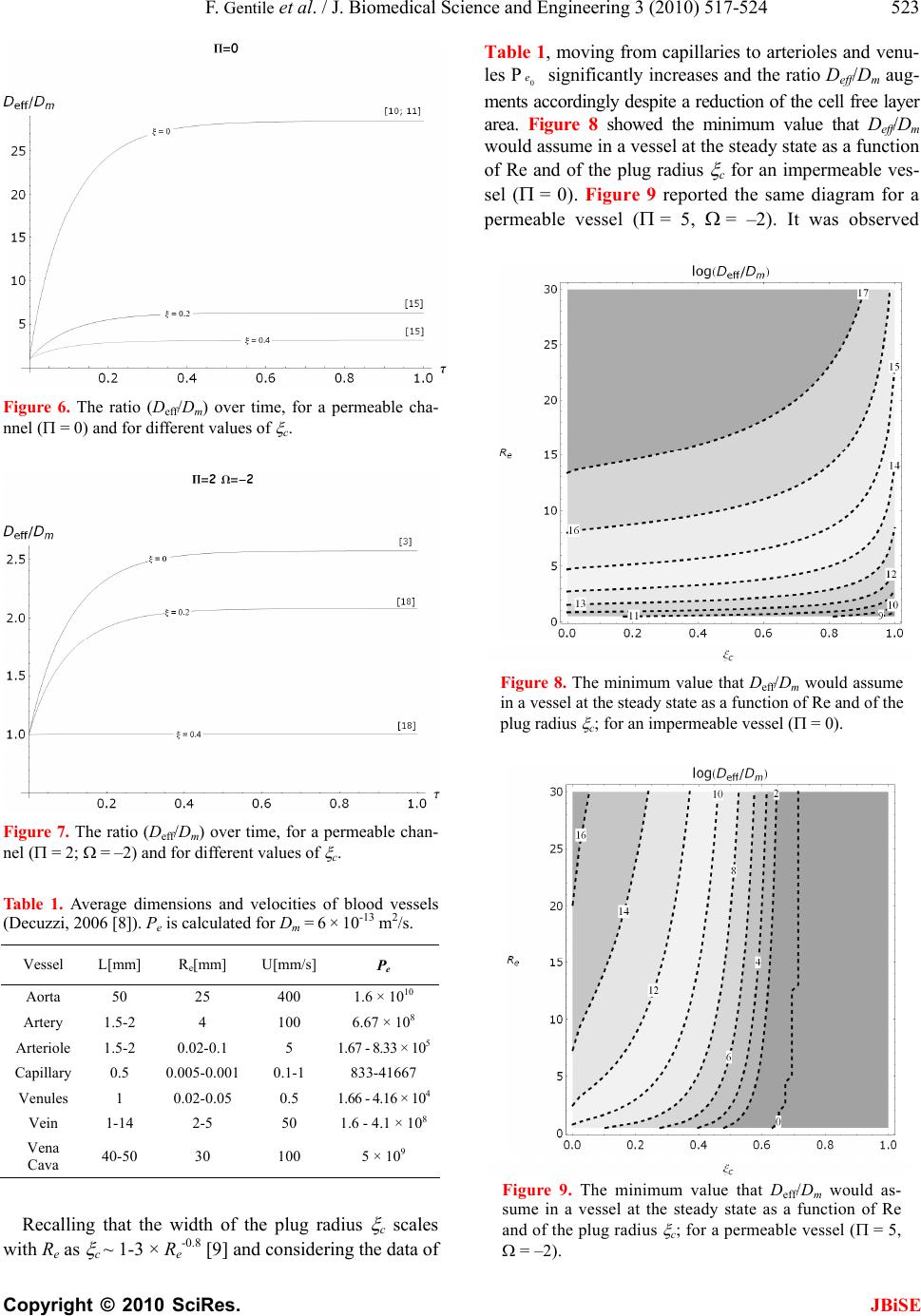 F. Gentile et al. / J. Biomedical Science and Engineering 3 (2010) 517-524 523 Copyright © 2010 SciRes. JBiSE Figure 6. The ratio (Deff/Dm) over time, for a permeable cha- nnel (= 0) and for different values of c. Figure 7. The ratio (Deff/Dm) over time, for a permeable chan- nel (= 2; = –2) and for different values of c. Table 1. Average dimensions and velocities of blood vessels (Decuzzi, 2006 [8]). Pe is calculated for Dm = 6 × 10-13 m2/s. Vessel ]mm[L ]mm[ e R ]s/mm[U Pe Aorta 50 25 400 1.6 × 10¹⁰ Artery 2-1.5 4 100 6.67 × 10⁸ Arteriole 2-1.5 0.1-0.02 5 1.67 - 8.33 × 10⁵ Capillary 0.5 0.001-0.005 1-0.1 41667 -833 Venules 1 0.05 -0.02 0.5 1.66 - 4.16 × 10⁴ Vein 14 -1 5-2 50 1.6 - 4.1 × 10⁸ Vena Cava 50 -40 30 100 5 × 10⁹ Recalling that the width of the plug radius c scales ith Re as c ~ 1-3 × Re -0.8 [9] and considering the data of g- morespce cell f layer are owednimulue thateff/Dm would assumea vessethe steatate an offlug radius c forpers- s0). e 9d the same d pe ve ( –t wa w Table 1, moving from capillaries to arterioles and venu- les P0 e significantly increases and the ratio Deff/Dm au ents acc a. Figure dingly d 8 sh ite a redu the mi tion of th m va ree D in l at dy ss a functio Re and o the p an immeable ve el (= Figur reporteiagram for a = 5, =2). Is observed ermeabl ssel Figure 8. The minimum value that Deff/Dm would assume in a vessel at the steady state as a function of Re and of the plug radius c; for an impermeable vessel (= 0). Figure 9. The minimum value that Deff/Dm would as- sume in a vessel at the steady state as a function of Re and of the plug radius c; for a permeable vessel (= 5, = –2). 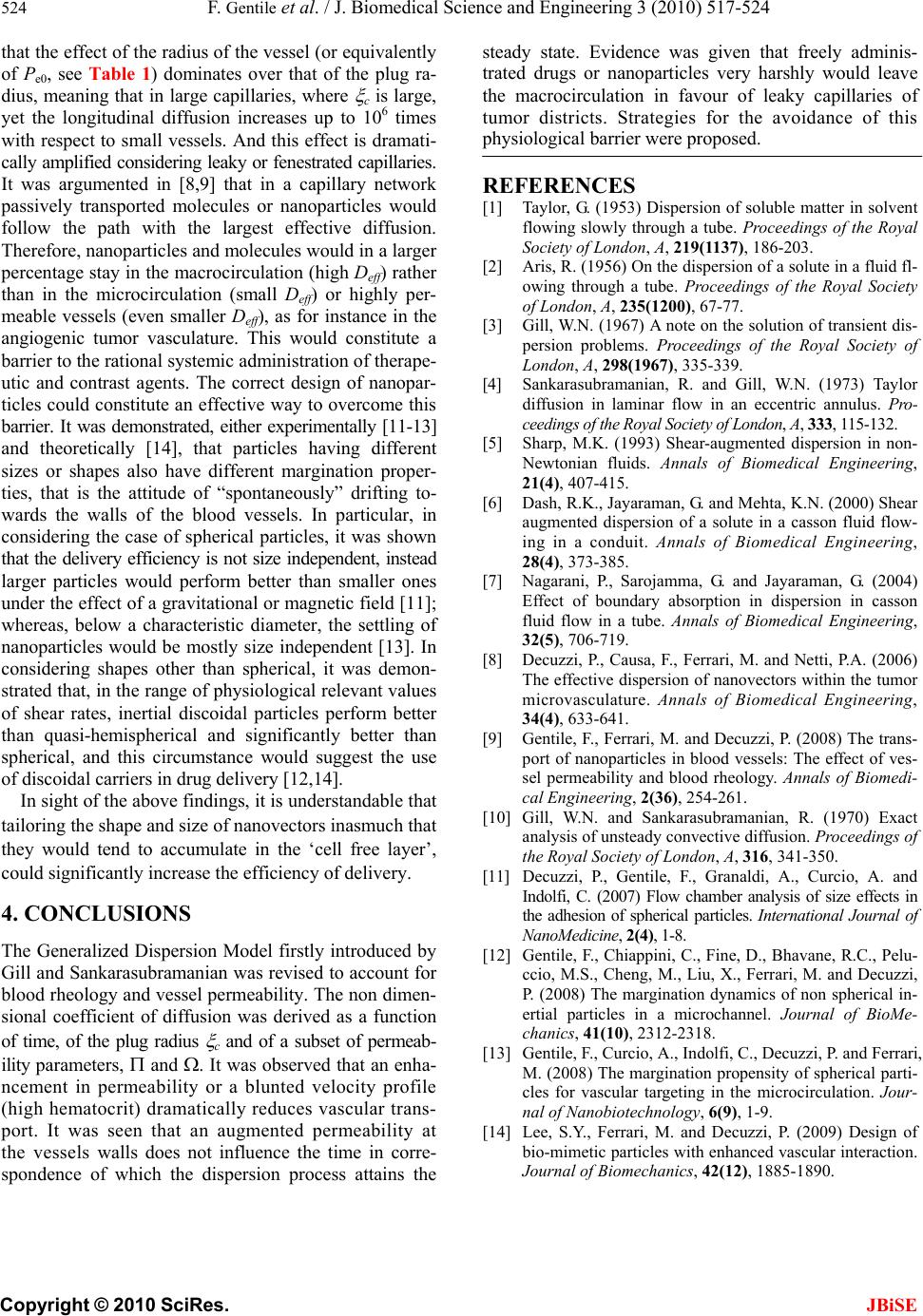 524 F. Gentile et al. / J. Biomedical Science and Engineering 3 (2010) 517-524 Copyright © 2010 SciRes. that the effect of the radius of the vessel (or equivalently of Pe0, see Table 1) dominates over that of the plug ra- dius, meaning that in large capillaries, where c is large, yet the longitudinal diffusion increases up to 106 times with respect to small vessels. And this effect is dramati- cally amplified considering leaky or fenestrated capillaries. It was argumented in [8,9] that in a capillary network passively transported molecules or nanoparticles would follow the path with the largest effective diffusion. Therefore, nanoparticles and molecules would in a larger percentage stay in the macrocirculation (high Deff) rather than in the microcirculation (small Deff) or highly per- meable vessels (even smaller Deff), as for instance in the angiogenic tumor vasculature. This would constitute a barrier to the rational systemic administration of therape- utic and contrast agents. The correct design of nanopar- ticles could constitute an effective way to overcome this barrier. It was demonstrated, either experimentally [11-13] and theoretically [14], that particles having differen si r- tie - wn ould leave th REFERENCES rsion of soluble matter in solvent Proceedings of the Royal ayaraman, G. (2004) be. Annals of Biomedical Engineering, JBiSE t zes or shapes also have different margination prope s, that is the attitude of “spontaneously” drifting to ards the walls of the blood vessels. In particular, i considering the case of spherical particles, it was shown that the delivery efficiency is not size independent, instead larger particles would perform better than smaller ones under the effect of a gravitational or magnetic field [11]; whereas, below a characteristic diameter, the settling of nanoparticles would be mostly size independent [13]. In considering shapes other than spherical, it was demon- strated that, in the range of physiological relevant values of shear rates, inertial discoidal particles perform better than quasi-hemispherical and significantly better than spherical, and this circumstance would suggest the use of discoidal carriers in drug delivery [12,14]. In sight of the above findings, it is understandable that tailoring the shape and size of nanovectors inasmuch that they would tend to accumulate in the ‘cell free layer’, could significantly increase the efficiency of delivery. 4. CONCLUSIONS The Generalized Dispersion Model firstly introduced by Gill and Sankarasubramanian was revised to account for blood rheology and vessel permeability. The non dimen- sional coefficient of diffusion was derived as a function of time, of the plug radius c and of a subset of permeab- ility parameters, and . It was observed that an enha- ncement in permeability or a blunted velocity profile (high hematocrit) dramatically reduces vascular trans- port. It was seen that an augmented permeability at the vessels walls does not influence the time in corre- spondence of which the dispersion process attains the steady state. Evidence was given that freely adminis- trated drugs or nanoparticles very harshly w e macrocirculation in favour of leaky capillaries of tumor districts. Strategies for the avoidance of this physiological barrier were proposed. [1] Taylor, G. (1953) Dispe flowing slowly through a tube. Society of London, A, 219(1137), 186-203. [2] Aris, R. (1956) On the dispersion of a solute in a fluid fl- owing through a tube. Proceedings of the Royal Society of London, A, 235(1200), 67-77. [3] Gill, W.N. (1967) A note on the solution of transient dis- persion problems. Proceedings of the Royal Society of London, A, 298(1967), 335-339. [4] Sankarasubramanian, R. and Gill, W.N. (1973) Taylor diffusion in laminar flow in an eccentric annulus. Pro- ceedings of the Royal Society of London, A, 333, 115-132. [5] Sharp, M.K. (1993) Shear-augmented dispersion in non- Newtonian fluids. Annals of Biomedical Engineering, 21(4), 407-415. [6] Dash, R.K., Jayaraman, G. and Mehta, K.N. (2000) Shear augmented dispersion of a solute in a casson fluid flow- ing in a conduit. Annals of Biomedical Engineering, 28(4), 373-385. [7] Nagarani, P., Sarojamma, G. and J Effect of boundary absorption in dispersion in casson fluid flow in a tu 32(5), 706-719. [8] Decuzzi, P., Causa, F., Ferrari, M. and Netti, P.A. (2006) The effective dispersion of nanovectors within the tumor microvasculature. Annals of Biomedical Engineering, 34(4), 633-641. [9] Gentile, F., Ferrari, M. and Decuzzi, P. (2008) The trans- port of nanoparticles in blood vessels: The effect of ves- sel permeability and blood rheology. Annals of Biomedi- cal Engineering, 2(36), 254-261. [10] Gill, W.N. and Sankarasubramanian, R. (1970) Exact analysis of unsteady convective diffusion. Proceedings of the Royal Society of London, A, 316, 341-350. [11] Decuzzi, P., Gentile, F., Granaldi, A., Curcio, A. and Indolfi, C. (2007) Flow chamber analysis of size effects in the adhesion of spherical particles. International Journal of NanoMedicine, 2(4), 1-8. [12] Gentile, F., Chiappini, C., Fine, D., Bhavane, R.C., Pelu- ccio, M.S., Cheng, M., Liu, X., Ferrari, M. and Decuzzi, P. (2008) The margination dynamics of non spherical in- ertial particles in a microchannel. Journal of BioMe- chanics, 41(10), 2312-2318. [13] Gentile, F., Curcio, A., Indolfi, C., Decuzzi, P. and Ferrari, M. (2008) The margination propensity of spherical parti- Jou cles for vascular targeting in the microcirculation. Jour- nal of Nanobiotechnology, 6(9), 1-9. [14] Lee, S.Y., Ferrari, M. and Decuzzi, P. (2009) Design of bio-mimetic particles with enhanced vascular interaction. rnal of Biomechanics, 42(12), 1885-1890. |