

Paper Menu >>
Journal Menu >>
 Psychology 2012. Vol.3, No.3, 289-295 Published Online March 2012 in SciRes (http://www.SciRP.org/journal/psych) http://dx.doi.org/10.4236/psych.2012.33041 Copyright © 2012 SciRes. 289 Understanding Word-of-Mouth in Counterfeiting Meei-Ying Lan1, Fangyi Liu1*, Cheng-Hsi Fang2, Tom M. Y. Lin1 1Department of Busines s A dministration, Natio n a l Taiwan University of Sci e nc e a nd Technology, Taipei, Chinese Taipei 2Department of Marketing a nd D is t ribution Management, Ching Yun University, Zhongl i C it y, Chinese Taipei Email: *[email protected] Received December 30th, 20 11; revised February 1st, 2012; accepted March 2 nd, 2012 Counterfeiting is a significant and growing problem in both growing and well developed countries. Since the promotion of counterfeits cannot use public media, it is interesting to investigate how people ex- change information and finally affect the sales of counterfeit. Although role of word-of-mouth (WOM) has been studied for many years for brand or well known products, limited attention has been given to ex- plore its role in counterfeiting. To further the understanding of this issue, the present study developed a self-report scale measuring consumer motivations for opinion seeking and giving in counterfeiting. We surveyed Indian and Taiwanese customers and found the following results: 1) WOM has significant role in locating counterfeit products; 2) WOM cannot considered as best purchasing driver; 3) Referral mar- keting does work and people share their opinion among strong tie; 4) The impact of PWOM is generally greater than NWOM; and 5) Most consumer share opinion that it is unethical to purchase counterfeit products. The authors then discuss the implications of this research and offers recommendations for mar- keters of brand products. Keywords: Counterfeiting; Word-of-Mouth; Tie Strength; Purchase Drivers Introduction Counterfeiting is a significant and growing problem world- wide, occurring both in less and well developed countries. In the USA economy, the cost of counterfeiting is estimated to be up to $200 billion per year (Chaudhry et al., 2005). Considering the countries worldwide, almost 5 percent of all products are counterfeit, according to the International Ant counterfeiting Coalition (IACC, 2005) and the International Intellectual Prop- erty Institute (IIPI, 2003). The global market for counterfeits today is estimated to exceed $600 billion, accounting for ap- proximately 7% of world trade (World Customs Organization 2004). Counterfeit products didn’t use any media advertisement still products can be sold in large quantities. Moreover, coun- terfeiting has also been linked to the growing global threats of narcotics, weapons, human trafficking, and terrorism (Thomas 2007). Consumers have a natural instinct to tell others about products they have purchased and services they have used and they usu- ally discuss their likes and dislikes with their friends and family about known brands. Base on researchers have examined the conditions under which consumers are likely to rely on others’ opinions to make a purchase decision, word-of-mouth (WOM) is expected to have much more influence, still we cannot find any research that mention any role of WOM on influencing consumer attitudes towards buying these products. Although role of WOM has been studied for many years for brand or well known products, limited attention has been given to explore the role of WOM in counterfeiting. Furthermore, there are other researchers who have worked on the power of word of mouth and its influence on purchase decision (e.g. Bansal & Voyer, 2000) still there is no research addressing the influence of word of mouth in the context of purchasing counterfeit products. This research on the role of WOM in counterfeiting is re- quired for five reasons. First, counterfeits do not use any media advertisement. So, how do people locate counterfeits? Does WOM have any significant role on locating counterfeits? Sec- ond, WOM is a powerful influence of consumer behavior. Do people recommend buying counterfeit products? Third, WOM is often the major reason for any product choice, but we do not yet understand how Positive WOM and Negative WOM con- tribute to the influence on buying counterfeits. Fourth, once product is counterfeit, what kind of WOM (positive/negative) has more powerful impact on purchase probability? Fifth, what factors can influence consumer evaluation of non-deceptive counterfeits? In the remainder of this paper, the methodology adopted for this investigation will be described. This will be followed by a presentation of the results of the investigation. The paper will conclude with a discussion of the outcomes of the survey. Literature Review Understandi ng Counterf e it ing Counterfeiting is a process which involves the production of copies which are identically packaged, including trademarks and labeling copies so as to seem to a consumer to be the genu- ine article (Key, 1990). Any unauthorized manufacturing of goods whose special characteristics are protected as intellectual property rights (trademarks, patents and copyrights) constitutes product counterfeiting (Cordell et al., 1996; Chaudhry et al., 2005). Counterfeit goods are illegal, low-priced, and often lower-quality replicas of products that typically possess high brand value (Lai & Zaichkowsky, 1999). *Corresponding author. Counterfeits are available quite extensively, and with a num-  M.-Y. LAN ET AL. ber of forms of deception. For some counterfeit brands, con- sumers do not know that they are not genuine when they are purchased called deceptive counterfeits while for others, con- sumers are fully aware that they are buying non-genuine brands known as non-deceptive counterfeits (Grossman & Shapiro, 1988). The quality of counterfeits varies according to product. Some counterfeit products are so good that even the brand owners are not able to distinguish them from genuine products without the help of laboratory tests, while others are very poor and easily distinguished. Attitude towards Counterfeits Consumer intentions to buy counterfeited products are de- pendent on the attitudes they have toward counterfeits, which in turn are more influenced by perceived risk, whether consumers have bought a counterfeit before, subjective norm, integrity, price-quality inference and personal gratification (Ashdown et al., 2011; Maltos et al., 2007). Consumers’ preferences for a counterfeit brand and the subsequent negative change in their preferences for the real brand are greater when their luxury brand attitudes serve a social-adjustive rather than a value- expressive function (Wilcox et al, 2009). When consumers have a social-adjustive attitude toward a product, they are motivated to consume it to gain approval in social situations. Conversely, attitudes serving a value expressive function (i.e., value-ex- pressive attitudes) help people communicate their central be- liefs, attitudes, and values to others (Katz, 1960). When con- sumers hold a value expressive attitude toward a product, they are motivated to consume it as a form of self-expression (Sny- der & De Bono, 1985). Social-adjustive attitudes toward luxury brands will motivate consumers to consume such products for form- or image-related reasons, whereas value expressive atti- tudes toward luxury brands will motivate them to consume such products for product function or, more specifically, quality- related reasons. Thus, compared with value-expressive attitudes, social-adjustive attitudes toward luxury brands should be asso- ciated with a greater preference for counterfeit brands because these are designed to look like luxury brands (i.e., high resem- blance in terms of product form) but are typically associated with lesser quality (i.e., low resemblance in terms of product function). Factors of Purchasing Counterfeits Previous research on purchasing counterfeits has connected with many factors, which Eisend and Schuchert-Guler (2006) classify into four categories. The first category labeled “person” includes demographic and psychographic variables, as well as attitudes toward counterfeiting. For example, consumers who purchase counterfeit products are of lower social status (Bloch et al., 1993; Peters & Rowat, 2011) and have more favorable attitudes toward counterfeiting (Penz & Stottinger, 2005). Re- search linking consumers’ beliefs about counterfeits to their purchase behavior (e.g., Gentry et al., 2006; Rabaglietti et al., 2011) also falls under this category. The second category fo- cuses on aspects of the product, such as price, uniqueness, and availability. Not surprisingly, consumers’ likelihood of buying a counterfeit brand is inversely related to the price of the genu- ine brand. The third and fourth categories refer to the social and cultural context in which the counterfeit purchase decision is made, ranging from cultural norms (Chang et al, 2011; Lai & Zaichkowsky, 1999) to the shopping environment (Leisen & Nill, 2001). For example, consumers are likely to purchase a counterfeit brand when they react more favorably to the shop- ping environment. Most of the authors who had written about counterfeiting focused on above mentioned factors. Understanding Word-of-Mouth WOM is defined as oral, person-to-person communication between a receiver and a communicator whom the receiver per- ceives as non-commercial, regarding a brand, product or service (Arndt, 1967). WOM communications is defined as informal communications directed at other consumers about the owner- ship, usage, or characteristics of particular goods and services and/or their sellers (Westbrook, 1987). The exchange of opin- ions among people about products and services has been widely researched during recent years. From a marketing perspective, WOM can be either positive or negative. Positive WOM occurs when good news testimoni- als and endorsements desired by the company are uttered. Negative WOM is the mirror image (Buttle, 1998). It has often been reported that WOM has a significant influence on con- sumers’ decisions to adopt a new product when WOM is posi- tive (Rogers, 2003; Sheth, 1971) and to switch from the product or brand when receiving negative information or rumors (Bone, 1992). Impact of WO M WOM has been shown to influence a variety of conditions: awareness, expectations, perceptions, attitudes, behavioral in- tentions and behavior (Buttle, 1998) and WOM was more im- portant than advertising in raising awareness of an innovation and in securing the decision to try the product (Sheth, 1971). Day (1971) inferred that this was due to source reliability and the flexibility of interpersonal communication. He computed that WOM was nine times as effective as advertising at con- verting unfavorable or neutral predispositions into positive attitudes. WOM has a more emphatic influence on the purchasing de- cision than other sources of influence (Mangold’s, 1987). This is perhaps because personal sources are viewed as more trust- worthy (Murray, 1991). In the industrial purchasing context, WOM influences expectations and perceptions during the in- formation search phase of the buying process and influences attitude during the pre-choice evaluation of alternative service providers (Lynn, 1987; Stock & Zinsner, 1987; Woodside et al., 1992). The influence of WOM on expectations has been re- ported that WOM communication have strongest impact on quality expectation (Webster, 1991; Zeithaml et al., 1993). Inference of Literature Review Based on Buttle’s research (Buttle 1998), we would expect that WOM is more powerful than advertising. This might be one of the reasons to sell counterfeits without using any adver- tizing media. But in counterfeit case, WOM is expected to play significant role, still no attempts have been taken in this field. Wilcox et al. (2009) provided convergent evidence that con- sumers’ desire for counterfeit brands rests on the extent to which such brands fulfill the social goals guiding their luxury brand preferences. Although he provided some evidence that influence consumer intention to purchase counterfeit products Copyright © 2012 SciRes. 290  M.-Y. LAN ET AL. but he didn’t mention any evidence of the role of WOM on in- fluencing consumer desire. Even if Wilcox et al. (2009) found one of the main reason (i.e. social-adjustive ) for buying counterfeit products which shows that consumer knows very well that the product is coun- terfeit and still buy it to adjust in the society. In order to adjust in the society one must feel comfortable of using the products. If counterfeit purchase is for social-adjustive purpose they will share their opinion in the society. Wilcox et al. didn’t mention anything about feedbacks or opinion sharing among counterfeit consumers. The earliest study on the effectiveness of WOM was survey based (Katz & Lazarsfeld, 1955) and was followed by more than 70 marketing studies, most of them also inferring WOM from self-reports in surveys (Godes & Mayzlin, 2004). Re- searchers have examined the conditions under which consumers are likely to rely on others’ opinions to make a purchase deci- sion, the motivations for different people to spread the word about a product, and the variation in strength of people’s influ- ence on their peers in WOM communications (Fang et al., 2011). Moreover, customers who self-report being acquired through WOM add more long-term value to the firm than cus- tomers acquired through traditional marketing channels (Vil- lanueva et al., 2008). Counterfeiting firms do not acquire any traditional marketing channel. Most of the information is ex- pected to pass through WOM. If the research views are true then consumers of counterfeit products should have long-term value to the counterfeiting firms. All the PWOM and NWOM research that has been discussed above are either focused on purchase of brand or well known products. Once the product is counterfeit, the impact of PWOM and NWOM may have different result. We will also try to find the impact of PWOM and NWOM in the context. Methods There could be many methods to understand the role of WOM on counterfeit products. One method is to measure Inter- net postings about brands and their subsequent sales perfor- mance (e.g., Godes & Mayzlin, 2004). East, Hammond and Lomax (2008) explained that there is problem with this method because there may be little correspondence between the content of consumer-generated media and face-to-face advice. One is not necessarily typical of the other, and the large amount of face-to-face advice is likely to be the dominant influence on consumption. A second method is to use laboratory experi- ments to investigate the response to information on familiar brands. This method is not suitable once we use counterfeit brand because the views on counterfeit products may vary dra- matically based on people culture, income level and society. Other techniques that may be used include role-play experi- ments and surveys. Since, there are many methods available, author found that survey is the best method that can explain the role of WOM in counterfeiting. By using survey method we can understand the power of WOM in counterfeiting as well as the impact of positive or negative word of mouth on counterfeits buying intention. This paper is preceded by reviews of relevant research and followed by a discussion of findings. The study was conducted in India and Taiwan. Asia is wit- nessing a spectacular rise in prosperity and a scurry among luxury fashion brands to enter or expand in these markets (Commuri 2009). For example, India stands second only to Singapore in the rise of its number of millionaires. Brands such as Brioni, Chanel, Escada, Fendi, Louis Vuitton, Valentino, Versace, and iphones, have all recently entered the Indian mar- ket, and others are reported to be actively considering such a move. At the same time, fashion brands encounter some of their worst abuse in Asia (Ibison, 2006). Both India and Taiwan have long histories of trafficking in counterfeits. The questionnaire were first developed in English for India and then translated into Chinese for Taiwan. There were 75 questionnaires from India and 1 questionnaire from Taiwan that was unusable and eliminated. Counterfeit mobile phone (for India) and counterfeit bag (for Taiwan) is used as a product category for this study. This choice was made because these products are widely avail- able in counterfeit form in both countries and was perceived to be a product that consumers buy after some thoughts. Questionnaires were delivered by hand as well as through email without using any incentives. It covered a range of issues, and the relevant questions are shown in Appendix A (English Version) and Appendix B (Chinese Version). The question- naires were basically categorized into six parts. In the first part, the respondents were asked whether they know any place to buy counterfeit p r oducts. If yes, we would like to know whether WOM has any significant role in locating counterfeit products. In the second part, the responded were asked to state their opinion and select reasons behind buying counterfeit products. In third and fourth part they were asked if they had received positive and negative advice in the last one year about counter- feit products. Whether they had received PWOM/NWOM or not they were asked to show their degree of change in their prospective of buying counterfeits before and after they receive PWOM/NWOM. The fifth part of the questionnaire was built to understand the attitude of the people towards counterfeit. It will make us understand the moral issues. The last and sixth part describes gender, age, education and income level of the re- spondent that may have some relevant relationship towards attitude and purchase of counterfeit after receiving WOM. The instrument adopted in the second and fifth part of the questionnaire comprising Likert-type five item scales with end- anchors (1 = strongly disagree, 5 = strongly agree). The other questions in part third and fourth allowed to establish: 1) how strongly expressed the advice was; 2) whether the communi- cator was close to or distant from the receiver; 3) whether the advice was about the counterfeits; 4) whether the advice was sought or not; and 5) how much advice on the category was given by the respondent. We also noted age and gender and income. All statistical analyses were conducted using SPSS version 19 (SPSS Inc, Chicago, Ill). Results were considered statistically significant if the two-tailed P value was <0.05. Results Role of WOM in Locating Counterfeits WOM provides the opportunity to products to share infor- mation in setting direct attention. Out of 170 valid respondent, 99 (58%) claimed that they have never bought counterfeits while 71 (42%) admitted that they have bought counterfeit products. Table 1 shows the results on sources of information in find- ing counterfeits location. 70.6% respondent said that they know the place because they had heard it from their friends or family. This shows that WOM is the main source of locating counter- feit products. It does not require any media channel, the infor- Copyright © 2012 SciRes. 291 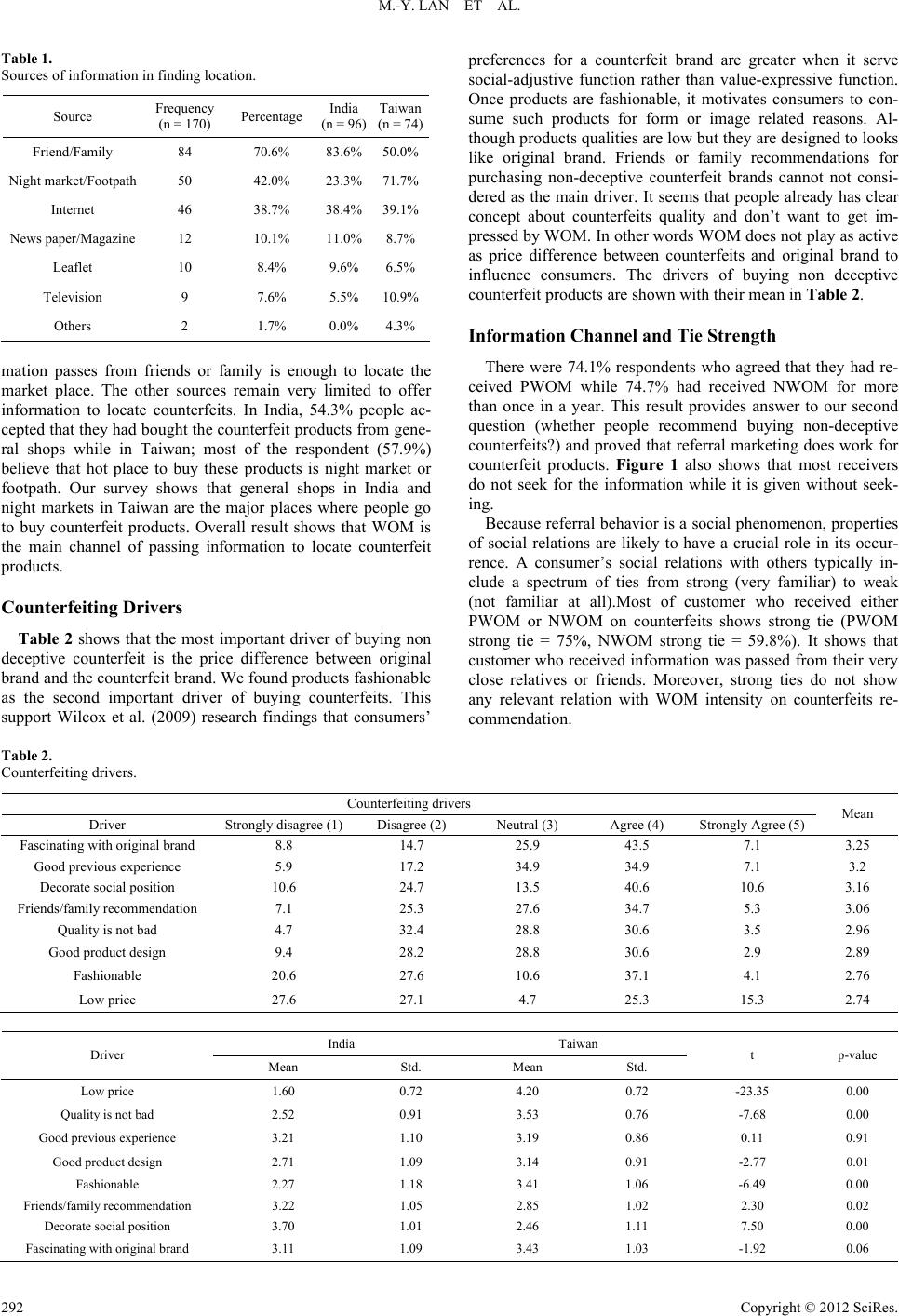 M.-Y. LAN ET AL. Copyright © 2012 SciRes. 292 Table 1. Sources of information in f inding location. Source Frequency (n = 170) Percentage India (n = 96)Taiwan (n = 74) Friend/Family 84 70.6% 83.6%50.0% Night market/Footpath 50 42.0% 23.3%71.7% Internet 46 38.7% 38.4%39.1% News paper/Magazine 12 10.1% 11.0%8.7% Leaflet 10 8.4% 9.6%6.5% Television 9 7.6% 5.5%10.9% Others 2 1.7% 0.0%4.3% mation passes from friends or family is enough to locate the market place. The other sources remain very limited to offer information to locate counterfeits. In India, 54.3% people ac- cepted that they had bought the counterfeit products from gene- ral shops while in Taiwan; most of the respondent (57.9%) believe that hot place to buy these products is night market or footpath. Our survey shows that general shops in India and night markets in Taiwan are the major places where people go to buy counterfeit products. Overall result shows that WOM is the main channel of passing information to locate counterfeit products. Counterfeiting Drivers Table 2 shows that the most important driver of buying non deceptive counterfeit is the price difference between original brand and the counterfeit brand. We found products fashionable as the second important driver of buying counterfeits. This support Wilcox et al. (2009) research findings that consumers’ preferences for a counterfeit brand are greater when it serve social-adjustive function rather than value-expressive function. Once products are fashionable, it motivates consumers to con- sume such products for form or image related reasons. Al- though products qualities are low but they are designed to looks like original brand. Friends or family recommendations for purchasing non-deceptive counterfeit brands cannot not consi- dered as the main driver. It seems that people already has clear concept about counterfeits quality and don’t want to get im- pressed by WOM. In other words WOM does not play as ac tive as price difference between counterfeits and original brand to influence consumers. The drivers of buying non deceptive counterfeit products are shown with their mean in Table 2. Information Channel and Tie Strength There were 74.1% respondents who agreed that they had re- ceived PWOM while 74.7% had received NWOM for more than once in a year. This result provides answer to our second question (whether people recommend buying non-deceptive counterfeits?) and proved that referral marketing does work for counterfeit products. Figure 1 also shows that most receivers do not seek for the information while it is given without seek- ing. Because referral behavior is a social phenomenon, properties of social relations are likely to have a crucial role in its occur- rence. A consumer’s social relations with others typically in- clude a spectrum of ties from strong (very familiar) to weak (not familiar at all).Most of customer who received either PWOM or NWOM on counterfeits shows strong tie (PWOM strong tie = 75%, NWOM strong tie = 59.8%). It shows that customer who received information was passed from their very close relatives or friends. Moreover, strong ties do not show any relevant relation with WOM intensity on counterfeits re- commendation. Table 2. Counterfeiting drivers. Counterfeiting drivers Driver Strongly disag ree (1) Disagree (2) Neutral (3) Agree (4) Strongly Agree (5) Mean Fascinating with original brand 8.8 14.7 25.9 43.5 7.1 3.25 Good previ ous experience 5.9 17.2 34.9 34.9 7.1 3.2 Decorate social position 10.6 24.7 13.5 40.6 10.6 3.16 Friends/family reco mmendation 7.1 25.3 27.6 34.7 5.3 3.06 Quality is not ba d 4.7 32.4 28.8 30.6 3.5 2.96 Good product design 9.4 28.2 28.8 30.6 2.9 2.89 Fashionable 20.6 27.6 10.6 37.1 4.1 2.76 Low price 27.6 27.1 4.7 25.3 15.3 2.74 India Taiwan Driver Mean Std. Mean Std. t p-value Low price 1.60 0.72 4.20 0.72 -23.35 0.0 0 Quality is not bad 2.52 0.91 3.53 0.76 -7.68 0.00 Good previous experience 3.21 1.10 3.19 0.86 0.11 0.91 Good pro duct design 2.71 1.09 3.14 0.91 -2.77 0.01 Fashionable 2.27 1.18 3.41 1.06 -6.49 0.00 Friends/family recommendation 3.22 1.05 2.85 1.02 2.30 0.02 Decorate social position 3.70 1.01 2.46 1.11 7.50 0.00 Fascinatin g with original bra nd 3.11 1.09 3.43 1.03 -1.92 0.06 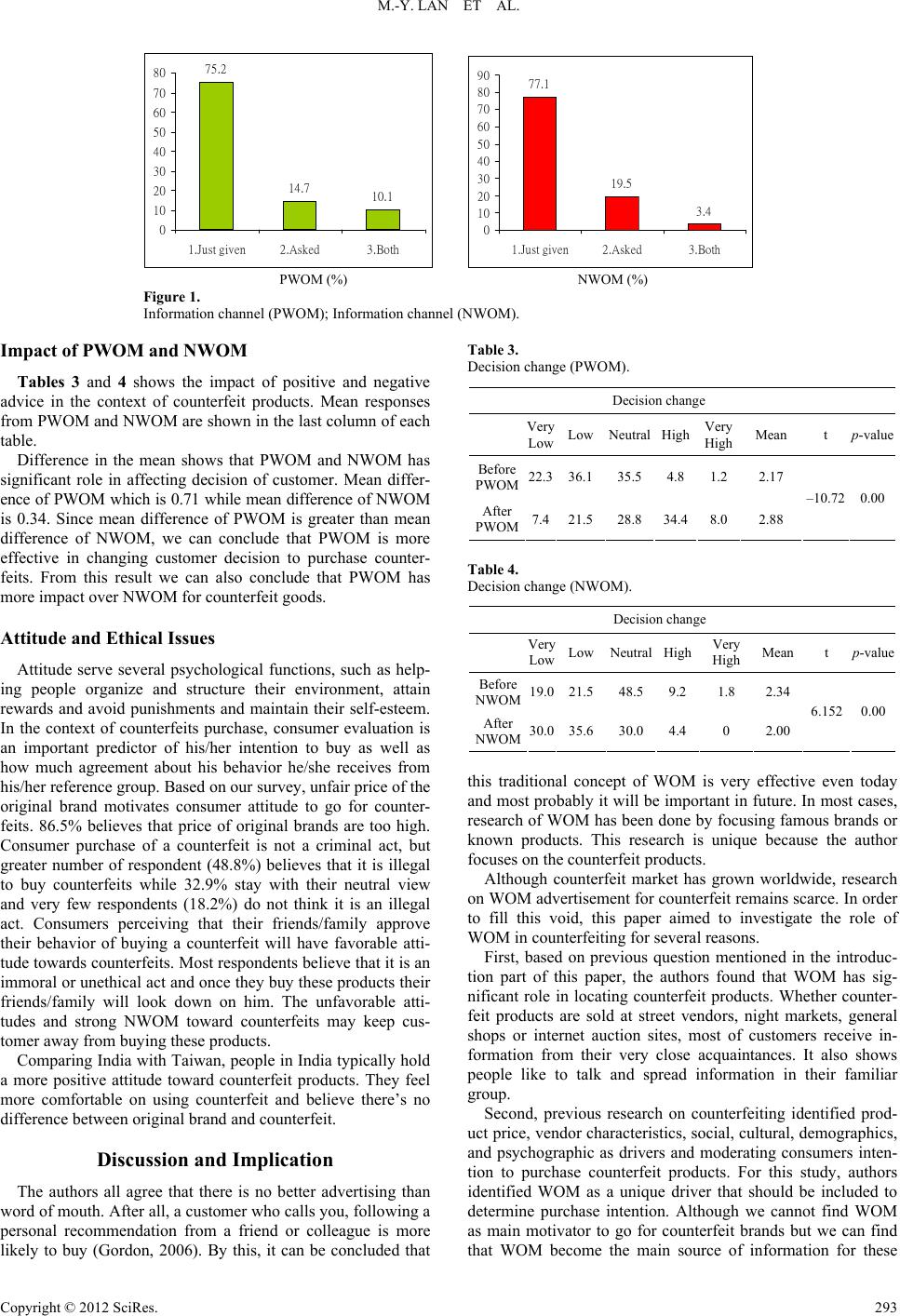 M.-Y. LAN ET AL. 75.2 14.7 10.1 0 10 20 30 40 50 60 70 80 1.Just given2.Asked3.Both 77.1 19.5 3.4 0 10 20 30 40 50 60 70 80 90 1.Just given2.Asked3.Both PWOM (%) NWOM (%) Figure 1. Information channel (PWOM); Information channel (NWOM). Impact of PWOM a nd NWOM Tables 3 and 4 shows the impact of positive and negative advice in the context of counterfeit products. Mean responses from PWOM and NWOM are shown in the last column of each table. Difference in the mean shows that PWOM and NWOM has significant role in affecting decision of customer. Mean differ- ence of PWOM which is 0.71 while mean differe nce of NWOM is 0.34. Since mean difference of PWOM is greater than mean difference of NWOM, we can conclude that PWOM is more effective in changing customer decision to purchase counter- feits. From this result we can also conclude that PWOM has more impact over NWOM for counterfeit goods. Attitude and Ethical Issues Attitude serve several psychological functions, such as help- ing people organize and structure their environment, attain rewards and avoid punishments and maintain their self-esteem. In the context of counterfeits purchase, consumer evaluation is an important predictor of his/her intention to buy as well as how much agreement about his behavior he/she receives from his/her reference group. Based on our survey, unfair price of the original brand motivates consumer attitude to go for counter- feits. 86.5% believes that price of original brands are too high. Consumer purchase of a counterfeit is not a criminal act, but greater number of respondent (48.8%) believes that it is illegal to buy counterfeits while 32.9% stay with their neutral view and very few respondents (18.2%) do not think it is an illegal act. Consumers perceiving that their friends/family approve their behavior of buying a counterfeit will have favorable atti- tude towards counterfeits. Most respondents believe that it is an immoral or unethical act and once they buy these products their friends/family will look down on him. The unfavorable atti- tudes and strong NWOM toward counterfeits may keep cus- tomer away from buying these products. Comparing India with Taiwan, people in India typically hold a more positive attitude toward counterfeit products. They feel more comfortable on using counterfeit and believe there’s no difference between original brand and counterfeit. Discussion and Implication The authors all agree that there is no better advertising than word of mouth. After all, a customer who calls you, following a personal recommendation from a friend or colleague is more likely to buy (Gordon, 2006). By this, it can be concluded that Table 3. Decision change (PWOM). Decision change Very Low LowNeutralHigh Very High Mean t p-value Before PWOM 22.336.135.54.8 1.2 2.17 After PWOM 7.4 21.528.834.4 8.0 2.88 –10.72 0.00 Table 4. Decision change (NWOM). Decision change Very Low LowNeutralHigh Very High Mean t p-value Before NWOM 19.021.548.59.2 1.8 2.34 After NWOM 30.035.630.04.4 0 2.00 6.152 0.00 this traditional concept of WOM is very effective even today and most probably it will be important in future. In most cases, research of WOM has been done by focusing famous brands or known products. This research is unique because the author focuses on the counterfeit products. Although counterfeit market has grown worldwide, research on WOM advertisement for counterfeit remains scarce. In order to fill this void, this paper aimed to investigate the role of WOM in counterfeiting for several reasons. First, based on previous question mentioned in the introduc- tion part of this paper, the authors found that WOM has sig- nificant role in locating counterfeit products. Whether counter- feit products are sold at street vendors, night markets, general shops or internet auction sites, most of customers receive in- formation from their very close acquaintances. It also shows people like to talk and spread information in their familiar group. Second, previous research on counterfeiting identified prod- uct price, vendor characteristics, social, cultural, demographics, and psychographic as drivers and moderating consumers inten- tion to purchase counterfeit products. For this study, authors identified WOM as a unique driver that should be included to determine purchase intention. Although we cannot find WOM as main motivator to go for counterfeit brands but we can find that WOM become the main source of information for these Copyright © 2012 SciRes. 293  M.-Y. LAN ET AL. kinds of products. There are a number of parties who want to put counterfeiting and piracy under control, or even totally terminate it. Unless the problem is understood clearly, the im- plications for genuine brands are clearly far-reaching. It is therefore important to understand the information channels of counterfeit brands. Once we discover how people think, react, speak and refer these products, it will help strategy maker to come with some effective majors to overcome the problem of counterfeiting. Third, purchase probability (in the direction indicated by the WOM) is limited by the Pre purchase probability, which could favor the impact of either PWOM or NWOM. East et al. (2008) discovered that PWOM has more impact than NWOM for brand purchase probability. Similarly, for counterfeit brand, PWOM has more impact than NWOM. It shows consumers perceive PWOM more reliable together with price priority. It also indicates that a place where there is more PWOM than NWOM for counterfeit brand, customer will go for counterfeits. We know that negative publicity is expected due to its low quality and negative acceptance in society. This might be the reason that NWOM has less impact on consumer. Understand- ing that PWOM is more effective than NWOM can help policy makers or managers of international brands to understand this trend and impl e ment best strategy to discourage consumpt ion of counterfeits and protect the original brand. At last, the customer who has bought counterfeit has more favorable attitudes when compared to those who have not. This is a real threat for the original brands, because once consumers experiment the counterfeit, they tend to have a favorable atti- tude and then have a positive behavioral intentions (Matos, Ituassu, & Rossi 2007). It is also connected with the ethical issues. In this case marketers should try to influence consumer personality, such as integrity, although this is the most difficult to change, encouraging consumers to consider values as re- sponsibility and h o n e s ty in their life. Limitation and Further Research Limitation This research was conducted with a sample of undergraduate and graduate students of National Taiwan University of Science and Technology in Taiwan, common people walking in mobile shops in New Delhi and some of the author’s online friends. There is little reason to believe that the relations of students’ behavioral responses to the functions served by their attitudes, including the extent to which they rely on their moral beliefs, will differ significantly from other relevant population. Al- though this sample frame helped control for some factors, it does not provide the ability to extrapolate to other populations. Counterfeiting is a worldwide problem. Survey with more di- vergent societies and countries might have been taken to under- stand complete role of WOM among people of diverse attitude. Despite the interesting findings, this study has taken into consideration of only two product category i.e. counterfeit bangs and counterfeit mobile phones. There are many categories of brands such as watches, camera, clothes etc. that has been coun- terfeited. Respondents may have bought a counterfeit product that is not mentioned in the survey questionnaire. Once we take more products category in consideration, people opinion and referral may change and may have different impact. The other possible limitation is the fact that the result might alter if author have adopted different methodology or different sample size. Considering, for example, that studies come from different sources, such as dissertations and papers published in journals of different quality, decisions related to design, data collection, and analyses could have an influence on the ob- tained results. Unfortunately, these factors are difficult, if not impossible, to control in the context of role of WOM in coun- terfeiting. Future Research Direction Future research should further discover the role of WOM in counterfeiting by integrating the prospective of the WOM re- cipient and WOM giver. An extension to this approach could include variables such as source credibility, source attractive- ness, message congruence, message repetition, situational in- volvement of the recipient and risk perceived by the recipient. These variables should be relevant in understanding how the received WOM influences customers’ propensity to pass the information to others about counterfeit products. Another aspect worthy of future investigation in the affective mechanisms related to the situations in which customer provide either positive or negative WOM based on their personal atti- tudes towards counterfeits. Correspondingly, future investiga- tions about WOM and its relationship with counterfeits satis- faction and loyalty could be extended to include specific emo- tions such as anger, regret, frustration, in order to understand the likely emotional and behavioral aspect of negative WOM when compared to the more cognitive positive WOM. Future research can also try to examine buying behavior based on referral regarding counterfeits products that have various degrees of involvement in more than two countries. Acknowledgements The authors would like to thank the anonymous referees for your valuable comments and suggestions, and the correspond- ing author Fangyi Liu can be contacted at: REFERENCES Arndt, J. (1967). Role of product—Related conversations in the diffu- sion of a new product. Journal o f Marketing Research, 4, 291-295. doi:10.2307/3149462 Ashdown, B. K., Gibbons, J. L., Hackathorn, J., & Harvey D. R. (2011). The influence of social and individual variables on ethnic attitudes in Guatemala. Psychology, 2, 78-84. doi:10.4236/psych.2011.22013 Bansal, H. S., & Voyer, P. A. (2000). Word-of-mouth processes within a services purchase decision context. Journal of Service Research, 3, 166-177. doi:10.1177/109467050032005 Bolfing, C. P. (1989). How do customers express dissatisfaction and what can service marketers do about it? Journal of Services Market- ing, 3, 5-23. Bone, P. F. (1992). Determinants of word-of-mouth communications during product consumption. Advances in Consumer Research, 19, 579-583. Buttle, F. A. (1998). Word of mouth: Understanding and managing re- ferral marketing. Journal of Strategic Marke ting, 6, 241-254. doi:10.1080/096525498346658 Chang, W. C., Osman, M. M., Tong, E. M. W., & Tan, D. (2011). Self- construal and subjective wellbeing in two ethnic communities in Sin- gapore. Psychology, 2, 63-70. doi:10.4236/psych.2011.22011 Chaudhry, P., Cordell, V., & Zimmerman, A. (2005). Modeling anti- counterfeiting strategies in response to protecting intellectual prop- Copyright © 2012 SciRes. 294  M.-Y. LAN ET AL. Copyright © 2012 SciRes. 295 erty rights in a global environment. Marketing Review , 5, 59-72. doi:10.1362/1469347053294832 Cordell, V., Wongtada, N., & JrKieschnick, R. L. (1996). Counterfeit purchase intentions: Role of lawfulness attitudes and product traits as determinants. Jou rnal of Busin ess Research, 35, 41-53. doi:10.1016/0148-2963(95)00009-7 Desatnick, R. L. (1987). Managing to keep the customer. San Francisco, CA: Jossey-Bass. East, R., Hammond, K., & Lomax, W. (2008). Measuring the impact of positive and negative word of mouth on brand purchase probability. International Journal of Research in Marketing, 25, 215-224. doi:10.1016/j.ijresmar.2008.04.001 Eisend, M., & Schuchert-Guler, P. (2006). Explaining counterfeit pur- chases: A review and preview. Academy of Marketing Science Re- view, 12, 1-22. Engel, J. F., Kegerris, R. J., & Blackwell, R. D.(1969). Word of mouth communication by the innovator. Journal of Marketing, 33, 15-19. doi:10.2307/1248475 Fang, C. H., Lin, T. M. Y., Liu, F., & Lin, Y. H. (2011). Product type and word of mouth: A dyadic perspective. Journal of Research in Interactive Marketing, 5, 189-202. doi:10.1108/17505931111187802 Gentry, J. W., Putrevu, S., & Clifford Shultz II (2006). The effects of counterfeiting on consumer search. Journal of Consumer Behavior, 5, 245-256. doi:10.1002/cb.176 Godes, D., & Mayzlin, D. (2004). Using online conversations to study word of mouth communication. Marketing Science, 23, 545-560. doi:10.1287/mksc.1040.0071 Gombeski, W. R., Fay, G. W, Niedzielski, K. R., & Weaver, F. J. (1988). Evaluating promotional strategy effectiveness for a health care orga- nization. Journal of Business Research, 17, 81-90. doi:10.1016/0148-2963(88)90025-2 Gould, S. J. (1989). Service opinion leadership: A management tool for service providers and product marketers Alike. Journal of Profes- sional Services Marketing, 4 , 3-14. doi:10.1300/J090v04n01_02 Grossman, G., & Shapiro, C. (1988). Foreign counterfeiting of status goods. Quarterly Journal of Economics, 103, 79-100. doi:10.2307/1882643 Grossman, G. M., & Shapiro C. (1988). Counterfeit—Product trade. American Economic Review, 78, 59-75. Hartline, M. D., & Jones, K. C. (1996). Employee performance cues in a hotel service environment: Influence on perceived service quality, value and word of mouth intentions. Journal of Business Research, 35, 207-215. doi:10.1016/0148-2963(95)00126-3 Hovland, C. I., Harvey, O. J., & Sherif, M. (1957). Assimilation and contrast effects in reactions to communication and attitude change. Journal of Abnormal and Social Psychology, 55, 244-25 2. doi:10.1037/h0048480 Johnson, J. D., & Meischke, S. F. (1991). Cancer Information: Women’s Source and Content Preferences. Journal of Health Care Marketing, 11, 37-44. Katz, D. (1960). The functional approach to the study of attitudes. Public Opinion Quarterly, 24, 163-204. doi:10.1086/266945 Katz, E., & Lazarsfeld, F. P. (1955). Personal influence; the part played by people in the flow of mass communications. Glencoe, IL: The Free Press. Kay, H. (1990). Fake’s progress. Management Today, 54 -59. Kotler, P., & Bloom, P. H. (1984). Marketing professional services. En- gelwood Cliffs, NJ: Prentice-Hall. Kenneth, G. D. B. (1985). Appeals to image and claims about quality: Understanding the psychology of advertising. Journal of Personality and Social Psychology, 49, 586-597. doi:10.1037/0022-3514.49.3.586 King, K. W., & Tinkhan, S. F. (1990). The learning and retention of outdoor advertising. Jou rn al o f Advertising Research, 29, 47-51. Lai, K. K., & Zaichkowsky J. L. (1999). Brand imitation: Do the chi- nese have different views? Asia Pacific Journal of Management, 16, 179-192. doi:10.1023/A:1015482707900 Lazarsfeld, P., Berelson, B., & Gaudet, H. (1948). The people’s choice. New York: Columbia University Press. Leisen, B., & Alexander, N. (2001). Combating product counterfeiting: an investigation into the likely effectiveness of a demand-oriented approach. In R. Krishnan, & M. Viswanathan (Eds.), AMA Winter Educators’ Conference Proceedings (Vol. 12, pp. 271-277), Chicago: American Marketing Association. Matos, C. A., Ituassu, C. T., & Rossi, C. A. V. (2007). Consumer atti- tudes towards counterfeits: A review and extension. Journal of Con- sumer Marketing, 24, 36-47. doi:10.1108/07363760710720975 McDonald, G., & Roberts, C. (1994). Product piracy: The problem that will not go away. Journal of Product and Brand Management, 3, 55-65. doi:10.1108/10610429410073129 Murray, K. B. (1991). A test of services marketing theory: Consumer information acq u i si t io n ac t i vi t ie s . Journal of Marketing, 55, 10-25. doi:10.2307/1252200 Peters, A., & Rowat, W. C. (2011). Associations between dispositional humility and social relationship quali ty. Psychology, 2, 155-161. doi:10.4236/psych.2011.23025 Penz, E., & Stottinger, B. (2005). Forget the “real” thing: Take the copy! An explanatory model for the volitional purchase of counterfeit products. In G. Menon, & A. R. Rao (Eds.), Advances in consumer research (Vol. 32, pp. 568-575). Duluth, MN: Association for Con- sumer Research. Rabaglietti, E., Liubicich, M. E., & Ciairano, S (2011). Gender differ- ences in the relationships between physical activity and the psycho- logical and physical self-reported condition of the elderly in a resi- dential care facility. Psychology, 2, 35-41. doi:10.4236/psych.2011.21006 Richins, M. L. (1983). Negative word-of-mouth by dissatisfied custo- mers: A pilot study. Journal of Marketing, 47, 68-78. doi:10.2307/3203428 Sen, S. (2009). Why do consumers buy counterfeit luxury brands? Jour- nal of Marketing Research, 46, 247-259. doi:10.1509/jmkr.46.2.247 Snyder, M. (1974). The self-monitoring of expressive behavior. Journal of Personality and Social Ps y c h o l o g y , 30, 526-537. doi:10.1037/h0037039 Strandvik, T. (1994). Tolerance zones in perceived service quality. Hel- sinki: Swedish School of Economics and Business Administration. Thomas, D. (2007). Terror’s purse strings. The New York Times, 30 August 2007, A23-A23. Tybout, A. M., Calder, B. J., & Sternthal, B. (1981). Using information processing theory to design marketing strategies. Journal of Market- ing Research, 18, 73-79. doi:10.2307/3151315 Villanueva, J., Shijin, Y., & Dominique, M. H. (2008). The impact of marketing-induced versus word-of-mouth customer acquisition on customer equity growth. Journal of Marketing Res ear ch, 45, 48-59. doi:10.1509/jmkr.45.1.48 Westbrook, R. A. (1987). Product/consumption based affective responses and post-purchase processes. Journal of Marketing Research, 24, 258-270. doi:10.2307/3151636 Wilcox, K., Kim, H. M., & Sen, S. (2009). Why do consumers buy counterfeit luxury brands? Journal of Marketing Research, 46, 247- 259. doi:10.1509/jmkr.46.2.247 Wilke, R. (1999). Brand imitation and its effects on innovation, compe- tition, and brand equity. Business Horizons, 42, 9-18. doi:10.1016/S0007-6813(99)80033-0 |