

Paper Menu >>
Journal Menu >>
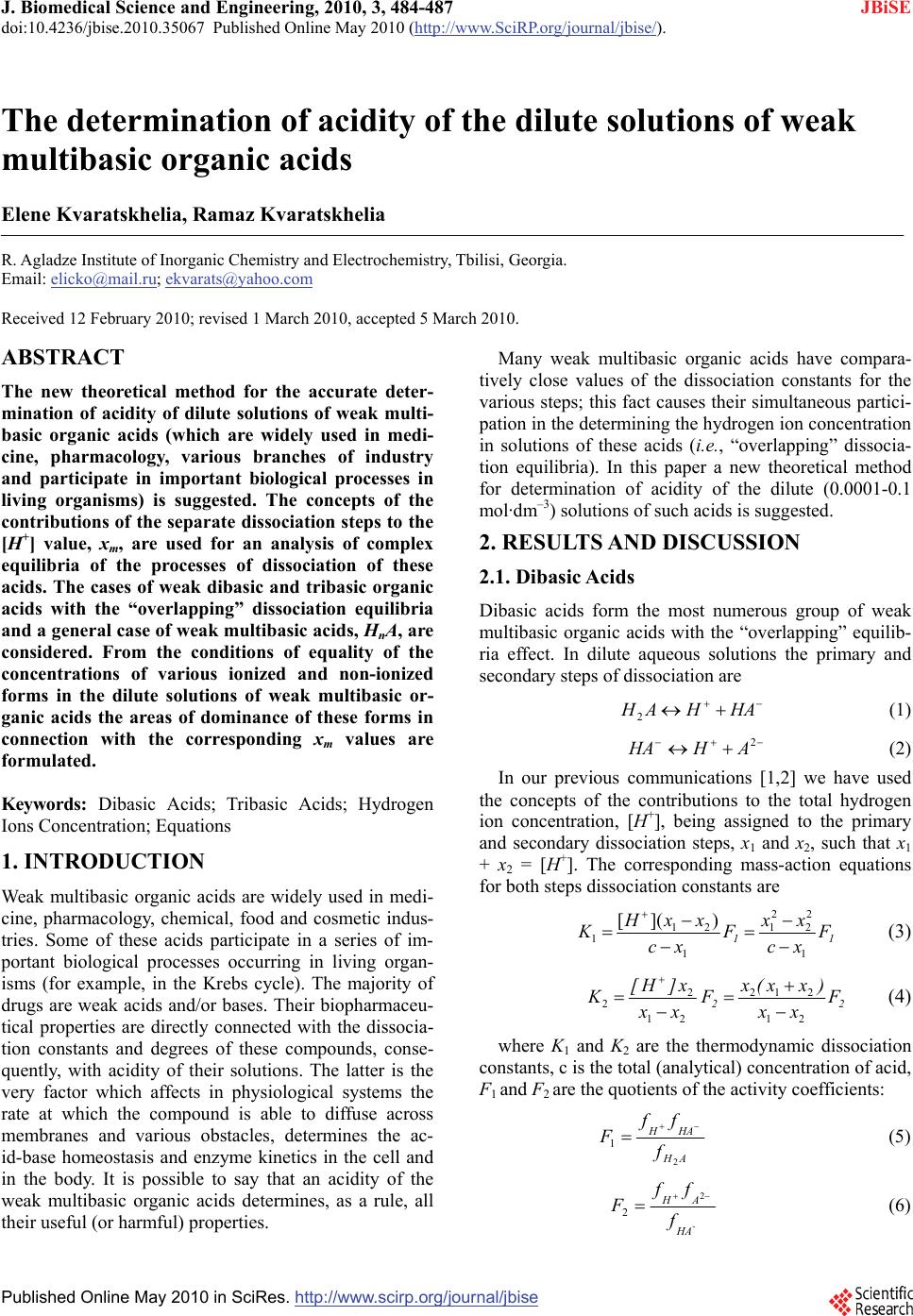 J. Biomedical Science and Engineering, 2010, 3, 484-487 doi:10.4236/jbise.2010.35067 Published Online May 2010 (http://www.SciRP.org/journal/jbise/ JBiSE ). Published Online May 2010 in SciRes. http://www.scirp.org/journal/jbise The determination of acidity of the dilute solutions of weak multibasic organic acids Elene Kvaratskhelia, Ramaz Kvaratskhelia R. Agladze Institute of Inorganic Chemistry and Electrochemistry, Tbilisi, Georgia. Email: [email protected]; [email protected] Received 12 February 2010; revised 1 March 2010, accepted 5 March 2010. ABSTRACT The new theoretical method for the accurate deter- mination of acidity of dilute solutions of weak multi- basic organic acids (which are widely used in medi- cine, pharmacology, various branches of industry and participate in important biological processes in living organisms) is suggested. The concepts of the contributions of the separate dissociation steps to the [H+] value, xm, are used for an analysis of complex equilibria of the processes of dissociation of these acids. The cases of weak dibasic and tribasic organic acids with the “overlapping” dissociation equilibria and a general case of weak multibasic acids, HnA, are considered. From the conditions of equality of the concentrations of various ionized and non-ionized forms in the dilute solutions of weak multibasic or- ganic acids the areas of dominance of these forms in connection with the corresponding xm values are formulated. Keywords: Dibasic Acids; Tribasic Acids; Hydrogen Ions Concentration; Equations 1. INTRODUCTION Weak multibasic organic acids are widely used in medi- cine, pharmacology, chemical, food and cosmetic indus- tries. Some of these acids participate in a series of im- portant biological processes occurring in living organ- isms (for example, in the Krebs cycle). The majority of drugs are weak acids and/or bases. Their biopharmaceu- tical properties are directly connected with the dissocia- tion constants and degrees of these compounds, conse- quently, with acidity of their solutions. The latter is the very factor which affects in physiological systems the rate at which the compound is able to diffuse across membranes and various obstacles, determines the ac- id-base homeostasis and enzyme kinetics in the cell and in the body. It is possible to say that an acidity of the weak multibasic organic acids determines, as a rule, all their useful (or harmful) properties. Many weak multibasic organic acids have compara- tively close values of the dissociation constants for the various steps; this fact causes their simultaneous partici- pation in the determining the hydrogen ion concentration in solutions of these acids (i.e., “overlapping” dissocia- tion equilibria). In this paper a new theoretical method for determination of acidity of the dilute (0.0001-0.1 mol·d m–3) solutions of such acids is suggested. 2. RESULTS AND DISCUSSION 2.1. Dibasic Acids Dibasic acids form the most numerous group of weak multibasic organic acids with the “overlapping” equilib- ria effect. In dilute aqueous solutions the primary and secondary steps of dissociation are HAHAH2 (1) 2 AHHA (2) In our previous communications [1,2] we have used the concepts of the contributions to the total hydrogen ion concentration, [H+], being assigned to the primary and secondary dissociation steps, x1 and x2, such that x1 + x2 = [H+]. The corresponding mass-action equations for both steps dissociation constants are 11 F xc xx F xc xxH K 1 2 2 2 1 1 21 1 )]([ (3) 22 F xx )xx(x F xx x]H[ K 21 212 21 2 2 (4) where K1 and K2 are the thermodynamic dissociation constants, c is the total (analytical) concentration of acid, F1 and F2 are the quotients of the activity coefficients: AH HAH f ff F 2 1 (5) - HA AH f ff F 2 2 (6) 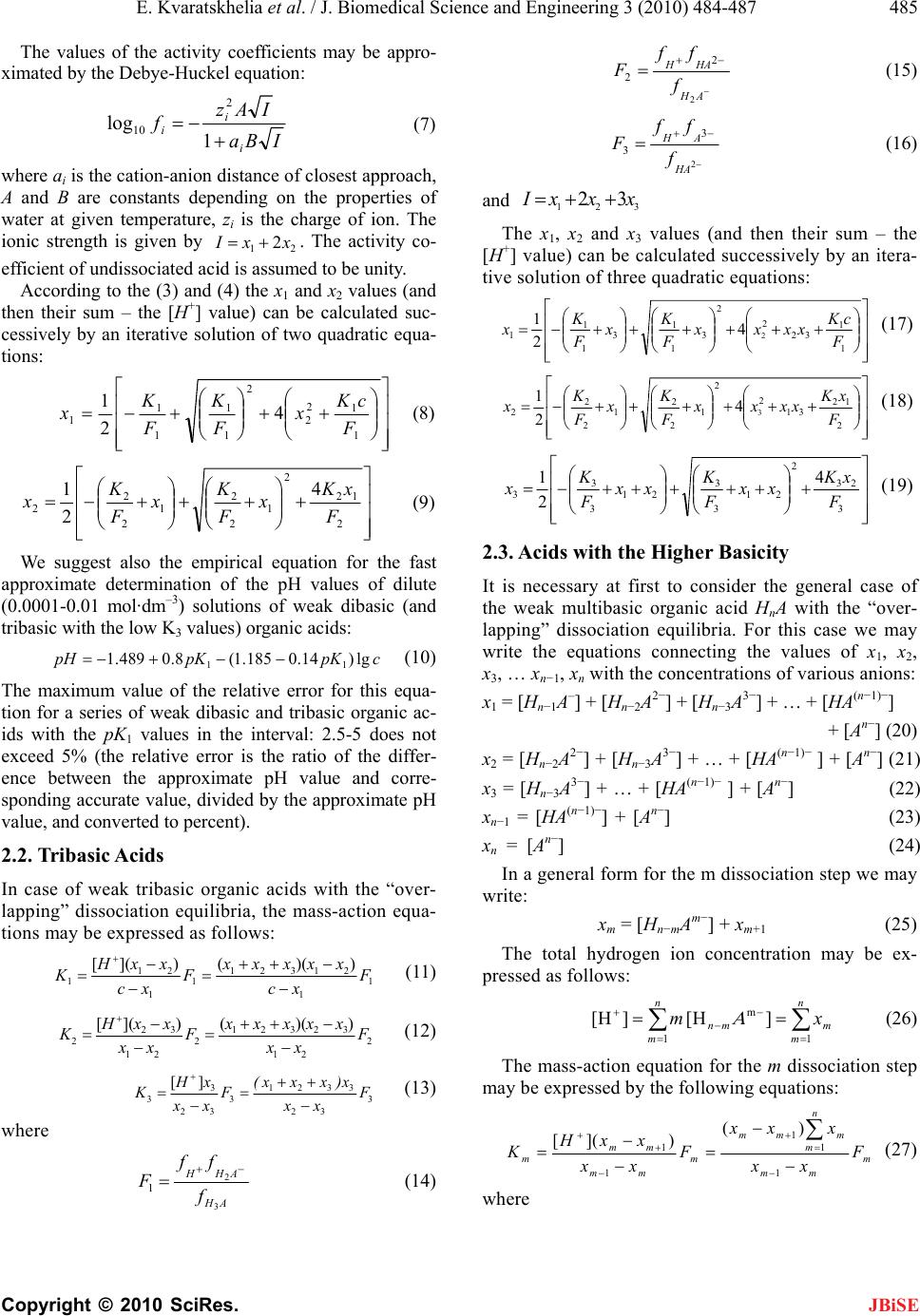 E. Kvaratskhelia et al. / J. Biomedical Science and Engineering 3 (2010) 484-487 485 Copyright © 2010 SciRes. JBiSE The values of the activity coefficients may be appro- ximated by the Debye-Huckel equation: IBa IAz f i i i 1 log 2 10 (7) where ai is the cation-anion distance of closest approach, A and B are constants depending on the properties of water at given temperature, zi is the charge of ion. The ionic strength is given by . The activity co- efficient of undissociated acid is assumed to be unity. 212xxI According to the (3) and (4) the x1 and x2 values (and then their sum – the [H+] value) can be calculated suc- cessively by an iterative solution of two quadratic equa- tions: 1 1 2 2 2 1 1 1 1 14 2 1 F cK x F K F K x (8) 2 12 2 1 2 2 1 2 2 2 4 2 1 F xK x F K x F K x (9) We suggest also the empirical equation for the fast approximate determination of the pH values of dilute (0.0001-0.01 mol·dm–3) solutions of weak dibasic (and tribasic with the low K3 values) organic acids: cpKpKpH lg)14.0185.1(8.0489.1 11 (10) The maximum value of the relative error for this equa- tion for a series of weak dibasic and tribasic organic ac- ids with the pK1 values in the interval: 2.5-5 does not exceed 5% (the relative error is the ratio of the differ- ence between the approximate pH value and corre- sponding accurate value, divided by the approximate pH value, and converted to percent). 2.2. Tribasic Acids In case of weak tribasic organic acids with the “over- lapping” dissociation equilibria, the mass-action equa- tions may be expressed as follows: 1 1 21321 1 1 21 1 ))(()]([ F xc xxxxx F xc xxΗ Κ (11) 2 21 32321 2 21 32 2 ))(()]([F xx xxxxx F xx xxΗ Κ (12) 31233 33 23 23 []Ηx(xxx)x Κ3 F F xx xx (13) where AH AHH f ff F 3 2 1 (14) AH HAH f ff F 2 2 2 (15) 2 3 3 HA AH f ff F (16) and 321 32 xxxI The x1, x2 and x3 values (and then their sum – the [H+] value) can be calculated successively by an itera- tive solution of three quadratic equations: 1 1 32 2 2 3 1 1 3 1 1 12 4 2 1 F cK xxxx F K x F K x (17) 2 12 31 2 2 1 2 2 1 2 2 23 4 2 1 F xK xxxx F K x F K x (18) 3 23 2 21 3 3 21 3 3 3 4 2 1 F xK xx F K xx F K x (19) 2.3. Acids with the Higher Basicity It is necessary at first to consider the general case of the weak multibasic organic acid HnA with the “over- lapping” dissociation equilibria. For this case we may write the equations connecting the values of x1, x2, x3, … xn−1, xn with the concentrations of various anions: x1 = [Hn−1A–] + [Hn−2A2−] + [Hn−3A3−] + … + [HA(n−1)−] + [An−] (20) x2 = [Hn−2A2−] + [Hn−3A3−] + … + [HA(n−1)− ] + [An−] (21) x3 = [Hn−3A3−] + … + [HA(n−1)− ] + [An−] (22) xn−1 = [HA(n−1)−] + [An−] (23) xn = [An−] (24) In a general form for the m dissociation step we may write: xm = [Hn−mAm−] + xm+1 (25) The total hydrogen ion concentration may be ex- pressed as follows: n m n m mmn x m 11 m]Η[]H[ (26) The mass-action equation for the m dissociation step may be expressed by the following equations: m mm n m mmm m mm mm mF xx xxx F xx xxΗ Κ 1 1 1 1 1 )( )]([ (27) where 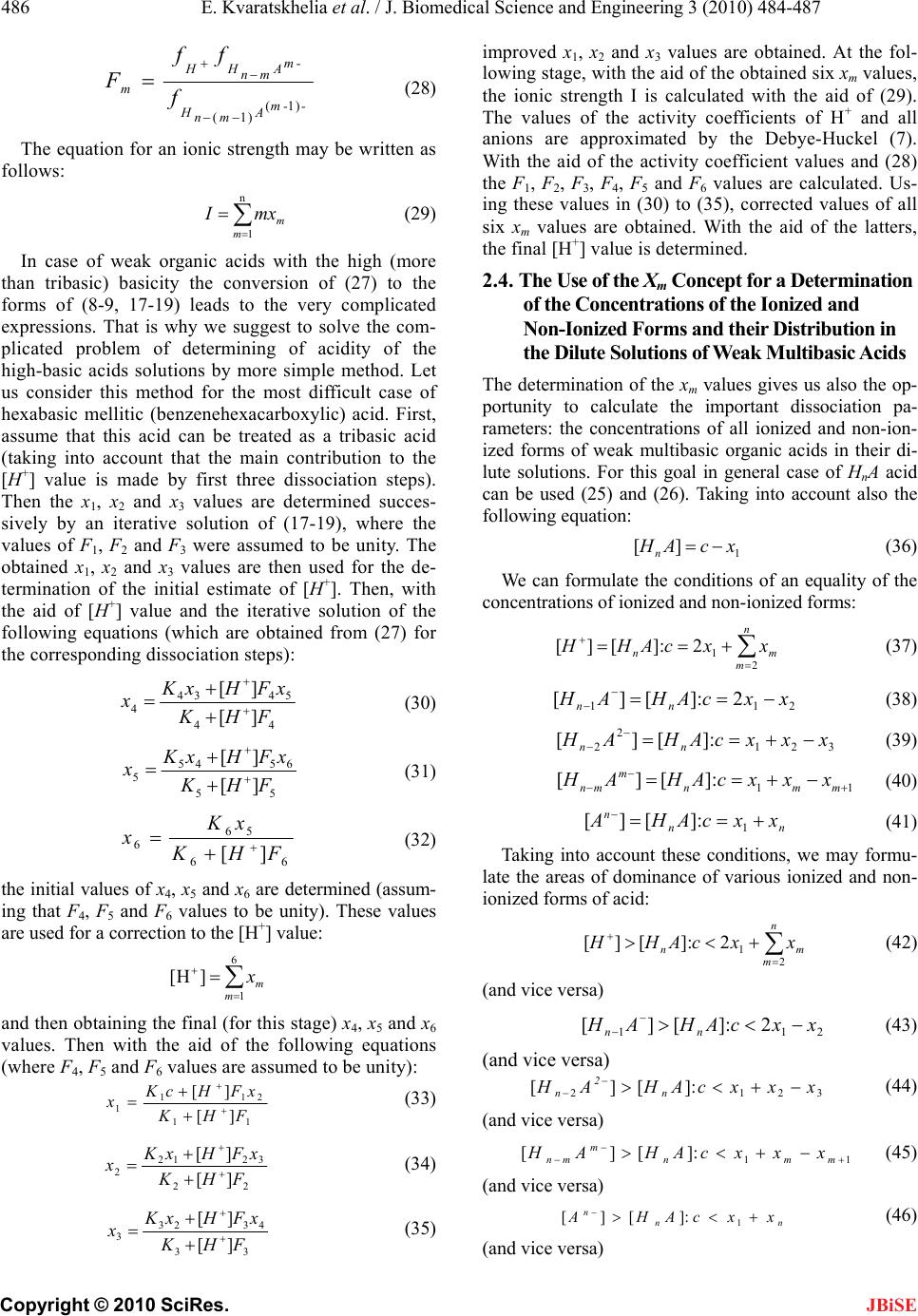 486 E. Kvaratskhelia et al. / J. Biomedical Science and Engineering 3 (2010) 484-487 Copyright © 2010 SciRes. JBiSE --m A mn H -m A mn HH mf ff F )1( )1( (28) The equation for an ionic strength may be written as follows: n 1m m mxI (29) In case of weak organic acids with the high (more than tribasic) basicity the conversion of (27) to the forms of (8-9, 17-19) leads to the very complicated expressions. That is why we suggest to solve the com- plicated problem of determining of acidity of the high-basic acids solutions by more simple method. Let us consider this method for the most difficult case of hexabasic mellitic (benzenehexacarboxylic) acid. First, assume that this acid can be treated as a tribasic acid (taking into account that the main contribution to the [H+] value is made by first three dissociation steps). Then the x1, x2 and x3 values are determined succes- sively by an iterative solution of (17-19), where the values of F1, F2 and F3 were assumed to be unity. The obtained x1, x2 and x3 values are then used for the de- termination of the initial estimate of [H+]. Then, with the aid of [H+] value and the iterative solution of the following equations (which are obtained from (27) for the corresponding dissociation steps): 44 5434 4][ ][ FHK xFHxK x (30) 55 6545 5][ ][ FHK xFHxK x (31) 66 56 6][ FHK xK x (32) the initial values of x4, x5 and x6 are determined (assum- ing that F4, F5 and F6 values to be unity). These values are used for a correction to the [H+] value: 6 1 ]H[ m m x and then obtaining the final (for this stage) x4, x5 and x6 values. Then with the aid of the following equations (where F4, F5 and F6 values are assumed to be unity): 11 211 1][ ][ FHK xFHcK x (33) 22 3212 2][ ][ FHK xFHxK x (34) 33 4323 3][ ][ FHK xFHxK x (35) improved x1, x2 and x3 values are obtained. At the fol- lowing stage, with the aid of the obtained six xm values, the ionic strength I is calculated with the aid of (29). The values of the activity coefficients of H+ and all anions are approximated by the Debye-Huckel (7). With the aid of the activity coefficient values and (28) the F1, F2, F3, F4, F5 and F6 values are calculated. Us- ing these values in (30) to (35), corrected values of all six xm values are obtained. With the aid of the latters, the final [H+] value is determined. 2.4. The Use of the Xm Concept for a Determination of the Concentrations of the Ionized and Non-Ionized Forms and their Distribution in the Dilute Solutions of Weak Multibasic Acids The determination of the xm values gives us also the op- portunity to calculate the important dissociation pa- rameters: the concentrations of all ionized and non-ion- ized forms of weak multibasic organic acids in their di- lute solutions. For this goal in general case of HnA acid can be used (25) and (26). Taking into account also the following equation: 1 ][ xcAHn (36) We can formulate the conditions of an equality of the concentrations of ionized and non-ionized forms: n m mn xxcAHH 2 1 2]:[][ (37) 211 2]:[][ xxcAHAH nn (38) 321 2 2]:[][ xxxcAHAH nn (39) 11 ]:[][ mmn m mnxxxcAHAH (40) nn nxxcAHA 1 ]:[][ (41) Taking into account these conditions, we may formu- late the areas of dominance of various ionized and non- ionized forms of acid: n m mn xxcAHH 2 1 2]:[][ (42) (and vice versa) 211 2]:[][ xxcAHAH nn (43) (and vice versa) 3212 ]:[][ xxxcAHAH n 2 n (44) (and vice versa) 11 ]:[][ mmn m mnxxxcAHAH (45) (and vice versa) nn nxxcAHA 1 ]:[][ (46) (and vice versa) 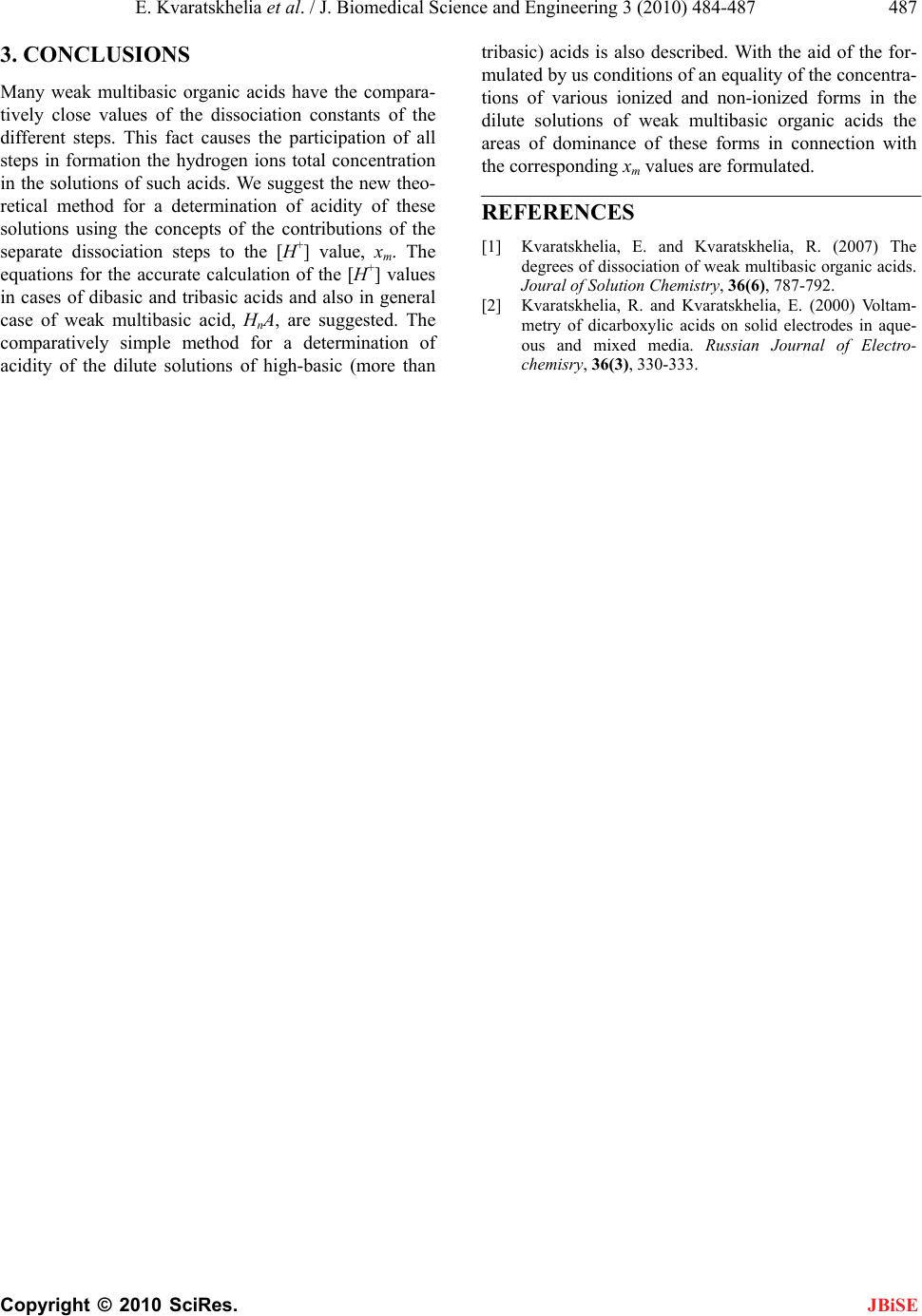 E. Kvaratskhelia et al. / J. Biomedical Science and Engineering 3 (2010) 484-487 487 Copyright © 2010 SciRes. 3. CONCLUSIONS Many weak multibasic organic acids have the compara- tively close values of the dissociation constants of the different steps. This fact causes the participation of all steps in formation the hydrogen ions total concentration in the solutions of such acids. We suggest the new theo- retical method for a determination of acidity of these solutions using the concepts of the contributions of the separate dissociation steps to the [H+] value, xm. The equations for the accurate calculation of the [H+] values in cases of dibasic and tribasic acids and also in general case of weak multibasic acid, HnA, are suggested. The comparatively simple method for a determination of acidity of the dilute solutions of high-basic (more than tribasic) acids is also described. With the aid of the for- mulated by us conditions of an equality of the concentra- tions of various ionized and non-ionized forms in the dilute solutions of weak multibasic organic acids the areas of dominance of these forms in connection with the corresponding xm values are formulated. REFERENCES [1] Kvaratskhelia, E. and Kvaratskhelia, R. (2007) The degrees of dissociation of weak multibasic organic acids. Joural of Solution Chemistry, 36(6), 787-792. [2] Kvaratskhelia, R. and Kvaratskhelia, E. (2000) Voltam- metry of dicarboxylic acids on solid electrodes in aque- ous and mixed media. Russian Journal of Electro- chemisry, 36(3), 330-333. JBiSE |