

Paper Menu >>
Journal Menu >>
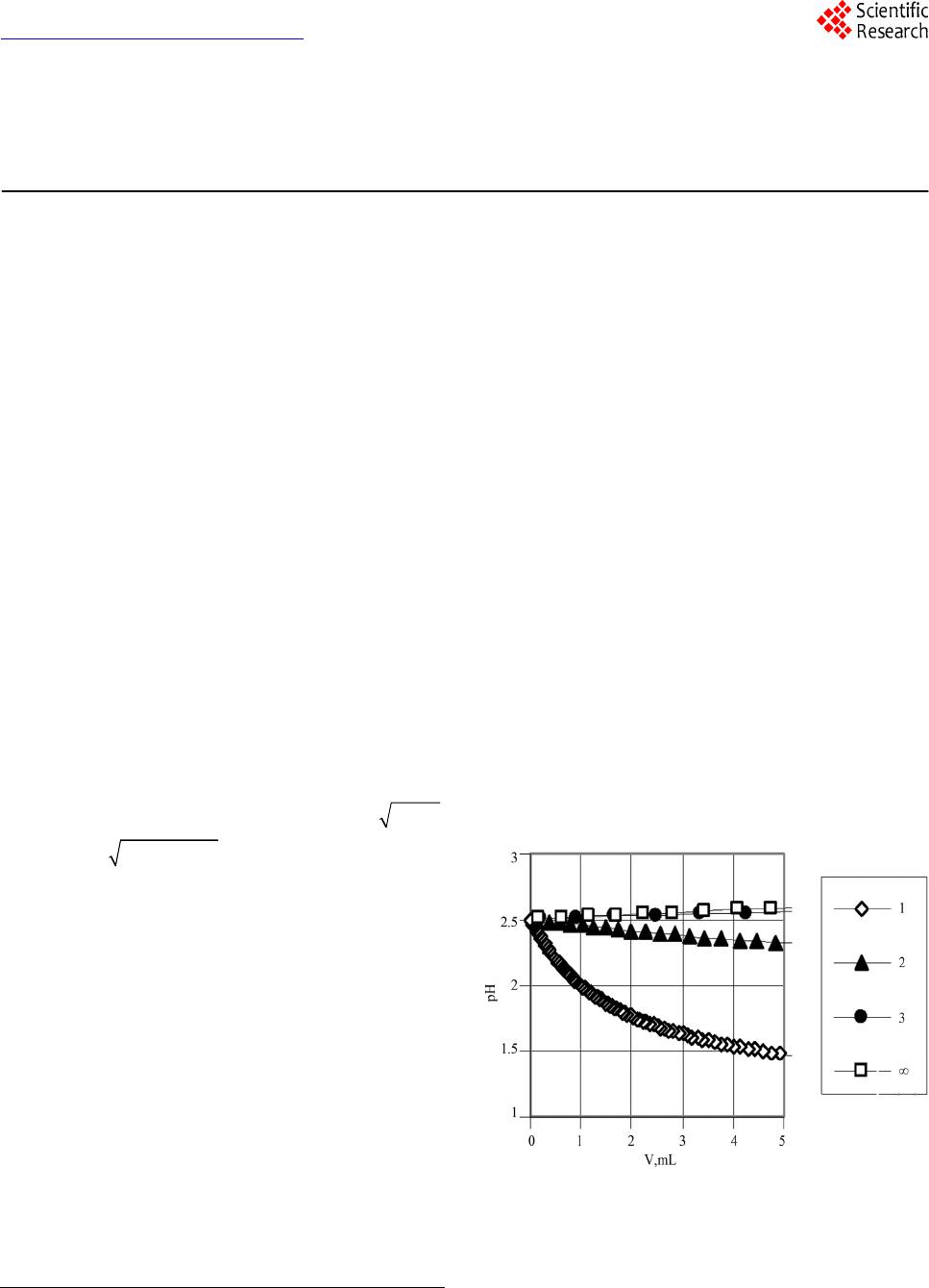 Journal of Analytical Sciences, Methods and Instrumentation, 2012, 2, 1-4 http://dx.doi.org/10.4236/jasmi.2012.21001 Published Online March 2012 (http://www.SciRP.org/journal/jasmi) 1 Formulation of the System of Isohydric Solutions Tadeusz Michałowski1*, Agustin G. Asuero2 1Faculty of Engineering and Chemical Technology, Technical University of Cracow, Kraków, Poland; 2Department of Analytical Chemistry, The University of Seville, Seville, Spain. Email: *[email protected] Received November 6th, 2011; revised November 30th, 2011; accepted December 22nd, 2011 ABSTRACT The isohydricity (pH constancy) as the property referred to mixtures of acids or bases, is illustrated on a simple example of the solutions: HL (C0, mol/L) and HL (C mol/L) mixed according to titrimetric mode (pH titration). A new derivation of the Michałowski formula 1 2 010 p K CCC expressing this property is presented, and its applicability for determi- nation of pK1 = – logK1 value is indicated. The principle of the isohydric method of pK1 determination is also outlined. Keywords: Isohydric Solutions; pH Titration 1. Introduction The term “isohydric” refers to solutions of the same hy- drogen-ion concentration. According to Arrhenius’ state- ment [1], expressed in more contemporary terms, “if two solutions of the same pH are mixed, pH of the mixture is unchanged, regardless the composition of the solutions”. This statement is not valid, however, when referred on any pair of electrolytic systems. To prove it, let us take, for example, the pair of solu- tions: C1 = 10–2.5 ≈ 0.003 mol/L HCN (pK1 = 9.2) and C2 = 1 mol/L AgNO3 ( = 2.3 for Ag+ + OH– = AgOH) OH 1 log K [2]. From the approximate formulae: 11 H CK and OH 21 H W CK K we get pH = 5.85, for both solutions. However, as were stated in [3], silver ions when added into HCN solution act as a strong acid, gen- erating protons mainly in the complexation reaction Ag+ + 2HCN = 2 + 2H+, and pH of the mixture drops abruptly. So, the isohydricity property is limited to the systems where only acid-base equilibria are involved. This property was formulated first by Michałowski [4] for different pairs of acid-base systems, then generalized on more complex mixtures of acid-base systems, and extended on mixtures containing basal salts and binary- solvent systems [5]. Moreover, the isohydricity concept was the basis for a very sensitive method of determina- tion of dissociation constants values [4,5]. AgCN The present article intends to familiarize the readers with this interesting concept [6] that is in some relevance with buffering action [7,8] and pH-static titration [9,10] principles. Isohydricity concept is also referred to acid- base homeostasis in living organisms [11]. 2. Principle of Isohydricity It is usually stated that an addition of a strong acid HB (C mol/L) into a weak acid HL (C0 mol/L) decreases pH value of the resulting solution and, consequently, shifts (retracts) the HL dissociation, according to Le Chatel- ier’s principle. As results from Figure 1, the decrease in pH value (dpH/dV < 0) and then retracting the dissocia- tion of HL occurs at higher C values, whereas the dilu- tion effect, expressed by dpH/dV > 0, predominates at lower C-values. The related effect depends, however, on the HL strength, expressed by its dissociation constant K1 value. Figure 1. The effect of addition of V mL of C = 10–pC mol/L strong acid HB into V0 = 10 mL of C0 = 0.1 mol/L weak acid (pK1 = 4.0). The titration curves V = V0·(α – C0/z)/(C – α), where α = 10–pH – 10pH–14 , z = + 1 are plotted for different pC = – logC values indicated at the corresponding curves; pC = 1, 2, 3, ∞. 1pH 10pK *Corresponding author. Copyright © 2012 SciRes. JASMI  Formulation of the System of Isohydric Solutions 2 1 [H][L] [HL] K (1) and on the relative concentrations (C0, C) of both acids, i.e. HL and HB. Under special conditions, expressed by the set of (C0, C, pK1) values [4], pH = const (i.e., dpH/dV = 0) when mixing the solutions in different pro- portions; it is just the subject of the present note. 3. Formulation of the Isohydricity Concept The simplest system of isohydric solutions is composed of a strong monoprotic acid HB and a weak monoprotic acid HL, characterized by pK1 = – logK1 value, where K1 is expressed by Equation (1). In order to derive the rela- tion for the isohydricity concept, let us consider the titra- tion of V0 mL of C0 mol/L HL with V mL of C mol/L HB. From charge and concentration balances HOH BL (2) 0 BCV VV (3) 00 0 HL LCV VV (4) we get 00 00 HOH1 CV CV n VV VV (5) where [HL] [HL] L n (6) i.e. 1 1 L 1HL LH K n K (7) Mixing the solutions can be made according to titri- metric mode, in quasistatic manner, under isothermal conditions; it enables some changes in equilibrium con- stants, affected by thermal effects, to be avoided. As will be seen later, the ionic strength (I) of the related mixture is also secured; it acts in favour of constancy of K1 and ionic product of water, KW = [H+][OH–] during the titra- tion in the system of isohydric solutions. This way, the terms: [H+] – [OH–] = [H+] – KW/[H+] and 1 – n (Equa- tion (7)) in Equation (5) are constant at any stage of titra- tion in the isohydric system. In particular, at the start for the titration, i.e. for V = 0, from (5) we have 0 1 H OHn C (8) Comparing the right sides of (5) and (8), we get, by turns: 00 0 00 0 11 1 CV CV nn VV VV C nC C (9) HOHC (10) Then we get, by turns, 0 1 H C KC 1 (11) 1 0 1 OH 1 W KC KC (12) 1/2 0 12 4 111 2 W CK C KCC (13) Assuming that 2 4 W KC1 , from (13) we get the formula [4] 1 2 010 p K CCC (14) Identical formula is obtained for reverse titration, where V0 mL of C mol/L HB is titrated with V mL of C0 mol/L HL. It means that the isohydricity condition is fulfilled for the set (C0, C, pK1) where the relationship (14) is valid, independently on the volume of titrant added. The related curves expressed by Equation (14) are plotted for different pK1 in Figure 2 within (pC, pC0) coordinates. The curves appear nonlinearity for lower pK1 values and are linear, with slope 2, for pK1 greater than ca. 6. This regularity can be stated from the Equa- tion (14) transformed by turns: 11 1 2 0 01 101 10 2log110 pK pK pC pK CC C pCpC pK (15) pC 0 Figure 2. The plots of pC0 = –logC0 vs. pC = –logC relation- ships obtained on the basis of Equation (14), for different pK1 values indicated at the corresponding lines. Copyright © 2012 SciRes. JASMI 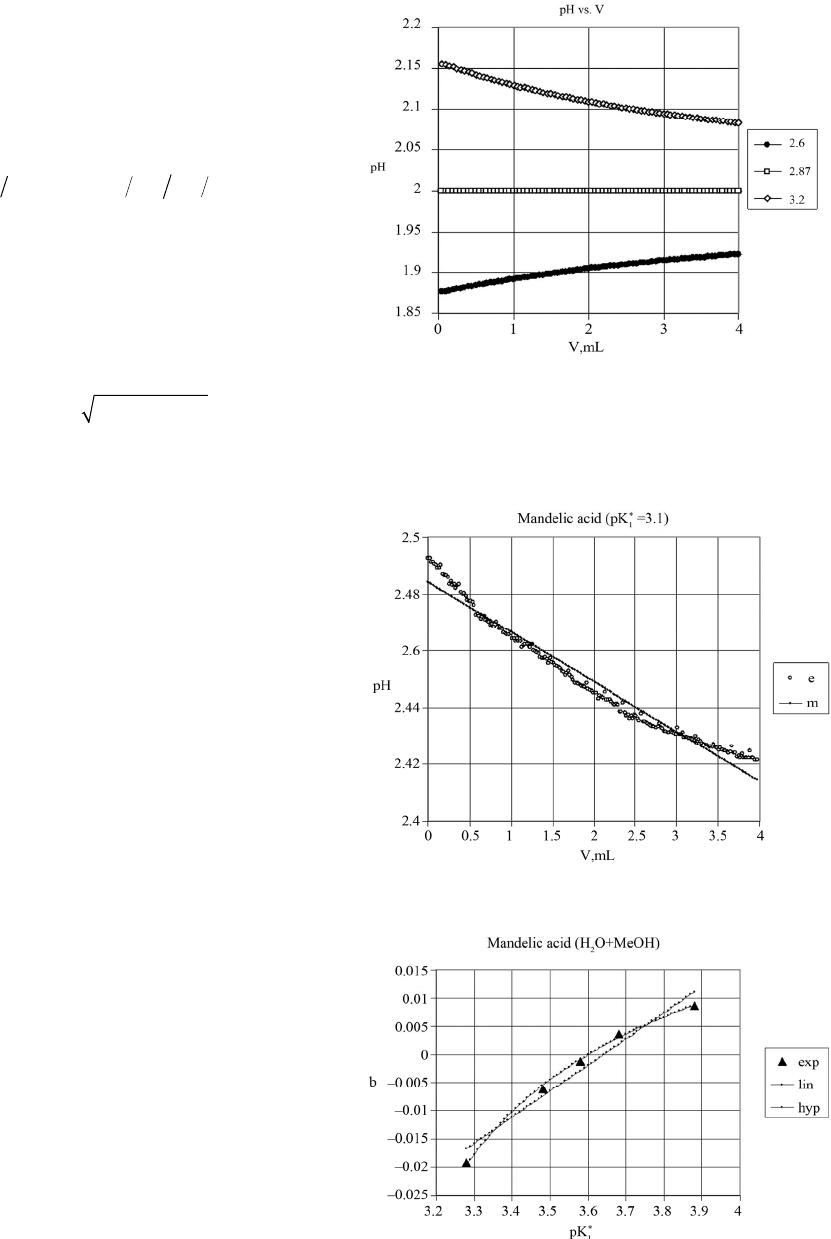 Formulation of the System of Isohydric Solutions 3 and valid for pC significantly smaller than pK1. It can also be noticed that ionic strength (I) of the so- lution remains constant during the titration, i.e. it is in- dependent on the volume V of the titrant added. Namely, from (2), (10)-(12) we get ––– 101 0 I0.5 HOHBL 0.51 1 W K CCKKCCC (16) It is the unique property in titrimetric analyses, ex- ploited in the new method of pK1 determination, suggested in [4,5]. In the light of the Debye-Hückel theory, the con- stancy in ionic strength (I) is, apart from constancy in temperature T and dielectric permeability , one of the properties securing constancy in K1 and KW values. Refer- ring again to Figure 1, from Equation (14) we calculate 11 0 0.5 104 1011 pK pK C C. For C0 = 0.1, pK1 = 4.0 we have pC = 2.507. 4. An Isohydric Method of Acidity Constant Determination The isohydricity property can be perceived as a valuable tool applicable for determination [4,5] of acidity constant (pK1 = – logK1) for a weak acid HL, see Equation 1. For this purpose, a series of pairs of solutions (HB (C), HL ()) is prepared, where C and are interrelated in the formula * 0i C* 0i C 1 *2 010 i pK i CCC (17) where 1i (i = 1,···, n) are the numbers chosen from the vicinity of the true pK1 value for HL. Within each pair (HB (C), HL ()), the pH titrations HB (C, V) HL (C, V0), are made (see Figure 3). In [4,5], at V0 = 3 mL, n = 5 titrations were made up to V = 4 mL. The re- sults of titrations are approximated by straight lines pH = ai + bi·V (see Figure 4), where bi is the slope of the re- lated line. The plots of the slopes vs. 1i values are usually arranged along the straight or hyperbolic line (Figure 5). The point of intersection with 1 pK * 0i * 0i C pK pK line, corresponding to the slope b = 0 (compare with Figure 3) provides an evaluation of the true pK1 value, 1 pK = pK1. Additional, n + 1 th titration HB (C, V) HL (C, V0), made at 0, 1 * 0, 1n1 2* 10 p K nprovides a con- firmation of this pK1 value, if bn+1 value obtained in this titration is relatively small. CCC 5. Final Comments The new derivation of the formula (14) expressing the isohydricity condition for the simplest case of a mixture composed of strong monoprotic (HB, C mol/L) and weak monoprotic (HL, C0 mol/L), when mixed according to titrimetric mode, is presented. The roles of titrand and Figure 3. The simulated pH vs. V relationships plotted for the titration HB (C, V) HL (, V0), at pK1 = 2.87, V0 = 3, C = 0.01, and 0i C 0i C calculated from Equation (17), at dif- ferent (indicated) 1i pK values. Figure 4. Exemplary approximation of experimental (e) points {(Vj, pHj) | j = 1,···,N} by straight line (m) [4]. Figure 5. Linear (lin) and hyperbolic (hyp) approximation of experimental (exp, ▲) points in ( 1 p K, b) co-ordinates [4]. Copyright © 2012 SciRes. JASMI  Formulation of the System of Isohydric Solutions Copyright © 2012 SciRes. JASMI 4 titrant in such systems can be reversed. The formulae for more complicated systems are given in [4]. The iso- hydricity property can be formulated for the systems where only acid-base equilibria occur Equation (14), relates analytical concentrations of strong acid HB and weak acid HL. Such an interesting property is not di- rectly relevant to buffering action. Nevertheless, it is on-line with a general property desired from buffering systems. The systems of isohydric solutions have a unique fea- ture, not stated in other acid-base systems. It is the con- stancy of ionic strength (I), not caused by presence of a basal electrolyte. The conjunction of properties: pH = const, I = const, together with constancy of temperature (T = const) provided a useful tool for a sensitive method of determination of pK1 values for weak acids, as indi- cated and applied in [4,5]. This method is illustrated with some examples taken from [4]. REFERENCES [1] S. Arrhenius, “Theorie der Isohydrischen Losungen,” Zeitschrift für Physikalische Chemie, Vol. 2, 1888, p. 284. [2] J. Inczédy, “Analytical Applications of Complex Equili- bria,” Horwood, Chichester, 1976. [3] T. Michałowski, M. Rymanowski and A. J. Pietrzyk, “Nontypical Brønsted Acids and Bases,” Journal of Che- mical Education, Vol. 82, No. 3, 2005, p. 470. doi:10.1021/ed082p470 [4] T. Michałowski, B. Pilarski, A. G. Asuero and A. Dob- kowska, “A New Sensitive Method of Dissociation Con- stants Determination Based on the Isohydric Solutions Principle,” Talanta, Vol. 82, No. 5, 2010, pp. 1965-1973. doi:10.1016/j.talanta.2010.08.024 [5] T. Michałowski, B. Pilarski, A. G. Asuero, A. Dob- kowska and S. Wybraniec, “Determination of Dissocia- tion Parameters of Weak Acids in Different Media Ac- cording to the Isohydric Method,” Talanta, Vol. 86, 2011, pp. 447-451. doi:10.1016/j.talanta.2011.09.002 [6] R. de Levie, “On Isohydric Solutions and Buffer pH,” Journal of Electroanalytical Chemistry, Vol. 582, No. 1-2, 2005, pp. 21-27. doi:10.1016/j.jelechem.2004.12.028 [7] A. G. Asuero, “Buffer Capacity of a Polyprotic Acid: First Derivative of the Buffer Capacity and pKa Values of Single and Overlapping Equilibria,” Critical Reviews in Analytical Chemistry, Vol. 37, No. 4, 2007, pp. 269-301. doi:10.1080/10408340701266238 [8] A. G. Asuero and T. Michałowski, “Comprehensive For- mulation of Titration Curves for Complex Acid-Base Systems and Its Analytical Implications,” Critical Re- views in Analytical Chemistry, Vol. 41, No. 2, 2011, pp. 151-187. doi:10.1080/10408347.2011.559440 [9] T. Michałowski, M. Toporek and M. Rymanowski, “Overview on the Gran and Other Linearisation Methods Applied in Titrimetric Analyses,” Talanta, Vol. 65, No. 5, 2005, pp. 1241-1253. doi:10.1016/j.talanta.2004.08.053 [10] T. Michałowski, M. Toporek and M. Rymanowski, “pH- Static Titration: A Quasistatic Approach,” Journal of Chemical Education, Vol. 84, No. 1, 2007, p. 142. doi:10.1021/ed084p142 [11] T. D. DuBose Jr. and L. Lee Hamm, “Acid-Base and Electrolyte Disorders. A Companion to Brenner & Rector’s, The Kidney,” WB Saunders, Philadelphia, 2002. |