

Paper Menu >>
Journal Menu >>
 Open Journal of Blood Diseases, 2012, 2, 11-13 http://dx.doi.org/10.4236/ojbd.2012.21002 Published Online March 2012 (http://www.SciRP.org/journal/ojbd) 11 On the Hyperferritinemia and Hereditary Cataract Syndrome Maria José Pérez-Lucena1, María Sierra Moreno-Rosel2, María Sagarra-Tió2, Jo r di Félez2* 1Area Bàsica de Salut (ABS) Serraparera, Cerdanyola del Vallès, Barcelona, Spain; 2Area Bàsica de Salut (ABS) Canaletes, Institut Català de la Salut (ICS), Cerdanyola del Vallès, Barcelona, Spain. Email: *[email protected] Received December 11th, 2011; revised January 26th, 2012; accepted February 10th, 2012 ABSTRACT Introduction: Mutations in the promoter region of ferritin light gene can induce an uncontro lled over expression of this protein. Consequently, ferritin is found in seru m at very high levels (~1000 ng/mL) and it accumulates in the crystalline lens, generating cataracts. This entity is known as hyperferritin and hereditary cataract syndrome (HHCS) which is in- herited in an autosomal dominant manner. Case Presentation: We describe a family affected by HHCS. The proband was identified among subjects submitted to a biological screening for hemochromatosis. He had very high levels of se- rum ferritin (~900 ng/mL) with normal transferrin saturation (TS). The proband has a single H63D HFE-gene mutation and normal HAMP-gene. He was submitted to periodical phlebotomies that induced anemia and a decrease in TS but no changes on serum ferritin levels. Analyses of promoter region of ferritin-light chain gene showed a 39C > T mutation, responsible for HHCS. The proband’s sister carried also this mutation. Both subjects had developed cataracts. Discus- sion: Similar to the first family described carrying this syndrome and to other cases reported, the proband was errone- ously submitted to phlebotomies. Clinical consequences are illustrated in this report. HHCS is an infrequent entity which has to be correctly identified. The unique therap eutic approach to this syndrome must be cataract surg ery. Keywords: Hyperferritinemia; Iron Overload; Cataract; Hyperferritinemia and Hereditary Cataract Syndrome (HHCS) 1. Introduction Prevalence of congenital cataract is estimated in 2.2 - 2.4 over 10,000 births [1]. Approximately 30% of patients suffering cataract have familiar history and frequently they are transmitted in an autosomal dominant manner [1]. The hyperferritinemia and hereditary cataract syn- drome (HHCS) has a relevant role among these syn- dromes. HHCS was first described in 1995 and it is characterized by an early onset of cataracts and the de- tection of very high serum ferritin levels [2-4]. It has an ubicous geographic distribution, affecting individuals from Europe, America, Australia and India [5]. This syndrome has a unique clinical complication: the pre- sence of cataracts with distinct morphology and variable period of onset which depends on both the molecular type of HHCS and on the ethnicity of affected individu- als [2-4]. HHCS patients have high serum ferritin levels but without iron-overload (reviewed in [6]). The associa- tion of cataract with hyperferritinemia and the fact that measurement of serum ferritin levels is broadly used in routine blood tests, confers an emergent relevance to HHCS which should be id entif ied by primary care practi- tioners, ophthalmologists, pediatricians, gastroenterolo- gists and hematologists. We hereby describe a patient affected by HHCS that was detected during a multicenter primary care case-finding study on hereditary hemo- chromatosis carried out by our group among 2739 indi- viduals [7]. 2. Case Report A 24 year-old male was enrolled in a biological study for screening of hemochromatosis. In a first blood test, he- moglobin of 15.8 g/L and serum ferritin levels of 900 ng/mL were detected as unique abnormalities. Transfer- rin saturation (TS) was normal. Hyperferritinemia was confirmed in two additional measurements. The proband has a single H63D HFE-gene mutation and normal HAMP-gene. Panel A of Figure 1 depicts iron-related abnormalities found in his family. Due to elevated serum ferritin levels found, the patient was sub mitted to six 400 mL phlebotomy that induced anemia and a decrease in TS but without changes on serum ferritin levels (Panels B and C). Medical history was reassessed and then, a cataract surgery was identified at early childhood. Analy- sis of ferritin light chain (FtL) promoter showed a 39C > *Corresponding a uthor. Copyright © 2012 SciRes. OJBD 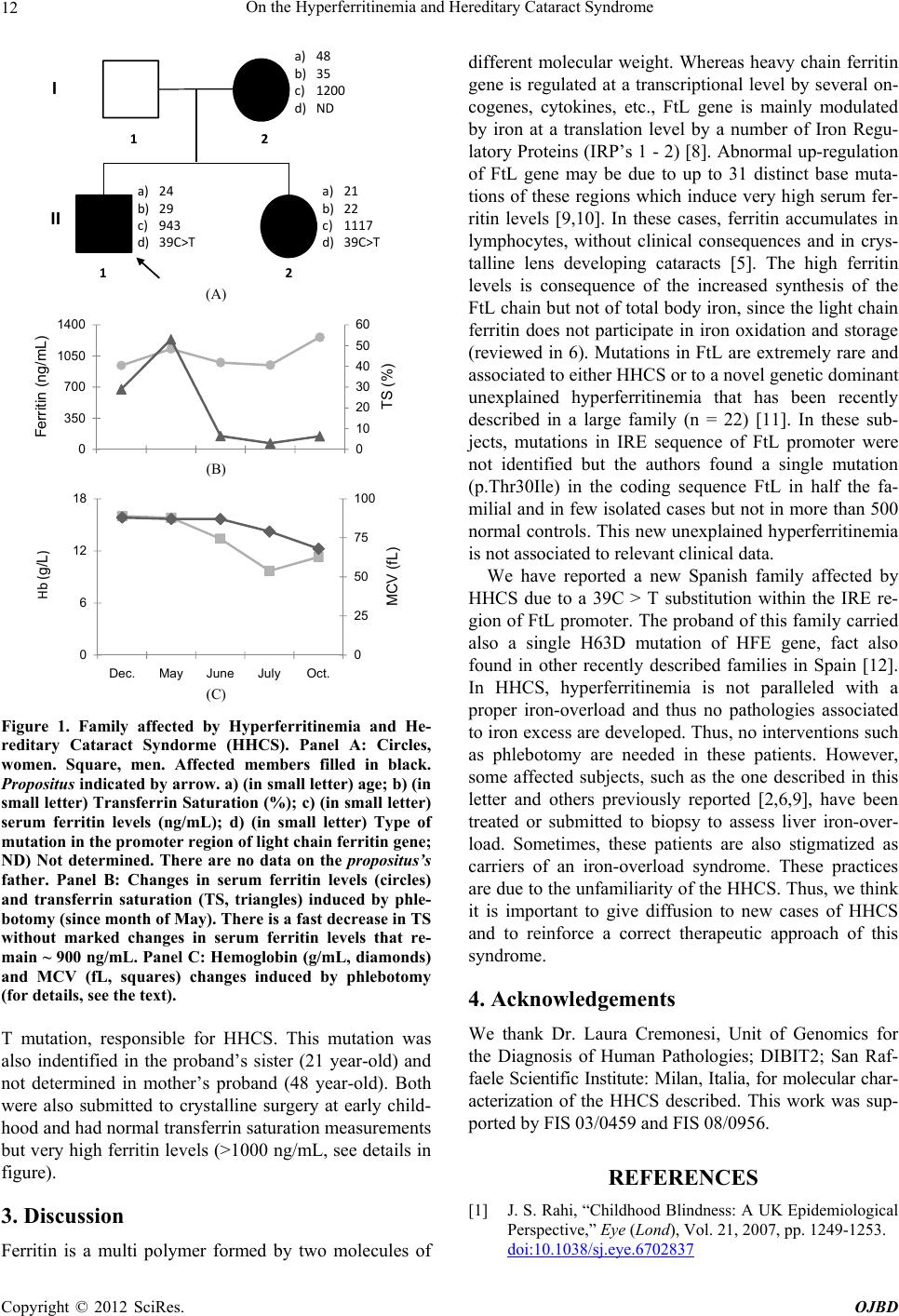 On the Hyperferritinemia and Hereditary Cataract Syndrome 12 12 12 a) 24 b) 29 c) 943 d) 39C>T a) 21 b) 22 c) 1117 d) 39C>T a) 48 b) 35 c) 1200 d) ND I II (A) 0 10 20 30 40 50 60 0 350 700 1050 1400 TS (%) Ferritin (ng/mL) (B) 0 25 50 75 100 0 6 12 18 Dec. May June JulyOct. MCV (f L) Hb (g/L) (C) Figure 1. Family affected by Hyperferritinemia and He- reditary Cataract Syndorme (HHCS). Panel A: Circles, women. Square, men. Affected members filled in black. Propositus indicated by arrow. a) (in small letter) age; b) (in small letter) Transferrin Saturation (%); c) (in small letter) serum ferritin levels (ng/mL); d) (in small letter) Type of mutation in the promoter region of light chain ferritin gene; ND) Not determined. There are no data on the propositus’s father. Panel B: Changes in serum ferritin levels (circles) and transferrin saturation (TS, triangles) induced by phle- botomy (since month of May). There is a fast decrease in TS without marked changes in serum ferritin levels that re- main ~ 900 ng/mL. Panel C: Hemoglobin (g/mL, diamonds) and MCV (fL, squares) changes induced by phlebotomy (for details, see the text). T mutation, responsible for HHCS. This mutation was also indentified in the proband’s sister (21 year-old) and not determined in mother’s proband (48 year-old). Both were also submitted to crystalline surgery at early child- hood and had normal transferrin saturation measurements but very high ferritin levels (>1000 ng /mL, see details in figure). 3. Discussion Ferritin is a multi polymer formed by two molecules of different molecular weight. Whereas heavy chain ferritin gene is regulated at a transcriptional level by several on- cogenes, cytokines, etc., FtL gene is mainly modulated by iron at a translation level by a number of Iron Regu- latory Proteins (IRP’s 1 - 2) [8]. Abnormal up-regulation of FtL gene may be due to up to 31 distinct base muta- tions of these regions which induce very high serum fer- ritin levels [9,10]. In these cases, ferritin accumulates in lymphocytes, without clinical consequences and in crys- talline lens developing cataracts [5]. The high ferritin levels is consequence of the increased synthesis of the FtL chain but not of total body iron, since the light chain ferritin does not participate in iron oxidation and storage (reviewed in 6). Mutations in FtL are extremely rare and associated to either HHCS or to a novel genetic dominant unexplained hyperferritinemia that has been recently described in a large family (n = 22) [11]. In these sub- jects, mutations in IRE sequence of FtL promoter were not identified but the authors found a single mutation (p.Thr30Ile) in the coding sequence FtL in half the fa- milial and in few isolated cases but not in more than 500 normal controls. This new unexplained hyperferritinemia is not associated to relevant clinical data. We have reported a new Spanish family affected by HHCS due to a 39C > T substitution within the IRE re- gion of FtL promoter. The proband of this family carried also a single H63D mutation of HFE gene, fact also found in other recently described families in Spain [12]. In HHCS, hyperferritinemia is not paralleled with a proper iron-overload and thus no pathologies associated to iron excess are developed. Thus, no interventions such as phlebotomy are needed in these patients. However, some affected subjects, such as the one described in this letter and others previously reported [2,6,9], have been treated or submitted to biopsy to assess liver iron-over- load. Sometimes, these patients are also stigmatized as carriers of an iron-overload syndrome. These practices are due to the unfamiliarity of the HHCS. Thus, we think it is important to give diffusion to new cases of HHCS and to reinforce a correct therapeutic approach of this syndrome. 4. Acknowledgements We thank Dr. Laura Cremonesi, Unit of Genomics for the Diagnosis of Human Pathologies; DIBIT2; San Raf- faele Scientific Institute: Milan, Italia, for molecular char- acterization of the HHCS described. This work was sup- ported by FIS 03/0459 an d FIS 08/0956. REFERENCES [1] J. S. Rahi, “Childhood Blindness: A UK Epidemiological Perspective,” Eye (Lond), Vol. 21, 2007, pp. 1249-1253. doi:10.1038/sj.eye.6702837 Copyright © 2012 SciRes. OJBD  On the Hyperferritinemia and Hereditary Cataract Syndrome Copyright © 2012 SciRes. OJBD 13 [2] D. Girelli, R. Corrocher, D. Bisceglia, et al., “Molecular Basis for the Recently Described Hereditary Hyperfer- ritinemia-Cataract Syndrome: A Mutation in the Iron- Responsive Element of Ferritin L-Subunit Gene (the ‘Verona Mutation’),” Blood, Vol. 86, 1995, pp. 4050- 4053. [3] C. Beaumont, P. Leneuve, I. Devaux, et al., “Mutation in the Iron Responsive Element of the L Ferritin mRNA in a Family with Dominant Hyperferritinaemia and Cataract,” Nature Genetics, Vol. 11, 1995, pp. 444-446. doi:10.1038/ng1295-444 [4] D. Bonneau, I. Winter-Fuseau, M. N. Loiseau, et al., “Bi- lateral Cataract and High Serum Ferritin: A New Domi- nant Genetic Disorder?” Journal of Medical Genetics, Vol. 32, No. 10, 1995, pp. 778-779. doi:10.1136/jmg.32.10.778 [5] V. Vanita, J. F. Hejtmancik, H. C. Hennies, et al., “Su- tural Cataract Associated with a Mutation in the Ferritin Light Chain Gene (FTL) in a Family of Indian Origin,” Molecular Vision, Vol. 21, 2006, pp. 93-99. [6] C. Camaschella and E. Poggiali, “Towards Explaining ‘Unexplained Hyperferritinemia’,” Haematologica, Vol. 94, No. 3, 2009, pp. 307-309. doi:10.3324/haematol.2008.005405 [7] N. Freixenet, M. S. Moreno-Rosel, M. J. Barceló, et al., “Detection of Hereditary Hemochromatosis and Bio- chemical Iron-Overload in Primary Care: A Multicenter Case-Finding Study in Spain,” American Journal of He- matology, Vol. 85, No. 4, 2010, pp. 294-296. doi:10.1002/ajh.21634 [8] K. J. Hintze and E. C. Theil, “Cellular Regulation and Molecular Interactions of the Ferritins,” Cellular and Molecular Life Sciences, Vol. 63, No. 5, 2006, pp. 591- 600. doi:10.1007/s00018-005-5285-y [9] M. Cazzola, G. Bergamaschi, L. Tonon, et al. “Hereditary Hyperferritinemia-Cataract Syndrome: Relationship be- tween Phenotypes and Specific Mutations in the Iron- Responsive Element of Ferritin Light-Chain mRNA,” Blood, Vol. 90, No. 2, 1997, pp. 814-821. [10] G. Milloning, M. U. Muckenthaler and S. Mueller, “Hy- perferritinaemia-Cataract Syndrome: Worldwide Muta- tions and Phenotype of an Increasingly Diagnosed Ge- netic Disorder,” Human Genomics, Vol. 4, No. 4, 2010, pp. 250-262. [11] C. Kannengiesser, A. M. Jouanolle, G. Hetter, et al., “A New Missense Mutation in the L Ferritin Coding Se- quence Associated with Elevated Levels of Glyscosylated Ferritin in Serum and Absence of Iron Overload,” Haematologica, Vol. 94, No. 3, 2009, pp. 335-339. doi:10.3324/haematol.2008.000125 [12] J. A. García Erce, T. Cortés, L. Cremonesi, et al., “Hiperferritinemia Familiar y Cataratas Congenitas Aso- ciadas a Mutación del Gen HFE. Dos Nuevas Familias Españolas y una Nueva Mutación (A37T: ‘Zaragoza’),” Medicina Clínica (Barc), Vol. 127, No. 2, 2006, pp. 55- 58. |