

Paper Menu >>
Journal Menu >>
 Open Journal of Microphysics, 2012, 2, 1-11 http://dx.doi.org/10.4236/ojm.2012.21001 Published Online February 2012 (http://www.SciRP.org/journal/ojm) Characteristics of Strange Hadron Production in Some High Energy Collisions and the Role of Power Laws Sunil Kumar Biswas1, Goutam Sau2, Amar Chandra Das Ghosh3, Subrata Bhattacharyya4* 1West Kodalia Adarsha Siksha Sadan, New Barrackpore, Kolkata, India 2Beramara RamChandrapur High School, Kolkata, India 3Department of Microbiology, Surendranath College, Kolkata, India 4Physics and Applied Mathematics Unit (PAMU), Indian Statistical Institute, Kolkata, India Email: {sunil_biswas2004, sau_goutam}@yahoo.com, [email protected], Received November 8, 2011; revised December 28, 2011; accepted January 10, 2012 ABSTRACT Studies on “strange” particle production have always occupied a very important space in the domain of Particle Physics. This was and is so, just because of some conjectures about specially abundant or excess production of “strange” parti- cles, at certain stages and under certain conditions arising out of what goes by the name of “Standard” model in Particle Physics. With the help of Hagedornian power laws we have attempted to understand and interpret here the nature of the -spectra for the strange particle production in a few high energy nuclear collisions, some interesting ratio-behaviors and the characteristics of the nuclear modification factors that are measured in laboratory experiments. After obtaining and analysing the final results we do not confront any peculiarities or oddities or extraneous excesses in the properties of the relevant observables with no left-over problems or puzzles. The model(s) used by us work(s) quite well for ex- plaining the measured data. T p Keywords: Hadron-Nucleus Collisions; Inclusive Production; Scaling Phenomena; Power Laws 1. Introduction Studying the nature of particle production in proton- proton collisions is important and interesting in itself, as it might shed light on the basic mechanism for pro- duction of particles. Besides, it could also serve as a necessary benchmark for the physics developments in ultra-relativistic heavy ion collisions [1,2]. This is specially important at the large hadron collider (LHC) where the heavy ion programme had started by Nove- mber 2010 delivering some preliminary results on some aspects of strange hadrons produced as the final product in high energy nuclear collisions and these strange secondaries are supposed to provide valuable insights into the properties of the “controversial” system newly formed. One of the main motivation for measuring strange particles in heavy nucleus-nucleus reactions at LHC is the expectation that their production-rates for participating nucleon should be enhanced with respect to basic nucleon-nucleon interactions. Strangeness enhance- ment has consistently been proposed as one of the strong diagnostics for a Quark Gluon Plasma (QGP) state [3,4]. The enhancement factor (E) is defined as rapidity-density of multiplicity (yield) par mean number of nucleon parti- cipants [ p art N] in heavy ion collisions, divided by the respective value in p + p collisions. The requisite information about p art N etc are to be obtained from Abelev et al. [5,6]. As the strange hadrons are not at all present in the initial system (A), the question rises very sharply: how do they make their appearance in the final products. So there must be some specific reflections on the constituent pictures of the particles and specifically the nucleons. Besides, enhancement of strangeness productions was/is one of the powerful diagnostics for the formation of quark gluon plasma (QGP) in relativistic heavy ion col- lisions and the colliders (RHIC). The observations of an increase of strange baryon production relative to p + p collision in SPS data, confirmed later at the RHIC studies, has brought excitement in this area.Besides, the increase of πp ratio (B) in such collisions in the non-strange domain had its parallel in the strangeness sector with the observation of slow rise of the 0 k values. The organization of this work is as follows. In Section 2 we give an outline of the model to be applied. In the next section (Section 3) we deliver the results by figures and tables with a short discussion on the results obtained. *Corres p ondin g autho r . C opyright © 2012 SciRes. OJM 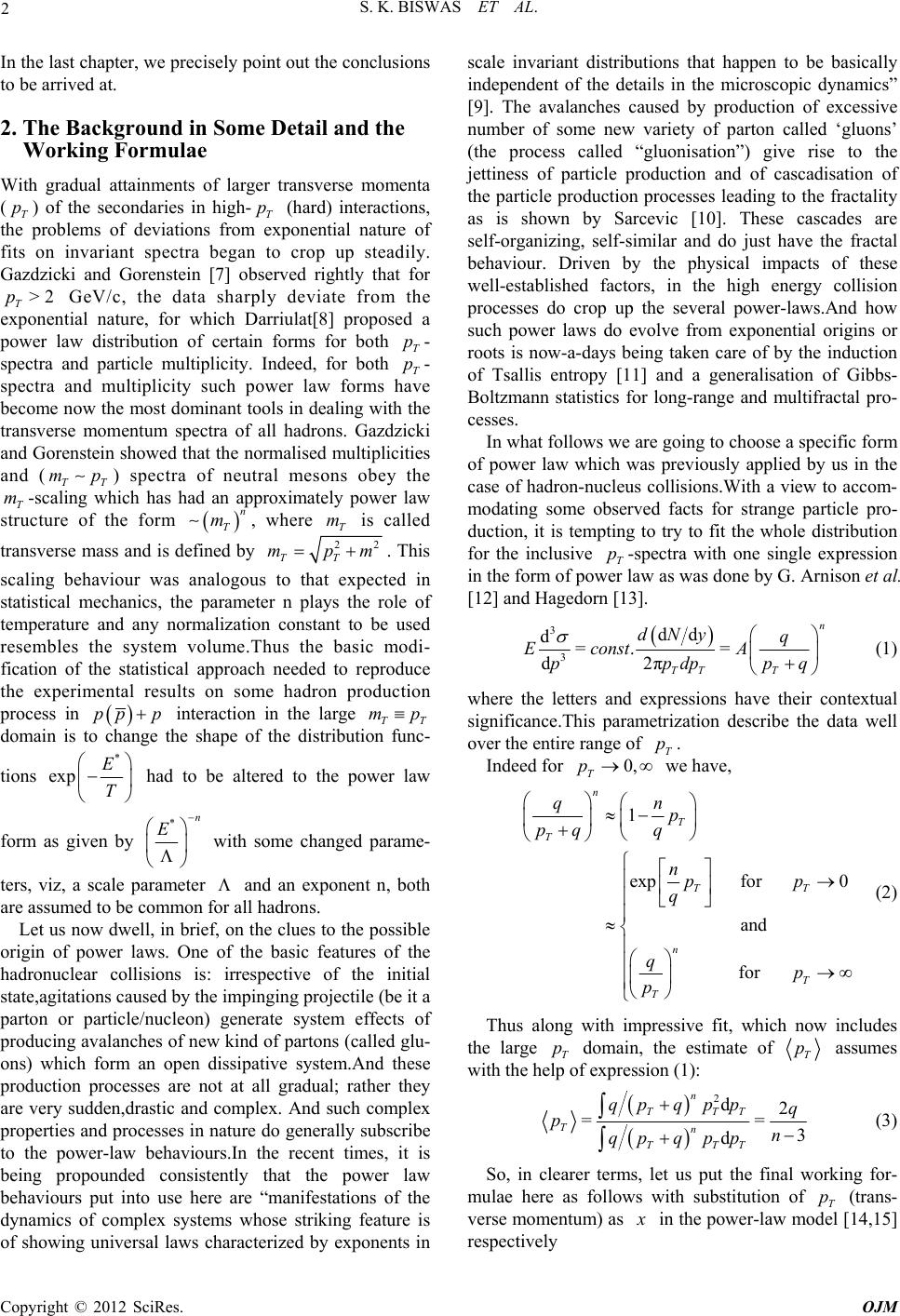 S. K. BISWAS ET AL. 2 In the last chapter, we precisely point out the conclusions to be arrived at. 2. The Background in Some Detail and the Working Formulae With gradual attainments of larger transverse momenta (T) of the secondaries in high-T (hard) interactions, the problems of deviations from exponential nature of fits on invariant spectra began to crop up steadily. Gazdzicki and Gorenstein [7] observed rightly that for GeV/c, the data sharply deviate from the exponential nature, for which Darriulat[8] proposed a power law distribution of certain forms for both - spectra and particle multiplicity. Indeed, for both T- spectra and multiplicity such power law forms have become now the most dominant tools in dealing with the transverse momentum spectra of all hadrons. Gazdzicki and Gorenstein showed that the normalised multiplicities and (T m) spectra of neutral mesons obey the T-scaling which has had an approximately power law structure of the form , where is called p T p m p >2 T p p T p n T mT m transverse mass and is defined by 2 mp2 TT m. This scaling behaviour was analogous to that expected in statistical mechanics, the parameter n plays the role of temperature and any normalization constant to be used resembles the system volume.Thus the basic modi- fication of the statistical approach needed to reproduce the experimental results on some hadron production process in pp p interaction in the large TT mp domain is to change the shape of the distribution func- tions * exp E T had to be altered to the power law form as given by *n E with some changed parame- ters, viz, a scale parameter and an exponent n, both are assumed to be common for all hadrons. Let us now dwell, in brief, on the clues to the possible origin of power laws. One of the basic features of the hadronuclear collisions is: irrespective of the initial state,agitations caused by the impinging projectile (be it a parton or particle/nucleon) generate system effects of producing avalanches of new kind of partons (called glu- ons) which form an open dissipative system.And these production processes are not at all gradual; rather they are very sudden,drastic and complex. And such complex properties and processes in nature do generally subscribe to the power-law behaviours.In the recent times, it is being propounded consistently that the power law behaviours put into use here are “manifestations of the dynamics of complex systems whose striking feature is of showing universal laws characterized by exponents in scale invariant distributions that happen to be basically independent of the details in the microscopic dynamics” [9]. The avalanches caused by production of excessive number of some new variety of parton called ‘gluons’ (the process called “gluonisation”) give rise to the jettiness of particle production and of cascadisation of the particle production processes leading to the fractality as is shown by Sarcevic [10]. These cascades are self-organizing, self-similar and do just have the fractal behaviour. Driven by the physical impacts of these well-established factors, in the high energy collision processes do crop up the several power-laws.And how such power laws do evolve from exponential origins or roots is now-a-days being taken care of by the induction of Tsallis entropy [11] and a generalisation of Gibbs- Boltzmann statistics for long-range and multifractal pro- cesses. In what follows we are going to choose a specific form of power law which was previously applied by us in the case of hadron-nucleus collisions.With a view to accom- modating some observed facts for strange particle pro- duction, it is tempting to try to fit the whole distribution for the inclusive T-spectra with one single expression in the form of power law as was done by G. Arnison et al. [12] and Hagedorn [13]. p 3 3 dd d=. = 2π d n TT T dNyq E constA pdpp q p (1) where the letters and expressions have their contextual significance.This parametrization describe the data well over the entire range of . T Indeed for we have, p 0, T p 1 exp for 0 and for n T T TT n T T qn p pq q npp q qp p (2) Thus along with impressive fit, which now includes the large T domain, the estimate of pT p assumes with the help of expression (1): 2d2 == 3 d n TTT Tn TTT qp qppq pn qp qpp (3) So, in clearer terms, let us put the final working for- mulae here as follows with substitution of T (trans- verse momentum) as p x in the power-law model [14,15] respectively Copyright © 2012 SciRes. OJM 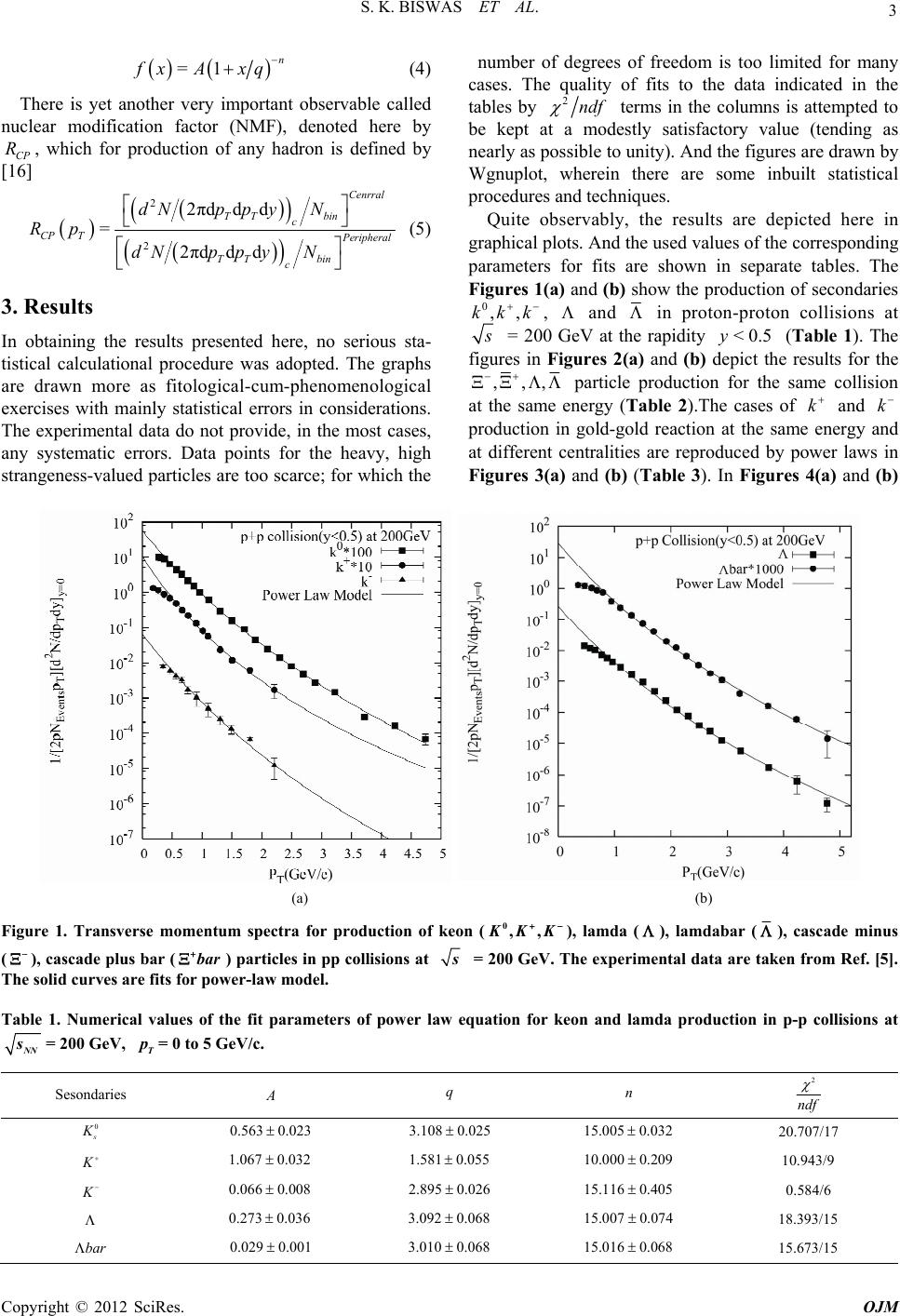 S. K. BISWAS ET AL. Copyright © 2012 SciRes. OJM 3 =1 n f xA xq (4) There is yet another very important observable called nuclear modification factor (NMF), denoted here by CP , which for production of any hadron is defined by [16] R 2 2 2πddd = 2πddd Cenrral TT bin c CP T P eripheral TT bin c dNp pyN Rp dNp pyN (5) number of degrees of freedom is too limited for many cases. The quality of fits to the data indicated in the tables by 2ndf terms in the columns is attempted to be kept at a modestly satisfactory value (tending as nearly as possible to unity). And the figures are drawn by Wgnuplot, wherein there are some inbuilt statistical procedures and techniques. Quite observably, the results are depicted here in graphical plots. And the used values of the corresponding parameters for fits are shown in separate tables. The Figures 1(a) and (b) show the production of secondaries 0,,kkk , and in proton-proton collisions at s = 200 GeV at the rapidity (Table 1). The figures in Figures 2(a) and (b) depict the results for the <0.5y ,,, 3. Results In obtaining the results presented here, no serious sta- tistical calculational procedure was adopted. The graphs are drawn more as fitological-cum-phenomenological exercises with mainly statistical errors in considerations. The experimental data do not provide, in the most cases, any systematic errors. Data points for the heavy, high strangeness-valued particles are too scarce; for which the particle production for the same collision at the same energy (Table 2).The cases of k and k production in gold-gold reaction at the same energy and at different centralities are reproduced by power laws in Figures 3(a) and (b) (Table 3). In Figures 4(a) and (b) (a) (b) Figure 1. Transverse momentum spectra for production of keon (0,,KKK ), lamda ( ), lamdabar (), cascade minus (), cascade plus bar () particles in pp collisions at bar s = 200 GeV. The ex perimental data are taken from Ref. [5]. The solid curves are fits for power-law model. Table 1. Numerical values of the fit parameters of power law equation for keon and lamda production in p-p collisions at NN s= 200 GeV, = 0 to 5 GeV/c. T p Sesondaries A q n 2 ndf 0 s K 0.563 0.023 3.108 0.025 15.005 0.032 20.707/17 K 1.067 0.032 1.581 0.055 10.000 0.209 10.943/9 K 0.066 0.008 2.895 0.026 15.116 0.405 0.584/6 0.273 0.036 3.092 0.068 15.007 0.074 18.393/15 bar 0.029 0.001 3.010 0.068 15.016 0.068 15.673/15 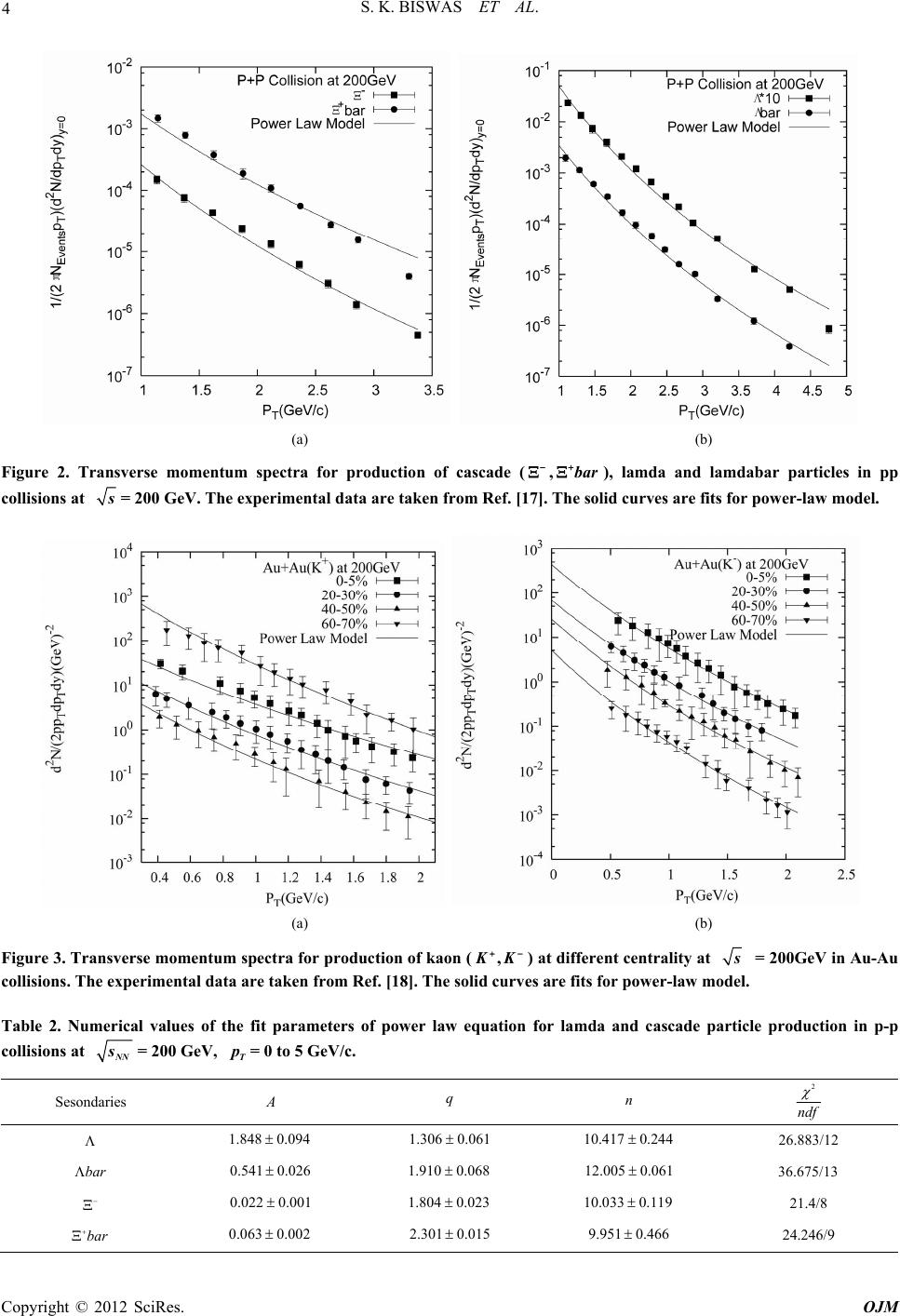 S. K. BISWAS ET AL. 4 (a) (b) Figure 2. Transverse momentum spectra for production of cascade ( ,), lamda and lamdabar particles in pp collisions at bar s= 200 GeV. The experimental data are taken from Ref. [17]. The solid curves are fits for power-law model. (a) (b) Figure 3. Transverse momentum spectra for production of kaon (,KK ) at different centrality at s = 200GeV in Au-Au collisions. The experimental data are taken from Ref. [18]. The solid curves are fits for power-law model. Table 2. Numerical values of the fit parameters of power law equation for lamda and cascade particle production in p-p collisions at NN s= 200 GeV, T p = 0 to 5 GeV/c. Sesondaries A q n 2 ndf 1.8480.094 1.3060.061 10.4170.244 26.883/12 bar 0.541 0.026 1.9100.068 12.0050.061 36.675/13 0.022 0.001 1.8040.023 10.0330.119 21.4/8 bar 0.063 0.002 2.3010.015 9.9510.466 24.246/9 Copyright © 2012 SciRes. OJM 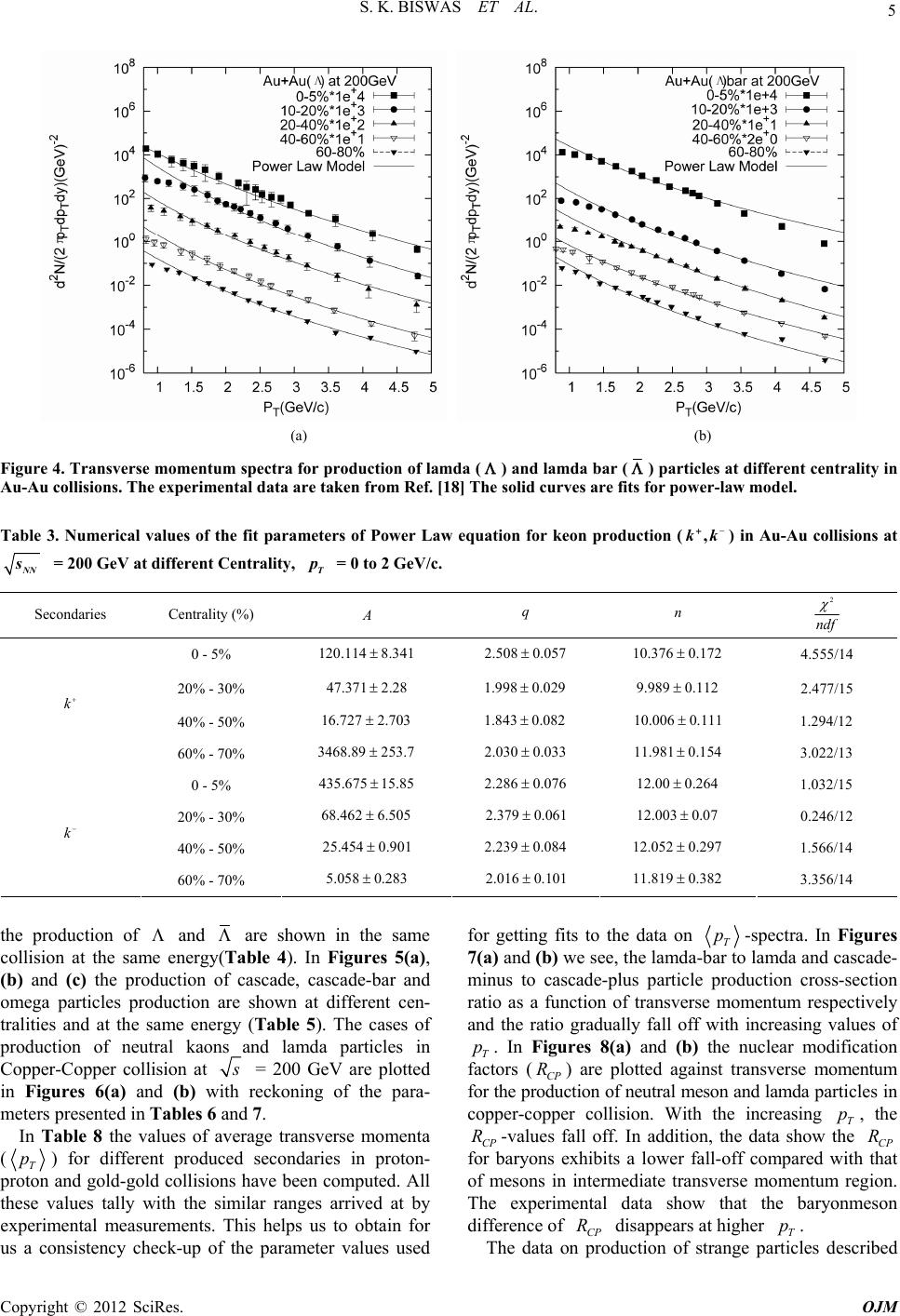 S. K. BISWAS ET AL. Copyright © 2012 SciRes. OJM 5 (a) (b) Figure 4. Transverse momentum spectra for production of lamda ( ) and lamda bar ( ) particles at different centrality in Au-Au collisions. The experimental data are taken from Ref. [18] The solid curves are fits for power - law model. Table 3. Numerical values of the fit parameters of Power Law equation for keon production () in Au-Au collisions at ,kk NN s = 200 GeV at different Centrality, T p = 0 to 2 GeV/c. Secondaries Centrality (%) A q n 2 ndf 0 - 5% 120.1148.341 2.5080.057 10.3760.172 4.555/14 20% - 30% 47.371 2.28 1.9980.029 9.9890.112 2.477/15 40% - 50% 16.727 2.703 1.8430.082 10.0060.111 1.294/12 k 60% - 70% 3468.89253.7 2.0300.033 11.9810.154 3.022/13 0 - 5% 435.675 15.85 2.2860.076 12.000.264 1.032/15 20% - 30% 68.462 6.505 2.3790.061 12.0030.07 0.246/12 40% - 50% 25.454 0.901 2.2390.084 12.0520.297 1.566/14 k 60% - 70% 5.058 0.283 2.0160.101 11.8190.382 3.356/14 the production of and are shown in the same collision at the same energy(Table 4). In Figures 5(a), (b) and (c) the production of cascade, cascade-bar and omega particles production are shown at different cen- tralities and at the same energy (Table 5). The cases of production of neutral kaons and lamda particles in Copper-Copper collision at s = 200 GeV are plotted in Figures 6(a) and (b) with reckoning of the para- meters presented in Tables 6 and 7. In Table 8 the values of average transverse momenta (T) for different produced secondaries in proton- proton and gold-gold collisions have been computed. All these values tally with the similar ranges arrived at by experimental measurements. This helps us to obtain for us a consistency check-up of the parameter values used for getting fits to the data on p T-spectra. In Figures 7(a) and (b) we see, the lamda-bar to lamda and cascade- minus to cascade-plus particle production cross-section ratio as a function of transverse momentum respectively and the ratio gradually fall off with increasing values of T. In Figures 8(a) and (b) the nuclear modification factors (CP ) are plotted against transverse momentum for the production of neutral meson and lamda particles in copper-copper collision. With the increasing T, the CP -values fall off. In addition, the data show the CP for baryons exhibits a lower fall-off compared with that of mesons in intermediate transverse momentum region. The experimental data show that the baryonmeson difference of disappears at higher . p p R R pR CP T he data on production of strange particles described R p T 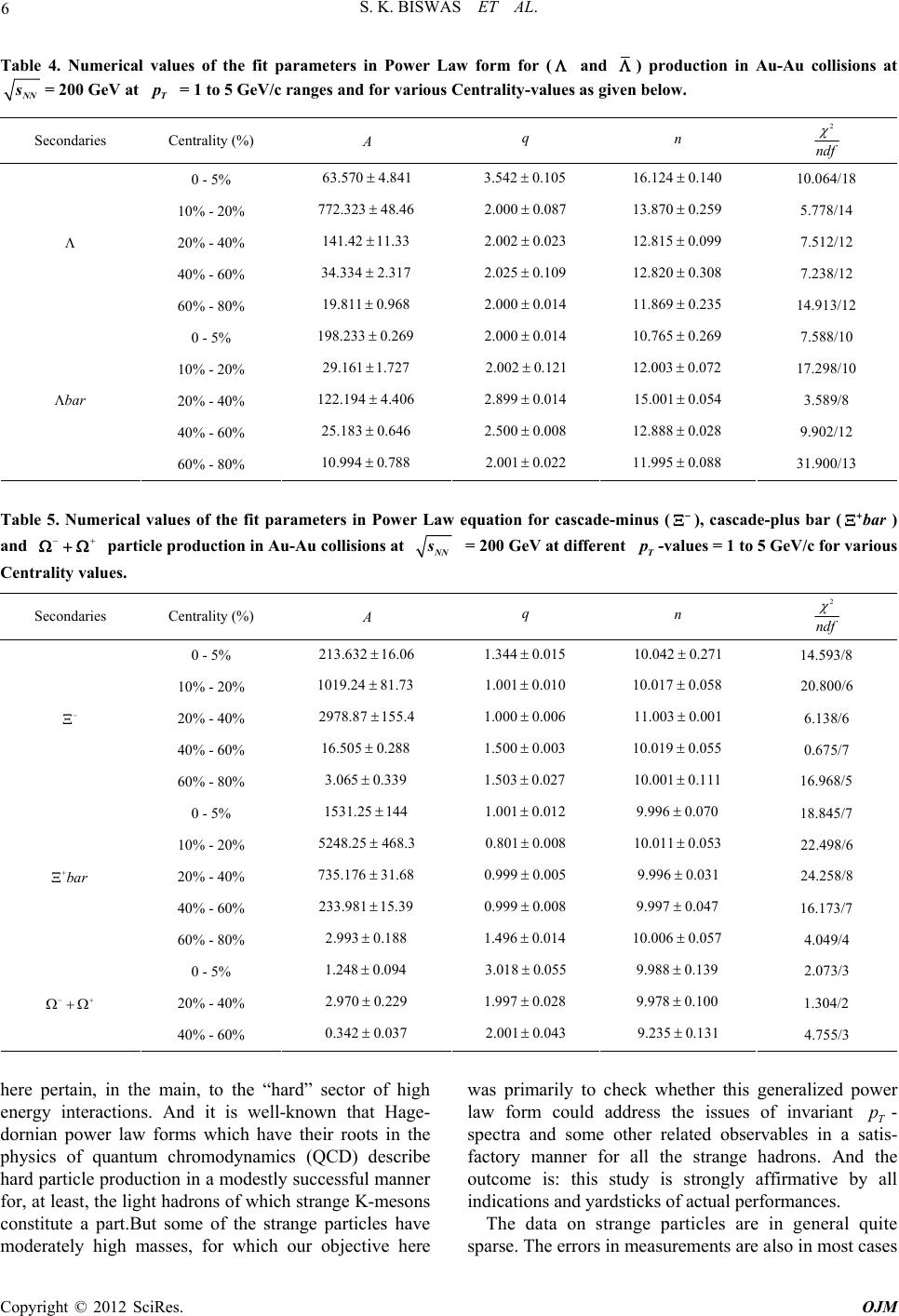 S. K. BISWAS ET AL. 6 Table 4. Numerical values of the fit parameters in Power Law form for ( and ) production in Au-Au collisions at NN s= 200 GeV at T p = 1 to 5 GeV/c ranges and for various Centrality-values as given below. Secondaries Centrality (%) A q n 2 ndf 0 - 5% 63.570 4.841 3.5420.105 16.1240.140 10.064/18 10% - 20% 772.323 48.46 2.0000.087 13.8700.259 5.778/14 20% - 40% 141.42 11.33 2.0020.023 12.8150.099 7.512/12 40% - 60% 34.334 2.317 2.0250.109 12.8200.308 7.238/12 60% - 80% 19.811 0.968 2.0000.014 11.8690.235 14.913/12 0 - 5% 198.2330.269 2.0000.014 10.7650.269 7.588/10 10% - 20% 29.161 1.727 2.0020.121 12.0030.072 17.298/10 20% - 40% 122.194 4.406 2.8990.014 15.0010.054 3.589/8 40% - 60% 25.1830.646 2.5000.008 12.8880.028 9.902/12 bar 60% - 80% 10.994 0.788 2.0010.022 11.9950.088 31.900/13 Table 5. Numerical values of the fit parameters in Power Law equation for cascade-minus ( ), cascade-plus bar () and particle production in Au-Au collisions at bar NN s 200 GeV at different T = p -values = 1 to 5 GeV/c for various Centrality values. Secondaries Centrality (%) A q n 2 ndf 0 - 5% 213.632 16.06 1.3440.015 10.0420.271 14.593/8 10% - 20% 1019.24 81.73 1.0010.010 10.0170.058 20.800/6 20% - 40% 2978.87 155.4 1.0000.006 11.0030.001 6.138/6 40% - 60% 16.505 0.288 1.5000.003 10.0190.055 0.675/7 60% - 80% 3.065 0.339 1.5030.027 10.0010.111 16.968/5 0 - 5% 1531.25144 1.0010.012 9.9960.070 18.845/7 10% - 20% 5248.25 468.3 0.8010.008 10.0110.053 22.498/6 20% - 40% 735.176 31.68 0.9990.005 9.9960.031 24.258/8 40% - 60% 233.981 15.39 0.9990.008 9.9970.047 16.173/7 bar 60% - 80% 2.993 0.188 1.4960.014 10.0060.057 4.049/4 0 - 5% 1.248 0.094 3.0180.055 9.9880.139 2.073/3 20% - 40% 2.970 0.229 1.9970.028 9.9780.100 1.304/2 40% - 60% 0.342 0.037 2.0010.043 9.2350.131 4.755/3 here pertain, in the main, to the “hard” sector of high energy interactions. And it is well-known that Hage- dornian power law forms which have their roots in the physics of quantum chromodynamics (QCD) describe hard particle production in a modestly successful manner for, at least, the light hadrons of which strange K-mesons constitute a part.But some of the strange particles have moderately high masses, for which our objective here was primarily to check whether this generalized power law form could address the issues of invariant T- spectra and some other related observables in a satis- factory manner for all the strange hadrons. And the outcome is: this study is strongly affirmative by all indications and yardsticks of actual performances. p The data on strange particles are in general quite sparse. The errors in measurements are also in most cases Copyright © 2012 SciRes. OJM 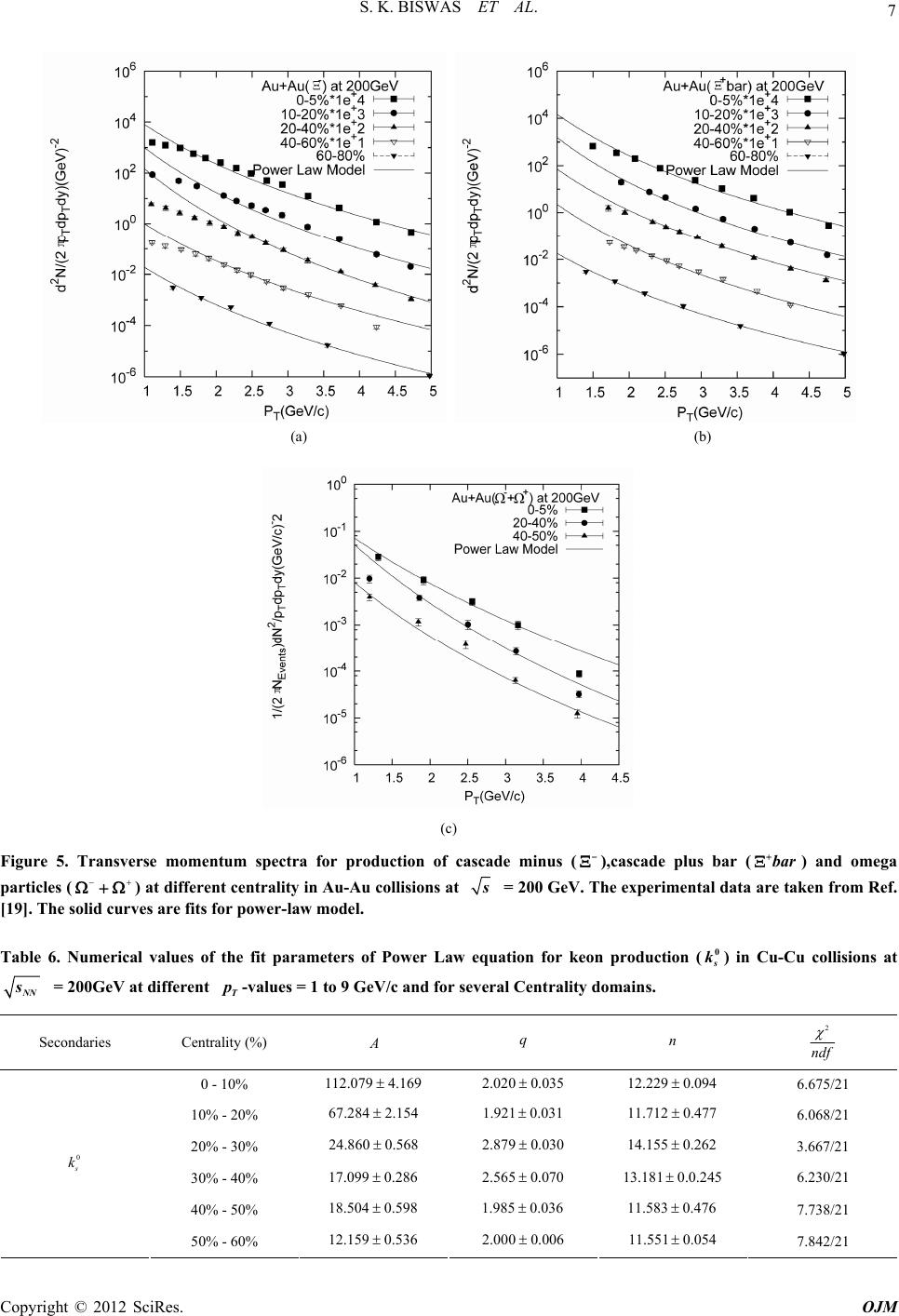 S. K. BISWAS ET AL. 7 (a) (b) (c) Figure 5. Transverse momentum spectra for production of cascade minus ( ),cascade plus bar () and omega particles () at different centrality in Au-Au collisions at bar s = 200 GeV. The experimental data are taken fr om Ref. [19]. The solid curves are fits for power-law model. Table 6. Numerical values of the fit parameters of Power Law equation for keon production () in Cu-Cu collisions at 0 s k NN s = 200GeV at different T p -values = 1 to 9 GeV/c and for several Centrality domains. Secondaries Centrality (%) A q n 2 ndf 0 - 10% 112.079 4.169 2.0200.035 12.2290.094 6.675/21 10% - 20% 67.284 2.154 1.9210.031 11.7120.477 6.068/21 20% - 30% 24.860 0.568 2.8790.030 14.1550.262 3.667/21 30% - 40% 17.099 0.286 2.5650.070 13.1810.0.245 6.230/21 40% - 50% 18.504 0.598 1.9850.036 11.5830.476 7.738/21 0 s k 50% - 60% 12.159 0.536 2.0000.006 11.5510.054 7.842/21 Copyright © 2012 SciRes. OJM 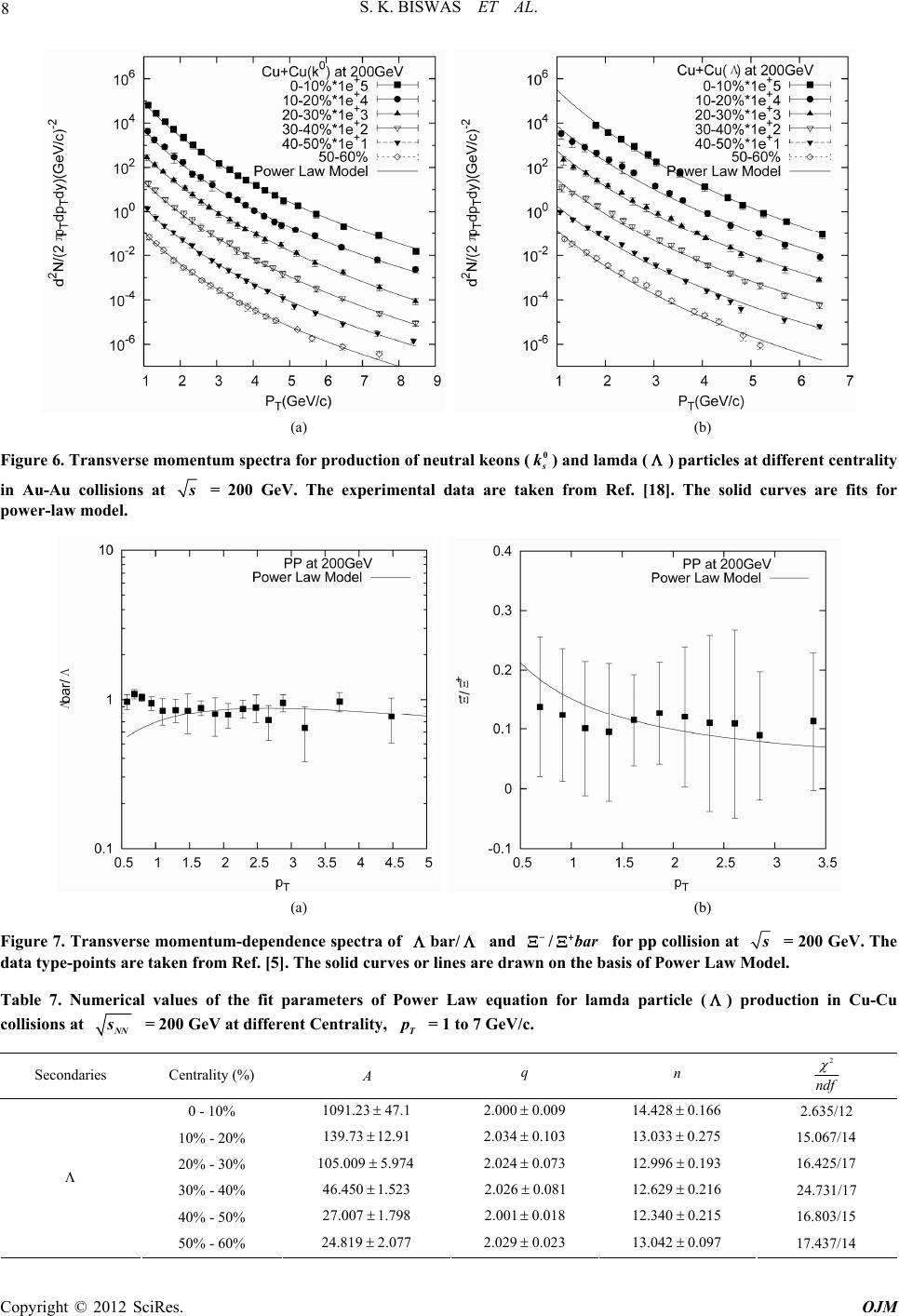 S. K. BISWAS ET AL. 8 (a) (b) Figure 6. Transverse momentum spectra for production of neutral keons () and lamda ( 0 s k ) particles at different centrality in Au-Au collisions at s = 200 GeV. The experimental data are taken from Ref. [18]. The solid curves are fits for power-law model. (a) (b) Figure 7. Transverse momentum-dependence spectra of bar/ and / for pp collision at bar s = 200 GeV. The ata type-points are taken from Ref. [5]. The solid curves or lines are drawn on the basis of Power Law Model. d Table 7. Numerical values of the fit parameters of Power Law equation for lamda particle () production in Cu-Cu collisions at NN s = 200 GeV at different Centrality, T p = 1 to 7 GeV/c. Secondaries Centrality (%) A q n 2 ndf 0 - 10% 1091.23 47.1 2.0000.009 14.4280.166 2.635/12 10% - 20% 139.7312.91 2.0340.103 13.0330.275 15.067/14 20% - 30% 105.009 5.974 2.0240.073 12.9960.193 16.425/17 30% - 40% 46.450 1.523 2.0260.081 12.6290.216 24.731/17 40% - 50% 27.007 1.798 2.0010.018 12.3400.215 16.803/15 50% - 60% 24.819 2.077 2.0290.023 13.0420.097 17.437/14 Copyright © 2012 SciRes. OJM  S. K. BISWAS ET AL. Copyright © 2012 SciRes. OJM 9 (a) (b) Figure 8. Plots of the nuclear modification factor (cp R ) versus T p spectra for Cu-Cu collisions at s = 200 GeV. The experimental data are taken from Ref. [18]. The solid curves indicate the power-law-based description of the data. Table 8. Calcul ated values of average transverse m omen tum T p for at <0.5 cm yNN s = 200 GeV. Nature of Collisions SecondariesValue of T p in GeV/c 0 s k 0.52 k 0.45 k 0.48 0.52 0.50 0.51 p-p Collisions bar 0.86 Au-Au Collisions k 0.68 k 0.50 0.54 0.52 0.38 bar 0.28 (Central) 0.86 quite considerable. If these limitations are taken into account, the importance of this comprehensive work, though entirely phenomenological, assumes some degree of importance. Barring these generalized comments on an overall basis, we have some specific observations as well, which are also quite well-merited and are being presented hereafter: 1) The power indices for all the varieties of strange hadrons lie in the most cases,in the range of 10 - 12. This is in accord with the prescription on the limit set by Brodsky [20], with the q-values bordering on the values, 2 - 3. 2) The 2 /ndf values for production of cascade and omega particles have suffered quantitatively due to very small values of the number of degrees of freedom. 3) Thirdly, the q and n values do not exhibit any clear centrality-dependence or the mass-de- pendence of the observed heavy secondaries. 4) However, we cannot ascertain at this moment the properties of these parameters with regard to the nature of their energy- dependence(s), if any. 5) The average momentum values of these measured heavy strange baryons are found to be quantitatively compatible with other non-strange light hadrons, though the expression for the average transverse momentum is not very rigorously derived, for which reliability of expression (3) is certainly limited. 6) Some ratio-values shown by Figures 7(a) and (b) are mo- destly well-described. 7) However, the values of the nu- clear modification factor, denoted by CP , are not reproduced satisfactorily, especially on the lower-side of the T-values. But this is no wonder, as the used power laws are suited to high-T values as was remarked above very concretely. 7) Still, with one of the simplest approaches, that we have succeeded in explaining the characteristics of a large bulk of data on these rare hadrons is certainly quite stimulating to and encouraging for us. R pp 4. Concluding Remarks Let us now sum up; 1) The used power laws explain quite well the mea- 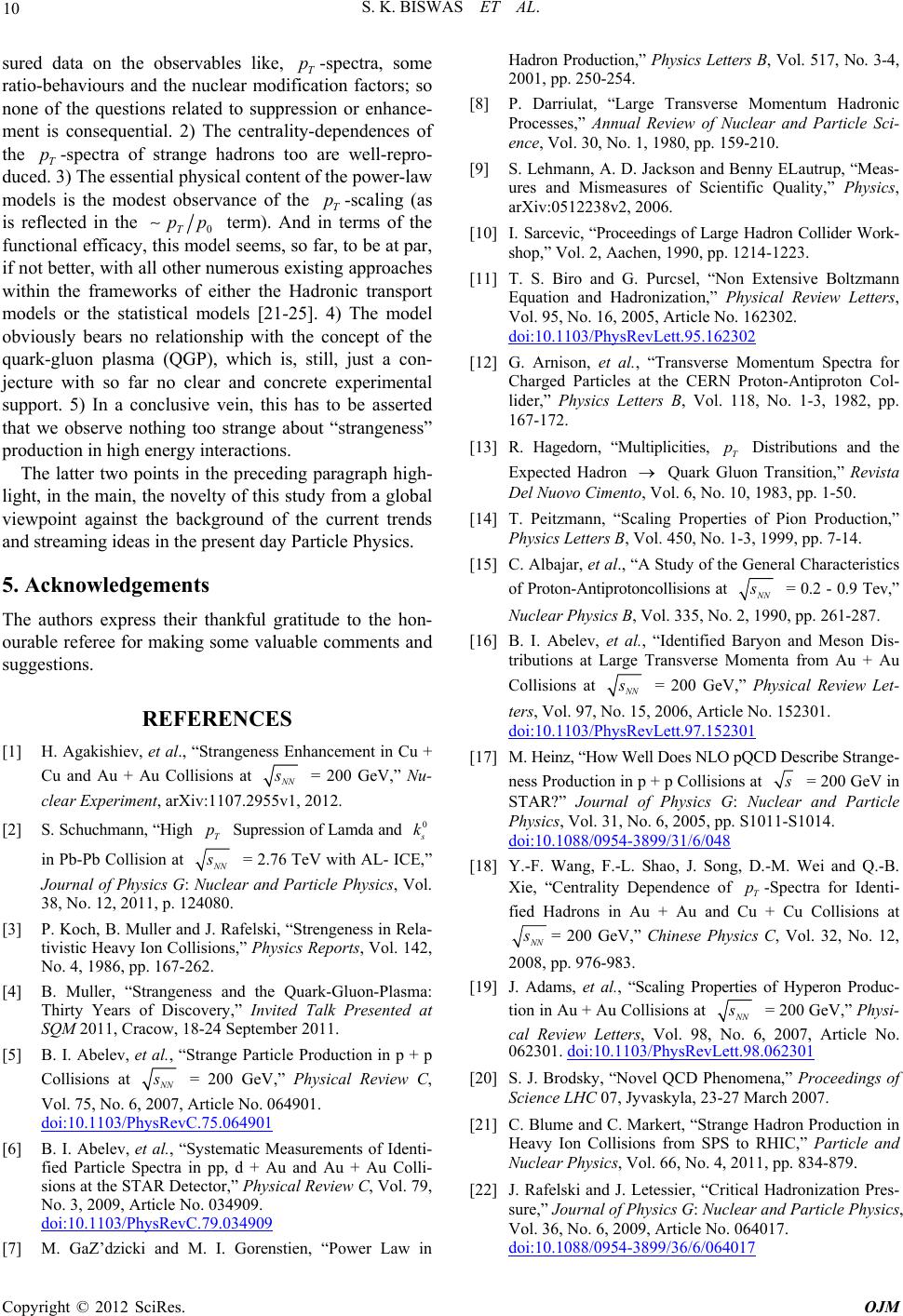 S. K. BISWAS ET AL. 10 sured data on the observables like, T-spectra, some ratio-behaviours and the nuclear modification factors; so none of the questions related to suppression or enhance- ment is consequential. 2) The centrality-dependences of the T-spectra of strange hadrons too are well-repro- duced. 3) The essential physical content of the power-law models is the modest observance of theT p-scaling (as is reflected in the p p 0Tp term). And in terms of the functional efficacy, this model seems, so far, to be at par, if not better, with all other numerous existing approaches within the frameworks of either the Hadronic transport models or the statistical models [21-25]. 4) The model obviously bears no relationship with the concept of the quark-gluon plasma (QGP), which is, still, just a con- jecture with so far no clear and concrete experimental support. 5) In a conclusive vein, this has to be asserted that we observe nothing too strange about “strangeness” production in high energy interactions. p The latter two points in the preceding paragraph high- light, in the main, the novelty of this study from a global viewpoint against the background of the current trends and streaming ideas in the present day Particle Physics. 5. Acknowledgements The authors express their thankful gratitude to the hon- ourable referee for making some valuable comments and suggestions. REFERENCES [1] H. Agakishiev, et al., “Strangeness Enhancement in Cu + Cu and Au + Au Collisions at NN s = 200 GeV,” Nu- clear Experiment, arXiv:1107.2955v1, 2012. [2] S. Schuchmann, “High T p Supression of Lamda and 0 s k in Pb-Pb Collision at NN s = 2.76 TeV with AL- ICE,” Journal of Physics G: Nuclear and Particle Physics, Vol. 38, No. 12, 2011, p. 124080. [3] P. Koch, B. Muller and J. Rafelski, “Strengeness in Rela- tivistic Heavy Ion Collisions,” Physics Reports, Vol. 142, No. 4, 1986, pp. 167-262. [4] B. Muller, “Strangeness and the Quark-Gluon-Plasma: Thirty Years of Discovery,” Invited Talk Presented at SQM 2011, Cracow, 18-24 September 2011. [5] B. I. Abelev, et al., “Strange Particle Production in p + p Collisions at NN s = 200 GeV,” Physical Review C, Vol. 75, No. 6, 2007, Article No. 064901. doi:10.1103/PhysRevC.75.064901 [6] B. I. Abelev, et al., “Systematic Measurements of Identi- fied Particle Spectra in pp, d + Au and Au + Au Colli- sions at the STAR Detector,” Physical Review C, Vol. 79, No. 3, 2009, Article No. 034909. doi:10.1103/PhysRevC.79.034909 [7] M. GaZ’dzicki and M. I. Gorenstien, “Power Law in Hadron Production,” Physics Letters B, Vol. 517, No. 3-4, 2001, pp. 250-254. [8] P. Darriulat, “Large Transverse Momentum Hadronic Processes,” Annual Review of Nuclear and Particle Sci- ence, Vol. 30, No. 1, 1980, pp. 159-210. [9] S. Lehmann, A. D. Jackson and Benny ELautrup, “Meas- ures and Mismeasures of Scientific Quality,” Physics, arXiv:0512238v2, 2006. [10] I. Sarcevic, “Proceedings of Large Hadron Collider Work- shop,” Vol. 2, Aachen, 1990, pp. 1214-1223. [11] T. S. Biro and G. Purcsel, “Non Extensive Boltzmann Equation and Hadronization,” Physical Review Letters, Vol. 95, No. 16, 2005, Article No. 162302. doi:10.1103/PhysRevLett.95.162302 [12] G. Arnison, et al., “Transverse Momentum Spectra for Charged Particles at the CERN Proton-Antiproton Col- lider,” Physics Letters B, Vol. 118, No. 1-3, 1982, pp. 167-172. [13] R. Hagedorn, “Multiplicities, T p Distributions and the Expected Hadron Quark Gluon Transition,” Revista Del Nuovo Cimento, Vol. 6, No. 10, 1983, pp. 1-50. [14] T. Peitzmann, “Scaling Properties of Pion Production,” Physics Letters B, Vol. 450, No. 1-3, 1999, pp. 7-14. [15] C. Albajar, et al., “A Study of the General Characteristics of Proton-Antiprotoncollisions at NN s = 0.2 - 0.9 Tev,” Nuclear Physi c s B, Vol. 335, No. 2, 1990, pp. 261-287. [16] B. I. Abelev, et al., “Identified Baryon and Meson Dis- tributions at Large Transverse Momenta from Au + Au Collisions at NN s = 200 GeV,” Physical Review Let- ters, Vol. 97, No. 15, 2006, Article No. 152301. doi:10.1103/PhysRevLett.97.152301 [17] M. Heinz, “How Well Does NLO pQCD Describe Strange- ness Production in p + p Collisions at s = 200 GeV in STAR?” Journal of Physics G: Nuclear and Particle Physics, Vol. 31, No. 6, 2005, pp. S1011-S1014. doi:10.1088/0954-3899/31/6/048 [18] Y.-F. Wang, F.-L. Shao, J. Song, D.-M. Wei and Q.-B. Xie, “Centrality Dependence of T p -Spectra for Identi- fied Hadrons in Au + Au and Cu + Cu Collisions at NN s = 200 GeV,” Chinese Physics C, Vol. 32, No. 12, 2008, pp. 976-983. [19] J. Adams, et al., “Scaling Properties of Hyperon Produc- tion in Au + Au Collisions at NN s = 200 GeV,” Physi- cal Review Letters, Vol. 98, No. 6, 2007, Article No. 062301. doi:10.1103/PhysRevLett.98.062301 [20] S. J. Brodsky, “Novel QCD Phenomena,” Proceedings of Science LHC 07, Jyvaskyla, 23-27 March 2007. [21] C. Blume and C. Markert, “Strange Hadron Production in Heavy Ion Collisions from SPS to RHIC,” Particle and Nuclear Physi c s, Vol. 66, No. 4, 2011, pp. 834-879. [22] J. Rafelski and J. Letessier, “Critical Hadronization Pres- sure,” Journal of Physics G: Nuclear and Particle Physics, Vol. 36, No. 6, 2009, Article No. 064017. doi:10.1088/0954-3899/36/6/064017 Copyright © 2012 SciRes. OJM  S. K. BISWAS ET AL. Copyright © 2012 SciRes. OJM 11 [23] W. Cassing and E. L. Bratkovskaya, “Hadronic and Elec- tromagnetic Probe of Hot and Dense Nucleon Matter,” Physics Reports, Vol. 308, No. 2-3, 1999, pp. 65-233. [24] G. Torrieri, “My Strange Times with Johann Rafelski,” Proceedings of SQM Conference Polish Academy of Arts and Sciences, Cracow, 2011. [25] G. Torrieri, “Strangeness and Charm in Heavy Ion Colli- sions: Business as Usual or Phase Transition?” Proceed- ings of SQM Conference Polish Academy of Arts and Sciences, Cracow, 2011. |