

Paper Menu >>
Journal Menu >>
 International Journal of Geosciences, 2012, 3, 175-178 http://dx.doi.org/10.4236/ijg.2012.31019 Published Online February 2012 (http://www.SciRP.org/journal/ijg) Mechanism of Elastic Waves Reflection in Geological Media Viktor Sidorov, Michail Tarantin Organization of Russian Academy of Sciences, Mining Institute Ural Branch RAS, Perm, Russia Email: [email protected] Received October 20, 2011; revised November 22, 2011; accepted December 14, 2011 ABSTRACT Reflecting properties of layered geological media are substantiated in the framework of phonon-phonon mechanism of elastic wave propagation in porous media. In this scope the reflectio n coefficient is calculated using not impedances bu t impulses of phonons in adjoining porous media. Assuming for the first approximation that rocks do fulfill an average time equation we got an expression for the reflection coefficient via porosity factors of that geological medium. For calculation of reflection coefficient the wavelength is chosen as averaging line scale. These coefficients are calculated at every depth point for a set of frequencies in seismic range. Resulting curves have special depth points. Being cross- plotted in time-frequency space such points do form coherent units. These units we call effective boundaries, because they cause all reflections for the given media in the framework of considered model. Effective boundaries are not wide-band as for two half spaces but have a cutoff at some low frequency. Geological medium at a whole is character- ized by the system of such effective boundaries that are capable to form a reflection waves field. To construct this field an algorithm is developed that solves the direct problem of seismic in the framework of effective boundaries theory. This algorithm is illustrated with vibroseis survey modeling for a specific geological section. Keywords: Elastic Waves; Phonons; Heterogeneous Media; Reflection Coefficient; Direct Seismic Problem; Effective Seismic Boundaries 1. Introduction We proposed a mechanism of elastic waves propagation in rocks [1] that ju stified an independence of logarithmic decrement on frequency or, equivalent, justified an ab- sence of velocity dispersion when an attenuation does take place. The problem of decrement arose long time ago [2] but is still not solved and the proposed mecha- nism as far as we know is unique. That is why we do not consider many models of elastic waves propagation in heterogeneous media among which the Biot model [3,4] is the most popular. This model describes the elastic waves propagation in the media with the so lid matrix and many recent works attend to it [5-7]. But this model does not comply with the frequency independence of decre- ment. Proposed mechanism supposes the elastic wave propa- gation in heterogeneous media to be the process that is attended and supported by phonon-phonon interactions of a special sort. At that the correspondence is proved of some phonon impulses and their combinations with elas- tic wave parameters. Justification is based on a specific type of heterogeneous medium-porous fluid-saturated rocks with an average ti me equation fulfilled . Th ese were the media where an experimental testing of a proposed mechanism was allowed. For that purposes laboratory data and acoustic logging material in carbonate forma- tions were analyzed [1,8]. The aim of the paper is to substantiate the reflection properties of layered geological media in the framework of phonon-phon on mechanism and to create on that basis an algorithm for solving the direct seismic problem. 2. The Reflection Coefficient Derivation For a special type of porous fluid-saturated media the longitudinal wave propagation is attended and supported by phonon interactions that are described by an impulse conservation law expression: P mPmfl P hmhmhh VV VV (1) In the expression above m denotes the porosity coeffi- cient, VPm—velocity of longitudinal waves in solid ma- trix, Vfl—velocity in the fluid, Vp—velocity in th e porous medium, h is the Plank constant and v is the phonon fre- quency. It is stated in mechanism that phonon’s veloci- ties are equal to that of waves in the co rresponding com- ponents of the porous medium . Phonons with impulses P m mh V and fl mh V are responsible for wave energy dissipation because they are directly proportional to porosity m and frequency v and correspond to attenuation coefficient in porous fluid-sa- C opyright © 2012 SciRes. IJG  V. SIDOROV ET AL. 176 turated media with the average time equation fulfilled. Such kind of media in turn has an attenuation coefficient direct proportional to wave porosity and frequency f [1]: f m . We supposed that reflection properties of a layered geological medium could be gained in the framework of phonon-phonon mechanism. Let’s consider from this point of view the reflection coefficient for two-media boundary. In the common form it could be written as 12 12 pp Rpp pV (2) where p is the impulse, that turns a production of density and velocity for elastic waves and is well- known as impedance. But this time p is the phonon im- pulse: phV . Let’s consider two adjoined media with porosities m1 and m2. Impulses in the reflection coefficient (2) we ex- press from left part o f (1) with poros ities m1 and m2. And so we got 11 11 Pm PmflPm Pm PmflPm mh mhm hh VV VV Rmh mhm hh VV VV 2 2 2 2 Pm fl Pm fl h mh V V h mh V V (3) Simple transformations lead us to: 11 1 () 2 fl Pm mV V V 12 mmm pV R (4) where and V–1 is the average interval time for two media. So we have an expression for reflection coefficient for a boundary of two porous media based on the expression for phonon interaction. It should be marked that exactly the same result could be gained if the reflection coeffi- cient (2) would be expressed via impulses when neglecting density changes an d assuming that in adjo ined media velocities are calculated using the average time equation. But such a definition would be tautological because for porous media the average interval time ex- pression used in this approach is the consequence of the phonon impulse conservation law. The next step is to use the coefficient R to determine the reflection properties of a layered geological media. We suppose from the beginning that rocks could be clas- sified as reference medium-porous fluid-saturated with average time equation fulfilled. Let’s calculate the ex- pression (4) for a moving window along the medium cross-section. At the boundary of two spaces this func- tion will have an extremum corresponded to the real re- flection coefficient for that media boundary (Figure 1(a)). For a single layer calculated function has a shape similar to that shown in Figure 1(b). Two kink points mark the layer boundaries and the corresponding reflec- tion coefficients. As a size of moving window it is natu- rally to take a wavelength because the phonon-phonon interaction is corresponded to the specific elastic wave frequency. And then an algorithm of calculations would be as follows. The log-curve of an interval time (reversal velocity) is transformed from depth-scale into time-scale. The value of frequency fn is set. Along the geological section with a special step moves the interval of a wavelength size with the reference point at the center. Above and below the reference point the function (4) is calculated with m be- ing equal to difference of porosity factors for upper and (a) (b) Figure 1. The view of re flection co efficient cur ves near two half-space boundary (a) and near thin layer (b); dT: interval time of wave, R: reflection coefficient. Copyright © 2012 SciRes. IJG 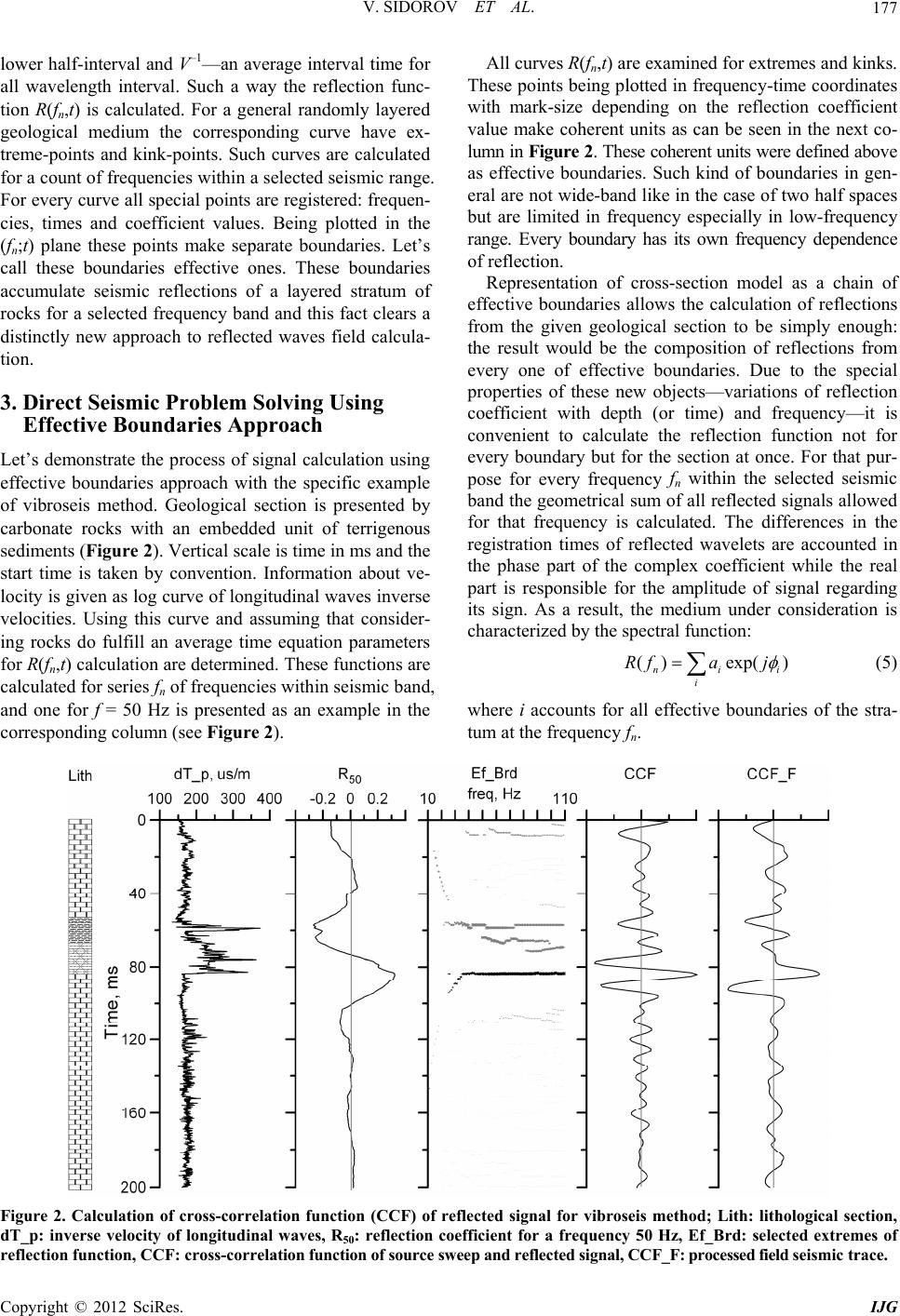 V. SIDOROV ET AL. 177 lower half-interval and V–1—an average interval time for all wavelength interval. Such a way the reflection func- tion R(fn,t) is calculated. For a general randomly layered geological medium the corresponding curve have ex- treme-points and kink-points. Such curves are calculated for a count of frequencies within a selected seismic range. For every curve all special points are registered: frequen- cies, times and coefficient values. Being plotted in the (fn;t) plane these points make separate boundaries. Let’s call these boundaries effective ones. These boundaries accumulate seismic reflections of a layered stratum of rocks for a selected frequency band and this fact clears a distinctly new approach to reflected waves field calcula- tion. 3. Direct Seismic Problem Solving Using Effective Boundaries Approach Let’s demonstrate the process of signal calculation using effective boundaries approach with the specific example of vibroseis method. Geological section is presented by carbonate rocks with an embedded unit of terrigenous sediments (Figure 2). Vertical scale is time in ms and the start time is taken by convention. Information about ve- locity is given as log curve of longitudinal waves inverse velocities. Using this curve and assuming that consider- ing rocks do fulfill an average time equation parameters for R(fn,t) calculation are determined. These functions are calculated for series fn of frequencies within seismic band, and one for f = 50 Hz is presented as an example in the corresponding c ol umn (see Figure 2). All curves R(fn,t) are examined for extremes and kinks. These points being plotted in frequency-time coordinates with mark-size depending on the reflection coefficient value make coherent units as can be seen in the next co- lumn in Figure 2. These coherent units were defined above as effective boundaries. Such kind of boundaries in gen- eral are not wide-band like in the case of two half spaces but are limited in frequency especially in low-frequency range. Every boundary has its own frequency dependence of reflection. Representation of cross-section model as a chain of effective boundaries allows the calculation of reflections from the given geological section to be simply enough: the result would be the composition of reflections from every one of effective boundaries. Due to the special properties of these new objects—variations of reflection coefficient with depth (or time) and frequency—it is convenient to calculate the reflection function not for every boundary but for the section at once. For that pur- pose for every frequency fn within the selected seismic band the geometrical sum of all reflected signals allowed for that frequency is calculated. The differences in the registration times of reflected wavelets are accounted in the phase part of the complex coefficient while the real part is responsible for the amplitude of signal regarding its sign. As a result, the medium under consideration is characterized by the spectral function: ( )exp() nii i Rfa j (5) where i accounts for all effective boundaries of the stra- tum at the frequency fn. Figure 2. Calculation of cross-correlation function (CCF) of reflected signal for vibroseis method; Lith: lithological section, dT_p: inverse velocity of longitudinal waves, R50: reflection coefficient for a frequency 50 Hz, Ef_Brd: selected extremes of reflection function, CCF: cross-correlation function of source sweep and reflected signal, CCF_F: pro ce s sed f iel d seismic trace. Copyright © 2012 SciRes. IJG 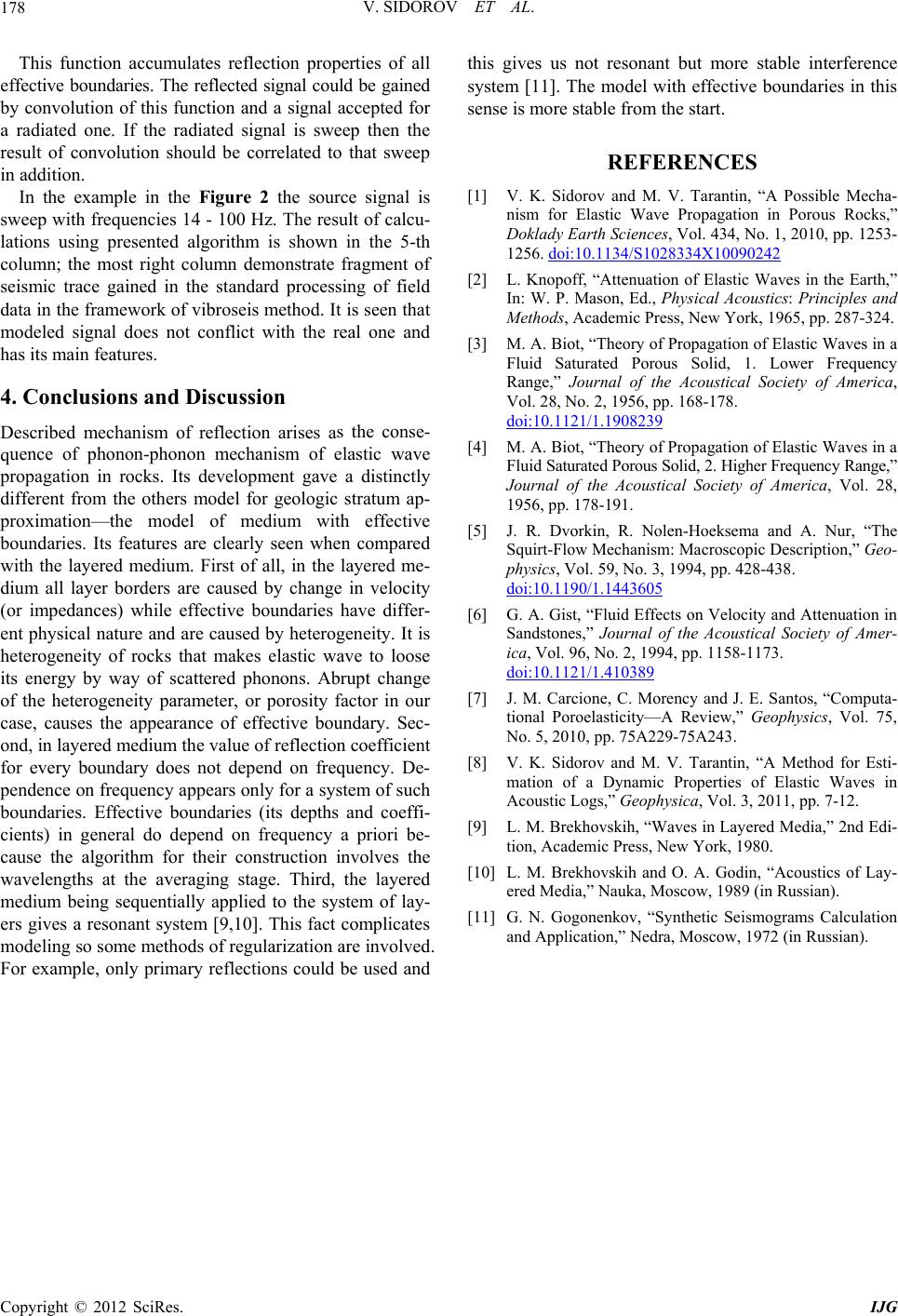 V. SIDOROV ET AL. 178 This function accumulates reflection properties of all this gives us not resonant but more stable interference ef ple in the Figure 2 the source signal is sw 4. Conclusions and Discussion s the conse- REFERENCES [1] V. K. Sidorov Possible Mecha- fective boundaries. The reflected signal could be gained by convolution of this function and a signal accepted for a radiated one. If the radiated signal is sweep then the result of convolution should be correlated to that sweep in addition. In the exam eep with frequencies 14 - 100 Hz. The result of calcu- lations using presented algorithm is shown in the 5-th column; the most right column demonstrate fragment of seismic trace gained in the standard processing of field data in the framework of vibroseis method. It is seen that modeled signal does not conflict with the real one and has its main features. Described mechanism of reflection arises a quence of phonon-phonon mechanism of elastic wave propagation in rocks. Its development gave a distinctly different from the others model for geologic stratum ap- proximation—the model of medium with effective boundaries. Its features are clearly seen when compared with the layered medium. First of all, in the layered me- dium all layer borders are caused by change in velocity (or impedances) while effective boundaries have differ- ent physical nature and are caused by heterogeneity. It is heterogeneity of rocks that makes elastic wave to loose its energy by way of scattered phonons. Abrupt change of the heterogeneity parameter, or porosity factor in our case, causes the appearance of effective boundary. Sec- ond, in layered medium the value of reflection coefficient for every boundary does not depend on frequency. De- pendence on frequency appears only for a system of such boundaries. Effective boundaries (its depths and coeffi- cients) in general do depend on frequency a priori be- cause the algorithm for their construction involves the wavelengths at the averaging stage. Third, the layered medium being sequentially applied to the system of lay- ers gives a resonant system [9,10]. This fact complicates modeling so some methods of regularization are involved. For example, only primary reflections could be used and system [11]. The model with effective boundaries in this sense is more stable from the start. and M. V. Tarantin, “A nism for Elastic Wave Propagation in Porous Rocks,” Doklad y Earth Sc ienc es, Vol. 434, No. 1, 2010, pp. 1253- 1256. doi:10.1134/S1028334X10090242 [2] L. Knopoff, “Attenuation of Elastic Waves in the Earth,” In: W. P. Mason, Ed., Physical Acoustics: Principles and Methods, Academic Press, New York, 1965, pp. 287-324. [3] M. A. Biot, “Theory of Propagation of Elastic Waves in a Fluid Saturated Porous Solid, 1. Lower Frequency Range,” Journal of the Acoustical Society of America, Vol. 28, No. 2, 1956, pp. 168-178. doi:10.1121/1.1908239 [4] M. A. Biot, “Theory of Propagation of Elastic Waves in a Nolen-Hoeksema and A. Nur, “The Flu id Saturated Porous Solid, 2. Highe r Frequenc y Range,” Journal of the Acoustical Society of America, Vol. 28, 1956, pp. 178-191. [5] J. R. Dvorkin, R. Squirt-Flow Mechanism: Macroscopic Description,” Geo- physics, Vol. 59, No. 3, 1994, pp. 428-438. doi:10.1190/1.1443605 [6] G. A. Gist, “Fluid Effects on Velocity and Attenuation in Sandstones,” Journal of the Acoustical Society of Amer- ica, Vol. 96, No. 2, 1994, pp. 1158-1173. doi:10.1121/1.410389 [7] J. M. Carcione, C. Morency and J. E. Santos, “Computa- , “A Method for Esti- Edi- coustics of Lay- ulation tional Poroelasticity—A Review,” Geophysics, Vol. 75, No. 5, 2010, pp. 75A229-75A243. [8] V. K. Sidorov and M. V. Tarantin mation of a Dynamic Properties of Elastic Waves in Acoustic Logs,” Geophysica, Vol. 3, 2011, pp. 7-12. [9] L. M. Brekhovskih, “Waves in Layered Media,” 2nd tion, Academic Press, New York, 1980. [10] L. M. Brekhovskih and O. A. Godin, “A ered Media,” Nauka, Moscow, 1989 (in Russian). [11] G. N. Gogonenkov, “Synthetic Seismograms Calc and Application,” Nedra, Moscow, 1972 (in Russian). Copyright © 2012 SciRes. IJG |