

Paper Menu >>
Journal Menu >>
 International Journal of Geosciences, 2012, 3, 126-132 http://dx.doi.org/10.4236/ijg.2012.31015 Published Online February 2012 (http://www.SciRP.org/journal/ijg) Test of Strain Behavior Model with Radon Anomaly in Seismogenic Area: A Bayesian Melding Approach Pushan Kumar Dutta1,2, Mrinal Kanti Naskar1,2, O. P. Mishra3,4 1Advanced Digital and Embedded System Lab, Electronics and Tele-Communication Department, Jadavpur University, Kolkata, India 2Electronics and Tele-Communication Department, Jadavpur University, Kolkata, India 3SAARC Disaster Management Centre (SDMC), New Delhi, India 4Geological Survey of India, Kolkata, India Email: {ascendent1, opmishra2010.saarc}@gmail.com, [email protected] Received August 18, 2011; revised September 17, 2011; accepted October 25, 2011 ABSTRACT Mathematical models in seismo-geochemical monitoring offer powerful tools for the study and exploration of complex dynamics associated with discharge of radon as the indicator of change of intense—deformed conditions of seismogenic layers or blocks within the lithosphere. Seismic precursory model of radon gas emanation in the process of earthquake prediction research aims to find out the distinct anomaly variation necessary to correlate radon gas with processes of preparation and realization of tectonic earthquakes in long-term and short-term forecasts tectonic earthquakes. The study involves a radon gas volume analytic model to find the correlation of radon fluctuations to stress drop under compression and dilatation strain condition. Here, we present a mathematical inference by observing radon gas emana- tion prior to the occurrence of earthquake that may reduce the uncertainties in models and updating their probability distributions in a Bayesian deterministic model. Using Bayesian melding theorem, we implement an inferential frame- work to understand the process of preparation of tectonic earthquake and concurrent occurrence of radon discharge during a tectonic earthquake phenomena. Bayesian melding for deterministic simulation models was augmented to make use of prior knowledge on correlations between model inputs. The background porosity is used as a priori infor- mation for analyzing the block subjected to inelastic strain. It can be inferred that use of probabilistic framework in- volving exhalation of radon may provide a scenario of earthquake occurrences on recession of the curve that represents a qualitative pattern of radon activity concentration drop, indicating associated stress change within the causative seis- mogenic fault. Using evidence analysis, we propose a joint conditional probability framework model simulation to un- derstand how a single fracture may be affected in response to an external load and radon anomaly change that can be used to detect the slip, a predictable nature of the causative fault in the subsurface rock. Keywords: Radon; Deterministic Model; Probability Distribution; Strain, Bayesian Melding; Seismogenic Layer; Earthquake Prediction 1. Introduction Geochemical and hydrological phenomena has attracted much attention in the study of the process of earthquake prediction studies to detect anomalous change in the con- centration of subsurface gas prior to an earthquake. There are many published records and evaluation studies on geochemical precursors reporting the detection of valida- ted precursory phenomenon between geochemical data and seismic activity [1]. Anomalous change in subsurface soil gas radon concentration have been observed to pre- cede earthquake occurrence and therefore radon has po- tential use in earthquake prediction studies [2]. The first evidence of a precursory correlation between radon and earthquake occurrence came from observation of radon concentration in well water prior to the Tashkent earth- quake of 1966 [3].The radon gets effected by opening or closing of cracks resulting releasing or confining the gas in deep earth. Crustal stress change creates new solid-fluid interfaces resulting in more than one pathways for the emanation of radon. Earthquake occurs in three phases of quasi elastic strain of compression and dilatation phe- nomena where strain decrease or increase has a subse- quent impact on the radon activity. The process of earth- quake occurrence is always accompanied by strain defor- mations resulting in the phenomena of complex short- or long-term anomalous variations [4] of radon concentra- tion in groundwater and soil gases prior to earthquakes reported from various regions of the world [5]. It was ob- served by [6] a radon anomaly which coincided with se- veral other geophysical and geochemical anomalies and appeared to have been associated with an earthquake. The C opyright © 2012 SciRes. IJG 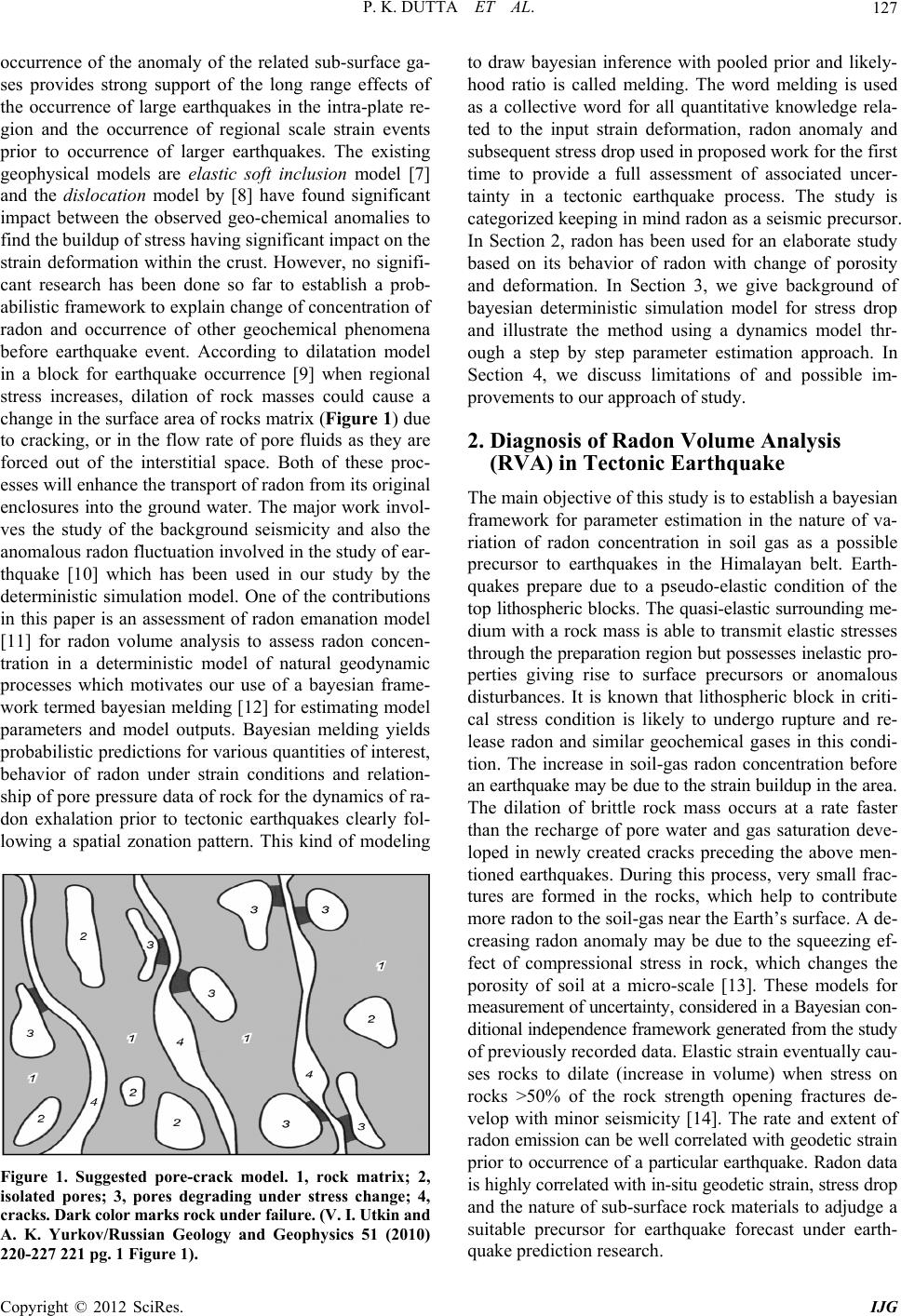 P. K. DUTTA ET AL. 127 occurrence of the anomaly of the related sub-surface ga- ses provides strong support of the long range effects of the occurrence of large earthquakes in the intra-plate re- gion and the occurrence of regional scale strain events prior to occurrence of larger earthquakes. The existing geophysical models are elastic soft inclusion model [7] and the dislocation model by [8] have found significant impact between the observed geo-chemical anomalies to find the buildup of stress having significant impact on the strain deformation within the crust. However, no signifi- cant research has been done so far to establish a prob- abilistic framework to explain change of concentration of radon and occurrence of other geochemical phenomena before earthquake event. According to dilatation model in a block for earthquake occurrence [9] when regional stress increases, dilation of rock masses could cause a change in the surface area of rocks matrix (Figure 1) due to cracking, or in the flow rate of pore fluids as they are forced out of the interstitial space. Both of these proc- esses will enhance the transport of radon from its original enclosures into the ground water. The major work invol- ves the study of the background seismicity and also the anomalous radon fluctuation involved in the study of ear- thquake [10] which has been used in our study by the deterministic simulation model. One of the contributions in this paper is an assessment of radon emanation model [11] for radon volume analysis to assess radon concen- tration in a deterministic model of natural geodynamic processes which motivates our use of a bayesian frame- work termed bayesian melding [12] for estimating model parameters and model outputs. Bayesian melding yields probabilistic predictions for various quantities of interest, behavior of radon under strain conditions and relation- ship of pore pressure data of rock for the dynamics of ra- don exhalation prior to tectonic earthquakes clearly fol- lowing a spatial zonation pattern. This kind of modeling Figure 1. Suggested pore-crack model. 1, rock matrix; 2, isolated pores; 3, pores degrading under stress change; 4, cracks. Dark color marks rock under failure. (V. I. Utkin and A. K. Yurkov/Russian Geology and Geophysics 51 (2010) 220-227 221 pg. 1 Figure 1). to draw bayesian inference with pooled prior and likely- hood ratio is called melding. The word melding is used as a collective word for all quantitative knowledge rela- ted to the input strain deformation, radon anomaly and subsequent stress drop used in proposed work for the first time to provide a full assessment of associated uncer- tainty in a tectonic earthquake process. The study is categorized keeping in mind radon as a seismic precursor. In Section 2, radon has been used for an elaborate study based on its behavior of radon with change of porosity and deformation. In Section 3, we give background of bayesian deterministic simulation model for stress drop and illustrate the method using a dynamics model thr- ough a step by step parameter estimation approach. In Section 4, we discuss limitations of and possible im- provements to our approach of study. 2. Diagnosis of Radon Volume Analysis (RVA) in Tectonic Earthquake The main objective of this study is to establish a bayesian framework for parameter estimation in the nature of va- riation of radon concentration in soil gas as a possible precursor to earthquakes in the Himalayan belt. Earth- quakes prepare due to a pseudo-elastic condition of the top lithospheric blocks. The quasi-elastic surrounding me- dium with a rock mass is able to transmit elastic stresses through the preparation region but possesses inelastic pro- perties giving rise to surface precursors or anomalous disturbances. It is known that lithospheric block in criti- cal stress condition is likely to undergo rupture and re- lease radon and similar geochemical gases in this condi- tion. The increase in soil-gas radon concentration before an earthquake may be due to the strain buildup in the area. The dilation of brittle rock mass occurs at a rate faster than the recharge of pore water and gas saturation deve- loped in newly created cracks preceding the above men- tioned earthquakes. During this process, very small frac- tures are formed in the rocks, which help to contribute more radon to the soil-gas near the Earth’s surface. A de- creasing radon anomaly may be due to the squeezing ef- fect of compressional stress in rock, which changes the porosity of soil at a micro-scale [13]. These models for measurement of uncertainty, considered in a Bayesian con- ditional independence framework generated from the study of previously recorded data. Elastic strain eventually cau- ses rocks to dilate (increase in volume) when stress on rocks >50% of the rock strength opening fractures de- velop with minor seismicity [14]. The rate and extent of radon emission can be well correlated with geodetic strain prior to occurrence of a particular earthquake. Radon data is highly correlated with in-situ geodetic strain, stress drop and the nature of sub-surface rock materials to adjudge a suitable precursor for earthquake forecast under earth- quake prediction research. Copyright © 2012 SciRes. IJG 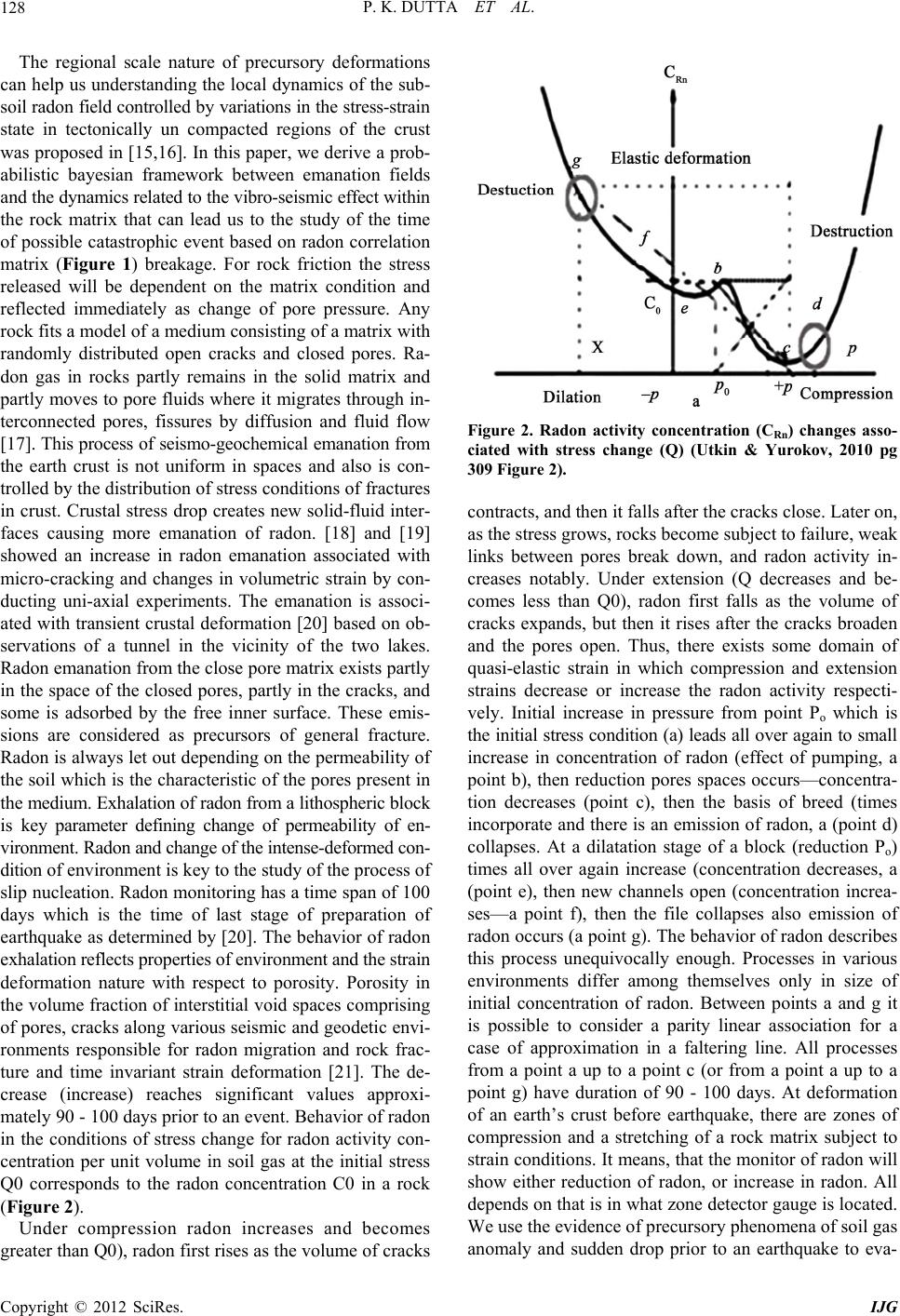 P. K. DUTTA ET AL. 128 The regional scale nature of precursory deformations can help us understanding the local dynamics of the sub- soil radon field controlled by variations in the stress-strain state in tectonically un compacted regions of the crust was proposed in [15,16]. In this paper, we derive a prob- abilistic bayesian framework between emanation fields and the dynamics related to the vibro-seismic effect within the rock matrix that can lead us to the study of the time of possible catastrophic event based on radon correlation matrix (Figure 1) breakage. For rock friction the stress released will be dependent on the matrix condition and reflected immediately as change of pore pressure. Any rock fits a model of a medium consisting of a matrix with randomly distributed open cracks and closed pores. Ra- don gas in rocks partly remains in the solid matrix and partly moves to pore fluids where it migrates through in- terconnected pores, fissures by diffusion and fluid flow [17]. This process of seismo-geochemical emanation from the earth crust is not uniform in spaces and also is con- trolled by the distribution of stress conditions of fractures in crust. Crustal stress drop creates new solid-fluid inter- faces causing more emanation of radon. [18] and [19] showed an increase in radon emanation associated with micro-cracking and changes in volumetric strain by con- ducting uni-axial experiments. The emanation is associ- ated with transient crustal deformation [20] based on ob- servations of a tunnel in the vicinity of the two lakes. Radon emanation from the close pore matrix exists partly in the space of the closed pores, partly in the cracks, and some is adsorbed by the free inner surface. These emis- sions are considered as precursors of general fracture. Radon is always let out depending on the permeability of the soil which is the characteristic of the pores present in the medium. Exhalation of radon from a lithospheric block is key parameter defining change of permeability of en- vironment. Radon and change of the intense-deformed con- dition of environment is key to the study of the process of slip nucleation. Radon monitoring has a time span of 100 days which is the time of last stage of preparation of earthquake as determined by [20]. The behavior of radon exhalation reflects properties of environment and the strain deformation nature with respect to porosity. Porosity in the volume fraction of interstitial void spaces comprising of pores, cracks along various seismic and geodetic envi- ronments responsible for radon migration and rock frac- ture and time invariant strain deformation [21]. The de- crease (increase) reaches significant values approxi- mately 90 - 100 days prior to an event. Behavior of radon in the conditions of stress change for radon activity con- centration per unit volume in soil gas at the initial stress Q0 corresponds to the radon concentration C0 in a rock (Figure 2). Under compression radon increases and becomes greater than Q0), radon first rises as the volume of cracks Figure 2. Radon activity concentration (CRn) changes asso- ciated with stress change (Q) (Utkin & Yurokov, 2010 pg 309 Figure 2). contracts, and then it falls after the cracks close. Later on, as the stress grows, rocks become subject to failure, weak links between pores break down, and radon activity in- creases notably. Under extension (Q decreases and be- comes less than Q0), radon first falls as the volume of cracks expands, but then it rises after the cracks broaden and the pores open. Thus, there exists some domain of quasi-elastic strain in which compression and extension strains decrease or increase the radon activity respecti- vely. Initial increase in pressure from point Ро which is the initial stress condition (a) leads all over again to small increase in concentration of radon (effect of pumping, a point b), then reduction pores spaces occurs—concentra- tion decreases (point c), then the basis of breed (times incorporate and there is an emission of radon, a (point d) collapses. At a dilatation stage of a block (reduction Рo) times all over again increase (concentration decreases, a (point e), then new channels open (concentration increa- ses—a point f), then the file collapses also emission of radon occurs (a point g). The behavior of radon describes this process unequivocally enough. Processes in various environments differ among themselves only in size of initial concentration of radon. Between points a and g it is possible to consider a parity linear association for a case of approximation in a faltering line. All processes from a point a up to a point c (or from a point a up to a point g) have duration of 90 - 100 days. At deformation of an earth’s crust before earthquake, there are zones of compression and a stretching of a rock matrix subject to strain conditions. It means, that the monitor of radon will show either reduction of radon, or increase in radon. All depends on that is in what zone detector gauge is located. We use the evidence of precursory phenomena of soil gas anomaly and sudden drop prior to an earthquake to eva- Copyright © 2012 SciRes. IJG  P. K. DUTTA ET AL. 129 luate the posterior odds of strain deformation increase. If a lithospherical block is not in a critical condition or is under pressure any trigger’s function cannot cause earth- quake. The lithospheric block should save up energy that could lead to a discharge of a pressure of a block. Thus the stronger external influence, the greater energy dump and the more strong aseismic faulting takes place. Induc- tive probability approach has been implemented in un- derstanding radon anomaly decline before large earth- quake. From local, regional, or global perspectives, one of the scientific conditions to our understanding is of the extreme event of reaching strain deformation condition and the corresponding likelihood of its occurrence. 3. Diagnosis of Radon Volume Data Analysis The prior odds and likelihood described above are com- bined to produce the posterior distribution that is used to make inference about the parameters, as well as prob- abilistic forecasts through a method of study of experi- mental or field data to reduce the uncertainties in models, by updating those probability distributions. Proper han- dling of such uncertainties is key to the successful usage of models to predict experimental or field observations. This problem has been addressed over the years by many tools for model calibration and parameter estimation. In this article we present a general framework for uncer- tainty analysis and parameter estimation that is designed to handle uncertainties associated with the modeling of dynamic models. 3.1. Bayesian Melding A growing theme in mathematical modeling of environ- mental study is uncertainty analysis. Bayesian melding, a method for assessing uncertainties in deterministic simu- lation models, was augmented to make use of prior know- ledge about correlations between model inputs. The meld- ing module provides a bayesian framework to analyze uncertainty in mathematical models. The method was developed initially for deterministic simulation models and can be applied to crack propogation model in homo- genous hierarchial medium with uniform stress when the strain deformation reaches the maximum value [22] in- cludes tools that allow modelers to integrate prior infor- mation about the model’s parameters and variables into the model, in order to explore the full uncertainty associ- ated with a model. The posterior distributions are estima- ted by sampling-importance-resampling [23]. We apply a posterior density that is proportional to the prior density times the likelihood. Bayesian melding is a way of put- ting the analysis of simulation models on a solid statistic- cal basis. In such cases, it may be interesting to use this information, to estimate the parameter values which ma- ximize the fit of our model to the data, number of sam- ples we will take from the joint prior distribution of the parameters to run the inference. The basic idea is to com- bine all the available evidence about model inputs and model outputs in a coherent bayesian way to yield a ba- yesian posterior distribution of the quantities of interest. We have H1, which is our hypothesis that a strain defor- mation increases with radon anomaly change G with po- rosity and rupture breakage E being our evidence. The analysis for this paper consists of three parts, involves re- plicating radon variation analysis; estimates the parame- ters and comparing them to the estimates obtained via Bayesian melding (BM) with the help of data (model se- lection) and estimate data which cannot be directly ob- served, with the help of theory for arguments (parameter estimation). Bayesian arguments give an expectation val- ue of radon anomaly change with pore pressure when a certain lithospherical block undergoes deformation of N number of blocks. This framework help us realize the ex- pectation as how any two blocks can undergo slip patch with the variation in the radon anomaly drop prior to any earthquake. However the pore precipitation, the spatial distribution of the generation rate of the background evi- dence is difficult to perceive and deviates from one sur- rounding to another. 3.2. Algorithm Defining the models parameters and initial conditions, and a function which takes in the parameters runs the model and returns the output. We have assimilated a sui- table algorithm for radon volume data analyses to detect the slip, a predictive nature of the causative fault in the sub-surface rock. 1) A random sample of size M from the values of 0 from its prior distribution qθ(θ). denote the sample by (01,02,···,0M). 2) Estimating finite mixtures by determining the num- ber of terms or component densities c in the mixture thr- ough an initial guess at the component parameters mixing coefficients, means, and covariance matrices for each mul- tivariate normal density. 3) Calculate the posterior probability and the current values of the parameters as the 1-Step. 4) Update the mixing coefficients, the means, and the covariance matrices for the individual components. This is the 2-Step. 5) Continue the iteration until the changes in the esti- mates at each iteration are less than some pre-set toler- ance. 6) Keep iterating until the likelihood function converges. 7) Instantiate our fitting Object. 8) Instantiate few arguments: the first n number of samples we will take from the joint prior distribution of the parameters to run the inference. The second one (mo- del) is the callable (function) which corresponds to the model you want to fit to data. Copyright © 2012 SciRes. IJG 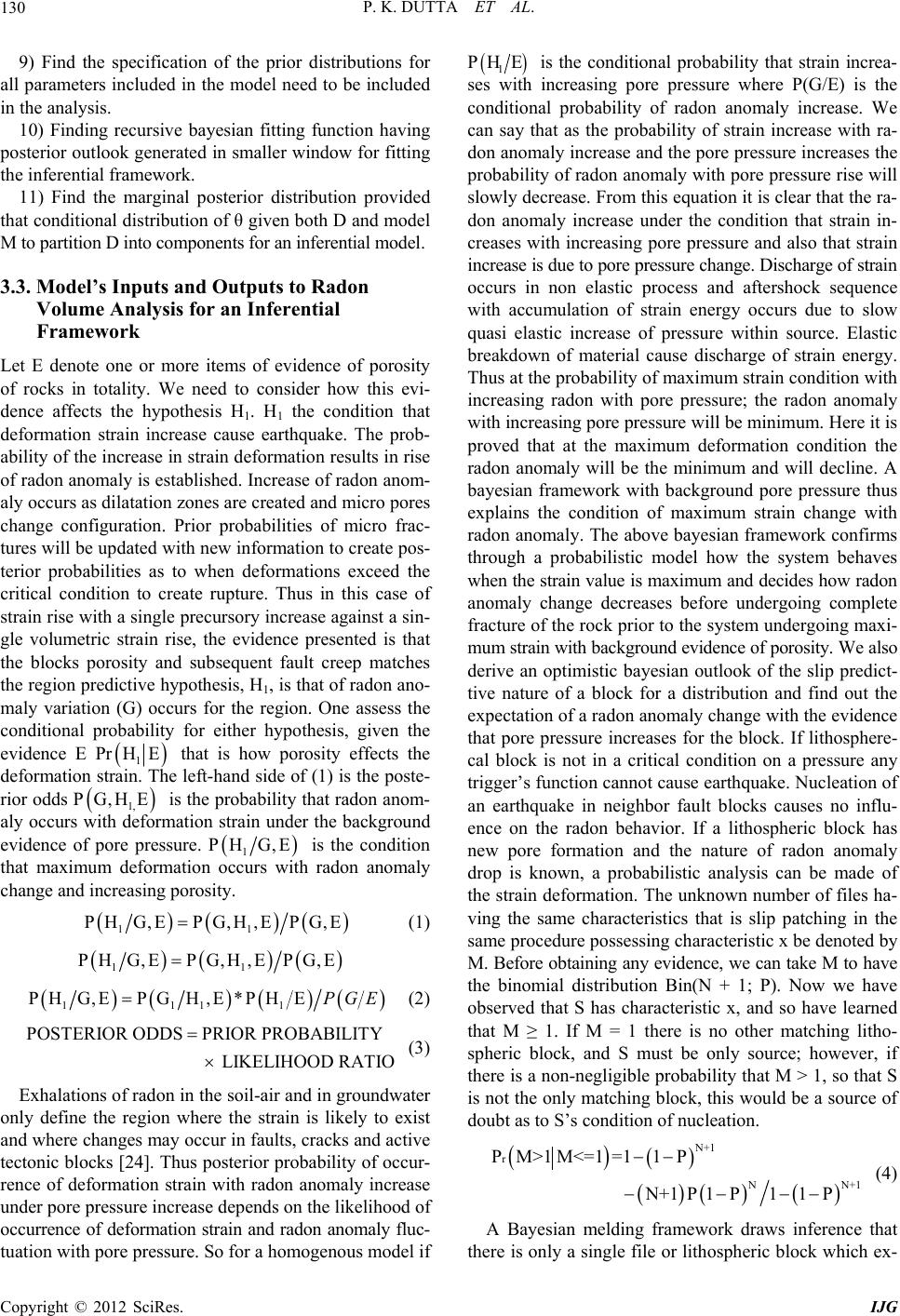 P. K. DUTTA ET AL. 130 9) Find the specification of the prior distributions for all parameters included in the model need to be included in the analysis. 10) Finding recursive bayesian fitting function having posterior outlook generated in smaller window for fitting the inferential framework. 11) Find the marginal posterior distribution provided that conditional distribution of θ given both D and model M to partition D into components for an inferential model. 3.3. Model’s Inputs and Outputs to Radon Volume Analysis for an Inferential Framework Let E denote one or more items of evidence of porosity of rocks in totality. We need to consider how this evi- dence affects the hypothesis H1. H1 the condition that deformation strain increase cause earthquake. The prob- ability of the increase in strain deformation results in rise of radon anomaly is established. Increase of radon anom- aly occurs as dilatation zones are created and micro pores change configuration. Prior probabilities of micro frac- tures will be updated with new information to create pos- terior probabilities as to when deformations exceed the critical condition to create rupture. Thus in this case of strain rise with a single precursory increase against a sin- gle volumetric strain rise, the evidence presented is that the blocks porosity and subsequent fault creep matches the region predictive hypothesis, H1, is that of radon ano- maly variation (G) occurs for the region. One assess the conditional probability for either hypothesis, given the evidence E Pr H E G,H E 1 that is how porosity effects the deformation strain. The left-hand side of (1) is the poste- rior odds P 1, is the probability that radon anom- aly occurs with deformation strain under the background evidence of pore pressure. P HG,E 1 is the condition that maximum deformation occurs with radon anomaly change and increasing porosity. 1 P HG,EP G,H1 ,EP G,E (1) 1 P HG,EP G,H1 ,EP G,E 111 PH G,EPGH,E*PH1 EPGE OBABILITY OD RATIO (2) POSTERIOR ODDSPRIOR PR LIKELIHO (3) Exhalations of radon in the soil-air and in groundwater only define the region where the strain is likely to exist and where changes may occur in faults, cracks and active tectonic blocks [24]. Thus posterior probability of occur- rence of deformation strain with radon anomaly increase under pore pressure increase depends on the likelihood of occurrence of deformation strain and radon anomaly fluc- tuation with pore pressure. So for a homogenous model if P 1 is the conditional probability that strain increa- ses with increasing pore pressure where P(G/E) is the conditional probability of radon anomaly increase. We can say that as the probability of strain increase with ra- don anomaly increase and the pore pressure increases the probability of radon anomaly with pore pressure rise will slowly decrease. From this equation it is clear that the ra- don anomaly increase under the condition that strain in- creases with increasing pore pressure and also that strain increase is due to pore pressure change. Discharge of strain occurs in non elastic process and aftershock sequence with accumulation of strain energy occurs due to slow quasi elastic increase of pressure within source. Elastic breakdown of material cause discharge of strain energy. Thus at the probability of maximum strain condition with increasing radon with pore pressure; the radon anomaly with increasing pore pressure will be minimum. Here it is proved that at the maximum deformation condition the radon anomaly will be the minimum and will decline. A bayesian framework with background pore pressure thus explains the condition of maximum strain change with radon anomaly. The above bayesian framework confirms through a probabilistic model how the system behaves when the strain value is maximum and decides how radon anomaly change decreases before undergoing complete fracture of the rock prior to the system undergoing maxi- mum strain with background evidence of porosity. We also derive an optimistic bayesian outlook of the slip predict- tive nature of a block for a distribution and find out the expectation of a radon anomaly change with the evidence that pore pressure increases for the block. If lithosphere- cal block is not in a critical condition on a pressure any trigger’s function cannot cause earthquake. Nucleation of an earthquake in neighbor fault blocks causes no influ- ence on the radon behavior. If a lithospheric block has new pore formation and the nature of radon anomaly drop is known, a probabilistic analysis can be made of the strain deformation. The unknown number of files ha- ving the same characteristics that is slip patching in the same procedure possessing characteristic x be denoted by M. Before obtaining any evidence, we can take M to have the binomial distribution Bin(N + 1; P). Now we have observed that S has characteristic x, and so have learned that M ≥ 1. If M = 1 there is no other matching litho- spheric block, and S must be only source; however, if there is a non-negligible probability that M > 1, so that S is not the only matching block, this would be a source of doubt as to S’s condition of nucleation. H E N+1 r NN+1 PM>1 M<=1=11P N+1 P 1P11P (4) A Bayesian melding framework draws inference that there is only a single file or lithospheric block which ex- Copyright © 2012 SciRes. IJG 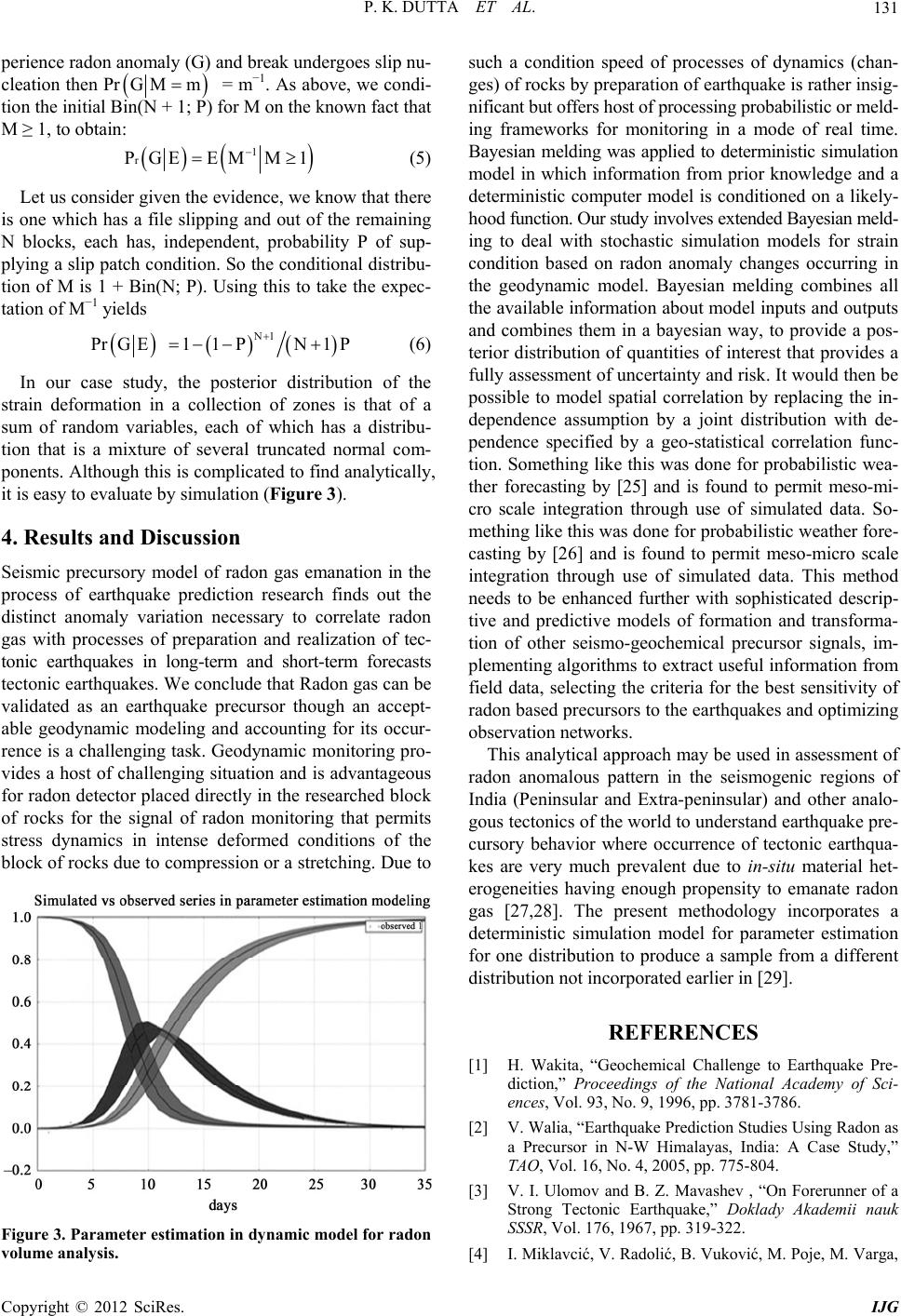 P. K. DUTTA ET AL. 131 perience radon anomaly (G) and break undergoes slip nu- cleation then Pr = m−1. As above, we condi- tion the initial Bin(N + 1; P) for M on the known fact that M ≥ 1, to obtain: GM m 1 EMM 1 r PGE (5) Let us consider given the evidence, we know that there is one which has a file slipping and out of the remaining N blocks, each has, independent, probability P of sup- plying a slip patch condition. So the conditional distribu- tion of M is 1 + Bin(N; P). Using this to take the expec- tation of M−1 yields N1 N1P PrGE 11P (6) In our case study, the posterior distribution of the strain deformation in a collection of zones is that of a sum of random variables, each of which has a distribu- tion that is a mixture of several truncated normal com- ponents. Although this is complicated to find analytically, it is easy to evaluate by simulation (Figure 3). 4. Results and Discussion Seismic precursory model of radon gas emanation in the process of earthquake prediction research finds out the distinct anomaly variation necessary to correlate radon gas with processes of preparation and realization of tec- tonic earthquakes in long-term and short-term forecasts tectonic earthquakes. We conclude that Radon gas can be validated as an earthquake precursor though an accept- able geodynamic modeling and accounting for its occur- rence is a challenging task. Geodynamic monitoring pro- vides a host of challenging situation and is advantageous for radon detector placed directly in the researched block of rocks for the signal of radon monitoring that permits stress dynamics in intense deformed conditions of the block of rocks due to compression or a stretching. Due to Figure 3. Parameter estimation in dynamic model for radon volume analysis. such a condition speed of processes of dynamics (chan- ges) of rocks by preparation of earthquake is rather insig- nificant but offers host of processing probabilistic or meld- ing frameworks for monitoring in a mode of real time. Bayesian melding was applied to deterministic simulation model in which information from prior knowledge and a deterministic computer model is conditioned on a likely- hood function. Our study involves extended Bayesian meld- ing to deal with stochastic simulation models for strain condition based on radon anomaly changes occurring in the geodynamic model. Bayesian melding combines all the available information about model inputs and outputs and combines them in a bayesian way, to provide a pos- terior distribution of quantities of interest that provides a fully assessment of uncertainty and risk. It would then be possible to model spatial correlation by replacing the in- dependence assumption by a joint distribution with de- pendence specified by a geo-statistical correlation func- tion. Something like this was done for probabilistic wea- ther forecasting by [25] and is found to permit meso-mi- cro scale integration through use of simulated data. So- mething like this was done for probabilistic weather fore- casting by [26] and is found to permit meso-micro scale integration through use of simulated data. This method needs to be enhanced further with sophisticated descrip- tive and predictive models of formation and transforma- tion of other seismo-geochemical precursor signals, im- plementing algorithms to extract useful information from field data, selecting the criteria for the best sensitivity of radon based precursors to the earthquakes and optimizing observation networks. This analytical approach may be used in assessment of radon anomalous pattern in the seismogenic regions of India (Peninsular and Extra-peninsular) and other analo- gous tectonics of the world to understand earthquake pre- cursory behavior where occurrence of tectonic earthqua- kes are very much prevalent due to in-situ material het- erogeneities having enough propensity to emanate radon gas [27,28]. The present methodology incorporates a deterministic simulation model for parameter estimation for one distribution to produce a sample from a different distribution not incorporated earlier in [29]. REFERENCES [1] H. Wakita, “Geochemical Challenge to Earthquake Pre- diction,” Proceedings of the National Academy of Sci- ences, Vol. 93, No. 9, 1996, pp. 3781-3786. [2] V. Walia, “Earthquake Prediction Studies Using Radon as a Precursor in N-W Himalayas, India: A Case Study,” TAO, Vol. 16, No. 4, 2005, pp. 775-804. [3] V. I. Ulomov and B. Z. Mavashev , “On Forerunner of a Strong Tectonic Earthquake,” Doklady Akademii nauk SSSR, Vol. 176, 1967, pp. 319-322. [4] I. Miklavcić, V. Radolić, B. Vuković, M. Poje, M. Varga, Copyright © 2012 SciRes. IJG 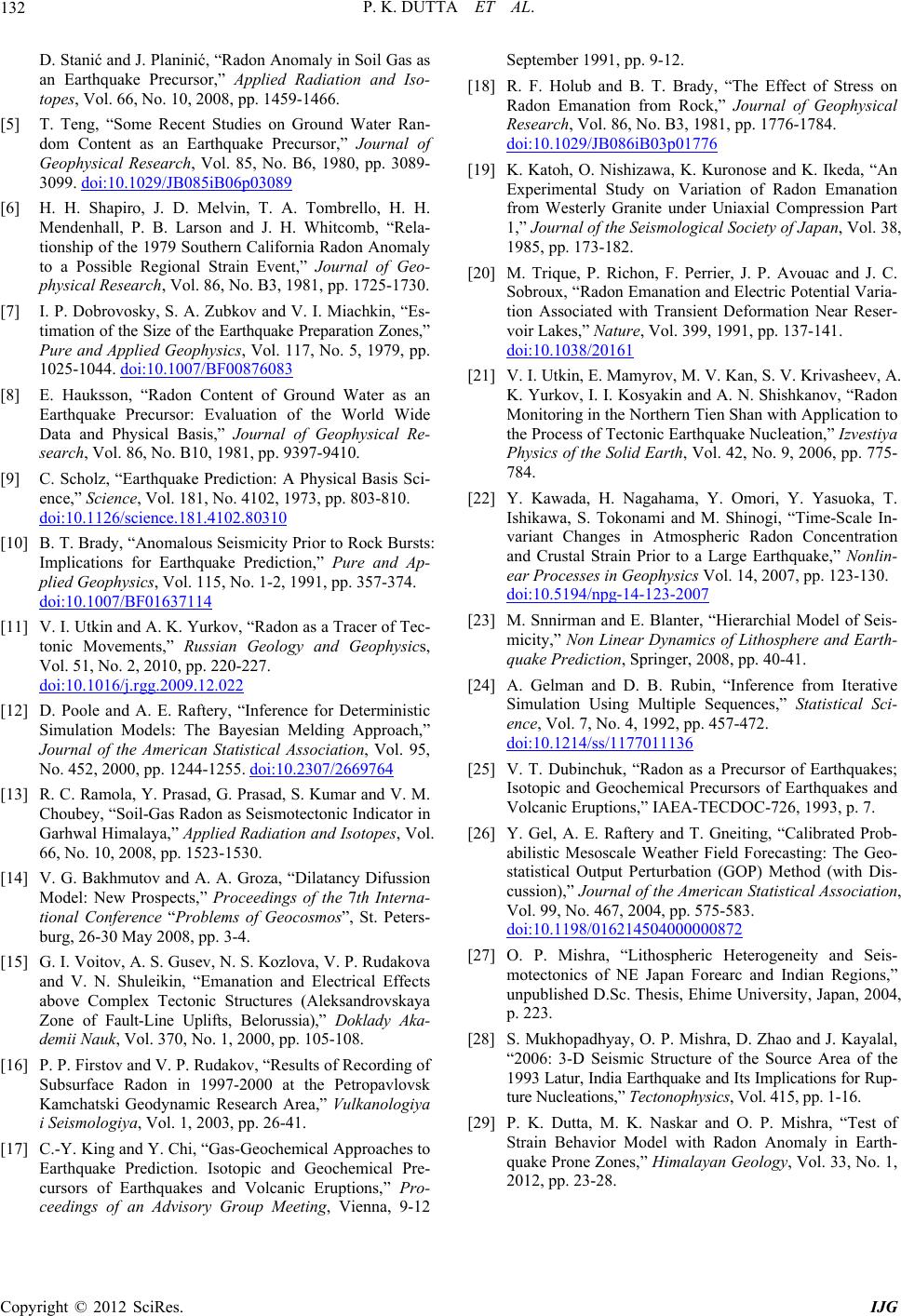 P. K. DUTTA ET AL. Copyright © 2012 SciRes. IJG 132 D. Stanić and J. Planinić, “Radon Anomaly in Soil Gas as an Earthquake Precursor,” Applied Radiation and Iso- topes, Vol. 66, No. 10, 2008, pp. 1459-1466. [5] T. Teng, “Some Recent Studies on Ground Water Ran- dom Content as an Earthquake Precursor,” Journal of Geophysical Research, Vol. 85, No. B6, 1980, pp. 3089- 3099. doi:10.1029/JB085iB06p03089 [6] H. H. Shapiro, J. D. Melvin, T. A. Tombrello, H. H. Mendenhall, P. B. Larson and J. H. Whitcomb, “Rela- tionship of the 1979 Southern California Radon Anomaly to a Possible Regional Strain Event,” Journal of Geo- physical Research, Vol. 86, No. B3, 1981, pp. 1725-1730. [7] I. P. Dobrovosky, S. A. Zubkov and V. I. Miachkin, “Es- timation of the Size of the Earthquake Preparation Zones,” Pure and Applied Geophysics, Vol. 117, No. 5, 1979, pp. 1025-1044. doi:10.1007/BF00876083 [8] E. Hauksson, “Radon Content of Ground Water as an Earthquake Precursor: Evaluation of the World Wide Data and Physical Basis,” Journal of Geophysical Re- search, Vol. 86, No. B10, 1981, pp. 9397-9410. [9] C. Scholz, “Earthquake Prediction: A Physical Basis Sci- ence,” Science, Vol. 181, No. 4102, 1973, pp. 803-810. doi:10.1126/science.181.4102.80310 [10] B. T. Brady, “Anomalous Seismicity Prior to Rock Bursts: Implications for Earthquake Prediction,” Pure and Ap- plied Geophysics, Vol. 115, No. 1-2, 1991, pp. 357-374. doi:10.1007/BF01637114 [11] V. I. Utkin and A. K. Yurkov, “Radon as a Tracer of Tec- tonic Movements,” Russian Geology and Geophysics, Vol. 51, No. 2, 2010, pp. 220-227. doi:10.1016/j.rgg.2009.12.022 [12] D. Poole and A. E. Raftery, “Inference for Deterministic Simulation Models: The Bayesian Melding Approach,” Journal of the American Statistical Association, Vol. 95, No. 452, 2000, pp. 1244-1255. doi:10.2307/2669764 [13] R. C. Ramola, Y. Prasad, G. Prasad, S. Kumar and V. M. Choubey, “Soil-Gas Radon as Seismotectonic Indicator in Garhwal Himalaya,” Applied Radiation and Isotopes, Vol. 66, No. 10, 2008, pp. 1523-1530. [14] V. G. Bakhmutov and A. A. Groza, “Dilatancy Difussion Model: New Prospects,” Proceedings of the 7th Interna- tional Conference “Problems of Geocosmos”, St. Peters- burg, 26-30 May 2008, pp. 3-4. [15] G. I. Voitov, A. S. Gusev, N. S. Kozlova, V. P. Rudakova and V. N. Shuleikin, “Emanation and Electrical Effects above Complex Tectonic Structures (Aleksandrovskaya Zone of Fault-Line Uplifts, Belorussia),” Doklady Aka- demii Nauk, Vol. 370, No. 1, 2000, pp. 105-108. [16] P. P. Firstov and V. P. Rudakov, “Results of Recording of Subsurface Radon in 1997-2000 at the Petropavlovsk Kamchatski Geodynamic Research Area,” Vulkanologiya i Seismologiya, Vol. 1, 2003, pp. 26-41. [17] C.-Y. King and Y. Chi, “Gas-Geochemical Approaches to Earthquake Prediction. Isotopic and Geochemical Pre- cursors of Earthquakes and Volcanic Eruptions,” Pro- ceedings of an Advisory Group Meeting, Vienna, 9-12 September 1991, pp. 9-12. [18] R. F. Holub and B. T. Brady, “The Effect of Stress on Radon Emanation from Rock,” Journal of Geophysical Research, Vol. 86, No. B3, 1981, pp. 1776-1784. doi:10.1029/JB086iB03p01776 [19] K. Katoh, O. Nishizawa, K. Kuronose and K. Ikeda, “An Experimental Study on Variation of Radon Emanation from Westerly Granite under Uniaxial Compression Part 1,” Journal of the Seismological Society of Japan, Vol. 38, 1985, pp. 173-182. [20] M. Trique, P. Richon, F. Perrier, J. P. Avouac and J. C. Sobroux, “Radon Emanation and Electric Potential Varia- tion Associated with Transient Deformation Near Reser- voir Lakes,” Nature, Vol. 399, 1991, pp. 137-141. doi:10.1038/20161 [21] V. I. Utkin, E. Mamyrov, M. V. Kan, S. V. Krivasheev, A. K. Yurkov, I. I. Kosyakin and A. N. Shishkanov, “Radon Monitoring in the Northern Tien Shan with Application to the Process of Tectonic Earthquake Nucleation,” Izvestiya Physics of the Solid Earth, Vol. 42, No. 9, 2006, pp. 775- 784. [22] Y. Kawada, H. Nagahama, Y. Omori, Y. Yasuoka, T. Ishikawa, S. Tokonami and M. Shinogi, “Time-Scale In- variant Changes in Atmospheric Radon Concentration and Crustal Strain Prior to a Large Earthquake,” Nonlin- ear Processes in Geophysics Vol. 14, 2007, pp. 123-130. doi:10.5194/npg-14-123-2007 [23] M. Snnirman and E. Blanter, “Hierarchial Model of Seis- micity,” Non Linear Dynamics of Lithosphere and Earth- quake Prediction, Springer, 2008, pp. 40-41. [24] A. Gelman and D. B. Rubin, “Inference from Iterative Simulation Using Multiple Sequences,” Statistical Sci- ence, Vol. 7, No. 4, 1992, pp. 457-472. doi:10.1214/ss/1177011136 [25] V. T. Dubinchuk, “Radon as a Precursor of Earthquakes; Isotopic and Geochemical Precursors of Earthquakes and Volcanic Eruptions,” IAEA-TECDOC-726, 1993, p. 7. [26] Y. Gel, A. E. Raftery and T. Gneiting, “Calibrated Prob- abilistic Mesoscale Weather Field Forecasting: The Geo- statistical Output Perturbation (GOP) Method (with Dis- cussion),” Journal of the American Statistical Association, Vol. 99, No. 467, 2004, pp. 575-583. doi:10.1198/016214504000000872 [27] O. P. Mishra, “Lithospheric Heterogeneity and Seis- motectonics of NE Japan Forearc and Indian Regions,” unpublished D.Sc. Thesis, Ehime University, Japan, 2004, p. 223. [28] S. Mukhopadhyay, O. P. Mishra, D. Zhao and J. Kayalal, “2006: 3-D Seismic Structure of the Source Area of the 1993 Latur, India Earthquake and Its Implications for Rup- ture Nucleations,” Tectonophysics, Vol. 415, pp. 1-16. [29] P. K. Dutta, M. K. Naskar and O. P. Mishra, “Test of Strain Behavior Model with Radon Anomaly in Earth- quake Prone Zones,” Himalayan Geology, Vol. 33, No. 1, 2012, pp. 23-28. |