

Paper Menu >>
Journal Menu >>
 Open Journal of Thoracic Surgery, 2012, 2, 5-9 http://dx.doi.org/10.4236/ojts.2012.21002 Published Online March 2012 (http://www.SciRP.org/journal/ojts) 5 Single Dose Inamrinone in Terminal Warm Cardioplegia in On-Pump Coronary Artery Bypass Patients Aarne Jyrala1*, Nicole M. Gatto2, Gregory L. Kay1 1Department of Cardiothoracic Surgery, The Heart Institute at Good Samaritan Hospital, Los Angeles, USA; 2School of Public Health, Department of Biostatistics, University of California, Los Angeles, USA. Email: *[email protected] Received December 11th, 2011; revised January 28th, 2012; accepted February 4th, 2012 ABSTRACT Background: Phosphodiesterase inhibitors (PDI) are used in cardiac surgery to improve and stabilize cardiac function after surgery. The aim of this study is to evaluate changes in hemodynamics and early outcomes when PDI (Inocor/ inamrinone) is given in terminal warm blood cardioplegia to on-pump CABG only patients and compare results with patients who did not receive the drug. Material and Methods: From April 2003 through September 2004 241 pts under- went elective on-pump CABG only surgery. 141 pts received Inocor in the terminal warm blood cardioplegia (Group 1) and 100 pts did no t (Group 2). Result s: Demographic data, preoperative EuroSCORE risk scores and operative details were similar. Of pts preoperatively in sinus rhythm (SR) 80.15% in Group 1 and 69.79% in Group 2 regained spontaneous SR (p = 0.07) after release of crossclamp. Ino tropic support was need ed in 5 pts in Group 1 and in 12 pts in Group 2, p = 0.02. Post cardiopu lmona ry b y-p ass ( CPB) IABP suppor t was ne eded for 4 p ts in Gr oup 2 and non e for Group 1 pts, p = 0.01. There was no operative mortality in either Group and hospital/30 day mortality was similar (3/2.13% vs 3/3.00%, p = 0.69). There w ere no statistical difference in stay in postoperative inten sive care unit (p = 0 .15), total hos- pital stay (p = 0.07), appearance of postoperative atrial fibrillation (p = 0.23) or appearance of postoperative kidney injury (p = 0.27). Post CPB cardiac index improved 16.90% in Group1but decreased 1.49% in Group 2, p < 0.0001. Mean arterial pressure decreased 7.46% in Group 1 pts and 5.08% in Group 2 pts, p = 0.002, but no pts in either Group needed medication for too low blood pr essure. Systemic vascular resistance decr eased 28.40% in Group 1 and 9.02% in Group 2, p < 0.0001. Conclusions: Inamrinone in terminal warm blood cardioplegia (hot shot) is safe and effective way to improve and stabilize cardiac function after on-pump CABG surgery but does not affect short-term outcomes. Keywords: Phosphodiesterase Inhibitors; Postop erative Cardiac Function 1. Introduction Phosphodiesterase (PDE) III inhibitors (PDI) are widely used in cardiac surgery [1] to facilitate weaning from cardiopulmonary bypass (CPB) and to stabilize the pa- tient after surgery. Mostly used is Primacor® (milrinone, Sanofi-Aventis, Bridgewater, NJ, USA), which is a de- rivative of Inocor® (inamrinone, Bedford Laboratories, Bedford, OH, USA) and has several times greater ino- tropic and vasodilatory properties on weight basis than Inocor but is short-lived (half life approx 30 min) and needs initial bolus dose and continued intravenous admini- stration which often leads to low systemic blood pressure and subsequent ne ed for drugs to increase blood pressur e [2,3] Inocor has a half-life of 3.6 hours and is able to sustain its effect for the critical early postoperative hours when given in a single dose before or after release of cross- clamp [4-7]. The hemodynamic effects of both drugs are similar [8]. We hypothesized that giving a PDI directly into the coronaries rather than intravenously or into CPB would result in better cardiac recovery and performance after CPB and possibly have less vasodilatory effects than systemic delivery. Intracoronary administration has been studied with CHF patients and shown to be effective in increasing cardiac performance acutely [9]. There are no earlier reports available about intracoronary use of PDI’s in combination with cardiac surgery. The PDI was given preemptively to all pts operated with cardiopulmonary by-pass by two surgeons. One surgeon did not give PDI to any patient, so we were able to compare two groups of elective on-pump CABG surgery patients for differences which may be achieved by giving preemptive Inocor intracoronary with the hot shot. The aim of this study is to evaluate the safety and ef- fects of intracoronary administration of Inocor after elec- *Corresponding a uthor. Copyright © 2012 SciRes. OJTS  Single Dose Inamrinone in Terminal Warm Cardioplegia in On-Pump Coronary Artery Bypass Patients 6 tive on-pump CABG surgery. The effects are compared with a matching population of patients who did not re- ceive Inocor. The study was approved by the hospital’s research committee. 2. Material and Methods From April 2003 through September 2004 510 pts under- went on-pump cardiac surgery at our institute. Only elec- tive on-pump CABG patients were included into the study. Patients with concomitant cardiac procedures, valve or aortic procedures, emergency operations, patients with ongoing inotrope infusions and pts with preoperative IABP support were excluded leaving 241 pts for the study. At the time of the study two surgeons gave preemptive Inocor to every pt and one surgeon did not give it to any pt and did not contribute in the preparation of manuscript. This created two groups of pts: Inocor group ( Group 1) n = 141 pts and no In ocor group (Gr ou p 2) n = 100 pts. 25 - 50 mg Inocor was given into the terminal warm cardioplegia (hot shot) by perfusionist. The dose was de- pendent on the size of the patient. Pts with a BSA > 2 m2 were given 50 mg and smaller pts 25 mg. The dose is about two thirds of the manufacturer recommended starting dose. Cardiac output, cardiac index (CI), arterial pressure were measured and systemic vascular resistance (SVR) calculated when pts were anesth etized but before open ing the chest and again 30 - 45 minutes after cross-clamp had been released and the patient weaned from CPB. The results were documented on the anesthesia sheet. Mean arterial pressures (MAP) were calculated using formula MAP = (Syst BP + 2 × Diast BP)/3. Operative and perfu- sion reports were analyzed for nu mber of graf ts, len g th of CPB, length of aortic cross-clamp, need for cathechola- mines at the time of separation from CPB and need for IABP support. Spontaneous return of sinus rhythm (SR) of pts preoperatively in SR were documented. Early outcomes [stay in the postoperative intensive care unit (ICU)], length of hospitalization (LOS), occur- rence of postoperative atrial fibrillation (AF) and acute kidney injury (AKI), operative and hospital/30 day mor- tality) were obtained from hospital charts of all pts. 3. Statistical Analysis Variables were examined in their continuous form and categorized as follows: baseline serum creatinine (>2.2 mg/dl, <2.25 mg/dl) and left ventricular ejection fraction (<0.3, >0.3). Demographic characteristics, EuroSCORE variables, operative factors and short-term follow-up measures were summarized by administration of PDI in the hot shot (Group 1-Inocor n = 141, Group 2-no Inocor, n = 100). Variables were compared between Groups us- ing simple parametric t-test or chi = square test and a p-value < 0.05 was regarded as statistically significant. All analyses used SAS version 9.2 (SAS Institute Inc. Cary, NC, USA). 4. Surgical Technique All pts were operated through standard median sternotomy. Ascending aorta was cannulated when feasible and single venous cannulation with vacuum assistance was used for venous return. Moderate hypothermia to 34˚C was used during CPB. Cold whole blood cardioplegia was used given ante- gradely and retrogradely. Retrograde cardioplegia was given continuously during cross-clamp time stopping only when it interfered with visualization and for maximum of 10 minutes at a time. Pts were rewarmed in the later stages of the procedure and when the pts temperature was >36˚C, 500 ml of warm blood was given retrogradely (hot shot). Inocor 25 - 50 mg was added to this by the perfusionist to Group 1 pts. Cross-clamp was removed when the hot shot was completed. Anesthesia was conducted according to hospital ap- proved protocol in all cases. 5. Results The demographic variables and ES risk scores were equal between the groups and no single variable had a statistic- cally significant difference. The data is summarized in Tables 1 an d 2. Comparing operative details the number of grafts, CPB and cross-clamp times were equal. Appearance of spon- taneous sinus rhythm in pts in preoperative SR after re- lease of cross-clamp was quite similar between the Groups: Group 1 pts (109/80.15% vs 67/69.79%, p = 0.07). Need for cathecholamines for weaning and stabilization the pa- tient was lower in Group 1 pts (5/3.55% vs 12/12.00%, P = 0.01). No pt needed IABP support after CPB in Group 1 but 4 pt s in Group 2, p = 0.01. Postoperative outcomes did not differ statistically al- though there was a tendency for longer ICU and LOS and higher incid ence of postoperativ e AF in Group 2 pts. There were no difference in appearance of AKI (defined as postoperative rise in s-crea > 2.2 mg/dl). Outcomes are summarized in Table 3. Mean pre CPB CI, MAP and SVR did not differ be- tween the groups. CI improved after CPB in Group 1 with 16.90%, p < 0.0001, while in Group 2 CI decreased by 1.49%, p = 0.64. MAP decreased sign ificantly in bo th groups, 7.46% v s 4.82%, p < 0.0001 for Group 1 pts and p = 0.002 for Group 2 pts. There was no pt in either Group who needed drugs for too low blood pressure. Copyright © 2012 SciRes. OJTS 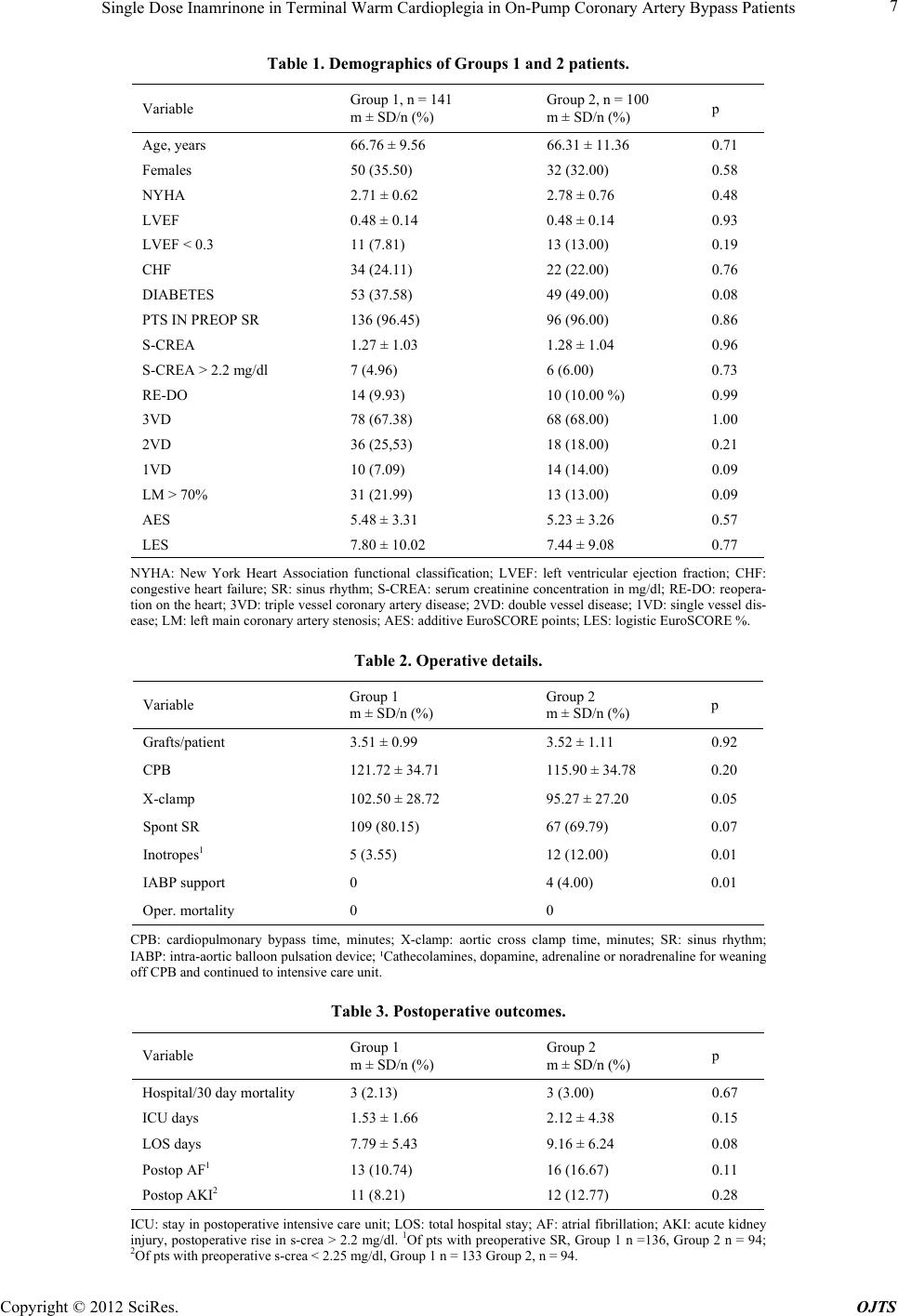 Single Dose Inamrinone in Terminal Warm Cardioplegia in On-Pump Coronary Artery Bypass Patients Copyright © 2012 SciRes. OJTS 7 Table 1. Demographics of Groups 1 and 2 patients. Variable Group 1, n = 141 m ± SD/n (%) Group 2, n = 100 m ± SD/n (%) p Age, years 66.76 ± 9.56 66.31 ± 11.36 0.71 Females 50 (35.50) 32 (32.00) 0.58 NYHA 2.71 ± 0.62 2.78 ± 0.76 0.48 LVEF 0.48 ± 0.14 0.48 ± 0.14 0.93 LVEF < 0.3 11 (7.81) 13 (13.00) 0.19 CHF 34 (24.11) 22 (22.00) 0.76 DIABETES 53 (37.58) 49 (49.00) 0.08 PTS IN PREOP SR 136 (96.45) 96 (96.00) 0.86 S-CREA 1.27 ± 1.03 1.28 ± 1.04 0.96 S-CREA > 2.2 mg/dl 7 (4.96) 6 (6.00) 0.73 RE-DO 14 (9.93) 10 (10.00 %) 0.99 3VD 78 (67.38) 68 (68.00) 1.00 2VD 36 (25,53) 18 (18.00) 0.21 1VD 10 (7.09) 14 (14.00) 0.09 LM > 70% 31 (21.99) 13 (13.00) 0.09 AES 5.48 ± 3.31 5.23 ± 3.26 0.57 LES 7.80 ± 10.02 7.44 ± 9.08 0.77 NYHA: New York Heart Association functional classification; LVEF: left ventricular ejection fraction; CHF: congestive heart failure; SR: sinus rhythm; S-CREA: serum creatinine concentration in mg/dl; RE-DO: reopera- tion on the heart; 3VD: triple vessel coronary artery disease; 2VD: double vessel disease; 1VD: single vessel dis- ease; LM: l eft main coronary artery stenosis; AES: additi v e EuroSCORE points; LES: logistic EuroSCORE %. Table 2. Operative details. Variable Group 1 m ± SD/n (%) Group 2 m ± SD/n (%) p Grafts/patient 3.51 ± 0.99 3.52 ± 1.11 0.92 CPB 1 21 .72 ± 34.71 115.90 ± 34.78 0.20 X-clamp 102.50 ± 28.72 95.27 ± 27.20 0.05 Spont SR 109 (80.15) 67 (69.79) 0.07 Inotropes1 5 (3.55) 12 (12.00) 0.01 IABP support 0 4 (4.00) 0.01 Oper. mortality 0 0 CPB: cardiopulmonary bypass time, minutes; X-clamp: aortic cross clamp time, minutes; SR: sinus rhythm; IABP: intra-aortic balloon pulsation device; ¹Cathecolamines, dopamine, adrenaline or noradrenaline for weaning off CPB and continued to intensive care unit. Table 3. Postoperative outcomes. Variable Group 1 m ± SD/n (%) Group 2 m ± SD/n (%) p Hospital/30 day mortality 3 (2.13) 3 (3.00) 0.67 ICU days 1.53 ± 1.66 2.12 ± 4.38 0.15 LOS days 7.79 ± 5.43 9.16 ± 6.24 0.08 Postop AF1 13 (10.74) 16 (16.67) 0.11 Postop AKI2 11 (8.21) 12 (12.77) 0.28 ICU: stay in postoperative intensive care unit; LOS: total hospital stay; AF: atrial fibrillation; AKI: acute kidney injury, postoperative rise in s-crea > 2.2 mg/dl. 1Of pts with preoperative SR, Group 1 n =136, Group 2 n = 94; 2Of pts with preopera tive s-crea < 2.25 mg/dl, Group 1 n = 13 3 Group 2, n = 94. 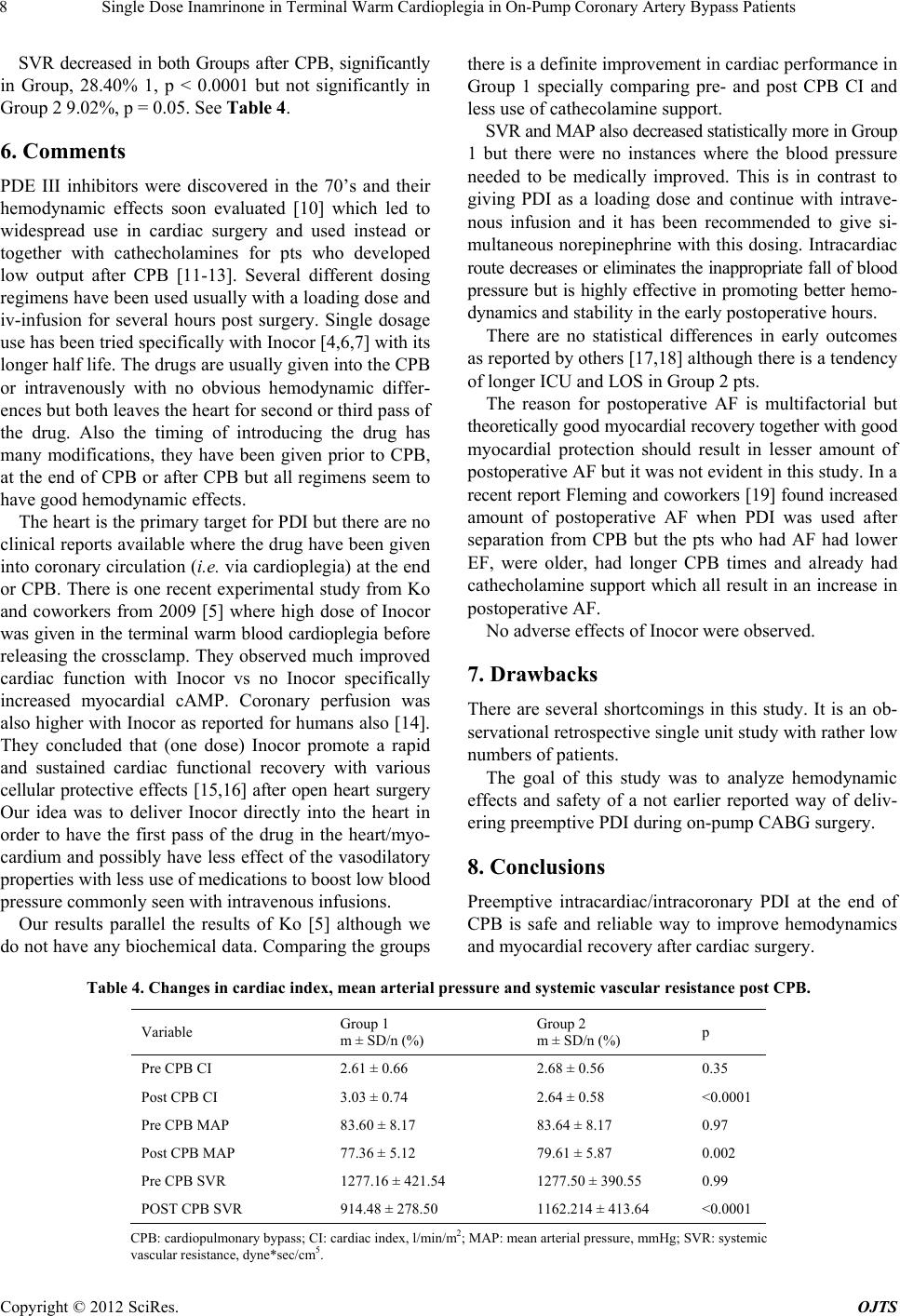 Single Dose Inamrinone in Terminal Warm Cardioplegia in On-Pump Coronary Artery Bypass Patients 8 SVR decreased in both Groups after CPB, significantly in Group, 28.40% 1, p < 0.0001 but not significantly in Group 2 9.02%, p = 0.05. See Table 4. 6. Comments PDE III inhibitors were discovered in the 70’s and their hemodynamic effects soon evaluated [10] which led to widespread use in cardiac surgery and used instead or together with cathecholamines for pts who developed low output after CPB [11-13]. Several different dosing regimens have been used usually with a loading dose and iv-infusion for several hours post surgery. Single dosage use has been tried sp ecifically with Inocor [4,6 ,7 ] with its longer half life. The drugs ar e usually given into the CPB or intravenously with no obvious hemodynamic differ- ences but both leaves the heart for second or third p ass of the drug. Also the timing of introducing the drug has many modifications, they have been given prior to CPB, at the end of CPB or after CPB but all regimens seem to have good hemodynamic effects. The heart is the primary target for PDI but there are no clinical reports available where the drug have been given into coronary circulation (i.e. via cardioplegia) at the end or CPB. There is one recent experimental study from Ko and coworkers from 2009 [5] where high dose of Inocor was given in the terminal warm blood cardioplegia before releasing the crossclamp. They observed much improved cardiac function with Inocor vs no Inocor specifically increased myocardial cAMP. Coronary perfusion was also higher with Inocor as reported for humans also [14]. They concluded that (one dose) Inocor promote a rapid and sustained cardiac functional recovery with various cellular protective effects [15,16] after open heart surgery Our idea was to deliver Inocor directly into the heart in order to have the first pass of the drug in the heart/myo- cardium and possibly have less effect of the vasodilatory properties with less use of medications to boost low blood pressure commonly seen with intravenous infusions. Our results parallel the results of Ko [5] although we do not have any biochemical data. Comparing the groups there is a definite improvement in cardiac performance in Group 1 specially comparing pre- and post CPB CI and less use of cathecolamine suppor t. SVR and MAP also decreased statistically more in Group 1 but there were no instances where the blood pressure needed to be medically improved. This is in contrast to giving PDI as a loading dose and continue with intrave- nous infusion and it has been recommended to give si- multaneous norepinephrine with this dosing. Intracardiac route decreases or eliminates the inappropriate fall of blood pressure but is highly effective in promoting better hemo- dynamics and stability in the early postoperative hours. There are no statistical differences in early outcomes as reported by others [17,18] although there is a tendency of longer IC U and LOS in Grou p 2 pts. The reason for postoperative AF is multifactorial but theoretically good myocardial recovery together with good myocardial protection should result in lesser amount of postoperative AF but it was not evid ent in this stud y. In a recent report Fleming and coworkers [19] found increased amount of postoperative AF when PDI was used after separation from CPB but the pts who had AF had lower EF, were older, had longer CPB times and already had cathecholamine support which all resu lt in an increase in postope ra t ive AF. No adverse effects of Inocor were observed. 7. Drawbacks There are several shortcomings in this study. It is an ob- servational retrospective single unit study with rather low numbers of patient s . The goal of this study was to analyze hemodynamic effects and safety of a not earlier reported way of deliv- ering preemptive PDI during on-pump CABG surgery. 8. Conclusions Preemptive intracardiac/intracoronary PDI at the end of CPB is safe and reliable way to improve hemodynamics and myocardial recovery after cardiac surgery. Table 4. Changes in cardiac index, mean arterial pressure and systemic vascular re sistanc e post CPB. Variable Group 1 m ± SD/n (%) Group 2 m ± SD/n (%) p Pre CPB CI 2.61 ± 0.66 2.68 ± 0.56 0.35 Post CPB CI 3.03 ± 0.74 2.64 ± 0.58 <0.0001 Pre CPB MAP 83.60 ± 8.17 83.64 ± 8.17 0.97 Post CPB MAP 77.36 ± 5.12 79.61 ± 5.87 0.002 Pre CPB SVR 1277.16 ± 421.5 4 1277.50 ± 390.55 0.99 POST CPB SVR 914.48 ± 278.50 1162.214 ± 413. 64 <0.0001 CPB: cardiopulmonary bypass; CI: cardiac index, l/min/m2; MAP: mean arterial pressure, mmHg; SVR: systemic vascular resistance, dyne*sec/cm5. Copyright © 2012 SciRes. OJTS  Single Dose Inamrinone in Terminal Warm Cardioplegia in On-Pump Coronary Artery Bypass Patients 9 When given directly into the heart with terminal warm cardioplegia the expected improvements in hemodynamics are prominent but the strong vasodilatation seen with intravenous use is decreased. The study was funded by Elma Larsson Foundation and Los Angeles Thoracic and Cardiovascular Foundation. Los Angeles, USA. REFERENCES [1] M. Kikura and S. Sato, “The Efficacy of Preemptive Mil- rinone or Amrinone Therapy in Patients Undergoing Coronary Artery Bypass Grafting,” Anesthesia & Analgesia, Vol. 94, No. 1, 2002, pp. 22-30. [2] J.-F. Hardy, N. Searic, M. Roy and J. Perrault, “Amrinone, in Combination with Norepinephrine, Is an Effective First-Line Drug for Difficult Separation from Cardiopul- monary Bypass,” Canadian Journal of Anesthesia, Vol. 40, No. 6, 1993, pp. 495-501. [3] T. Yamada, J. Takeda, N. Katori, K. Tsuzaki and R. Ochial, “Hemodynamic Effect s of Milrinone during We an- ing from Cardiopulmonary Bypass: Comparison of Pa- tients with a Low and High Prebypass Cardiac Index,” Journal of Cardiothoracic and Vascular Anesthesia, Vol. 14, No. 4, 2000, pp. 367-373. doi:10.1053/jcan.2000.7920 [4] Y. Hamada, K. Kawachi, T. Yamamoto, T. Nakata, Y. Kashu, M. Sato and Y. Watanabe, “Effects of single ad- ministration of a phophodiesterase III inhibitor during cardiopulmonary bypass. Comparison of Milrinone and Amrinone,” Japanese Circulation Journal, Vol. 63, No. 8, 1999, pp. 605-6095. doi:10.1253/jcj.63.605 [5] Y. Ko, K. Morita, R. Nagahori, K. Kinouchi, G. Shino- hara, H. Kagawa and H. Hashimoto, “Myocardial Cyclic AMP Augmentation with High-Dose PDE III Inhibitor in Terminal Warm Blood Cardioplegia,” Annals of Thoracic and Cardiovascular Surgery, Vol. 15, No. 5, 2009, pp. 311-316. [6] K. J. Fogg and D. Royston, “Improved Performance with Single Dose Phosphodiesterase Inhibitor (Editorial),” Bri- tish Journal of Anaesthesia, Vol. 81, No. 5, 1998, pp. 663-666. [7] M. Kikura, J. H. Levy, J. M. Bailey, J. S. Sha ne wise, L. G. Michelsen and S. M. Sadel, “A Bolus Dose of 1.5 mg/kg Amrinone Effectively Improves Low Cardiac Output S tate Following Separation from Cardiopulmonary Bypass in Cardiac Surgical Patients,” Acta Anaesthesiologica Scan- dinavica, Vol. 42, No. 7, 1998, pp. 825-833. doi:10.1111/j.1399-6576.1998.tb05329.x [8] J. P. Rathmell, R. C. Prielipp, J. F. Butterworth, E. Wil- liams, F. Villamaria, L. Testa, C. Viscomi, F. P. Ittleman, E. C. Baisden and L. R. Royster, “A Multicenter, Ran- domized, Blind Comparison of Amrinone with Milrinone after Elective Cardiac Surgery,” Anesthesia & Analgesia, Vol. 86, 1998, pp. 683-690. [9] P. L. Ludmer, R. F. Wright, J. M. Arnold, P. Ganz, E. Braunwald and W. S. Colucci, “Separation of the Direct Myocardial and Vasodilator Actions of Milrinone Ad- ministered by Intracoronary Infusion Technique,” Circu- lation, Vol. 73, No. 1, 1986, pp. 130-137. doi:10.1161/01.CIR.73.1.130 [10] R. J. Benotti, W. Grossman, E. Braunwald, D. D. Davolos and A. A. Alousi, “Hemodynamic Assessment of Amri- none,” New England Journal of Medicine, Vol. 299, 1978, pp. 1373-1377. doi:10.1056/NEJM197812212992501 [11] K. P. Lewis, I. R. Appadurai, E. T. Pierce, E. F. Halpern and R. H. Bode Jr., “Prophylactic Amrinone for Weaning from Cardiopulmonary Bypass,” Anaesthesia, Vol. 55, No. 7, 2000, pp. 627-633. doi:10.1046/j.1365-2044.2000.01372.x [12] J. F. Butterworth, R. L. Royster, R. C. Prielipp, S. T. Lawless and S. L. Wallenhaupt, “Amrinone in Cardiac Surgical Patients with Left Ventricular Dysfunction. A Prospective, Randomized Placeo-Controlled Trial,” Chest, Vol. 104, No. 6, 1993, pp. 1660-1667. doi:10.1378/chest.104.6.1660 [13] M. Gillies, R. Bellomo, L. Doolan and B. Buxton, “B e nc h - to-Bedside Review: Inotropic Drug Therapy after Adult Cardiac Surgery—Systematic Literature Review,” Criti- cal Care, Vol. 9, No. 3, 2005, pp. 266-279. [14] M. Arbeus, B. Axelsson, O. Friberg, A. Magnuson, L. Bodin and J. Hultman, “Milrinone Increases Flow in Coronary Artery Bypass Grafts after Cardiopulmonary Bypass: A Prospective, Randomized, Double-Blind, Pla- cebo-Controlled Study,” Journal of Cardiothoracic and Vascular Anesthesia, Vol. 23, No. 1, 2009, pp. 48-53. doi:10.1053/j.jvca.2008.07.005 [15] E. B. Lobato, F. Urdaneta, T. D. Martin and N. Graven- stein, “Effects of Milrinone versus Epinephrine on Grafted Internal Mammary Artery Flow after Cardiopulmonary Bypass,” Journal of Cardiothoracic and Vascular Anes- thesia, Vol. 14, No. 1, 2000, pp. 9-11. doi:10.1016/S1053-0770(00)90047-8 [16] V. Simkova, P. Radermacher and E. Barth, “Metabolic Effects of Phosphodiesterase III Inhibitors: Another Rea- son to Promote Their Use?” Critical Care, Vol. 11, 2007, pp. 139-140. doi:10.1186/cc5924 [17] M. Jebeli, M. Ghazinoor, M. H. Mandegar, M. R. Rasouli, P. Eghtesadi-Araghi, H. Goodarzynejad , R. Mohaamadzadeh, A. Darehzereshki and S. Dianat, “Effect of Milrinone on Short-Term Outcome of Patients with Myocardial Dys- function Undergoing Coronary Artery Bypass Graft: A Randomized Controlled Trial,” Cardiology Journal, Vol. 17, No. 1, 2010, pp. 73-78. [18] M. Heringlake, M. Wernerus, J. Grünfeld, S. Klaus, H. Heinze, M. Bechtel, L. Bahlmann, J. Poeling and J. Schön, “The Metabolic and Renal Effects of Adrenaline and Mil- rinone in Patients with Myocardial Dysfunction after Coronary Artery Bypass,” Critical Care, Vol. 11, No. 2, 2007, pp. R51-R61. doi:10.1186/cc5904 [19] G. A. Fleming, K. T. Murray, C. Yu, J. G. Byrne, J. P. Greelish, M. R. Petracek, S. J. Hoff, S. K. Ball, N. J. Brown and M. Pretorius, “Milrinone Use Is Associated with Postoperative Atrial Fibrillation after Cardiac Sur- gery,” Circulation, Vol. 118, No. 16, 2008, pp. 1619- 1625. doi:10.1161/CIRCULATIONAHA.108.790162 Copyright © 2012 SciRes. OJTS |